



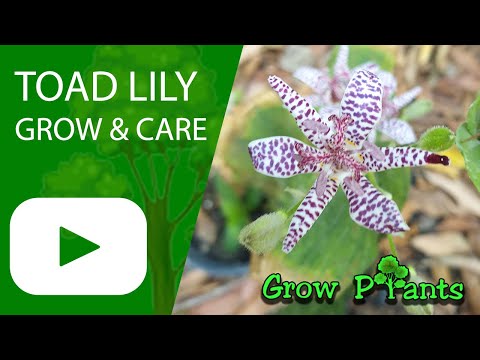
Plant Profile & Key Characteristics
Overview: Toad lily (Tricyrtis) is a hardy, shade-loving woodland perennial grown for its orchid-like, intricately spotted flowers borne in summer and autumn on arching leafy stems. It forms slowly spreading clumps and dies back to the ground each winter.
Quick Specifications
| Specification | Attribute |
|---|---|
| Plant Type / Life Cycle | Perennial (herbaceous) |
| Foliage Type | Deciduous — herbaceous, dies back in winter and re-shoots in spring |
| Mature Size | 40-70 cm (16-28 in) tall |
| Growth Rate | Moderate to fast |
| Root System | Rhizomatous — spreads by short, creeping underground rhizomes to form slowly enlarging clumps |
| Hardiness | USDA 4-9 |
Growth Form & Structure
- Height & Spread: Forms an arching clump 40-70 cm (16-28 in) tall, spreading slowly outward by rhizomes; grows well in containers — start in a pot about 30-50% larger than the rootball and pot up as it fills.
- Growth Habit & Form: Clump-forming perennial with upright to gracefully arching leafy stems that spread slowly by rhizomes into a woodland groundcover in shade.
- Lifespan & Maturity: Long-lived rhizomatous perennial; reaches mature clump size within a couple of seasons and enlarges steadily over the years. Ornamental only — does not bear edible fruit.
Anatomy & Physical Features
- Leaves & Foliage: Green ovate leaves clasping the stem.
- Flower Characteristics: Star-shaped, six-tepalled flowers 2-4 cm across, white spotted purple with a yellow centre.
Primary Uses & Landscape Value
- Functional & Ornamental Roles: Shade and woodland groundcover; front-to-mid shade border and stream-side planting; long-lasting cut flower valued for its late-season, orchid-like blooms; container plant for shaded patios.
Note: Prefers part shade — foliage can scorch in hot, direct sun, especially with dry soil.
Care Guide: Planting, Soil & Watering
Overview: Toad lilies (Tricyrtis) are woodland shade perennials that grow best in cool, humid positions with rich, humus-laden soil kept consistently moist. They dislike hot, dry summers, so give them a shaded spot, a generous mulch, and never let the soil dry out.
Quick Care Requirements
| Requirement | Ideal Condition |
|---|---|
| Planting Season | Plant in spring to early summer in cooler regions; spring through autumn in milder regions, avoiding the hottest part of summer. |
| Growth Rate | Moderate to fast |
| Soil Type | Rich, humus-laden, consistently moist yet free-draining woodland soil |
| Water Need | Moderate to high — keep the soil evenly moist at all times and never let it dry out |
Planting & Establishment
- Best Planting Season: Plant the rhizomes in spring or summer where summers stay cool; in warmer areas plant from spring to autumn but avoid setting them out during peak summer heat.
- How to Plant:
- Hole Preparation: Dig a hole at least twice as wide as the root ball or rhizomes.
- Soil Amendments: Backfill with plenty of organic matter — compost, humus, leaf mould and well-rotted leaves — to enrich the soil and hold moisture.
- Planting Depth: Set the rhizome or root ball so it is only lightly covered, firmed just enough to hold the plant, then top with mulch and a generous layer of leaf litter.
- Growth Speed & Expectations: Moderate to fast in cool, moist, shaded conditions.
Soil, Watering & Drainage Care
- Soil Mix & Drainage Needs: Humus-rich, moisture-retentive but free-draining soil; in containers use a potting or peat mix with perlite blended with humus and organic matter, mulched to keep the soil damp while still letting excess water escape.
- Watering Schedule & Technique:
- Young / Newly Planted: Keep the soil constantly moist while plants establish; mulch well and, in dry air, mist to raise humidity.
- Established: Water regularly and deeply so the soil never dries — moisture needs are moderate to high, especially in warm weather.
- Seasonal Adjustments: Increase watering during heat and dry spells, when the plant is most likely to scorch, and ease back as growth slows in cold weather.
Climate, Light & Hardiness
Toad lily (Tricyrtis macropoda) is a woodland-shade perennial that thrives in cool, moist, humus-rich temperate conditions and resents hot, dry summers. It is grown in full to partial shade and is reliably cold-hardy as dormant rhizomes - roughly USDA zones 5–8 (to 9a with care) - dying back in cold-winter areas and re-emerging in spring.
Quick Climate Specifications
| Climate Zones | Temperate, subtropical and Mediterranean (as a shaded understory plant); also grown indoors |
|---|---|
| USDA Hardiness Zones | Approximately 5–8 (to 9a with care) |
| Optimal Temp Range | Approximately 15–24 °C (59–75 °F); cool conditions preferred |
| Cold Damage Begins | Top growth blackened by autumn frost near 0 °C (32 °F); dormant rhizomes unharmed |
| Approx. Survival Minimum | Dormant rhizomes generally hardy to about −29 °C (−20 °F) |
| Frost Tolerance | Foliage: Low; dormant rhizomes: High |
| Light Conditions | Full to partial shade (morning sun only in cool-summer climates) |
| Wind Tolerance | Low to Moderate (tall flowering stems prefer shelter) |
| Salt / Coastal Tolerance | Low |
Sunlight & Light Exposure
Optimal Light Setup
Grow toad lily in full to dappled shade, mimicking its woodland-floor origins. In cool, overcast or short-season climates it accepts more light - light half-shade or gentle morning sun - which can improve flowering, but only where the root-zone stays cool and moist.
Shade & Heat Management
Hot midday and afternoon sun - especially combined with dry air - scorches the foliage and browns the leaf margins. Site the plant where it is shaded during the hottest part of the day and protected from heat reflected off walls or paving.
Best Exposure / Orientation
A north- or east-facing aspect, or a bed beneath deciduous trees and shrubs, suits it well: spring light while the dormant buds break, then cool shade through summer.
Temperature Extremes & Hardiness
USDA Hardiness & Regional Limits
As a dormant, rhizomatous perennial it is cold-hardy across roughly USDA zones 5–8 (to 9a with care). In the warmest part of that range (to about zone 9a with care) it can still be grown, but success there depends on deep shade, a cool microclimate and steady soil moisture, because hot summers - not winter cold - are the real limit.
Cold Damage & Winter Protection
In cold-winter zones the top growth dies back and the plant overwinters as dormant rhizomes; in mild, largely frost-free areas it may hold some foliage. A winter mulch of leaf-mould or bark protects the crown and rhizomes, mattering most in the coldest listed zones and for container-grown plants, whose root-zone freezes far faster than open ground.
Frost Sensitivity
The soft top growth is frost-tender and is cut down by the first hard autumn frosts, but this is normal seasonal die-back rather than a threat to an established plant, whose rhizomes remain safe below ground.
Extreme Heat Tolerance
Heat is the chief limiting factor. Prolonged hot spells cause wilting, leaf scorch and early dormancy, so the plant performs best where summers stay relatively cool and the root-zone is shaded and mulched.
Wind, Humidity & Microclimate
Humidity Preferences
Moderate to high atmospheric humidity suits it, matching its moist woodland habitat. When grown indoors, keep it away from heaters, radiators, ventilators and air-conditioning, whose dry, moving air quickly stresses the foliage.
Dry-Air Tolerance
Tolerance of dry air is low: hot, arid conditions brown the leaf edges and dull the plant, which is why a sheltered, humid pocket is preferable to an open, exposed position.
Wind Tolerance
The tall, arching flowering stems are easily flattened or tattered by strong wind, and drying wind compounds heat stress. A sheltered spot - among other planting or against a shaded wall - keeps growth intact.
Coastal / Salt Tolerance
Toad lily is not regarded as a salt-tolerant plant and is poorly suited to direct coastal salt spray; grow it in sheltered inland or garden settings rather than on an exposed seafront.
Rainfall & Seasonal Moisture
It is adapted to climates with reliable moisture through the growing season and struggles in regions with long, hot, dry summers unless a shaded, cool microclimate compensates.
Microclimate Recommendations
Aim for a cool, sheltered, shaded pocket - the north side of a building, under trees, or beside a shaded water feature - with a mulched, humus-rich root-run to buffer both heat and cold.
Growing in Pots, Balconies & Indoors
Tricyrtis macropoda (Tricyrtis macropoda) is one of the rare flowering perennials the grower rates as a genuine houseplant – a shade-loving woodland plant that also does well in pots on a cool, bright patio or a shaded balcony. Indoors it needs good light (even a little direct sun) to flower, so give it the brightest spot that stays cool and away from dry, heated air.
Quick Details
- Container Size: Start in a pot only about 30-50% larger than the plant and pot up as the roots fill it; expect a mature size of roughly 40-70 cm (16-28 in).
- Indoor Suitability: A good houseplant in bright, indirect light – keep it cool and away from radiators, fans and air-conditioning.
- Best Spot: Shade to part shade outdoors (morning sun in cooler climates); a bright, cool position indoors.
- Soil & Drainage: Potting mix or peat with perlite, enriched with humus and organic matter; moisture-retentive but free-draining.
- Watering in Pots: Keep evenly moist – a chopped mulch on the surface holds moisture; never let the mix dry out or sit waterlogged.
Indoors & On the Windowsill
- A genuine houseplant: The grower confirms toad lily can be grown indoors. Give it bright light – even a little direct sun helps it bloom – and keep it in a cool position.
- Keep the air right: Do not stand it next to heaters, fans or air-conditioning, which dry the plant out; a surface mulch and steady moisture keep the cool, humid conditions it likes.
- Cool winter rest: Toad lily is a hardy perennial that naturally dies back and rests over winter – let a potted plant have a cool dormant period rather than forcing it in a warm room.
On a Balcony or Patio
- Light & shelter: Unlike most container flowers this one wants shade – a north or east aspect, or a spot shaded by walls, is ideal, and it dislikes hot afternoon sun. Walls and paving still reflect heat and dry pots quickly, so check moisture often and mulch the surface.
- Practicalities: Grouping pots together or tucking them among taller plants keeps the roots cool and the humidity up on an exposed balcony.
Choosing the Pot, Soil & Long-Term Care
- Pot & drainage: Any pot with strong drainage holes; skip a permanently full saucer to avoid root rot (see the grower’s bottom-watering tip below). Terracotta breathes and dries fast, while glazed or plastic holds moisture longer – handy for a plant that likes to stay damp.
- Potting mix: Well-aerated and moisture-retentive – potting mix or peat with perlite, mixed with humus and organic matter.
- Feeding: Potted plants exhaust their mix faster as nutrients leach with watering, so feed lightly through the growing season.
- Repotting: Pot up to the next size in winter once the root ball fills the container; when it reaches the size you want, refresh the mix every few years – for a small pot, tip it out, trim some roots and prune the top – and clear away worn-out old plants after flowering.
Grower’s Container Tip
- Right-sized pots and same-day bottom watering: Keep it in a pot just 30-50% bigger than the plant and step it up gradually, moving to a larger pot in winter as the roots outgrow it. Top the mix with chopped mulch to hold moisture, and when you water from below let the base of the pot stand in water only briefly – it should take up what it needs and be dry again the same day, never left sitting wet.
Growing this plant in a greenhouse
A greenhouse can give tricyrtis macropoda frost protection and cold protection.
Greenhouse at a glance
| Greenhouse suitability | Good - clearly useful |
|---|---|
| Main benefits | frost protection, cold protection |
| Outdoor protection advisable below | about 0°C |
| Suitable types | unheated greenhouse, polycarbonate greenhouse |
| Heating | Heating is optional - useful mainly for winter growing in cold areas. |
Related greenhouse guides
- Greenhouses: How to Choose the Right Greenhouse
- Polycarbonate Greenhouses: What to Look for Before Buying
Fertilizing & Feeding
A modest feeder: a balanced feeding as growth resumes in spring and a further light feeding through the summer-to-autumn bloom, backed by rich, moist soil and organic matter, with feeding held off during winter dormancy.
Quick Fertilizing Specs
| Feeding Level | Modest feeder |
|---|---|
| Main Nutrient Priority | Balanced feeding with adequate nitrogen for foliage and steady bloom |
| Best Feeding Period | Spring growth through the summer-to-autumn bloom |
| Organic Options | Compost, leaf mold, humus, and mulch |
| Reduce/Stop Feeding | Hold off feeding once top growth dies back for winter dormancy |
| Micronutrients | Usually supplied by organic matter and a complete fertilizer; correct only diagnosed issues |
| Soil pH | Slightly acidic to near neutral |
Feeding by Growth Stage
Spring flush of growth
Support fresh stems and foliage as this shade perennial breaks dormancy and pushes new growth in spring.
| Nutrient direction | A balanced complete fertilizer with adequate nitrogen to fuel leafy growth ahead of bloom. |
|---|---|
| Timing | As new growth emerges in spring. |
| Frequency | A light feeding as growth resumes, over soil already enriched with organic matter. |
| Fertilizer types | A balanced complete fertilizer, Compost, leaf mold, and other organic matter worked in with mulch |
| Precautions | Keep feeding modest; this woodland perennial leans on rich, moist soil and organic matter, so heavy feeding mainly produces soft, floppy stems. |
Summer to autumn bloom
Sustain healthy foliage and the succession of spotted, orchid-like flowers through the warm-season bloom.
| Nutrient direction | Continue a balanced complete fertilizer; adequate, steady nutrition drives bloom better than any high-phosphorus product. |
|---|---|
| Timing | Through the summer-to-autumn flowering period. |
| Frequency | A further light feeding as the bloom season gets underway, with mulch and organic matter renewed as needed. |
| Fertilizer types | A balanced complete fertilizer, Compost or leaf mold as a top-dressing |
| Precautions | Avoid pushing extra fertilizer to force more flowers; overfeeding favors weak, leaning growth over bloom. Do not rely on high-phosphorus ‘bloom boosters’. |
Winter dormancy
Let the rhizomes rest through cool weather after the top growth dies back, without pushing new growth.
| Nutrient direction | None – withhold fertilizer while the plant is dormant and not taking up nutrients. |
|---|---|
| Timing | From late autumn through winter, once top growth has died back. |
| Frequency | No feeding at this stage; resume only when new growth returns in spring. |
| Fertilizer types | No feeding at this stage; do not fertilize until active growth resumes in spring. |
| Precautions | Do not fertilize during winter dormancy; feeding a resting plant wastes nutrients and risks salt buildup around the rhizomes. |
Nutrient Deficiency Signs & Corrections
Older, lower leaves fade to pale green or uniform yellow and overall growth slows.
| Possible causes | low available soil nitrogen, nitrogen leaching from the consistently moist soil these plants prefer, thin soil low in organic matter |
|---|---|
| Appears first on | older, lower leaves |
| What to check | recent feeding history, soil organic matter and mulch, watering and drainage |
| Possible correction | Apply a balanced complete fertilizer with adequate nitrogen and build soil organic matter, then keep the soil evenly moist. |
Newest leaves turn pale or yellow between the veins while the veins themselves stay green.
| Possible causes | iron made unavailable by alkaline soil or over-liming, waterlogged or compacted soil limiting root uptake, genuinely low soil iron |
|---|---|
| Appears first on | youngest leaves |
| What to check | soil pH, drainage and root health, any recent liming |
| Possible correction | Correct soil pH toward slightly acidic and improve drainage; if chlorosis persists, apply a chelated iron product per its label. |
Leaf margins brown or scorch and growth stalls despite steady watering.
| Possible causes | fertilizer salt buildup in the root zone, under-watering that concentrates salts, excessive or too-frequent feeding, especially in containers |
|---|---|
| Appears first on | leaf margins and tips |
| What to check | recent fertilizer amounts, watering consistency, drainage, especially in pots |
| Possible correction | Ease off feeding, water thoroughly to flush accumulated salts, then return to lighter feeding. |
Pruning, Training & Seasonal Maintenance
Tricyrtis macropoda (toad lily) is a 40–70 cm toad lily that holds its flower clusters aloft on long stalks above upright, arching stems in late summer and autumn. Like all toad lilies it is a rhizomatous, herbaceous shade perennial that throws up fresh stems each year and flowers on that current-season growth, which is the single fact that governs its pruning: cut the stems back in spring or summer and you remove the very shoots that were about to bloom. So the stems are largely left to flower, and the practical interventions are an optional early-summer pinch to curb height and flopping, a discreet stake or grow-through support as the stems lengthen, and a dormant cut-down once the foliage dies back.
Quick Pruning & Maintenance Specs
| Pruning Tolerance | Low in the growing season (flowers on current stems); high once dormant |
| Primary Pruning Window | Late autumn/winter cut-down once the foliage has died back |
| Secondary Maintenance Window | Optional early-summer pinch; staking as stems lengthen |
| Typical Frequency | Mainly the once-yearly dormant cut-down, plus ongoing sanitary tidying |
| Main Objective | Protect the late bloom; manage height and floppy stems |
| Young Plant Priority | Leave stems intact; keep roots cool and moist; support only if lax |
| Mature Plant Priority | Dormant cut-down; divide the rhizome in spring to renew a tired clump |
| Best Tool Type | Precision snips plus soft ties/stakes |
| Avoid Heavy Pruning During | Spring and summer — cutting stems then removes the flowering shoots |
Pruning by Plant Age & Size
Newly Established
Leave a young plant’s stems entirely and concentrate on the roots — cool, shaded, evenly moist soil with a mulch. Cutting stems back now only delays or removes the first flowering; the one exception is snipping off any stem broken or scorched at planting.
Young / Formative
No woody framework is built. The one useful shaping is an optional early-summer pinch of the growing tips, taken once when stems are roughly a third grown, which trades a little height for shorter, better-branched, sturdier flowering stems that flop less under the late flowers. Skip it if you want maximum height or the earliest bloom.
Mature / Established
Through the season the clump is left to flower; stake or ring lax stems so the late flowers show above the foliage. After frost or dieback, cut all the dead stems to the ground. Renew an old, congested clump by lifting and dividing the rhizome in spring, not by hard-cutting the top.
Seasonal Pruning Schedule
Early Summer (optional pinch)
Objective: curb height and flopping before flowering. Remove: just the soft growing tips, once. Do NOT remove: more than the tips, or you delay and reduce the bloom. Response: shorter, branchier stems carrying more, sturdier flowering points; flowering is pushed slightly later.
Late Season Bloom (leave uncut)
Objective: preserve the display. Remove: nothing structural — the flowers open on these current-season stems from late summer into autumn. Do NOT remove: flowering stems for ‘tidiness’; cutting them mid-season simply throws the bloom away. Impact: this is the plant’s one main show, so restraint here is the whole point.
Dormant Cut-Down
Objective: sanitation and tidiness once the season ends. Remove: all dead top growth to ground level after the foliage dies back (in frost-free areas, once the tired stems finish). Impact: none on next year’s flowers, which arise on new stems from the rhizome.
Ongoing Sanitary
Objective: health. Remove: leaves scorched by heat or dry wind, and any foliage showing the fungal leaf-spotting this genus is prone to in stagnant, wet air. Do NOT: compost visibly diseased leaves — bin them. Impact: cosmetic and preventive, with no effect on bloom.
Structural Pruning & Training
There is no persistent woody framework to shape; ‘training’ means keeping the tall, arching stems presentable — an optional early-summer pinch for compactness, and a discreet stake or grow-through support so lax stems do not sprawl on the ground and bury the late flowers. An old, crowded clump is renewed by lifting and dividing the rhizome in spring rather than by cutting the top.
Special Growth to Remove
There are no suckers, watersprouts or woody growths to manage. The routine removals are simply spent, dead or scorched stems and leaves. Do not deadhead in the hope of a rebloom — the display is a single late-season flush on the current stems, and cutting the flowering stems mid-season only removes it.
Container & Small-Space Pruning
In a pot the plant is kept cool, shaded and steadily moist, and the same pruning rules apply — no stem-shortening in the growing season, and a dormant cut-down once the top dies back. An early pinch keeps a potted plant more compact if it is running tall. Refresh and divide the root ball every few years, ideally in winter, because a congested container clump flowers poorly; a modest amount of root trimming at that repotting is tolerated and can be paired with dividing the rhizome to make new plants.
Cut Placement & Technique
Pinch by nipping out only the soft tip just above a leaf, using finger and thumb or snips. Cut spent stems back to near ground level in dormancy, leaving no long dead stubs. Where stems flop, support them with soft ties to a discreet stake or a grow-through ring rather than shortening them mid-season, which would sacrifice flowers. All cuts are thinning-type removals of whole stems at the base; there are no heading cuts into woody structure because there is none.
Post-Pruning Care
After the dormant cut-down, mulch to protect the shallow rhizome and hold moisture over winter. No feeding is prompted by cutting; the plant’s real needs are cool roots, shade and steady moisture, since it scorches in heat and dry wind — that is a siting and watering matter, not a pruning one. If you divided at the same time, keep the new pieces shaded and evenly moist until they take hold, and water them in well.
Common Pruning Mistakes
- Cutting the stems back in spring or summer — this removes the current-season shoots that carry the late flowers, so the plant ‘fails to bloom’ when it was simply pruned at the wrong time.
- Deadheading in the hope of a second flush, when the plant flowers once, late, on stems it has already made.
- Skipping the optional early pinch or support on tall stems and letting the late flowers flop out of sight.
- Blaming pruning for scorched leaf edges, when the real cause is too much sun, heat or dry wind — move and water the plant rather than cutting it.
- Composting fungus-spotted foliage and spreading the leaf-spot back onto the clump, instead of binning the diseased leaves.
When NOT to Prune
Do not cut stems back during spring and summer growth or through the late bloom — you would lose the flowers. Hold off the dormant cut-down until the foliage has genuinely died back and fed the rhizome. Avoid dividing or disturbing the plant during hot, dry spells, when this heat-sensitive, moisture-loving shade plant is already stressed and liable to scorch.
Recommended Tools (by task)
- precision_snips — the right tool for pinching soft tips, cutting spent stems down in dormancy, and removing dead or spotted leaves on a soft-stemmed perennial — no coarser blade is needed.
- soft_ties_stakes — for supporting tall, lax stems so the late flowers are held up and visible rather than flopping to the ground.
- garden_spade — for lifting and dividing the rhizome in spring to renew a tired clump and to multiply the plant.
Pruning Troubleshooting
| Problem | Possible Cause | What to Check | Corrective Action |
| Few or no flowers despite healthy leaves | Stems cut back in spring/summer, removing the flowering shoots | Whether the clump was trimmed during the growing season | Leave stems uncut in season; confine cutting to the dormant clean-up and (if used) a single early pinch |
| Stems flopping and flowers hidden at ground level | Tall, lax stems not pinched or supported | Stem height and whether an early pinch or stake was used | Pinch tips in early summer (or Chelsea-chop the tallest) and add a stake or grow-through support |
| Brown or black spots spreading on the leaves | Fungal leaf-spot in stagnant, over-wet, crowded conditions | Air movement, overhead wetting, and crowding around the clump | Remove and bin (do not compost) affected leaves, clean tools afterwards, and improve spacing and airflow |
| Leaf edges scorched and brown | Too much sun, heat or dry wind — not a pruning fault | Exposure, soil moisture and wind protection | Move to cooler shade, keep evenly moist and mulch; simply trim off badly scorched leaves |
Propagation Guide
Tricyrtis macropoda are most reliably increased by division of the rhizomatous clump, which is quick, keeps flower colour and any variegation true, and follows the plant’s natural habit of spreading by rhizomes; stem cuttings, ground layering and seed all work too. Seed of the species is mostly uniform, but toad lilies hybridise freely, so garden-collected seed raised near other Tricyrtis can vary, and named or variegated selections must be propagated vegetatively to stay true — overall an easy plant to propagate.
Quick Propagation Specs
| Best Propagation Method | Rhizome / clump division |
| Alternative Methods | Seed, stem cuttings, ground (tip) layering |
| Propagation Difficulty | Easy |
| Seed True-to-Type | Mostly uniform for the species; hybrids & variegated cultivars vary |
| Vegetative True-to-Type | Yes |
| Best Propagation Season | Early spring for division; spring or autumn for seed; spring–summer for cuttings |
| Seed Germination Time | About 4–8 weeks from spring sowing; autumn sowings usually germinate the following spring |
| Cutting Rooting Time | Usually a few weeks under warm, humid conditions |
| Germination Temperature | 16–21°C (60–70°F) |
| Seed Sowing Depth | About 1–2 cm (0.5–1 inch), kept in bright light |
Growing from Seed
Seed Handling & Viability
Sow fresh seed for the best results. Seed keeps better cool, so store it in the refrigerator — either in barely-moist peat or in a paper bag — until sowing.
Dormancy & Pre-Sowing Treatment
Germination is more even after a cold, moist spell of at least a month. Sowing fresh in autumn lets winter supply that chill naturally; in mild-winter areas give the seed a comparable cold period in the coldest part of the refrigerator before spring sowing.
Sowing Season
Sow in spring or autumn. Autumn sowing of fresh seed is preferred so it receives the winter cold; in hot (zone 10) climates autumn sowing also avoids summer heat.
Sowing Depth & Spacing
Sow shallowly, about 1–2 cm (0.5–1 inch) deep, and keep the surface in bright light, which the seed needs to germinate. Space seedlings about 20 × 20 cm (8 × 8 inches).
Germination Conditions
Keep the soil consistently moist — never letting it dry out — in bright light at about 16–21°C (60–70°F).
Germination Time
Spring sowings usually germinate in about 4–8 weeks; autumn sowings generally come up the following early spring.
Seedling Care
Grow seedlings on in moist soil and out of strong heat.
Stem Cuttings
Cutting Preparation & Rooting Setup
Root stem cuttings in a moist peat-based mix (the more reliable option) or in water. Keep them under high humidity with regular misting until roots and new growth appear.
Rooting Hormone
Rooting hormone is optional; these soft stems root readily without it.
Rooting Time
Cuttings usually root within a few weeks under warm, humid conditions.
Air & Ground Layering
Toad lilies layer very easily. Bend a lax stem down to the soil and cover a section with soil, leaving the tip exposed; kept moist, the buried section roots and can then be severed and lifted as a new plant once established. This is a simple way to renew a clump before old stems die back.
Rhizome Division
These rhizomatous perennials spread by underground rhizomes and divide easily — the most reliable method, and one that keeps flower colour and any variegation true. Lift and split established clumps in early spring, making sure each division carries healthy rhizome with roots and at least one growth bud, then replant and keep moist and lightly shaded until re-established.
Timing for planting divided rhizomes: Planting can be spring or summer in hardiness zone 4–8, in hardiness zone 9a spring to autumn but if the summer is too much hot not in the summer.
Bloom & Flower Guide
Quick Details
- Bloom Season: Summer into autumn – valued especially for late-season colour
- Time to First Bloom: Established clumps flower reliably from their first or second year
- Flower Appearance: Upward-facing, star-shaped flowers, white with purple dots and a yellow centre; six outer tepals with three small upright inner segments, about 2-4 cm across
- Edibility: Not edible – grown as an ornamental for its flowers. A toad lily (Tricyrtis), not a true lily
Detailed Blooming Overview
Toad lilies are prized woodland perennials that come into their own as the rest of the garden winds down, carrying curiously exotic, orchid-like flowers along their arching stems. Toad lily (Tricyrtis macropoda) opens blooms white with purple dots and a yellow centre, each intricately spotted – the marking that gives these plants their common name. The blooms open flat and star-like, facing upward along the stems. They shine in a shaded border and also make unusual, long-lasting cut flowers.
Flower Characteristics
- Flowers white with purple dots and a yellow centre, finely speckled with the spotting typical of toad lilies.
- Six spreading outer tepals with three smaller upright inner segments, about 2-4 cm across. The segments spread wide into an open star.
- A prominent central column of stamens and styles rises from the middle of each bloom.
Bloom Care & Thinning
- Placement: Flowers best in cool, moist, humus-rich soil in part to full shade, sheltered from hot afternoon sun.
- Protecting the buds: Never let the roots dry out during budding and bloom, or the buds may drop before opening.
- Pollination: The flowers are worked by bumblebees and other insects.
- Cutting: Stems last well in water and can be enjoyed as cut flowers.
Bloom Health & Protection
- Slugs and snails: The classic toad-lily pest, chewing new shoots, buds and open flowers; hand-picking or an iron-phosphate slug bait helps, and keeping mulch back from the crown removes their hiding places.
Pests, Diseases & Troubleshooting
Overview: Toad lilies are shade-loving woodland perennials that are largely pest-resistant but have two classic weak points: slugs and snails devouring the emerging spring shoots, and leaf scorch when the soil dries or the plant catches too much sun or wind. Diseases are mainly minor fungal leaf spots and rust in damp, crowded plantings. Grow them cool, moist and shaded with good airflow and the problems largely take care of themselves — reach for sprays only when needed.
Quick Troubleshooting Overview
| Issue / Pest | Main Symptom | Primary Solution |
|---|---|---|
| Slugs & snails | Emerging shoots and leaves shredded; slime trails | Hand-pick at night, barriers, iron-phosphate bait |
| Aphids | Colonies on soft new growth and buds; sticky honeydew | Water jet, encourage beneficials, insecticidal soap if severe |
| Spider mites | Fine stippling and webbing on stressed, dry plants | Keep soil moist and cool; horticultural oil / insecticidal soap |
| Leaf spot / anthracnose | Brown blotches on leaves in humid, crowded sites | Remove leaves, improve airflow, avoid wetting foliage |
| Rust | Orange-brown pustules on leaf undersides | Bin infected leaves, thin clumps, sulphur if persistent |
| Leaf scorch | Crispy brown leaf tips and margins | Shade, wind shelter, steady soil moisture, mulch |
Common Pests & Management
- Slugs & snails:
- Symptoms: The number-one toad-lily pest — tender young spring shoots and leaves are grazed to ragged stumps, leaving holes and silvery slime trails, worst in the damp, shaded conditions these plants love.
- Prevention & Control: Patrol after dark to hand-pick, clear leaf litter and boards that shelter them, ring emerging crowns with grit or copper barriers, and scatter iron-phosphate bait in wet spells. Beer traps help in small beds.
- Aphids (Aphis / Myzus spp.):
- Symptoms: Green or black soft-bodied colonies on new shoots, flower stalks and buds; distorted growth, honeydew and sooty mould. They can also transmit mosaic viruses.
- Prevention & Control: Wash them off with a water jet, pinch out badly infested tips, and encourage ladybirds and lacewings. Use insecticidal soap or a light neem spray only for stubborn colonies.
- Two-spotted spider mite (Tetranychus urticae):
- Symptoms: Fine pale stippling and faint webbing on the undersides, mostly when the plant is drought-stressed or grown too hot and dry — a sign it needs more moisture and shade.
- Prevention & Control: Fix the underlying dryness first: keep the soil evenly moist, mulch, and shade the plant. Rinse foliage and treat with insecticidal soap or horticultural oil, repeating to break the cycle.
- Foliar nematodes (Aphelenchoides spp.):
- Symptoms: Angular brown patches bounded by the leaf veins, spreading upward on the plant in wet conditions — an occasional problem of shade perennials.
- Prevention & Control: Remove and destroy affected leaves, avoid overhead watering and splashing, space plants to dry quickly, and discard badly infested crowns; there is no home cure once inside the leaf.
Diseases & Fungal Issues
- Fungal leaf spot / anthracnose (Colletotrichum, Cercospora spp.):
- Symptoms: Brown or tan spots and blotches, sometimes with darker margins or yellow halos, on leaves kept wet or grown in stagnant, crowded shade.
- Treatment & Management: Pick off spotted leaves, thin and space clumps for airflow, water at the base in the morning, and clear fallen debris in autumn. A copper spray is only needed for spreading outbreaks.
- Rust (Puccinia spp.):
- Symptoms: Raised orange-to-brown powdery pustules on leaf undersides, with yellow flecking above, in damp, humid weather.
- Treatment & Management: Remove and bin infected leaves (do not compost), open up congested clumps, and avoid wetting foliage. Sulphur fungicide helps in a persistent, wet season.
- Grey mould / Botrytis (Botrytis cinerea):
- Symptoms: Fuzzy grey mould rotting flowers, buds and soft foliage in cool, damp, still air, especially on the late-season blooms.
- Treatment & Management: Remove faded flowers and mouldy tissue promptly, improve ventilation and spacing, and avoid evening overhead watering; sanitation usually suffices.
- Crown & root rot (Pythium / Sclerotium spp.):
- Symptoms: Wilting and collapse from a soft, rotting crown, typically after standing winter wet in heavy soil.
- Treatment & Management: Plant in humus-rich but free-draining soil, never let the crown sit waterlogged over winter, and lift and divide healthy pieces if a clump begins to rot from the centre.
Growing Difficulties & Abiotic Problems
- Leaf scorch (brown tips & margins):
- Cause & Symptoms: The classic toad-lily complaint — crispy brown leaf edges and tips caused by too much sun, drying wind, or the soil going dry, since these woodlanders demand cool shade and steady moisture.
- Correction Strategy: Site in dappled to full shade with shelter from wind, mulch to hold moisture, and water deeply and consistently through dry spells so the roots never parch.
- Drought stress & wilting:
- Cause & Symptoms: Shallow-rooted and moisture-loving, the plant flags, browns and drops leaves when the soil dries out, and mite attacks follow.
- Correction Strategy: Enrich the soil with leaf-mould and compost to hold water, mulch annually, and keep watering even during flowering in late season.
- Winter crown rot in wet soil:
- Cause & Symptoms: Heavy, waterlogged ground over winter rots the dormant crown, so the clump fails to reshoot in spring.
- Correction Strategy: Improve drainage with grit and organic matter, avoid low wet spots, and grow on a slightly raised bed where winters are soggy.
- Poor flowering / sparse growth:
- Cause & Symptoms: Too much dry shade, root competition from trees, or a starved clump gives weak, sparse growth and few of the orchid-like autumn blooms.
- Correction Strategy: Feed with an annual mulch of compost, keep it out of dry root-filled soil, and divide tired congested clumps every few years to reinvigorate them.
What Helps — Products & Tools
The most valuable ‘products’ for toad lilies are cultural: shade, wind shelter, a moisture-holding leaf-mould mulch and iron-phosphate slug bait to protect the spring shoots. Keep insecticidal soap and neem or horticultural oil on hand for aphids and spider mites, copper fungicide for spreading leaf spot, and sulphur for rust. Grit or copper barriers deter slugs and snails around emerging crowns. Follow all labels and protect pollinators when the plant is in bloom.