

Plant Profile & Key Characteristics
Overview: A compact, evergreen succulent forming tight, ground-hugging rosettes to 15-30 cm (6-12 in) in spreading colonies. This very hardy, drought-tolerant houseleek is grown as an ornamental for rockeries, troughs, containers and green roofs, prized for its geometric rosettes and freely produced offsets (‘chicks’).
Quick Specifications
| Specification | Attribute |
|---|---|
| Plant Type / Life Cycle | Evergreen succulent perennial (rosettes are monocarpic – each flowers once, then dies and is replaced by offsets) |
| Foliage Type | Evergreen |
| Mature Size | 15-30 cm (6-12 in) – rosettes small, spreading into wide mats and colonies |
| Growth Rate | Slow |
| Root System | Shallow and fibrous |
| Toxicity | Non-toxic – historically grown on roofs and used in folk medicine; not listed as toxic to cats or dogs |
| Hardiness | USDA zones 4-11 |
Growth Form & Structure
- Height & Spread: Each rosette is only a few centimetres high and 15-30 cm (6-12 in) across, but plants multiply into wide, weed-suppressing mats; equally at home in a shallow pot, trough or wall crevice.
- Growth Habit & Form: Ground-hugging, clump-forming succulent; a central rosette (the ‘hen’) rings itself with offset rosettes (‘chicks’) on short runners, and throws up a thick flowering stalk before that rosette dies and is replaced.
- Lifespan & Maturity: The colony is effectively perennial and self-renewing; an individual rosette lives a few years, flowers once, then dies while its offsets carry on.
Anatomy & Physical Features
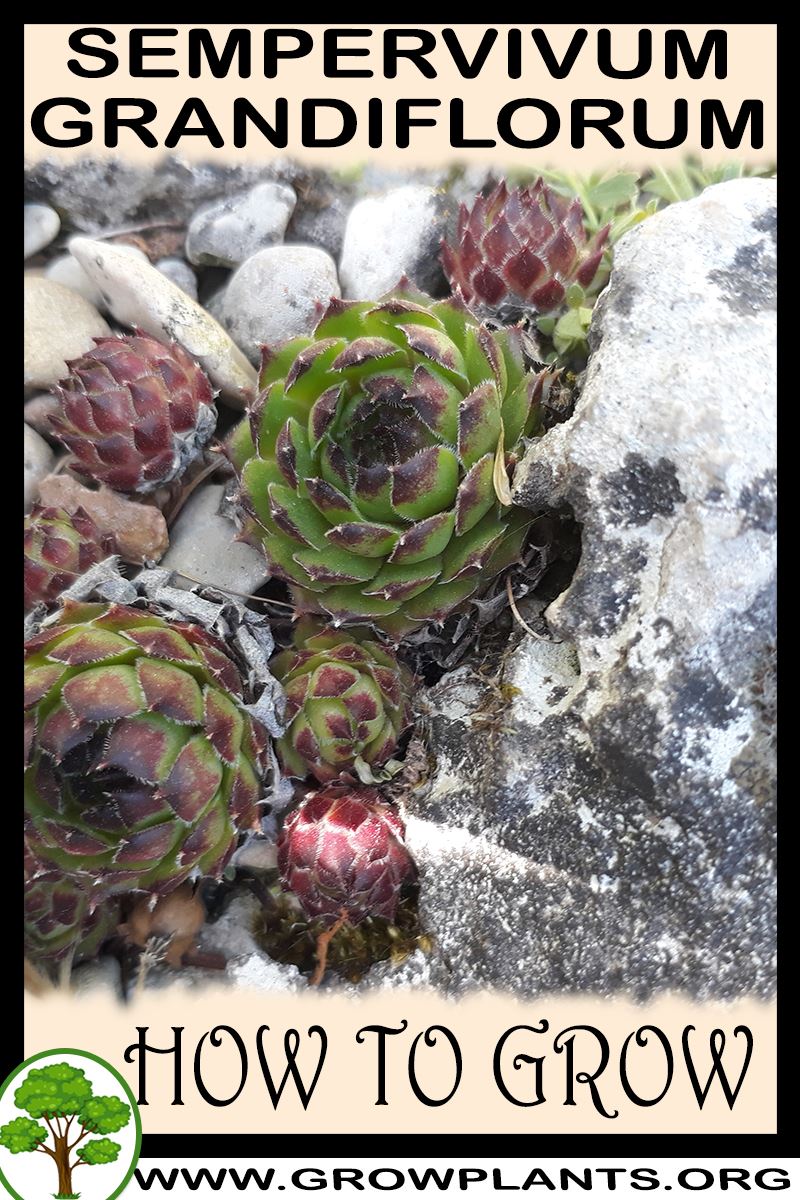
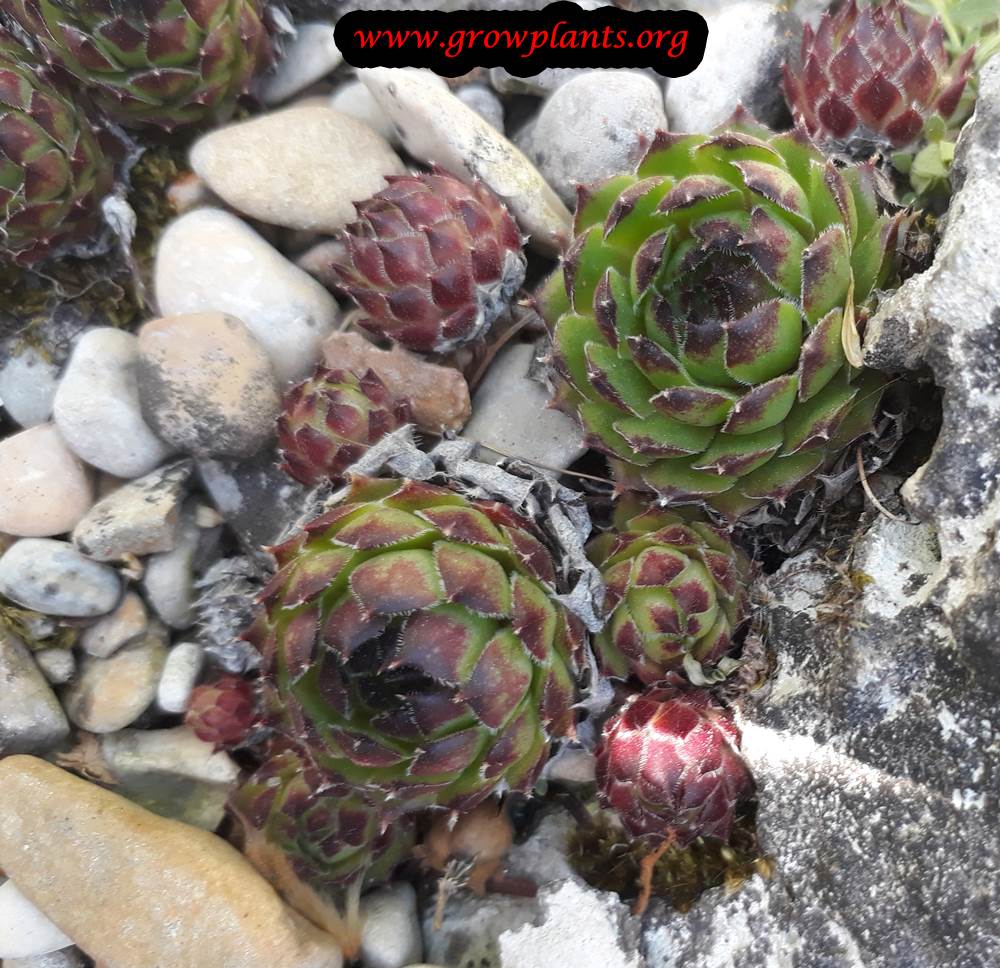
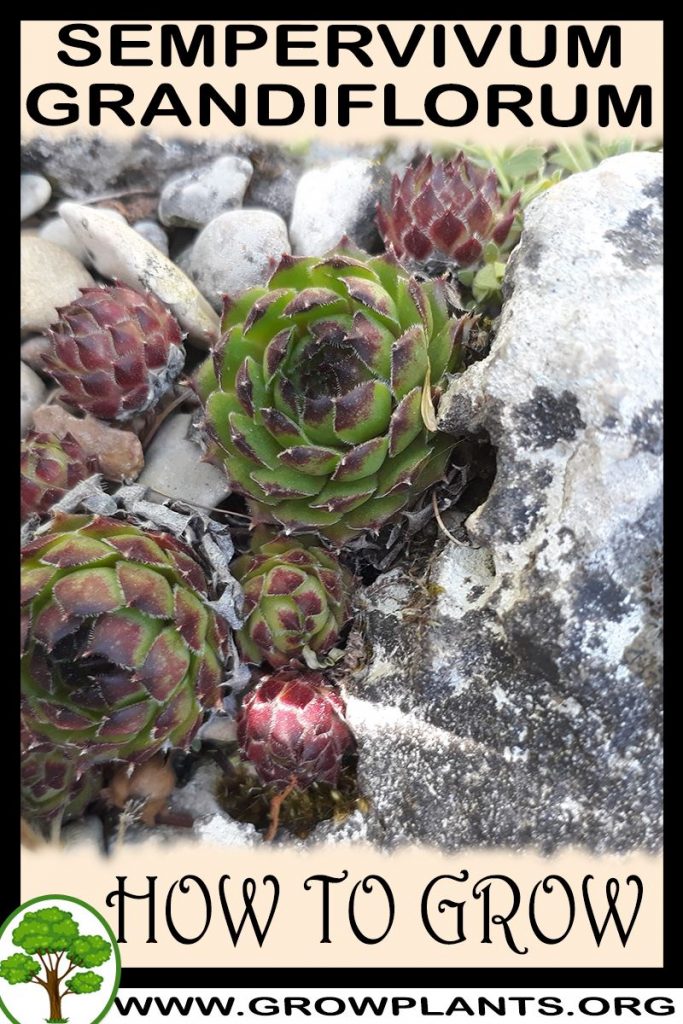
- Leaves & Foliage: Green, wedge-shaped leaves with red tips and a pointed apex.
- Flower Characteristics: Star-shaped, many-petalled blooms in yellow carried on a stout upright stalk in the warm season (each rosette flowers only once).
Primary Uses & Landscape Value
- Functional & Ornamental Roles: Rockery, trough, wall, green-roof and edging plant; an excellent low-water groundcover and popular collector’s succulent (best grown outdoors rather than as a houseplant).
Care Guide: Planting, Soil & Watering
Overview: Sempervivum grandiflorum (Common houseleek) is a tough, cold-hardy alpine succulent that grows best in full sun with sharply drained, gritty soil. It stores water in its rosettes and needs very little irrigation, so the soil must drain fast to keep the roots from rotting.
Quick Care Requirements
| Requirement | Ideal Condition |
|---|---|
| Planting Season | In spring or summer once the soil has warmed |
| Growth Rate | Slow |
| Soil Type | Sharply drained, gritty or sandy soil; poor lean soil is fine |
| Water Need | Low — drought-tolerant; let the soil dry out fully between waterings |
Planting & Establishment
- Best Planting Season: Plant offsets in spring or summer during warm, active growth; this species is frost-hardy in zones 4–11, but establishing it in the warm season lets the roots settle before winter.
- How to Plant:
- Hole Preparation: Dig a shallow hole just big enough for the small root system, in a spot that never collects standing water.
- Soil Amendments: Mix coarse sand, grit or perlite into the bed to open up drainage; avoid rich, moisture-holding soil, which encourages rot.
- Planting Depth: Set the rosette so its base sits right at the soil surface — do not bury the crown, and press grit around the neck to keep it dry.
- Growth Speed & Expectations: Expect slow, steady growth; each rosette clumps up over time by producing offsets (the ‘chicks’) around the parent.
Soil, Watering & Drainage Care
- Soil Mix & Drainage Needs: Provide a gritty, free-draining mix — cactus or succulent soil cut with extra sand or perlite; in containers make sure water drains straight through, as waterlogged soil is the quickest way to lose the plant.
- Watering Schedule & Technique:
- Young / Newly Planted: Water lightly after planting to settle the roots, then let the soil dry before watering again while the rosette establishes.
- Established: Water sparingly and deeply only once the soil has dried out; established plants get by on very little and tolerate drought well.
- Seasonal Adjustments: Give a little more in prolonged summer heat, and keep it nearly dry through winter, when cold, wet soil is most dangerous.
Climate, Light & Hardiness
Common houseleek is a legendarily tough alpine succulent, at home in Mediterranean, desert, subtropical, and temperate climates alike. It grows best in full sun to half shade and is exceptionally cold-hardy - frost itself is rarely the real threat; wet, poorly drained winter soil is.
Quick Climate Specifications
| Climate Zones | Mediterranean, desert, subtropical, temperate |
|---|---|
| USDA Hardiness Zones | 4–11 |
| Optimal Temp Range | Approximately 15–27°C (59–80°F) |
| Approx. Survival Minimum | Established plants in zone 4 typically endure winter minimums around −29°C to −34°C (−20°F to −30°F) |
| Frost Tolerance | High |
| Light Conditions | Full Sun / Half Shade |
| Wind Tolerance | High |
Sunlight & Light Exposure
Optimal Light Setup
Full sun produces the tightest rosettes and the best red leaf tips; half shade is tolerated but rosettes stretch and lose some color.
Direct Sun Requirement
Benefits from strong direct sun typical of this classic rock-garden succulent.
Shade & Heat Management
Handles hot, sunny, exposed sites well, as befits a plant traditionally grown on sun-baked rooftops and walls.
Best Exposure / Orientation
Rock crevices, gravel beds, green roofs, or troughs in full sun suit it perfectly.
Temperature Extremes & Hardiness
USDA Hardiness & Regional Limits
Hardy across zones 4–11, one of the broadest ranges among alpine succulents, and equally comfortable in hot, dry climates and cold continental winters.
Cold Damage & Winter Protection
The site data notes it can survive frost but does best without prolonged exposure to it in combination with wet soil; sharp drainage matters more for winter survival than the cold itself.
Frost Sensitivity
Very frost tolerant - houseleeks are named for surviving on exposed rooftops through hard winters - provided the site drains well.
Extreme Heat Tolerance
Excellent, consistent with its desert and Mediterranean range.
Wind, Humidity & Microclimate
Humidity Preferences
Strongly prefers dry, well-ventilated air; humid climates raise the risk of rot, particularly in winter.
Dry-Air Tolerance
Excellent.
Wind Tolerance
Very high - its low rosette form is built for exposed, windy sites.
Rainfall & Seasonal Moisture
Best suited to climates with a distinct dry season; consistently wet conditions, especially in winter, are its main climate weakness.
Microclimate Recommendations
Sharply drained, sun-exposed microclimates - rock gardens, troughs, walls, or green roofs - let it thrive across almost its entire hardiness range.
Growing in Pots, Balconies & Indoors
Sempervivum grandiflorum (a houseleek) is a hardy alpine rosette succulent, 15-30 cm across. The grower marks it as not a houseplant, but it is a natural for containers – a shallow, gritty pot, trough or bowl on a bright, sunny sill, balcony or patio.
Quick Details
- Container Size: Shallow and wide – a pan or bowl; 5 L is plenty for a cluster of rosettes
- Indoor Suitability: Not a deep-room houseplant, but happy on a bright, sunny windowsill
- Best Spot: Full sun to part shade – the brightest spot you have
- Soil & Drainage: Gritty, very free-draining alpine/cactus mix
- Watering in Pots: Sparingly – it stores water in its leaves; let the mix dry out fully
Indoors & On the Windowsill
- Not a true houseplant: The grower marks it ‘No’ – houseleeks want strong sun and cool, moving air that a warm room lacks.
- Windowsill: It does well on a very bright, cool, sunny sill with direct light; poor light makes the rosettes stretch and lose their tight form.
- Overwintering: Fully hardy and happier outdoors – it actually needs a cool winter; no need to bring it in except in the harshest conditions.
On a Balcony or Patio
- Light & heat: Ideal for a hot, sunny balcony – it shrugs off reflected heat from walls and paving. Give it the brightest spot and it will colour up beautifully.
- Rain & drainage: In prolonged wet weather move pots under cover; combined with cold, standing water is what kills these succulents, not drought.
Choosing the Pot, Soil & Long-Term Care
- Pot & drainage: A shallow, wide pan with strong holes; skip a standing water saucer to avoid root rot. Terracotta suits its love of drying out.
- Potting mix: A gritty, lean blend – cactus mix or potting mix with sharp sand and a gravel topping.
- Feeding: Almost none needed; a very weak feed once in the growing season is plenty.
- Refreshing: Rosettes offset and fill the pan – divide and refresh the gritty mix every couple of years.
Fertilizing & Feeding
A very light feeder: this slow-growing, frost-hardy houseleek forms tight rosettes best in lean, well-drained soil and needs only a touch of feeding while actively growing, none while it rests.
Quick Fertilizing Specs
| Feeding Level | Light feeder |
|---|---|
| Main Nutrient Priority | Low-nitrogen balanced feeding to keep rosettes compact and firm |
| Best Feeding Period | Spring and summer during active growth |
| Organic Options | A light topdressing of compost worked into gritty, well-drained soil |
| Reduce/Stop Feeding | Hold off feeding through winter, when the rosettes are hardy but dormant |
| Micronutrients | Rarely needed in well-drained, mineral soil |
| Soil pH | Tolerates a wide range of well-drained garden soils |
Feeding by Growth Stage
Spring and summer active growth
Support the slow, steady formation of new offset rosettes and good rosette color.
| Nutrient direction | A dilute, low-nitrogen balanced feeding is enough to support offsets and firm, well-colored rosettes. |
|---|---|
| Timing | During spring and summer, the plant’s main growth period. |
| Frequency | A light feeding once growth is clearly underway is plenty for this slow grower. |
| Fertilizer types | A diluted, low-nitrogen balanced fertilizer, A light topdressing of compost in gritty, fast-draining soil |
| Precautions | This naturally slow, tight-growing succulent loses its compact rosette shape and firmness if fed too rich or too often. |
Winter rest
Let the frost-hardy rosettes sit through winter without encouraging soft new growth that cold could damage.
| Nutrient direction | None – withhold fertilizer while the plant is dormant through winter. |
|---|---|
| Timing | During winter, when growth has clearly slowed even though the rosettes survive frost. |
| Frequency | No feeding at this stage. |
| Fertilizer types | No feeding at this stage; do not fertilize until active growth resumes in spring. |
| Precautions | Do not fertilize dormant rosettes; soft growth pushed by feeding is more vulnerable to cold damage. |
Nutrient Deficiency Signs & Corrections
Rosettes look pale or washed out and produce fewer new offsets than expected.
| Possible causes | low available nitrogen in very lean soil, heavy shade reducing overall vigor and color, old, exhausted potting mix if grown in a container |
|---|---|
| Appears first on | older, outer rosette leaves |
| What to check | recent feeding history, light exposure, how long it has been since a container was last refreshed with new mix |
| Possible correction | Apply a diluted, low-nitrogen balanced fertilizer during active growth and confirm adequate sun. |
New central leaves emerge pale yellow while the veins stay greener.
| Possible causes | compacted or poorly drained soil restricting root function, overly alkaline soil tying up iron, root stress from overwatering |
|---|---|
| Appears first on | newest center growth |
| What to check | soil drainage and texture, watering frequency, soil pH if chlorosis persists |
| Possible correction | Improve drainage with a gritty mix and correct pH before considering a chelated iron product per its label. |
Outer leaf tips brown and shrivel and rosettes look loose or shrunken despite adequate watering.
| Possible causes | fertilizer salt buildup from feeding too rich or too often, underwatering concentrating salts in shallow, fast-draining soil, poor drainage trapping salts near the roots, especially in containers |
|---|---|
| Appears first on | outer leaf tips and margins |
| What to check | recent fertilizer strength and frequency, watering consistency, drainage of the growing medium or pot |
| Possible correction | Ease off feeding, flush the soil with water to move salts past the root zone, then resume only light feeding. |
Pruning, Training & Seasonal Maintenance
Sempervivum grandiflorum needs almost no pruning in the usual sense: each rosette is monocarpic, meaning it flowers once on a central stem and then dies naturally, while surrounding offsets (“chicks”) carry the clump forward. The only real tasks are removing the spent flowered rosette, clearing old dried outer leaves, and thinning crowded offsets; any time of year works, though tidying is easiest in spring or after a rosette finishes blooming. None of this affects future flowering — each rosette’s bloom is a one-time event regardless of pruning.
Quick Pruning & Maintenance Specs
| Pruning Tolerance | Low |
| Primary Pruning Window | All year; most useful right after a rosette flowers |
| Typical Frequency | As needed, a few times a year |
| Main Objective | Remove the spent (flowered) rosette and old leaves; thin crowded offsets |
| Young Plant Priority | Leave offsets attached until they have their own roots |
| Mature Plant Priority | Clear dead mother rosettes; divide congested clumps |
| Best Tool Type | Precision snips (or fingers, for loose old leaves) |
Pruning by Plant Age & Size
Newly Established
Do not disturb a newly planted rosette or its offsets; let it root in fully before any grooming.
Young / Formative
No structural training applies — the plant is a self-contained rosette that multiplies by offsets. Only remove clearly dead outer leaves.
Mature / Established
In an established clump, the main job is removing each rosette after it flowers and dies, and separating offsets that have become overcrowded, to keep good air circulation and prevent rot.
Special Growth to Remove
- The spent mother rosette after it flowers and dies back — cut it out at the base once fully dry
- Old, dried, or shriveled outer leaves on any rosette
- Offsets that are overcrowding the clump (these can be replanted elsewhere rather than discarded)
Container & Small-Space Pruning
In shallow pots or troughs, remove spent rosettes and excess offsets promptly, since crowding in a small container raises humidity around the crowns and increases rot risk more than it would in open ground.
Tools
- Precision snips — for cutting out the dead mother rosette and separating offsets from their runners
Tool Hygiene & Disease Risk
Routine care is sufficient; use clean, sharp snips. No notable transmissible disease risk beyond crown rot if dead material is left sitting in a damp, crowded clump.
Cut Placement & Technique
Cut the spent rosette off close to where it joins the base, and sever offset runners cleanly rather than pulling, which can damage the offset’s new roots.
Post-Pruning Care
No feeding is needed; simply let the clump breathe by keeping dead rosettes and crowded offsets cleared out.
Common Pruning Mistakes
- Removing a rosette before it has actually finished flowering and died back, rather than letting the natural cycle complete
- Leaving spent, decaying rosettes in place, which can encourage rot in neighboring offsets
- Separating offsets before they have formed their own roots
When NOT to Prune
- While a rosette is still actively flowering
- During prolonged wet weather, when cut wounds are slower to dry and more prone to rot
Recommended Tools (by task)
- precision_snips — the only cuts needed are removing a spent rosette and separating small offsets, both fine, low-force cuts
Propagation Guide
Sempervivum grandiflorum is best propagated by separating the small rosette offsets (“chicks”) that form around the base of the mature rosette (“hen”), which guarantees plants identical to the parent; the site notes that vegetative propagation is needed if you want offspring to match the parent exactly, since seed-grown plants can vary. Overall this is an easy plant to propagate, especially by offsets.
Quick Propagation Specs
| Best Propagation Method | Offsets (separating rosette “chicks” from the mother rosette) |
| Alternative Methods | Seed sowing |
| Propagation Difficulty | Easy |
| Seed True-to-Type | Variable – seedlings can differ somewhat from the parent |
| Vegetative True-to-Type | Yes (site notes vegetative propagation is needed for offspring identical to the parent) |
| Best Propagation Season | Spring to summer |
Growing from Seed
Seed is fine and dust-like; sow it on the surface of a gritty, free-draining mix, as is typical for small succulent seed, and keep lightly moist but not wet. The site gives no specific germination timing for this species, so treat germination time as variable and check the seed tray regularly rather than expecting a fixed schedule. Because Sempervivum rosettes can cross-pollinate in the garden, seed-raised plants may not be identical to the parent even though they usually resemble the species reasonably well.
Division, Offsets, Pups & Suckers
Like other houseleeks, mature rosettes of Sempervivum grandiflorum are monocarpic: an individual rosette that flowers eventually dies back, but by then it has usually produced a ring of offset rosettes around its base that keep the planting going — this is the reason the site flags vegetative propagation as the way to guarantee identical offspring. In spring or summer, gently separate offsets that have their own small root system (or at least a firm base) from the mother rosette, taking care to keep any roots attached. Offsets removed with little or no root can still be potted on and will usually root in, but very small, immature offsets are less likely to establish successfully. Set divisions into free-draining soil and keep them lightly moist until new roots take hold; letting the separated base dry for a short time before potting can help reduce rot risk in humid conditions.
Bloom & Flower Guide
Quick Details
- Bloom Season: Summer
- Time to First Bloom: Once a rosette is mature – each rosette flowers a single time in its life
- Flower Appearance: Star-shaped yellow flowers, many-petalled, in a cluster on an upright stem
- Edibility: Ornamental only – grown for its rosettes; not eaten
Detailed Blooming Overview
Houseleek, or ‘hen and chicks’, flowers in a striking farewell. When a rosette matures it stretches upward and opens a cluster of star-shaped yellow flowers on a stout stem. This is a once-in-a-lifetime event for that rosette – it is monocarpic, so the flowering rosette dies afterwards. By then it has ringed itself with offset ‘chicks’, and these carry the planting on without a break.
Flower Characteristics
- Star-shaped, many-petalled yellow flowers in an inflorescence on an upright stem.
Bloom Care & Thinning
- After flowering: Once the flowered rosette dies, lift and remove it and let the surrounding offsets fill the gap.
- Keeping the colony going: Leave plenty of chicks in place so there is always a fresh generation coming up to bloom.
Pests, Diseases & Troubleshooting
Overview: Houseleeks are exceptionally tough alpine succulents and are among the most pest-free plants you can grow; their real enemies are wet, and a distinctive rust plus a small handful of soft-bodied insects. Sharp drainage and honest sun prevent the great majority of problems, so management is almost entirely cultural.
Quick Troubleshooting Overview
| Issue / Pest | Main Symptom | Primary Solution |
|---|---|---|
| Vine weevil | Rosettes wilt/topple; roots eaten, C-shaped grubs | Drench with beneficial nematodes; check roots |
| Root & crown rot | Rosettes go mushy, brown, collapse | Sharp drainage; dry gritty mix; avoid wet crowns |
| Houseleek rust | Orange-brown swollen pustules deforming leaves | Remove affected rosettes; improve airflow |
| Aphids | Clusters on new growth & flower stalks; sticky | Rinse off; insecticidal soap if needed |
| Mealybugs | White cottony tufts in the rosette centre/roots | Alcohol swab; systemic if root mealybug |
| Etiolation | Rosettes stretch, open up, lose colour | Give full, bright sun; grow hard and lean |
Common Pests & Management
- Vine weevil (Otiorhynchus sulcatus):
- Symptoms: The most damaging pest of container houseleeks: fat, legless, C-shaped white grubs with brown heads eat the roots and hollow out the base, so rosettes suddenly wilt, discolour and lift away at a touch. Adults notch leaf edges at night but do little harm compared with the larvae.
- Prevention & Control: Inspect roots when repotting and squash any grubs. Drench pots with entomopathogenic nematodes (Steinernema/Heterorhabditis) in warm soil as a biological control, and encourage birds and beetles in the open garden. Fresh, gritty mix and vigilance at potting time keep numbers down.
- Aphids (Aphis / Macrosiphum spp.):
- Symptoms: Green, black or grey clusters on tender new growth and especially on the emerging flower stalks, sucking sap and coating the plant in sticky honeydew that attracts ants and sooty mould.
- Prevention & Control: Blast off with a jet of water or wipe away small colonies. Insecticidal soap or a light oil clears heavier infestations; spray in the evening to protect pollinators drawn to the flowers. Ladybirds and hoverflies usually keep outdoor plants clean without help.
- Mealybugs & root mealybugs (Pseudococcus / Rhizoecus spp.):
- Symptoms: White, cottony tufts hidden deep in the rosette centre or, more insidiously, white waxy deposits on the roots and inner pot wall (root mealybug) that quietly sap vigour and cause slow decline.
- Prevention & Control: Swab visible colonies with alcohol on a cotton bud. For root mealybug, bare-root and wash the plant, discard old mix, and repot into fresh gritty medium; a soil drench of insecticidal soap or a systemic can be used for stubborn cases. Quarantine new plants and check roots at potting.
Diseases & Fungal Issues
- Houseleek rust (Endophyllum sempervivi):
- Symptoms: A signature disease of the genus: swollen, distorted leaves bearing orange to red-brown powdery pustules, often systemic within a rosette so the whole rosette is deformed and stunted. It spreads between touching rosettes in damp, crowded plantings.
- Treatment & Management: There is no easy cure once systemic — remove and destroy affected rosettes promptly and do not propagate from infected plants. Improve airflow and spacing, avoid overhead watering, and keep plantings lean and open. Copper or sulphur fungicides give some protection on valued collections but sanitation is the main tool.
- Crown, stem & root rot (Phytophthora / Pythium / Fusarium spp.):
- Symptoms: Rosettes turn soft, brown and mushy from the centre or base and pull away rotten; the classic result of wet, humid, poorly drained conditions, water sitting in the rosette, or winter wet on heavy soil.
- Treatment & Management: Prevention is drainage and dryness: grow in a very gritty, free-draining mix or raised/rock setting, water sparingly and only at the base, and keep crowns dry especially over winter. Remove rotten rosettes and surrounding soil; the healthy offsets can be re-rooted in dry, gritty mix.
Growing Difficulties & Abiotic Problems
- Winter/wet rot and frost heave:
- Cause & Symptoms: Although very cold-hardy, houseleeks rot in cold combined with wet, and freeze-thaw can lift shallow rosettes out of the ground.
- Correction Strategy: Ensure perfect drainage, add a grit mulch under the rosettes to keep necks dry, and shelter from prolonged winter wet with an overhead pane if needed. Firm heaved plants back in spring.
- Etiolation (too little light):
- Cause & Symptoms: In shade the tight rosettes stretch, open up, pale, and lose their red and purple tones, becoming soft and rot-prone.
- Correction Strategy: Grow in full sun to very bright light; the leaner and brighter the conditions, the tighter and more colourful the rosettes. Move indoor plants to the sunniest spot or supplement with a grow light.
- Monocarpic flowering (‘death bloom’):
- Cause & Symptoms: Each individual rosette is monocarpic — after it sends up its tall flower spike it sets seed and dies. This is natural, not a disease.
- Correction Strategy: Nothing is wrong: the many offsets (‘chicks’) around the parent carry on. Simply remove the spent rosette after flowering and let the surrounding offsets fill the gap.
What Helps – Products & Tools
Houseleeks need very little: beneficial nematodes are the key tool against vine-weevil grubs in pots, insecticidal soap or light horticultural oil handles the occasional aphid or mealybug, and rubbing alcohol on a cotton bud spot-treats rosette mealybugs. For the characteristic houseleek rust, sanitation is primary, with copper or sulphur fungicide as backup on prized plants. The most valuable ‘products’ are really a gritty, free-draining mix and a grit topdressing — keep them sunny, lean and dry and disease all but disappears.