Plant Profile & Key Characteristics
Overview: An evergreen ornamental shrub of the genus Pseuderanthemum, reaching about 30-120 cm (12-48 in), grown chiefly for its richly coloured purple to multi-coloured foliage and pollinator-friendly flowers. It is a warm-climate, drought-tolerant plant with a fast to moderate growth rate.
Quick Specifications
| Specification | Attribute |
|---|---|
| Plant Type / Life Cycle | Evergreen shrub (perennial) |
| Foliage Type | Evergreen |
| Mature Size | 30-120 cm (12-48 in) tall |
| Growth Rate | Moderate to fast |
| Hardiness | USDA zones 8-11 |
Growth Form & Structure
- Height & Spread: A modest shrub of 30-120 cm (12-48 in); grows well in large containers as well as in the ground.
- Growth Habit & Form: Bushy, upright evergreen shrub grown mainly for its coloured foliage; pruned largely for shape.
- Lifespan & Maturity: A fast- to moderate-growing evergreen perennial that establishes quickly in warm conditions.
Anatomy & Physical Features
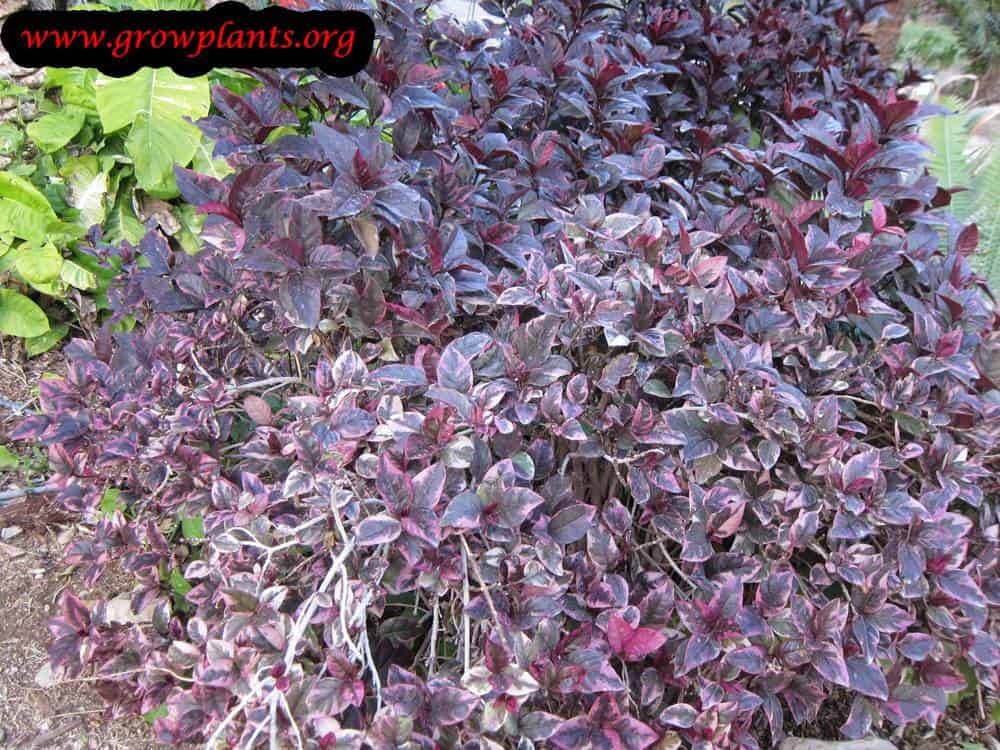
- Leaves & Foliage: Elliptic leaves in purple, green, pink, yellow or multi-coloured tones — the plant’s principal ornamental feature.
- Flower Characteristics: Purple, white or pink cross-shaped flowers that attract pollinators, over a long season from spring into autumn.
Primary Uses & Landscape Value
- Functional & Ornamental Roles: A drought-tolerant coloured-foliage ornamental for warm-climate borders and containers.
Care Guide: Planting, Soil & Watering
Overview: Pseuderanthemum atropurpureum is an evergreen subtropical shrub grown for its coloured foliage, thriving in full sun to part shade in moist, well-draining soil. It is drought-tolerant once established, taking a low to moderate amount of water, but grows best with extra moisture in summer.
Quick Care Requirements
| Requirement | Ideal Condition |
|---|---|
| Planting Season | In the warm season, from spring through autumn |
| Growth Rate | Moderate to Fast |
| Soil Type | Moist, well-draining soil |
| Water Need | Low to Moderate — drought-tolerant once established, but water more in summer heat |
Planting & Establishment
- Best Planting Season: Plant during the warm season, from spring through autumn, once conditions are reliably mild.
- How to Plant:
- Hole Preparation: Dig a hole about twice the width of the root ball, loosening the sides so roots establish quickly.
- Soil Amendments: Work compost or organic matter into the soil and mulch the surface to hold moisture.
- Planting Depth: Set the shrub with the root collar level with the surrounding soil; do not bury the stem.
- Growth Speed & Expectations: Expect a fast to moderate pace, the plant quickly forming a leafy, colourful shrub in warm conditions.
Soil, Watering & Drainage Care
- Soil Mix & Drainage Needs: Give moist, well-draining soil topped with mulch; in a container use a free-draining mix and ensure the pot drains freely.
- Watering Schedule & Technique:
- Young / Newly Planted: Water newly planted shrubs regularly to keep the soil moist while they establish.
- Established: Water regularly but let the surface dry between waterings; it tolerates some drought but not prolonged dryness in heat.
- Seasonal Adjustments: Increase watering in hot summer weather and reduce it in cool months.
Climate, Light & Hardiness
Pastel flower is a drought-tolerant, colorful-leaved evergreen shrub for subtropical, Mediterranean, and temperate climates, growing well in full sun to half shade. It is hardy through USDA zones 8–11.
Quick Climate Specifications
| Climate Zones | Subtropical, Mediterranean, Temperate |
|---|---|
| USDA Hardiness Zones | 8–11 |
| Frost Tolerance | Low |
| Light Conditions | Full Sun / Half Shade |
Sunlight & Light Exposure
Optimal Light Setup
Full sun to half shade both suit this shrub; brighter light generally intensifies its purple and multicolor leaf tones.
Temperature Extremes & Hardiness
USDA Hardiness & Regional Limits
Hardy through USDA zones 8–11, a warm-climate shrub best suited to mild-winter subtropical and Mediterranean gardens.
Frost Sensitivity
Frost-sensitive at the cooler end of its range; a hard freeze can damage or kill unprotected plants, so gardeners near zone 8 should plant in a sheltered microclimate.
Wind, Humidity & Microclimate
Dry-Air Tolerance
Reasonably drought-tolerant once established, consistent with its listing as a drought-tolerant ornamental in the site's own data.
Growing in Pots, Balconies & Indoors
Grown for its rich purple foliage, this tender tropical shrub is not listed by the grower as a true houseplant, but its need for warmth and light means a bright, warm windowsill suits it well. It makes a colourful patio pot in summer that must come indoors before cold weather.
Quick Details
- Container Size: A medium pot suits it; pot on as it grows to 30-120 cm
- Indoor Suitability: Not rated a full houseplant, but grows on a warm, bright windowsill
- Best Spot: Full sun to part shade with warmth; the best leaf colour comes in good light
- Soil & Drainage: Free-draining, organic-rich mix
- Watering in Pots: Small to average; keep lightly moist and warm, never cold and wet
Indoors & On the Windowsill
- Warm, bright sill: The grower does not class it as a full houseplant, but as a tender tropical it grows on a warm, bright windowsill with good light for strong leaf colour; it dislikes cold rooms and draughts.
- Overwintering: Frost-tender, so in cold climates keep it potted and bring it into a warm, bright room for winter – a key reason to grow it in a pot.
On a Balcony or Patio
- Light & warmth: A warm, sheltered, bright balcony brings out its purple tones in summer; keep it out of cold wind and move it under cover before temperatures drop.
Choosing the Pot, Soil & Long-Term Care
- Pot & drainage: Use a pot with strong drainage holes; skip a standing-water saucer (or empty it promptly) so the roots never sit wet and rot. Terracotta breathes and dries fast; glazed or plastic holds moisture longer.
- Potting mix: A free-draining yet organic-rich mix – a quality potting mix or peat/coir blended with perlite or vermiculite for aeration.
- Feeding: Potted plants exhaust their soil faster than those in the ground – feed through the growing season, since nutrients leach out with every watering.
- Repotting: Refresh the top of the mix and pot on every couple of years; for perennials, lightly prune the root ball and top growth when you do.
Fertilizing & Feeding
A moderate feeder – light, balanced feeding through its long spring-to-autumn growing season keeps both flowering and the plant’s signature purple and multicolor foliage looking their best.
Quick Fertilizing Specs
| Feeding Level | Moderate – a light, balanced feeding schedule supports vivid foliage color and repeat bloom |
|---|---|
| Main Nutrient Priority | Balanced feeding without overdoing nitrogen, which can dull the plant’s natural leaf coloring |
| Best Feeding Period | Spring through autumn while the shrub is actively growing and blooming |
| Soil pH | Adaptable to a range of well-drained garden soil; no special pH adjustment typically needed |
| Reduce/Stop Feeding | Stop feeding once growth slows in cool weather |
Feeding by Growth Stage
Spring growth flush
Support fresh stem and colorful leaf growth as this purple-and-multicolor foliage shrub breaks into active growth
| Nutrient direction | A balanced fertilizer supports strong stem and leaf color without overdoing nitrogen at the expense of the shrub’s naturally compact, colorful habit |
|---|---|
| Timing | In spring as new growth begins |
| Frequency | A light feeding at the start of the growing season is usually enough |
| Fertilizer types | A balanced general-purpose or flowering-shrub fertilizer, Compost worked into well-drained soil |
| Precautions | Avoid heavy nitrogen feeding, which can push plain green growth at the expense of this plant’s purple and multicolor leaf coloring |
Extended bloom through summer and autumn
Maintain steady nutrition through the long bloom window, which can run from spring through autumn
| Nutrient direction | Continue a light, balanced feed through the extended bloom period rather than a single heavy application |
|---|---|
| Timing | From summer into autumn while the cross-shaped flowers continue to open |
| Frequency | Light, spaced-out feeding through the bloom period is usually enough to sustain flowering |
| Fertilizer types | A balanced general-purpose or flowering-shrub fertilizer at a light rate |
| Precautions | Reduce feeding if flowering slows and foliage becomes lush and floppy instead, and keep this drought-tolerant shrub from being overfed alongside overwatering |
Cool-season slowdown
Let growth slow naturally as temperatures drop toward the cooler end of this shrub’s growing range
| Nutrient direction | None – withhold fertilizer while growth is slow or stalled in cool weather |
|---|---|
| Timing | During the coolest months, when growth largely stalls |
| Frequency | No feeding at this stage |
| Fertilizer types | No feeding at this stage; resume light feeding when spring growth resumes |
| Precautions | Do not fertilize while the shrub is not actively growing, and protect it from cold since it is only reliably hardy in warmer zones |
Nutrient Deficiency Signs & Corrections
Leaves lose vibrancy and look smaller and paler than the plant’s usual bold purple and multicolor pattern
| Possible causes | Nitrogen deficiency, Too little direct sun, which also mutes leaf coloring in this species, Root stress from soil that’s either too wet or too dry |
|---|---|
| Appears first on | Overall foliage color and new leaf size |
| What to check | Light exposure – full sun to half shade is preferred for best color, Soil moisture consistency, Recent fertilizing history |
| Possible correction | Apply a balanced fertilizer per its label and confirm the plant is getting enough light before assuming it’s purely a nutrient issue |
New leaves emerge yellowish with the veins staying green
| Possible causes | Iron deficiency linked to alkaline or poorly drained soil, Root stress from overwatering, High soil pH limiting nutrient availability |
|---|---|
| Appears first on | Newest leaves at the shoot tips |
| What to check | Soil pH and drainage, Whether yellowing is interveinal versus solid yellow, Watering frequency and soil moisture |
| Possible correction | Correct pH toward neutral if testing shows it’s too alkaline, and consider a chelated iron product per its label |
Leaf tips and edges turn brown and crisp despite adequate watering
| Possible causes | Fertilizer salt buildup from repeated feeding without flushing the soil, Underlying drought or heat stress, Excess fertilizer applied too concentrated or too close to the roots |
|---|---|
| Appears first on | Leaf margins and tips, especially on older leaves |
| What to check | Recent fertilizing rate and frequency, Whether the soil has been flushed with plain water recently, Overall watering consistency |
| Possible correction | Flush the soil with plain water to move built-up salts past the root zone and reduce fertilizer strength going forward |
Pruning, Training & Seasonal Maintenance
Pseuderanthemum atropurpureum is grown mainly for its richly colored foliage rather than its modest flowers, and it responds well to pinching and light trimming to stay bushy and compact. As a frost-tender subtropical/tropical shrub (hardy roughly zone 8–11), the safest pruning window is during active warm-season growth rather than late in the year, since a hard cut close to cool weather leaves tender new regrowth exposed to cold damage. Pruning timing has little effect on bloom, since flowers form on new growth – the real trade-off to manage is foliage color and density, not flower-bud wood.
Quick Pruning & Maintenance Specs
| Pruning Tolerance | Moderate – responds well to pinching and light shaping |
| Primary Pruning Window | Early spring into summer, during active growth |
| Secondary Maintenance Window | Ongoing pinching/tip removal through the growing season |
| Typical Frequency | Light pinching repeatedly; one harder shaping cut per year |
| Main Objective | Bushiness and compact form; remove reverted (plain green) shoots to keep foliage color |
| Young Plant Priority | Pinch tips repeatedly to build a branched, bushy framework |
| Mature Plant Priority | Cut back legginess; remove reverted or sparse growth; keep the canopy open enough for good leaf color |
| Best Tool Type | Precision snips |
| Avoid Heavy Pruning During | Autumn and winter, when regrowth would be frost-tender |
Pruning by Plant Age & Size
Newly Established
Pinch growing tips lightly once the plant is rooted in to encourage branching from the start; avoid any hard cuts until established.
Young / Formative
Repeated pinching is the main training method – tip out young stems regularly to build a dense, multi-branched shrub rather than a single leggy stem.
Mature / Established
Cut back leggy or bare stems by up to about a third in spring to renew density and color, and remove any shoots that have reverted to plain green on variegated/colorful cultivars, since they grow more vigorously and will crowd out the colored foliage if left.
Seasonal Pruning Schedule
Pre-Growth / Early-Spring: once the risk of cold has passed, do the year’s main shaping or rejuvenation cut so the plant has the full warm season to regrow and hold its color before cooler weather returns.
Ongoing Sanitary: pinch tips and remove reverted green shoots throughout the summer growing season.
Structural Pruning & Training
Thin crowded interior stems occasionally so light reaches lower leaves – this species colors up best with good light exposure, and a dense, self-shading canopy dulls the lower foliage. Control height and spread with pinching rather than infrequent hard cuts.
Special Growth to Remove
- Shoots that have reverted to plain green on variegated or purple-leaved forms.
- Spent flower spikes.
- Leggy, sparsely-leaved stems.
Container & Small-Space Pruning
Well suited to pot culture. Pinch more frequently than an in-ground plant to keep it in scale with the container, and favor light, frequent tipping over occasional hard cuts, since a containerized root system regrows more slowly after a severe cutback.
Tools
Precision snips for pinching tips and light shaping – stems stay soft and thin at this plant’s modest size (30–120 cm).
Tool Hygiene & Disease Risk
Routine – clean, sharp snips are sufficient; no significant tool-transmissible disease is documented for this species.
Cut Placement & Technique
Pinch or cut just above a leaf node to prompt two new branches from that point; make shaping cuts to an outward-facing bud to keep the center open.
Heavy Pruning & Rejuvenation
Tolerates a moderate cutback (up to roughly a third of the plant) to rejuvenate a leggy specimen, best done as active growth resumes in spring so the plant has a full season to recover its color and density before cooler weather.
Post-Pruning Care
Keep freshly cut plants protected from any late cold snaps, since new growth is frost-tender; water normally and avoid feeding immediately after a hard cut.
Common Pruning Mistakes
- Hard pruning in autumn or winter, leaving frost-tender new growth exposed to cold damage or dieback.
- Leaving reverted plain-green shoots in place, letting them out-compete the colorful growth.
- Removing too much upper growth at once, which reduces the light-driven leaf coloring on the rest of the plant.
When NOT to Prune
Avoid hard pruning in the cooler months when regrowth would be frost-tender, and avoid removing all flowering shoots at once if bloom display is wanted.
Recommended Tools (by task)
- Precision snips – for pinching tips and all routine shaping on this soft-stemmed shrub.
Propagation Guide
Pseuderanthemum atropurpureum roots very easily from stem or tip cuttings, making this the best way to keep a particular leaf-color form (purple, green, pink, yellow or multicolor) true. Seed is also viable, but seedlings can show variation in leaf coloring compared with the parent plant, so cuttings are preferred where a specific color pattern matters. This is an easy plant to propagate.
Quick Propagation Specs
| Best Propagation Method | Stem/Tip Cuttings |
| Alternative Methods | Seed |
| Propagation Difficulty | Easy |
| Seed True-to-Type | Variable (leaf coloring may differ from the parent) |
| Vegetative True-to-Type | Yes |
| Best Propagation Season | Spring through Autumn |
| Cutting Rooting Time | Typically a couple of weeks under warm conditions |
Growing from Seed
Sowing Season
Spring to summer, in warm conditions.
Germination Conditions
Moist, free-draining medium, kept warm; germination is usually straightforward but can be uneven.
Seedling Care
Grow seedlings on to see how their leaf coloring develops before selecting the best-colored plants.
Stem Cuttings
Cutting Type
Tip or stem cuttings, around 8–10cm, from non-flowering growth.
Best Timing
Spring through summer, during active growth.
Cutting Preparation
Trim just below a node and remove the lower leaves.
Rooting Setup
Roots readily in a moist, free-draining potting mix, or even in water, kept warm and out of harsh direct sun.
Rooting Hormone
Not necessary – this species roots easily without it.
Rooting Time
Usually within a couple of weeks.
Bloom & Flower Guide
Quick Details
- Bloom Season: Spring through autumn (near year-round in warm climates)
- Flower Appearance: Small white, pink or purple cross-shaped flowers on upright spikes above dark foliage
- Edibility: Ornamental only
Detailed Blooming Overview
Grown mainly for its deep purple foliage, Pseuderanthemum atropurpureum also produces dainty cross-shaped flowers over a long warm-season period that draw in pollinators.
Flower Characteristics
- Small five-lobed flowers, white to pink or purple, often with a spotted throat.
- Carried on slender upright spikes above the coloured leaves.
Bloom Care & Thinning
- Conditions: warmth, humidity and good light bring the best flowering.
- Shaping: pinch growing tips to keep the plant bushy and well-covered.
Pests, Diseases & Troubleshooting
Overview: Grown for its richly coloured foliage, this purple false eranthemum (Acanthaceae) is an easy-going tropical/indoor shrub whose troubles are the classic warm-glasshouse sap-suckers — mealybugs, scale, spider mites, aphids and whitefly — plus leaf spot and root rot when kept too wet. Steady warmth, humidity, good light and careful watering keep it clean.
Quick Troubleshooting Overview
| Issue / Pest | Main Symptom | Primary Solution |
|---|---|---|
| Mealybugs | White cottony tufts in leaf joints | Alcohol swab; neem or insecticidal soap |
| Spider mites | Fine stippling, webbing in dry air | Raise humidity; rinse; horticultural oil |
| Scale insects | Brown bumps on stems and veins | Scrape off; horticultural oil |
| Whitefly / aphids | Sticky honeydew, sooty mould, weak growth | Sticky traps; insecticidal soap |
| Leaf spot | Brown/black spots on leaves | Remove leaves; avoid wetting foliage |
| Root rot | Wilting, yellowing in soggy soil | Ease watering; free-draining mix |
Common Pests & Management
- Mealybugs (Pseudococcidae):
- Symptoms: White, cottony, waxy tufts in leaf axils, along veins and around the root crown. They suck sap, weaken the plant and leave honeydew and sooty mould; growth becomes stunted and distorted.
- Prevention & Control: Dab visible clusters with a cotton bud soaked in rubbing alcohol and isolate infested plants. Wash foliage and avoid over-feeding with nitrogen, which fuels them. Repeat sprays of insecticidal soap or neem oil at 7–10 day intervals break the cycle; check root crowns and pot rims where they hide.
- Spider mites (Tetranychus urticae):
- Symptoms: Fine pale stippling or bronzing on leaves, worst in hot, dry, dusty conditions; on close inspection you see tiny moving specks and delicate webbing on leaf undersides and shoot tips. Heavy attacks cause leaves to yellow and drop.
- Prevention & Control: Raise humidity and hose foliage regularly, as mites thrive in dry air. Avoid drought stress and dusty leaves. Release or encourage predatory mites. If they persist, spray insecticidal soap or horticultural oil onto leaf undersides and repeat every few days to catch newly hatched mites; rotate products to avoid resistance.
- Scale insects (Coccidae & Diaspididae):
- Symptoms: Small, immobile brown, tan or white bumps hugging stems, twigs and leaf veins; soft scales excrete honeydew that fuels sooty mould, while armoured scales cause yellow spotting and dieback. Heavy infestations weaken shoots and reduce vigour.
- Prevention & Control: Scrub light infestations off with a soft brush or a cotton pad dipped in diluted alcohol, and prune out badly encrusted wood. Conserve parasitic wasps and predatory beetles. For persistent populations apply horticultural oil to smother the crawler stage, timing it to the emergence of the mobile young and repeating as the label directs.
- Whitefly (Trialeurodes vaporariorum):
- Symptoms: Tiny white moth-like insects that fly up in a cloud when the plant is disturbed; nymphs and adults on leaf undersides suck sap, causing yellowing, weak growth and honeydew with sooty mould. A common problem under cover.
- Prevention & Control: Hang yellow sticky traps to monitor and reduce adults, and encourage parasitic wasps (Encarsia) and other predators. Improve airflow and avoid overcrowding. Spray insecticidal soap or neem oil on leaf undersides, repeating to catch successive generations.
- Aphids (Aphidoidea):
- Symptoms: Soft-bodied green, black or grey insects clustering on new shoots, flower buds and leaf undersides. Feeding causes curled, distorted young growth, a sticky honeydew coating and, in time, black sooty mould on that honeydew. Ants farming the colony are a giveaway. Attracted to soft, over-fed new growth on the colourful shoot tips.
- Prevention & Control: Knock colonies off with a firm jet of water and pinch out badly infested tips. Encourage ladybirds, lacewings and hoverflies by avoiding broad-spectrum sprays and leaving some flowering plants nearby. If numbers stay high, spray insecticidal soap or a light horticultural/neem oil, covering leaf undersides; repeat weekly until clear and treat in the cool of the evening to protect pollinators.
Diseases & Fungal Issues
- Leaf spot (Cercospora / Colletotrichum / Xanthomonas):
- Symptoms: Brown, black or yellow-haloed spots on the leaves, sometimes enlarging or merging in warm, wet, humid conditions or where foliage stays wet; badly affected leaves yellow and drop.
- Treatment & Management: Remove affected leaves, avoid wetting the foliage, water at the base and improve airflow and spacing. Isolate new plants. A copper fungicide checks stubborn fungal or bacterial spotting, but ventilation and dry leaves usually prevent it.
- Root & stem rot (Pythium / Rhizoctonia):
- Symptoms: Wilting despite moist soil, yellowing lower leaves and a soft, darkened stem base or decayed roots — a sign of overwatering or a heavy, airless mix.
- Treatment & Management: Use a free-draining potting mix, let the top of the soil dry before watering, and ensure pots drain freely. Remove badly affected plants; take healthy cuttings to start again. Avoid cold, wet conditions.
Growing Difficulties & Abiotic Problems
- Low humidity / dry air:
- Cause & Symptoms: In dry indoor air leaf edges brown and crisp, growth checks, and spider mites move in.
- Correction Strategy: Raise humidity with grouping, trays of moist gravel or a humidifier, keep away from hot draughts and heaters, and mist in very dry conditions.
- Faded leaf colour:
- Cause & Symptoms: In too little light the vivid purple/variegated foliage fades to plain green and growth grows leggy; harsh direct sun can scorch it.
- Correction Strategy: Give bright, indirect light (some morning sun suits it) to keep colour strong, and avoid both deep shade and fierce midday sun.
- Overwatering / cold stress:
- Cause & Symptoms: Soggy soil and chilly conditions cause leaf drop, yellowing and root rot in this frost-tender tropical.
- Correction Strategy: Keep it warm (above about 13°C / 55°F), water when the surface dries, and never leave it standing in water.
What Helps — Products & Tools
Keep this foliage plant warm, humid and evenly watered and it stays largely trouble-free. For pests, use rubbing-alcohol swabs and insecticidal soap or neem oil on mealybugs and aphids, horticultural oil for scale and mites, and yellow sticky traps for whitefly. A copper fungicide addresses persistent leaf spot; otherwise better airflow, dry foliage and free-draining soil prevent most disease.