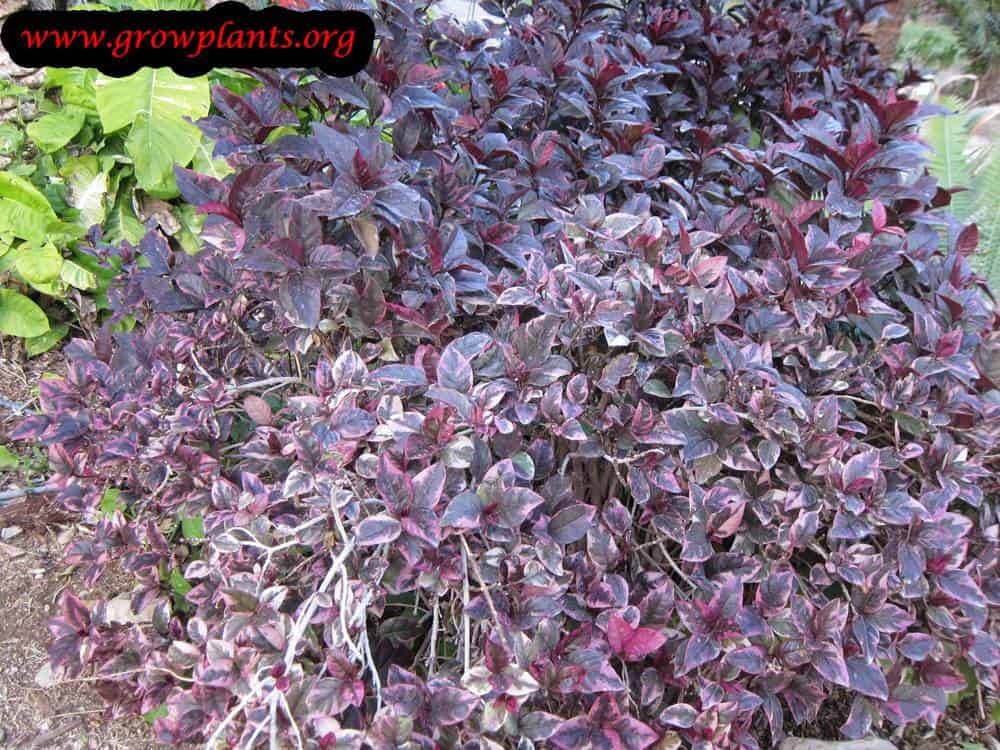
Plant Profile & Key Characteristics
Overview: An evergreen ornamental shrub of the genus Pseuderanthemum, reaching about 30-120 cm (12-48 in), grown for its glossy, often variegated foliage and pollinator-friendly flowers. It is a warm-climate, drought-tolerant plant with a fast to moderate growth rate.
Quick Specifications
| Specification | Attribute |
|---|---|
| Plant Type / Life Cycle | Evergreen shrub (perennial) |
| Foliage Type | Evergreen |
| Mature Size | 30-120 cm (12-48 in) tall |
| Growth Rate | Moderate to fast |
| Hardiness | USDA zones 8-11 |
Growth Form & Structure
- Height & Spread: A modest shrub of 30-120 cm (12-48 in); well suited to large containers, where a pot roughly 20-30% wider than the root ball works well.
- Growth Habit & Form: Bushy, upright evergreen shrub grown as much for its foliage as its flowers; responds well to an annual prune.
- Lifespan & Maturity: A fast- to moderate-growing evergreen perennial that fills out quickly in warm conditions.
Anatomy & Physical Features
- Leaves & Foliage: Glossy leaves in oval, elliptic or deltoid shapes, green or variegated with pink, purple or yellow — the plant’s main ornamental feature.
- Flower Characteristics: Purple, white or pink cross- to star-shaped flowers with 4-5 petals that attract pollinators, over a long season.
Primary Uses & Landscape Value
- Functional & Ornamental Roles: A drought-tolerant ornamental foliage shrub for warm-climate borders and containers, valued for its colourful leaves and long flowering; can be lightly invasive in ideal conditions.
Care Guide: Planting, Soil & Watering
Overview: Pseuderanthemum is an evergreen subtropical shrub that grows best in full sun to part shade (light shade in hot climates), in rich, moist, well-draining soil improved with organic matter. It is fairly drought-tolerant once established, taking a low to moderate amount of water, but appreciates extra watering through hot summer weather.
Quick Care Requirements
| Requirement | Ideal Condition |
|---|---|
| Planting Season | Spring to autumn in zone 10, spring to summer in zones 8–9, and year-round in zone 11 |
| Growth Rate | Moderate to Fast |
| Soil Type | Rich, organic, moist yet well-draining soil |
| Water Need | Low to Moderate — drought-tolerant once established, but water more in summer heat |
Planting & Establishment
- Best Planting Season: Plant from spring to autumn in zone 10, spring to summer in zones 8–9, or at any time of year in zone 11.
- How to Plant:
- Hole Preparation: Dig a hole about twice the width of the root ball; for containers choose a pot 20–30% larger than the root ball.
- Soil Amendments: Work compost or organic matter into the soil and mulch the surface to enrich it and hold moisture.
- Planting Depth: Set the shrub with the root collar level with the surrounding soil; do not bury the stem.
- Growth Speed & Expectations: Expect a fast to moderate pace, the plant quickly forming a leafy shrub in warm conditions.
Soil, Watering & Drainage Care
- Soil Mix & Drainage Needs: Give rich, well-draining soil topped with mulch to conserve moisture; in a container use a free-draining mix in a pot 20–30% larger than the root ball, refreshing the mix every few years and trimming dead roots to encourage new growth.
- Watering Schedule & Technique:
- Young / Newly Planted: Water newly planted shrubs regularly to keep the soil moist while they establish.
- Established: Water regularly but let the surface dry between waterings; it tolerates some drought but not prolonged dryness in extreme heat.
- Seasonal Adjustments: Increase watering markedly in hot summer weather — in extreme heat (around 40°C) it will need water to avoid dieback — and reduce it in cool months.
Climate, Light & Hardiness
Pseuderanthemum is a subtropical-to-warm-temperate shrub grown for its glossy, often variegated foliage and flowers, doing best in full sun to half shade (morning sun with midday shade in hot climates). It tolerates only light frost and needs consistently warm conditions to thrive.
Quick Climate Specifications
| Climate Zones | Subtropical, Mediterranean, Temperate |
|---|---|
| USDA Hardiness Zones | 8–11 |
| Frost Tolerance | Low |
| Light Conditions | Full Sun / Half Shade (in hot climates, roughly 50% shade with morning sun preferred) |
Sunlight & Light Exposure
Optimal Light Setup
Full sun works in cooler parts of its range (zone 8–10a); in hot-summer zones 10b–11 it prefers half shade.
Shade & Heat Management
In hot climates, provide roughly 50% shade and favor morning sun over harsh midday/afternoon exposure to prevent leaf stress.
Temperature Extremes & Hardiness
USDA Hardiness & Regional Limits
Hardy in zones 8–11, with sunny sites recommended in the cooler end (8–10a) and part shade favored in the warmest, hottest-summer areas (10b–11).
Frost Sensitivity
Only lightly frost tolerant; hard freezes are likely to cause significant damage, so it is best treated as a mild-winter or protected-site plant outside zone 9–11.
Wind, Humidity & Microclimate
Rainfall & Seasonal Moisture
Prefers consistently moist conditions; in very hot weather (around 40°C/104°F) additional water becomes important to avoid heat stress, though this is a watering-frequency detail covered more fully elsewhere.
Growing in Pots, Balconies & Indoors
Pseuderanthemum is a tropical foliage shrub (30-120 cm) grown for its coloured leaves. Interestingly, the grower marks it as not a houseplant but well suited to containers – so treat it as a warm-climate patio or greenhouse pot plant rather than a room plant.
Quick Details
- Container Size: A pot 20-30% larger than the root ball (per the grower)
- Indoor Suitability: Not a houseplant, per the grower – grow it in a pot outdoors or under cover
- Best Spot: Full sun to half shade; in hot climates give ~50% shade and morning sun
- Soil & Drainage: Well-draining mix
- Watering in Pots: Small to average amount; increase in summer heat – it is drought-tolerant but suffers in extreme heat without water
Indoors & On the Windowsill
- Grower’s call: He lists it as not a houseplant, so keep it as an outdoor or under-cover container plant rather than indoors.
- Windowsill: A very bright, warm sill could hold a young plant, but the grower favours pot culture in warmth and light rather than a room.
On a Balcony or Patio
- Light, wind & heat: Give it the brightest spot it will tolerate; walls and railings reflect heat and dry pots quickly, so check moisture often and shelter or stake exposed growth.
- Heat & shade: In hot climates give roughly half shade and morning sun; increase watering during heat waves – the leaves suffer above about 40C without water.
Choosing the Pot, Soil & Long-Term Care
- Pot & drainage: A container about 20-30% larger than the root ball, as the grower advises. Use strong drainage holes and skip a standing-water saucer to avoid root rot. Terracotta breathes and dries faster; glazed or plastic holds moisture longer.
- Potting mix: A well-draining mix works; keep drainage good.
- Feeding: Potted plants use up their soil faster as nutrients leach out with watering – feed lightly and regularly through the growing season.
- Repotting: Change the soil every few years and, when you do, trim away dead roots to encourage vigorous new root growth.
Grower’s Container Tip
- Pot sizing & root pruning: Choose a pot only 20-30% bigger than the root ball rather than an oversized one, ensure good drainage, and every few years refresh the soil and cut away dead roots from the root ball to spur new roots and stronger growth.
Fertilizing & Feeding
A moderate feeder for a shrub grown for both glossy, often variegated foliage and a long bloom season: rich, organic-matter-fed soil plus balanced feeding through the growing season keeps leaf color and flowering going, with feeding eased back during any cooler slowdown.
Quick Fertilizing Specs
| Feeding Level | Moderate feeder |
|---|---|
| Main Nutrient Priority | Balanced feeding with adequate nitrogen to support glossy foliage and repeat bloom |
| Best Feeding Period | Spring through the long spring-to-autumn bloom season |
| Organic Options | Compost, mulch, and organic matter worked into rich, well-drained soil |
| Reduce/Stop Feeding | Ease off feeding during any cooler-season slowdown |
| Micronutrients | Usually met by a complete fertilizer in rich, well-managed soil |
| Soil pH | Prefers rich, well-drained soil over a strict pH target |
Feeding by Growth Stage
Spring growth flush
Support fresh, glossy foliage growth – variegated in green with pink, purple, or yellow – as the shrub heads into its long bloom season.
| Nutrient direction | A balanced fertilizer with adequate nitrogen supports both leaf color and vigorous new growth as the shrub comes out of any winter slowdown. |
|---|---|
| Timing | Spring as new growth resumes, adjusted to the local planting season. |
| Frequency | A light feeding as growth resumes, alongside mulch to help hold soil moisture. |
| Fertilizer types | A balanced complete fertilizer, Compost or mulch worked into rich soil |
| Precautions | Keep soil consistently moist, especially in summer heat, alongside feeding; dry soil under a heavy feeding schedule stresses this plant more than the feeding helps. |
Repeat bloom through spring, summer, and autumn
Sustain the star-shaped purple, white, or pink flowers that draw in pollinators across this shrub’s extended bloom season.
| Nutrient direction | Continued balanced feeding supports both ongoing bloom and the shrub’s glossy foliage display; extra phosphorus is not needed to drive flowering. |
|---|---|
| Timing | Through spring, summer, and into autumn as flowering continues. |
| Frequency | An occasional light feeding through the extended bloom season. |
| Fertilizer types | A balanced complete fertilizer, Organic matter to help retain soil moisture through summer heat |
| Precautions | In very hot weather this plant needs extra water to avoid decline; don’t compensate for heat stress with extra fertilizer, which won’t replace the water it needs. |
Cooler-season slowdown
Let the shrub coast through any cooler stretch when growth and bloom naturally slow, without unnecessary fertilizer.
| Nutrient direction | None – minimal growth during a cool slowdown does not need feeding. |
|---|---|
| Timing | Any cooler part of the year when growth visibly slows, depending on climate. |
| Frequency | No feeding during this slowdown; resume light feeding once active growth returns. |
| Fertilizer types | No feeding at this stage – growth is minimal during the cool slowdown. |
| Precautions | Do not fertilize while growth is stalled from cool weather; wait for active new growth before feeding again. |
Nutrient Deficiency Signs & Corrections
Overall pale or dulled leaf color and reduced new growth, most visible on older leaves.
| Possible causes | low available soil nitrogen, nitrogen leaching from regular watering, container soil that has become depleted |
|---|---|
| Appears first on | older, lower leaves |
| What to check | recent feeding history, watering and drainage, container soil age if grown in a pot |
| Possible correction | Apply a balanced fertilizer with adequate nitrogen and refresh old container soil if relevant. |
New leaves emerge yellow while the veins stay green, dulling the plant’s normal glossy, variegated look.
| Possible causes | high soil pH limiting iron availability, waterlogged soil from overwatering, compacted or poorly aerated soil, especially in containers |
|---|---|
| Appears first on | newest growth |
| What to check | soil drainage and pH, container soil condition and age, recent transplant or repotting stress |
| Possible correction | Improve drainage first, then apply a chelated iron product per its label if the coloring doesn’t recover. |
Wilting, leaf drop, or scorched leaf edges during hot weather even with regular feeding.
| Possible causes | insufficient water during high heat, roots outgrowing a container that dries too quickly, too much direct sun for the local climate |
|---|---|
| Appears first on | leaf margins and youngest growth first |
| What to check | watering frequency during hot spells, container size relative to root growth, amount of direct versus filtered sun |
| Possible correction | Increase watering during heat, size up a crowded container, and add afternoon shade in hot climates rather than adjusting fertilizer. |
Pruning, Training & Seasonal Maintenance
Pseuderanthemum is a soft-wooded, fast-to-medium growing shrub grown for glossy, colorful foliage and flowers across an unusually long Spring–Summer–Autumn bloom season. One annual structural cutback plus regular light pinching keeps it full rather than leggy. The most effective time for that yearly cutback is right after the long bloom season ends – timed to the earlier part of the Autumn–Winter window, not deep winter, especially toward the cooler (zone 8–9) edge of its range, so any resulting new growth has time to firm up before real cold arrives.
Quick Pruning & Maintenance Specs
| Pruning Tolerance | Moderate–High |
| Primary Pruning Window | Early Autumn–Winter, once bloom finishes |
| Secondary Maintenance Window | Light pinching through the growing/bloom season for bushiness |
| Typical Frequency | One structural cutback per year, plus ongoing pinching |
| Main Objective | Maintain a bushy, compact habit; remove dead parts; refresh foliage/flower display |
| Young Plant Priority | Pinch tips early to build a multi-branched framework |
| Mature Plant Priority | Annual post-bloom cutback to prevent legginess and renew display quality |
| Best Tool Type | Precision snips/bypass secateurs – a soft-stemmed shrub, never needs a saw |
| Avoid Heavy Pruning During | Peak Spring–Summer–Autumn bloom; deep winter in the cooler zone-8/9 edge of its range; extreme heat stress days |
Pruning by Plant Age & Size
Newly Established
Pinch growing tips on young plants to encourage branching from the base rather than a single stem.
Young / Formative
No formal training system – this is pinching for fullness, not a trained framework. Where a specific leaf or flower color form was chosen from cuttings, pinch early to multiply growing points of that selected form.
Mature / Established
Give the plant one structural cutback each year once bloom finishes, removing dead parts and reducing overly long stems, and keep pinching lightly through the following growing season to maintain a full, compact 30–120 cm habit.
Seasonal Pruning Schedule
Post-Flowering (old-wood bloomers)
Objective: refresh the plant’s shape and remove dead material once the long Spring–Summer–Autumn bloom cycle has finished, without pushing tender growth into cold weather. Remove: dead or damaged parts, spent flower stems, and any overly leggy growth. Do not remove: too much at once on a plant near the cooler edge of its hardiness range – stage the cutback rather than stripping the plant bare going into winter. Expected response: a fuller, more compact plant that resumes flowering the following spring. Flowering impact: minimal, since the cut is timed after the display has already ended for the year.
Ongoing Sanitary
Pinch and lightly shape through the active Spring–Summer–Autumn growth and bloom period; each pinch also tends to create additional branching and flowering points rather than removing bloom potential.
Structural Pruning & Training
No formal framework – the structural priority is overall bushiness and size containment within its typical 30–120 cm range. Since this species is noted as potentially invasive, also keep an eye on unusually vigorous shoots or self-sown growth that push beyond the intended footprint.
Special Growth to Remove
Remove dead parts as they appear and deadhead spent flower stems to keep the display tidy through its long bloom season. Given the noted potential for invasiveness, also remove any excessively vigorous shoots or volunteer seedlings encroaching outside the intended planting area.
Container & Small-Space Pruning
Pair the annual top cutback with the recommended repotting routine – sizing up the pot by roughly 20–30% over the root ball and trimming away dead roots at that time to stimulate fresh root growth. This combined top-and-root renewal, done together in the same post-bloom window, keeps a container plant proportionate and vigorous.
Tools
Precision snips for pinching and deadheading; bypass secateurs for the annual structural cutback – the soft, non-woody stems of this shrub never require loppers or a saw.
Tool Hygiene & Disease Risk
Routine – keep tools clean and sharp. The only recorded pest is aphids, which are not spread by pruning cuts.
Cut Placement & Technique
Pinch just above a leaf node to promote branching; deadhead spent flower stems back to the nearest leaf junction. When root-pruning at repotting, use a clean blade to trim only dead or circling roots, leaving healthy roots intact.
Heavy Pruning & Rejuvenation
Reasonably well tolerated given the plant’s fast-to-medium growth rate and ease of propagation from cuttings – a cutback of up to half the plant’s size in the post-bloom window is generally fine. On a stressed or newly potted plant, stage the cutback rather than doing it all at once.
Post-Pruning Care
Ease off watering somewhat after the Autumn–Winter cutback as growth naturally slows, especially if roots were freshly trimmed at repotting, to avoid rot; resume the heavier summer watering this species needs (including on extreme heat days) once active growth resumes in spring.
Common Pruning Mistakes
Cutting hard in the middle of the long Spring–Summer–Autumn bloom season and losing display; overwatering right after an Autumn–Winter cutback and root-prune, when growth has slowed and rot risk is higher; ignoring the plant’s noted potential for invasiveness and letting vigorous or self-sown growth spread unchecked.
When NOT to Prune
Avoid heavy pruning during peak Spring–Summer–Autumn bloom, during deep winter near the cooler zone-8/9 edge of its range, and during extreme heat-stress days when the plant is already under water stress.
Recommended Tools (by task)
- precision_snips – pinching for bushiness and deadheading through the long bloom season.
- bypass_secateurs – the annual post-bloom structural cutback.
Propagation Guide
Stem cuttings are the best method for Pseuderanthemum, especially since the site notes that cuttings are the reliable way to keep a specific leaf or flower colour; seed is possible but colour and variegation are not guaranteed to come true. Overall this is an easy plant to propagate at home.
Quick Propagation Specs
| Best Propagation Method | Stem cuttings |
| Alternative Methods | Seed |
| Propagation Difficulty | Easy |
| Seed True-to-Type | Variable – leaf and flower colour may not match the parent plant |
| Vegetative True-to-Type | Yes – the reliable way to keep a specific leaf or flower colour |
| Best Propagation Season | Spring to summer |
| Seed Germination Time | Generally a few weeks under warm conditions |
| Cutting Rooting Time | Often a few weeks under warm, humid conditions |
| Germination Temperature | Around 21–27°C (70–80°F), reflecting its subtropical/tropical origin |
| Seed Sowing Depth | Shallow – just covered |
Growing from Seed
Sowing Season
Spring, once conditions are reliably warm.
Sowing Depth & Orientation
Sow shallowly in a free-draining seed mix.
Germination Conditions
Keep warm and evenly moist, in bright but not harsh light.
Germination Time
Typically a few weeks, though timing can vary with warmth and seed freshness.
Seedling Care
Pot on once seedlings are established; grow in full sun to half shade, moving toward more shade in hot climates as the site’s care notes describe for mature plants.
Stem Cuttings
Cutting Type
Softwood to semi-hardwood tip cuttings.
Best Timing
Spring through summer, during active growth.
Cutting Preparation
Take a cutting a few nodes long, remove the lower leaves, and trim just below a node.
Rooting Setup
Insert into a moist, free-draining, rich mix (matching the plant’s preference for moist, well-drained, organically rich soil); keep humidity elevated.
Rooting Hormone
Optional – can help speed and even out rooting but is not essential.
Rooting Time
Roots typically develop within a few weeks under warm, humid conditions.
Bloom & Flower Guide
Quick Details
- Bloom Season: Spring through autumn in warm climates
- Time to First Bloom: On established plants in warm, bright conditions
- Flower Appearance: Small five-petalled flowers in a cross or star shape, in white, pink or purple, often with a speckled throat
- Edibility: Not eaten – grown as an ornamental
Detailed Blooming Overview
Grown for both its glossy, often variegated foliage and its dainty pastel flowers, Pseuderanthemum blooms over a long warm season and draws in pollinators.
Flower Characteristics
- White, pink or purple flowers with 4-5 petals in a cross or star shape.
- Often marked with a speckled throat.
Bloom Care & Thinning
- Encouraging bloom: Warmth and bright, filtered light bring the best flowering.
- Shaping: Pinch stems to keep growth bushy and well covered in flowers.
Pests, Diseases & Troubleshooting
Overview: Grown for its richly coloured foliage, this Pseuderanthemum (Acanthaceae) is an easy-going tropical/indoor shrub whose troubles are the classic warm-glasshouse sap-suckers — mealybugs, scale, spider mites, aphids and whitefly — plus leaf spot and root rot when kept too wet. Steady warmth, humidity, good light and careful watering keep it clean.
Quick Troubleshooting Overview
| Issue / Pest | Main Symptom | Primary Solution |
|---|---|---|
| Mealybugs | White cottony tufts in leaf joints | Alcohol swab; neem or insecticidal soap |
| Spider mites | Fine stippling, webbing in dry air | Raise humidity; rinse; horticultural oil |
| Scale insects | Brown bumps on stems and veins | Scrape off; horticultural oil |
| Whitefly / aphids | Sticky honeydew, sooty mould, weak growth | Sticky traps; insecticidal soap |
| Leaf spot | Brown/black spots on leaves | Remove leaves; avoid wetting foliage |
| Root rot | Wilting, yellowing in soggy soil | Ease watering; free-draining mix |
Common Pests & Management
- Mealybugs (Pseudococcidae):
- Symptoms: White, cottony, waxy tufts in leaf axils, along veins and around the root crown. They suck sap, weaken the plant and leave honeydew and sooty mould; growth becomes stunted and distorted.
- Prevention & Control: Dab visible clusters with a cotton bud soaked in rubbing alcohol and isolate infested plants. Wash foliage and avoid over-feeding with nitrogen, which fuels them. Repeat sprays of insecticidal soap or neem oil at 7–10 day intervals break the cycle; check root crowns and pot rims where they hide.
- Spider mites (Tetranychus urticae):
- Symptoms: Fine pale stippling or bronzing on leaves, worst in hot, dry, dusty conditions; on close inspection you see tiny moving specks and delicate webbing on leaf undersides and shoot tips. Heavy attacks cause leaves to yellow and drop.
- Prevention & Control: Raise humidity and hose foliage regularly, as mites thrive in dry air. Avoid drought stress and dusty leaves. Release or encourage predatory mites. If they persist, spray insecticidal soap or horticultural oil onto leaf undersides and repeat every few days to catch newly hatched mites; rotate products to avoid resistance.
- Scale insects (Coccidae & Diaspididae):
- Symptoms: Small, immobile brown, tan or white bumps hugging stems, twigs and leaf veins; soft scales excrete honeydew that fuels sooty mould, while armoured scales cause yellow spotting and dieback. Heavy infestations weaken shoots and reduce vigour.
- Prevention & Control: Scrub light infestations off with a soft brush or a cotton pad dipped in diluted alcohol, and prune out badly encrusted wood. Conserve parasitic wasps and predatory beetles. For persistent populations apply horticultural oil to smother the crawler stage, timing it to the emergence of the mobile young and repeating as the label directs.
- Whitefly (Trialeurodes vaporariorum):
- Symptoms: Tiny white moth-like insects that fly up in a cloud when the plant is disturbed; nymphs and adults on leaf undersides suck sap, causing yellowing, weak growth and honeydew with sooty mould. A common problem under cover.
- Prevention & Control: Hang yellow sticky traps to monitor and reduce adults, and encourage parasitic wasps (Encarsia) and other predators. Improve airflow and avoid overcrowding. Spray insecticidal soap or neem oil on leaf undersides, repeating to catch successive generations.
- Aphids (Aphidoidea):
- Symptoms: Soft-bodied green, black or grey insects clustering on new shoots, flower buds and leaf undersides. Feeding causes curled, distorted young growth, a sticky honeydew coating and, in time, black sooty mould on that honeydew. Ants farming the colony are a giveaway. Attracted to soft, over-fed new growth on the colourful shoot tips.
- Prevention & Control: Knock colonies off with a firm jet of water and pinch out badly infested tips. Encourage ladybirds, lacewings and hoverflies by avoiding broad-spectrum sprays and leaving some flowering plants nearby. If numbers stay high, spray insecticidal soap or a light horticultural/neem oil, covering leaf undersides; repeat weekly until clear and treat in the cool of the evening to protect pollinators.
Diseases & Fungal Issues
- Leaf spot (Cercospora / Colletotrichum / Xanthomonas):
- Symptoms: Brown, black or yellow-haloed spots on the leaves, sometimes enlarging or merging in warm, wet, humid conditions or where foliage stays wet; badly affected leaves yellow and drop.
- Treatment & Management: Remove affected leaves, avoid wetting the foliage, water at the base and improve airflow and spacing. Isolate new plants. A copper fungicide checks stubborn fungal or bacterial spotting, but ventilation and dry leaves usually prevent it.
- Root & stem rot (Pythium / Rhizoctonia):
- Symptoms: Wilting despite moist soil, yellowing lower leaves and a soft, darkened stem base or decayed roots — a sign of overwatering or a heavy, airless mix.
- Treatment & Management: Use a free-draining potting mix, let the top of the soil dry before watering, and ensure pots drain freely. Remove badly affected plants; take healthy cuttings to start again. Avoid cold, wet conditions.
Growing Difficulties & Abiotic Problems
- Low humidity / dry air:
- Cause & Symptoms: In dry indoor air leaf edges brown and crisp, growth checks, and spider mites move in.
- Correction Strategy: Raise humidity with grouping, trays of moist gravel or a humidifier, keep away from hot draughts and heaters, and mist in very dry conditions.
- Faded leaf colour:
- Cause & Symptoms: In too little light the vivid purple/variegated foliage fades to plain green and growth grows leggy; harsh direct sun can scorch it.
- Correction Strategy: Give bright, indirect light (some morning sun suits it) to keep colour strong, and avoid both deep shade and fierce midday sun.
- Overwatering / cold stress:
- Cause & Symptoms: Soggy soil and chilly conditions cause leaf drop, yellowing and root rot in this frost-tender tropical.
- Correction Strategy: Keep it warm (above about 13°C / 55°F), water when the surface dries, and never leave it standing in water.
What Helps — Products & Tools
Keep this foliage plant warm, humid and evenly watered and it stays largely trouble-free. For pests, use rubbing-alcohol swabs and insecticidal soap or neem oil on mealybugs and aphids, horticultural oil for scale and mites, and yellow sticky traps for whitefly. A copper fungicide addresses persistent leaf spot; otherwise better airflow, dry foliage and free-draining soil prevent most disease.