

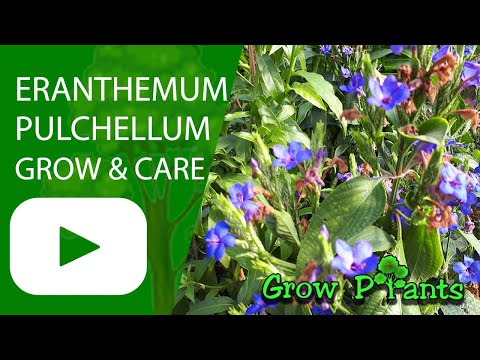

Plant Profile & Key Characteristics
Also known as: Blue eranthemum, Eranthemum nervosum, Blue sage
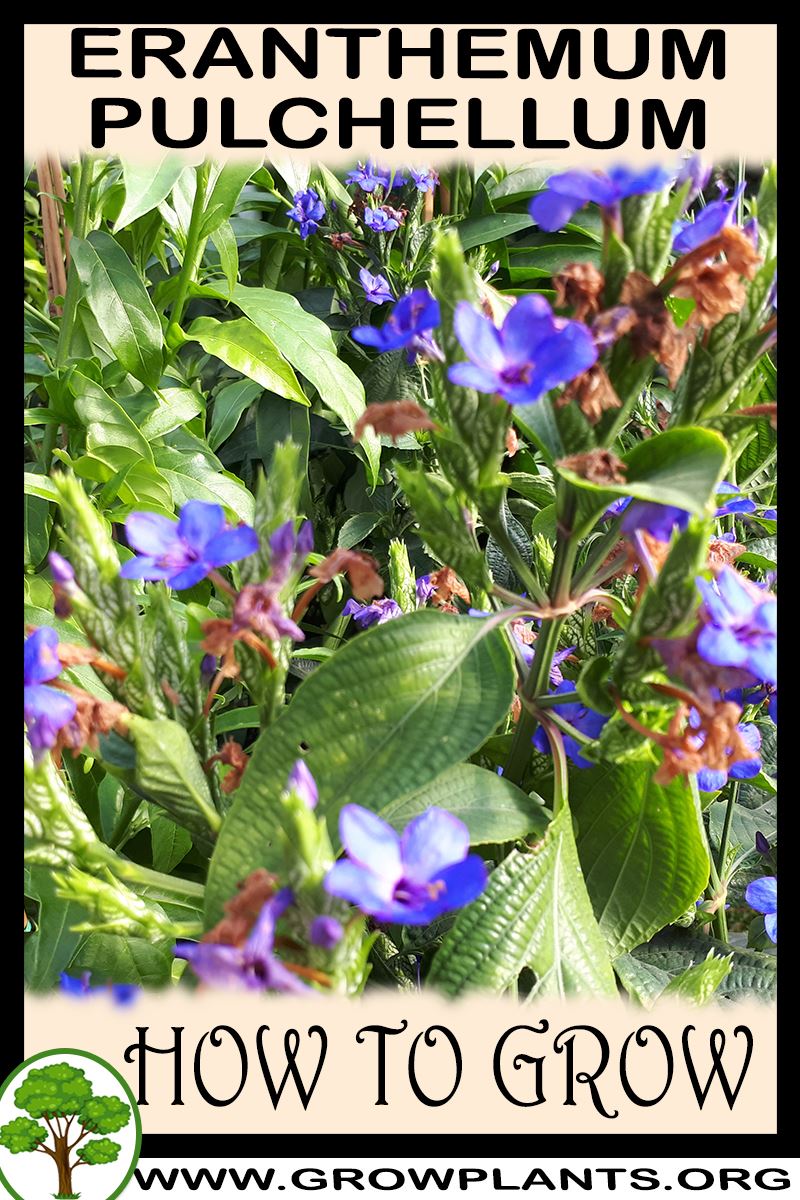
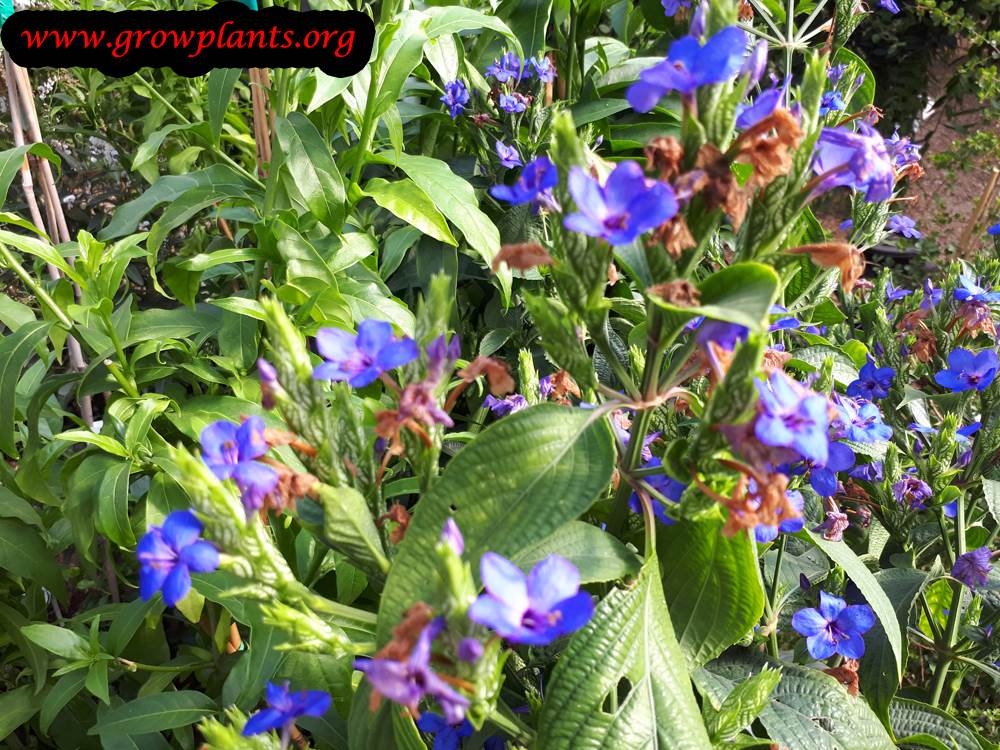
Overview: Eranthemum pulchellum (blue sage) is an evergreen shrub 50-200 cm (20-80 in) tall with hairy lance-shaped leaves and clusters of vivid blue-purple flowers. Fast-growing, it is grown as an ornamental and hedge that attracts pollinators, and is treated as an annual in cold climates.
Quick Specifications
| Specification | Attribute |
|---|---|
| Plant Type / Life Cycle | Perennial (or annual in cold zones) |
| Foliage Type | Evergreen |
| Mature Size | 50-200 cm (20-80 in) tall |
| Growth Rate | Moderate to fast |
| Hardiness | USDA zone 10b+ (perennial) / 5-10a (annual) |
Growth Form & Structure
- Height & Spread: 50-200 cm (20-80 in) tall; readily kept compact in containers and grown indoors with enough light to bloom.
- Growth Habit & Form: Bushy, upright shrub.
- Lifespan & Maturity: Perennial in warm climates; short-lived or annual where frost-killed.
Anatomy & Physical Features
- Leaves & Foliage: Green lance-shaped, hairy leaves.
- Flower Characteristics: Blue to purple saucer-shaped flowers, sometimes massed into ball-like clusters (full detail in the Bloom guide).
Primary Uses & Landscape Value
- Functional & Ornamental Roles: Grown as a flowering ornamental and informal hedge; valued for attracting pollinators and as a container or house plant.
Care Guide: Planting, Soil & Watering
Overview: Eranthemum pulchellum (blue sage) is a fast-growing shrub that thrives in warmth, partial to full shade, and moist, rich, slightly acidic soil high in organic matter. It likes steady moisture and benefits from added humus, never drying out fully.
Quick Care Requirements
| Requirement | Ideal Condition |
|---|---|
| Planting Season | Spring; year-round in frost-free zones |
| Growth Rate | Moderate to fast |
| Soil Type | Moist, rich, organic |
| Soil pH | Slightly acidic – as specified in the source |
| Water Need | Moderate to high – keep evenly moist |
Planting & Establishment
- Best Planting Season: In cool zones (about 5-10a) grow it as an annual planted in spring; as a perennial (zone 10b and warmer) plant from spring to summer, and year-round in frost-free zones (12+).
- How to Plant:
- Hole Preparation: Dig a hole about twice the width of the root ball and the same depth.
- Soil Amendments: Enrich generously with compost, organic matter and humus to build the moist, fertile, slightly acidic soil it prefers.
- Planting Depth: Set the root ball level with the surrounding soil, keeping the stem base at soil level.
- Growth Speed & Expectations: Growth is fast to moderate; plants bulk up quickly into leafy, flowering shrubs.
Soil, Watering & Drainage Care
- Soil Mix & Drainage Needs: The soil should stay moist and humus-rich while still draining; in pots use a fertile mix in a container 20-30% larger than the root ball.
- Watering Schedule & Technique:
- Young / Newly Planted: Keep the soil evenly moist while establishing and do not let it dry out.
- Established: Water regularly to maintain steady moisture, more in heat.
- Seasonal Adjustments: Water freely in warm growth and reduce in cool weather.
Climate, Light & Hardiness
Eranthemum pulchellum grows across tropical, subtropical, mediterranean, desert, and temperate climates (or indoors as a houseplant), thriving in half shade to full shade with consistently moist, rich soil. It persists as a perennial only in zone 10b and warmer; in zones 5–10a it is grown as a frost-killed annual.
Quick Climate Specifications
| Climate Zones | Tropical, subtropical, mediterranean, desert, temperate (or houseplant) |
|---|---|
| USDA Hardiness Zones | 10b+ as a perennial; grown as an annual in zones 5–10a |
| Frost Tolerance | Low |
| Light Conditions | Half shade to full shade |
Sunlight & Light Exposure
Optimal Light Setup
Half to full shade suits it best; a little direct or bright light is still needed to trigger good flowering.
Direct Sun Requirement
Not a full-sun plant; heavy direct sun is more likely to stress the foliage than help it.
Shade & Heat Management
Tolerates full shade well. Indoors or in deep shade, a brief spell of brighter light before the bloom season helps encourage flowering.
Best Exposure / Orientation
Dappled or filtered light - for example under high canopy outdoors, or a bright indoor spot without harsh midday sun.
Temperature Extremes & Hardiness
USDA Hardiness & Regional Limits
Reliable as an outdoor perennial only from zone 10b upward (and can grow nearly or fully year-round toward zone 12+); in zones 5–10a it is grown as a warm-season annual, replanted each spring.
Cold Damage & Winter Protection
Frost kills top growth. Where grown as a perennial near the cold edge of its range, a warm, sheltered microclimate improves winter survival.
Frost Sensitivity
Low frost tolerance.
Extreme Heat Tolerance
Succeeds in hot tropical and desert climates provided it has shade and consistent moisture; combining full sun with heat is more stressful than shade with heat.
Wind, Humidity & Microclimate
Humidity Preferences
Benefits from a humid, consistently moist growing environment, in keeping with its preference for moist, rich soil.
Rainfall & Seasonal Moisture
Prefers consistently moist conditions rather than dry spells; not documented as drought tolerant.
Microclimate Recommendations
A shaded, humid, sheltered spot - such as a garden understory, patio shade, or bright indoor room - suits it best; give extra winter shelter in marginal outdoor zones.
Growing in Pots, Balconies & Indoors
Eranthemum pulchellum (blue sage) is a shade-loving tropical shrub that the grower grows as a houseplant. Indoors it needs good light to flower, so give it a bright spot – and a taste of gentle sun before its flowering season to trigger bloom.
Quick Details
- Container Size: A pot about 20-30% larger than the root ball; it can also be kept small by pruning.
- Indoor Suitability: Yes – a good houseplant, though it needs enough light to bloom.
- Best Spot: Part to full shade with bright, indirect light; a little direct sun helps flowering.
- Soil & Drainage: Rich, well-aerated mix that drains freely.
- Watering in Pots: Even, moderate to generous moisture; do not let it dry out.
Indoors & On the Windowsill
- Houseplant: A genuine indoor plant – the grower grows it inside successfully.
- Getting it to bloom: Indoors it may skip flowering if light is weak; give it the brightest spot and expose it to a little direct sun ahead of its flowering season to bring the blooms on.
- Overwintering: It is tender, so in cold climates a pot lets you keep it indoors over the cold months.
On a Balcony or Patio
- Light and shelter: A part-shaded, sheltered patio spot suits it; protect it from harsh midday sun on a hot wall and from drying wind.
- Watering: Pots dry fast in warm weather – keep the mix evenly moist and never bone-dry.
Choosing the Pot, Soil & Long-Term Care
- Pot size: Use a pot roughly 20-30% bigger than the root ball; you can also keep it compact by pruning both the top and the roots, and it will still grow well without becoming pot-bound.
- Pot & drainage: Choose a pot with strong drainage holes and skip a standing-water saucer, which invites root rot; terracotta breathes and dries quickly, while glazed or plastic hold moisture longer.
- Potting mix: Fill with a well-aerated, organic-rich medium – a good potting mix, or peat/coir blended with perlite or vermiculite for drainage.
- Feeding: Container plants run through nutrients fast because watering washes them out, so feed a little more often through the growing season than you would in open ground.
- Repotting: Refresh the mix or pot up about every couple of years; for perennials, lightly trim the roots and top growth at the same time.
Grower’s Container Tip
- Keep it small by pruning: The grower keeps plants compact by pruning the top and the roots together – done this way the plant stays a manageable size and does not atrophy.
Fertilizing & Feeding
Grown as an ornamental shrub or informal hedge for its blue-to-purple flowers and pollinator appeal, this species prefers rich, slightly acidic, moisture-retentive soil and responds well to moderate feeding through its growth and bloom period.
Quick Fertilizing Specs
| Feeding Level | Moderate feeder while actively growing |
|---|---|
| Main Nutrient Priority | Balanced feeding supported by organic matter, suited to a rich, moisture-retentive soil |
| Best Feeding Period | Through the warm growing season leading into its winter-to-spring bloom |
| Organic Options | Compost, humus, or other organic matter worked into the planting area |
| Reduce/Stop Feeding | Ease off feeding as flowering finishes or as growth slows in cooler weather |
| Soil pH | Prefers slightly acidic, rich soil rather than an alkaline site |
| Micronutrients | Usually met by a complete fertilizer paired with organic-matter-rich soil |
Feeding by Growth Stage
Warm-season vegetative growth
Build a full, well-branched shrub with healthy foliage before the main bloom period.
| Nutrient direction | A balanced, complete fertilizer paired with organic matter supports steady growth in this species’ preferred rich, slightly acidic soil. |
|---|---|
| Timing | During the warm growing season as new shoots and leaves develop. |
| Frequency | Regular feeding through active growth supports strong branching before flowering begins. |
| Fertilizer types | A balanced, complete fertilizer suited to acid-loving or humus-loving shrubs, Compost or humus worked into the root zone |
| Routine trace nutrients | iron, manganese |
| Precautions | Keep the soil consistently moist when feeding; this species does not tolerate the root zone drying out for long between waterings. |
Winter-to-spring bloom
Sustain the saucer-shaped blue or purple flowers that attract pollinators through the main bloom period.
| Nutrient direction | Continued balanced feeding keeps foliage healthy and supports the flowering display without forcing excess soft growth. |
|---|---|
| Timing | As flower buds form and open, typically in winter into spring depending on climate. |
| Frequency | Lighter, less frequent feeding through the bloom period is enough once the plant is well established. |
| Fertilizer types | A balanced, complete fertilizer at a lighter rate than during vegetative growth |
| Precautions | Do not switch to a high-phosphorus “bloom booster”; balanced feeding supports flowering better than pushing phosphorus alone. |
Post-bloom rest
Let the plant rest after flowering, particularly where cooler weather or reduced light slows growth.
| Nutrient direction | None – withhold fertilizer while growth is minimal. |
|---|---|
| Timing | After flowering finishes, through any period of cool weather or reduced light. |
| Frequency | No feeding at this stage. |
| Fertilizer types | No feeding at this stage; the plant is resting rather than actively growing. |
| Precautions | Do not fertilize while growth is minimal; resume feeding once new growth signals the plant is active again. |
Nutrient Deficiency Signs & Corrections
New leaves turn pale yellow while the veins remain green.
| Possible causes | soil pH too alkaline for good iron uptake in a plant that prefers acidic conditions, poor drainage or waterlogged roots limiting nutrient uptake, low iron availability in the soil |
|---|---|
| Appears first on | newest leaves |
| What to check | soil pH, drainage around the root zone, recent feeding history |
| Possible correction | Correct soil pH toward the slightly acidic range this species prefers and apply a chelated iron product per its label if chlorosis persists. |
Lower leaves fade to pale green or yellow and overall growth slows.
| Possible causes | low available soil nitrogen, nutrient leaching from consistent moist-soil watering, thin soil low in organic matter |
|---|---|
| Appears first on | older, lower leaves |
| What to check | recent feeding history, soil organic matter, watering routine |
| Possible correction | Apply a balanced, complete fertilizer and build up organic matter in the root zone. |
The shrub grows leafy and full but produces few flowers.
| Possible causes | insufficient light for a plant that needs good light to bloom well, especially indoors, overfeeding with a nitrogen-heavy fertilizer that favors leafy growth over flowers, lack of pruning leaving old, less floriferous wood |
|---|---|
| Appears first on | whole-plant effect rather than a single stem |
| What to check | light exposure, recent fertilizer type and amount, pruning history |
| Possible correction | Improve light exposure, keep feeding balanced rather than nitrogen-heavy, and prune to renew flowering wood. |
Pruning, Training & Seasonal Maintenance
Eranthemum pulchellum is a soft-wooded shrub (50–200cm) grown both for its blue/purple winter–spring flowers and as an informal hedge or screen. It tolerates moderate to fairly hard pruning well, but because it flowers on growth produced during the growing season and matured going into the cool season, the safest and most effective time to shape it is right after flowering finishes in late winter/spring – this gives a full season for new growth to develop and set the next round of flower buds. Pruning late in summer or autumn risks cutting off the wood that would have bloomed that winter, and dead flower spikes should be removed regularly since the plant’s own care notes flag that spent blooms make it look untidy.
Quick Pruning & Maintenance Specs
| Pruning Tolerance | Moderate–High |
| Primary Pruning Window | Late winter/spring, immediately after flowering ends |
| Secondary Maintenance Window | Light tipping/deadheading through summer |
| Typical Frequency | One main shaping prune per year, ongoing deadheading |
| Main Objective | Maintain shape/size and protect the coming winter–spring flower display |
| Young Plant Priority | Pinch tips to build a bushy, multi-stemmed base |
| Mature Plant Priority | Shape or hedge-trim after bloom; renew leggy growth |
| Best Tool Type | Bypass secateurs (hedge shears only if maintained as a clipped hedge) |
| Avoid Heavy Pruning During | The winter–spring bloom period, and late-summer/autumn (removes forming flower wood) |
Pruning by Plant Age & Size
Newly Established
Only remove damaged growth at first; once the young plant is rooted in, pinch the growing tips to encourage branching from low down.
Young / Formative
No formal leader system is used – train as a bushy multi-stemmed shrub by repeated pinching. If it will be kept as a clipped hedge, begin light shaping early to build density from the base.
Mature / Established
After each winter–spring bloom, shape the plant or trim the hedge line, and thin out any leggy or weak interior growth. Because it can reach up to 2m, mature plants also need height and spread control to stay in bounds for the space.
Seasonal Pruning Schedule
| Post-Flowering (late winter/spring) | Shape cuts, height/spread control, hedge trimming if applicable | Do not remove more than needed to shape – this growth will produce next winter’s flowers | Vigorous summer growth flush | None – this is the ideal time, as it maximizes the season available to form new flower wood |
| Summer Canopy Management | Light tipping/pinching to maintain density or hedge form | Avoid heavy cuts late in summer | Continued branching | Heavy cuts late in the season can remove the developing flower buds for the coming winter |
| Ongoing Sanitary | Deadhead spent flower spikes as they fade | – | Tidier appearance | None |
Flowering & Fruiting Wood
Flowers form on the growth produced during the spring–summer growing season, which matures into the winter–spring floral display. Pruning promptly after flowering ends allows a full growing season for that new wood to develop before the next bloom; pruning late in the season removes wood that was about to carry flowers, reducing or delaying the display.
Structural Pruning & Training
- Height & spread control – needed given its 50–200cm size range.
- Canopy density – thin or shear depending on whether it is grown as an informal flowering shrub or a clipped hedge.
- Renewal pruning – cut back leggy, sparse growth to encourage fresh basal shoots.
Special Growth to Remove
- Spent flower stems – explicitly worth removing, as the plant’s own care notes state that dead flowers left in place make it look untidy.
- Weak or overly thin interior growth – thin out to keep the shrub from becoming congested.
Container & Small-Space Pruning
Well suited to containers: the plant’s own care guidance notes it can be kept compact by pruning both the top growth and the roots, so it doesn’t outgrow the pot. In a container, prune a little more frequently and lightly than an in-ground plant to maintain that balance between root volume and canopy size.
Tools
- Bypass secateurs – general shaping cuts and removal of leggy growth.
- Precision snips – deadheading individual flower spikes.
- Hedge shears – only if the plant is being maintained as a clipped hedge.
Tool Hygiene & Disease Risk
Routine – clean, sharp tools are sufficient. Aphids are the only documented pest; inspect new flush growth after pruning rather than applying any special disinfection protocol.
Cut Placement & Technique
Cut just above a leaf node or bud facing the direction you want new growth to go; deadhead by removing the spent flower truss back to the first healthy set of leaves below it.
Heavy Pruning & Rejuvenation
Tolerates a fairly hard cutback to renew leggy or overgrown plants; do this right after flowering so the plant has the full growing season to recover. Expect vigorous regrowth and a temporarily lighter bloom the following winter as the plant rebuilds flowering wood.
Post-Pruning Care
Water normally to support the post-prune growth flush; watch for aphids colonising the tender new shoots. No extra feeding is needed – the flush of new growth already follows from the cut.
Common Pruning Mistakes
- Shearing indiscriminately as a hedge without regard to the bloom cycle, which can strip off the developing winter flower buds.
- Pruning too late in summer or in autumn, sacrificing that winter’s flower display.
- Skipping deadheading, leaving the shrub looking tired even while the leaves are healthy.
When NOT to Prune
Avoid heavy pruning during the winter–spring bloom itself if the flowers are wanted (deadhead selectively instead), and avoid hard cuts heading into cold snaps in the cooler end of its growable range, since it is frost-tender where grown as an annual.
Pruning Troubleshooting
| Poor flowering this winter | Pruned too late in summer/autumn, removing forming flower wood | Check timing of last major cut against the bloom season | Shift the main prune to immediately after the next flowering |
| Leggy, sparse-looking shrub | Infrequent pinching/shaping when young, or years without renewal cuts | Look for bare lower stems and growth concentrated only at the tips | Cut back hard right after flowering to force fresh basal growth |
| Untidy appearance despite healthy growth | Spent flowers left in place | Check for retained dead flower trusses | Deadhead regularly through the bloom period |
Recommended Tools (by task)
- bypass_secateurs – the main tool for shaping cuts and renewal pruning of stems.
- precision_snips – fine deadheading of individual spent flower spikes.
- hedge_shears – only where the plant is kept clipped as a hedge rather than an informal flowering shrub.
Propagation Guide
Stem cuttings are by far the easiest and most common way to start Eranthemum pulchellum – the site notes it roots readily either in water or directly in soil. Seed is also listed as an option, though it is used less often since cuttings are so reliable; vegetative propagation isn’t strictly necessary but is the easy default choice. Overall difficulty is easy.
Quick Propagation Specs
| Best Propagation Method | Stem cuttings |
| Alternative Methods | Seed |
| Propagation Difficulty | Easy |
| Seed True-to-Type | Usually true-to-type |
| Vegetative True-to-Type | Yes |
| Best Propagation Season | Spring |
Growing from Seed
Seed is possible but used less often than cuttings for this shrub. As a warm-climate ornamental, seed generally needs warm, humid conditions to germinate; no further site-specific detail is available, so treat timing and depth cautiously and prefer cuttings where practical.
Stem Cuttings
Cutting Type
Stem cuttings.
Best Timing
Spring.
Cutting Preparation
Take a stem section and choose one of two rooting routes described for this plant.
Rooting Setup
Either (1) stand the cutting in water, changing the water every day until roots form, or (2) insert it directly into moist soil in about 30% sun/shade (partial light) and do not let the soil dry out.
Rooting Hormone
Not needed – this species is noted as really easy to root from cuttings.
Rooting Time
Not precisely documented; expect roots to form within a few weeks under the warm, humid spring conditions described above.
Bloom & Flower Guide
Quick Details
- Bloom Season: Winter into spring
- Time to First Bloom: Establishes quickly; young plants flower in their first cool season
- Flower Appearance: Saucer-shaped flowers in genuine blue to purple, often massing into a rounded head
- Edibility: Grown as an ornamental — the flowers are not eaten
Detailed Blooming Overview
Blue sage earns its place for the rare, genuinely blue flowers it opens through winter and into spring, when little else is in bloom. The flowers sit in spikes among pale-veined green bracts, brightening a shady corner and drawing in pollinators.
Flower Characteristics
- Saucer- or salver-shaped flowers with spreading lobes.
- Deep blue to purple, sometimes clustering into a ball-like head.
- Held in dense spikes above conspicuously veined bracts.
Bloom Care & Thinning
- Site for best flowering: Warmth and light shade in hot climates; protect from frost, which cuts the display short.
- Managing the bloom: Cut back after flowering to keep the plant bushy and encourage the next round of spikes.
- Pollination: The flowers attract and are worked by pollinators.
Pests, Diseases & Troubleshooting
Overview: Eranthemum pulchellum (blue sage) is a soft-wooded tropical Acanthaceae shrub grown for its vivid blue winter flowers, and like its relatives it mainly attracts sap-sucking greenhouse and houseplant pests – aphids, whitefly, mites, mealybugs – rather than serious disease. Warmth, airflow and routine inspection keep it clean; most trouble is cosmetic and easily reversed.
Quick Troubleshooting Overview
| Issue / Pest | Main Symptom | Primary Solution |
|---|---|---|
| Aphids | Colonies on soft tips/buds, honeydew, distortion | Water jet; insecticidal soap; predators |
| Whitefly | Tiny white flies rising when disturbed, sooty mould | Yellow sticky traps; insecticidal soap; airflow |
| Spider mites | Stippled, dull, webbed leaves in warm dry air | Raise humidity; rinse; insecticidal soap |
| Mealybugs / scale | White fluff or brown bumps, honeydew | Alcohol/oil; isolate; wipe clean |
| Leaf spot | Brown spots in humid, crowded conditions | Airflow; base-water; remove affected leaves |
Common Pests & Management
- Aphids (Aphis / Myzus spp.):
- Symptoms: Soft green or black colonies on tender shoot tips, buds and flower spikes, with honeydew, sooty mould and curled, distorted new growth.
- Prevention & Control: Rinse off with water and encourage ladybirds and lacewings; treat persistent colonies with insecticidal soap or neem. Avoid excess nitrogen, which fuels soft, aphid-prone growth.
- Whitefly (Trialeurodes vaporariorum / Bemisia tabaci):
- Symptoms: Clouds of tiny white flies that lift off the leaf undersides when the plant is disturbed; yellowing, honeydew and sooty mould. A common pest under glass and indoors.
- Prevention & Control: Hang yellow sticky traps to monitor and reduce adults, improve airflow, and treat undersides with insecticidal soap or horticultural oil, repeating to catch new hatchlings; introduce Encarsia parasitoids in greenhouses.
- Spider mites (Tetranychus urticae):
- Symptoms: Fine stippling, a dull bronzed look and delicate webbing on leaf undersides in warm, dry, still air.
- Prevention & Control: Raise humidity, rinse the foliage, and treat with insecticidal soap or a light horticultural oil, covering undersides well and repeating.
- Mealybugs & scale (Pseudococcus / Coccidae spp.):
- Symptoms: White cottony mealybugs in leaf axils and along stems, or brown scale bumps on stems and leaf undersides, both with honeydew and sooty mould.
- Prevention & Control: Dab mealybugs with alcohol, scrape scale, wipe the plant, and follow with horticultural oil or insecticidal soap; isolate and re-treat until clear.
Diseases & Fungal Issues
- Fungal & bacterial leaf spot (Cercospora / Pseudomonas spp.):
- Symptoms: Brown or dark, sometimes water-soaked spots and blotches on leaves in humid, crowded, or overhead-watered conditions.
- Treatment & Management: Improve airflow and spacing, water at the base to keep foliage dry, remove and destroy affected leaves, and use a copper fungicide only if spotting spreads.
- Powdery mildew (Erysiphe / Oidium spp.):
- Symptoms: A white powdery coating on leaves in humid but poorly ventilated conditions, with yellowing and leaf drop.
- Treatment & Management: Increase ventilation, avoid crowding, and remove affected leaves; a sulphur or potassium-bicarbonate fungicide helps in persistent cases.
- Root rot (Pythium / Phytophthora spp.):
- Symptoms: Wilting, yellowing and stem-base softening in cold, waterlogged soil, especially in pots overwintered too wet.
- Treatment & Management: Use a free-draining mix, water more sparingly in cool weather, ensure pots drain freely, and remove rotted material; keep the plant warm.
Growing Difficulties & Abiotic Problems
- Legginess without pruning:
- Cause & Symptoms: Left untrimmed the soft shrub grows open, sparse and leggy, flowering less well.
- Correction Strategy: Prune hard after the winter flowering flush to promote bushy, well-branched, floriferous growth, and pinch young plants to shape.
- Cold & drought leaf drop:
- Cause & Symptoms: A tender tropical, it drops leaves and browns if exposed to cold, draughts, or if allowed to dry out sharply.
- Correction Strategy: Keep it warm and frost-free with even moisture and humidity; bring under cover in cold climates and avoid cold draughts.
- Poor flowering / weak colour:
- Cause & Symptoms: Too little light, or feeding that is too high in nitrogen, gives lush leaves but few of the signature blue flowers.
- Correction Strategy: Give bright light, feed with a balanced fertiliser, and let the plant experience the cooler, shorter days that trigger its winter bloom.
What Helps – Products & Tools
Blue sage responds to the standard soft-plant toolkit: insecticidal soap, neem and horticultural oil for aphids, whitefly, mites, mealybugs and scale; yellow sticky traps for whitefly monitoring; and copper or sulphur fungicide for occasional leaf spot or mildew. Sharp secateurs for the post-flowering prune are as important as any spray.