

Plant Profile & Key Characteristics
Overview: A clump-forming herbaceous perennial reaching about 50-150 cm (20-60 in), grown chiefly as a shade ornamental for its bold variegated green foliage. It also produces edible young leaves and summer flower spikes.
Quick Specifications
| Specification | Attribute |
|---|---|
| Plant Type / Life Cycle | Perennial (herbaceous) |
| Foliage Type | Deciduous (dies back in winter, re-shoots in spring) |
| Mature Size | 50-150 cm (20-60 in) tall |
| Growth Rate | Moderate |
| Root System | Rhizomatous, clump-forming with fibrous roots |
| Toxicity | Young leaves edible for humans; toxic to dogs and cats (saponins) |
| Hardiness | USDA zone 3-9 |
Growth Form & Structure
- Height & Spread: 50-150 cm (20-60 in) tall in the ground; also grows well in shaded containers and as a houseplant.
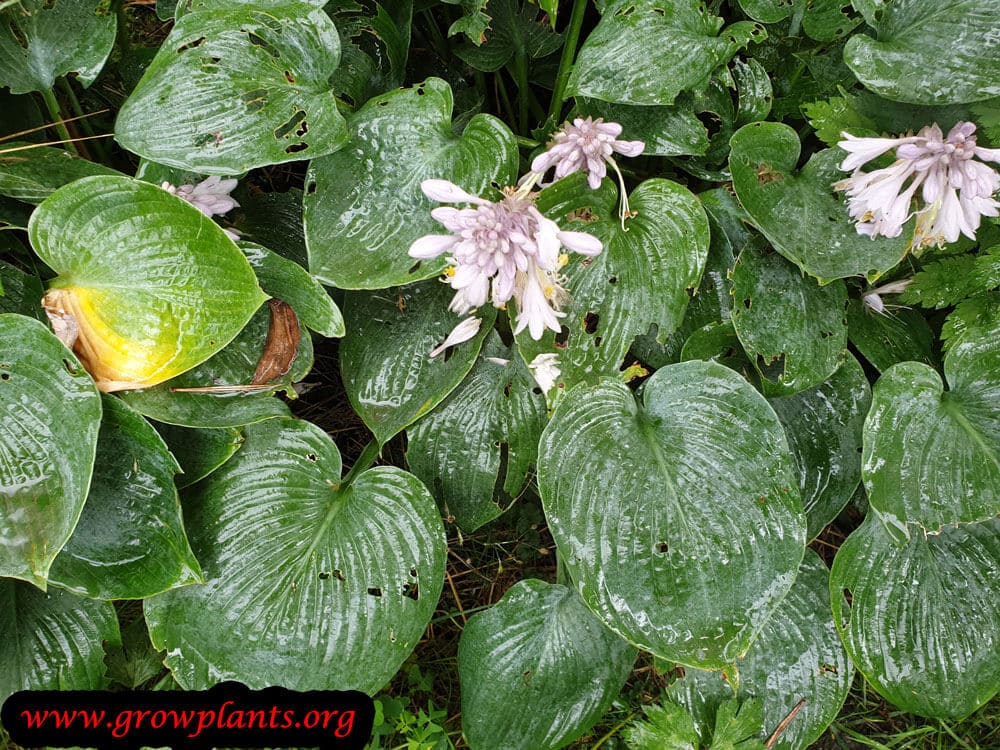
- Growth Habit & Form: Low, mounding clump of overlapping basal leaves with flower stems rising above the foliage.
- Lifespan & Maturity: Long-lived perennial; clumps bulk up over a few seasons and can be divided.
Anatomy & Physical Features
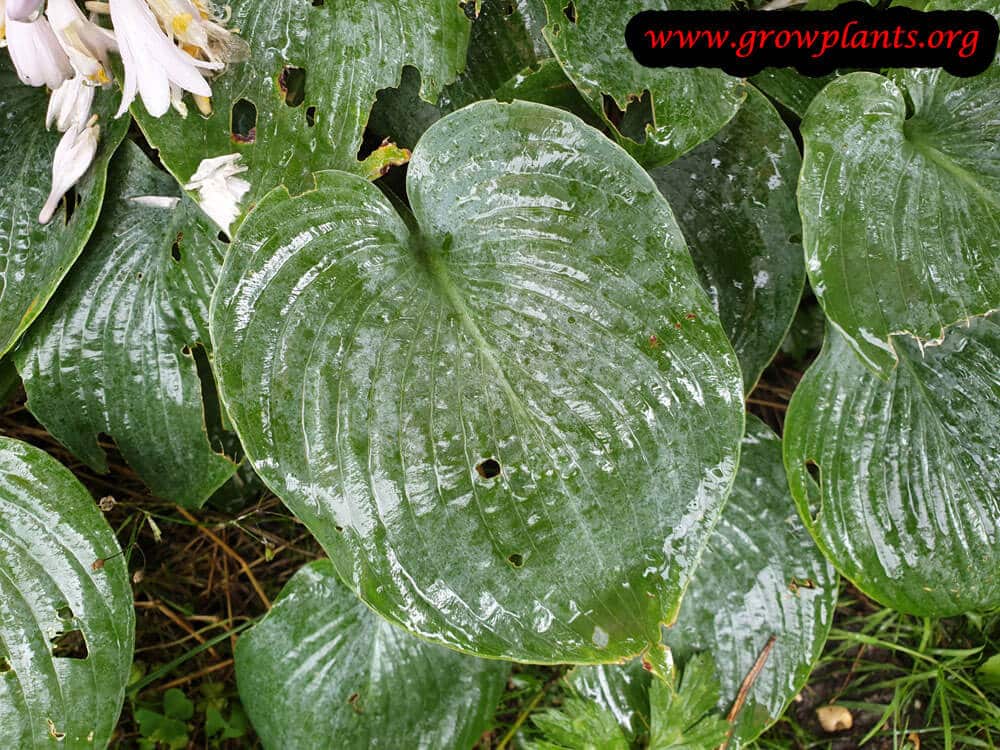
- Leaves & Foliage: Oval to heart-shaped leaves, green and often variegated with yellow or white.
- Flower Characteristics: Trumpet-shaped flowers on tall racemes in summer (full detail in the Bloom section).
Primary Uses & Landscape Value
- Edible Uses: Young, unfurling leaves eaten cooked, raw, in stews or rolled.
- Functional & Ornamental Roles: Prized shade and woodland ornamental, ground-level foliage plant, container and houseplant.
Care Guide: Planting, Soil & Watering
Overview: Hostas are shade-loving foliage perennials that prefer partial to full shade and rich, moist, well-drained soil high in organic matter. They like consistent moisture and thrive in climates with cold winters and warm summers.
Quick Care Requirements
| Requirement | Ideal Condition |
|---|---|
| Planting Season | Spring to summer |
| Growth Rate | Moderate |
| Soil Type | Rich, moist, humus-rich, well-drained soil |
| Water Need | Moderate to high – keep consistently moist, never bone dry |
Planting & Establishment
- Best Planting Season: Plant in spring or summer once the soil has warmed and frost has passed.
- How to Plant:
- Hole Preparation: Dig a hole a little wider than the root ball to loosen the surrounding soil.
- Soil Amendments: Blend plenty of compost or leaf mould into the backfill and mulch to conserve moisture.
- Planting Depth: Set the crown at the soil surface – planting too deep can cause rot, and shallow so the growing eyes sit just at soil level.
- Growth Speed & Expectations: Moderate – clumps expand steadily each year, taking a few seasons to reach full size.
Soil, Watering & Drainage Care
- Soil Mix & Drainage Needs: Rich, humus-rich soil that stays moist yet still drains; add organic matter to hold moisture, and use a moisture-retentive but free-draining mix in pots.
- Watering Schedule & Technique:
- Young / Newly Planted: Keep the soil consistently moist while the crown establishes.
- Established: Water regularly so the soil never dries out fully, especially in summer heat; the large leaves lose a lot of moisture.
- Seasonal Adjustments: More water through warm, dry summer weather; much less once the plant dies back for winter dormancy.
Climate, Light & Hardiness
Hosta tardiana is a shade-loving, deciduous-rooted temperate perennial that dies back to the crown each winter and benefits from a genuine seasonal swing of cold winter and hot summer. It is happiest in half to full shade with good ambient light – strong direct sun burns the leaves – and it is reliably hardy across USDA zones 3–9.
Quick Climate Specifications
| Climate Zones | Temperate; also grown as a houseplant outside this range |
|---|---|
| USDA Hardiness Zones | 3–9 |
| Frost Tolerance | High (crown); foliage dies back naturally each autumn regardless of frost |
| Light Conditions | Half shade / full shade with good ambient light |
Sunlight & Light Exposure
Optimal Light Setup
Half shade to full shade with reasonably bright ambient light gives the best foliage, including good development of any leaf variegation; deep, dim shade can reduce vigor.
Shade & Heat Management
Leaves scorch in strong, direct sun, so shade – especially through the hottest part of the day – is important for keeping the foliage in good condition through summer heat.
Best Exposure / Orientation
An east-facing or otherwise dappled, shaded position that avoids strong midday and afternoon sun suits it best.
Temperature Extremes & Hardiness
USDA Hardiness & Regional Limits
Hardy zone 3 through 9 – a slightly broader warm-end range than some other Hostas – with the crown surviving winter underground while top growth dies back completely.
Cold Damage & Winter Protection
Needs a genuinely cold winter for proper dormancy, consistent with the site's 'cold winter and hot summer' care note; in warm-winter or frost-free climates without adequate winter chill, vigor and growth can decline over time. No special winter protection is required within its hardy zones.
Frost Sensitivity
Established crowns tolerate hard frost well; foliage naturally dies back with autumn cold as part of its normal cycle rather than as damage.
Extreme Heat Tolerance
Tolerates hot summers well as long as it has adequate shade and the soil stays consistently moist, per the site's 'hot summer' note.
Wind, Humidity & Microclimate
Microclimate Recommendations
A shaded bed with a real winter chill and warm (but not scorching, sun-exposed) summer conditions matches its natural preferences; it also adapts to container or indoor growing where light stays bright but indirect.
Growing in Pots, Balconies & Indoors
This hosta is a shade-loving foliage perennial (clump to around 50-150 cm including flower scapes) and the grower confirms it grows indoors. It makes an excellent low-light container and houseplant for bright, indirect light – its leaves scorch in strong, direct sun.
Quick Details
- Container Size: A wide pot to match the clump – roughly 10-20 L, sizing up as it divides
- Indoor Suitability: A good foliage houseplant in bright, indirect light
- Best Spot: Part to full shade with plenty of ambient light; no hot direct sun
- Soil & Drainage: Rich, moisture-retentive mix that still drains
- Watering in Pots: Keep evenly moist – hostas dislike drying out, and pots dry fast
Indoors & On the Windowsill
- As a houseplant: The grower grows it indoors. Give it a bright but indirect spot – a north- or east-facing window is ideal – and keep it out of scorching midday sun.
- Winter rest: Hostas appreciate a cool dormant period; as the leaves die back, move it somewhere cool, reduce watering, and it will re-shoot in spring.
- Safety: Hostas contain saponins that are toxic to cats and dogs – keep them out of reach of pets.
On a Balcony or Patio
- Light & shelter: A shaded or part-shaded balcony is perfect; keep it out of hot direct sun that burns the leaves. Keep the mix evenly moist and watch for slugs.
Choosing the Pot, Soil & Long-Term Care
- Pot & drainage: A wide pot with drainage holes; skip a standing saucer to avoid root rot.
- Potting mix: A rich, moisture-retentive mix with organic matter that still drains freely.
- Feeding & dividing: Feed through the growing season and refresh the mix or divide the clump every couple of years.
Fertilizing & Feeding
A shade-loving, variegated foliage perennial that thrives in rich, moist soil; moderate feeding through the growing season keeps its patterned leaves lush, with a complete rest once it dies back for winter.
Quick Fertilizing Specs
| Feeding Level | Moderate |
|---|---|
| Main Nutrient Priority | Balanced feeding with adequate nitrogen to support full, well-colored, variegated foliage |
| Best Feeding Period | Spring through summer while the plant is actively producing leaves |
| Organic Options | Compost worked into rich soil, plus a mulch top-dressing to help retain moisture |
| Soil pH | Tolerates a wide range; thrives best in rich, moisture-retentive soil |
| Micronutrients | No routine micronutrient program typically needed in rich, well-mulched soil |
| Reduce/Stop Feeding | Feeding stops once the foliage yellows and dies back for winter |
Feeding by Growth Stage
Establishment After Planting or Division
Help newly planted or divided Hosta root into rich, moist, shaded soil and put out its first leaves.
| Nutrient direction | A balanced feeding worked into rich, moist soil supports early root and leaf establishment. |
|---|---|
| Timing | At planting or division, and through the first flush of new leaves in spring. |
| Frequency | A light feeding at planting supports establishment. |
| Fertilizer types | A balanced, complete fertilizer worked into rich soil, Organic matter such as compost mixed into the planting hole |
| Precautions | Keep soil consistently moist after feeding; dry soil limits root establishment in shade. |
Spring and Summer Leaf Growth
Support the lush, variegated foliage this plant is grown for through its main growing season.
| Nutrient direction | Continued balanced feeding, with adequate nitrogen, supports full foliage and helps keep variegation well-defined. |
|---|---|
| Timing | Through spring and summer while the plant is actively producing leaves. |
| Frequency | A light feeding during the growing season is generally enough for an established clump. |
| Fertilizer types | A balanced, complete fertilizer, A compost top-dressing to help retain moisture and feed the shallow root system |
| Precautions | Rich, moist soil and mulch do much of the work; avoid overfeeding, which offers little extra benefit to an established clump. |
Winter Rest
Let the plant die back and rest through winter after the foliage yellows in autumn.
| Nutrient direction | None – withhold fertilizer once the foliage dies back for winter. |
|---|---|
| Timing | Autumn through winter, after the leaves die back. |
| Frequency | No feeding at this stage. |
| Fertilizer types | No feeding at this stage; resume feeding only once new growth returns in spring. |
| Precautions | Do not fertilize the dormant crown through winter. |
Nutrient Deficiency Signs & Corrections
Leaves emerge pale green to yellowish with a smaller than expected clump.
| Possible causes | Low available soil nitrogen, Thin or depleted soil that has not been amended in years, Root competition from nearby trees or shrubs |
|---|---|
| Appears first on | Older, lower leaves first. |
| What to check | Soil richness and organic matter, Recent feeding history, Root competition nearby |
| Possible correction | Apply a balanced, complete fertilizer during active growth and refresh compost or mulch. |
Interveinal yellowing on older leaves while the veins themselves stay green.
| Possible causes | Low soil magnesium, Heavy potassium feeding competing with magnesium uptake, Leaching in light, sandy soils |
|---|---|
| Appears first on | Older, lower leaves. |
| What to check | Soil magnesium status, Recent feeding balance, Soil texture and drainage |
| Possible correction | Apply a labeled magnesium source such as Epsom salt and rebalance feeding. |
Leaf edges turn brown and crisp, especially on plants exposed to more direct sun than this shade-loving species prefers.
| Possible causes | Too much direct sun for this shade-preferring species, Fertilizer salt buildup from over-concentrated feeding, Inconsistent watering that lets the root zone dry out |
|---|---|
| Appears first on | Leaf margins and tips. |
| What to check | Hours of direct sun the planting receives, Recent fertilizer amounts, Watering consistency |
| Possible correction | Improve shade or move the planting, flush the soil with plain water if salts have built up, and water more consistently. |
Pruning, Training & Seasonal Maintenance
Hosta tardiana is grown chiefly for its heart-shaped, blue-green to variegated foliage, so the goal of any cutting is to protect that leaf display rather than shape the plant. Like other Hostas it dies back to the crown in the dormant season, so the main pruning event is a single autumn–winter cleanup of collapsed leaves and spent flower stalks once natural dieback has happened, done partly to clear away overwintering sites for the slugs, snails and Hosta virus this species is also prone to. Because the blue-grey bloom on tardiana-type leaves marks and rubs off with handling, cutting is done carefully by the stem rather than grabbing across the foliage.
Quick Pruning & Maintenance Specs
| Pruning Tolerance | Low – herbaceous clump grown for foliage display, sanitation only |
| Primary Pruning Window | Autumn to winter, after foliage dies back |
| Typical Frequency | Once a year, plus deadheading through spring–summer bloom |
| Main Objective | Preserve leaf display quality; remove dead material and reduce pest/disease overwintering habitat |
| Young Plant Priority | Let the clump establish and bulk up before any cutback |
| Mature Plant Priority | Deadhead bloom stalks; full autumn–winter foliage cutback |
| Best Tool Type | Precision snips |
Pruning by Plant Age & Size
Newly Established
Leave the clump undisturbed beyond removing damaged leaves; a young division needs its full leaf area to build up the crown.
Young / Formative
No branch training applies; the only maintenance choice at this stage is whether and when to divide an expanding clump, which is a propagation task rather than a pruning one.
Mature / Established
Deadhead the purple-to-white raceme flower stalks as bloom fades through spring–summer, keeping the foliage as the visual focus, then clear the whole clump at the autumn–winter dieback.
Special Growth to Remove
- Spent flower stems (racemes) – cut at the base once bloom fades, so they don’t detract from the foliage display.
- Dead or collapsed leaves – remove at the autumn–winter dieback to limit slug, snail and Hosta virus carryover.
Container & Small-Space Pruning
Grows well in containers and indoors as a houseplant. In a pot, apply the same seasonal cleanup; handle leaves by their stems rather than the blades to avoid rubbing off the glaucous blue coating that gives this group its foliage colour.
Tools
- Precision snips – sufficient for both deadheading and the annual foliage cutback.
Tool Hygiene & Disease Risk
Increased – Hosta virus is a documented risk for this species (along with aphids, slugs and snails). Clean snips between clumps, especially if any leaves show virus symptoms such as mottling or streaking that could be confused with normal variegation.
Cut Placement & Technique
Cut flower stalks at their base once bloom is finished, holding by the stem rather than the leaf blade. At the dormant cutback, cut foliage close to the crown without damaging it, since it holds next spring’s growth buds.
Common Pruning Mistakes
- Handling or cutting across the leaf blades and rubbing off the blue-grey surface bloom that gives this group its signature colour.
- Leaving decayed foliage over winter right at the crown, sheltering slugs, snails and disease.
When NOT to Prune
- Avoid cutting the clump back while foliage is still green and functional; wait for natural autumn–winter dieback so the crown stores full reserves.
Recommended Tools (by task)
- precision_snips – for deadheading and the annual foliage cutback on this soft-leaved foliage perennial.
- blade_disinfectant – wipe down between clumps given the documented Hosta virus risk.
Propagation Guide
Hosta tardiana is best propagated by dividing the crown, since seedlings frequently fail to reproduce the parent’s yellow-or-white variegated leaf pattern reliably; division is the standard way to keep a specific variegated form true. Seed is possible for the plain species character but is a poor choice when the variegation itself needs to be preserved.
Quick Propagation Specs
| Best Propagation Method | Crown division |
| Alternative Methods | Seed |
| Propagation Difficulty | Easy |
| Seed True-to-Type | Variable – variegation is often not reproduced reliably from seed |
| Vegetative True-to-Type | Yes |
| Best Propagation Season | Spring, as new shoots (eyes) emerge; also possible in early autumn |
Growing from Seed
Seed Handling & Viability
Seed forms in capsules after flowering; sowing reasonably fresh seed tends to give the most reliable results.
Dormancy & Pre-Sowing Treatment
A period of cold-moist stratification can help produce more even germination, though it is not always essential.
Germination Conditions
A moist, well-drained medium in bright, indirect light, in the cool-winter/warm-summer conditions this plant favors.
Germination Time
Germination can be slow and somewhat uneven, and seedlings raised this way commonly come up plain green or with inconsistent variegation rather than matching the parent’s pattern.
Seedling Care
Seedlings grow slowly at first; keep them consistently moist and watch for slugs and snails, which readily damage young hosta growth.
Division, Offsets, Pups & Suckers
Because hostas have no true above-ground stem, leaf or stem cuttings will not form new plants – propagation instead relies on dividing the crown, which is also the reliable way to keep this plant’s yellow-or-white leaf variegation intact. Divide in spring as new shoots (eyes) emerge, or in early autumn; each division should include at least one eye with healthy roots attached, and larger divisions with multiple eyes will establish faster. Trimming back some of the foliage on a division helps reduce moisture loss while new roots take hold, and divisions should be kept shaded and evenly moist until re-established.
Bloom & Edible Flower Guide
Quick Details
- Bloom Season: Late spring into summer
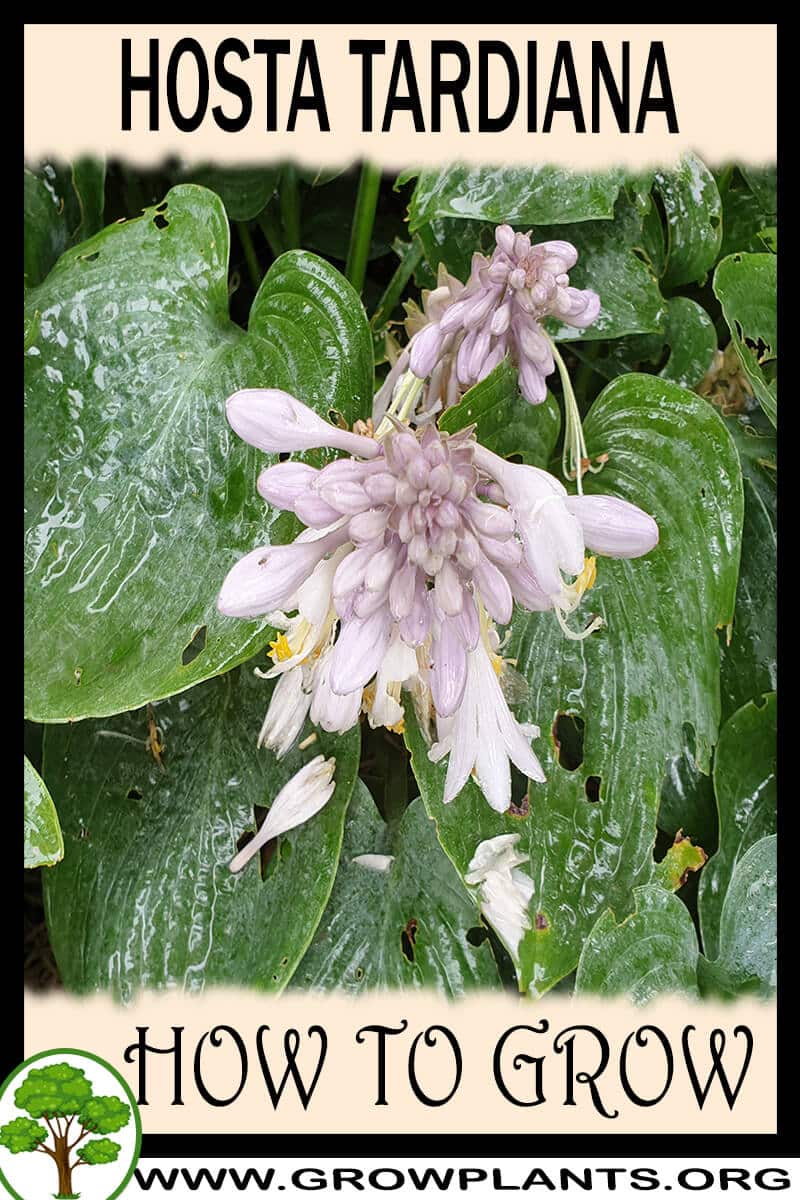
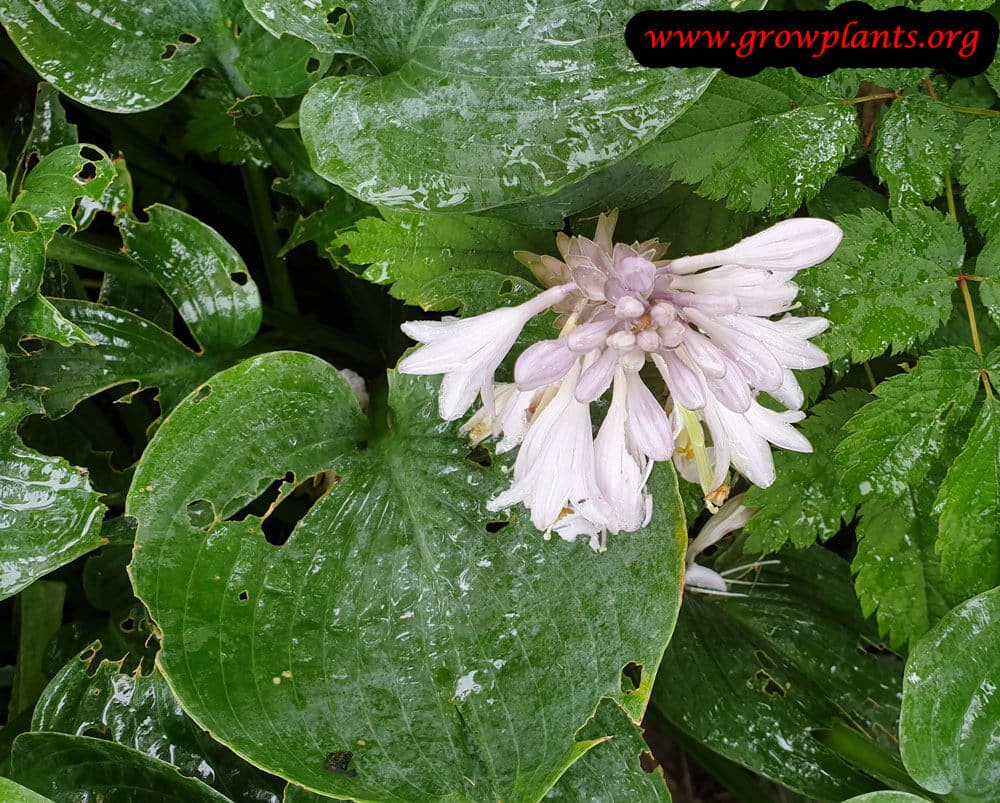
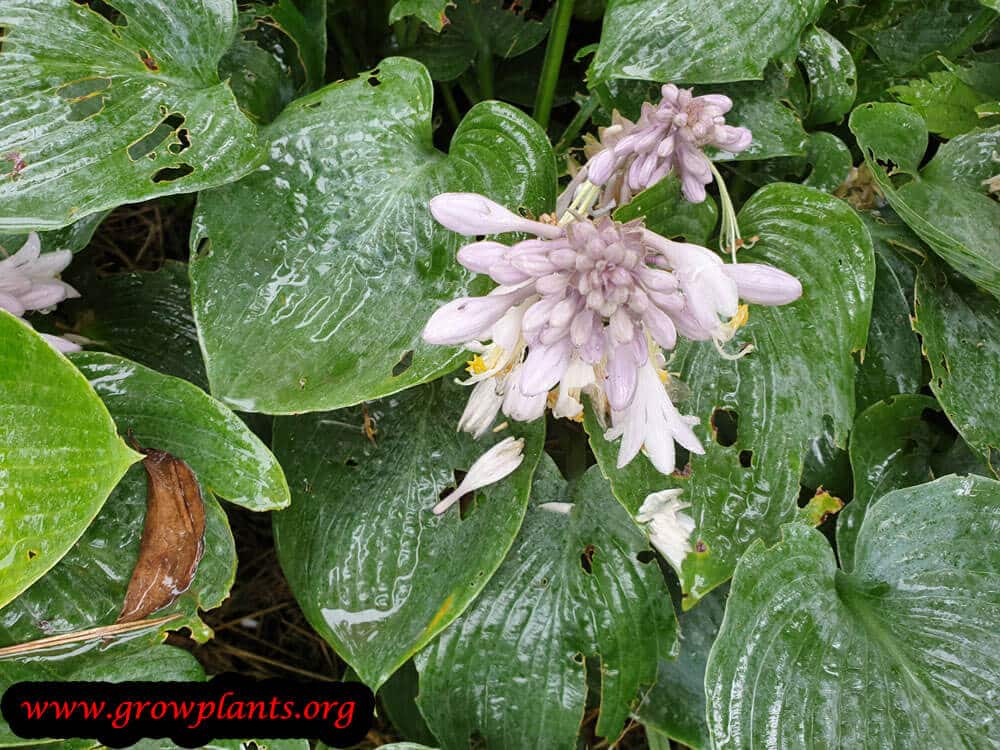
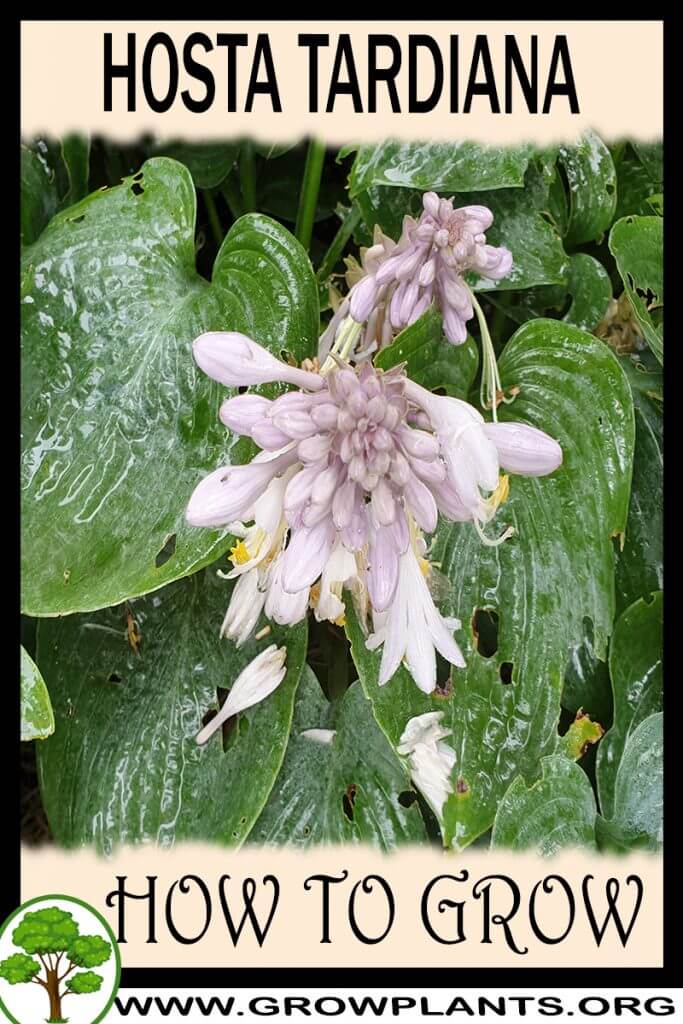
- Flower Appearance: Trumpet-shaped flowers in purple to white, held above the foliage on tall stems in a raceme
- Edibility: Hosta is edible – the flowers, and the young furled shoots (eaten in Japan as “urui”), can be used; the flowers make a mild garnish
Detailed Blooming Overview
Grown first and foremost for its cool blue-green foliage, this hosta also sends up tall stems of trumpet-shaped flowers in early to midsummer, shading from purple to white. Held well above the leaves, the blooms are loved by bees and hummingbirds.
Flower Characteristics
- Trumpet-shaped flowers ranging from purple to white.
- Arranged as a raceme up a tall stem that stands clear of the leaf mound.
Bloom Care & Thinning
- Managing the bloom: Some gardeners remove the flower stems to steer energy into the leaves, while others leave them for the pollinators – either is fine. Cut spent scapes off at the base once finished.
Fruit & Uses
Hosta tardiana is grown as both an ornamental foliage plant and an edible one: the young, still-rolled leaf shoots are harvested in spring and eaten raw, cooked, or stewed. Its leaves can be variegated with yellow or white, but the young shoot stage is used for food the same way as green-leaved hostas; once leaves fully unfurl and mature they become tougher.
Quick Edible Specs
| Edible Parts | Leaves / young leaf shoots |
|---|---|
| Main Use(s) | Culinary – spring green, eaten rolled, cooked, raw, or stewed |
| Eaten Raw or Cooked | Both – young leaves can be eaten raw, or cooked/stewed |
| Preparation Required | None required for young leaves; older leaves are better cooked |
| Harvest Season | Young shoots mainly in Spring; site notes leaves can be harvested most of the year once established |
| Time to First Harvest | Qualitative – once the plant is established; see Propagation/Care for planting details |
| Storage | Best used fresh, shortly after picking |
| Safety/Toxicity Caveat | No toxicity documented for humans; the site notes the plant is toxic to dogs, so keep pets from grazing on it even though the young leaves are a human food |
Leaves & Greens
Leaves range from green to dark green and can be variegated with yellow or white; they are harvested young, from the base of the plant, once it is established. The still-rolled young shoots are the most prized stage – eaten raw, cooked, or stewed.
Harvesting
Harvest is cut-and-come-again, mainly in spring when new shoots emerge, though the site notes leaves can be taken across most of the year once the plant is established. Taking leaves for food will reduce the plant’s mature variegated-foliage display, so balance harvesting against how much decorative growth you want to keep (see Pruning for general foliage upkeep).
Preparation, Uses & Safety
Young rolled shoots and leaves can be eaten raw, or cooked and stewed, per the site’s recorded uses. No human toxicity is documented for this species, but the site notes it is toxic to dogs – keep pets away from the plant even while harvesting leaves for the table.
Pests, Diseases & Troubleshooting
Overview: Hostas are shade-loving foliage perennials whose lush, tender leaves make them the classic target of slugs and snails – by far the signature pest. They are otherwise durable, but a few soil and root pests, browsing mammals, and one incurable virus warrant attention. Blue-leaved Tardiana hybrids owe their colour to a waxy bloom that summer heat and handling can rub off; their thicker, glaucous leaves give them useful slug resistance if kept in shade. Management is cultural and organic first: night patrols, barriers, good hygiene and strict tool sanitation.
Quick Troubleshooting Overview
| Issue / Pest | Main Symptom | Primary Solution |
|---|---|---|
| Slugs & snails | Irregular holes and shredded, ragged leaves with slime trails, worst on new growth | Hand-pick after dark, remove hiding places, ring with grit/copper, use iron-phosphate bait |
| Hosta Virus X (HVX) | Mottled blue/green ink-bleed patterns, lumpy or puckered tissue | No cure – dig and destroy the plant; disinfect tools between plants |
| Vine weevil | Notched leaf margins (adults) with sudden wilt/collapse from root-eating grubs | Check rootball, apply beneficial nematodes, remove adults at night |
| Crown / petiole rot | Base of petioles turns brown and mushy; white fungal threads and mustard-seed bodies | Improve drainage, thin crowns, remove infected tissue and surrounding soil |
| Deer & rabbits | Whole leaves or shoots grazed off cleanly overnight | Fencing, scent/repellents, rotate deterrents |
| Foliar nematode | Brown wedges between leaf veins, spreading upward in wet conditions | Remove affected leaves, avoid overhead watering, discard heavily infested clumps |
Common Pests & Management
- Slugs & snails (Deroceras reticulatum, Cornu aspersum):
- Symptoms: The defining hosta pest: rasped holes and torn, tattered leaves, silvery slime trails, damage heaviest on emerging spring shoots and thin-leaved cultivars. Damage looks like chewing but without the clean cuts of caterpillars.
- Prevention & Control: Patrol at night with a torch and hand-pick; clear mulch, boards and debris where they shelter; surround crowns with sharp grit, crushed shell or copper tape; encourage ground beetles, frogs and birds; use iron-phosphate pellets (pet-safe) rather than metaldehyde; beer traps help monitor. Thick, heavily textured or blue cultivars resist better.
- Vine weevil (Otiorhynchus sulcatus):
- Symptoms: Adults chew characteristic notches from leaf edges at night; the real damage is from creamy C-shaped grubs that devour roots and crown, causing sudden wilting and easy lifting of the plant – especially in containers.
- Prevention & Control: Inspect and drench the rootball with entomopathogenic nematodes (Steinernema/Heterorhabditis) in warm soil; hand-collect flightless adults at night; refresh container compost; avoid peaty mixes that favour grubs.
- Cutworms (Noctuidae (Agrotis spp.)):
- Symptoms: Night-feeding caterpillars sever young shoots at ground level and chew ragged holes; plants may topple or emerge stunted in spring.
- Prevention & Control: Search the top few centimetres of soil around damaged shoots and remove larvae; keep beds weed-free; cardboard collars protect emerging crowns; Bacillus thuringiensis or nematodes for persistent pressure.
- Foliar (leaf) nematode (Aphelenchoides fragariae):
- Symptoms: Microscopic worms move in water films and feed inside leaves, producing brown to black wedge-shaped bands trapped between the veins, progressing up the plant in wet weather.
- Prevention & Control: Remove and bin affected leaves promptly; water at the base only and avoid wetting foliage; space plants for airflow; discard and do not divide badly infested clumps; there is no effective home chemical cure.
- Deer & rabbits:
- Symptoms: Hostas are highly palatable to deer and rabbits, which graze whole leaves and shoots, often overnight, sometimes clearing a clump to the ground.
- Prevention & Control: Physical fencing is the only reliable defence; rotate scent-based repellents, motion deterrents and interplanting with less palatable species; container growing near the house reduces access.
Diseases & Fungal Issues
- Hosta Virus X (HVX) (Potexvirus):
- Symptoms: The most important hosta disease: mottled, blotchy blue-on-green ‘ink-bleed’ patterns following the veins, lumpy or collapsed tissue, and stunting. Symptoms are often mistaken for attractive variegation, which spreads it in the trade.
- Treatment & Management: Incurable – dig up and destroy affected plants (do not compost). The virus spreads in sap on knives, dividing tools and hands, so disinfect blades between every plant and buy from clean stock; do not propagate suspect plants.
- Crown / petiole rot (Sclerotium rolfsii (Athelia rolfsii)):
- Symptoms: Petiole bases turn brown, soft and slimy and outer leaves yellow and topple; a white fungal web and tan, mustard-seed-sized sclerotia appear at the soil line, especially in warm, wet, mulched conditions.
- Treatment & Management: Remove and destroy affected crowns plus a margin of surrounding soil; improve drainage and airflow; keep mulch off the crown; avoid overhead watering; do not replant hostas in the same spot without renewing soil.
- Anthracnose (Colletotrichum spp.):
- Symptoms: Large, irregular tan spots with darker margins that later tear and drop out, giving a shot-hole look, worst in warm humid weather and on stressed plants.
- Treatment & Management: Remove infected leaves and autumn debris; water at the base and keep foliage dry; improve spacing and airflow; a copper-based fungicide can protect valued plants under persistent pressure.
- Grey mould (Botrytis cinerea):
- Symptoms: Brown flecks and fuzzy grey mould on leaves and flower stalks in cool, damp, crowded conditions or on frost-damaged tissue.
- Treatment & Management: Remove dead and dying material promptly, thin for airflow, avoid wetting foliage in the evening; rarely needs more than good hygiene.
Growing Difficulties & Abiotic Problems
- Leaf scorch & sun stress:
- Cause & Symptoms: Bleached, brown, crispy leaf edges and faded colour where hostas get too much direct sun or dry out – variegated and blue types burn most.
- Correction Strategy: Site in dappled to full shade, keep soil evenly moist with an organic mulch, and water deeply in heat; morning sun is tolerated better than harsh afternoon sun.
- Spring frost damage:
- Cause & Symptoms: Newly emerged shoots and unfurling leaves blacken and collapse after a late frost.
- Correction Strategy: Site away from frost pockets, delay removing winter mulch, and cover emerging crowns with fleece when late frosts threaten.
- Drought & establishment stress:
- Cause & Symptoms: Wilting, browning margins and reduced size where roots are dry or competing with tree roots.
- Correction Strategy: Mulch to conserve moisture, water deeply during dry spells, and improve soil with compost; divide congested clumps to restore vigour.
- Loss of blue colour:
- Cause & Symptoms: The blue tone is a removable wax bloom that melts or rubs off in strong sun, heat and rough handling, leaving leaves greener.
- Correction Strategy: Grow in cool shade, avoid overhead watering and handling of the leaves, and accept some greening as the season warms.
What Helps – Products & Tools
Reach for cultural tools first: iron-phosphate slug pellets, copper tape and sharp grit barriers, beer traps for monitoring, and beneficial nematodes for vine weevil and cutworm grubs. For foliar and rot diseases, sanitation and airflow do most of the work, backed by a copper-based fungicide on valued plants. Keep a bottle of tool disinfectant beside your knives to stop HVX spread, and use diatomaceous earth or wildlife-safe repellents for browsers.