Plant Profile & Key Characteristics
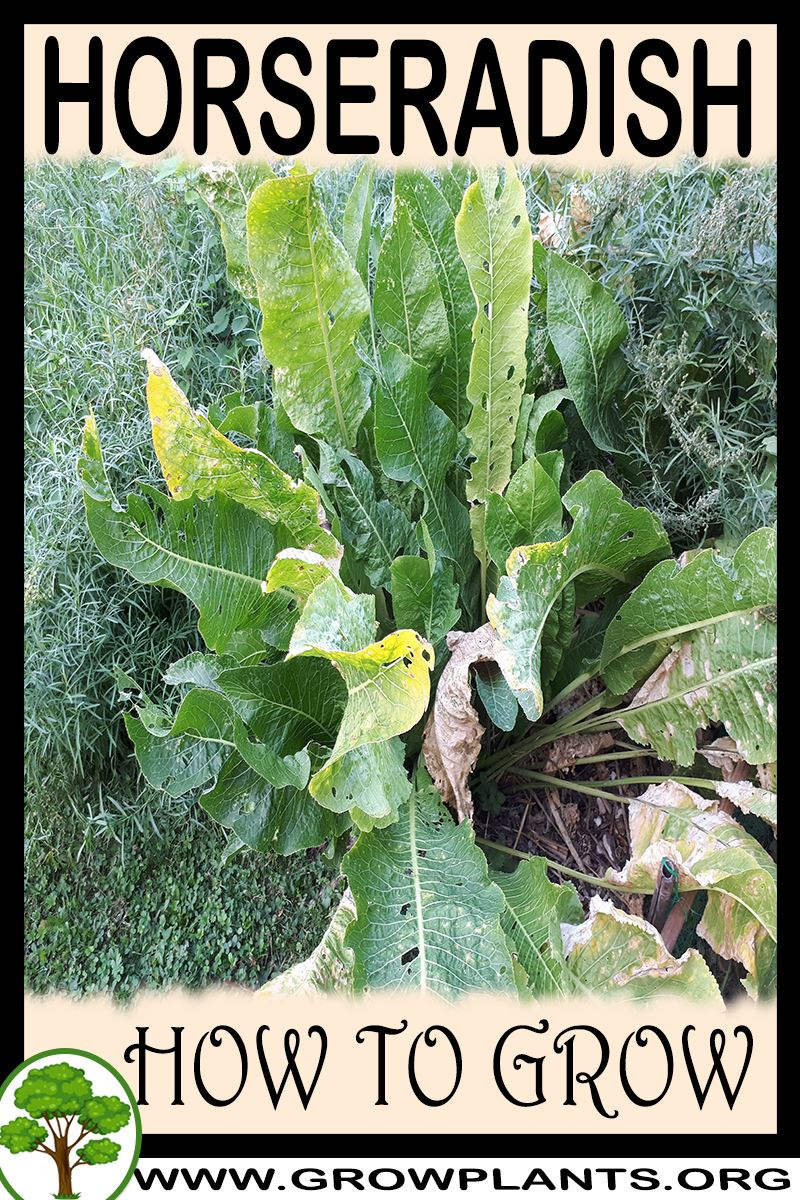
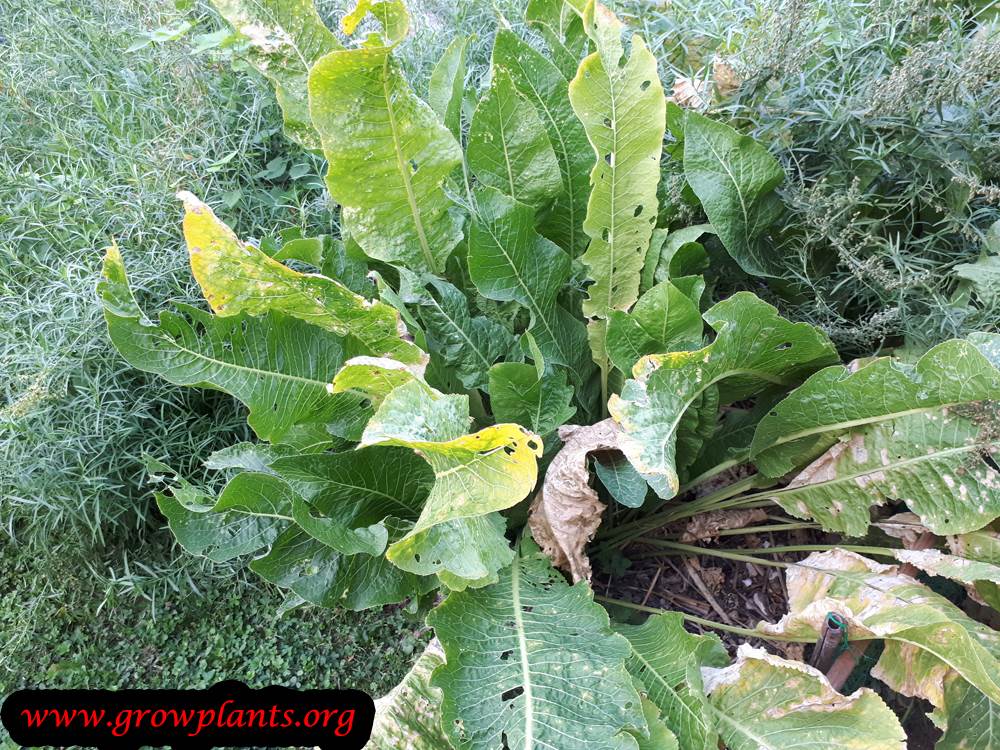
Overview: Horseradish (Armoracia rusticana) is a hardy, herbaceous perennial reaching about 0.8-1.5 m (32-60 in) tall, grown mainly for its large, pungent white taproot and its edible young leaves. It is a vigorous culinary root crop and herb that spreads readily, so it is best given its own space.
Quick Specifications
| Specification | Attribute |
|---|---|
| Plant Type / Life Cycle | Perennial (herbaceous) |
| Foliage Type | Herbaceous (dies back in cold winters, evergreen in mild climates) |
| Mature Size | 0.8-1.5 m (32-60 in) tall |
| Growth Rate | Moderate |
| Root System | Taproot – thick, elongated white-fleshed root (the edible part); spreads from root fragments |
| Toxicity | Non-toxic / edible for humans (root and young leaves are culinary); the pungent mustard oils can irritate skin and eyes |
| Hardiness | USDA 3-11 |
Growth Form & Structure
- Height & Spread: A clump of large leaves 0.8-1.5 m (32-60 in) tall rising from a deep root; can also be grown in a large, deep container.
- Growth Habit & Form: Clump-forming herbaceous perennial with a rosette of big, coarse basal leaves above a stout taproot.
- Lifespan & Maturity: Long-lived perennial; roots are ready to lift roughly one year after planting.
Anatomy & Physical Features
- Leaves & Foliage: Large, ovate to oblong green leaves 10-30+ cm long, edible with a spicy flavour.
- Flower Characteristics: Small white flowers on an erect, branched inflorescence in summer; plants rarely set viable seed.
Primary Uses & Landscape Value
- Edible Uses: The grated root is the classic pungent condiment and sauce ingredient; young leaves can be eaten in salads or used as a spread.
- Functional & Ornamental Roles: Primarily a culinary herb and root crop; vigorous and allelopathic, so best confined to its own bed or a large container.
Care Guide: Planting, Soil & Watering
Overview: Horseradish is a vigorous, hardy perennial root crop that grows best in full sun with a little winter chill, in deep, loose, rich soil. It needs steady, even moisture to swell long, straight roots, yet the ground must still drain freely.
Quick Care Requirements
| Requirement | Ideal Condition |
|---|---|
| Planting Season | Spring or autumn, in cool weather |
| Growth Rate | Moderate |
| Soil Type | Deep, loose, rich loam with steady moisture and good drainage |
| Water Need | Moderate — keep the soil evenly moist for good root development |
Planting & Establishment
- Best Planting Season: Plant in spring or autumn while the weather is cool, usually from a root cutting or crown. Give it a dedicated bed or a large container: the roots spread aggressively and are allelopathic, and a spot can stay hard to replant for about a year after the plant is removed.
- How to Plant:
- Hole Preparation: Loosen the soil deeply (30 cm or more) so roots can drive straight down; set root cuttings with the crown just below the surface.
- Soil Amendments: Dig in plenty of compost or well-rotted organic matter before planting to enrich and lighten the soil.
- Planting Depth: Set the crown at or just below soil level — do not bury it deeply.
- Growth Speed & Expectations: Moderate — it makes a large leafy clump about 0.8-1.5 m, 32-60 inches across the season, with roots ready to lift after roughly a year.
Soil, Watering & Drainage Care
- Soil Mix & Drainage Needs: Deep, loose, fertile loam is ideal; stony or compacted ground gives forked, stunted roots. Keep the soil moisture-retentive but free-draining so the roots never sit waterlogged.
- Watering Schedule & Technique:
- Young / Newly Planted: Keep the soil evenly moist after planting so the crown establishes and roots begin to run.
- Established: Water regularly and deeply through the growing season; consistent moisture produces plump, straight roots.
- Seasonal Adjustments: Water more in summer heat; ease back in cool, wet weather and over the dormant winter period.
Climate, Light & Hardiness
Horseradish is a tough, long-lived herbaceous perennial grown for its pungent root in temperate, Mediterranean and subtropical climates, in full sun. It is very cold-hardy - the leaves die back in winter while the roots survive hard freezes underground - and a little winter chill suits it.
Quick Climate Specifications
| Climate Zones | Temperate, Mediterranean and subtropical |
| USDA Hardiness Zones | Approx. 3–10 |
| Optimal Temp Range | approximately 15–24 °C (59–75 °F) |
| Cold Damage Begins | foliage cut back by frost around −3 to −5 °C (27 to 23 °F); a normal die-back |
| Approx. Survival Minimum | dormant roots survive to about −34 °C (−29 °F) (zone 3) |
| Frost Tolerance | High |
| Light Conditions | Full Sun |
| Wind Tolerance | Moderate to High |
Sunlight & Light Exposure
Optimal Light Setup
Full sun drives the vigorous top growth that feeds the roots; the facts list full sun as optimal.
Shade & Heat Management
It needs no heat protection in most of its range; deep shade simply weakens the plant and reduces root quality, so an open position is best.
Best Exposure & Orientation
An open, sunny, deeply worked bed - ideally in its own space, since it spreads and is allelopathic to neighbours - suits it best.
Temperature Extremes & Hardiness
USDA Hardiness & Regional Limits
The site lists USDA 3–10, and horseradish is genuinely among the hardiest root crops: the top dies down each winter and the deep, fleshy roots overwinter through hard freezes, reshooting reliably in spring. A cool winter dormancy actually improves the plant; its limit is more the warm, frost-free end of the range than winter cold.
Cold Damage & Winter Protection
Autumn frosts around −3 to −5 °C (27 to 23 °F) knock the leaves down as a normal seasonal die-back, and the dormant roots then tolerate severe soil freezing to around −34 °C (−29 °F) at the cold end of the range. Little winter protection is needed beyond the soil itself.
Frost Sensitivity
Very low at the root: only tender new spring foliage can be nipped by a late frost, and the plant regrows readily.
Extreme Heat Tolerance
It tolerates warm summers but performs best where it gets a genuine cool dormant season; in hot, frost-free climates growth can be weaker and roots milder, so the warm end of the range is the practical limit.
Wind, Humidity & Microclimate
Wind Tolerance
The large, coarse leaves (0.8–1.5 m / 32–60 in) are sturdy and take wind well, though very exposed sites can tatter the foliage.
Rainfall & Seasonal Moisture
Adapted to temperate conditions with a moist growing season and a cool, drier winter dormancy; it is not fussy but resents a waterlogged root zone. This is a climate-adaptation note, separate from routine irrigation.
Microclimate Recommendations
An open, sunny site with a distinct cool season gives the strongest, most pungent roots; a confined bed keeps its spreading, allelopathic roots from overrunning neighbours.
Growing in Pots, Balconies & Indoors
Horseradish actually grows best in a large, deep pot – a container is the ideal way to grow it, because it keeps the vigorous, spreading roots from taking over a bed. It is not an indoor houseplant, though: it is a big, hardy perennial that wants full sun outdoors.
Quick Details
- Container Size: A large, deep pot (30 cm / 12 in or more each way) for a big perennial and its long taproot
- Indoor Suitability: Not a houseplant; too large and light-hungry for a room
- Best Spot: full sun – an open, sunny balcony or patio
- Soil & Drainage: Deep, loose, stone-free mix; free-draining for a long straight root
- Watering in Pots: Keep evenly moist through growth – pots dry fast, and a heavy plant in a large pot drinks a lot
Indoors & On the Windowsill
- Houseplant limits: Not a houseplant; a plant reaching 0.8-1.5 m needs full outdoor light and simply gets too big and leggy in a room.
- Windowsill use: A sill is no more than a place to start a root cutting before it goes into its pot outside.
- Overwintering: Fully hardy – the top dies back and the root rests through winter in the pot; the cold does it no harm.
On a Balcony or Patio
- Light & wind: Full sun and a sturdy, heavy pot for the tall leaves; the container also stops the invasive roots escaping into other plantings.
- Practicalities: A big, heavy plant – place it where the weight and drainage runoff are not a problem, and where you can lift it to harvest.
Choosing the Pot, Soil & Long-Term Care
- Pot & drainage: A large, deep pot (30 cm+) with strong drainage holes; no standing-water saucer. The pot’s main job is containing the spreading root.
- Potting mix: A deep, loose, stone-free organic mix so the root runs long and straight.
- Feeding: A balanced liquid feed through the growing season; do not overfeed with nitrogen or you get all leaf.
- Long term: A perennial grown for its root – lift, harvest and divide it, replanting a root cutting into fresh mix every year or two.
Fertilizing & Feeding
A moderate feeder: a balanced start with steady moisture, easing toward potassium as the root swells and stopping before harvest, gives the best-quality roots. A fertilizer formulated for tomatoes and vegetables supports that feeding pattern through harvest.
Quick Fertilizing Specs
| Feeding Level | Moderate |
|---|---|
| Main Nutrient Priority | Balanced at the start, easing toward potassium as the root bulks, with nitrogen kept moderate. |
| Best Feeding Period | During the cool-season active growing period. |
| Organic Options | Compost or well-rotted manure worked in ahead of planting, plus diluted liquid feeds during growth. |
| Micronutrients | Usually supplied by fertile soil; boron shortfalls can cause internal browning of the root in sandy or high-pH ground. |
| Soil pH | Near neutral; tolerates a wide range. |
| Reduce/Stop Feeding | Ease off through late season and stop feeding as the plant heads into winter dormancy. |
Feeding by Growth Stage
Establishment after sowing
Settle young plants in and build early roots and leaves in loose soil.
| Nutrient direction | A balanced complete fertilizer worked into loose, well-drained soil before sowing. |
|---|---|
| Timing | From sowing until seedlings are actively growing. |
| Frequency | Light feeding worked into the bed is usually enough at planting. |
| Fertilizer types | Balanced complete garden fertilizer, Well-rotted compost worked into the bed |
| Precautions | Avoid fresh manure and clumps of concentrated fertilizer, which can cause forked or hairy roots; keep the root zone loose and stone-free. |
Leaf-canopy growth
Grow enough leaf to power root development, without running to excess foliage.
| Nutrient direction | A modest nitrogen-forward feed to build the leaf canopy early on. |
|---|---|
| Timing | During early leaf growth before the root begins to swell. |
| Frequency | A light feeding during early leaf growth. |
| Fertilizer types | Nitrogen-forward complete fertilizer, Diluted liquid feed |
| Precautions | Keep nitrogen moderate – too much drives leafy tops at the expense of the root. |
Root bulking and development
Support root swelling, firmness and eating quality.
| Nutrient direction | Shift toward potassium with lower nitrogen as the root begins to swell. |
|---|---|
| Timing | As the root starts to enlarge through to near-maturity. |
| Frequency | A light potassium-leaning feed as roots bulk up. |
| Fertilizer types | Potassium-leaning complete fertilizer, A potassium source such as wood ash used sparingly |
| Precautions | Avoid a late flush of nitrogen, which delays maturity and can hurt flavor and storage. |
Winter dormancy
Let the perennial root rest over winter before regrowth.
| Nutrient direction | None – withhold fertilizer while the plant is dormant. |
|---|---|
| Timing | After top growth dies back in autumn until new growth resumes in spring. |
| Frequency | No feeding at this stage. |
| Fertilizer types | No feeding at this stage – the dormant root needs no fertilizer until active growth resumes. |
| Precautions | Do not fertilize the dormant crown; feed again once spring growth resumes. |
Nutrient Deficiency Signs & Corrections
Older leaves turn pale and yellow, tops stay small and weak, and root growth is slow.
| Possible causes | Low soil nitrogen or nitrogen leached by heavy watering or rain, Cold or waterlogged soil limiting uptake, Poor, low-organic-matter soil |
|---|---|
| Appears first on | Older, lower leaves |
| What to check | Recent heavy rain or irrigation, Soil organic matter and fertility, Soil temperature and drainage |
| Possible correction | Apply a modest nitrogen-forward feed early in growth and keep the soil evenly moist; avoid overdoing nitrogen once the root is bulking. |
Scorched, browning margins on older leaves with weak, poorly-filled roots.
| Possible causes | Low soil potassium, Sandy soil low in nutrients, Drought stress limiting potassium uptake |
|---|---|
| Appears first on | Margins of older leaves |
| What to check | Soil test for potassium, Watering consistency during bulking, Soil type and organic matter |
| Possible correction | Use a complete fertilizer that includes potassium as the root bulks, and keep watering consistent. |
Internal browning, hollow or corky spots inside the root, sometimes with cracked skin.
| Possible causes | Low soil boron, often in sandy or high-pH soils, Dry soil limiting boron movement to the root, Over-liming raising soil pH |
|---|---|
| Appears first on | Inside the developing root |
| What to check | Soil test for boron before adding any, Soil moisture consistency during bulking, Recent liming or high pH |
| Possible correction | Only if a soil test confirms low boron, apply a boron product very carefully per its label – the margin between enough and too much is narrow; otherwise correct moisture and pH. |
Pruning, Training & Seasonal Maintenance
Horseradish (Armoracia rusticana) is a vigorous, spreading perennial grown for its pungent taproot, and its note is clear: ‘no need to prune — can cut old and dead leaves.’ It is never structurally pruned, but three deliberate cutting jobs shape a good crop: removing the flower stalk so energy stays in the root, rubbing off the side crowns and lateral roots so the plant makes one straight root instead of a fork, and cutting away old leaves. Because horseradish is invasive and allelopathic — any root fragment regrows and it suppresses neighbours — containing and lifting it is as much about control as harvest.
Quick Pruning & Maintenance Specs
| Pruning Tolerance | Not a pruned plant — but extremely tolerant of lifting, cutting and division; regrows from fragments |
| Primary Maintenance | Removing the flower stalk; rubbing off side shoots / lateral roots for a straight main root |
| Secondary Maintenance | Cutting old and dead leaves; containing spreading roots |
| Typical Frequency | Annual lift-and-replant of root sets; ongoing flower-stalk and old-leaf removal |
| Main Objective | A large, straight, single root — and keeping the plant from spreading |
| Young Plant Priority | Let the set establish one season; remove flower stalk |
| Mature Plant Priority | Lift and divide annually for best roots; remove flowers and side crowns |
| Best Tool Type | Snips for stalks/leaves; a knife for de-eyeing sets; a spade for lifting |
Pruning by Plant Age & Size
Newly Established (First-Year Set)
A horseradish plant is usually started from a root set (a ‘thong’). In its first season let it establish leaves and root; remove any flower stalk. Do not expect to shape the root much in year one — the technique work comes when you lift it.
Young / Formative
The ‘training’ here is done on the root, not the top. For one clean straight root rather than a forked mass, expose the upper root in mid-season and rub off the small side shoots and lateral roots, leaving only the crown and the leading root — the traditional way to grow a market-quality stick.
Mature / Established
Lift the main root in autumn after the leaves die back. Cut old and dead foliage away, remove the flower stalk whenever it appears, and replant a straight side thong to grow on. Left un-lifted, horseradish makes a congested, forked, ever-spreading clump.
Seasonal Pruning Schedule
Spring–Summer Growth
Remove the flower stalk as it rises — flowering and seeding divert energy from the root you are growing. Cut away any tatty old leaves. Mid-season is also when you can ‘dress’ the root by rubbing off side shoots for a straight stick.
Autumn Harvest & Dieback
As the large leaves die down, cut them off and lift the root. This is the main crop and, effectively, the renewal: you replant a set and remove the rest, which also stops the plant colonising further.
Ongoing Containment
Because every root fragment can resprout, remove stray shoots appearing away from the crown, and lift and clean up broken root pieces so the plant does not run through the bed.
Structural Pruning & Training
No top structure to train. The equivalent operation is root dressing: rubbing off side crowns and lateral roots on the growing plant so it forms a single straight root instead of a branched, forked one. This is the closest thing horseradish has to ‘formative pruning,’ and it happens below ground.
Special Growth to Remove
- Flower stalk — remove to keep energy in the root.
- Side shoots and lateral roots — rub off in mid-season for one straight main root.
- Old and dead leaves — cut away (its own note).
- Stray/escaping roots and shoots — remove to contain this invasive spreader.
Container & Small-Space Pruning
Growing horseradish in a large, deep container or a buried bottomless bucket is the standard way to contain its invasive roots — the ‘pruning’ benefit of a pot is that it stops the plant escaping. In a container, lift and replant a single set annually and discard the rest so it does not become a root-bound tangle.
Tools
Precision snips or secateurs for flower stalks and leaves; a clean knife for de-eyeing/dressing sets and rubbing off side roots; a spade or fork for lifting and dividing. No saw, loppers or shears apply.
Tool Hygiene & Disease Risk
Routine — horseradish is famously tough and little troubled by disease. Use a clean knife when cutting sets and dressing roots so cut surfaces heal rather than rot, and clean tools after handling it because even small root scraps can grow where they fall.
Cut Placement & Technique
Cut flower stalks and old leaves at the base. When preparing a set, keep the top and bottom oriented correctly and cut the crown end square and the lower end slanted (the grower’s convention) so you replant it right way up. Rub or cut off side shoots cleanly against the main root for a straight stick.
Heavy Pruning & Rejuvenation
Rejuvenation is by annual lift-and-divide, not by cutting the top back. Horseradish is effectively renewed every year: lift the clump, take a straight thong to replant and remove the rest. It regrows explosively from any piece left behind, so ‘heavy pruning’ here means digging out and controlling, not renovating a framework.
Post-Pruning Care
After removing flower stalks or dressing roots, simply keep the plant watered — it needs no coddling. After lifting and replanting a set, water it in; growth resumes vigorously with no feeding needed. Stay alert for regrowth from any fragments you missed.
When NOT to Prune
Avoid chopping the roots up carelessly in the bed — every fragment becomes a new plant, so ‘pruning’ the roots without lifting them just multiplies the problem. Do not remove all foliage from a plant you intend to keep growing that season; leave enough leaf to feed the root until harvest.
Recommended Tools (by task)
- bypass_secateurs — cutting flower stalks and old leaves cleanly.
- grafting_knife — a clean sharp knife to dress sets and rub off side roots for a straight main root.
- garden_spade — lifting, dividing and containing the vigorous root system.
Pruning Troubleshooting
| Problem | Possible Cause | What to Check | Corrective Action |
| Forked, branched, unusable roots | Side shoots and lateral roots never removed | Whether the root was dressed mid-season | Rub off side shoots on the growing plant next year; start from a single straight thong |
| Lots of leaf, small root | Flowering left on and/or plant never lifted; over-rich nitrogen | Flower stalks present; how long since division | Remove flower stalks; lift and replant single sets annually; ease off high-nitrogen feeding |
| Horseradish spreading through the bed | Root fragments left after cutting/lifting | Stray shoots away from the crown | Grow in a contained bed/container; lift carefully and remove every fragment |
Propagation Guide
Horseradish is grown almost entirely from root cuttings (sets or ‘thongs’): a pencil-thick section of root planted in spring establishes quickly and reproduces the parent exactly. It rarely sets viable seed, so seed is not a practical route — overall an Easy plant to propagate, so easy in fact that left-behind root pieces regrow readily.
Quick Propagation Specs
| Best Propagation Method | Root cuttings (sets / ‘thongs’) |
| Alternative Methods | Crown division |
| Propagation Difficulty | Easy |
| Seed True-to-Type | Not applicable in practice — horseradish rarely sets viable seed |
| Vegetative True-to-Type | Yes — root cuttings and divisions reproduce the parent |
| Best Propagation Season | Spring (root cuttings and division); autumn also possible |
Growing from Seed
Horseradish rarely produces viable seed, so seed is not a dependable method; vegetative root sets are the standard way to increase it.
Leaf & Root Cuttings
Root cuttings (‘thongs’) are the normal method and give true-to-type plants.
- Cut pencil-thick side roots into sections about 15–30 cm (6–12 in) long.
- Keep polarity clear — a straight cut at the top (crown end) and a slanting cut at the lower end — so the set is planted the right way up.
- Plant sets in spring, slightly angled, with the top a few centimetres below the surface.
Division, Offsets, Pups & Suckers
A crown can simply be lifted and divided in spring; each piece needs a bud or crown section and some root to grow away.
Bloom & Edible Flower Guide
Quick Details
- Bloom Season: Summer
- Time to First Bloom: Once established – as a perennial it may flower in summer from its second year on, though it blooms sparsely and rarely sets viable seed
- Flower Appearance: Many small four-petalled white flowers massed on tall branching stems (racemes)
- Edibility: Edible – the flowers are edible with a mild, faintly pungent note, though horseradish is grown chiefly for its fiery root
Detailed Blooming Overview
Horseradish is a vigorous perennial grown for its pungent root. Once established it can throw up tall, airy stems of small white cruciform flowers in summer, but it flowers only sparsely and seldom produces viable seed, spreading instead from its roots. The blooms are a modest bonus for pollinators.
Flower Characteristics
- Many small four-petalled (cruciform) white flowers on tall branching racemes.
- Rarely sets viable seed; the plant spreads mainly from root pieces.
Bloom Care & Thinning
- Managing the bloom: Many growers cut off the flowering stems so the plant’s energy goes into the root; leave them only if you want the blooms for pollinators.
- Pollination: Visited by bees and butterflies.
Bloom Health & Protection
- Aphids: Aphids often cluster on flowering shoots and buds; a strong jet of water, insecticidal soap or neem oil keeps them in check.
- Cabbage white caterpillars: These can graze buds and open flowers – a Bacillus thuringiensis (Bt) spray is a targeted, low-impact option.
Fruit & Uses
The pungent white taproot is horseradish’s main edible part, grated into a sharp condiment, while the young leaves are also edible. The root is prepared (peeled and grated) rather than eaten whole; young leaves can be eaten raw and older leaves are cooked.
Quick Edible Specs
| Edible Parts | Root (taproot) and leaves |
|---|---|
| Main Use(s) | Culinary – grated root as a hot condiment/relish; leaves in salad or as a spread |
| Eaten Raw or Cooked | Root grated raw as a condiment; young leaves raw, mature leaves cooked |
| Preparation Required | Peel and grate the root – the sharp pungency develops after grating |
| Harvest Season | Leaves all year; root lifted about a year after planting |
| Time to First Harvest | Root roughly one year from planting (see care notes) |
| Safety/Toxicity Caveat | Very pungent — grating releases sharp, eye-watering volatile compounds; use in small amounts |
Roots & Tubers
The edible root is an elongated white-brown taproot with a strongly spicy taste. It is usually ready to lift about a year after planting and can be pulled through the year. Peel and grate the fresh root; the characteristic heat develops once it is cut or grated. On the site it is noted for salad use, but its typical role is as a grated condiment or relish rather than eaten in pieces.
Leaves & Greens
The leaves are edible and spicy, ovate to pinnatisect with an oval tip and green colour. Harvest by trimming leaves at the base next to the stem: take young leaves for salad and mature leaves for cooking. It is best not to strip the leaves before the root is lifted, so the plant can keep feeding the root. Leaf uses recorded on the site are salad and as a spread.
Preparation, Uses & Safety
Peel and grate the root just before use; its heat comes from volatile mustard-oil compounds released on grating, so work in a ventilated spot and use small quantities. Young leaves can go into salads raw and older leaves are better cooked. The plant is strongly pungent rather than toxic, but the concentrated grated root is intense — add to taste.
Pests, Diseases & Troubleshooting
Overview: Horseradish is a vigorous, iron-hardy member of the cabbage family (Brassicaceae) that shrugs off most trouble, but it shares the classic brassica pests – chewing flea beetles that pepper the leaves and cabbage-white caterpillars that shred them. Below ground, root-knot nematodes and clubroot can distort the prized root, while brassica diseases such as white rust and leaf spot mark the foliage. Most leaf damage is cosmetic on so tough a plant; protect it with brassica hygiene, crop rotation and vigour.
Quick Troubleshooting Overview
| Issue / Pest | Main Symptom | Primary Solution |
|---|---|---|
| Flea beetles | Tiny round shot-holes peppering the leaves | Row cover; keep plants vigorous and watered |
| Cabbage caterpillars | Ragged holes, green droppings, chewed leaves | Hand-pick; spray Bt (Bacillus thuringiensis) |
| Aphids | Curled, sticky leaves; grey-green clusters | Water blast; insecticidal soap |
| Root-knot nematode | Galled, forked, knobbly roots; stunting | Rotate crops; grow in clean soil |
| White rust | White blister-like pustules under leaves | Remove affected leaves; improve airflow |
| Clubroot | Swollen, distorted roots; wilting in heat | Lime the soil; long rotation |
Common Pests & Management
- Flea beetles (Phyllotreta spp.):
- Symptoms: Tiny black (sometimes striped) beetles that jump when disturbed and chew countless small round “shot-holes” in the leaves, worst on young plants in warm, dry weather. Established horseradish tolerates a lot of this damage.
- Prevention & Control: Float a fine insect-mesh row cover over young plants; keep them growing fast with steady moisture so they outgrow the damage. A grit or straw mulch, sticky traps and yellow cards help; diatomaceous earth or spinosad can be used for severe attacks.
- Cabbage white caterpillars & loopers (Pieris rapae / Trichoplusia ni):
- Symptoms: Velvety green caterpillars that chew ragged holes and leave dark-green frass; imported cabbageworm blends with the leaf, while cabbage loopers arch as they crawl. Look under leaves for eggs and young larvae.
- Prevention & Control: Inspect and hand-pick regularly, squash egg clusters, and cover plants with insect mesh to block the egg-laying butterflies and moths. The organic bacterium Bt (Bacillus thuringiensis) or spinosad gives selective control that spares beneficials.
- Cabbage & green peach aphids (Brevicoryne brassicae / Myzus persicae):
- Symptoms: Dense grey-waxy or green colonies on shoot tips and leaf undersides, curling and puckering the foliage, coating it in sticky honeydew and sooty mould; they can also spread viruses.
- Prevention & Control: Blast off with water, squash small colonies and support ladybirds, lacewings and parasitic wasps. Insecticidal soap or neem oil clears heavier infestations – spray thoroughly under the leaves in the cool of the evening.
- Root-knot nematode (Meloidogyne spp.):
- Symptoms: Microscopic soil roundworms that gall and fork the roots, causing knobbly swellings, stunted top growth, wilting in heat and a distorted, unmarketable main root – the chief below-ground pest of horseradish.
- Prevention & Control: Rotate away from brassicas and other hosts, grow in clean, well-drained soil rich in organic matter, and plant marigolds or a biofumigant mustard as a break crop. Do not replant horseradish into infested ground; solarise badly affected beds.
- Diamondback moth (Plutella xylostella):
- Symptoms: Small, slender green caterpillars that graze the leaf underside leaving thin “windowpane” patches and small holes; they wriggle vigorously and drop on silk threads when disturbed.
- Prevention & Control: Use insect mesh, encourage parasitic wasps, and rotate brassicas. Bt or spinosad controls larvae; rotate active ingredients as this pest resists chemicals readily.
Diseases & Fungal Issues
- White rust (white blister) (Albugo candida):
- Symptoms: Shiny, white, blister-like pustules erupting mostly on the undersides of leaves and on stems, sometimes with distortion and swelling of infected tissue; favoured by cool, wet, humid conditions.
- Treatment & Management: Remove and destroy infected leaves, space plants for airflow, and avoid overhead watering and dense weedy growth. Rotate brassicas; a copper-based fungicide can protect plants under high disease pressure.
- Cercospora / Ramularia leaf spot (Cercospora armoraciae / Ramularia armoraciae):
- Symptoms: Numerous small brown to greyish angular or round leaf spots, sometimes with a pale centre and darker margin; heavy spotting yellows and kills older leaves in warm, wet weather.
- Treatment & Management: Clear fallen infected leaves, water at the base early in the day, and rotate. Improve spacing for airflow; copper fungicide gives protection where spotting is severe, but the crop usually tolerates it.
- Verticillium wilt (Verticillium dahliae):
- Symptoms: A soil-borne vascular disease causing yellowing and wilting of lower leaves, often one-sided, with brown streaking in the root and stem vascular tissue and gradual decline.
- Treatment & Management: There is no cure once infected – remove and destroy affected plants and practise long rotations out of susceptible crops. Plant into clean soil, keep plants vigorous, and avoid moving infested soil around the garden.
- Clubroot (Plasmodiophora brassicae):
- Symptoms: The key brassica-family root disease: roots become grossly swollen, distorted and club-shaped, plants wilt in the heat of the day, growth stunts and the root is ruined. The pathogen persists in soil for many years and thrives in acidic, wet ground.
- Treatment & Management: Rotate brassicas on the longest cycle possible, raise soil pH toward neutral with lime, and improve drainage. Never move infested soil or plants; remove and destroy affected roots rather than composting them.
Growing Difficulties & Abiotic Problems
- Forked, hairy or misshapen roots:
- Cause & Symptoms: Heavy, stony or compacted soil, root disturbance and dry-then-wet swings cause the main root to fork, twist and grow whiskery side-roots, reducing quality.
- Correction Strategy: Grow in deep, loose, stone-free, well-worked soil with steady moisture; a raised bed or deep loosened trench gives long, straight roots. Avoid disturbing the crop mid-season.
- Invasive spread from root fragments:
- Cause & Symptoms: Horseradish regrows vigorously from the smallest piece of left-behind root, quickly colonising a bed and popping up where unwanted.
- Correction Strategy: Grow it in a dedicated bed, a bottomless container or a buried barrier, and lift as much root as possible at harvest. Deal with strays promptly before they establish.
- Bolting and bitter, tough roots:
- Cause & Symptoms: Heat, age and stress push plants to flower (bolt), and over-mature or drought-stressed roots turn woody, fibrous and harshly bitter.
- Correction Strategy: Keep plants evenly watered, harvest roots at the right stage (after the tops die back), and remove flower stalks to keep energy in the root. Grow as an annual replant for the best-quality roots.
- Leaf scorch and nutrient stress:
- Cause & Symptoms: In poor, dry soil the big leaves can scorch at the margins and yellow; excess nitrogen instead gives lush leaves but poor, mild roots.
- Correction Strategy: Grow in fertile but not over-rich soil with balanced feeding and steady moisture; mulch to buffer moisture and keep the large leaves working.
What Helps – Products & Tools
Lean on cultural tools first: insect-mesh row cover, hand-picking and crop rotation. For pests, Bt or spinosad handles caterpillars, insecticidal soap or neem oil handles aphids, and diatomaceous earth or spinosad checks flea beetles. Diseases are managed with sanitation, rotation and liming for clubroot, with copper fungicide held in reserve for white rust and leaf spot. Key tools: fine insect netting, sticky traps and a deep, loose, stone-free bed.