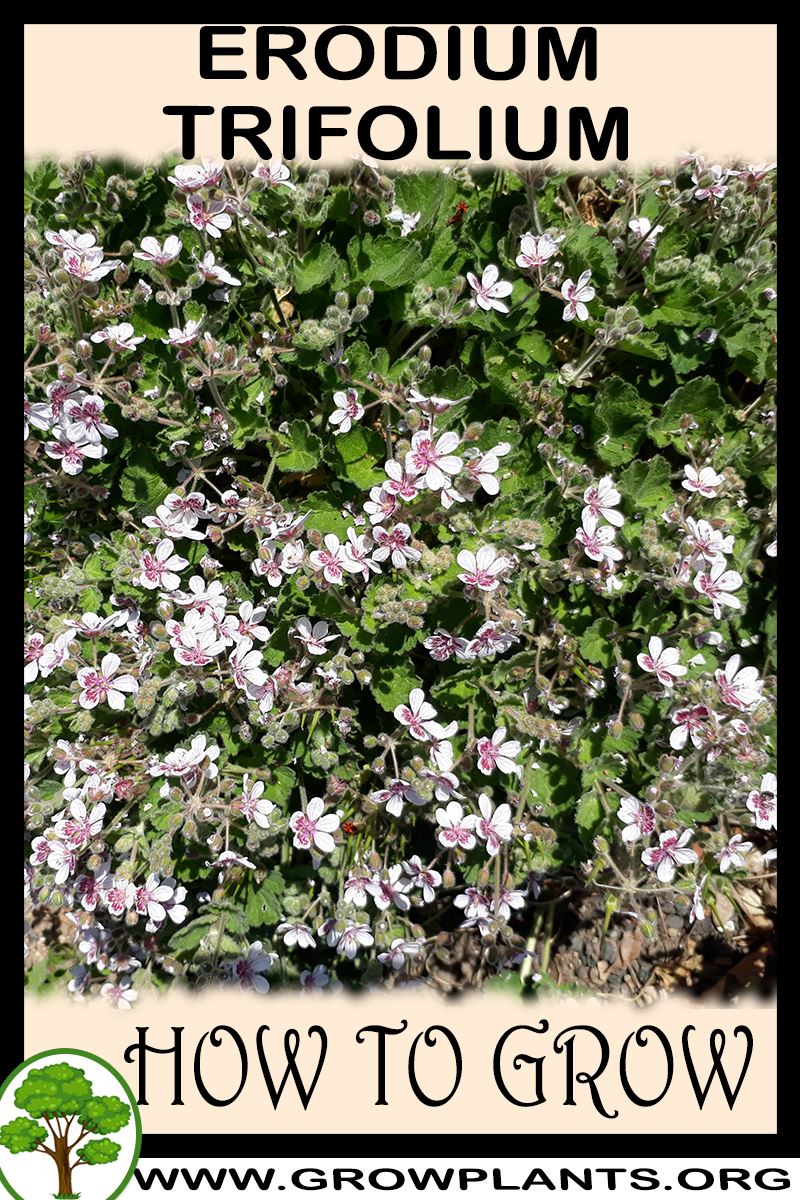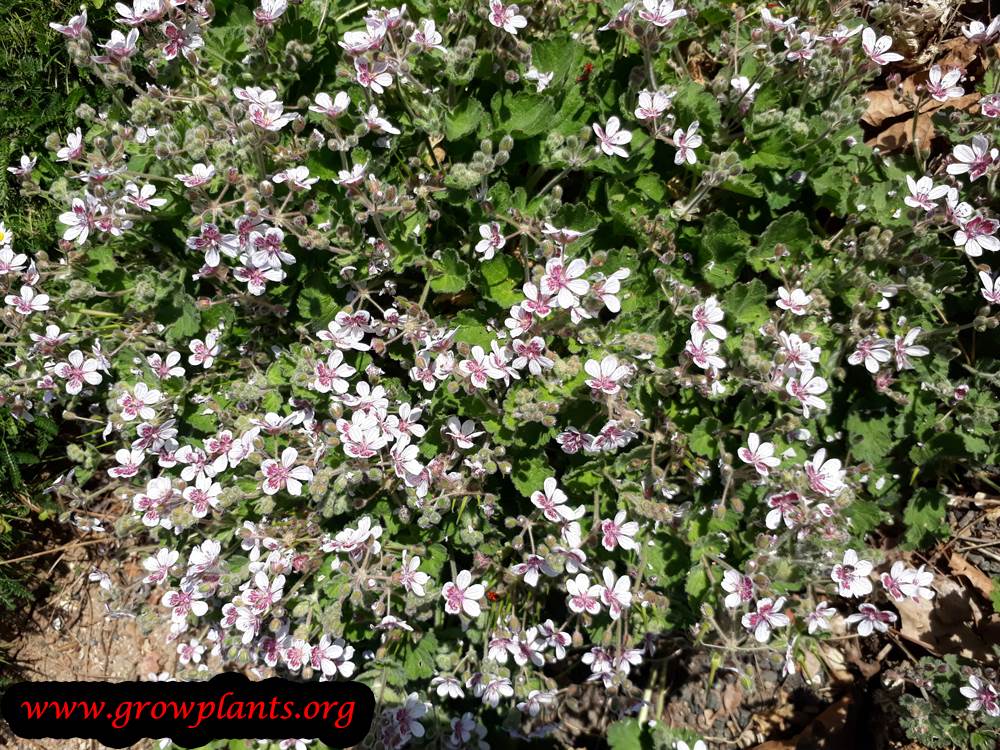
Plant Profile & Key Characteristics
Overview: A low storksbill reaching 10-60 cm, grown as a perennial (deciduous) or an annual, with lobed spoon-shaped green leaves in threes. It is grown as a drought-tolerant ornamental prized for white-to-pink flowers marked with dark blotches.
Quick Specifications
| Specification | Attribute |
|---|---|
| Plant Type / Life Cycle | Perennial (deciduous); grown as an annual in colder zones |
| Foliage Type | Deciduous |
| Mature Size | 10-60 cm (4-24 in) tall and wide |
| Growth Rate | Moderate to fast |
| Hardiness | USDA zones 7-11 as a perennial (4-7 grown as an annual) |
Growth Form & Structure
- Height & Spread: A low clump 10-60 cm (4-24 in) high and wide; suited to rockeries, edging and containers.
- Growth Habit & Form: Herbaceous mound-forming groundcover from a basal rosette.
- Lifespan & Maturity: Short-lived perennial, quick to reach flowering size.
Anatomy & Physical Features
- Leaves & Foliage: Green spoon-shaped, lobed leaves, borne in groups of three.
- Flower Characteristics: White-to-pink flat five-petalled flowers with a dark pink centre, borne in clusters from spring through autumn.
Primary Uses & Landscape Value
- Functional & Ornamental Roles: Drought-tolerant ornamental groundcover for rock gardens, edging and containers.
Care Guide: Planting, Soil & Watering
Overview: Erodium trifolium is a low, drought-tolerant perennial (or annual in colder zones) that grows best in full sun to light shade with sharp drainage. It wants gritty, well-drained soil and only light to moderate water.
Quick Care Requirements
| Requirement | Ideal Condition |
|---|---|
| Planting Season | Warm season, spring through autumn |
| Growth Rate | Moderate to Fast |
| Soil Type | Light, gritty, sharply well-drained |
| Water Need | Low to Moderate (dry between waterings) |
Planting & Establishment
- Best Planting Season: Plant in the warm growing season, spring through autumn, once hard frost has passed.
- How to Plant:
- Hole Preparation: Dig a hole about as wide as, and no deeper than, the root ball so the crown sits at soil level.
- Soil Amendments: Mix in coarse grit or sand to improve drainage; it resents heavy, waterlogged soil.
- Planting Depth: Set the root collar level with the surrounding soil – keep the crown at the surface to prevent rot.
- Growth Speed & Expectations: Forms a low mound at a moderate to fast pace in its first seasons.
Soil, Watering & Drainage Care
- Soil Mix & Drainage Needs: Needs a sharply draining, gritty mix in the ground or in pots; add sand or gravel and ensure drainage holes.
- Watering Schedule & Technique:
- Young / Newly Planted: Water regularly to settle the roots, keeping soil lightly moist but never soggy.
- Established: Once established, water sparingly and deeply, letting the top few cm dry fully between waterings.
- Seasonal Adjustments: Reduce watering in winter and cool spells; water a little more in summer heat.
Climate, Light & Hardiness
This storksbill behaves as a true perennial in mild-winter climates and as a cold-tolerant annual further north, growing well across a wide span of temperate, Mediterranean, and subtropical conditions. It prefers full sun to half shade and free-draining soil.
Quick Climate Specifications
| Climate Zones | Temperate, Mediterranean, Subtropical |
|---|---|
| USDA Hardiness Zones | 7–11 (perennial); 4–7 (grown as annual) |
| Frost Tolerance | Moderate |
| Light Conditions | Full Sun to Half Shade |
Sunlight & Light Exposure
Optimal Light Setup
Full sun gives the most compact form and best bloom; half shade is tolerated.
Temperature Extremes & Hardiness
USDA Hardiness & Regional Limits
Persists as a perennial in USDA zones 7–11, where winters stay mild enough for the crown to survive between seasons. In colder zones 4–7, winter freezes typically kill the plant outright, so it is instead treated as a cold-tolerant annual there.
Wind, Humidity & Microclimate
Rainfall & Seasonal Moisture
Best suited to climates with a dry season; avoid continuously wet soil.
Growing in Pots, Balconies & Indoors
Erodium trifolium is a low, sun-loving storksbill. The grower confirms it is not a houseplant but grows well in containers, so grow it on a bright sill or a sunny patio.
Quick Details
- Container Size: 5-10 L – a compact 10-60 cm plant
- Indoor Suitability: Not a houseplant; a compact plant can grow on a bright, sunny windowsill
- Best Spot: Full sun with a little shade tolerance
- Soil & Drainage: Free-draining, gritty potting mix – it hates wet feet
- Watering in Pots: Water moderately, letting the surface dry between waterings
Indoors & On the Windowsill
- Not a houseplant: The grower marks it as unsuitable indoors – it needs more direct sun than a room interior offers.
- Windowsill: A bright, sunny sill with direct light is the one indoor option; keep it airy to avoid soft, damp-prone growth.
- Overwintering: In cold areas a pot lets you shelter this Mediterranean plant from hard frost – move it to a bright, frost-free spot over winter.
On a Balcony or Patio
- Light & wind: Give it a bright, sunny, airy spot; good drainage and free air movement keep it healthy, and pots dry fast in sun.
- Practicalities: Its low, neat habit suits the front of a mixed pot or a sunny window box; let runoff drain away.
Choosing the Pot, Soil & Long-Term Care
- Pot & drainage: A pot with generous drainage holes and a layer of grit at the base; terracotta suits these plants because it dries quickly and the crown must never sit wet. Top-dress with grit to keep the neck dry.
- Potting mix: A sharply drained, gritty mix – loam-based compost cut with plenty of grit or coarse sand.
- Feeding: Feed sparingly – a weak balanced feed a few times in the growing season; these plants dislike rich conditions and lush, soft growth.
- Repotting: Refresh the top of the mix each year and pot on or divide every couple of years, lightly trimming roots and old growth to keep it vigorous.
Fertilizing & Feeding
A drought-tolerant storksbill grown mainly for its clustered white-to-pink flowers; light feeding through spring growth and bloom is enough, with none needed once the plant dies back or goes deciduous.
Quick Fertilizing Specs
| Feeding Level | Light feeder |
|---|---|
| Main Nutrient Priority | Balanced feeding through spring foliage growth and into bloom |
| Best Feeding Period | Spring through the main flowering period |
| Organic Options | A light topdressing of compost worked into well-drained soil |
| Micronutrients | Rarely an issue in well-drained garden soil; correct specific issues only when diagnosed |
| Soil pH | Tolerates a wide range provided drainage is good |
| Reduce/Stop Feeding | Stop feeding once foliage dies back for the season, whether the plant behaves as a deciduous perennial or as an annual |
Feeding by Growth Stage
Spring foliage growth
Support fresh spoon-shaped leaf growth as the plant breaks growth for the season.
| Nutrient direction | A balanced, light feeding to encourage steady foliage growth. |
|---|---|
| Timing | As new growth resumes in spring, whether from a returning crown or newly germinated seedlings. |
| Frequency | A single light feeding is usually enough to start the season. |
| Fertilizer types | A balanced, light-strength complete fertilizer |
| Precautions | Avoid rich, heavily fertilized soil, which tends to produce lush, floppy growth in this drought-tolerant plant. |
Active flowering
Support the clustered white-to-pink, dark-centered flowers through their main display.
| Nutrient direction | Maintain a balanced feeding approach; this plant does not need extra phosphorus to flower well. |
|---|---|
| Timing | Through the main spring-to-summer bloom period. |
| Frequency | Feed sparingly, if at all, once buds and flowers are actively forming. |
| Fertilizer types | A balanced, light-strength complete fertilizer if growth looks thin |
| Precautions | Do not favor high-phosphorus products for bloom; a balanced feed with adequate nitrogen supports flowering better. |
Dormancy or seasonal dieback
Let the plant rest through its deciduous dormant period, or complete its life cycle where it grows as an annual.
| Nutrient direction | None – withhold fertilizer once foliage dies back for the season. |
|---|---|
| Timing | From foliage dieback through the dormant or off season. |
| Frequency | No feeding at this stage. |
| Fertilizer types | No feeding at this stage – resume light feeding only if and when new growth returns |
| Precautions | Do not fertilize dormant or dying-back growth; this drought-tolerant plant does not benefit from feeding once its cycle is finished. |
Nutrient Deficiency Signs & Corrections
Older leaves turn pale green to yellow and overall foliage growth looks thin.
| Possible causes | low soil nitrogen, very lean, sandy or gravelly soil, root stress from poor drainage or compaction |
|---|---|
| Appears first on | older, lower leaves |
| What to check | soil texture and organic matter, drainage around the crown, overall foliage density and color |
| Possible correction | Apply a light, balanced feeding and work a little compost into the surrounding soil. |
New leaves emerge pale yellow with the veins remaining green.
| Possible causes | high soil pH limiting iron availability, waterlogged or poorly drained soil, root damage limiting nutrient uptake |
|---|---|
| Appears first on | the newest leaves |
| What to check | soil pH, drainage quality, recent watering pattern |
| Possible correction | Correct pH toward a more favorable range or apply a chelated iron product per its label if a true deficiency is confirmed. |
The crown of the plant softens or blackens and foliage wilts despite normal or wet soil moisture.
| Possible causes | poorly drained, waterlogged soil, overwatering in heavier soils, overly rich or over-fed soil weakening drought-adapted roots |
|---|---|
| Appears first on | the crown and base of the plant |
| What to check | soil drainage, recent watering frequency, recent feeding history |
| Possible correction | Improve drainage, let soil dry between watering, and avoid rich, over-fed soil going forward. |
Pruning, Training & Seasonal Maintenance
Erodium trifolium behaves differently depending on climate: in zones 7–11 it is a true evergreen/deciduous perennial (10–60 cm) and benefits from the same light, ongoing grooming as its Erodium relatives; in colder zones 4–7 it is typically grown as an annual and simply completes its life cycle without needing rejuvenation pruning. In both cases pruning tolerance is low and limited to deadheading the beaked seed capsules and a seasonal tidy, since flowers form continuously on new growth rather than on old wood.
Quick Pruning & Maintenance Specs
| Pruning Tolerance | Low |
| Primary Pruning Window | Winter, for perennial plantings (dormant tidy) |
| Secondary Maintenance Window | Spring–autumn, as flowers/seed pods form |
| Typical Frequency | Light, ongoing deadheading through bloom; one winter groom per year where grown as a perennial |
| Main Objective | Remove spent flower/seed stalks; limit self-seeding; keep the clump tidy |
| Young Plant Priority | Leave undisturbed while establishing |
| Mature Plant Priority | Deadhead regularly (perennial form); no rejuvenation needed if grown as an annual |
| Best Tool Type | Precision snips |
| Avoid Heavy Pruning During | Peak bloom flush |
Pruning by Plant Age & Size
Newly Established
Do not prune a newly planted specimen; remove only damaged growth while it establishes.
Young / Formative
No structural training applies – the plant forms its own low mound or spreading clump.
Mature / Established
Where hardy as a perennial: deadhead through the season and cut back hard in late winter if the clump becomes woody or gappy. Where grown as an annual: no ongoing maintenance pruning is needed – the plant is removed and replaced at season’s end.
Seasonal Pruning Schedule
Dormant / Winter (perennial climates)
- Objective: annual tidy and rejuvenation.
- Remove: dead foliage, old flower/seed stalks.
- Do not remove: healthy evergreen rosette growth.
- Expected response: fresh basal growth in spring.
- Flowering impact: none – flowers form on the following season’s new growth.
Ongoing Sanitary (spring–autumn)
- Objective: tidiness and limiting self-seeding.
- Remove: spent flowers and beaked seed capsules as they brown.
- Do not remove: open flowers or buds.
- Expected response: neater plant, fewer volunteer seedlings.
- Flowering impact: minimal to current bloom.
Special Growth to Remove
- Spent flower stems and seed capsules, to reduce self-seeding.
- Dead foliage at the winter tidy (perennial plantings).
Container & Small-Space Pruning
Suitable for containers in well-drained soil; grooming is the same as in-ground. In pots, deadhead a little more diligently to avoid seed dropping into neighboring containers.
Tools
- Precision snips – sufficient for all deadheading and light shaping.
Tool Hygiene & Disease Risk
Routine: no notable transmissible disease risk; clean tools are adequate.
Cut Placement & Technique
Cut spent stalks back to the base rosette rather than shearing, which damages the lobed foliage.
Heavy Pruning & Rejuvenation
For perennial plantings: tolerated if the clump becomes leggy or woody – cut back hard in late winter, expect a brief bare period before fresh regrowth, with no loss to the coming season’s flowers. Not applicable where the plant is grown as an annual.
Post-Pruning Care
Water lightly after cutting back; avoid overwatering in cool, wet conditions since good drainage is important for crown health. No feeding required.
Common Pruning Mistakes
- Treating an annual planting as if it needs winter rejuvenation pruning.
- Letting seed capsules dry and split before deadheading, increasing unwanted self-seeding.
When NOT to Prune
Avoid hard pruning right after transplanting or during a peak bloom flush if preserving the current display matters.
Recommended Tools (by task)
- All stages, deadheading flower & seed stalks → precision_snips – precise cuts suited to the plant’s fine stems.
Propagation Guide
Seed is the primary way to raise this storksbill, and it self-sows readily where happy, matching the site’s own ‘invasive’ growing note. Where the plant persists as a perennial (roughly the warmer end of its range), established clumps can also be divided; propagation is easy by either route.
Quick Propagation Specs
| Best Propagation Method | Seed |
| Alternative Methods | Division (where grown as a perennial) |
| Propagation Difficulty | Easy |
| Seed True-to-Type | Usually true-to-type |
| Vegetative True-to-Type | Yes |
| Best Propagation Season | Spring or Autumn |
| Seed Sowing Depth | Shallow, just covered |
Growing from Seed
Seed Handling & Viability
Seed carries the small dispersal awn typical of the genus and germinates readily once shed or sown.
Dormancy & Pre-Sowing Treatment
No special pre-treatment is usually needed for fresh seed.
Sowing Season
Spring, or autumn in milder areas, within the site’s spring/summer/autumn planting window.
Sowing Depth & Orientation
Sow shallowly, just covering the seed.
Germination Conditions
Keep evenly moist and warm; germination can be somewhat uneven.
Germination Time
Usually a few weeks.
Seedling Care
Pot on young seedlings once they have true leaves; in colder parts of its range treat surplus self-sown seedlings as the main route to new plants, since the species behaves more as a self-renewing annual there.
Division, Offsets, Pups & Suckers
In the milder end of its range, where it grows as a true perennial, lift and divide established clumps in spring, keeping roots attached to each piece. In colder areas where it behaves as an annual, division is not applicable and propagation relies on seed instead.
Bloom & Flower Guide
Quick Details
- Bloom Season: Spring through summer and into autumn
- Time to First Bloom: Flowers over a long season once established
- Flower Appearance: Flat, five-petalled flowers in white to pink, with a darker pink flush toward the centre
- Edibility: Grown as an ornamental – the flowers are not eaten
Detailed Blooming Overview
Three-leaf storksbill flowers generously over a long season, its pale five-petalled blooms marked with a deeper pink eye at the throat. Held in small clusters above the lobed foliage, they suit a sunny border edge, trough or rock garden.
Flower Characteristics
- Flat, five-petalled flowers, white to pink with a dark pink centre.
- Carried in small clusters on short stems above the leaves.
Bloom Care & Thinning
- Encouraging bloom: Full sun and sharp drainage give the longest, freest flowering.
- Pollination: Open flowers visited by bees and other small pollinators.
Pests, Diseases & Troubleshooting
Overview: Heron’s bill (Erodium trifolium) is a tough alpine/rockery member of the geranium family that thrives in gritty, free-draining soil. Its real enemies are not so much insects as winter and crown wet, which rots the collar, and root-feeding vine weevil in pots; aphids, mites, slugs and the odd mildew or rust make up the rest. Manage it with sharp drainage first, then gentle cultural controls.
Quick Troubleshooting Overview
| Issue / Pest | Main Symptom | Primary Solution |
|---|---|---|
| Crown / root rot | Rot and collapse at the base, especially in winter wet | Gritty sharp drainage, grit collar, keep dry in winter |
| Vine weevil | Sudden wilting, roots eaten away, notched leaf edges | Check rootball, apply nematodes, remove grubs |
| Aphids | Distorted sticky new growth | Hose off, insecticidal soap, encourage beneficials |
| Spider mites | Fine pale stippling and webbing in heat | Rinse foliage, raise humidity, soap or oil |
| Powdery mildew / rust | White patches or orange pustules on leaves | Airflow, sun, remove affected leaves, sulfur |
| Slugs & snails | Rasped, holed young leaves with slime trails | Grit barriers, traps, iron-phosphate bait |
Common Pests & Management
- Aphids (Aphis spp. / Myzus persicae):
- Symptoms: Small green or dark aphids cluster on tender new shoots and flower stalks, distorting growth and leaving honeydew; alpine Erodium in pots and frames are especially prone in spring.
- Prevention & Control: Dislodge with a water spray and encourage ladybirds and lacewings; treat persistent colonies with insecticidal soap, and avoid overfeeding, which drives the soft growth aphids prefer.
- Vine weevil (Otiorhynchus sulcatus):
- Symptoms: Adults notch leaf margins at night, but the real damage is done by white C-shaped grubs that devour roots and crowns of container-grown plants, causing sudden wilting and collapse.
- Prevention & Control: Inspect and, if needed, wash out and repot suspect plants removing grubs; drench pots with entomopathogenic nematodes in warm soil, and keep frames clean, since containers are the high-risk zone.
- Spider mites (Tetranychus urticae):
- Symptoms: In hot, dry conditions (particularly under glass) leaves show fine pale stippling, dull bronzing and faint webbing on the undersides.
- Prevention & Control: Raise humidity and rinse foliage to suppress mites, isolate badly affected plants, and use insecticidal soap or horticultural oil; predatory mites work well in enclosed settings.
- Slugs & snails (Gastropoda):
- Symptoms: Ragged holes and rasped patches on soft young leaves and shoots, with tell-tale slime trails, worst in damp weather and on seedlings.
- Prevention & Control: Surround plants with sharp grit or gravel (which alpines love anyway), set traps, hand-collect at night, and use iron-phosphate bait; good drainage and open conditions reduce slug pressure.
Diseases & Fungal Issues
- Powdery mildew (Podosphaera / Golovinomyces):
- Symptoms: White powdery patches on leaves and stems in crowded, humid or shaded conditions, sometimes distorting growth late in the season.
- Treatment & Management: Grow in full sun with free air movement, avoid overhead watering and crowding, remove affected leaves, and use sulfur or potassium-bicarbonate spray if it takes hold.
- Rust (Puccinia geranii):
- Symptoms: Orange to brown powdery pustules on leaf undersides with yellow blotching above; can weaken plants in humid seasons.
- Treatment & Management: Remove and destroy infected leaves promptly, improve airflow, avoid wetting foliage, and apply a suitable fungicide only if the infection is spreading.
- Crown & root rot (Pythium / Phytophthora / Botrytis):
- Symptoms: The main killer of alpine Erodium: the collar and roots blacken and rot in cold, wet, poorly drained soil, and the plant collapses; grey Botrytis mould may follow on dying tissue.
- Treatment & Management: Provide gritty, sharp drainage with a collar of grit around the crown, keep foliage dry and plants on the lean side over winter, and grow in raised beds, troughs or scree; there is no cure once the crown rots.
Growing Difficulties & Abiotic Problems
- Winter wet crown rot:
- Cause & Symptoms: The single most common cause of loss: cold, sodden soil around the crown over winter rots these drought-adapted alpines even when they tolerate the cold itself.
- Correction Strategy: Grow in raised beds, troughs or scree with a deep grit collar around the neck, keep winter moisture off the crown (a pane of glass or gravel mulch helps), and never plant in heavy, wet ground.
- Poor drainage & damping off:
- Cause & Symptoms: Seedlings and young plants keel over from rot in stagnant, wet compost, and established plants sulk in heavy soil.
- Correction Strategy: Use a free-draining, gritty compost, sow thinly with good airflow, water from below and sparingly, and add plenty of grit to garden soil before planting.
- Leaf scorch & flopping:
- Cause & Symptoms: Reflected heat can scorch foliage in exposed spots, while soft, lush growth from rich soil flops and is more disease-prone.
- Correction Strategy: Grow hard in lean, gritty soil for compact, sun-tolerant growth; give a little shelter from the most intense reflected heat and avoid overfeeding.
What Helps – Products & Tools
For heron’s bill the most important ‘product’ is grit – sharp drainage prevents most problems. Beyond that: insecticidal soap or horticultural oil (aphids, mites), entomopathogenic nematodes (vine weevil grubs), iron-phosphate slug bait, and sulfur or potassium-bicarbonate spray for mildew and rust. A robust three-lobe heron’s bill for the front of a bed; the standard gritty, sunny, sharp-drained regime suits it well.