
Plant Profile & Key Characteristics
Overview: Cleistocactus winteri f. cristata is the crested (fasciated) form of the golden rat tail cactus, an evergreen succulent around 30–80 cm (12–32 in), grown as an ornamental curiosity, houseplant or groundcover. It is a long-lived perennial for subtropical and Mediterranean gardens or indoor culture.
Quick Specifications
| Specification | Attribute |
|---|---|
| Plant Type / Life Cycle | Perennial (evergreen succulent cactus) |
| Foliage Type | Evergreen (leafless succulent stems) |
| Mature Size | 30–80 cm (12–32 in) |
| Growth Rate | Fast to moderate |
| Toxicity | Non-toxic (spines can cause mechanical injury) |
| Hardiness | USDA zone 9–11 |
Growth Form & Structure
- Height & Spread: Stems reach 30–80 cm (12–32 in); the fused, undulating stems form sculptural fan- or brain-like mounds.
- Growth Habit & Form: Low, spreading succulent used as an ornamental groundcover, houseplant or hanging-basket plant.
- Lifespan & Maturity: Long-lived perennial succulent.
Anatomy & Physical Features
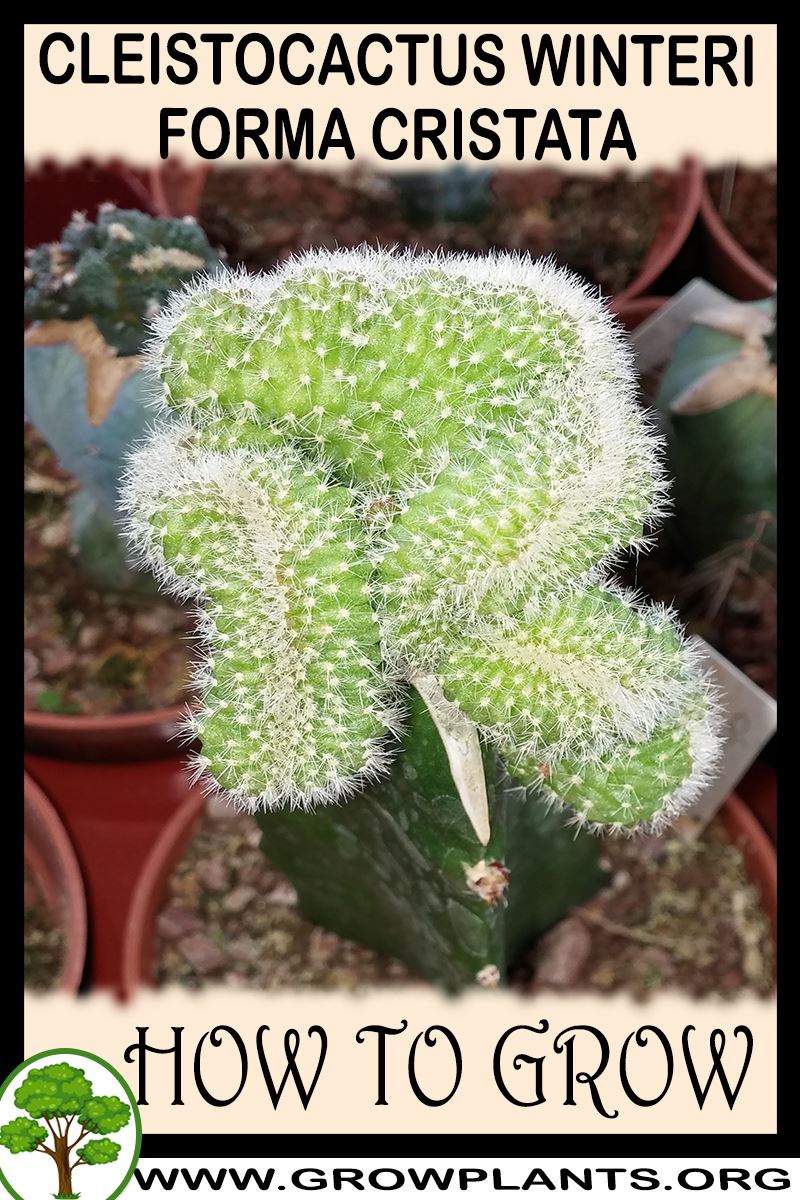
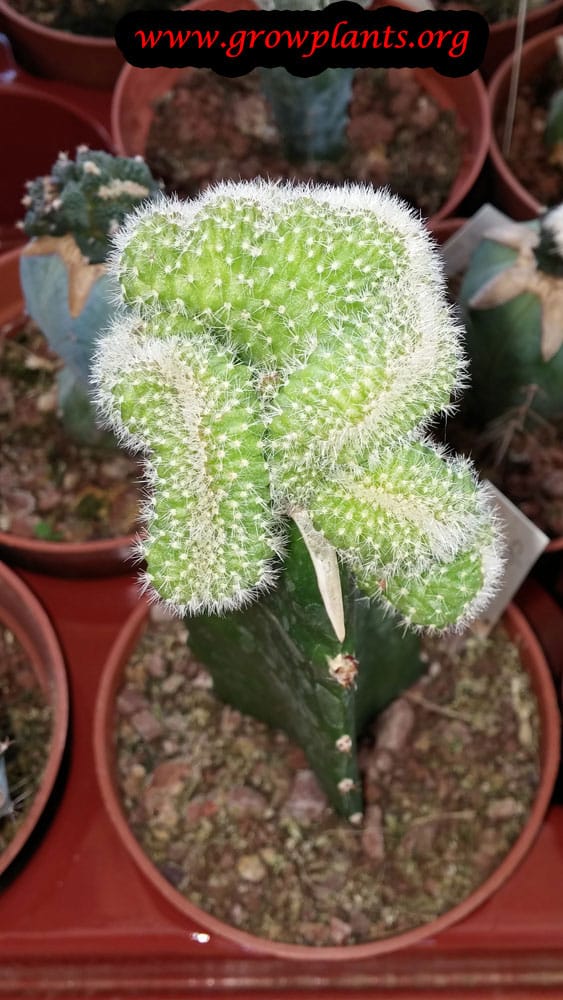
- Leaves & Foliage: Leafless green succulent stems that fuse into crested, wave-like ridges (a ‘mountain-range’ cristate form), clothed in white, rose or yellow spines.
- Flower Characteristics: Trumpet-shaped, many-petalled flowers in peach, pink, purple or red, appearing in summer (see the Bloom guide).
Primary Uses & Landscape Value
- Functional & Ornamental Roles: Ornamental groundcover, houseplant, and hanging-basket or elevated-container specimen; suited to subtropical and Mediterranean gardens or indoor culture.
Care Guide: Planting, Soil & Watering
Overview: The Cleistocactus winteri forma cristata (crested rat tail cactus) is a trailing, easy-going cactus that grows best in bright but filtered light – it can scorch in harsh full sun – and warm conditions above about 5 °C. It needs a fast-draining, gritty cactus mix and only light watering, letting the soil dry out well between drinks.
Quick Care Requirements
| Requirement | Ideal Condition |
|---|---|
| Planting Season | Warm season (spring, summer or autumn) |
| Growth Rate | Fast to moderate |
| Soil Type | Gritty, very free-draining cactus/succulent mix |
| Water Need | Low – water sparingly and let the soil dry between waterings |
Planting & Establishment
- Best Planting Season: Plant or repot during the warm growing season – spring, summer or autumn – when the cactus is in active growth. Avoid the cold of winter, and keep it above about 5 °C.
- How to Plant:
- Hole Preparation: Set it into a free-draining container or a raised, gritty spot; a slightly raised position helps water drain away from the stems.
- Soil Amendments: Use a purpose-made cactus mix, or lighten standard potting soil with plenty of coarse sand, grit or perlite for fast drainage.
- Planting Depth: Plant at the same depth it was growing – keep the base of the stems right at the surface, never buried, to avoid rot at the crown.
- Growth Speed & Expectations: A fast to moderate grower that quickly forms long, weeping stems – well suited to a hanging basket or a raised, well-drained position.
Soil, Watering & Drainage Care
- Soil Mix & Drainage Needs: Drainage is everything: a gritty, airy cactus mix in a pot with open drainage holes, or a raised, sharply drained spot in the garden. Standing moisture quickly rots the trailing stems, so a higher position or hanging basket suits it well.
- Watering Schedule & Technique:
- Young / Newly Planted: After planting or repotting, wait a few days, then water lightly and let the mix dry before watering again while the roots settle in.
- Established: Water only once the soil has dried out – a modest soak, then leave it to dry again. These cacti store water and shrug off short dry spells far better than sogginess.
- Seasonal Adjustments: Water a little more through the warm growing season, and keep it nearly dry during cool winter rest to prevent rot.
Climate, Light & Hardiness
Cleistocactus winteri forma cristata is a crested, trailing cactus suited to subtropical and mediterranean climates, or grown as a houseplant, and prefers filtered rather than harsh direct light. The site's own guidance is to keep it above roughly 5°C (41°F), reflecting only light frost tolerance.
Quick Climate Specifications
| Climate Zones | Subtropics, mediterranean, or indoors as a houseplant |
|---|---|
| USDA Hardiness Zones | 9–11 |
| Optimal Temp Range | Approximately 15–28°C (59–82°F) |
| Approx. Survival Minimum | Around 5°C (41°F) per the site's own data |
| Frost Tolerance | Low |
| Light Conditions | Half shade (not too much sun) to full shade |
Sunlight & Light Exposure
Optimal Light Setup
Bright but filtered light suits it best - the site specifically notes not too much direct sun, with half shade to full shade being ideal for the crested, wave-like stems.
Direct Sun Requirement
Not required, and too much direct sun can be harmful to the fleshy stems.
Shade & Heat Management
Grows well in shadier spots than most cacti; this makes it useful for hanging baskets under eaves or dappled tree cover.
Best Exposure / Orientation
A hanging basket or elevated planting position in filtered light or half shade, which also helps keep the trailing, crested stems off the ground as the site's own care notes recommend.
Temperature Extremes & Hardiness
USDA Hardiness & Regional Limits
The site places it at roughly zone 9–11; outside mild subtropical or mediterranean climates it is best grown as an indoor houseplant, which the site confirms is a suitable option.
Cold Damage & Winter Protection
The site's own guidance is to keep it above roughly 5°C (41°F); colder exposure risks damage to the fleshy trailing stems, so move container plants indoors or under cover before winter cold sets in.
Frost Sensitivity
High - treat as frost-tender.
Extreme Heat Tolerance
Good in warm subtropical and mediterranean summers, though the site's preference for reduced sun exposure suggests it appreciates some relief from the most intense heat.
Wind, Humidity & Microclimate
Humidity Preferences
Adapts to average subtropical and mediterranean humidity levels.
Dry-Air Tolerance
Reasonably good, though not as extreme-desert-adapted as sun-loving globe or columnar cacti.
Rainfall & Seasonal Moisture
Adapted to climates without prolonged waterlogging; well-drained soil matters, and the site specifically recommends planting it in a higher point to keep the trailing stems and roots from sitting in wet soil.
Microclimate Recommendations
A raised or hanging position in filtered light or half shade, sheltered from hard frost, suits it best; avoid low, damp planting spots.
Growing in Pots, Balconies & Indoors
This crested golden rat tail (Cleistocactus winteri forma cristata) makes a fine houseplant – the grower confirms it grows well indoors and in pots. Reaching 30-80 cm (12-32 in) and preferring bright, indirect light over harsh sun, its sculptural crested stems look striking on a shelf or in a wide bowl.
Quick Details
- Container Size: A pot or wide bowl 20-50% larger than the plant; the roots are shallow
- Indoor Suitability: A good houseplant – happy indoors in bright, indirect light
- Best Spot: Bright light with only gentle direct sun
- Soil & Drainage: Free-draining cactus/succulent mix over a gravel or lava-rock base; strong drainage holes. A ready-made cactus and succulent soil mix provides that structure without mixing it yourself.
- Watering in Pots: Water sparingly and let the mix dry out between waterings; cut back further in the cool dormant season – pots must never stay wet
Indoors & On the Windowsill
- A real houseplant: Grows well indoors – give it a bright window with soft light and it keeps its colour and crested form.
- Windowsill growing: Bright, indirect light is best; too much fierce midday sun through glass can scorch it, too little makes it dull.
- Care: Ordinary room air suits it; water sparingly and much less in the cool season.
On a Balcony or Patio
- Light & wind: A bright, sheltered balcony out of the fiercest sun suits it in summer; warm walls dry pots fast, so check the mix but water only when dry.
- Bring it in for winter: Frost-tender – move it under cover before cold weather.
Choosing the Pot, Soil & Long-Term Care
- Pot & drainage: Use a pot only 20-50% larger than the plant – it need not be deep, since the roots run shallow. Add a layer of gravel, lava rock or pebbles in the base, give it strong drainage holes, and never leave it standing in water.
- Potting mix: A free-draining cactus and succulent mix – gritty and well aerated so it dries quickly.
- Feeding: Potted cacti need only light feeding, as nutrients leach out with each watering; a dilute low-nitrogen cactus feed through the warm growing season is enough.
- Repotting: Every few years, once the roots fill the pot or the mix has broken down, refresh the soil and move up one size.
Fertilizing & Feeding
A light feeder: the fan-like crested form needs only occasional light feeding through the warm growing season, with feeding stopped during the cool dormant rest.
Quick Fertilizing Specs
| Feeding Level | Light feeder |
|---|---|
| Main Nutrient Priority | A very restrained, low-nitrogen cactus feed, since crested growth is more prone to soft, rot-susceptible tissue if overfed |
| Best Feeding Period | The active warm-season growth period |
| Organic Options | A light top-dressing of compost worked into the mineral mix |
| Reduce/Stop Feeding | Feeding is stopped through the cool dormant season |
| Micronutrients | A complete cactus fertilizer usually covers routine needs |
| Soil pH | Tolerates a wide range in a fast-draining mineral mix |
Feeding by Growth Stage
Warm-season active growth
Support steady growth of the fan-shaped crest and healthy spine and flower color without soft, weak tissue.
| Nutrient direction | A diluted, low-nitrogen cactus fertilizer supports the crest without encouraging soft, rot-prone tissue. |
|---|---|
| Timing | Through the warm active growing season, from the resumption of growth in spring into summer. |
| Frequency | Light, occasional feeding suits active growth; minimal feeding is needed the rest of the year. |
| Fertilizer types | A diluted, low-nitrogen cactus or succulent fertilizer, An optional light compost top-dressing |
| Precautions | Feed sparingly and keep the mix well-drained – the irregular crested growth is more susceptible to fungal rot than the normal columnar form when overfed or kept too moist. |
Cool-season dormancy
Let the plant rest through cooler weather without pushing new growth it can’t support.
| Nutrient direction | None – withhold fertilizer while the plant is dormant. |
|---|---|
| Timing | Through cool weather or the winter rest period. |
| Frequency | No feeding at this stage; feeding resumes once active growth restarts. |
| Fertilizer types | No feeding at this stage; hold off fertilizing until active growth resumes. |
| Precautions | Withhold fertilizer during dormancy – feeding a resting plant wastes nutrients and raises the risk of rot in the crest’s tightly folded tissue. |
Nutrient Deficiency Signs & Corrections
Older parts of the fan fade to a dull yellow-green and growth along the crest’s margin slows.
| Possible causes | low available nitrogen in a very lean mineral mix, nitrogen leached out by frequent watering, a mix that has gone without any organic matter for a long time |
|---|---|
| Appears first on | older, lower parts of the fan |
| What to check | feeding history, potting mix composition, watering frequency |
| Possible correction | Apply a diluted, low-nitrogen cactus fertilizer during active growth and consider refreshing the potting mix. |
New growth along the crest’s growing margin emerges pale or yellowish while older tissue stays green.
| Possible causes | high soil pH limiting iron availability, waterlogged or poorly aerated soil restricting root uptake, a potting mix depleted of micronutrients over time |
|---|---|
| Appears first on | the crest’s actively growing margin |
| What to check | soil drainage and aeration, potting mix age, recent watering habits |
| Possible correction | Improve drainage, correct pH if identified as a cause, and apply a chelated iron product per its label. |
Margins of the crest brown and dry out despite otherwise adequate care.
| Possible causes | fertilizer salt buildup from infrequent flushing, underwatering that concentrates salts in the mix, feeding more often than the plant can use |
|---|---|
| Appears first on | the crest’s outer margin |
| What to check | recent feeding frequency and strength, time since the mix was last flushed, container drainage |
| Possible correction | Ease off feeding, flush the mix thoroughly with water, then resume only light feeding. |
Pruning, Training & Seasonal Maintenance
This is the crested (cristate) form of the rat tail cactus, grown specifically for its wavy, fan-like, mountain-range growth pattern rather than the normal cylindrical trailing stems – a mutation at the growing point that must be preserved rather than cut into. Routine maintenance is limited to removing dead or rotted tissue and occasionally trimming stray normal-form (non-crested) growth that can revert from the base, since cutting into the crest itself risks losing the very feature the plant is valued for. Any propagation should be taken from crested tissue, not from reverted normal growth, to keep the offspring’s crest.
Quick Pruning & Maintenance Specs
| Pruning Tolerance | Low on the crest itself; Moderate for removing reverted normal-form growth |
| Primary Pruning Window | As needed, any time |
| Typical Frequency | Occasional – dead-tissue removal and watching for reversion |
| Main Objective | Preserve the crest; remove dead tissue and any reverted normal stems |
| Young Plant Priority | Leave the crest growth point completely undisturbed |
| Mature Plant Priority | Remove dead tissue; remove reverted (non-crested) growth at its base if it appears |
| Best Tool Type | Sterile blade, reserved for reversion removal or dead tissue only |
| Avoid Heavy Pruning During | Always on the crest itself – the growing point does not regenerate its fasciated form once cut |
Pruning by Plant Age & Size
Newly Established
No pruning; the crest must be left completely undisturbed while it establishes its characteristic wavy growth.
Young / Formative
No structural training – the ornamental value is entirely in the crest’s natural, unguided fasciated form.
Mature / Established
Watch for reversion – some crested cacti occasionally produce a normal, non-crested stem from the base; remove this reverted growth at its point of origin if a purely crested specimen is wanted, since reverted growth is more vigorous and can outcompete the crest over time.
Special Growth to Remove
- Dead or rotted tissue – remove promptly, cutting well into firm healthy tissue.
- Reverted (normal-form) growth – if an ordinary cylindrical stem appears at the base instead of the wavy crested form, it can be removed to keep the plant’s growth directed into the crest, since reverted growth tends to be more vigorous and will dominate if left.
Container & Small-Space Pruning
Grown as a houseplant or in containers; because the crest cannot be reshaped by pruning, its ultimate form is fixed by its own growth pattern rather than by any container-training technique.
Tools
- Grafting knife / sterile blade – for the occasional dead-tissue or reverted-growth removal.
Tool Hygiene & Disease Risk
Increased risk: this form is noted as prone to fungal issues, and the crest’s convoluted, folded surface can trap moisture more than a normal round stem, so any cut should be made with a clean, sterile blade and allowed to dry fully before watering.
Cut Placement & Technique
Cut only reverted normal-form growth or dead tissue, never the crested growth point itself; cut cleanly at the base of the unwanted growth and let the wound callus in dry conditions before watering resumes.
Heavy Pruning & Rejuvenation
Not tolerated on the crest. There is no rejuvenation pruning that restores or improves a crest – once damaged, that portion of the fasciated growth does not regenerate its wavy form.
Post-Pruning Care
Keep any cut area dry until fully callused, watching the crest’s folds in particular for trapped moisture and early rot signs, given the species’ fungal susceptibility.
Common Pruning Mistakes
- Cutting into the crest itself, permanently damaging the feature the plant is grown for.
- Leaving reverted normal-form growth unchecked, letting it outcompete and eventually overwhelm the crest.
- Taking propagation cuttings from reverted growth instead of crested tissue, producing normal-form offspring instead of crested ones.
When NOT to Prune
Never cut the crest itself; avoid any cutting in cold or prolonged wet weather given the form’s fungal susceptibility and the moisture-trapping folds of the crest.
Recommended Tools (by task)
- grafting_knife – a sterile blade for the occasional removal of dead tissue or reverted normal-form growth, kept well away from the crest itself.
- blade_disinfectant – important given the form’s fungal susceptibility and the moisture-trapping crest folds.
Propagation Guide
This is the crested (cristata) form of the rat tail cactus, and like other cristate cactus mutations, the fan-like growth is not reliably passed on through seed — propagation is done by stem cuttings taken directly from the crested growth to preserve the mutation. Cuttings root readily, as in the normal species, making this an easy plant to propagate as long as vegetative material from the crest itself is used.
Quick Propagation Specs
| Best Propagation Method | Stem cuttings, taken from the crested growth |
| Alternative Methods | Grafting onto vigorous rootstock (optional, sometimes used to boost growth of a weak or slow-growing crest) |
| Propagation Difficulty | Easy to Moderate — cuttings root readily, though crested growth can be slower or weaker than normal stems |
| Seed True-to-Type | No — seed from a cristate plant typically reverts to normal, uncrested growth and does not reliably preserve the crest |
| Vegetative True-to-Type | Yes |
| Best Propagation Season | Spring through autumn, matching the plant’s planting season |
| Cutting Rooting Time | Typically a few weeks under warm conditions (general guidance for Cleistocactus; not specified by the site) |
Stem Cuttings
Cutting Type
Take the cutting directly from the crested (fan-shaped) growth, not from any normal round stem that may appear on the same plant, to keep the mutation in the new plant.
Best Timing
Warm growing months, spring through autumn.
Cutting Preparation
Cut with a sterile blade and let the cut surface callus in a dry, shaded spot for several days to a week before planting, as for the standard species.
Rooting Setup
Set the cutting on a gritty, well-drained mix in a slightly elevated, well-drained spot, as recommended for this species generally, and water sparingly until rooted.
Rooting Hormone
Not necessary.
Rooting Time
Typically a few weeks under warm conditions.
Grafting & Budding
Why Grafting Is Used
Crested growth can be slow or structurally weaker than normal stems on its own roots, so grafting a piece of the crest onto a vigorous columnar rootstock is sometimes used to speed growth and improve vigor. It is not required — per site data, vegetative propagation (including grafting) is only necessary to keep the same growth form/cultivar, not for the plant to survive.
Preferred Grafting Methods
A flat graft union, as typically used when grafting columnar cactus material onto a compatible columnar rootstock.
Bloom & Flower Guide
Quick Details
- Bloom Season: Summer.
- Flower Appearance: Trumpet-shaped, multi-petalled flowers in peach, pink, purple or red.
- Edibility: Ornamental only; not grown as an edible flower.
Detailed Blooming Overview
This is the crested (forma cristata) form of the golden rat tail, Cleistocactus winteri – the same plant whose stems fan and fold into curious brain-like crests. It carries the species’ bright, tubular flowers, which in Cleistocactus are typically vivid orange to salmon and are shaped for hummingbird pollination. Crested plants often flower more sparingly than the normal form, as their energy goes into that distinctive fanned growth, so blooms are a welcome bonus on a plant grown mainly for its sculptural shape.
Flower Characteristics
- Colour: peach, pink, purple or red (often a warm orange-salmon).
- Form: slender, tubular, multi-petalled trumpet flowers.
- Position: emerging along the crested stems.
Bloom Care & Thinning
- Bright light: generous light supports what flowering the crested form will give.
- Cool, drier winter rest: a cool, restrained-water dormancy encourages summer buds.
- Resume watering as growth restarts; simply remove spent flowers afterwards.
Pests, Diseases & Troubleshooting
Overview: The crested golden rat tail cactus is a tough, largely pest-free columnar cactus whose problems are overwhelmingly about water rather than bugs: overwatering and cold, wet mix cause soft basal and root rot, which is the main killer. As a crested (cristate) form, its brain-like folds trap moisture and hide pests, so airflow and careful dry watering matter even more. The few pests it does get – mealybug (including root mealybug), scale and spider mite – are easily managed, so the priority is sharp drainage, bright light and restrained watering.
Quick Troubleshooting Overview
| Issue / Pest | Main Symptom | Primary Solution |
|---|---|---|
| Overwatering / basal rot | Soft, brown, mushy stem base; collapse | Cut to firm tissue; dry gritty mix; water less |
| Mealybugs | White cottony fluff between ribs/spines | Dab with alcohol/oil; systemic if severe |
| Root mealybug | Poor growth; white waxy specks on roots | Bare-root, wash, repot in fresh mix |
| Scale | Small brown/grey bumps on stems | Scrape off; horticultural oil |
| Spider mites | Rusty/corky bronzing near tips; fine webbing | Rinse, raise humidity; miticide if needed |
| Etiolation / sunscald | Weak thin growth, or pale scorched patches | Bright light but acclimatise to full sun |
Common Pests & Management
- Mealybugs (Planococcus citri, Pseudococcus spp.):
- Symptoms: White, cottony waxy tufts tucked between the ribs, around the spine clusters and at the growing tip, with sticky honeydew and sometimes sooty mould; feeding causes yellowing, weak growth and scarring. On this crested (cristate) form, the folds and crevices trap water and debris, so rot and hidden mealybugs are an even greater risk than on a normal stem.
- Prevention & Control: Check regularly, including the crown; dab colonies with a cotton bud dipped in diluted isopropyl alcohol or spot-treat with horticultural oil / insecticidal soap. Keep ants away. For a heavy or recurring infestation a systemic insecticide drench is effective; isolate new plants before adding them to a collection.
- Root mealybugs (Rhizoecus spp.):
- Symptoms: Growth stalls and the plant looks unthrifty despite good care; tipping it out of the pot reveals white, waxy, mould-like specks and deposits over the roots and inner pot wall. Common in long-unrepotted container cacti.
- Prevention & Control: Bare-root the plant, wash all soil from the roots under running water, and trim damaged roots; repot into fresh, gritty, free-draining mix and a clean pot. A soil drench of systemic insecticide or repeated soap/oil root soaks clears survivors. Inspect roots at each repotting.
- Scale insects (Diaspis echinocacti, Coccus spp.):
- Symptoms: Small, flat, grey-brown or whitish limpet-like bumps firmly attached to the stem surface, sometimes in crusty patches; they suck sap, cause yellow blotches and, with soft scale, leave honeydew.
- Prevention & Control: Scrape or brush off light infestations and rub the spot with diluted alcohol; horticultural oil smothers them (test on a small area first, and avoid oil in strong sun/heat). Repeat as new crawlers hatch, and isolate affected plants.
- Spider mites (Tetranychus urticae, Panonychus spp.):
- Symptoms: Fine pale stippling that develops into a rusty, corky bronze scarring near the growing tip and upper stem, with very fine webbing in hot, dry, still air – the russeting is permanent even after mites are gone.
- Prevention & Control: Mites hate humidity and moving air, so rinse the plant, raise humidity and improve ventilation; keep it from baking in stagnant heat. Preserve predatory mites outdoors. A miticidal soap or suitable acaricide controls a heavy outbreak – treat early before scarring spreads.
Diseases & Fungal Issues
- Basal / soft stem rot (Fusarium, Phytophthora, Pectobacterium (Erwinia)):
- Symptoms: A soft, watery, brown-to-black mushy patch, usually starting at the base or a wound and spreading up the stem, sometimes foul-smelling (bacterial) or with pink/white fungal growth. Caused by too much water – especially cold, wet mix, overwatering, or water sitting in the crown. Crested forms rot readily in their folded crevices.
- Treatment & Management: This is the number-one killer of these cacti and is prevented, not cured, by dry culture: a gritty, sharply-drained mix, a pot with drainage, watering only when the mix is fully dry, and less water in cool, dark or dormant periods. If caught early, cut back to firm, clean green tissue, dust the wound with sulphur, let it callus, and re-root the healthy top. Discard badly rotted plants.
- Fungal spots & corky scab (various fungi; also physiological):
- Symptoms: Sunken brown or black dry spots, or rough corky patches, on the stem – often following cold damp air, water splashed and left on the plant, or old injury; usually cosmetic if the tissue stays firm and dry.
- Treatment & Management: Improve airflow and avoid wetting the stem, especially in cool weather; water in the morning at the base. Remove badly affected areas is rarely needed – keep the plant dry, warm and bright and new growth will be clean. A sulphur dusting protects fresh wounds.
Growing Difficulties & Abiotic Problems
- Overwatering & root rot:
- Cause & Symptoms: The commonest cause of decline: constantly moist or poorly-drained mix rots the roots and base, giving softening, yellowing, blackening and collapse – often mistaken for a pest problem.
- Correction Strategy: Use a very free-draining cactus/succulent mix with extra grit, water thoroughly only when the mix is bone-dry, and cut watering right back in winter and dull weather. Never leave the pot standing in water; a terracotta pot helps the mix dry out.
- Etiolation (weak, thin growth):
- Cause & Symptoms: In too little light the stem grows pale, thin, soft and stretched, losing its tight ribbed form and strong spination, and becomes floppy and rot-prone.
- Correction Strategy: Give the brightest light possible – full sun outdoors in season or a very bright windowsill/grow-light indoors. Introduce strong sun gradually to avoid scorching etiolated tissue; the stretched section won’t recover but new growth will be firm.
- Sunscald & cold damage:
- Cause & Symptoms: Sudden exposure to intense sun (especially after winter indoors) bleaches and scars pale, corky patches on the sun-facing side; frost and prolonged cold cause soft, translucent, collapsing tissue.
- Correction Strategy: Acclimatise plants to full sun gradually over a couple of weeks, and provide light shade in the fiercest midday heat. Keep the plant above its cold limit – bring it in or protect it before frost, and keep it dry when cold.
- Corky base & edema:
- Cause & Symptoms: The oldest, lowest part of the stem naturally turns brown and corky with age (normal), while soft raised blisters/edema can appear if the plant is overwatered in cool, humid, low-light conditions.
- Correction Strategy: Distinguish firm, dry corking (harmless ageing) from soft rot (act immediately). Reduce watering and raise light and airflow to stop edema; a firm corky base needs no treatment.
What Helps – Products & Tools
These cacti are near pest-free – the real enemy is water. Keep a gritty, free-draining cactus/succulent mix and a well-drained pot as your first line of defence, plus isopropyl alcohol and horticultural oil / insecticidal soap for mealybug and scale, a systemic insecticide drench for stubborn root mealybug, a miticide for spider mites, and sulphur powder to dust wounds and cuttings against rot. Bright light, sharp drainage and careful watering prevent almost every problem.
Varieties & Cultivars
- Cleistocactus winteri — Learn more about Cleistocactus winteri · Shop Cleistocactus winteri on Amazon