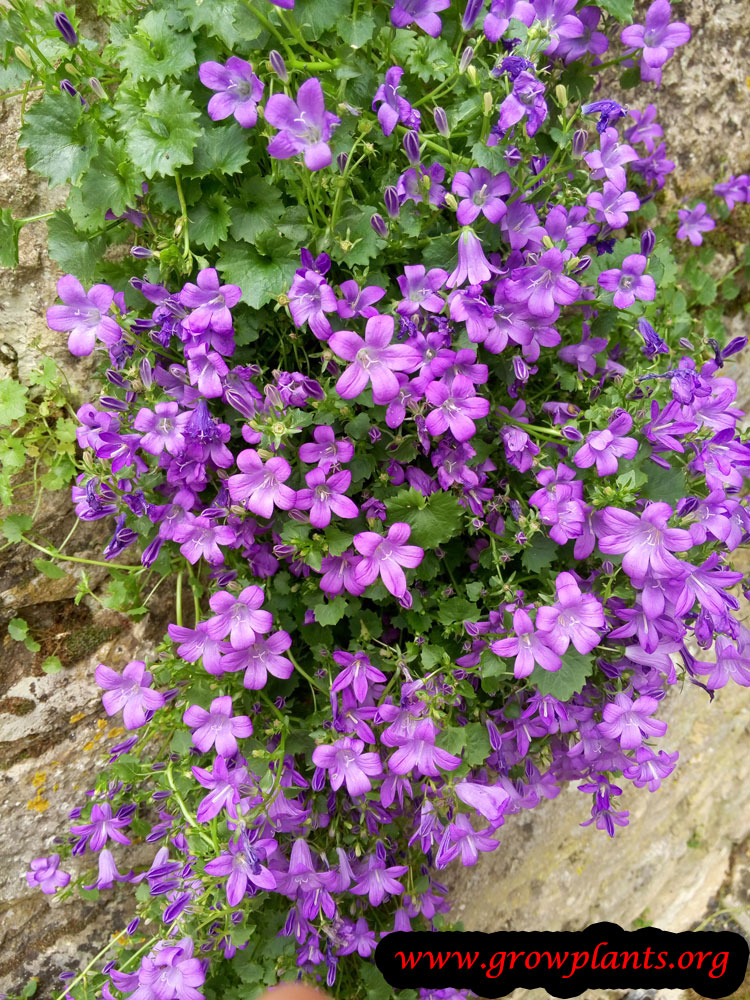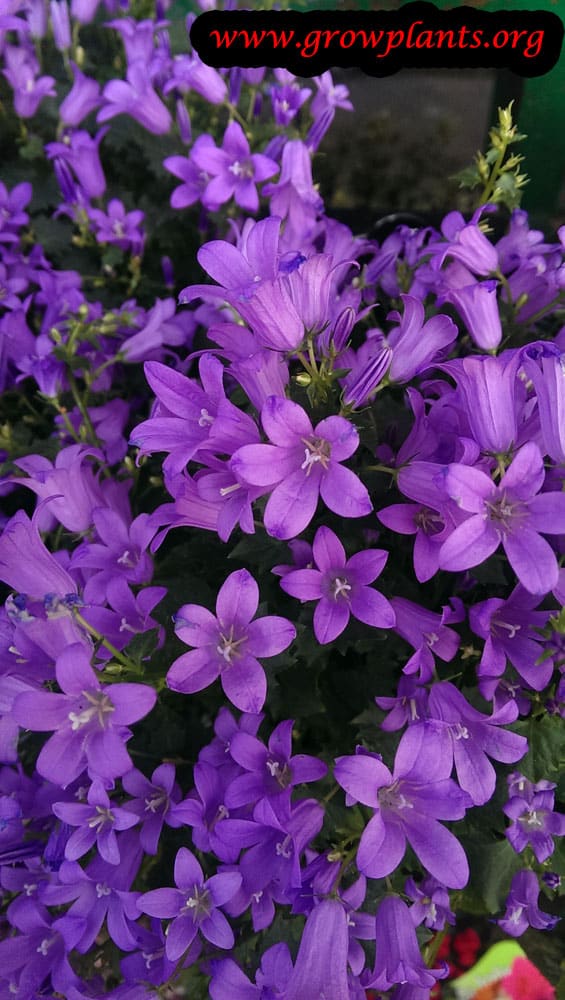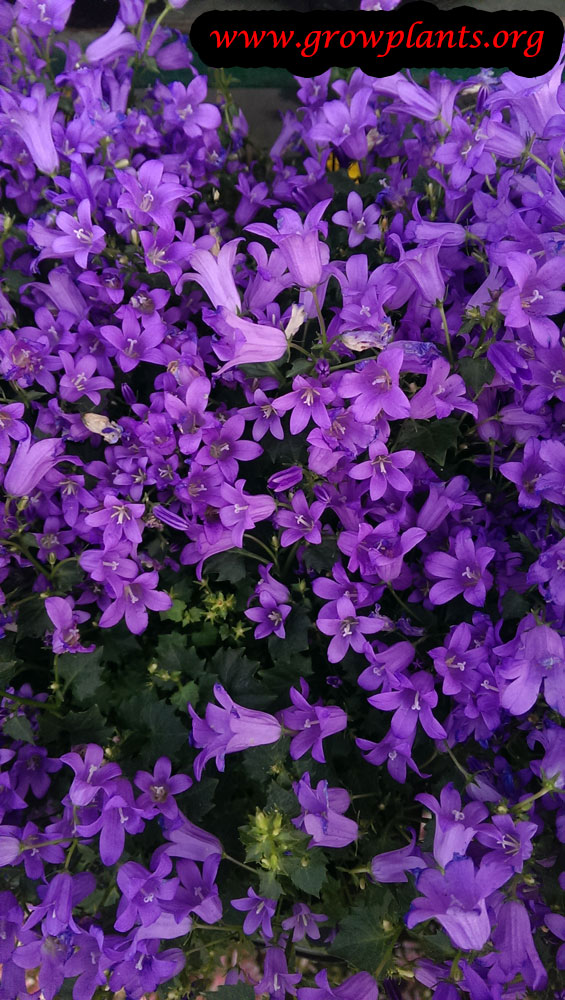

Plant Profile & Key Characteristics
Also known as: Bellflower plant, Campulana
Overview: A large and varied genus of herbaceous plants, grown as perennials, biennials or annuals from 0.1-2 m (4 in to 6 ft) tall. Bellflowers are grown as ornamentals for their bell- or star-shaped flowers, some as cut flowers and some as groundcovers.
Quick Specifications
| Specification | Attribute |
|---|---|
| Plant Type / Life Cycle | Perennial, biennial or annual (varies by species) |
| Foliage Type | Evergreen (many species) |
| Mature Size | 0.1-2 m (4 in to 6 ft), varies by species |
| Growth Rate | Fast to moderate |
| Toxicity | Non-toxic (some species edible) |
| Hardiness | USDA zone 3-10 (to 11 as annual) |
Growth Form & Structure
- Height & Spread: Very variable, from 10 cm alpine cushions to 2 m border plants; most form a low leafy mound with taller flowering spikes, and smaller species suit containers.
- Growth Habit & Form: Clump- or mat-forming herbaceous plants; habit ranges from trailing groundcovers to upright border perennials depending on species.
- Lifespan & Maturity: Perennials take a season to establish and then grow faster; annual and biennial types complete their cycle more quickly.
Anatomy & Physical Features
- Leaves & Foliage: Green leaves, typically elliptic with serrated edges, though leaf shape differs widely between species.
- Flower Characteristics: Bell- or star-shaped flowers in purple, blue, pink, white, yellow or red at the stem tips (full detail in the Bloom section).
Primary Uses & Landscape Value
- Functional & Ornamental Roles: Ornamental borders, rock and alpine gardens; taller species as cut flowers and trailing species as groundcover or in containers/hanging baskets.
Care Guide: Planting, Soil & Watering
Overview: A cool-weather perennial (or annual/biennial) bellflower that thrives in rich, moist, well-drained soil enriched with organic matter. It likes steady moisture and full sun to part shade, with a little afternoon shade where summers are hot.
Quick Care Requirements
| Requirement | Ideal Condition |
|---|---|
| Planting Season | Annuals in spring (late winter to early spring in warm zones 10b-11); perennials in spring in cool zones, summer in zones 6-10, autumn in zones 10-11 |
| Growth Rate | Moderate to Fast (perennials slower to establish) |
| Soil Type | Rich, moist, well-draining with organic matter |
| Water Need | Moderate to High – keep moist; depends on species, wind and drainage |
Planting & Establishment
- Best Planting Season: Plant from spring through summer (occasionally autumn); annuals in spring or late winter to early spring in warm zones 10b-11, perennials in spring in cool zones, summer in zones 6-10, and autumn in zones 10-11.
- How to Plant:
- Hole Preparation: Dig a hole larger than the root ball.
- Soil Amendments: Mix decayed leaves and organic matter into well-drained backfill.
- Planting Depth: Plant and cover lightly without over-firming; set the crown at soil level.
- Growth Speed & Expectations: Fast to moderate; perennials take a season to establish, then speed up.
Soil, Watering & Drainage Care
- Soil Mix & Drainage Needs: Rich soil with organic matter and good drainage; in containers use potting mix or peat with perlite/vermiculite and refresh every few years to prevent root rot.
- Watering Schedule & Technique:
- Young / Newly Planted: Water twice a day for the first few days, then regularly until established.
- Established: Keep the soil moist with deep watering, adjusting for wind and drainage.
- Seasonal Adjustments: More water in summer heat, less in winter.
Climate, Light & Hardiness
Campanula (bellflower) is a large genus of mostly cool-climate herbaceous plants for temperate, Mediterranean and mild-subtropical gardens, grown in full sun where summers are cool and in half shade where they are hot. Most are very cold-hardy perennials whose dormant crowns survive hard winters within roughly USDA zones 3–10 – but hardiness and heat tolerance vary widely by species, so treat these as genus-level guidance.
Quick Climate Specifications
| Climate Zones | Temperate, Mediterranean and subtropical |
| USDA Hardiness Zones | 3–10 |
| Optimal Temp Range | cool to mild, roughly 13–24 °C (55–75 °F) |
| Cold Damage Begins | very cold-tolerant; only soft new growth and open flowers are nipped by hard late frost |
| Approx. Survival Minimum | approximately −40 to −34 °C (−40 to −30 °F) for the dormant crown |
| Frost Tolerance | High (dormant crown very hardy) |
| Light Conditions | Full sun to half shade |
Sunlight & Light Exposure
Optimal Light Setup
Full sun gives the best flowering in cool and cool-summer climates. Where summers are hot, half shade protects the foliage and prolongs bloom.
Direct Sun Requirement
Welcomes several hours of direct sun in mild climates. In hot regions, intense all-day summer sun shortens flowering and stresses the plant, so temper it with afternoon shade.
Shade & Heat Management
Afternoon shade plus a mulched, cool root run extends flowering through heat. In hot-summer areas the site favours half shade over full sun.
Best Exposure / Orientation
A cool, bright aspect suits it best; in hot climates an east-facing or afternoon-shaded position is preferable to a baking south wall.
Temperature Extremes & Hardiness
USDA Hardiness & Regional Limits
The site places it in roughly USDA zones 3–10, which describes winter cold survival, not heat preference. For this cool-weather plant the warm end of the range is the practical limit – heat and humidity, not cold, decide where it thrives. In the hottest, effectively frost-free areas (about zone 10b–11) many species are grown as cool-season annuals, and a number also need a cold winter (or deliberate cold-stratification) to germinate and flower well, which further limits them in frost-free climates.
Cold Damage & Winter Protection
The plant dies back and overwinters as a dormant crown, coming through cold reliably across its stated range. The main winter risk is wet-cold rot, so sharp drainage matters more than mulch; container roots are more exposed to freezing than those in open ground.
Frost Sensitivity
Established plants shrug off frost. Only soft new spring growth and open flowers can be nipped by a hard late frost, and they recover quickly.
Extreme Heat Tolerance
This is the real limit for a cool-weather bellflower: prolonged heat and humidity cause decline, early flower fade and stress. Keep the roots cool and shaded through the hottest part of summer. In frost-free hot zones it is often treated as a cool-season annual for this reason.
Wind, Humidity & Microclimate
Microclimate Recommendations
A cool, airy, well-drained position gives the best results; avoid stagnant humid heat, and in the hottest zones lean on shade and a cool root run to keep it comfortable.
Growing in Pots, Balconies & Indoors
Campanula (bellflower) is mostly a low, small plant that throws up taller flowering spikes, and the grower’s note is clear: it is not a true deep-room houseplant, but it grows happily indoors on a bright windowsill, and it is well suited to pots and containers.
Quick Details
- Container Size: Small – mostly compact plants that are content in a small pot (the grower).
- Indoor Suitability: Not a deep-indoor houseplant, but fine on a bright windowsill (the grower).
- Best Spot: Full sun to half shade – half shade where summers are hot, full sun in cooler areas; exact need varies by species.
- Soil & Drainage: Rich soil with organic matter and good drainage – the grower’s mix is about 50-60% potting mix or peat with 40-50% perlite or vermiculite.
- Watering in Pots: Average to generous water depending on species, wind and drainage; never waterlogged.
Indoors & On the Windowsill
- Houseplant limits: The grower does not rate it as a room houseplant – deep indoors the light is too weak for good flowering.
- Windowsill growing: It does grow indoors on a bright windowsill; give it the most direct light you can and turn the pot for even growth.
- Overwintering: Many bellflowers are hardy; in a pot you can shelter tender types from hard frost, keeping them cool and on the dry side while dormant.
On a Balcony or Patio
- Light & wind: A bright balcony or patio suits it; in hot-summer spots give some afternoon shade, in cooler climates full sun. Pots on sunny, wall-backed balconies dry quickly – check often. Tall flower spikes may need a little support in wind.
- Practicalities: Being small it is easy to place and move; just make sure drainage water runs away freely.
Choosing the Pot, Soil & Long-Term Care
- Pot & drainage: A small, free-draining pot with strong holes; skip a standing-water saucer to avoid root rot. Terracotta breathes and dries faster; glazed or plastic holds moisture longer.
- Potting mix: Rich in organic matter yet sharply drained – the grower uses roughly 50-60% potting mix or peat with 40-50% perlite or vermiculite.
- Feeding: Potted plants need feeding more often through the growing season, as watering washes nutrients out of the mix.
- Repotting: For perennial types, refresh or replace the mix every few years.
Grower’s Container Tip
- Refresh the soil for perennials: The grower warns that old potting soil loses its viability and can rot the roots, so for perennial bellflowers switch the soil after a few years rather than leaving them in tired mix.
Fertilizing & Feeding
A cool-weather bellflower grown for its flowers: a balanced complete fertilizer with organic matter through the active growing season supports steady bloom, with feeding eased back as the plant rests.
Quick Fertilizing Specs
| Feeding Level | Moderate feeder |
|---|---|
| Main Nutrient Priority | Balanced feeding with adequate nitrogen; no need for high-phosphorus bloom formulas |
| Best Feeding Period | Spring through the active growing and flowering season |
| Organic Options | Compost, humus, and other organic matter |
| Reduce/Stop Feeding | Ease off and hold feeding through dormancy or the rest period |
| Micronutrients | Usually met by organic matter and a complete fertilizer; correct only diagnosed issues |
| Soil pH | Adaptable; roughly near neutral to slightly acidic |
Feeding by Growth Stage
Spring resumption of growth
Support fresh leafy growth and strong stems as the plant resumes active growth in the cool season.
| Nutrient direction | A balanced complete fertilizer with adequate nitrogen to fuel healthy leafy growth, supported by organic matter worked into the soil. |
|---|---|
| Timing | As growth resumes in spring or the start of the active growing season. |
| Frequency | A light feeding as growth begins, with organic matter renewed as needed. |
| Fertilizer types | A balanced complete fertilizer, Compost, humus, and organic matter worked in |
| Precautions | Keep feeding light and avoid pushing lush, soft growth; Prefers cool weather with consistently moist but well-drained soil. |
Flowering period
Fuel abundant bell-shaped flowers through the blooming period while keeping growth sturdy.
| Nutrient direction | Continue a balanced complete fertilizer with adequate nitrogen; a balanced feeding supports bloom better than forcing extra phosphorus. |
|---|---|
| Timing | Through the flowering period of the active growing season. |
| Frequency | Occasional light balanced feeding while the plant is actively growing and blooming. |
| Fertilizer types | A balanced complete fertilizer, Compost or humus as a top-dressing |
| Precautions | Avoid high-phosphorus bloom formulas and heavy feeding, which waste nutrients and can weaken stems; light feeding is usually enough. |
Dormancy or rest period
Let the plant coast through cool-season dormancy or the natural rest after flowering without pushing new growth.
| Nutrient direction | None – withhold fertilizer while the plant is not in active growth. |
|---|---|
| Timing | During cool-season dormancy or the natural rest after flowering. |
| Frequency | No feeding at this stage; resume only when active growth returns. |
| Fertilizer types | No feeding at this stage; hold off fertilizing until active growth resumes. |
| Precautions | Do not fertilize now; feeding a resting plant wastes nutrients and risks salt buildup in the root zone. |
Nutrient Deficiency Signs & Corrections
Older, lower leaves fade to pale green or uniform yellow and overall growth slows.
| Possible causes | low available soil nitrogen, nitrogen leaching from heavy watering or rain, thin, low-organic-matter soil |
|---|---|
| Appears first on | older, lower leaves |
| What to check | recent feeding history, soil organic matter, watering and drainage |
| Possible correction | Apply a nitrogen-containing complete fertilizer and build soil organic matter, then water evenly. |
Interveinal yellowing on the newest leaves while the veins stay green.
| Possible causes | iron made unavailable by high soil pH, waterlogged or poorly drained soil limiting root uptake, genuinely low soil iron |
|---|---|
| Appears first on | youngest leaves at the shoot tips |
| What to check | soil pH, drainage and how wet the root zone stays, whether symptoms are worst on new growth |
| Possible correction | Correct soil pH and drainage, and apply a chelated iron product per its label if the deficiency is confirmed. |
Leaf margins brown or scorch and growth stalls despite adequate watering.
| Possible causes | fertilizer salt buildup in the root zone, under-watering that concentrates salts, excessive or too-frequent feeding |
|---|---|
| Appears first on | leaf margins and tips |
| What to check | recent fertilizer amounts, watering consistency, drainage, especially in containers |
| Possible correction | Ease off feeding, water thoroughly to flush accumulated salts, then return to lighter feeding. |
Pruning, Training & Seasonal Maintenance
Campanula (bellflower) is a large genus spanning low cushion-forming alpines only a few centimeters tall to upright perennial spike-formers reaching around 2m, plus annual and biennial species – so pruning need and technique genuinely differ by growth habit, and the notes below are the principles that hold across that range rather than a single fixed routine. In general the genus tolerates only light, ongoing maintenance rather than structural pruning: removing spent flowers and dead leaves as they occur through the bloom season, which for many species runs from spring into summer. Because some Campanula species are noted to self-seed aggressively, deadheading before seed drop is the single most useful habit across the genus.
Quick Pruning & Maintenance Specs
| Pruning Tolerance | Low to Moderate – light, ongoing maintenance rather than structural cutting; varies by species habit |
| Primary Pruning Window | Throughout the bloom season, as flowers fade (spring–summer for most species) |
| Typical Frequency | Ongoing/continuous rather than a single seasonal pass |
| Main Objective | Deadhead to prolong bloom and limit self-seeding; remove dead leaves |
| Young Plant Priority | Minimal – let seedlings/young plants establish before any deadheading routine begins |
| Mature Plant Priority | Ongoing deadheading; for mounding perennial types, a post-bloom tidy of the clump |
| Best Tool Type | Precision snips (fine, non-woody stems throughout the genus) |
| Avoid Heavy Pruning During | Active flowering, if preserving that season’s display is the goal |
Pruning by Plant Age & Size
Newly Established
Newly planted Campanula of any habit need little more than removal of damaged leaves; let the plant establish its root system before beginning a deadheading routine.
Young / Formative
No structural training applies to any Campanula habit in this genus – there is no leader, framework or cane system to form, whether the species is a low cushion, an upright clump, or a tall spike-former.
Mature / Established
For the many perennial species in this genus, mature-plant care is mostly cosmetic tidying: deadheading through the bloom period, plus removing dead leaves and spent stems, done mostly “for design” rather than out of biological necessity, as the source notes for this genus.
Seasonal Pruning Schedule
| Post-Flowering (ongoing, as each flower or flush fades) | Prolong bloom and reduce self-seeding across the bloom season | Spent individual flowers and, once a full flush finishes, the flowering stem | Buds and flowers still opening | Many perennial species rebloom or extend flowering when deadheaded promptly | Deadheading generally encourages further flowering rather than reducing it |
| Dormant / Winter (perennial species) | Clear dead top growth once foliage dies back for the season | Fully dried leaves and stems | Any basal foliage still green, especially in evergreen or semi-evergreen species | Fresh growth resumes from the crown or rootstock in spring | None – new flowering growth is produced fresh each season |
Special Growth to Remove
- Spent individual flowers and, once a flush finishes, the flowering stem – the main maintenance task across the genus.
- Dead or tattered leaves, removed as they appear.
- Self-sown seedlings of species noted as capable of aggressive spread, pulled or clipped before they mature, if containing spread is a goal.
Container & Small-Space Pruning
Many Campanula species are naturally small and well suited to pots; container culture limits any self-seeding spread into surrounding beds, and the main task stays the same – prompt deadheading and dead-leaf removal – with periodic repotting or division as the rootstock fills the container.
Tools
Stems and spent flowers across the genus are fine and non-woody, so precision snips or fingernail pinching handle essentially every cut; no loppers, saw or hedge shears are relevant to any Campanula habit.
Tool Hygiene & Disease Risk
Routine – clean, sharp snips are sufficient. The source notes spider mites, aphids and slugs as the relevant pest pressures, none of which are cut-transmissible, so no elevated disinfection protocol applies.
Cut Placement & Technique
Deadhead by cutting or pinching just above the next bud, leaf node, or the basal rosette, depending on species habit; remove fully spent flowering stems back to the rosette once a flush is completely finished.
Heavy Pruning & Rejuvenation
Most perennial Campanula tolerate being cut back to the basal rosette once bloom finishes for the season, refreshing the clump’s appearance; this is a light seasonal tidy rather than a rejuvenation technique, and the genus generally does not need or benefit from harder renewal cutting.
Post-Pruning Care
Keep soil evenly moist after cutting back, since the genus generally favors consistent moisture over drought; watch for slugs on tender regrowth, a noted pest risk. Routine feeding is not required after a light deadheading pass.
Common Pruning Mistakes
- Skipping deadheading and allowing self-seeding species to spread further than intended.
- Applying a single heavy species-appropriate cutback technique uniformly across the genus, when low cushion types, tall spike-formers, biennials and annuals each call for a different touch.
- Cutting back a biennial or annual species as if it were a hardy perennial that will resprout from the crown.
When NOT to Prune
Avoid removing flowering stems mid-display if extending that particular bloom is the goal, and avoid cutting back biennial or annual species expecting perennial-style regrowth.
Recommended Tools (by task)
- Deadheading individual flowers and light stem trims across all Campanula habits → precision_snips – the fine, non-woody stems throughout this genus need nothing heavier.
Propagation Guide
Across the bellflowers the practical choice depends on the species and its lifespan: seed is the standard, well-documented route (the site notes seed handling, cold storage and germination in detail), while clump-forming perennials are also lifted and divided and many respond to basal cuttings. Seed of pure species is mostly uniform, but named colour forms and cultivars must be divided or taken as cuttings to stay true; most bellflowers are easy, with only the cushion alpines being more demanding.
Quick Propagation Specs
| Best Propagation Method | Seed |
| Alternative Methods | Division of clumping perennials; basal stem cuttings |
| Propagation Difficulty | Easy (cushion alpines Moderate) |
| Seed True-to-Type | Mostly uniform for species; named colour forms and cultivars variable (propagate vegetatively); each species differs |
| Vegetative True-to-Type | Yes |
| Best Propagation Season | Sow spring to summer (mid-winter in zones 10b–11); divide in spring or early autumn |
| Seed Germination Time | 1–4 weeks |
| Germination Temperature | A sunny, moist position at moderate warmth of roughly 15–21°C (59–70°F) |
| Seed Sowing Depth | About 0.5 cm (0.25 in) |
Growing from Seed
Seed Handling & Viability
Store seed in a cool, dry place — a refrigerator suits it — until sowing.
Dormancy & Pre-Sowing Treatment
Chilling matters for many bellflowers: the seed benefits from cold stratification, so cold storage before sowing (or a naturally cold spell) improves germination, especially for species from cold climates. Each species has its own requirement.
Sowing Season
Spring to summer, and rarely in autumn. Optimal timing varies by zone: annuals in zones 3–10a in spring and in zones 10b–11 from late winter to early spring; perennials in zones 3–8 in spring, zones 6–10 in summer, and zones 10–11 in autumn.
Sowing Depth & Orientation
Sow shallowly, about 0.5 cm (0.25 in) deep, spacing plants roughly 20 × 30 cm (8 × 12 in) as they grow on.
Germination Conditions
A sunny position with steadily moist mix that is not allowed to dry out; the seed germinates better in good light. Water needs are average to high.
Germination Time
Usually 1–4 weeks, depending on species and temperature.
Seedling Care
Water regularly, keep the soil moist and give a sunny spot; seedlings resent root disturbance, so check that the root system is well developed before transplanting.
Division, Offsets, Pups & Suckers
Clump- and mat-forming perennial bellflowers are easily lifted and split in spring or early autumn, each piece carrying roots and shoots; replant at the same depth and water in. Spreading, mat-forming kinds root as they go and supply ready-rooted pieces. Annual and short-lived species are raised from seed instead.
Stem Cuttings
Many perennial bellflowers root from short, non-flowering basal shoots taken in spring and set in a gritty, moist mix; rooting hormone is optional. Basal cuttings are the usual way to keep named colour forms and choice alpines true where division is awkward.
Bloom & Edible Flower Guide
Quick Details
- Bloom Season: Spring to summer; annual types bloom later than perennials and, in hot climates, can carry on into late autumn
- Time to First Bloom: Perennial types usually flower from their second year; annual forms bloom in their first summer
- Flower Appearance: Bell- or star-shaped flowers in purple, blue, pink, white, yellow or red at the stem tips
- Edibility: Edible – bellflower blooms are mild and slightly sweet, popular as a fresh salad garnish
Detailed Blooming Overview
Bellflowers are grown above all for their flowers, which nod at the stem ends in the classic bell shape or open flat into stars. The genus spans annuals, biennials and perennials, so bloom timing varies, but most reward you with weeks of colour through the warm season – and the flowers are as at home on a salad plate as in the border.
Flower Characteristics
- Bell- or star-shaped flowers carried at the ends of the stems.
- Colours range across purple, blue, pink, white, yellow and red, sometimes more than one to a flower.
Bloom Care & Thinning
- Managing the bloom: Deadhead spent flowers regularly to keep fresh buds coming right through the season.
- Pollination: The open bells are worked mainly by bees.
Fruit & Uses
Bellflowers are grown chiefly as ornamentals, but Campanula is also a long-recognised edible genus: the young leaves are used as a salad green or pot-herb and the flowers are eaten raw as a garnish. A few relatives — notably rampion (Campanula rapunculus) and creeping bellflower (Campanula rapunculoides) — were also grown or foraged for their edible roots. There is no fruit crop; the everyday edible parts are the tender leaves and the flowers.
Quick Edible Specs
| Edible Parts | Young leaves and shoots; flowers |
|---|---|
| Main Use(s) | Culinary — salad green and pot-herb; flowers as an edible garnish |
| Eaten Raw or Cooked | Young leaves raw or cooked; flowers raw |
| Preparation Required | None for young leaves and flowers; older leaves are better cooked |
| Harvest Season | Leaves in spring to early summer, before flowering; flowers through the bloom season |
| Storage | Best used fresh; leaves keep only a few days refrigerated |
| Safety/Toxicity Caveat | No bellflower is known to be poisonous, but identify positively and eat in modest amounts |
Leaves & Greens
The young, tender leaves and shoots are the mainstay. Pick them in spring and early summer while they are soft and mild; at this stage they can go straight into a salad. As the plant grows and comes into flower the foliage turns tougher and more bitter, so older leaves are better wilted or cooked briefly like spinach rather than eaten raw. Harvest a few leaves or shoot tips at a time by pinching or snipping, taking from several stems so no single plant is stripped.
Flowers & Flower Buds
The open flowers are edible raw and make a mild, faintly sweet garnish for salads, desserts and drinks; unopened buds can be eaten too. Pick fully open, undamaged blooms and use them the same day, as they wilt quickly. Note the trade-off with the leaf harvest: once the plant puts its energy into flowering the leaves coarsen, so a plant grown mainly for greens is best cut for leaves before it blooms.
Harvesting
Gather leaves as a cut-and-come-again crop through spring and early summer, always taking the youngest growth. Harvest flowers as they open across the bloom season. Both are picked by hand; neither needs curing or ripening. There is no seed or fruit harvest of culinary interest.
Preparation, Uses & Safety
Young leaves and flowers need no special preparation: rinse and add raw to salads, or wilt older leaves briefly as a cooked green. A few members of the genus (rampion and creeping bellflower) are also dug for their edible roots, which are scrubbed and eaten raw or cooked like a small parsnip; that is a root-vegetable use specific to those species rather than the genus as a whole. No Campanula is known to be poisonous, and members of the genus appear in foraging and edible-flower guides, but there are no strong culinary or medicinal claims to make for it — it is a mild wild green rather than a staple. As with any foraged plant, identify it positively before eating, sample a small amount the first time, avoid material that may have been sprayed, and eat in moderation.
Pests, Diseases & Troubleshooting
Overview: Bellflowers are generally easy, resilient perennials, but their soft foliage is a favourite of slugs and snails, and they can suffer rust and powdery mildew in humid, crowded conditions. As a rock-garden and alpine bellflower it demands gritty, sharply drained soil, and winter wet – not summer drought or insects – is its most likely killer. Manage them with good drainage, airflow and vigilant slug control, keeping sprays as a last resort.
Quick Troubleshooting Overview
| Issue / Pest | Main Symptom | Primary Solution |
|---|---|---|
| Slugs & snails | Shredded leaves, grazed seedlings | Hand-pick, barriers, iron-phosphate pellets |
| Spider mites | Fine stippling, bronzing, webbing | Hose off, raise humidity, soap / oil |
| Aphids | Sticky curled shoots and buds | Rinse off, encourage predators, soap |
| Rust | Orange-brown pustules under leaves | Remove leaves, airflow, resistant kinds |
| Powdery mildew | White powdery coating on leaves | Spacing, airflow, sulphur / bicarbonate |
| Crown / root rot | Collapse in wet winter soil | Sharp drainage, grit, avoid winter wet |
Common Pests & Management
- Slugs and snails (Deroceras, Arion, Helix species):
- Symptoms: The number-one bellflower pest: soft leaves and especially young shoots and seedlings are shredded and holed overnight, with slime trails confirming the culprits; whole small plants can vanish.
- Prevention & Control: Hand-pick after dark, ring plants with grit, wool pellets or copper barriers, and set beer traps or wildlife-safe iron-phosphate pellets. Encourage frogs, hedgehogs, birds and ground beetles, and clear hiding places near vulnerable clumps.
- Spider mites (Tetranychus urticae):
- Symptoms: Fine pale stippling, a dull bronzed look and delicate webbing on leaf undersides in hot, dry weather, causing leaves to dry and drop; worst on drought-stressed and wall-side plants.
- Prevention & Control: Keep plants watered and hose down foliage to knock back mites and raise humidity. Release predatory mites where practical, and treat outbreaks with insecticidal soap or horticultural oil, coating leaf undersides.
- Aphids (Aphis and Myzus species):
- Symptoms: Clusters of green or dark soft insects on soft new shoots, buds and flower stalks, causing curled sticky growth, sooty mould and sometimes virus spread.
- Prevention & Control: Rinse colonies off, encourage ladybirds, lacewings and hoverflies, and pinch out badly infested tips. Treat persistent outbreaks with insecticidal soap or neem in the cool of the day.
- Thrips (Frankliniella and Thrips species):
- Symptoms: Slender insects in buds and flowers giving silvery flecking and streaked, distorted blooms, and occasionally spreading viruses.
- Prevention & Control: Monitor with blue sticky traps, remove spent flowers, and keep plants unstressed. Treat heavy infestations with insecticidal soap or spinosad.
- Froghoppers / spittlebugs (Philaenus spumarius):
- Symptoms: Frothy ‘cuckoo-spit’ blobs on stems and leaf axils in early season, within which pale nymphs feed; largely cosmetic, causing only minor distortion.
- Prevention & Control: Simply wash off the froth with a jet of water if it bothers you; the damage is trivial and no insecticide is warranted for this harmless sap-feeder.
- Vine weevil (Otiorhynchus sulcatus):
- Symptoms: Adults notch leaf margins at night, while creamy C-shaped grubs eat the roots of container-grown bellflowers, causing sudden wilting and collapse.
- Prevention & Control: Check the rootball of wilting pots for grubs and drench with parasitic nematodes in warm soil; remove adults after dark. Keep plants vigorous and repot into fresh compost if grubs are found.
Diseases & Fungal Issues
- Rust (Coleosporium tussilaginis, Puccinia species):
- Symptoms: The characteristic bellflower disease: bright orange to rusty-brown powdery pustules on the leaf undersides with yellow spots above, causing leaves to yellow, distort and fall in humid, crowded stands.
- Treatment & Management: Remove and destroy affected leaves at the first sign, thin and space plants for airflow, and avoid overhead watering. Choose less susceptible species and keep plants healthy; a sulphur-based fungicide can be used on valued plants under heavy pressure.
- Powdery mildew (Golovinomyces, Erysiphe species):
- Symptoms: White powdery coating on leaves and stems, worst in crowding, dry-root/humid-air stress and late season, causing yellowing and early leaf loss.
- Treatment & Management: Improve spacing and airflow, keep roots evenly moist to reduce stress, and remove affected leaves. Sulphur or potassium-bicarbonate sprays and milk-based home remedies help; avoid excess soft nitrogen growth.
- Leaf spots (Ramularia, Septoria, Cercospora species):
- Symptoms: Brown or grey angular spots, sometimes with darker margins, on foliage kept wet in humid crowded conditions.
- Treatment & Management: Remove spotted leaves, water at the base rather than overhead, and ventilate clumps. Rarely serious; sanitation usually resolves it without fungicide.
- Southern blight and crown rot (Sclerotium rolfsii, Botrytis, Phytophthora):
- Symptoms: Sudden wilting with white fungal threads and mustard-seed-like sclerotia at the stem base (Southern blight), or grey mould and rot of the crown in wet, congested, poorly drained conditions.
- Treatment & Management: Remove affected plants with the surrounding soil, improve drainage and airflow, and avoid deep mulch piled against the crowns. Space plants, keep the crown dry, and do not replant susceptible plants in the same spot.
Growing Difficulties & Abiotic Problems
- Crown and root rot from winter wet:
- Cause & Symptoms: The commonest way bellflowers – especially alpine and rock-garden types – are lost: cold, wet, poorly drained soil in winter rots the crown and roots, and plants fail to reappear or collapse.
- Correction Strategy: Plant in gritty, sharply drained soil, add grit to heavy ground or grow in raised beds and troughs, and keep the crown clear of wet mulch. Alpine species particularly need a free-draining, open position.
- Leaf scorch in hot dry sun:
- Cause & Symptoms: In fierce sun and drought the leaf margins brown and scorch and plants wilt, especially thin-leaved woodland and moisture-loving species.
- Correction Strategy: Match the species to its site – full sun for tough kinds, light shade and even moisture for woodland types – mulch to conserve moisture, and water in prolonged dry spells.
- Flopping and legginess:
- Cause & Symptoms: Over-rich soil or too much shade gives soft, floppy, over-tall growth that sprawls and flowers poorly.
- Correction Strategy: Grow in lean-to-moderate soil in adequate light, avoid excess nitrogen, and support or trim taller kinds; shearing after the first flush encourages compact rebloom.
- Poor flowering:
- Cause & Symptoms: Congested old clumps, deep shade or excess feeding can reduce flowering.
- Correction Strategy: Divide crowded clumps every few years to rejuvenate them, give enough light, and deadhead spent flowers to prolong and encourage bloom.
What Helps – Products & Tools
Slug control leads the bellflower toolkit – barriers, wildlife-safe iron-phosphate pellets, beer traps and nematodes (Phasmarhabditis) – backed by insecticidal soap and neem or horticultural oil for mites, aphids and thrips, and blue sticky traps. For disease, rely on airflow, spacing and sanitation, with sulphur or potassium-bicarbonate sprays for rust and mildew on valued plants. The key cultural tool is sharp drainage to prevent winter crown rot.
Frequently Asked Questions
How much water does Campanula need?
Campanula needs moderate to high water and likes to be kept consistently moist. Water twice a day for the first few days after planting, then regularly until established; once established, keep the soil moist with deep watering, adjusting for wind and drainage. More water in summer heat, less in winter.
How much sun does Campanula need?
Campanula grows in full sun to part shade. Full sun gives the best flowering in cool and cool-summer climates, while where summers are hot, half shade protects the foliage and prolongs bloom.
What pests and diseases affect Campanula?
Bellflowers are generally easy and resilient, but their soft foliage is a favourite of slugs and snails, which leave leaves and seedlings shredded and holed overnight. They can also suffer rust and powdery mildew in humid, crowded conditions, though winter wet – not summer drought or insects – is its most likely killer.
Can Campanula be grown in pots or indoors?
Yes. It is not a true deep-room houseplant, but it grows happily indoors on a bright windowsill, and it is well suited to pots and containers since it is mostly a small, compact plant. Use a free-draining mix of about 50-60% potting mix or peat with 40-50% perlite or vermiculite, and refresh the mix every few years, since old potting soil loses its viability and can rot the roots.
Are Campanula flowers edible?
Yes, bellflower flowers are edible – mild and slightly sweet, popular as a fresh salad garnish. Pick fully open, undamaged blooms and use them the same day, as they wilt quickly.