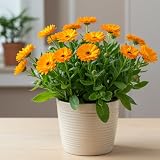


Plant Profile & Key Characteristics
Overview: A herbaceous plant reaching about 20-60 cm (8-24 in), grown as an ornamental, edible and medicinal plant; an annual or, in mild climates, a short-lived evergreen perennial.
Quick Specifications
| Specification | Attribute |
|---|---|
| Plant Type / Life Cycle | Annual or short-lived perennial |
| Foliage Type | Evergreen in mild climates (otherwise herbaceous) |
| Mature Size | 20-60 cm tall (8-24 in) |
| Growth Rate | Fast to Moderate |
| Root System | Taproot |
| Toxicity | Non-toxic; edible petals and medicinal |
| Hardiness | USDA zone 9+ (perennial) / 3-9 (annual) |
Growth Form & Structure
- Height & Spread: 20-60 cm (8-24 in); grows well in beds and containers.
- Growth Habit & Form: Bushy, upright herbaceous plant.
- Lifespan & Maturity: Fast-growing; flowers within a season, self-seeding readily.
Anatomy & Physical Features
- Leaves & Foliage: Green, lanceolate, sometimes hairy leaves.
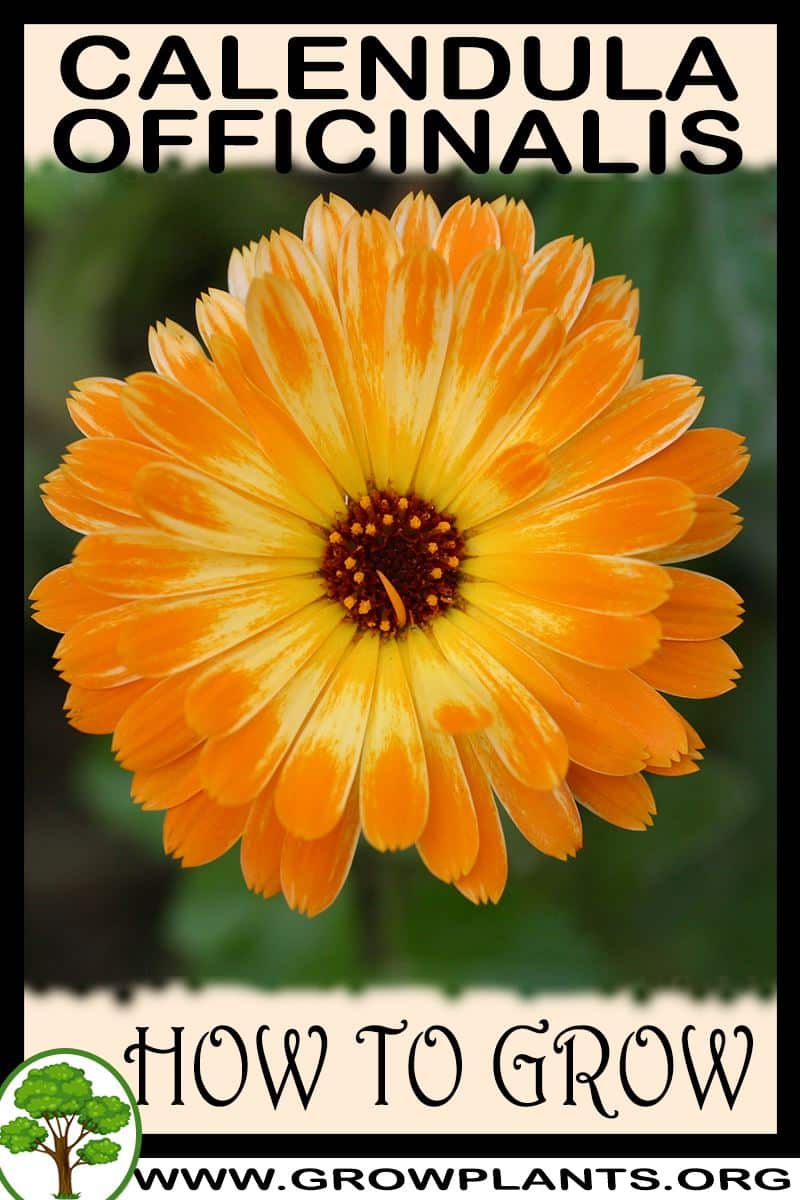
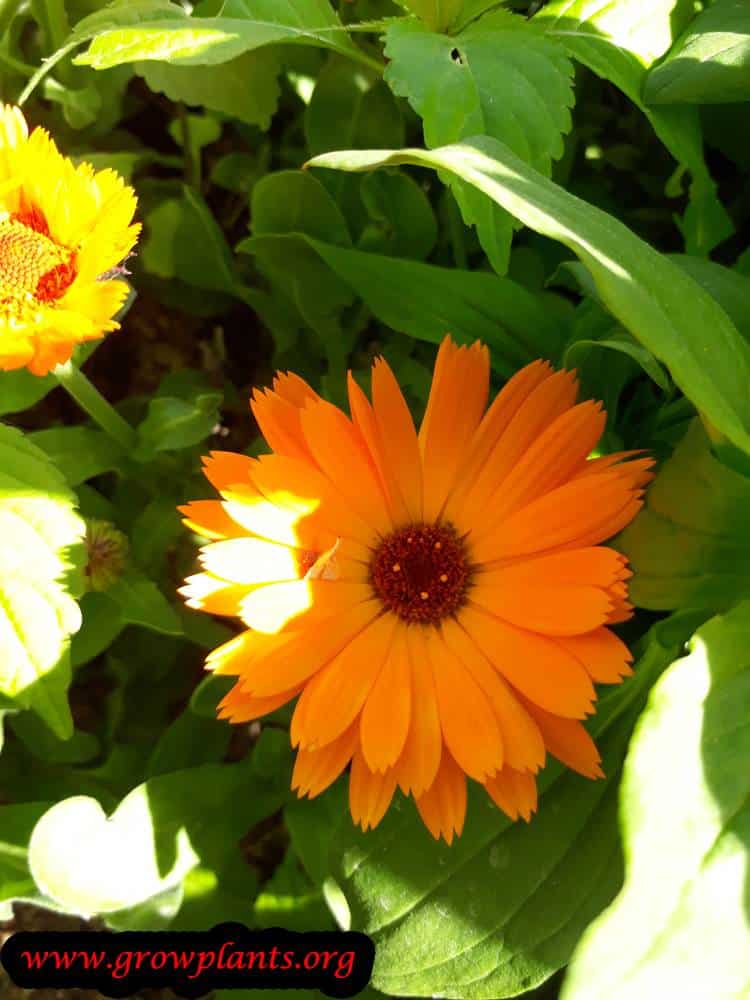
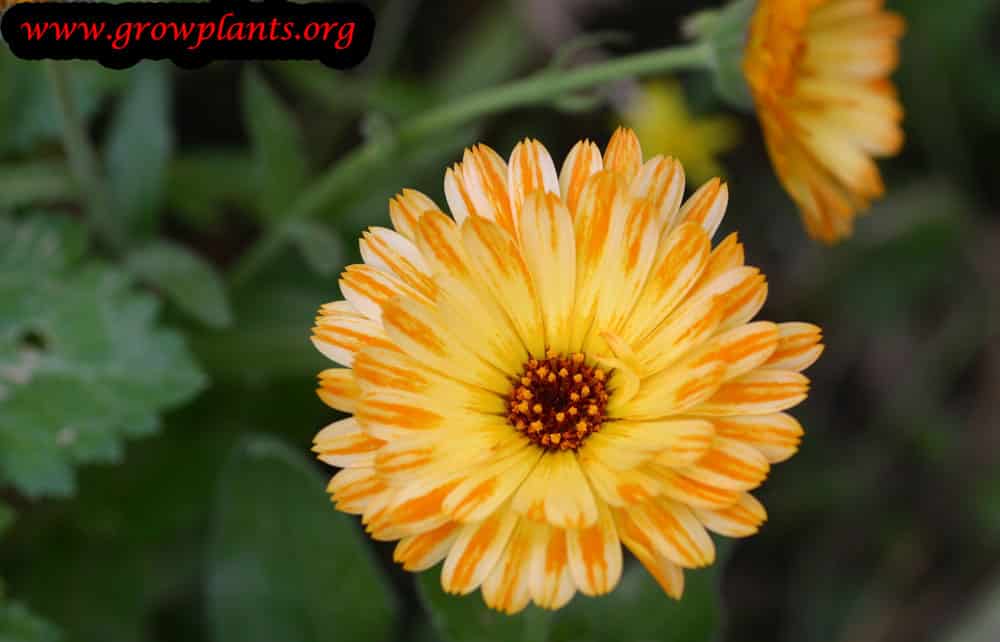
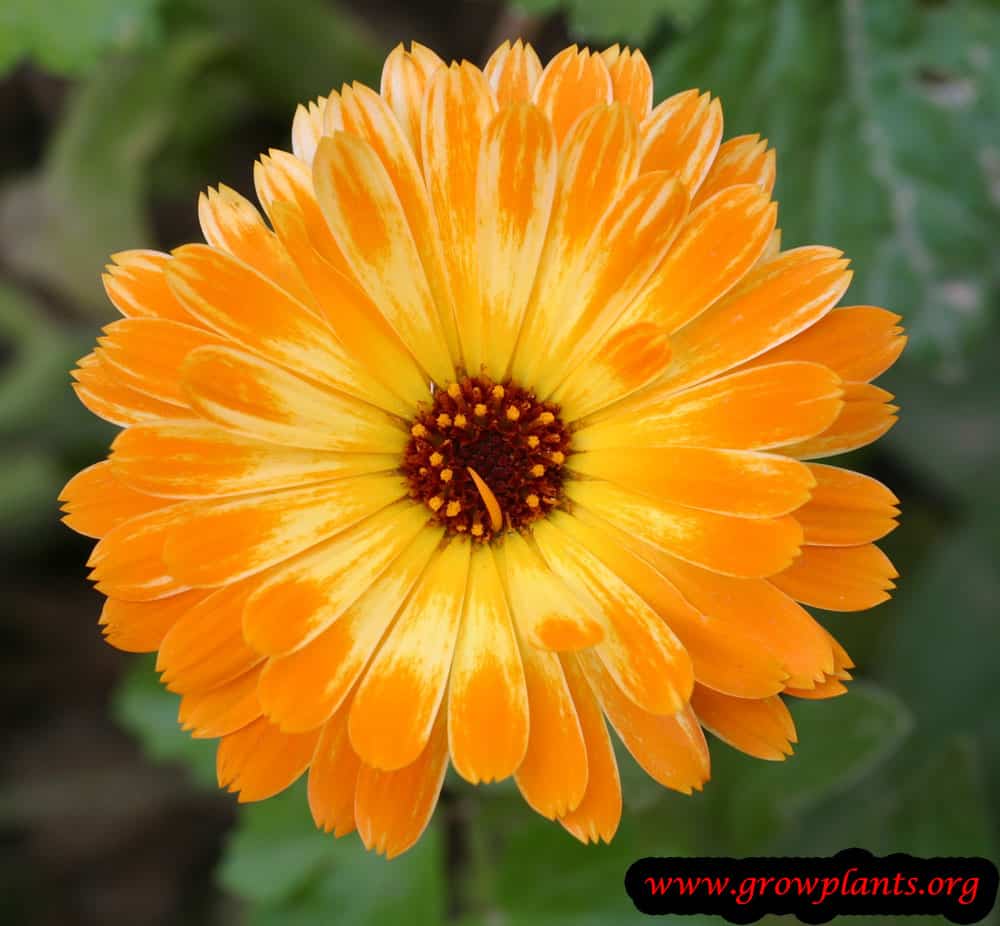
- Flower Characteristics: Daisy-like, flat, multi-petalled flowers in yellow or orange.
Primary Uses & Landscape Value
- Edible Uses: Edible petals used in salads and as a natural colouring; widely used in herbal teas and skin salves.
- Functional & Ornamental Roles: Ornamental bedding and cottage-garden plant, cut flower, companion plant, and medicinal herb.
Care Guide: Planting, Soil & Watering
Overview: An easy, cool-weather flowering herb for mediterranean to temperate gardens (hardiness zone 9+ as a perennial, 3-9 as an annual) in full sun to light shade. It grows in average, well-drained soil and needs only a light to moderate supply of water.
Quick Care Requirements
| Requirement | Ideal Condition |
|---|---|
| Planting Season | Cool season – spring or autumn |
| Growth Rate | Moderate to Fast |
| Soil Type | Average, well-drained |
| Water Need | Low to Moderate |
Planting & Establishment
- Best Planting Season: Plant in the cooler parts of the year – spring, or autumn in milder zones (around 10) – as it favours cool weather and struggles in high heat.
- How to Plant:
- Hole Preparation: Plant into ordinary, well-dug soil; it isn’t fussy about the site as long as drainage is reasonable.
- Soil Amendments: A little compost improves average soil, but rich feeding isn’t needed for good flowering.
- Planting Depth: Set the crown level with the soil surface – don’t bury the stem base.
- Growth Speed & Expectations: Fast to moderate, reaching 20-60 cm and flowering freely from spring into autumn.
Soil, Watering & Drainage Care
- Soil Mix & Drainage Needs: Average, free-draining soil suits it well; avoid rich, wet ground which encourages soft growth and rot.
- Watering Schedule & Technique:
- Young / Newly Planted: Keep the soil lightly moist while seedlings and young plants establish.
- Established: Once growing it needs only moderate water – let the surface dry between waterings.
- Seasonal Adjustments: Water a little more in warm dry spells and ease back in cool, damp weather.
Climate, Light & Hardiness
Calendula officinalis is a cool-season flowering plant, grown as a perennial in mild climates and as a cool-weather annual elsewhere; it thrives in full sun to half shade and prefers cooler conditions over intense summer heat. It is grown outdoors from about USDA zone 9 as a perennial, or zone 3–9 for a spring-through-cool-season annual display.
Quick Climate Specifications
| Climate Zones | Mediterranean, desert, subtropics, temperate |
| USDA Hardiness Zones | 9+ as a perennial; 3–9 as a cool-season annual |
| Optimal Temp Range | Approximately 10–24°C (50–75°F); flowering and quality decline in sustained heat |
| Frost Tolerance | Moderate - tolerates light frost better than it tolerates prolonged heat |
| Light Conditions | Full sun to half shade |
| Wind Tolerance | Moderate |
| Salt / Coastal Tolerance | Moderate |
Sunlight & Light Exposure
Optimal Light Setup
Full sun gives the most abundant bloom in cool weather; in hot climates a spot with some relief from intense afternoon sun helps prolong flowering.
Direct Sun Requirement
Direct sun is preferred during cooler months; in warm-summer climates, half shade helps reduce heat stress.
Shade & Heat Management
Performs best where summer heat is moderated by shade, elevation, or a cool-season growing schedule - flowering and plant vigor decline once sustained heat sets in.
Best Exposure / Orientation
An open bed that gets full sun in the cooler months of the year suits this cool-season bloomer well.
Temperature Extremes & Hardiness
USDA Hardiness & Regional Limits
As a perennial it is limited to about zone 9 and warmer; in colder zones (3–9) it is grown as a cool-season annual, since summer heat - not winter cold - is usually the more limiting factor for continued bloom quality.
Cold Damage & Winter Protection
Tolerates light frost reasonably well; in mild-winter climates it can be planted in autumn for winter-through-spring bloom.
Frost Sensitivity
Only mildly frost-sensitive compared with many bedding annuals, allowing autumn or early-spring planting in suitable zones.
Extreme Heat Tolerance
Poor tolerance of sustained heat - flowering and plant quality decline noticeably once temperatures stay consistently warm, which is the main factor limiting its growing season in hot climates.
Wind, Humidity & Microclimate
Humidity Preferences
Adapts to a range of humidity but benefits from good air circulation to reduce fungal disease in humid conditions.
Dry-Air Tolerance
Reasonably tolerant of dry air, particularly in its preferred cool, mediterranean-type climate.
Wind Tolerance
Moderate wind tolerance; its relatively low, branching habit is not easily damaged by wind.
Rainfall & Seasonal Moisture
Prefers a climate or planting schedule with cool, moderately moist conditions rather than hot, dry summer stretches.
Microclimate Recommendations
In hot-summer climates, timing planting for autumn-to-spring growth (rather than summer) keeps this cool-season plant within its comfortable temperature range.
Growing in Pots, Balconies & Indoors
Calendula officinalis (pot marigold) is a cheerful, easy annual – and, true to its name, an excellent pot plant for a sunny spot. The grower doesn’t rate it as a houseplant, but it flowers freely in containers on a patio, balcony or bright windowsill.
Quick Details
- Container Size: A small-to-medium pot, roughly 5-12 L (1.5-3 gal); it also grows well in window boxes
- Indoor Suitability: Not a true houseplant, but a compact plant can flower on a bright, sunny sill
- Best Spot: Full sun to light shade
- Soil & Drainage: Free-draining general potting mix; nothing rich is needed.
- Watering in Pots: Water when the surface begins to dry; it prefers moderate, steady moisture and dislikes waterlogging.
Indoors & On the Windowsill
- Houseplant limits: Deep indoors the light is too weak and plants grow pale and floppy.
- Windowsill growing: A compact strain on a sunny, direct-light sill can flower well – the closest this plant gets to being grown indoors.
On a Balcony or Patio
- Light & wind: Give it a sunny to lightly shaded spot; it is cool-tolerant and unfussy. Reflected wall heat dries pots faster, so check moisture in summer.
- Practicalities: Water the pot in – allow for its weight on a balcony, and set it where drainage runoff won’t be a nuisance.
Choosing the Pot, Soil & Long-Term Care
- Edible blooms: The petals are edible and long used in the kitchen – a nice bonus for a pot by the door.
- Pot & drainage: Choose a pot with strong drainage holes and skip a standing-water saucer, which invites root rot. Terracotta breathes and dries quickly, which suits these sun-lovers; glazed or plastic pots hold moisture longer if you can’t water often.
- Potting mix: Free-draining general potting mix; nothing rich is needed.
- Feeding: Potted plants use up their food faster because watering leaches nutrients away, so feed a little more often through the growing season than you would in open ground.
- Repotting: Refresh the mix or pot up about every couple of years to keep growth healthy.
Fertilizing & Feeding
A moderate feeder: pot marigold flowers most freely on balanced, unforced nutrition, and modest feeding also keeps the petals grown for salves and culinary use free of excess nitrate accumulation.
Quick Fertilizing Specs
| Feeding Level | Moderate feeder |
|---|---|
| Main Nutrient Priority | Balanced feeding rather than nitrogen-heavy, to favor flower production over foliage |
| Best Feeding Period | Cool-season growth in spring and autumn, or through mild winters where hardy |
| Organic Options | Compost worked into well-drained soil |
| Reduce/Stop Feeding | Ease off feeding as summer heat arrives and bloom winds down |
| Micronutrients | Usually met by a complete fertilizer; correct only a diagnosed deficiency |
| Soil pH | Tolerates a range of soils; performs best in well-drained conditions |
Feeding by Growth Stage
Establishing seedlings in cool weather
Get young pot marigold plants rooted in and growing steadily while the weather is still cool.
| Nutrient direction | A balanced, modest feeding paired with organic matter supports steady early growth without forcing soft, hairy foliage. |
|---|---|
| Timing | At planting in cool-season conditions, whether spring, autumn, or a mild winter. |
| Frequency | A light feeding at planting is usually enough to start. |
| Fertilizer types | A balanced complete fertilizer, Compost worked into the planting bed |
| Precautions | Keep initial feeding light; like other calendula, this species self-seeds and spreads readily, and rich soil only encourages that further. |
Main flowering flush
Support the flat, multi-petaled yellow or orange flowers this species is traditionally grown for, both ornamentally and for their petals.
| Nutrient direction | Balanced feeding, not a high-phosphorus bloom product, is what supports strong, reliable flowering here. |
|---|---|
| Timing | Through the main cool-season bloom period. |
| Frequency | Modest, occasional feeding sustains flowering without overdoing it. |
| Fertilizer types | A balanced complete fertilizer, Compost as a light top-dressing |
| Precautions | Avoid rich or frequent feeding, which pushes hairy green foliage at the expense of the flowers this plant is grown for. |
Extending bloom with regular harvest and deadheading
Keep flowers coming through the extended spring-to-autumn bloom window, since regular picking of flower heads also encourages more to form.
| Nutrient direction | A light, balanced feeding alongside regular removal of spent or harvested flowers helps sustain repeat flowering. |
|---|---|
| Timing | Through the growing season, following the initial bloom flush. |
| Frequency | Light, infrequent feeding paired with deadheading or harvest is usually enough. |
| Fertilizer types | A balanced complete fertilizer at reduced strength |
| Precautions | Keep feeding light here; this species is already noted as an aggressive self-seeder and doesn’t need extra encouragement. |
Heat decline or end-of-cycle rest
Let the plant decline gracefully as summer heat arrives, since this is fundamentally a cool-weather plant.
| Nutrient direction | None – withhold fertilizer once heat sets in and flowering fades for the season. |
|---|---|
| Timing | As summer heat arrives and bloom naturally declines, or once the plant has finished its cycle. |
| Frequency | No feeding at this stage. |
| Fertilizer types | No feeding at this stage; do not fertilize a plant that is declining in heat or finishing its cycle. |
| Precautions | Withhold fertilizer now; feeding a heat-stressed or spent plant only wastes nutrients. |
Nutrient Deficiency Signs & Corrections
Older leaves turn pale green to yellow and overall growth looks thin and weak.
| Possible causes | low available soil nitrogen, nitrogen leaching from watering during cool, wet weather, crowded plantings competing for nutrients |
|---|---|
| Appears first on | older, lower leaves |
| What to check | recent feeding history, watering and drainage, planting density |
| Possible correction | Apply a balanced complete fertilizer and work compost into the surrounding soil. |
Plenty of leafy, hairy foliage but relatively few flowers form.
| Possible causes | excess nitrogen feeding favoring foliage over blooms, warm weather stress on this cool-season plant, spent flowers left unharvested, letting seed set slow further blooming |
|---|---|
| Appears first on | whole plant, most noticeable at peak bloom time |
| What to check | recent feeding balance and amount, temperature and season, whether flowers are being picked or deadheaded |
| Possible correction | Moderate nitrogen-heavy feeding, expect fewer blooms as heat rises, and harvest or deadhead regularly to prolong flowering. |
Fine stippling or bronzing on leaves along with fine webbing in warm, dry conditions.
| Possible causes | hot, dry, dusty conditions favoring mite buildup, drought or under-watering stress weakening the plant, over-fertilizing producing soft growth more susceptible to pest damage |
|---|---|
| Appears first on | leaf undersides, especially in warm weather |
| What to check | recent watering consistency, signs of fine webbing on leaf undersides, recent feeding amounts |
| Possible correction | Keep the plant evenly watered, avoid overfeeding, and rinse foliage to discourage mites before considering a labeled treatment. |
Pruning, Training & Seasonal Maintenance
Pot marigold is a fast-growing, soft-stemmed annual (or short-lived perennial in mild-winter zones) with no woody framework, so pruning is entirely deadheading and light shearing. Unlike purely ornamental Calendula, this species is grown as much for its yellow/orange petals — used fresh or dried in cooking and skincare — as for garden display, so routine petal harvesting doubles as deadheading: picking flowers for use removes them before they set seed and directly prompts the plant to produce more. There is effectively no closed pruning season; light grooming and harvest can continue through the plant's active flowering.
Quick Pruning & Maintenance Specs
| Pruning Tolerance | High |
| Primary Pruning Window | Ongoing through the flowering period (spring–autumn; year-round in mild-winter zones) |
| Typical Frequency | Every 3–7 days while in bloom (harvesting/deadheading) |
| Main Objective | Sustain continuous flower/petal production and prevent unwanted self-seeding |
| Young Plant Priority | Pinch the growing tip once after transplanting to encourage a bushier, more productive plant |
| Mature Plant Priority | Harvest/deadhead flowers regularly; shear back hard if flowering stalls in summer heat |
| Best Tool Type | Fingers or precision snips |
| Avoid Heavy Pruning During | Not applicable — tolerates cutting back at any point in its cycle |
Pruning by Plant Age & Size
Newly Established
No pruning beyond removing damaged seedling leaves. Pinch the central tip once the plant has 3–4 sets of true leaves to build a bushier, more productive plant with more flowering stems to harvest from.
Young / Formative
No formal training system — this is a herbaceous mounding annual. Continue light tip-pinching to maximize the number of flowering stems before bloom begins.
Mature / Established
Harvest or deadhead flowers regularly — for petal use, pick just as flowers fully open for best color and yield. If growth turns sparse or flowering stalls during summer heat, shear the plant back by a third to a half to force fresh, more productive regrowth.
Seasonal Pruning Schedule
Because this species flowers across spring, summer and autumn (year-round where winters are mild), there is no single dormant pruning window; maintenance is continuous harvesting/deadheading rather than staged by season, with an optional mid-summer rejuvenation shear if heat stalls flowering.
Ongoing Sanitary
Objective: maximize usable flower/petal yield and appearance.
Remove: open flowers (harvested for use) or faded heads left too long, plus yellowing foliage.
Do not remove: unopened buds.
Expected response: rapid rebloom, typically within 1–2 weeks.
Flowering impact: regular harvesting/deadheading increases total flower count over the season; letting heads go to seed shortens both the bloom and harvest window.
Special Growth to Remove
- Open flowers past their prime (or ready for harvest) — cut/pick back to a leaf node or side bud to trigger branching and new buds.
- Dead/yellowing leaves — remove for appearance and to reduce fungal leaf-spot risk in humid conditions.
- Excess self-sown seedlings — this species self-seeds readily; thin volunteers if a contained bed is wanted.
Container & Small-Space Pruning
In pots, harvest/deadhead even more promptly than in-ground plantings, since container plants have less root volume to spare for seed production. A light all-over shear at mid-season keeps container specimens compact and productive; root pruning does not apply to this annual habit.
Tools
- Precision snips or fingers — the only tool needed; stems are soft and easily pinched or snipped for both harvest and deadheading.
Tool Hygiene & Disease Risk
Routine — keep tools reasonably clean, particularly since flowers here are harvested for culinary/medicinal use. Powdery mildew and aphids are the noted risks; wipe blades if handling visibly diseased material before moving to healthy plants or harvestable flowers.
Cut Placement & Technique
Cut or pinch the stem back to just above the nearest leaves or a side bud, not just the flower head itself, so the plant branches and produces a new flowering stem rather than one bare regrowing stub.
Heavy Pruning & Rejuvenation
Tolerated well: if plants become leggy or flowering slows in mid-summer heat, shear the entire plant back by a third to half its height. Expect a brief 1–2 week gap before a flush of fresh, more compact, more productive growth.
Post-Pruning Care
Water normally after a hard shear-back; skip extra feeding, which pushes soft growth at the expense of flower/petal production. Watch new growth for aphids, drawn to tender regrowth.
Common Pruning Mistakes
- Letting flowers pass their peak unharvested/undeadheaded, which shortens both the display and the usable-petal season.
- Cutting only the flower head and leaving a long bare stub, wasting the plant's energy on a stem that won't rebloom.
- Never shearing back leggy summer growth, resulting in a sparse plant with fewer flowers to harvest for the rest of the season.
When NOT to Prune
Avoid heavy shearing during extended wet, humid weather when powdery mildew or botrytis risk on fresh-cut wounds is elevated; otherwise this species can be groomed or harvested at essentially any time.
Recommended Tools (by task)
- precision_snips — for routine flower harvesting, deadheading, and stem pinching on this soft-stemmed annual.
Propagation Guide
Calendula officinalis, the classic pot marigold, is propagated almost entirely by seed – it germinates quickly, needs no grafting or special vegetative technique, and self-sows so freely that many gardens are maintained from volunteer seedlings alone. Seed produces plants true to the species, and propagation is Easy.
Quick Propagation Specs
| Best Propagation Method | Seed (direct sow or seed tray) |
| Alternative Methods | Self-sown volunteer seedlings |
| Propagation Difficulty | Easy |
| Seed True-to-Type | Usually true-to-type |
| Best Propagation Season | Spring (autumn sowing possible in hardiness zone 10+) |
| Seed Germination Time | Roughly 1–2 weeks |
| Germination Temperature | About 18–21°C (65–70°F) |
| Seed Sowing Depth | Shallow, about 0.5–1 cm (¼–½ inch) |
Growing from Seed
Sowing Season
Direct-sow in spring after the last frost; where winters are mild (hardiness zone 10 and warmer) an autumn sowing also works.
Sowing Depth & Orientation
Cover seed lightly, roughly 0.5–1 cm (¼–½ inch) deep; no particular orientation is required.
Germination Conditions
Cool, bright conditions with even soil moisture suit germination best.
Germination Time
About 1–2 weeks under favorable conditions.
Seedling Care
Thin crowded seedlings once true leaves form, and move young plants to their final spot while still small – the goal is to avoid unnecessary root disturbance.
Bloom & Edible Flower Guide
Quick Details
- Bloom Season: Spring, summer, and autumn
- Flower Appearance: Flat, many-petaled daisy-like flowers in yellow or orange
- Edibility: Edible – the petals are edible with a mildly tangy, slightly peppery taste and are sometimes used to color food as a saffron substitute
Detailed Blooming Overview
Pot marigold is one of the great long-flowering annuals, throwing out flat, cheerful daisies in warm yellow and orange from spring right through autumn. Both a kitchen and a medicinal plant by tradition, it keeps blooming best when the flowers are picked or deadheaded regularly.
Flower Characteristics
- Flat, open flowers packed with many petals (ray florets).
- Bright yellow to deep orange, on sturdy stems above the foliage.
Bloom Care & Thinning
- Prolonging the bloom: Picking flowers and deadheading spent ones keeps the plant producing buds for months.
- Using the flowers: Harvest freshly opened, unsprayed blooms and pull the petals for salads, rice, and garnishes.
Bloom Health & Protection
- Aphids: These sap-suckers often cluster on buds and flower stems – a strong jet of water, or an insecticidal soap or neem oil, keeps them in check.
- Powdery mildew: A white coating can appear on foliage in humid, crowded plantings – good spacing and airflow help, with a sulfur- or bicarbonate-based fungicide as a backup.
Fruit & Uses
The edible part of Calendula officinalis (Pot Marigold) is the flower – specifically the ray florets (“petals”) that make up the yellow or orange bloom. They are eaten raw, fresh off the plant, or dried for later use, with no cooking required.
Quick Edible Specs
| Edible Parts | Flower petals (ray florets) |
|---|---|
| Main Use(s) | Culinary (garnish, salads, colorant/saffron substitute, tea); medicinal-note (traditional herbal preparations) |
| Eaten Raw or Cooked | Raw (fresh) or dried |
| Preparation Required | None – rinse before use; pull petals free of the bitter green flower base |
| Harvest Season | Through the bloom season – spring, summer and autumn |
| Time to First Harvest | As soon as flowers open; picking continues for as long as the plant keeps blooming |
| Storage | Best used fresh; petals can also be air- or oven-dried and kept airtight, out of light |
| Safety/Toxicity Caveat | Only the petals are eaten, not the bitter green receptacle/base; people with Asteraceae (daisy family) or ragweed allergies should be cautious |
Flowers & Flower Buds
Pick flower heads once fully open, ideally on a dry day. Snip or pinch off the whole head, then separate the petals from the central disc by hand – only the petals are used. Fresh petals add mild, slightly peppery flavour and bright colour to salads, eggs, rice, soups and soft cheeses. Dried petals are commonly used as an affordable substitute for saffron, colouring rice, soups and baked goods, and are also steeped as a tea or infused into honey or oil.
Harvesting
Harvest is repeat and season-long rather than a single event: picking flowers regularly (the same deadheading described in Pruning) encourages the plant to keep producing new blooms, so edible and ornamental upkeep go hand in hand.
Preparation, Uses & Safety
No cooking or processing is required – petals are ready to eat as soon as they are picked and rinsed. Beyond fresh culinary use, dried calendula has a long history in traditional herbal preparations (teas, salves); this is a traditional-use note only, not a health claim. Stick to the petals themselves, avoid the tougher green flower base, and anyone with known sensitivity to Asteraceae-family plants or pollen should introduce it cautiously.
Pests, Diseases & Troubleshooting
Overview: Pot marigold is an easy, cheerful annual/short-lived perennial whose main troubles are aphids (which it also traps away from other crops) and foliar fungal diseases – powdery mildew and its characteristic smut/leaf spot – especially in humid, crowded, or ageing plantings. It is otherwise robust and pollinator-friendly.
Quick Troubleshooting Overview
| Issue / Pest | Main Symptom | Primary Solution |
|---|---|---|
| Aphids | Sticky, curled growth; clusters on buds | Water jet, insecticidal soap, beneficials |
| Whitefly & thrips | White flies or silvery streaks, honeydew | Sticky traps, soap/oil |
| Spider mites | Fine stippling in hot dry weather | Hose off, oil/soap |
| Caterpillars | Chewed leaves and flowers | Hand-pick, Bt |
| Powdery mildew | White coating on leaves late season | Airflow, spacing, sulphur |
| Smut / leaf spot | Pale then brown blotches on leaves | Remove leaves, avoid wet foliage |
Common Pests & Management
- Aphids (Aphis fabae, Myzus persicae):
- Symptoms: Dense green or black clusters on new shoots, flower buds and stems, causing curling, honeydew and sooty mould; calendula is a well-known aphid magnet (useful as a trap plant).
- Prevention & Control: Blast off with water and rely heavily on the ladybirds, hoverflies and lacewings the flowers attract; use insecticidal soap only for heavy build-ups, keeping open flowers clear for pollinators.
- Whitefly (Trialeurodes / Bemisia spp.):
- Symptoms: Tiny white flies clustering on leaf undersides, rising in clouds when disturbed, with honeydew and yellowing.
- Prevention & Control: Use yellow sticky traps, encourage parasitoids, and spray insecticidal soap or horticultural oil on undersides if numbers climb.
- Thrips (Frankliniella spp.):
- Symptoms: Silvery streaking and speckling on leaves and petals, deformed buds, and dark frass; thrips also vector viruses.
- Prevention & Control: Monitor with blue sticky traps, remove affected buds, and treat with insecticidal soap or spinosad.
- Spider mites (Tetranychus spp.):
- Symptoms: Fine stippling, bronzing and webbing in hot, dry conditions, especially on stressed plants.
- Prevention & Control: Hose down foliage and relieve drought stress; horticultural oil or insecticidal soap controls outbreaks.
- Caterpillars (cabbage looper, cutworms) & slugs/snails:
- Symptoms: Chewed, holed leaves and flowers with frass from caterpillars, or ragged holes and slime trails from molluscs on seedlings.
- Prevention & Control: Hand-pick, use Bt for caterpillars, and protect seedlings with iron-phosphate bait or grit against slugs and snails.
Diseases & Fungal Issues
- Powdery mildew (Podosphaera / Golovinomyces spp.):
- Symptoms: White powdery coating on leaves and stems, common on crowded, ageing, or shaded plants late in the season, leading to yellowing and decline.
- Treatment & Management: Space plants for airflow, grow in sun, avoid excess nitrogen, and remove the worst-affected leaves. Treat early with sulphur, potassium bicarbonate, or a horticultural oil; replace tired plants with fresh sowings.
- Calendula smut / white leaf spot (Entyloma and Cercospora):
- Symptoms: Round pale-yellow to grey spots that turn brown and papery, sometimes numerous enough to blight the foliage in wet seasons.
- Treatment & Management: Remove and destroy affected leaves, water at the base to keep foliage dry, and improve spacing. Copper-based fungicide helps in persistently wet weather; practise crop rotation with annual sowings.
- Downy mildew & rust (occasional):
- Symptoms: Downy mildew gives yellow blotches with greyish growth beneath in cool damp weather; rust shows orange-brown pustules on undersides.
- Treatment & Management: Improve airflow and drainage, remove affected leaves, and avoid overhead watering; copper helps for downy mildew.
- Botrytis, damping-off & aster yellows:
- Symptoms: Botrytis rots flowers and seedlings in damp still air; damping-off collapses seedlings at the soil line; aster yellows (a phytoplasma spread by leafhoppers) causes stunted, deformed, greenish flowers.
- Treatment & Management: Sow thinly in clean mix with good airflow to prevent damping-off and botrytis; there is no cure for aster yellows – remove affected plants and control leafhoppers.
Growing Difficulties & Abiotic Problems
- Heat decline / poor bloom:
- Cause & Symptoms: Legginess, sparse flowering and general fading in hot weather – calendula is a cool-season plant that performs best in mild conditions.
- Correction Strategy: Grow in the cooler parts of the year, deadhead regularly to prolong bloom, and expect and accept a summer lull; re-sow for a fresh flush in cooler weather.
- Root rot in wet soil:
- Cause & Symptoms: Yellowing, wilting and collapse in heavy, waterlogged ground.
- Correction Strategy: Grow in free-draining soil, avoid overwatering, and don’t crowd plants in damp beds.
- Legginess in shade:
- Cause & Symptoms: Weak, stretched, poorly-flowering plants in too little light.
- Correction Strategy: Grow in full sun to light shade; strong light keeps plants compact and floriferous.
What Helps – Products & Tools
Because calendula draws in so many beneficial insects, lean on them first; otherwise keep on hand insecticidal soap for aphid, whitefly and mite outbreaks, yellow/blue sticky traps for whitefly and thrips, Bt and iron-phosphate bait for caterpillars and slugs, and sulphur, potassium bicarbonate or copper fungicide for powdery mildew, smut and leaf spot.