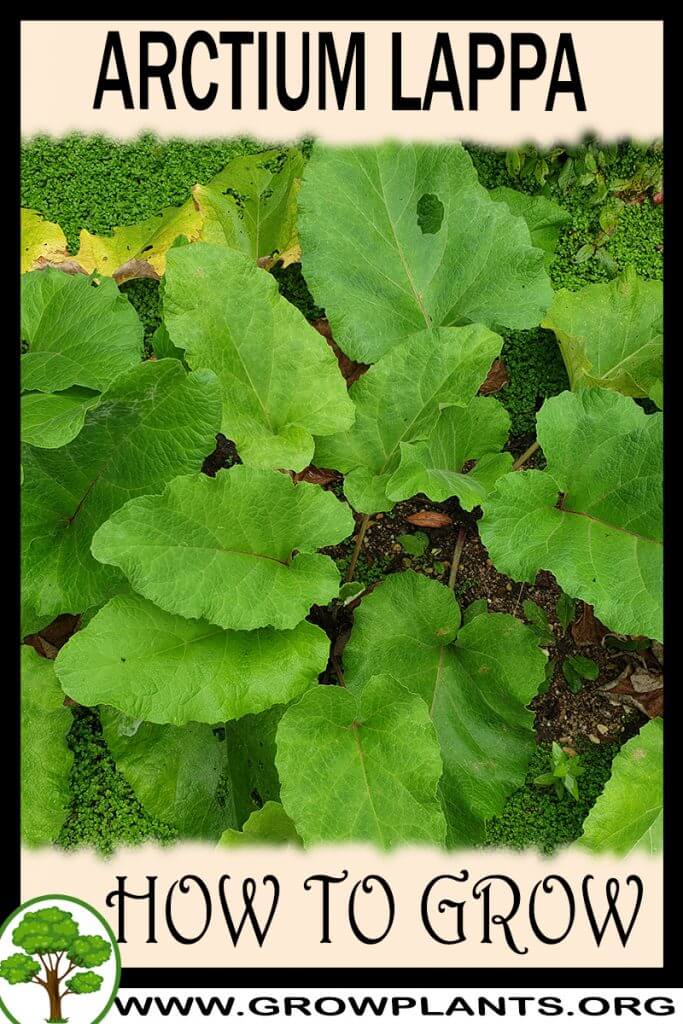
Plant Profile & Key Characteristics
Overview: Greater burdock (Arctium lappa), also known as gobo, is a large biennial herb reaching 1-2 m and grown mainly for its long, edible taproot. It builds a rosette of big leaves in the first year and sends up spiny purple flower heads in the second.
Quick Specifications
| Specification | Attribute |
|---|---|
| Plant Type / Life Cycle | Biennial |
| Mature Size | 1-2 m tall (3-6 ft) |
| Growth Rate | Fast to moderate |
| Root System | Long, thick taproot (the edible gobo root) |
| Toxicity | Non-toxic – root, young leaves and flower heads are edible |
| Hardiness | USDA zones 3-7 |
Growth Form & Structure
- Height & Spread: 1-2 m (3-6 ft) tall when flowering; can be grown in a deep container to accommodate the long root.
- Growth Habit & Form: Robust herbaceous plant forming a broad basal rosette the first year, then a tall branched flowering stalk.
- Lifespan & Maturity: Biennial – roots are usually harvested in the first summer/autumn before the plant flowers and dies in year two.
Anatomy & Physical Features
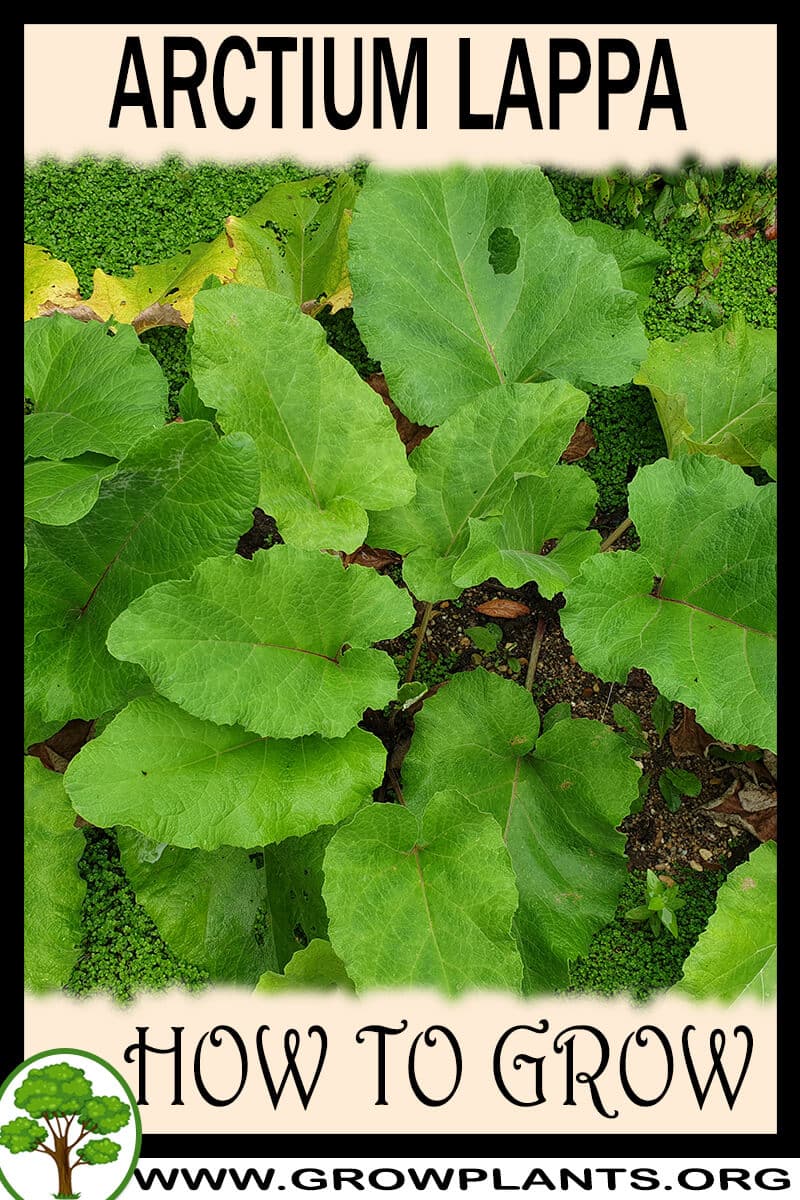
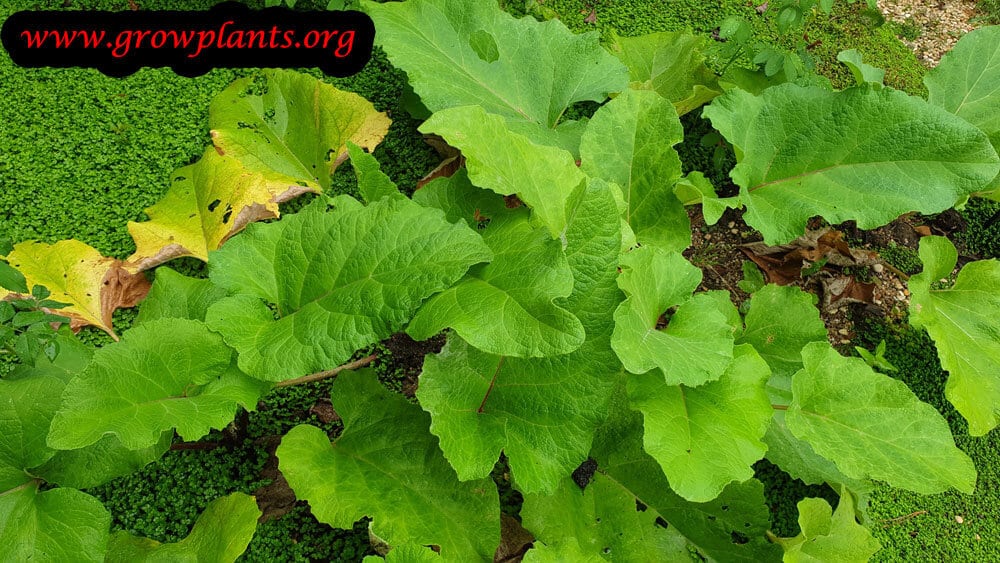
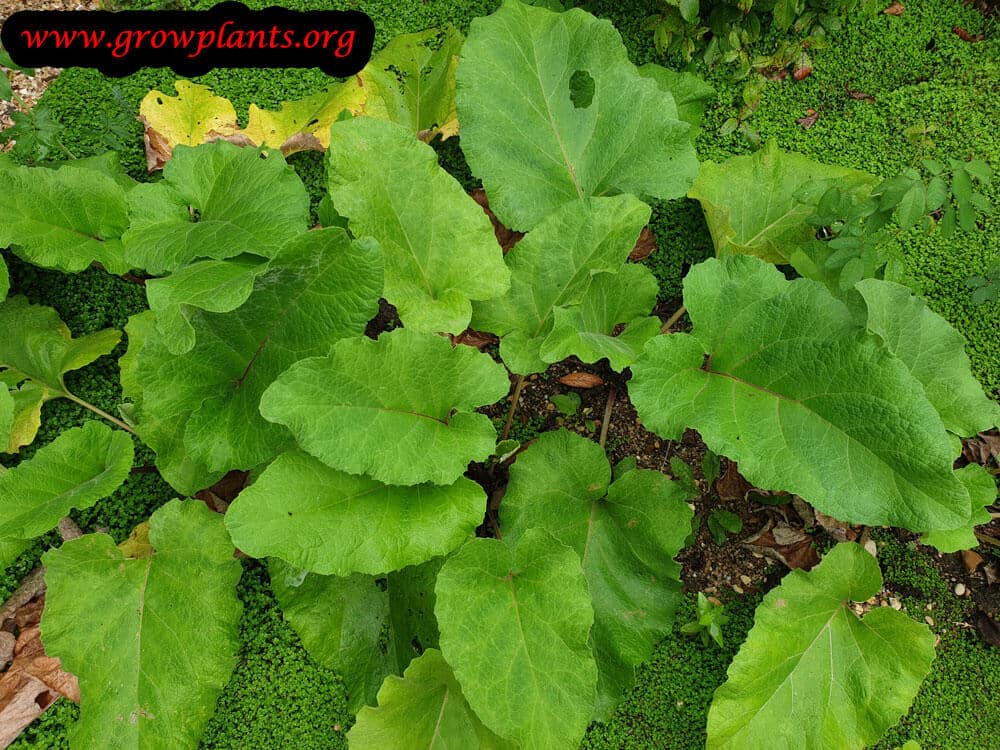
- Leaves & Foliage: Large green leaves in a spear to deltoid (arrowhead) shape; young leaves are edible.
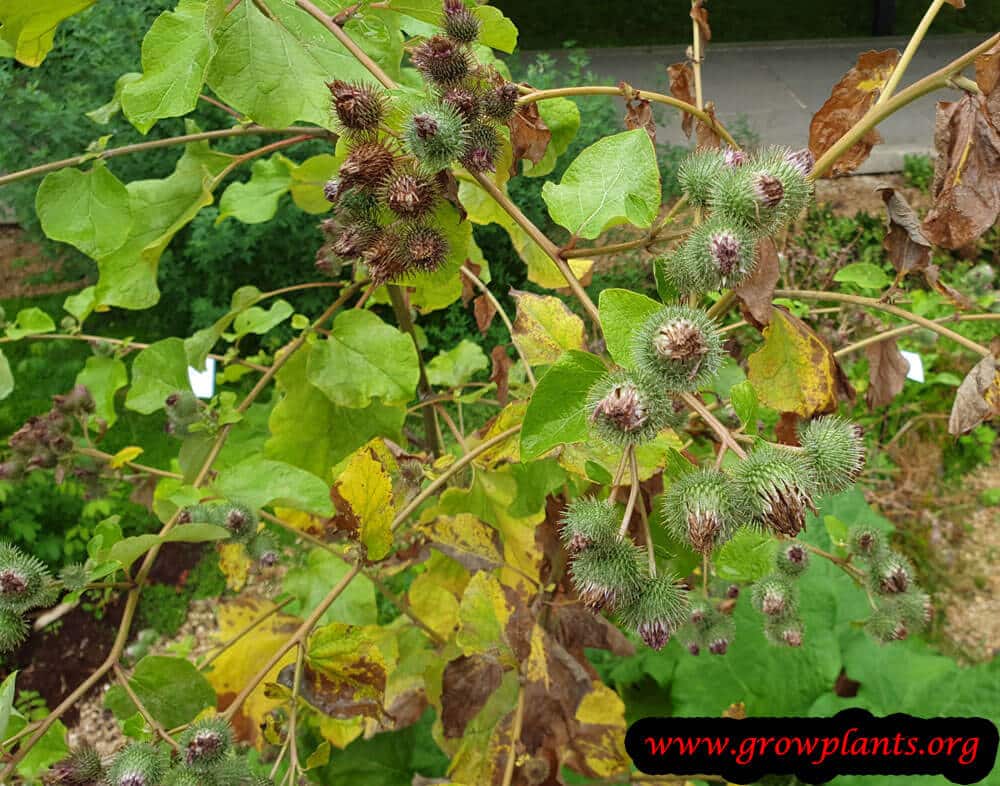
- Flower Characteristics: Purple thistle-like flower heads surrounded by hooked spines (the burrs).
- Fruit Profile: Bristly burrs (seed heads) that cling to fur and clothing.
Primary Uses & Landscape Value
- Edible Uses: Long taproot eaten cooked or used as a beverage; young leaves cooked, flower heads eaten cooked or raw.
- Functional & Ornamental Roles: Grown as an edible/root vegetable and traditional medicinal; also ornamental, though it can be invasive.
Care Guide: Planting, Soil & Watering
Overview: Greater burdock is a vigorous biennial grown for its long edible taproot, thriving in full sun to part shade and cool climates. It wants deep, loose, consistently moist soil so the roots can drive straight down.
Quick Care Requirements
| Requirement | Ideal Condition |
|---|---|
| Planting Season | In spring through autumn during the warm season |
| Growth Rate | Fast |
| Soil Type | Deep, loose, rich and moisture-retentive |
| Water Need | Moderate to High; keep evenly moist |
Planting & Establishment
- Best Planting Season: Sow or plant out from spring into summer, and into autumn in hotter climates, once the soil has warmed.
- How to Plant:
- Hole Preparation: Cultivate deeply, loosening at least 30-60 cm (1-2 ft) of soil and removing stones so the long taproot can grow straight and unforked.
- Soil Amendments: Dig in plenty of compost or well-rotted organic matter to feed this hungry, fast grower and help the soil hold moisture.
- Planting Depth: Set transplants at the same depth they grew in the pot, keeping the crown at soil level.
- Growth Speed & Expectations: A fast grower that reaches 1-2 m (3-6 ft), so give it room; note that it self-seeds and can spread.
Soil, Watering & Drainage Care
- Soil Mix & Drainage Needs: It likes rich, moisture-retentive but not waterlogged soil, and loose, deep ground gives the best roots. It can be grown in a deep container.
- Watering Schedule & Technique:
- Young / Newly Planted: Keep seedlings and transplants consistently moist while they establish.
- Established: Water regularly and deeply so the soil never dries out; steady moisture keeps the roots tender and helps prevent premature bolting.
- Seasonal Adjustments: Increase watering in summer heat and ease off in cool or wet weather.
Climate, Light & Hardiness
Greater burdock is a cold-hardy biennial suited to temperate and subtropical regions with reliably cool, moist conditions; it needs full sun in cooler climates but appreciates some afternoon shade where summers run hot.
Quick Climate Specifications
| Climate Zones | Temperate, subtropical |
|---|---|
| USDA Hardiness Zones | Approximately 3–7 |
| Light Conditions | Full sun; half shade in hotter climates |
Sunlight & Light Exposure
Optimal Light Setup
Full sun suits cool-temperate climates best.
Shade & Heat Management
In hotter subtropical areas, half shade helps prevent heat stress; the plant's preference for a cool climate and consistently moist soil points to one that does not relish intense heat.
Temperature Extremes & Hardiness
USDA Hardiness & Regional Limits
Hardy roughly zone 3–7, completing its two-year biennial cycle - a rosette the first year and a flowering stalk the second - within that range.
Wind, Humidity & Microclimate
Rainfall & Seasonal Moisture
Prefers consistently moist soil and a cool climate rather than hot, dry conditions.
Growing in Pots, Balconies & Indoors
Burdock is a large biennial grown for its long taproot, reaching 1-2 m; the grower confirms container growing but not as a houseplant. If you want a usable root, give it the deepest pot you can.
Quick Details
- Container Size: A deep container of 30 L or more – depth matters for the long taproot
- Indoor Suitability: Not an indoor plant – too large, and the root needs deep, cool soil
- Best Spot: Full sun, or part shade in hot climates – outdoors
- Soil & Drainage: Deep, loose, well-drained organic mix so the taproot can run
- Watering in Pots: Water generously and keep the mix consistently moist – pots dry fast; ensure excess drains away and never leave it standing in water
Indoors & On the Windowsill
- Not a houseplant: The grower marks it No – it is a big plant whose root needs a deep, cool run of soil.
- Windowsill note: Not suited to a sill; grow it outdoors in a tall, deep container.
On a Balcony or Patio
- Light, wind & heat: Give it the sunniest spot you have. Walls and paving reflect heat so pots dry quickly – check moisture often in warm weather. On an exposed balcony, stake tall stems and shelter from strong wind.
- Practicalities: A full pot is heavy once watered – make sure the balcony can take the load and that drainage runoff has somewhere to go.
Choosing the Pot, Soil & Long-Term Care
- Pot & drainage: Use a pot with strong drainage holes and skip a standing-water saucer to avoid root rot. Terracotta breathes and dries faster; glazed or plastic pots hold moisture longer.
- Potting mix: A well-aerated, organic-rich mix – potting mix or peat/coir blended with perlite or vermiculite for free drainage.
- Feeding: Potted plants need feeding more often than those in open ground, as nutrients leach out with each watering – feed regularly through the growing season.
- Season to season: As a short-lived plant there is no long-term repotting – empty and refill the pot with fresh, clean mix each cycle so pests and disease are not carried over.
Fertilizing & Feeding
A moderate feeder grown for its long edible taproot: balanced feeding at establishment, nitrogen while the leafy top growth builds, then a shift to potassium as the root develops, with feeding stopped as harvest nears.
Quick Fertilizing Specs
| Feeding Level | Moderate feeder |
|---|---|
| young_feeding | A balanced starter feeding with organic matter worked into the bed |
| mature_feeding | Shift toward potassium as the taproot develops, then stop before harvest |
| Best Feeding Period | From establishment through root development |
| Main Nutrient Priority | Balanced early, nitrogen for leafy growth, then potassium for the developing taproot |
| Soil pH | Prefers moist, well-worked soil |
| Organic Options | Compost or aged organic matter worked into the soil |
| Reduce/Stop Feeding | Stop feeding as the plant approaches its summer-to-autumn root harvest |
Feeding by Growth Stage
Establishment after sowing or transplanting
Help seedlings or young plants root in before the taproot begins to develop.
| Nutrient direction | A balanced complete fertilizer with organic matter worked into the bed. |
|---|---|
| Timing | At sowing or transplanting, in spring or, in warmer climates, into autumn. |
| Frequency | A modest starter feeding as seedlings establish. |
| Fertilizer types | Balanced complete fertilizer, Compost or aged organic matter worked into the soil |
| Precautions | This plant can be invasive; site it away from wild areas and manage self-seeding. |
Leafy growth
Build the broad, spear-shaped leaves that fuel development of the long edible taproot.
| Nutrient direction | A nitrogen-forward complete fertilizer to drive leafy growth. |
|---|---|
| Timing | During the main leafy growth period. |
| Frequency | Feed moderately while the foliage is actively expanding. |
| Fertilizer types | Complete fertilizer with a nitrogen emphasis |
| Precautions | Do not overdo nitrogen, which favors top growth at the expense of the taproot. |
Root development
Support lengthening and sizing of the long, edible taproot.
| Nutrient direction | Shift toward potassium with a complete fertilizer as the root develops. |
|---|---|
| Timing | As the plant matures toward its summer-to-autumn root harvest. |
| Frequency | Feed moderately through root development. |
| Fertilizer types | Complete fertilizer with a potassium emphasis |
| Precautions | Loose, deep, well-worked soil matters as much as feeding for a straight, unforked taproot. |
Maturation before harvest
Let the taproot finish developing before it is dug.
| Nutrient direction | None – withhold fertilizer as harvest approaches. |
|---|---|
| Timing | As the plant approaches its summer-to-autumn harvest window. |
| Frequency | No feeding at this stage. |
| Fertilizer types | No feeding at this stage – a maturing root is not the time for fresh fertilizer. |
| Precautions | Do not fertilize until active growth resumes in a following planting. |
Nutrient Deficiency Signs & Corrections
Older, lower leaves turn uniformly pale green to yellow and overall growth slows.
| Possible causes | Low available nitrogen in the soil, Cold or waterlogged soil limiting root uptake, Nitrogen leached away after heavy watering or rain |
|---|---|
| Appears first on | Older, lower leaves. |
| What to check | Recent feeding history, Soil moisture and drainage, Whether paling starts on old lower leaves |
| Possible correction | Apply a balanced complete fertilizer at a light rate and improve drainage. |
Older leaves show yellowing and browning along their margins.
| Possible causes | Low available potassium in the soil, Sandy soils that hold few nutrients, Drought stress limiting uptake during root development |
|---|---|
| Appears first on | Older, lower leaves, starting at the margins. |
| What to check | Leaf margins on older leaves, Soil type and organic matter, Watering consistency |
| Possible correction | Apply a complete fertilizer that also supplies potassium and keep the soil evenly moist. |
Roots forked, stunted, or misshapen at harvest.
| Possible causes | Compacted, rocky, or shallow soil restricting root growth, Excess nitrogen favoring leafy growth over root development, Fresh manure or an obstruction in the root zone |
|---|---|
| Appears first on | The harvested taproot itself. |
| What to check | Soil compaction and depth, Recent nitrogen feeding levels, Stones, clay, or manure in the planting bed |
| Possible correction | Work the bed deeply, avoid fresh manure and excess nitrogen, and plant in loose, stone-free soil. |
Pruning, Training & Seasonal Maintenance
Greater burdock is a biennial: a basal rosette forms in year one, then in year two it bolts, flowers in summer/autumn, sets its notorious hooked burs, and dies. Almost no true pruning is needed or done—the plant’s own data limits it to ongoing dead-leaf removal. The one genuinely important pruning-relevant task is deadheading spent flower heads before the burs mature and disperse, since the species is explicitly flagged invasive and spreads by hitchhiking on animals and clothing.
Quick Pruning & Maintenance Specs
| Pruning Tolerance | Low – a rosette/taproot plant, not a cut-and-shape plant |
| Primary Pruning Window | Ongoing sanitary, all season |
| Secondary Maintenance Window | Late summer, before the seed burs dry and disperse |
| Main Objective | Sanitary tidiness; preventing unwanted self-seeding (per its own “Invasive” flag) |
| Young Plant Priority | None – let the first-year rosette fully develop |
| Mature Plant Priority | Deadhead before bur-set; remove dead leaves |
| Best Tool Type | Bypass secateurs for flower stalks; leaves are simply harvested/cut at the base |
| Avoid Heavy Pruning During | First-year rosette development – the plant needs full leaf area to build its taproot |
Pruning by Plant Age & Size
Newly Established (Year 1 Rosette)
No pruning. Root and second-year growth quality depend on an unchecked first-year rosette, so leave the leaves alone beyond removing anything clearly dead.
Young / Formative
Not applicable—this is a taprooted rosette plant with no structural framework to train.
Mature / Established (Year 2, Bolting & Flowering)
As a monocarpic biennial, the whole plant dies after seeding, so there is no renewal pruning. The only decision is whether to cut spent flower stalks before the burs mature (to stop self-seeding) or leave them if you’re intentionally seed-saving.
Seasonal Pruning Schedule
Ongoing Sanitary
Objective: tidiness, matching the plant’s own “All season” pruning-window fact. Remove: dead or yellowing leaves. Do not remove: healthy first-year rosette leaves, which build the taproot. If harvesting leaves for food, the plant’s own data specifies taking them “just when the plant [is] young,” cut at the base.
Pre-Seed-Set (Late Summer, Before Burs Mature)
Objective: stop unwanted spread. Remove: spent flower heads/stalks at the base before the hooked burs dry and detach. Do not remove: heads you intend to seed-save. Expected response: no regrowth—this is a monocarpic plant’s final season.
Special Growth to Remove
- Spent flower/seed heads—the single highest-value cut given the plant’s documented invasiveness; remove before the burs dry and disperse.
- Dead or damaged lower leaves through the season.
Container & Small-Space Pruning
Arctium lappa develops a long taproot (it is harvested as the plant’s “root,” per its own data), so container culture needs a deep pot rather than any canopy-shaping—there is no canopy to prune, only depth to accommodate.
Tools
- Precision snips or bypass secateurs for cutting flower stalks and harvesting young leaves at the base.
Tool Hygiene & Disease Risk
Routine. No transmissible disease is flagged for this plant.
Cut Placement & Technique
Cut spent flower stalks at their base. Harvest young leaves at the base, per the plant’s own instruction.
Heavy Pruning & Rejuvenation
Not applicable—a biennial taproot plant that dies after its second-year flowering has no framework to rejuvenate.
Post-Pruning Care
None special.
Common Pruning Mistakes
- Letting burs mature and disperse, spreading this documented invasive plant via clothing and animal fur.
- Stripping first-year rosette leaves too aggressively, weakening the root and second-year growth.
When NOT to Prune
- Don’t remove first-year rosette leaves needed to build the taproot.
- Skip cutting spent heads before seed-set if intentionally seed-saving.
Recommended Tools (by task)
- Task: Cutting spent flower stalks before burs mature – fibrous stem → bypass_secateurs – tougher than a soft herb stem but not woody enough to need loppers.
- Task: Harvesting young leaves at the base → precision_snips – clean single cuts on soft leaf stalks.
Propagation Guide
Burdock is propagated from seed, the only method typically used or needed for this biennial root-and-leaf crop; seed-grown plants are true to the species and no grafting or vegetative propagation is required. Propagation is easy, but the site notes the plant can be invasive, so spent flower heads are best removed before seed sets if self-seeding is a concern.
Quick Propagation Specs
| Best Propagation Method | Direct-sown seed |
| Alternative Methods | Nursery-grown seedlings/transplants |
| Propagation Difficulty | Easy |
| Seed True-to-Type | Yes |
| Best Propagation Season | Spring; also summer or autumn in warmer climates |
Growing from Seed
Sowing Season
Sow in spring in cooler climates, or spring through summer and into autumn in warmer regions, matching the site’s planting-season guidance.
Sowing Depth & Orientation
Sow seed shallowly, just barely covered with soil.
Germination Conditions
Germinates readily in moist, cool-to-average soil without any special pretreatment.
Seedling Care
Because the edible root is a long taproot, direct-sowing into loose, deep soil is preferable to transplanting; thin crowded seedlings early so each plant can develop an unobstructed root. Where self-seeding is unwanted, remove flower heads before they set seed, since the site flags this plant as invasive.
Bloom & Edible Flower Guide
Quick Details
- Bloom Season: Summer into autumn
- Time to First Bloom: A biennial – it makes leaves the first year and flowers in its second
- Flower Appearance: Purple thistle-like heads set in rounded, hooked bracts (the future burrs)
- Edibility: Yes – the young flower heads and stalks are edible, cooked or raw
Detailed Blooming Overview
Greater burdock is best known for its long, edible gobo roots, but the plant is edible above ground too. In its second year it sends up branching stems topped with purple thistle-like flowers, each cradled in a globe of hooked bracts. Those same bracts become the clinging burrs that spread the seed, so the flowering stage is also the moment to decide how much of the plant to let mature.
Flower Characteristics
- Rounded purple heads of tubular florets, thistle-like in form.
- Each head is wrapped in stiff, hooked bracts that later dry into burrs.
- Carried in branching clusters on tall second-year stems.
Bloom Care & Thinning
- Eating the flower stalks: Harvest the young flower stems and heads while still tender, before the bracts harden, and cook or use them raw.
- Managing spread: Remove flower heads before they set seed to stop the burrs from scattering and self-sowing.
- Pollination: The nectar-rich heads are worked by bees and other insects.
Fruit & Uses
Burdock (gobo) is grown mainly for its long taproot, which is the most prized edible part, alongside young leaves and the immature flower heads. The root and leaves are eaten cooked, while the flower head can be used cooked or raw.
Quick Edible Specs
| Edible Parts | Root, young leaves, flower head/buds |
|---|---|
| Main Use(s) | Culinary root vegetable ("gobo"), cooked leafy green, cooked or raw flower head; root also used as a beverage (roasted burdock root) |
| Eaten Raw or Cooked | Root – cooked or brewed; Leaves – cooked; Flower head – cooked or raw |
| Preparation Required | Peel/scrub root before cooking; cook leaves to soften bitterness; trim spines from the flower head |
| Harvest Season | Leaves – spring; Root – summer to autumn; Flower head – summer to autumn (bloom season) |
| Time to First Harvest | Leaves are best taken young, soon after the plant establishes; the root is dug once it has bulked up later in the plant’s growth (see Propagation for how the plant establishes) |
| Storage | Root stores like other firm root vegetables, kept cool; use leaves fresh |
| Safety/Toxicity Caveat | No significant toxicity known; the flower head is spiny – handle and trim with care |
Roots & Tubers
The taproot is the classic edible part (known as gobo), with a brown outer peel and white flesh in a long cone shape. Roots are lifted in summer to autumn once sized up, then scrubbed and peeled before use. They are cooked (braised, stir-fried, simmered) or used to make a roasted-root beverage; the flavour is mild and earthy.
Leaves & Greens
Young leaves, spear- to deltoid-shaped and green, are harvested in spring while still tender, cutting them at the base of the plant. They are cooked rather than eaten raw, as mature leaves turn coarse and bitter – take them while young for the best texture.
Flowers & Flower Buds
The purple, spiny flower head is also edible, picked while the plant is in bloom (summer to autumn). It can be used cooked or raw; trim away the spiny bracts before eating.
Harvesting
Burdock offers a staggered harvest: leaves in spring, then the flower head as the plant blooms in summer and autumn, and finally the root once the plant has bulked up by summer to autumn. Taking the root ends that plant’s growth, so leaf and root harvests from the same plant should be balanced against each other.
Preparation, Uses & Safety
Root: scrub, peel and cook (or dry/roast for a beverage). Leaves: cook to reduce bitterness rather than eating raw. Flower head: trim off the spines before eating raw or cooked. No significant toxicity is documented for this plant; the main precaution is mechanical – the spiny flower head and coarse older leaves – rather than a chemical safety concern.
Pests, Diseases & Troubleshooting
Overview: Burdock is a vigorous, deep-rooted Asteraceae biennial (grown as gobo for its edible root) and is fairly robust, but its large soft leaves attract sap-suckers and leaf-eaters, and it is very prone to powdery mildew in late season. Arctium lappa (greater burdock / edible gobo) is grown for its long taproot, so soil depth and clean roots matter most. Good spacing, airflow and deep, stone-free soil prevent most problems; healthy plants simply outgrow minor pest damage.
Quick Troubleshooting Overview
| Issue / Pest | Main Symptom | Primary Solution |
|---|---|---|
| Aphids | Colonies on leaf undersides, sticky honeydew | Water jet, ladybirds, insecticidal soap |
| Leaf miners | Pale winding tunnels inside leaves | Pick off mined leaves, floating row cover |
| Burdock borer / root larvae | Wilting, tunnelled stems and root crown | Remove affected plants, rotate, tidy debris |
| Caterpillars & loopers | Ragged holes chewed in leaves | Hand-pick, Bt spray, encourage birds |
| Powdery mildew | White powdery coating on upper leaves | Airflow, avoid crowding, sulfur or potassium bicarbonate |
| Forked / split roots | Distorted, forked gobo roots at harvest | Deep, loose, stone-free soil; steady moisture |
Common Pests & Management
- Aphids (Aphis / Uroleucon spp.):
- Symptoms: Dense colonies of soft green or black aphids on the undersides of the big leaves and on flower stalks, leaving sticky honeydew, sooty mould and puckered growth. They can also spread viruses.
- Prevention & Control: Dislodge them with a strong spray of water and rely on ladybirds, lacewings and parasitic wasps, which colonise burdock readily. Remove badly infested lower leaves. For heavy attacks use insecticidal soap or neem, coating leaf undersides.
- Leaf miners (Agromyzidae):
- Symptoms: Pale, meandering or blotchy tunnels mined between the leaf surfaces by small larvae, giving a scribbled, translucent look. Damage is mostly cosmetic on a vigorous plant.
- Prevention & Control: Pick off and destroy mined leaves as they appear to remove the larvae inside. Floating row cover over young plants keeps egg-laying flies off. Encourage parasitic wasps; sprays are rarely justified for a root crop.
- Burdock borer & root-feeding larvae (Papaipema cataphracta):
- Symptoms: Larvae that tunnel into the stem base, crown and upper root, causing sudden wilting, weakened or toppling stems, and frass at entry holes — a real concern for a root crop.
- Prevention & Control: Pull and destroy infested plants, and clear weedy Asteraceae and plant debris where moths overwinter. Rotate the crop to fresh ground each year and cultivate to expose pupae. Healthy, unstressed roots resist minor tunnelling.
- Caterpillars & loopers (Noctuidae):
- Symptoms: Ragged holes and chewed margins on the large leaves, with green or brown caterpillars and dark droppings on the foliage. Seldom fatal but disfiguring.
- Prevention & Control: Hand-pick caterpillars in the evening and encourage insect-eating birds and predatory wasps. For outbreaks on young plants, spray Bacillus thuringiensis (Bt), which is selective and pollinator-safe.
- Flea beetles (Chrysomelidae: Alticini):
- Symptoms: Tiny jumping beetles that pepper leaves with small round shot-holes, worst on young seedlings in warm dry weather.
- Prevention & Control: Protect seedlings with row cover until established, keep them well watered and vigorous, and use yellow sticky traps. A dusting of diatomaceous earth on dry foliage deters them; established plants tolerate the damage.
- Spider mites (Tetranychus urticae):
- Symptoms: Fine pale stippling and a dull bronzed cast to leaves, with faint webbing on undersides during hot, dry, dusty spells.
- Prevention & Control: Hose foliage to raise humidity and knock mites off, mulch to keep roots cool and moist, and protect predatory mites. Insecticidal soap or horticultural oil controls stubborn colonies.
Diseases & Fungal Issues
- Powdery mildew (Erysiphe / Golovinomyces cichoracearum):
- Symptoms: A white to greyish powdery bloom spreading over the upper leaf surfaces, especially in late season, on crowded plants and in warm days with cool nights. Leaves yellow and die back early.
- Treatment & Management: Space plants generously and thin surrounding growth for airflow, and water at the base rather than over the leaves. Remove the worst leaves. Apply sulfur, potassium bicarbonate or a milk spray at first signs; these organic options work well on burdock.
- Downy mildew (Peronosporaceae):
- Symptoms: Pale yellow angular patches on the upper leaf with a greyish or purplish fuzzy mould beneath in cool, wet, humid conditions. Distinct from powdery mildew, which coats the top surface.
- Treatment & Management: Improve drainage and air movement, avoid overhead watering and evening wetness, and remove infected leaves promptly. Copper fungicide gives preventive protection where downy mildew recurs in damp seasons.
- Leaf spot (Cercospora / Septoria spp.):
- Symptoms: Round to angular brown or grey spots, sometimes with dark borders or pale centres, scattered across leaves and merging in wet weather to brown out foliage.
- Treatment & Management: Rake up fallen leaves, rotate crops, and keep foliage dry with base watering and good spacing. Copper fungicide can be applied in persistently wet conditions, but cultural sanitation usually suffices.
- Root & crown rot / Sclerotinia (Sclerotinia / Rhizoctonia):
- Symptoms: Soft, water-soaked rot at the crown and upper root, wilting, and (with Sclerotinia) a white cottony mould with hard black resting bodies, especially in wet, heavy soil.
- Treatment & Management: Grow in deep, free-draining soil, avoid overwatering and waterlogging, and rotate away from other Asteraceae and susceptible crops. Remove and destroy rotted plants; do not compost them. No spray substitutes for good drainage and rotation.
Growing Difficulties & Abiotic Problems
- Forked, split or stunted roots:
- Cause & Symptoms: Stony, compacted, shallow or freshly manured soil forces the long taproot to fork, split or stunt — the main quality problem for a root crop like gobo.
- Correction Strategy: Cultivate deeply (30–60 cm) into loose, stone-free soil, avoid fresh manure before sowing, and keep moisture steady so the root drives straight down. Raised deep beds give the cleanest roots.
- Premature bolting:
- Cause & Symptoms: As a biennial, burdock runs to a tall flower stalk in its second year or under stress (heat, drought, crowding), making the root woody and inedible.
- Correction Strategy: Harvest roots in the first season before flowering, sow at the right time for your climate, and keep plants unstressed with even watering and spacing. Remove flower stalks if you only want foliage.
- Drought stress:
- Cause & Symptoms: Prolonged dryness wilts the large leaves, checks root growth and makes roots tough and fibrous, while also inviting mites and mildew.
- Correction Strategy: Mulch well and water deeply during dry spells to keep the deep root zone moist. Consistent moisture gives tender, well-formed roots and lush foliage.
What Helps — Products & Tools
Burdock rarely needs much: a water jet and insecticidal soap or neem for aphids and mites, Bacillus thuringiensis (Bt) for caterpillars, floating row cover and yellow sticky traps for flies and flea beetles, and diatomaceous earth on dry foliage as a deterrent. For late-season powdery mildew, sulfur, potassium bicarbonate or a milk spray are effective and food-safe; copper fungicide covers downy mildew and leaf spot in wet seasons. The deepest control is cultural — deep loose soil, spacing and rotation.