
Seeds germinate on temperature as much as moisture. Many warm-season and tropical plants – tomatoes, peppers, chillies, basil, and most tropical fruit and houseplants – germinate slowly or not at all in a cool room, but race away with gentle bottom heat. A seedling heat mat warms the root zone a few degrees above ambient, and paired with a thermostat it holds a steady germination temperature. This guide covers heat mats, thermostats, and how to use them safely.
As an Amazon Associate GrowPlants earns from qualifying purchases. We recommend product types that genuinely suit the plant; prices and availability are set by Amazon.
Quick recommendations
- Best all-round: a standard seedling heat mat sized to your tray
- Best for control: a heat mat paired with a thermostat
- Best for a collection: a large or multi-tray heat mat
- Best for a windowsill: a compact single-tray mat
How we chose
We judged mats on even, gentle heat, waterproofing and electrical safety, thermostat compatibility, and the size range to fit standard seed trays. A thermostat matters most – without one, a mat can push the mix too warm. Recommendations are based on propagation practice, not lab testing.
Recommended options
Seedling heat mats
The core tool: a waterproof mat that sits under the tray and raises the medium a few degrees. Match the mat size to your tray footprint for even warmth.


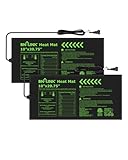
Heat mats with thermostat
A thermostat with a probe in the medium holds a target temperature and switches the mat off when it’s reached – the difference between guessing and consistent germination.

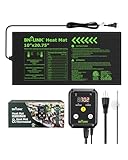
Large / multi-tray heat mats
For starting many trays at once; look for even heat across the whole surface.


Germination temperature guidance
| Group | Typical germination range | Heat mat? |
|---|---|---|
| Warm-season & tropical (tomato, pepper, basil, many tropical fruit) | ~21–29°C (70–85°F) | Very helpful |
| Most common vegetables/herbs | ~18–24°C (65–75°F) | Helpful in cool rooms |
| Cool-season (lettuce, brassicas) | Lower; can be too warm on a mat | Often not needed |
Ranges are general guidance – always follow the seed packet for the specific plant, and use a thermostat to hold the target.
How to use a heat mat
- Put the probe in the medium (not on the mat) and set the thermostat to the seed’s target range.
- Bottom heat + a humidity dome speeds germination; pair with a propagator.
- Turn the heat off once seedlings emerge – they want light and cooler, sturdier growing conditions, not continued bottom heat.
- Keep it safe: use a mat rated for damp environments and don’t let water pool on it.
Common mistakes
- No thermostat, so the mix overheats and dries or cooks the seeds.
- Leaving the mat on after germination, giving leggy, weak seedlings.
- Placing the probe on the mat instead of in the medium.
- Using a mat on cool-season seeds that prefer lower temperatures.
FAQ
Do I need a heat mat to start seeds? Not for everything, but warm-season and tropical seeds germinate far better with gentle bottom heat, especially in a cool home.
Do I need a thermostat too? Strongly recommended – it holds the target temperature and prevents overheating; without one a mat can run too warm.
How warm should the soil be? Most warm-season seeds like roughly 21–29°C (70–85°F); follow the seed packet and set the thermostat accordingly.
When do I turn the heat mat off? Once seedlings emerge – then give them strong light and normal temperatures for stocky growth.
Final recommendation
For reliable germination of warm-season and tropical seeds, use a seedling heat mat with a thermostat, sized to your tray, with the probe in the medium. Pair it with a propagator/humidity dome for warmth plus humidity, and switch to grow lights for seedlings the moment they sprout.
As an Amazon Associate GrowPlants earns from qualifying purchases. GrowPlants does not sell these products.
See also: best propagators & humidity domes · seed-starting & potting soil · all propagation equipment.
Related: how to germinate seeds.