




Plant Profile & Key Characteristics
Overview: A compact tuberous begonia reaching about 20-30 cm (8-12 in) with fleshy evergreen foliage, grown mainly for its long, prolific bloom. It is a tender perennial in frost-free zones but most often grown as an annual for bedding, containers or as a houseplant, valued for ornamental colour and cut flowers.
Quick Specifications
| Specification | Attribute |
|---|---|
| Plant Type / Life Cycle | Perennial (usually grown as an annual) |
| Foliage Type | Evergreen (tender) |
| Mature Size | 20-30 cm (8-12 in) tall |
| Growth Rate | Fast |
| Root System | Tuberous / rhizomatous |
| Toxicity | Toxic to dogs and cats (soluble calcium oxalates; tubers most toxic) |
| Hardiness | USDA zone 10b+ as a perennial, zones 5-10 as an annual |
Growth Form & Structure
- Height & Spread: 20-30 cm (8-12 in) tall in the ground or in a container; suits 10-20 L (2.5-5 gal) pots.
- Growth Habit & Form: Mounding, clump-forming herbaceous plant on fleshy stems arising from a tuber/rhizome.
- Lifespan & Maturity: Reaches flowering size within a single season from seed or tuber; overwintered as a dormant tuber where hardy.
Anatomy & Physical Features
- Leaves & Foliage: Fleshy, asymmetric heart-shaped to rounded and lobed leaves in green, purple or yellow tones.
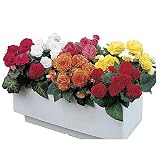
- Flower Characteristics: Double, multi-petalled flowers in pink, red, orange, yellow or white, often bicoloured and borne in clusters over a long season (full detail in the Bloom section).
Primary Uses & Landscape Value
- Functional & Ornamental Roles: Bedding, borders, hanging baskets and containers, indoors as a houseplant, and for cut flowers.
Care Guide: Planting, Soil & Watering
Overview: Tuberous begonia thrives in a rich, humus-heavy, consistently moist but well-drained soil, grown in half to full (bright) shade and protected from both frost and heat (best kept above about 5°C / 41°F). It is a fast-growing tender plant – an annual in cooler zones and a tender perennial in zone 10b and warmer – that wants steady moisture without ever sitting waterlogged.
Quick Care Requirements
| Requirement | Ideal Condition |
|---|---|
| Planting Season | In spring after the last frost as an annual (zones 5–10a); spring–summer where grown as a perennial (zones 10b–11); year-round in zone 12+ |
| Growth Rate | Fast |
| Soil Type | Rich, humus-heavy and well-draining (potting mix or peat opened up with perlite or vermiculite) |
| Water Need | Moderate – keep evenly moist but never waterlogged |
Planting & Establishment
- Best Planting Season: Plant in spring once the last frost has passed and the soil has warmed; in frost-free zones (11+) it can go in almost year-round.
- How to Plant:
- Hole Preparation: Dig a hole noticeably wider than the tuber or root ball to loosen the surrounding soil.
- Soil Amendments: Work in plenty of organic matter – compost, humus and chopped dead leaves – for a rich, moisture-retentive yet free-draining bed.
- Planting Depth: Set the plant only lightly, covering the tuber or crown thinly; do not bury the stem or growing point.
- Growth Speed & Expectations: Fast-growing; establishes and reaches its mounded 20–30 cm (8–12 in) flowering size within a single season in good conditions.
Soil, Watering & Drainage Care
- Soil Mix & Drainage Needs: Needs an airy, well-ventilated mix with sharp drainage to prevent tuber and root rot – a peat or potting-mix base lightened with perlite or vermiculite; avoid leaving pots standing in a saucer of water.
- Watering Schedule & Technique:
- Young / Newly Planted: Keep the soil consistently moist while roots establish, watering whenever the surface begins to dry.
- Established: Water regularly to hold even moisture, letting just the top of the soil dry slightly between waterings – begonias dislike both drought and soggy roots.
- Seasonal Adjustments: Increase during hot, dry spells (heat waves can be fatal) and reduce sharply in winter, especially for tubers kept dormant over winter.
Climate, Light & Hardiness
Non-stop begonia grows in tropical, Mediterranean, subtropical, and temperate climates, or indoors as a houseplant, and does best in half to full (bright) shade rather than strong sun. It has essentially no frost tolerance and is grown as a perennial only in the warmest, frost-free zones.
Quick Climate Specifications
| Climate Zones | Tropical, Mediterranean, subtropical, temperate, or indoor as a houseplant |
|---|---|
| USDA Hardiness Zones | 10b+ as a perennial; grown as an annual in zones 5–10; may persist as a perennial in zone 10a with careful care |
| Cold Damage Begins | Approximately 5°C (41°F) and below |
| Frost Tolerance | None to Very Low |
| Light Conditions | Half Shade to Full Shade (with good ambient light) |
Sunlight & Light Exposure
Optimal Light Setup
Half shade to bright full shade suits it best; avoid deep, light-less corners since it still needs good ambient light to flower well.
Shade & Heat Management
In hot-summer climates, full shade becomes necessary rather than optional – a heat wave can kill the plant outright, so afternoon shade and cooler siting matter more here than for most sun-tolerant annuals.
Best Exposure / Orientation
An exposure that avoids intense midday and afternoon sun works well, both outdoors and indoors near a bright window that doesn't get direct hot sun.
Temperature Extremes & Hardiness
USDA Hardiness & Regional Limits
Reliably perennial only in the warm, frost-free conditions of zone 10b+. It is widely grown as a warm-season annual, or as a houseplant, from zone 5 upward, since winter cold kills it outdoors; in the marginal zone 10a it can survive winter and behave as a perennial with attentive care.
Cold Damage & Winter Protection
The plant prefers temperatures above about 5°C (41°F). With attentive winter care – moving containers indoors, cutting back on watering, and keeping it in a frost-free spot – it can tolerate brief dips below this, but sustained cold is damaging.
Frost Sensitivity
Essentially no frost tolerance; it is grown as an annual, houseplant, or protected perennial anywhere winters bring freezing temperatures.
Extreme Heat Tolerance
Notably heat-sensitive for a tropical-origin plant – a heat wave can kill it outright, so in hot-summer climates it needs shade and protection from extreme heat rather than the full sun many annuals tolerate.
Frost-Free Growing Season
Where grown as an annual (zones 5–10), plant out only after the last frost, once conditions stay reliably above about 5°C (41°F); it needs the full frost-free season to establish and flower before autumn cold ends its display.
Wind, Humidity & Microclimate
Humidity Preferences
Prefers humid air alongside consistently moist (not soggy) soil, reflecting its tropical/subtropical origins; indoors this often means grouping plants, a pebble tray, or a naturally humid room.
Growing in Pots, Balconies & Indoors
The Non-Stop begonia is a compact tuberous begonia (20-30 cm) prized for its near-continuous flowering. The grower confirms it grows indoors as long as it gets enough light – it is an excellent houseplant and patio plant for bright, indirect light and part shade.
Quick Details
- Container Size: 10-20 L (2.5-5 gal)
- Indoor Suitability: A good flowering houseplant given enough light
- Best Spot: Bright, indirect light / part to full shade with light; no harsh direct sun
- Soil & Drainage: Well-aerated, free-draining rich mix – potting or peat with perlite or vermiculite
- Watering in Pots: Average – keep evenly moist and let excess drain; never soggy
Indoors & On the Windowsill
- As a houseplant: The grower grows it indoors with enough light. Give it a bright but indirect spot – an east- or north-facing window is ideal – and keep it out of scorching sun.
- Winter rest: The tuber goes dormant – reduce watering, let it rest cool over winter, then restart it when growth resumes.
- Safety: Tuberous begonias (especially the tubers) are toxic to cats and dogs – keep them out of reach of pets.
On a Balcony or Patio
- Light & shelter: A shaded or part-shaded balcony is ideal, especially in hot climates where it needs shade; protect it from hot direct sun and wind, and keep the mix evenly moist but not waterlogged.
Choosing the Pot, Soil & Long-Term Care
- Pot & drainage: 10-20 L with plenty of drainage holes; the grower prefers no saucer, letting water run out to protect the tuber.
- Potting mix: Well-aerated, free-draining rich mix – potting or peat with perlite or vermiculite and organic matter.
- Feeding & refreshing: Feed through the growing season. Grown as a perennial, refresh the soil and lightly prune roots and top every couple of years; grown as an annual, start each time with fresh, weed-free mix.
Growing this plant in a greenhouse
A greenhouse can give non-stop begonia frost protection and cold protection.
Greenhouse at a glance
| Greenhouse suitability | Good - clearly useful |
|---|---|
| Main benefits | frost protection, cold protection |
| Season extension | earlier spring & later autumn |
| Outdoor protection advisable below | about 5°C |
| Maintain greenhouse minimum | around 5°C for active growth |
| Suitable types | unheated greenhouse, polycarbonate greenhouse |
| Heating | Heating is optional - useful mainly for winter growing in cold areas. |
Related greenhouse guides
- Greenhouses: How to Choose the Right Greenhouse
- Polycarbonate Greenhouses: What to Look for Before Buying
Fertilizing & Feeding
A moderate feeding program: light, balanced feedings through the long, near-continuous bloom period, easing off as growth slows.
Quick Fertilizing Specs
| Feeding Level | Moderate – light, regular feeding supports its long, repeat-blooming display. |
|---|---|
| young_feeding | Young or newly planted starts need only a light, balanced feeding to establish before heavy blooming begins. |
| mature_feeding | Established plants benefit from light, balanced feedings spaced through the bloom season to keep flowers coming. |
| Main Nutrient Priority | Balanced feeding with adequate nitrogen; a high-phosphorus “bloom booster” is not needed to sustain flowering. |
| Best Feeding Period | Spring growth through the main flowering season. |
| Organic Options | Compost or aged organic matter mixed into the soil or potting mix. |
| Soil pH | Prefers a slightly acidic to near-neutral, rich, well-drained soil. |
| Reduce/Stop Feeding | Taper feeding as flowering slows in cooler weather, and hold off entirely once the plant is dormant or resting. |
Feeding by Growth Stage
Spring Growth Flush
Build a healthy framework of stems and leaves before heavy flowering begins.
| Nutrient direction | A balanced feeding with adequate nitrogen to support fresh foliage and stem growth. |
|---|---|
| Timing | Spring as new growth resumes or shortly after planting or transplanting. |
| Frequency | A light feeding as active growth begins is usually enough to start the season. |
| Fertilizer types | A balanced, complete fertilizer suited to flowering annuals or tender perennials., Compost or aged organic matter worked into the soil or potting mix. |
| Routine trace nutrients | iron, manganese |
| Precautions | Avoid heavy nitrogen, which can push soft, leggy growth at the expense of later flowering. |
Main Bloom Period
Support the first flush of the plant’s signature continuous flowering.
| Nutrient direction | A balanced feeding with adequate nitrogen; no need to switch to a high-phosphorus product to encourage bloom. |
|---|---|
| Timing | As the first flower buds form and open. |
| Frequency | Light, evenly spaced feedings through the bloom flush are usually sufficient. |
| Fertilizer types | A balanced, complete fertilizer with moderate nitrogen., A diluted liquid feed for container-grown plants, applied lightly and regularly. |
| Routine trace nutrients | iron, manganese |
| Precautions | Deadhead spent flowers and avoid letting fertilizer salts build up in containers, which can stress roots. |
Repeat Blooming
Sustain the plant’s characteristic non-stop flowering as older blooms fade and new ones form.
| Nutrient direction | Keep feeding light and balanced to fuel continued flower production without pushing excess foliage. |
|---|---|
| Timing | Through the extended bloom season, as long as the plant continues actively flowering. |
| Frequency | Light, regular feedings help sustain repeat blooming, easing off if flowering slows. |
| Fertilizer types | A balanced, complete fertilizer with moderate nitrogen, applied lightly and consistently., A light top-dressing of compost for plants grown in the ground. |
| Routine trace nutrients | iron, manganese |
| Precautions | If flowering slows and foliage looks lush and dark, ease back on nitrogen rather than increasing feeding. |
Dormancy or Winter Rest
Let the plant rest naturally where it dies back as an annual or goes dormant as a stored tuber.
| Nutrient direction | None – withhold fertilizer while the plant is dormant or resting. |
|---|---|
| Timing | Late autumn through winter, or whenever growth and flowering have stopped. |
| Frequency | No feeding at this stage. |
| Fertilizer types | No feeding at this stage – allow the plant or stored tuber to rest until active growth resumes. |
| Precautions | Do not fertilize dormant growth or stored tubers; resume feeding only once new growth appears. |
Nutrient Deficiency Signs & Corrections
Pale, yellowing older leaves and weak, sparse new growth.
| Possible causes | Insufficient nitrogen feeding for the plant’s growth stage, Fast-draining potting mix leaching nutrients between waterings, Root stress from an overly root-bound container |
|---|---|
| Appears first on | Older, lower leaves first. |
| What to check | Recent feeding history and mix drainage, Container size relative to root mass, Overall watering consistency |
| Possible correction | Resume a balanced feeding suited to the growth stage and check whether the plant needs repotting. |
Interveinal yellowing on newer leaves while the veins stay green.
| Possible causes | High soil or potting mix pH limiting iron availability, Waterlogged or poorly draining mix restricting root uptake, Cold or stressed roots reducing nutrient uptake |
|---|---|
| Appears first on | Newest leaves near the growing tips. |
| What to check | Potting mix or soil pH, Drainage and recent watering habits, Root temperature and overall root health |
| Possible correction | Improve drainage, work toward a more neutral pH, and apply a chelated iron product per its label if chlorosis persists. |
Crisp, browning leaf edges, especially on container-grown plants.
| Possible causes | Fertilizer salt buildup from frequent feeding without flushing, Underwatering allowing salts to concentrate in the mix, Overly strong fertilizer applications for the container size |
|---|---|
| Appears first on | Leaf margins, especially on older or lower leaves. |
| What to check | Feeding frequency and strength relative to container size, Visible salt crust on the soil surface or pot rim, Recent watering thoroughness |
| Possible correction | Flush the container thoroughly with plain water to leach excess salts and scale back feeding strength going forward. |
Pruning, Training & Seasonal Maintenance
Non-stop begonia tolerates light-to-moderate pruning, and its main task is deadheading: it blooms nearly year-round (spring through autumn where grown as a perennial), so promptly removing spent flowers directly extends and increases flowering rather than risking next season’s blooms. On top of this ongoing task, perennial or container-grown specimens get one harder cutback a year after the main bloom flush, usually timed with rhizome division and repotting. Because it prefers humid, moist conditions and is prone to powdery mildew, removing spent flowers and damaged leaves promptly also reduces disease pressure.
Quick Pruning & Maintenance Specs
| Pruning Tolerance | Moderate |
| Primary Pruning Window | Ongoing through the bloom season (spring-autumn, or most of the year in warm/indoor conditions) |
| Secondary Maintenance Window | One harder cutback a year, after the main bloom flush, often at repotting/division time |
| Typical Frequency | Deadhead as flowers fade, several times a week at peak bloom; one annual cutback |
| Main Objective | Sustain continuous flowering; manage disease-prone spent tissue |
| Young Plant Priority | Light tip pinching to encourage a bushy base (fast-growing habit) |
| Mature Plant Priority | Deadhead continuously; annual cutback and rhizome division for perennial/container specimens |
| Best Tool Type | Precision snips (soft, succulent tissue) |
| Avoid Heavy Pruning During | Heat waves — this plant is documented as vulnerable to being killed by extreme heat |
Pruning by Plant Age & Size
Newly Established
No pruning beyond removing damaged transplant leaves; let the young plant establish.
Young / Formative
Pinch growing tips once the plant has a few sets of leaves to encourage branching and a fuller flowering habit; this is a fast-growing plant that responds quickly.
Mature / Established
Deadhead continuously through the bloom period. On perennial or container specimens, combine the once-a-year harder cutback with rhizome division at repotting, trimming back leggy top growth and some roots at the same time.
Seasonal Pruning Schedule
Ongoing Sanitary (spring-autumn, or most of the year where it blooms continuously)
- Objective: sustain flowering and plant vigor
- Remove: spent flowers promptly (don’t wait for them to fully die) and any yellowing or damaged leaves
- Do not remove: healthy young buds or foliage
- Expected response: continued production of new flowers and leaves
- Flowering impact: positive — prompt deadheading is what keeps a ‘non-stop’ bloomer non-stop
Post-Bloom / Onset of Cooler Months (perennial & container specimens)
- Objective: refresh and compact the plant going into its slower period
- Remove: leggy or spent top growth, typically alongside rhizome division at repotting
- Do not remove: this stage does not apply to plants grown as annuals in colder zones, which are simply removed at season’s end rather than cut back for regrowth
- Expected response: fresh, more compact regrowth given the plant’s fast growth rate
- Flowering impact: temporary pause, then resumed flowering as new growth establishes
Special Growth to Remove
- Spent flowers — deadhead promptly rather than letting them fade on the plant
- Dead, yellowing, or damaged leaves
- Old rhizome sections removed at division time
Container & Small-Space Pruning
This plant is regularly grown in containers and indoors. For perennial specimens, repotting every couple of years (once roots fill the pot) is paired with a light root trim and a matching top cutback, keeping top growth in proportion to the reduced root mass. For annual bedding use, skip the repotting-linked prune entirely — just keep up with seasonal deadheading until the plant is removed at season’s end.
Tools
- Precision snips — deadheading and trimming soft leaves/stems
- Bypass secateurs — the annual cutback and rhizome division, where tissue is slightly firmer
Tool Hygiene & Disease Risk
Increased risk: this species is documented as susceptible to powdery mildew, and it prefers consistently moist, humid conditions where fungal issues spread easily. Wipe or disinfect blades between plants when deadheading multiple specimens, and especially when dividing rhizomes, since that work directly contacts tissue that can carry rot.
Cut Placement & Technique
- Deadhead by cutting the flower stem back to just above a leaf node, removing the full spent pedicel rather than leaving a stub that can rot in humid conditions
- When dividing the rhizome, make clean cuts and let them callus briefly before replanting into moist peat-based mix, to reduce rot risk
Heavy Pruning & Rejuvenation
Tolerates a once-yearly harder cutback of top growth, especially tied to rhizome division, with fresh regrowth typical given its fast growth rate. Avoid this during an active heat wave, a documented plant-killer for this species, or during winter dormancy below its comfort range (it prefers to stay above about 5°C with appropriate overwinter care).
Post-Pruning Care
After the annual cutback or division, keep the soil consistently moist (not soggy) and humidity up, and watch for rot at cut or division points. Resume the plant’s normal 2-4 times a year fertilizing schedule rather than adding extra feed right after cutting.
Common Pruning Mistakes
- Letting spent flowers linger — this directly reduces new flower and leaf production and looks unattractive
- Cutting back or dividing during a heat wave, a documented risk to this plant’s survival
- Over-wetting freshly divided rhizome sections, inviting rot in an already moisture-loving, humidity-preferring plant
When NOT to Prune
- Avoid a heavy cutback or rhizome division during extreme heat
- Avoid hard pruning of overwintering plants kept below their comfort range until they resume active growth
Recommended Tools (by task)
| Task | Tool Category | Why |
| Deadheading spent blooms; trimming dead/damaged leaves | precision_snips | Frequent, small cuts on soft succulent tissue |
| Annual cutback and rhizome division at repotting | bypass_secateurs | Rhizome and root tissue is firmer than flower stems |
| Between plants/divisions | blade_disinfectant | Powdery mildew susceptibility and rot-prone moist rhizome tissue |
Propagation Guide
Non-stop begonia is most easily multiplied from stem cuttings or by dividing its rhizome, and since vegetative propagation is needed to guarantee an exact flower color and form, that is the preferred route for reproducing a specific plant; as an F1 hybrid seed strain it is also widely grown from seed for first-year blooms, though individual seedlings can vary. Propagation is moderate difficulty because of its warmth and humidity requirements.
Quick Propagation Specs
| Best Propagation Method | Stem cuttings |
| Alternative Methods | Rhizome division; seed (mixed-color strain, blooms in the same season) |
| Propagation Difficulty | Moderate |
| Seed True-to-Type | Hybrid offspring vary |
| Vegetative True-to-Type | Yes |
| Best Propagation Season | Rhizome division after flowering or at the very start of spring; cuttings when temperatures are warm, above 26°C (80°F) |
| Seed Germination Time | 1–3 weeks |
| Germination Temperature | 22–26°C (70–80°F) |
| Seed Sowing Depth | Surface-sown or barely covered, up to 0.5cm (0.25 inch) |
Growing from Seed
Seed Handling & Viability
Store seed in a dry, dark location until sowing.
Sowing Season
Spring to summer; can also be started indoors in early winter.
Sowing Depth & Orientation
Seeds are very small – sow on the surface or cover no more than about 0.5cm (0.25 inch); placing the seed on vermiculite helps germination. Space seedling trays/plugs at roughly 15x20cm (6–8 inches) as plants develop.
Germination Conditions
High humidity at 22–26°C (70–80°F), in a potting mix or peat soil with vermiculite.
Germination Time
1–3 weeks.
Seedling Care
Seedlings are delicate – let them grow on a little before transplanting, keep humidity high, water moderately to heavily (misting twice a day), and increase light exposure as they establish.
Stem Cuttings
Cutting Type
Stem cuttings.
Best Timing
When temperatures are warm, above 26°C (80°F).
Cutting Preparation
Take the cutting when conditions are warm; avoid cold water or cold soil.
Rooting Setup
Two options: root in water in full shade with high humidity, changing the water every few days; or root directly in moist peat soil, misting regularly with a sprayer.
Rooting Hormone
Beneficial – recommended when rooting in soil.
Rooting Time
Not specified precisely by site.
Division, Offsets, Pups & Suckers
The rhizome can be separated into sections, best done just after flowering finishes or at the very beginning of spring. Each division should keep healthy roots and at least one growth point, and be potted into rich, well-drained soil and kept humid until new growth resumes.
Bloom & Edible Flower Guide
Quick Details
- Bloom Season: Much of the year – spring through autumn outdoors, and longer under cover; Non-stop types flower continuously in their first season
- Time to First Bloom: In the same season from seed – that is the whole point of the “Non-stop” strain
- Flower Appearance: Large single, double or fully rose-form flowers in pink, red, orange, yellow or white, often bicoloured, borne in clusters
- Edibility: Edible – begonia flowers are crisp and citrus-tart; because they contain oxalic acid, enjoy them in moderation and avoid them if you have kidney stones or gout
Detailed Blooming Overview
Non-stop begonias are seed-raised tuberous begonias bred to bloom the very same season and then keep going, which is exactly how they earn their name. Like other tuberous begonias they carry showy double male flowers alongside smaller single female flowers, so the big, ruffled doubles are what steal the show through a very long season.
Flower Characteristics
- Large flowers – single, double or fully rose-form – in pink, red, orange, yellow or white, sometimes bicoloured.
- The prominent double blooms are the male flowers; smaller singles are the females.
Bloom Care & Thinning
- Keep it non-stop: Remove faded flowers regularly to keep new ones forming.
- For bigger doubles: Pinching off the small single female flowers channels energy into the large showy male blooms.
Bloom Health & Protection
- Powdery mildew: The classic begonia problem – a white coating on leaves and stems in humid, still air; better airflow and neem oil, or a suitable fungicide, keep it in check.
- Grey mould (botrytis) on the blooms: Rots spent and crowded flowers in damp conditions – remove faded blooms promptly and improve airflow.
Fruit & Uses
Non-stop begonia is grown for its flowers, not as a food crop, but the petals of tuberous begonias are a recognised edible garnish with a sour, citrus-like flavour from their natural oxalic acid content. Only the flowers are used, sparingly, and only from a plant grown at home without chemical treatment.
Quick Edible Specs
| Edible Parts | Flower petals |
|---|---|
| Main Use(s) | Edible garnish (salads, desserts, drinks) – ornamental/novelty use, not a culinary staple |
| Eaten Raw or Cooked | Raw, in small amounts |
| Preparation Required | Rinse; use petals only, in moderation; only from home-grown, chemical-free plants |
| Harvest Season | Through the bloom season (see Blooming) |
| Time to First Harvest | Any open flower on an untreated, home-grown plant |
| Storage | Use fresh; petals do not store |
| Safety/Toxicity Caveat | Contains oxalic acid – the sour taste comes from this compound, so eat only in small amounts and avoid entirely if you have gout, kidney stones or rheumatism; do not eat flowers from nursery-bought or florist plants, which are commonly treated with systemic pesticides that persist in the tissue regardless of washing |
Flowers & Flower Buds
The petals of the pink, red, orange, yellow or white flowers (see Blooming for full colour range) can be used fresh as a garnish on salads, desserts or drinks, giving a mildly tart, citrus-like note. Pick fully open, healthy flowers rather than spent or deadheaded ones (see Pruning for regular deadheading), and use only petals from a plant you have grown yourself for a full season with no systemic pesticide or fungicide treatment – commercially grown bedding and pot plants are frequently treated with chemicals that remain in the tissue.
Preparation, Uses & Safety
Rinse petals gently before use; no cooking is required. Because of their oxalic acid content, eat only in small, occasional amounts as a garnish rather than in quantity, and people prone to gout, kidney stones or rheumatism should avoid them. The main safety rule is sourcing: only eat flowers from an untreated, home-grown plant, never from a purchased ornamental plant.
Pests, Diseases & Troubleshooting
Overview: Tuberous begonias have soft, high-moisture stems and leaves, which makes them prime targets for foliar fungi – powdery mildew is their signature affliction – and for grey mould (Botrytis) in cool, damp, still air. Sucking insects thrive under glass, and the fleshy tuber rots easily if it stays wet. Manage them culturally first: bright indirect light, generous airflow, water at the base in the morning, and never bury the tuber crown.
Quick Troubleshooting Overview
| Issue / Pest | Main Symptom | Primary Solution |
|---|---|---|
| Powdery mildew | White powdery patches on leaves and stems | Space plants, improve airflow, avoid wetting foliage; sulphur or potassium-bicarbonate spray |
| Botrytis (grey mould) | Fuzzy grey rot on flowers, stems and fallen petals | Remove debris, ventilate, keep foliage dry, reduce humidity |
| Mealybugs | White cottony masses in leaf axils, sticky honeydew | Wipe off, dab with alcohol, insecticidal soap, encourage predators |
| Whitefly | Tiny white flies fly up when disturbed, sooty mould | Yellow sticky traps, insecticidal soap or neem, Encarsia wasps |
| Stem / tuber rot | Mushy, blackened stem base and sudden collapse | Cut watering, sharp drainage, keep crown proud of the soil |
| Oedema (edema) | Corky blisters on leaf undersides | Reduce watering and raise light and airflow |
Common Pests & Management
- Mealybugs (Pseudococcus / Planococcus spp.):
- Symptoms: White cottony tufts tucked into leaf axils, stem joints and along veins, with sticky honeydew and sooty mould; heavy infestations stunt and yellow growth.
- Prevention & Control: Wipe colonies off with an alcohol-dipped cotton bud, rinse foliage, and release predators such as Cryptolaemus; treat persistent cases with insecticidal soap or horticultural oil, repeating to catch crawlers, and control ants that farm them.
- Whitefly (Trialeurodes vaporariorum):
- Symptoms: Clouds of tiny white flies rise from the leaves when disturbed; nymphs on leaf undersides excrete honeydew that fuels sooty mould, and leaves pale and weaken.
- Prevention & Control: Hang yellow sticky traps to monitor and thin adults, spray insecticidal soap or neem on leaf undersides in the evening, and introduce Encarsia formosa under glass.
- Western flower thrips (Frankliniella occidentalis):
- Symptoms: Silvery flecking and stippling on leaves, distorted new growth and scarred buds; thrips also transmit tospoviruses.
- Prevention & Control: Use blue sticky traps, remove weeds, encourage predatory mites (Amblyseius), and spin between spinosad and insecticidal soap if pressure is high.
- Two-spotted spider mite (Tetranychus urticae):
- Symptoms: Fine pale stippling, a dull bronzed cast and fine webbing on leaf undersides in hot, dry conditions; leaves dry and drop.
- Prevention & Control: Raise humidity, hose down foliage, and apply insecticidal soap or horticultural oil to undersides; release Phytoseiulus predatory mites in bad outbreaks.
- Fungus gnats (Bradysia spp.):
- Symptoms: Small dark flies over the soil surface; larvae feed on roots and tender tuber tissue in constantly wet mix, weakening seedlings.
- Prevention & Control: Let the surface dry between waterings, use yellow sticky traps, and drench with Bacillus thuringiensis israelensis or apply beneficial nematodes.
- Foliar nematode (Aphelenchoides spp.):
- Symptoms: Angular brown patches bounded by leaf veins, spreading upward in humid conditions; badly affected leaves shrivel.
- Prevention & Control: Remove and destroy affected leaves, avoid overhead watering and leaf wetness, isolate new plants, and discard heavily infested stock – there is no home cure.
Diseases & Fungal Issues
- Powdery mildew (Golovinomyces / Oidium spp.):
- Symptoms: White powdery patches spreading over leaves, stems and buds; tissue underneath yellows and distorts. This is the classic begonia disease.
- Treatment & Management: Increase spacing and airflow, avoid wetting the foliage, and remove infected leaves; spray sulphur, potassium bicarbonate or a labelled fungicide, and choose mildew-tolerant cultivars.
- Botrytis blight (grey mould) (Botrytis cinerea):
- Symptoms: Water-soaked spots that turn to fuzzy grey mould on flowers, stems and fallen leaves in cool, damp, still air.
- Treatment & Management: Improve ventilation, cut humidity, remove spent flowers and dead tissue promptly, water early in the day, and use a botryticide only if the problem persists.
- Bacterial leaf spot (Xanthomonas axonopodis pv. begoniae):
- Symptoms: Small water-soaked blister spots on leaf undersides that enlarge into brown, sometimes ringed lesions; can progress to systemic wilt in tuberous types.
- Treatment & Management: There is no cure – remove and destroy affected plants, avoid overhead watering and splashing, disinfect tools, and buy clean, culture-indexed stock.
- Pythium / Rhizoctonia root and stem rot (Pythium / Rhizoctonia spp.):
- Symptoms: Blackened, mushy stem base, wilting and collapse, with rotted roots or tuber in wet, poorly drained mix.
- Treatment & Management: Use a free-draining sterile mix, water sparingly, keep the tuber crown at the surface, and discard rotted plants; drench with a labelled fungicide only on valued stock.
Growing Difficulties & Abiotic Problems
- Oedema (edema):
- Cause & Symptoms: Roots take up more water than the leaves can transpire in humid, low-light, over-watered conditions, forming corky bumps and blisters on leaf undersides.
- Correction Strategy: Reduce watering frequency, raise light levels and improve airflow; the plant grows out of it once moisture balance is restored.
- Tuber rot from overwatering:
- Cause & Symptoms: Constantly saturated, cold mix rots the fleshy tuber, causing yellowing, wilt and collapse.
- Correction Strategy: Water only when the surface dries, use sharply drained mix, keep the crown above soil level, and lift and dry-store dormant tubers.
- Leaf scorch:
- Cause & Symptoms: Direct hot sun bleaches and browns the soft leaves.
- Correction Strategy: Give bright but filtered light; move plants out of harsh midday sun.
- Nutrient / bud drop:
- Cause & Symptoms: Erratic watering, low light or feed swings cause leaf yellowing and flower-bud drop.
- Correction Strategy: Keep moisture and feeding even with a balanced dilute fertiliser and stable light.
What Helps – Products & Tools
For this plant lean on insecticidal soap and horticultural or neem oil for mealybugs, whitefly, thrips and mites; sulphur or potassium-bicarbonate fungicide for powdery mildew; yellow sticky traps for whitefly and fungus gnats; and improved drainage plus a light copper option for leaf spots. Spray oils in the evening to protect pollinators and follow the label.


