

Plant Profile & Key Characteristics
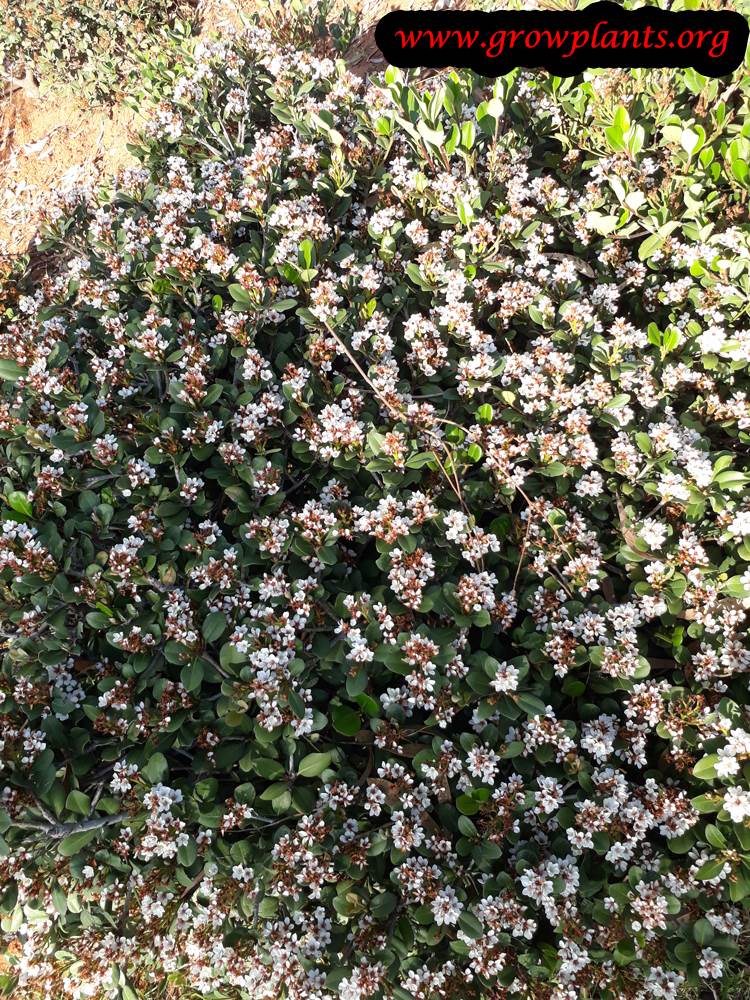
Overview: A compact evergreen shrub 1-4 m (3-13 ft) tall with leathery dark-green leaves, grown mainly as an ornamental and hedge and bearing small edible fruit. It forms a neat rounded mound valued for its fragrant spring bloom.
Quick Specifications
| Specification | Attribute |
|---|---|
| Plant Type / Life Cycle | Perennial (evergreen shrub) |
| Foliage Type | Evergreen |
| Mature Size | 1-4 m (3-13 ft) |
| Growth Rate | Fast to moderate |
| Toxicity | Non-toxic / edible fruit |
| Hardiness | USDA zones 8-10 |
Growth Form & Structure
- Height & Spread: 1-4 m (3-13 ft) in the ground; also grown in large containers.
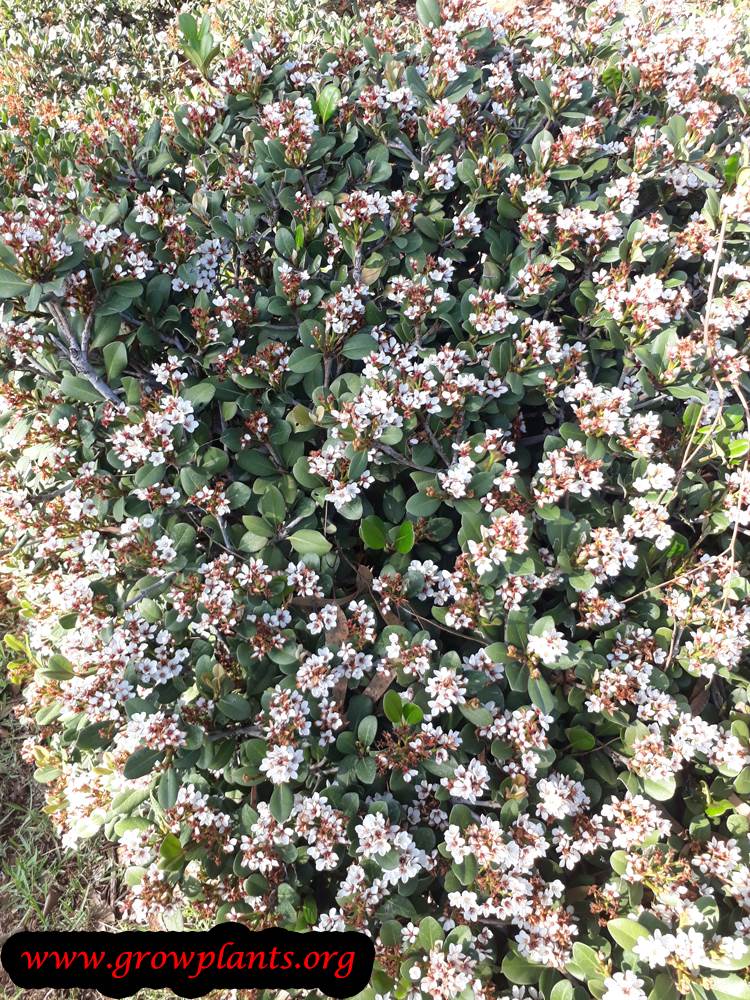
- Growth Habit & Form: Dense, rounded evergreen shrub that makes a good low hedge or foundation planting.
- Lifespan & Maturity: Long-lived evergreen shrub.
Anatomy & Physical Features
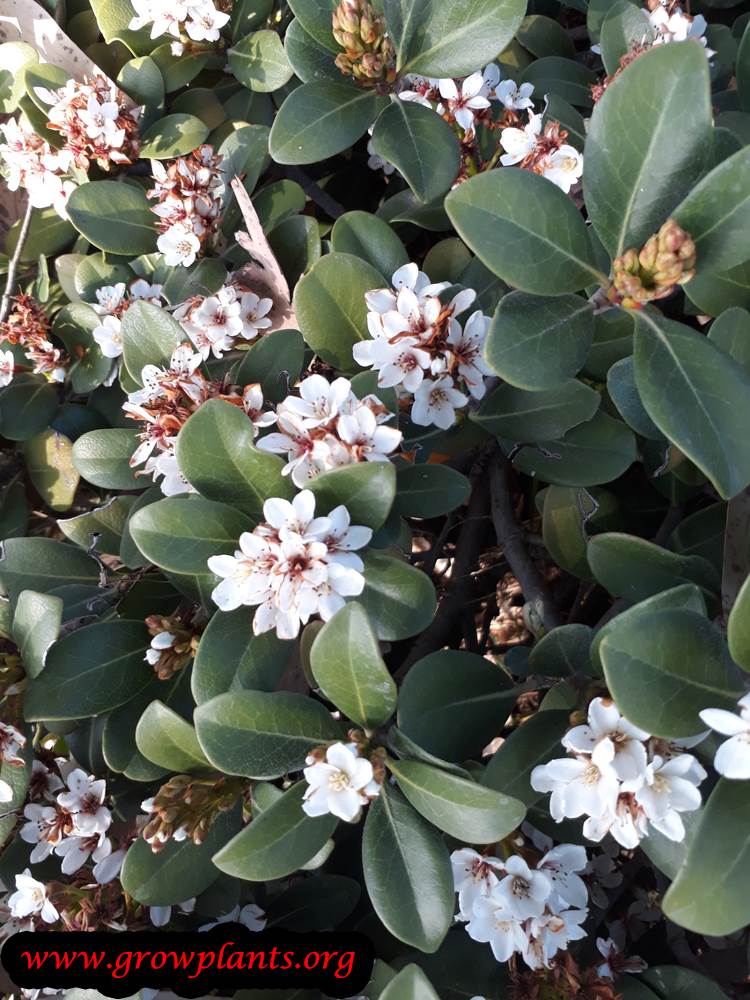
- Leaves & Foliage: Dark green, leathery, elliptic to oval leaves with a pointed tip.
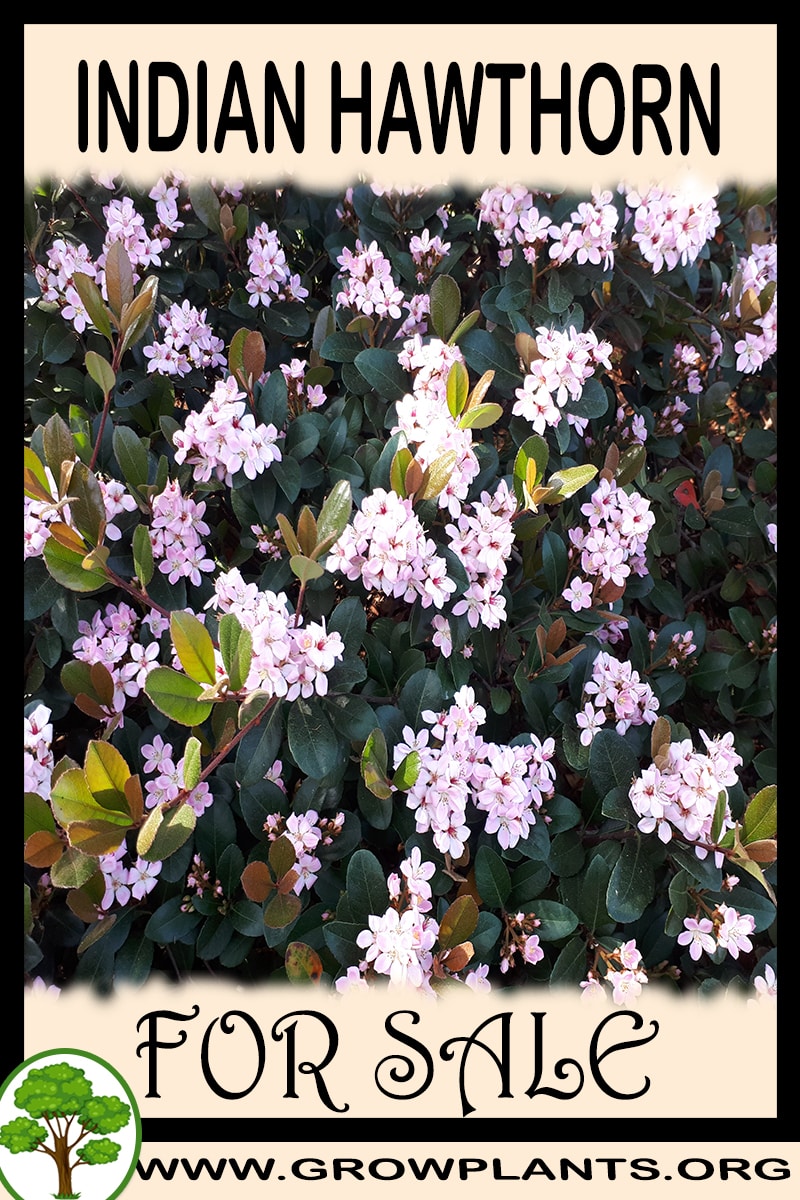
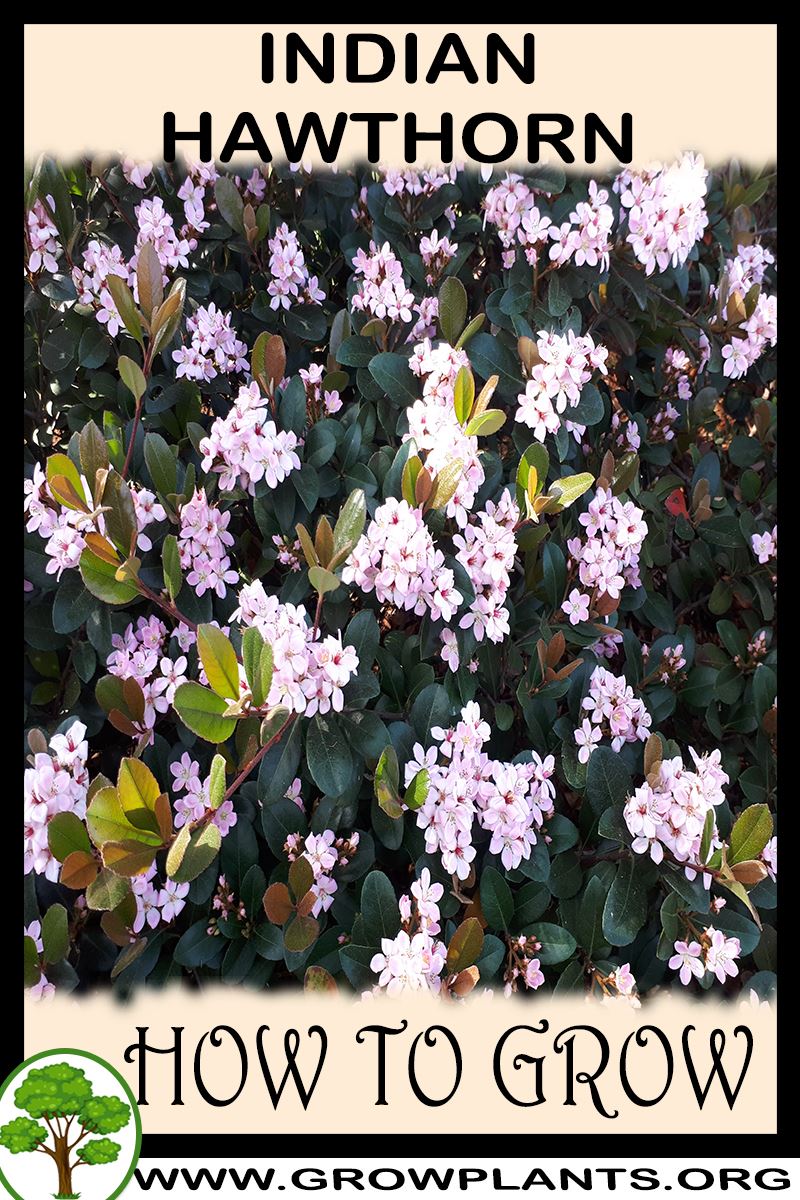
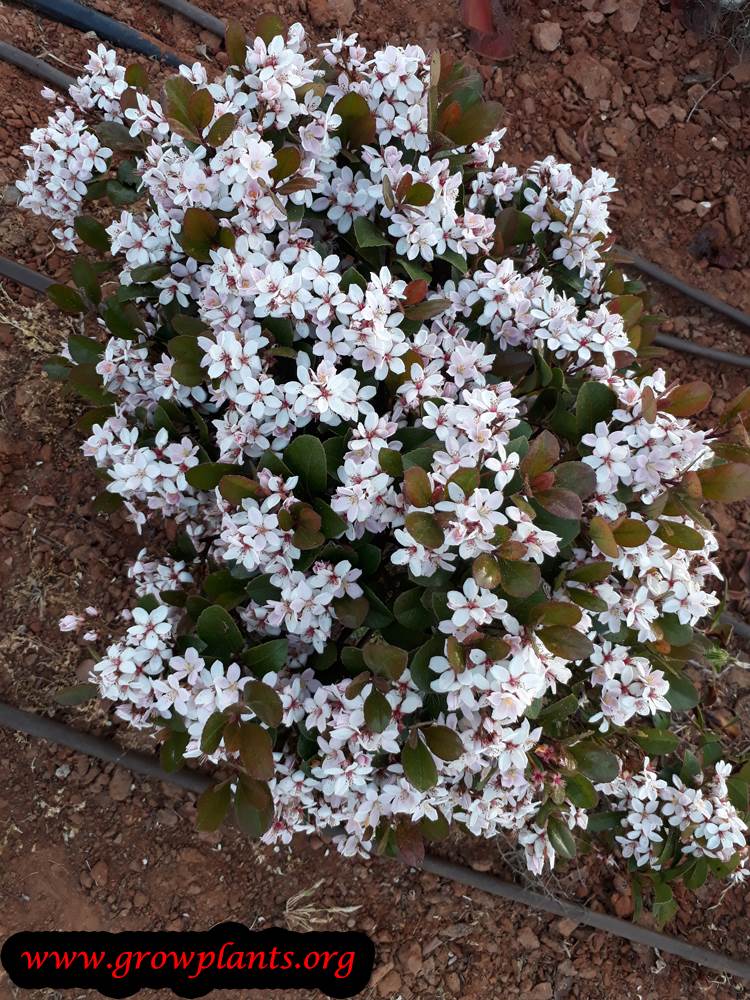
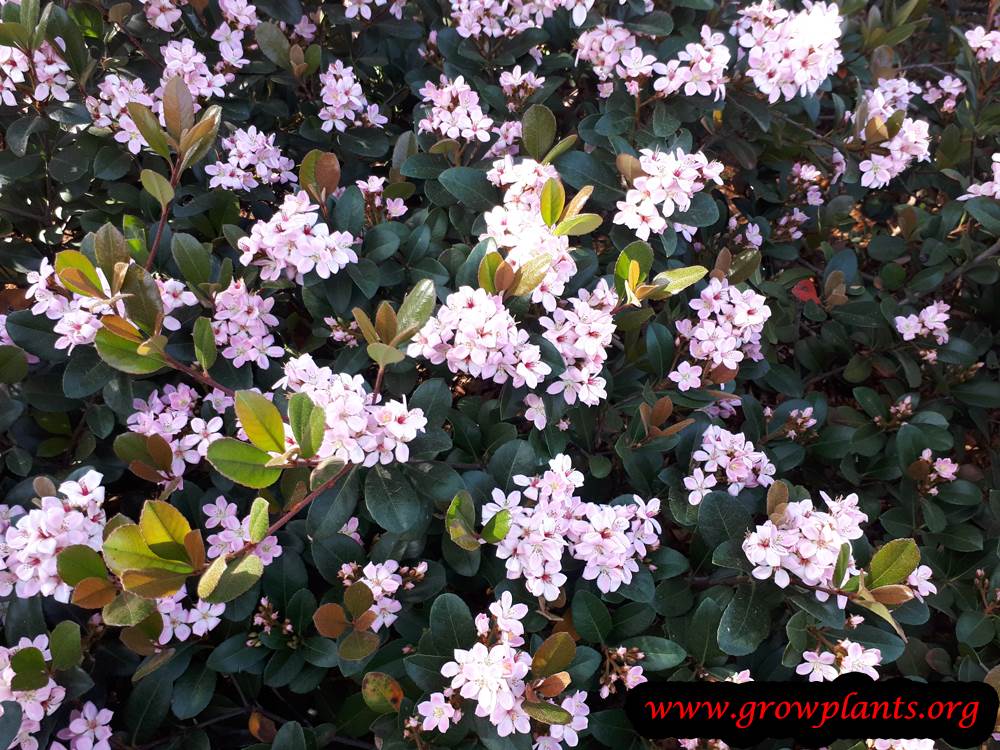
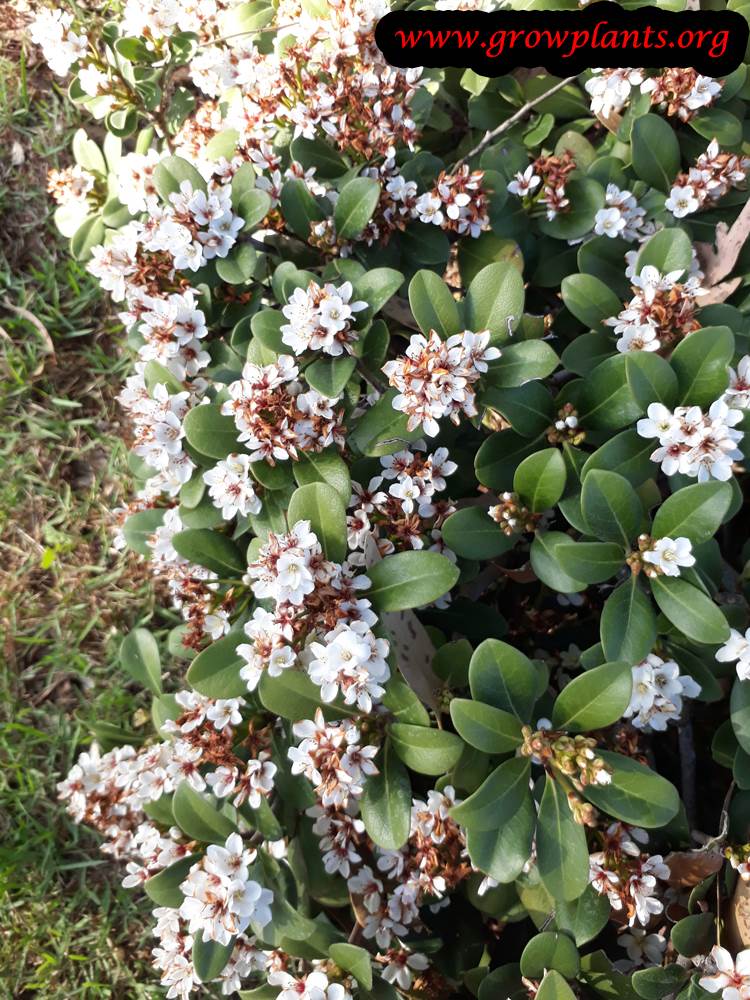
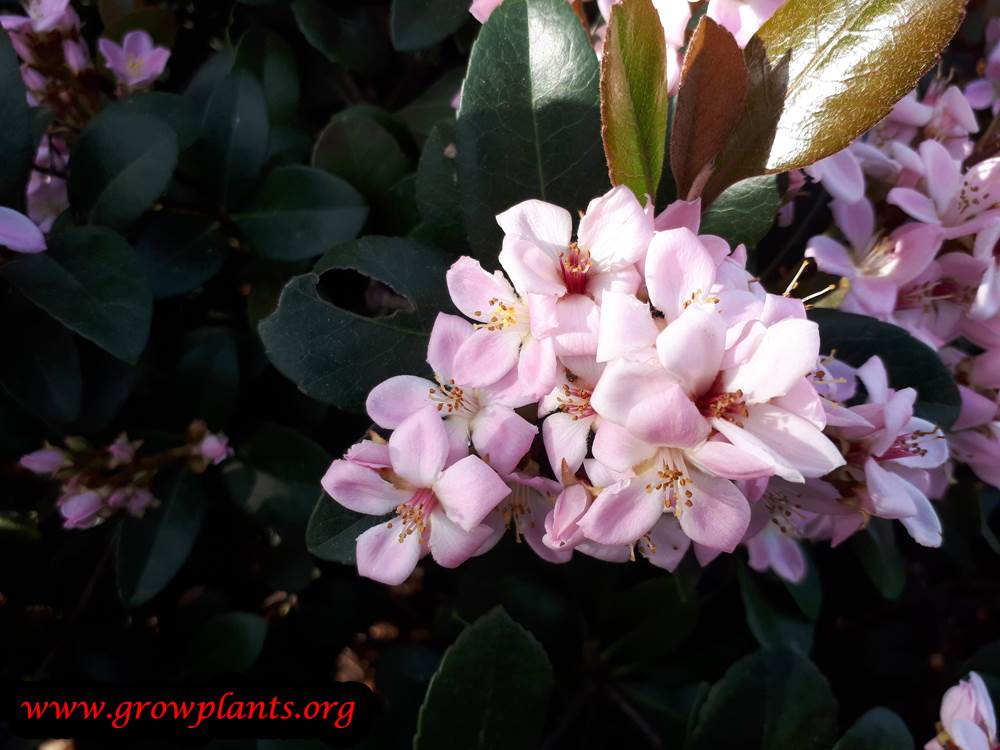
- Flower Characteristics: Fragrant white to pink five-petalled flowers of flat form, borne in clusters.
- Fruit Profile: Small round fruit ripening blue to black.
Primary Uses & Landscape Value
- Edible Uses: Small blue-black fruit is edible.
- Functional & Ornamental Roles: Evergreen hedge, foundation and container shrub, grown for its neat form and fragrant flowers.
Care Guide: Planting, Soil & Watering
Overview: Indian hawthorn is a compact evergreen shrub that grows best in full sun to part shade in fertile, well-drained soil. It is fairly drought tolerant once established and needs only modest watering.
Quick Care Requirements
| Requirement | Ideal Condition |
|---|---|
| Planting Season | Spring, summer or autumn |
| Growth Rate | Moderate to Fast |
| Soil Type | Fertile, well-draining |
| Water Need | Low to Moderate — drought tolerant once established |
Planting & Establishment
- Best Planting Season: Plant in spring, summer or autumn in mild climates, allowing time to root before the coldest or hottest weather.
- How to Plant:
- Hole Preparation: Dig a hole roughly twice as wide as the root ball and the same depth, loosening the sides to encourage rooting out.
- Soil Amendments: Improve the planting soil with compost or organic matter, especially in poor or heavy ground, to aid drainage and establishment.
- Planting Depth: Plant with the top of the root ball level with the soil surface; do not bury the base of the stems.
- Growth Speed & Expectations: A moderate to fairly fast grower that forms a rounded, dense mound suited to low hedging and mass planting.
Soil, Watering & Drainage Care
- Soil Mix & Drainage Needs: It needs good drainage above all; on heavy soils improve with organic matter and avoid waterlogged sites. It also grows well in a well-drained container.
- Watering Schedule & Technique:
- Young / Newly Planted: Water regularly for the first season to establish a strong root system, keeping the soil evenly moist.
- Established: Once established it tolerates dry conditions; water deeply but occasionally, letting the soil dry between waterings.
- Seasonal Adjustments: Water more in hot, dry weather; cut back in cool or rainy periods to avoid soggy soil and root problems.
Climate, Light & Hardiness
Indian hawthorn is a tough, evergreen hedge shrub for subtropical, Mediterranean, and temperate gardens, thriving in full sun to half shade. It is reliably hardy through USDA zone 8–10 and is a well-known choice for coastal landscaping.
Quick Climate Specifications
| Climate Zones | Subtropical, mediterranean, temperate |
|---|---|
| USDA Hardiness Zones | 8–10 |
| Light Conditions | Full sun to half shade |
| Frost Tolerance | Moderate |
| Salt / Coastal Tolerance | High |
Sunlight & Light Exposure
Optimal Light Setup
Full sun gives the densest habit and heaviest flowering; half shade is tolerated with a looser growth form.
Temperature Extremes & Hardiness
USDA Hardiness & Regional Limits
Hardy from zone 8 through 10; suited to mild-winter climates rather than hard-freeze regions.
Wind, Humidity & Microclimate
Coastal / Salt Tolerance
Widely used as a seaside and coastal hedge plant, tolerating salt spray and wind reasonably well – a genuine strength of this species in landscape use.
Growing in Pots, Balconies & Indoors
Indian hawthorn (Rhaphiolepis indica) is a tough, compact evergreen shrub that the grower confirms grows well in containers – a neat, long-lived choice for a sunny balcony or patio. It is not a houseplant: it needs real sun and open air, so grow it outdoors in a good-sized pot rather than inside.
Quick Details
- Container Size: A sturdy pot for a 1-4 m shrub – around 30-50 L for a long-term plant, potting up as it grows
- Indoor Suitability: Not a houseplant; an outdoor shrub that needs full sun to half shade
- Best Spot: Full sun to half shade on a balcony or patio
- Soil & Drainage: Free-draining, slightly acidic, organic-rich mix
- Watering in Pots: Average – drought-tolerant once established; water when the top of the mix dries
Indoors & On the Windowsill
- Not a houseplant: The grower marks it ‘no’, and indoors it would lack the light it needs to stay dense and flower. Keep it outside.
- Windowsill: Not suitable – it is a woody shrub, too large and too light-hungry for a sill.
On a Balcony or Patio
- Light & wind: A sunny, open balcony or patio suits it; it tolerates wind and coastal exposure well. Reflected heat from walls dries pots faster, so check moisture in hot spells.
- Weight & longevity: Use a heavy, stable pot – it is a long-lived evergreen that will anchor a container display for years.
Choosing the Pot, Soil & Long-Term Care
- Pot & drainage: A large, stable pot with strong drainage holes. Use a pot with strong drainage holes and skip a standing water saucer – constantly wet feet are the quickest route to root rot. Terracotta breathes and dries quickly (good for plants that dislike wet feet); glazed or plastic pots hold moisture longer.
- Potting mix: Free-draining, organic-rich and slightly acidic; it dislikes waterlogged soil.
- Feeding & repotting: Potted plants exhaust their food faster than those in the ground, as watering leaches nutrients out; feed lightly but more regularly through the growing season. Refresh the top few centimetres of mix each year and pot up (or root-prune and return with fresh mix) about every two years. Light pruning after flowering keeps it compact.
Fertilizing & Feeding
Indian hawthorn is a full, evergreen hedge and flowering shrub that keeps its best density and bloom with a balanced spring feeding program.
Quick Fertilizing Specs
| Feeding Level | Moderate – a full, evergreen hedge and flowering shrub |
|---|---|
| young_feeding | Balanced feeding while a newly planted shrub establishes its root system |
| mature_feeding | Balanced feeding through spring into the flowering period supports full, healthy hedge growth |
| Main Nutrient Priority | Balanced feeding – adequate nitrogen for dense hedge growth alongside overall nutrition to support flowering |
| Best Feeding Period | From the start of spring growth through flowering |
| Organic Options | Compost or well-rotted organic matter worked around the root zone in spring |
| Micronutrients | Watch for iron chlorosis in alkaline soil, a common issue for many broadleaf evergreen shrubs |
| Soil pH | Prefers slightly acidic to near-neutral soil and can struggle in strongly alkaline conditions |
| Reduce/Stop Feeding | Ease off feeding as growth slows heading into the cooler part of the year |
Feeding by Growth Stage
Spring Growth Flush
Support new leaf and stem growth as the shrub resumes active growth in spring.
| Nutrient direction | A balanced, complete fertilizer applied as new growth begins supports the full, dense growth typical of a well-kept hedge or specimen shrub. |
|---|---|
| Timing | As new growth begins in spring. |
| Frequency | A feeding at the start of the growing season is usually sufficient, with light follow-up feeding through spring. |
| Fertilizer types | A balanced, complete fertilizer applied around the root zone in spring, Compost or well-rotted organic matter worked into the soil surface |
| Routine trace nutrients | iron, manganese |
| Precautions | Keep fertilizer away from the trunk base and water it in well to avoid root or foliage burn. |
Flowering Period
Support the fragrant flower clusters this shrub is valued for.
| Nutrient direction | Established plants generally flower well on the spring feeding already applied; minimal additional feeding is needed during bloom itself. |
|---|---|
| Timing | During the winter-to-spring bloom period. |
| Frequency | Established shrubs rarely need extra feeding specifically for bloom. |
| Fertilizer types | A light, balanced feeding only if growth or flowering looks weak – otherwise minimal feeding is standard during bloom |
| Precautions | Avoid heavy nitrogen feeding right at bloom time, which can push leafy growth at the expense of flowers. |
Winter Rest
Let the evergreen shrub coast through its slowest growth period of the year.
| Nutrient direction | None – withhold fertilizer during the slow winter growth period. |
|---|---|
| Timing | Through the cooler winter months. |
| Frequency | No feeding at this stage. |
| Fertilizer types | No feeding at this stage – growth is too slow to make use of additional fertilizer |
| Precautions | Do not fertilize during the winter rest period; resume feeding as active spring growth begins. |
Nutrient Deficiency Signs & Corrections
New leaves turn yellow between the veins while the veins stay green.
| Possible causes | Iron deficiency (chlorosis), High or alkaline soil pH limiting iron availability, Poorly drained or compacted soil restricting root uptake |
|---|---|
| Appears first on | Newest leaves. |
| What to check | Soil pH, especially in alkaline garden soil, Drainage and compaction around the root zone, Whether yellowing is specific to new growth |
| Possible correction | Correct soil pH toward a more favorable range and apply a chelated iron product per its label if chlorosis is confirmed. |
Overall foliage looks pale or light green with slower, sparser new growth.
| Possible causes | Nitrogen deficiency, Poor, depleted soil around the root zone, Root competition from nearby trees, shrubs, or turf |
|---|---|
| Appears first on | Overall foliage color and new growth density. |
| What to check | Soil richness and organic matter, Root competition from nearby plantings, Recent feeding history |
| Possible correction | A balanced, complete fertilizer applied in spring generally restores healthy color and density. |
Interveinal yellowing appears on middle-aged leaves, similar to iron chlorosis but slightly duller.
| Possible causes | Manganese deficiency, High soil pH limiting manganese availability, Overly wet, poorly aerated soil |
|---|---|
| Appears first on | Middle-aged leaves. |
| What to check | Soil pH and drainage, Whether the pattern differs from classic iron chlorosis on the newest leaves, Overall plant vigor |
| Possible correction | Correct soil pH and drainage, and apply a chelated manganese product per its label if a deficiency is confirmed. |
Pruning, Training & Seasonal Maintenance
Indian hawthorn is a slow-to-moderate, evergreen flowering shrub most often grown as a hedge or foundation planting; it tolerates shearing but flowers and stays healthiest with more selective thinning. Because its fragrant spring flower clusters form on wood produced the previous season, the safest and most effective pruning window is right after flowering ends, not the dormant autumn/winter period – pruning too late in the year removes the buds already set for next spring’s bloom.
Quick Pruning & Maintenance Specs
| Pruning Tolerance | Moderate to High |
| Primary Pruning Window | Immediately after flowering ends (mid-to-late spring) |
| Secondary Maintenance Window | Light touch-ups in summer if needed; avoid heavy cuts close to autumn bud-set |
| Typical Frequency | Once a year for formal hedges; occasional touch-ups for informal shrubs |
| Main Objective | Shape/size control, canopy airflow for disease prevention, tidy after bloom |
| Young Plant Priority | Light shaping only; build several well-spaced canes |
| Mature Plant Priority | Renewal thinning of dense interior growth plus size maintenance |
| Best Tool Type | Bypass secateurs for selective cuts; hedge shears only if formally hedged |
| Avoid Heavy Pruning During | Autumn (removes already-set flower buds) and wet, humid weather (spreads leaf spot) |
Pruning by Plant Age & Size
Newly Established
Remove only damaged or crossing growth; let the young shrub fill in before any shaping cuts.
Young / Formative
Either informal shaping (selecting several well-placed main canes) or, if grown as a formal hedge, establishing the hedge line with light shearing – this species is used both ways.
Mature / Established
Renewal-thin the oldest, densest interior stems each year after bloom to maintain airflow, and control overall size before it exceeds its space.
Seasonal Pruning Schedule
| Post-Flowering (spring) | Objective: shape, size control and canopy renewal. Remove spent flower clusters and any winter-damaged wood; thin select older interior stems. Do not remove all of the new growth – it will carry next year’s flower buds. Response: a fresh flush that sets the following spring’s buds over summer. Flowering impact: none if done promptly after bloom, since there is a full season to reset buds before next spring. |
| Ongoing Sanitary | Objective: disease management. Remove dead, damaged or leaf-spot-affected foliage and twigs at any time; bag and dispose of debris rather than composting it to limit fungal spread. |
Flowering & Fruiting Wood
Flowers form on wood grown during the previous season, with terminal buds set in autumn that open the following late winter into spring. Pruning in autumn or winter cuts off buds that are already formed for the coming bloom, while pruning right after flowering allows a full growing season to set the next round of buds before the following spring.
Structural Pruning & Training
Thin dense interior growth to improve airflow through the canopy – this directly reduces the humid, still conditions that favor Entomosporium leaf spot, a common problem on sheared Rhaphiolepis hedges. Remove crossing or rubbing stems, and control height and spread, since the shrub can reach 1–4 m and is often kept lower as a hedge or foundation planting.
Special Growth to Remove
- Suckers arising below the graft union, if the plant is a grafted cultivar.
- Spent flower clusters – mainly cosmetic, and helps if the ornamental (not edible) fruit display is unwanted.
Container & Small-Space Pruning
Container specimens benefit even more from an annual post-bloom shaping cut, since airflow around a potted plant near a patio or wall is often more restricted – keeping it open reduces leaf-spot pressure in a tight space.
Tools
- Bypass secateurs for selective renewal and thinning cuts.
- Hedge shears only if the plant is maintained as a sheared, formal hedge line.
Tool Hygiene & Disease Risk
Increased: Entomosporium leaf spot is a well-documented fungal problem on this species, spread by water splash and readily carried on pruning tools and fresh wounds in humid or wet weather. Disinfect tools between plants when leaf spot is present, avoid pruning wet foliage, and prune to open the canopy so it dries faster.
Cut Placement & Technique
Prefer thinning cuts over indiscriminate shearing where a fuller flower display and better airflow are wanted. If maintained as a sheared hedge, taper the sides slightly wider at the base so light reaches the lower foliage, and avoid leaving stubs.
Heavy Pruning & Rejuvenation
Tolerates a fairly hard rejuvenation cut-back right after bloom if overgrown or leggy, producing a vigorous flush; expect reduced or no flowering the following spring while the plant resets its bud wood. Avoid repeating a hard rejuvenation more than once every few years.
Post-Pruning Care
Avoid overhead watering onto freshly cut foliage, since wet wounds invite leaf spot; monitor for leaf-spot lesions especially after wet spring weather. No extra feeding is needed after routine pruning – care requirements for this shrub are otherwise minimal.
Common Pruning Mistakes
- Shearing in autumn or winter and losing most of the following spring’s bloom.
- Dense, repeated shearing without thinning, which traps humidity and worsens leaf spot.
- Wetting the foliage right after pruning cuts are made.
When NOT to Prune
Avoid heavy pruning in autumn once flower buds have set for the winter/spring bloom, and avoid pruning or working the plant while foliage is wet or during prolonged humid weather, since this spreads leaf-spot fungus. Avoid pruning during full bloom if the flower display is wanted that season.
Pruning Troubleshooting
| Problem | Possible Cause | What to Check | Corrective Action |
| Little or no spring bloom | Pruned in autumn/winter after flower buds had set | Timing of the last significant prune relative to bloom season | Shift pruning to immediately after next spring’s flowering |
| Leaf-spot lesions spreading through the shrub | Entomosporium fungal leaf spot, spread by wet foliage or tools | Humidity, overhead irrigation habits, tool hygiene | Thin for airflow, avoid wetting foliage, disinfect tools, remove and dispose of infected debris |
| Dense, twiggy interior with sparse flowers | Repeated shearing without any thinning cuts | Pruning method/history | Switch to selective thinning cuts to reopen the canopy and restore flowering wood |
Recommended Tools (by task)
- bypass_secateurs – selective renewal and thinning cuts on an informally shaped shrub.
- hedge_shears – only where the plant is kept as a sheared, formal hedge.
- blade_disinfectant – given the real, documented risk of spreading Entomosporium leaf spot via pruning tools.
Propagation Guide
Indian hawthorn is most reliably propagated from semi-hardwood stem cuttings taken in summer, which preserve named flower-color cultivars true to the parent; seed works for growing the species type but germinates slowly and will not reproduce hybrid selections exactly. Difficulty is Moderate, typical for a woody evergreen landscape shrub.
Quick Propagation Specs
| Best Propagation Method | Semi-hardwood stem cuttings |
| Alternative Methods | Seed (species type only) |
| Propagation Difficulty | Moderate |
| Seed True-to-Type | Cultivar-dependent – species seed is generally similar to the parent, but named cultivars and hybrids must be propagated vegetatively to keep their exact traits |
| Vegetative True-to-Type | Yes |
| Best Propagation Season | Summer for cuttings; site lists spring, summer or autumn as the general planting season |
| Cutting Rooting Time | Several weeks to a couple of months |
Growing from Seed
Seed Handling & Viability
Clean seed from the ripe blue-to-black fruit before sowing or storing.
Dormancy & Pre-Sowing Treatment
Woody shrub seed like this often benefits from a period of cool, moist stratification over winter before it germinates well; treat this as a general precaution rather than a confirmed requirement for this species.
Germination Conditions
Germination can be slow and uneven for a woody shrub; keep soil consistently moist.
Stem Cuttings
Cutting Type
Semi-hardwood tip cuttings, taken once new growth has begun to firm up.
Best Timing
Summer, within the site’s spring/summer/autumn planting window.
Cutting Preparation
Take a cutting roughly 10-15 cm (4-6 in) long, remove the lower leaves, and cut just below a node.
Rooting Setup
Insert into a well-draining propagation mix, keep humidity up (misting or a cover), and provide light shade rather than full sun while rooting.
Rooting Hormone
Beneficial for improving rooting consistency in this woody shrub, though not strictly required.
Rooting Time
Several weeks to a couple of months.
Bloom & Flower Guide
Quick Details
- Bloom Season: Late winter to spring
- Time to First Bloom: Once the shrub is established, generally a couple of years from planting
- Flower Appearance: Clusters of fragrant flowers in white to pink, each with five flat petals
- Edibility: Grown as an ornamental flowering shrub – the flowers are not eaten
Detailed Blooming Overview
Indian hawthorn earns its place as an evergreen hedge for its late-winter and spring display: rounded clusters of five-petaled white-to-pink flowers open across the whole shrub, lightly fragrant and busy with bees. A light trim after flowering keeps the plant neat and encourages a dense, well-shaped bush for the following year.
Flower Characteristics
- Five flat petals per flower, in shades of white to pink.
- Carried in showy, rounded clusters across the shrub.
- Lightly fragrant and attractive to bees.
Bloom Care & Thinning
- Managing the bloom: Trim lightly just after flowering to shape the shrub and encourage a good bloom the following season.
- Pollination: By bees and other insects.
Fruit & Uses
Indian hawthorn’s small round fruit is noted as edible, though this is a secondary trait of a plant grown mainly as an ornamental hedge. Site data does not describe flavor, harvest timing, or a specific culinary use, so this should be treated as a minor, exploratory edible bonus rather than a reliable food crop.
Quick Edible Specs
| Edible Parts | Fruit (small round pome-type berries) |
|---|---|
| Main Use(s) | Minor/other — occasional fresh eating; no specific culinary use documented |
| Eaten Raw or Cooked | Can be sampled raw once fully ripe (blue to black) |
| Preparation Required | None documented; wait for full ripening |
| Harvest Season | Not specified on this page |
| Safety/Toxicity Caveat | No toxicity documented, but edible-use detail is minimal; treat as a marginal/exploratory use, not a relied-upon food source |
Fruit
Small, round fruits ripen from green to a blue-to-black color. The site confirms they are edible but provides no further detail on flavor, texture, or exact ripeness timing. As a general ripeness cue, wait until the fruit has fully darkened and softened before sampling, since under-ripe fruit is likely to be firm and astringent.
Harvesting
No specific harvest season is documented for this species; watch for the fruit to darken fully to blue-black and soften as the ripeness signal.
Preparation, Uses & Safety
Ripe fruit can be sampled fresh once fully colored. No toxicity is documented for this species, but because detailed edible-use information is sparse and Indian hawthorn is grown chiefly as an ornamental hedge, treat any fruit harvest as a minor bonus rather than a dependable food source.
Pests, Diseases & Troubleshooting
Indian hawthorn (Rhaphiolepis indica) is a compact evergreen shrub in the rose family whose defining problem is Entomosporium leaf spot in warm, wet, crowded conditions; pests such as aphids and scale are secondary. Choosing resistant varieties, spacing for airflow and keeping the foliage dry prevent nearly all trouble.
Quick Troubleshooting Overview
| Issue / Pest | Main Symptom | Primary Solution |
|---|---|---|
| Entomosporium leaf spot | Round red-grey spots peppering leaves; heavy drop | Airflow, dry foliage, resistant cultivars, remove litter |
| Aphids | Curled sticky new shoots, sooty mould | Water jet, insecticidal soap/neem, beneficials |
| Scale insects | Bumps on stems/leaves, sooty mould | Horticultural oil, prune out, control ants |
| Fire blight | Blackened, wilted shoot tips (‘crook’) | Prune out below cankers, avoid excess N |
| Spider mites | Stippled bronzed leaves in hot dry spells | Hose foliage, horticultural oil |
| Chlorosis | Yellow leaves with green veins | Improve drainage; chelated iron on alkaline soil |
Common Pests & Management
- Aphids (Aphididae):
- Symptoms: Colonies on tender new growth and flower buds curl and distort shoots and leave sticky honeydew and sooty mould.
- Prevention & Control: Wash off with water, encourage ladybirds and lacewings, and prune out heavily infested tips. Insecticidal soap or neem controls persistent colonies; spray in the evening to protect pollinators.
- Scale insects (Coccidae / Diaspididae):
- Symptoms: Brown or white immobile bumps on stems and leaf undersides that sap vigour and produce honeydew and sooty mould, often with attendant ants.
- Prevention & Control: Prune out or scrub off light infestations, control ants, and encourage parasitic wasps and ladybirds. Horticultural or neem oil, thoroughly coating the scales, gives good control.
- Spider mites (Tetranychidae):
- Symptoms: Fine pale stippling and bronzing of leaves with faint webbing in hot, dry, dusty positions; heavy attacks cause leaf drop.
- Prevention & Control: Hose down foliage, keep plants watered to reduce stress, conserve predatory mites, and treat hotspots with horticultural oil or insecticidal soap.
Diseases & Fungal Issues
- Entomosporium leaf spot (Diplocarpon mespili (Entomosporium)):
- Symptoms: Numerous small round spots, red to grey with reddish-purple margins, peppering the leaves; heavy infection merges into blotches and causes extensive yellowing and premature leaf drop, sometimes defoliating the shrub. This is by far the most important and disfiguring disease of Indian hawthorn, worst in warm, wet, humid, crowded plantings.
- Treatment & Management: Grow resistant cultivars, space plants for full airflow, and keep foliage dry – use drip irrigation, not overhead watering. Rake up and destroy fallen infected leaves, prune to open the canopy, and apply a protectant fungicide (copper, chlorothalonil or myclobutanil) to new growth during prolonged wet weather if needed.
- Fire blight (Erwinia amylovora):
- Symptoms: As a rose-family plant it can suffer fire blight: blossoms and shoot tips suddenly blacken, wilt and bend into a ‘shepherd’s crook’, with sunken cankers on stems.
- Treatment & Management: Avoid lush growth from excess nitrogen, disinfect pruning tools, and cut out infected wood well below the visible margin in dry weather, burning the prunings. A copper spray at bloom reduces new infection in humid springs.
- Root rot (Phytophthora spp.):
- Symptoms: Yellowing, wilting, thinning canopy and dieback in wet, poorly drained soil as the roots decay.
- Treatment & Management: Plant in free-draining soil or raised beds, avoid overwatering, and keep the crown dry. Remove severely affected plants and improve drainage before replanting.
Growing Difficulties & Abiotic Problems
- Iron chlorosis:
- Cause & Symptoms: On alkaline or waterlogged soils young leaves yellow between green veins from locked-up iron.
- Correction Strategy: Improve drainage and organic matter, avoid over-liming, and apply chelated iron; acidify the root zone on limey soils.
- Root rot from wet soil:
- Cause & Symptoms: Poor drainage or overwatering rots the roots and causes decline – a common problem in irrigated landscapes.
- Correction Strategy: Site in well-drained soil, water deeply but infrequently, and let the soil surface dry between waterings.
- Leaf drop after stress:
- Cause & Symptoms: Drought, transplant shock or heavy leaf-spot infection cause leaf yellowing and drop.
- Correction Strategy: Keep newly planted shrubs evenly watered and mulched, and address leaf spot promptly to prevent defoliation.
- Sparse flowering:
- Cause & Symptoms: Heavy shearing at the wrong time or deep shade reduces bloom.
- Correction Strategy: Grow in full sun to light shade and prune just after flowering rather than shearing off the developing buds.
What Helps – Products & Tools
The key defence for Indian hawthorn is cultural – resistant cultivars, spacing and dry foliage – backed by a protectant fungicide (copper, chlorothalonil or myclobutanil) against Entomosporium leaf spot in wet weather. Keep insecticidal soap, neem and horticultural oil for aphids, scale and mites, and chelated iron for chlorosis on alkaline soils.