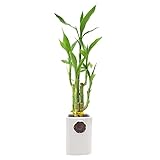


Plant Profile & Key Characteristics
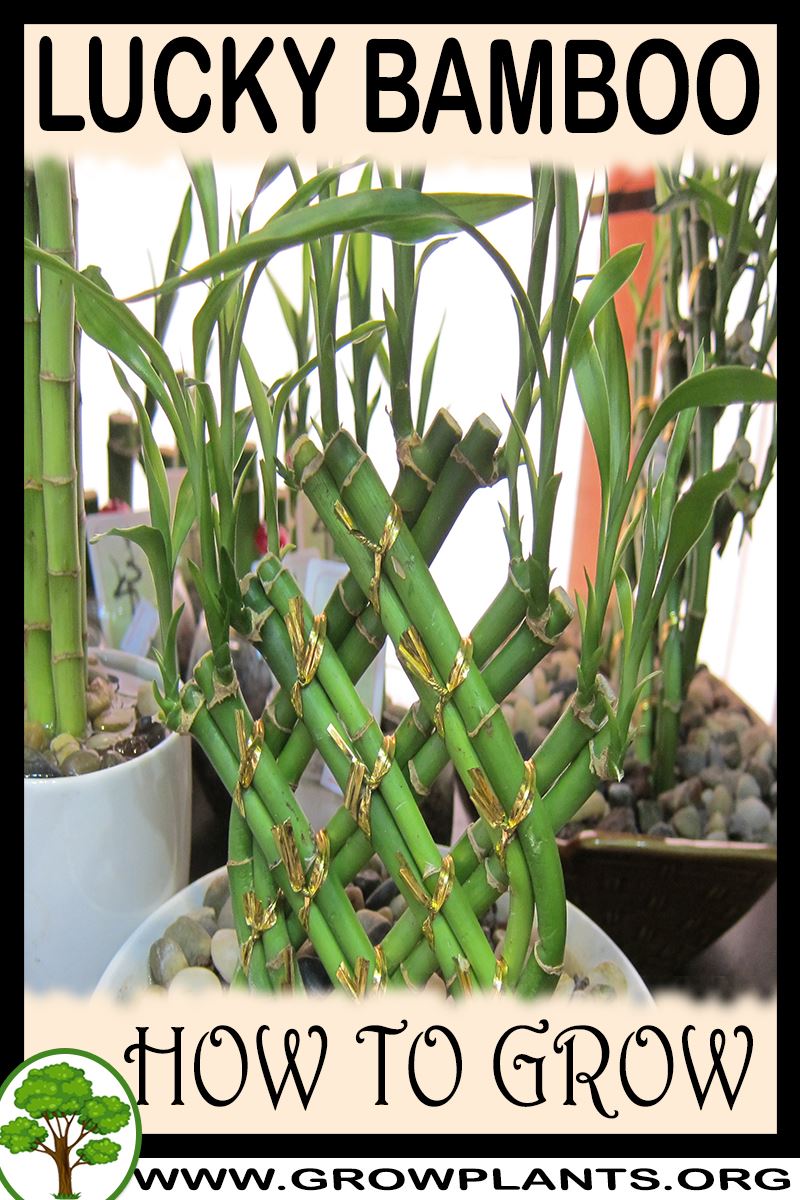
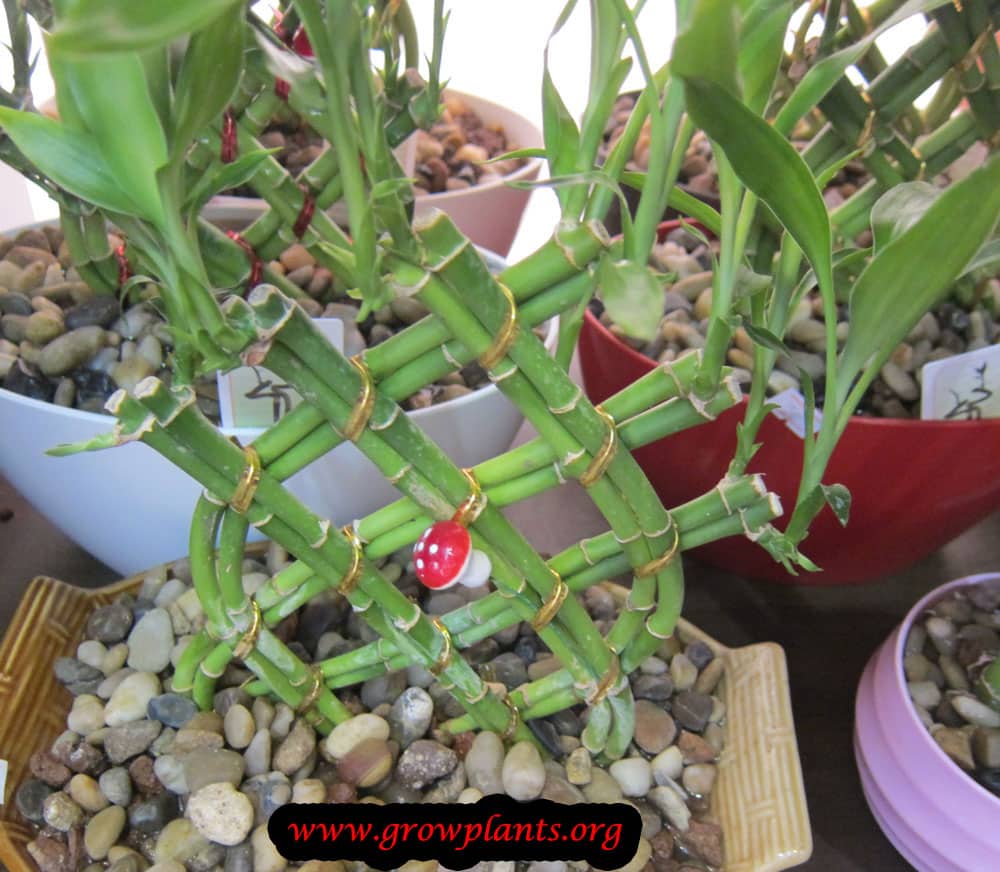
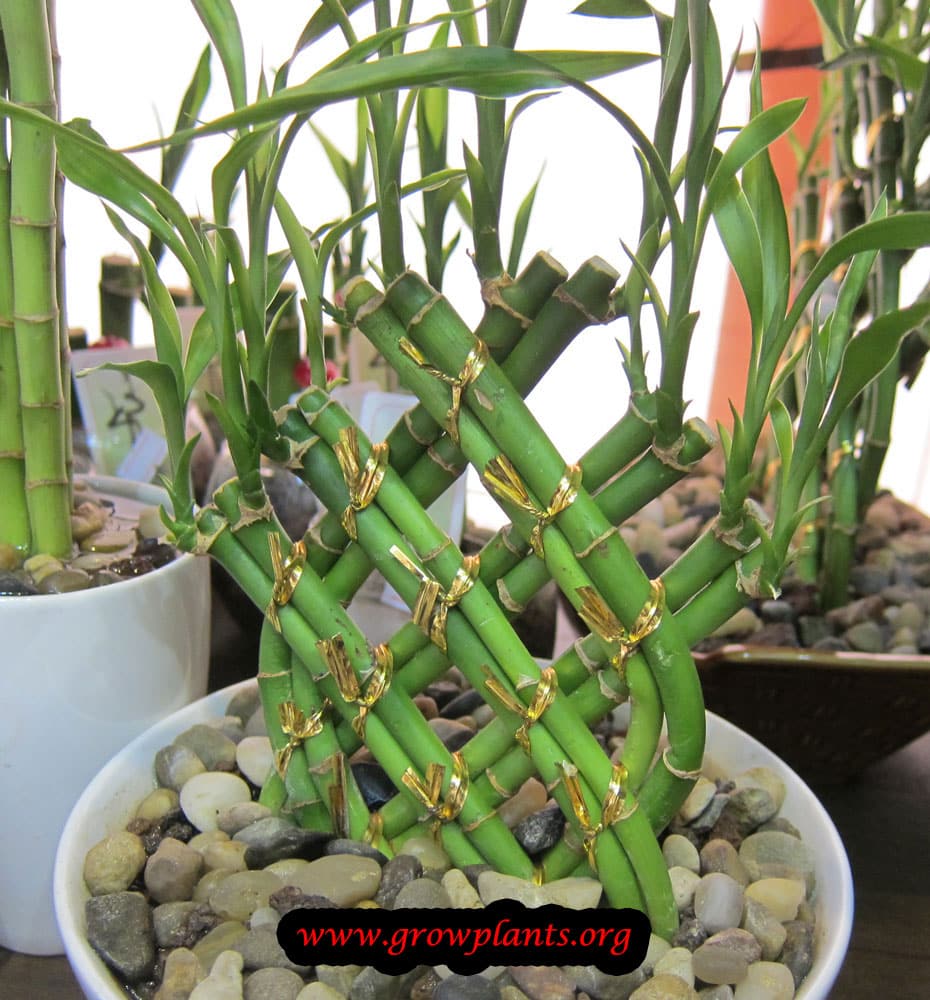
Overview: Lucky bamboo (Dracaena braunii) is an evergreen herbaceous perennial reaching 0.4–1 m (16–40 in), grown as an ornamental and often cultivated in water. It is prized for its upright green canes, which are commonly curled or trained into shapes.
Quick Specifications
| Specification | Attribute |
|---|---|
| Plant Type / Life Cycle | Perennial (evergreen) |
| Foliage Type | Evergreen |
| Mature Size | 0.4–1 m (16–40 in) |
| Growth Rate | Moderate to slow |
| Root System | Fibrous |
| Toxicity | Toxic to cats and dogs (contains saponins) |
| Hardiness | USDA zone 10b and above |
Growth Form & Structure
- Height & Spread: Reaches 0.4–1 m; usually kept short indoors, grown in water or soil and often trained into spirals or lattices.
- Growth Habit & Form: Upright, jointed green canes bearing elliptic leaves; frequently sold trained or curled.
- Lifespan & Maturity: Long-lived perennial; flowers only rarely in cultivation.
Anatomy & Physical Features
- Leaves & Foliage: Elliptic green leaves (variegated green-and-yellow in some forms) along the canes.
- Flower Characteristics: White flowers with needle-like petals in ball-shaped clusters, rare in cultivation.
Primary Uses & Landscape Value
- Functional & Ornamental Roles: Popular ornamental and gift houseplant, grown hydroponically in water or in pots — for anyone wanting to take water-growing further, a dedicated hydroponic system builds on the same no-soil principle; used in dish gardens and as a novelty trained plant.
Care Guide: Planting, Soil & Watering
Overview: Lucky bamboo (Dracaena braunii) is an easy-going Dracaena that can be grown either in a container of water or in moist, well-drained soil. Unlike its drought-tolerant relatives it likes to stay consistently moist and tolerates deep shade.
Quick Care Requirements
| Requirement | Ideal Condition |
|---|---|
| Planting Season | Year-round, as it is typically grown indoors in stable, frost-free conditions |
| Growth Rate | Slow to moderate |
| Soil Type | Grows in water, or in a rich, well-draining potting soil kept evenly moist |
| Water Need | Moderate to high — keep the medium consistently moist; if grown in water, refresh it every 2–3 weeks |
Planting & Establishment
- Best Planting Season: Can be started or potted up at any time of year in a sheltered, frost-free spot indoors.
- How to Plant:
- Soil Amendments: In soil, use a rich but free-draining potting mix; in water culture, stand the stems in a few centimetres of clean water with pebbles to hold them upright.
- Planting Depth: Set the base so the roots are covered but the stem itself is not buried deeply.
- Growth Speed & Expectations: Growth is slow to moderate; stems lengthen steadily and can be trained or trimmed to shape.
Soil, Watering & Drainage Care
- Soil Mix & Drainage Needs: If grown in soil, keep it moist but never waterlogged and ensure the pot drains freely; if grown in water, use clean, ideally non-chlorinated water and refresh it regularly to prevent stagnation.
- Watering Schedule & Technique:
- Young / Newly Planted: Keep the medium consistently moist as the roots establish.
- Established: In soil, water whenever the surface begins to dry so it never fully dries out; in water culture, top up and change the water every 2–3 weeks.
- Seasonal Adjustments: Growth slows in winter, so water a little less; increase moisture during warm, dry periods.
Climate, Light & Hardiness
Lucky bamboo is a warmth–loving succulent herbaceous plant grown outdoors in Mediterranean, subtropical, and tropical climates (roughly zone 10b and above), and very commonly as a houseplant or water plant. It prefers full shade and has little tolerance for cold.
Quick Climate Specifications
| Climate Zones | Mediterranean, subtropics, tropics; commonly grown as a houseplant/water plant |
|---|---|
| USDA Hardiness Zones | 10b+ |
| Frost Tolerance | Very Low |
| Light Conditions | Full Shade |
Sunlight & Light Exposure
Prefers full shade or bright, indirect light; direct sun can scorch the foliage, which is why it thrives as an indoor tabletop or water–grown plant.
Temperature Extremes & Hardiness
USDA Hardiness & Regional Limits
Reliable outdoors only from about zone 10b upward; it is overwhelmingly grown indoors as a houseplant, often in water, well outside that range.
Frost Sensitivity
Not frost tolerant; this tropical species needs warm, frost–free conditions year–round.
Wind, Humidity & Microclimate
Humidity Preferences
Appreciates moderate to high humidity in keeping with its tropical origins, though typical indoor humidity is generally adequate.
Growing in Pots, Balconies & Indoors
Lucky bamboo (Dracaena braunii) is a classic, forgiving houseplant – the grower confirms it grows well indoors and in containers. It is a shade-lover that thrives in low light and takes plenty of water, which makes it ideal for rooms and offices.
Quick Details
- Container Size: A small to medium pot; it stays compact (0.4-1 m)
- Indoor Suitability: A reliable, easy houseplant
- Best Spot: Full or part shade – never harsh direct sun
- Soil & Drainage: Rich, moisture-retentive but not waterlogged mix
- Watering in Pots: Keep evenly moist; it enjoys generous watering
Indoors & On the Windowsill
- A genuine houseplant: Marked Yes by the grower – one of the best plants for low-light interiors.
- Windowsill growing: Prefers a shaded or north-facing sill; direct sun scorches the leaves.
- Care indoors: It likes ample water; if grown in soil keep it consistently moist. Use non-fluoridated water where possible, as it can brown the tips.
- Safety: Toxic to cats and dogs if chewed – site it out of pets’ reach.
On a Balcony or Patio
- Light & shelter: Outdoors keep it in shade with shelter from wind and hot sun; container plants dry quickly, so check moisture often.
- Overwintering: Frost-tender – bring it indoors for winter in any climate with cold spells.
Choosing the Pot, Soil & Long-Term Care
- Pot & drainage: A small-to-medium pot with strong drainage holes; skip a standing-water saucer to avoid root rot. Terracotta breathes and dries fast, while glazed or plastic holds moisture longer.
- Potting mix: A well-aerated, organic-rich mix – peat or coir blended with perlite or vermiculite for free drainage.
- Feeding: Potted plants run their soil down fast as nutrients leach out, so feed more often than plants in open ground during active growth.
- Repotting: Refresh the mix or pot up about every two years; on established plants, lightly prune the root ball and top growth to keep them balanced.
Fertilizing & Feeding
A very light feeder whether grown in a vase of water or potted in soil; its stalks and strappy leaves ask for only occasional, dilute feeding and suffer more from over-feeding than under-feeding.
Quick Fertilizing Specs
| Feeding Level | Light |
|---|---|
| young_feeding | A newly rooted cutting or a plant just moved into a fresh vase or pot should be left unfed until new growth confirms it has settled in. |
| mature_feeding | An established stalk needs only occasional, well-diluted feeding to keep its foliage green. |
| Main Nutrient Priority | A balanced, low-strength feed suits this plant; heavy nitrogen pushes soft growth that can flop, and any fertilizer salts are easy for it to over-accumulate. |
| Best Feeding Period | Feed sparingly during the warmer months when new leaves are actively unfurling. |
| Organic Options | A well-diluted general houseplant feed is the practical option; plain water changes on their own supply little nutrition for water-grown stalks. |
| Micronutrients | A complete, dilute houseplant fertilizer supplies the trace elements this plant otherwise lacks in plain water culture. |
| Soil pH | Tolerates a wide pH range in either water or a well-drained potting mix; extremes are best avoided. |
| Reduce/Stop Feeding | Cut feeding back, or skip it altogether, once growth slows or leaf tips start browning, which often signals a fertilizer-salt buildup rather than a deficiency. |
Feeding by Growth Stage
Establishment
Let a newly rooted cutting or a plant just settled into fresh water or soil build roots before it is asked to take up nutrients.
| Nutrient direction | None – withhold fertilizer while the plant settles in |
|---|---|
| Timing | Right after propagation, or after moving the plant into fresh water or a fresh pot. |
| Frequency | No feeding at this stage. |
| Fertilizer types | No feeding at this stage – plain water only until new growth is visible. |
| Precautions | Do not fertilize a plant that has not yet shown new roots or leaves; fresh cuttings are especially sensitive to fertilizer salts. |
Active Growth
Keep the stalks and foliage a healthy green through the plant’s active growing stretch, whether grown in water or soil.
| Nutrient direction | A balanced feed used at a light, well-diluted strength |
|---|---|
| Timing | During the warmer months whenever new leaves are actively unfurling. |
| Frequency | Feed sparingly; this plant is far more tolerant of too little fertilizer than too much. |
| Fertilizer types | A balanced liquid houseplant fertilizer diluted well below normal container strength, A specialty low-dose liquid feed formulated for water-grown foliage plants |
| Routine trace nutrients | iron, manganese |
| Precautions | Avoid concentrated fertilizer, which readily scorches roots and browns leaf tips in this species; refresh the water or flush the potting mix regularly to keep dissolved salts from building up. |
Low-Light Slowdown
Avoid pushing nutrients into a plant that is not actively growing in low light or cooler conditions.
| Nutrient direction | None – hold off on fertilizer while growth is minimal |
|---|---|
| Timing | During low-light stretches or cooler indoor conditions when no new leaves are forming. |
| Frequency | No feeding at this stage. |
| Fertilizer types | No feeding at this stage – resume only once active growth is visible again. |
| Precautions | Do not fertilize a plant that has stopped producing new growth; unused nutrients accumulate quickly in a small vase or pot. |
Nutrient Deficiency Signs & Corrections
Leaf tips and margins turn brown and crisp while the rest of the leaf stays green.
| Possible causes | Fertilizer or mineral salts accumulating in the water or soil, Chlorine, fluoride, or other tap-water sensitivity, Low humidity or inconsistent watering drying the leaf edges |
|---|---|
| Appears first on | Tips and margins of the most mature leaves first |
| What to check | Review how concentrated recent feeding has been, Check the water source and consider filtered or rested water instead of straight tap water, Assess humidity and watering consistency around the plant |
| Possible correction | Cut back or pause feeding, flush the soil or fully refresh the water, and switch to filtered or rested water if tap-water sensitivity is suspected. |
Overall pale, yellowish-green leaves and slowed new growth despite otherwise healthy conditions.
| Possible causes | Too little nitrogen reaching the plant, especially common in long-term water culture, Insufficient light limiting the plant’s ability to use available nutrients, Root or stalk rot reducing nutrient uptake |
|---|---|
| Appears first on | Whole plant, most noticeable on newer leaves |
| What to check | Confirm whether any feeding has been given recently, particularly for water-grown stalks, Check light levels the plant is receiving, Inspect the base of the stalk and roots for soft, discoloured tissue |
| Possible correction | Introduce a light, balanced feed appropriate for water or soil culture and improve light conditions; address any rot found at the base. |
New leaves emerge pale or yellowish with the veins remaining greener than the leaf tissue between them.
| Possible causes | An iron or manganese shortfall in long-term water culture with no feeding, Water or growing medium pH outside the range where these micronutrients stay available, Root stress limiting micronutrient uptake |
|---|---|
| Appears first on | Newest leaves first |
| What to check | Review whether a complete fertilizer with trace elements has been used, Estimate the pH of the water or growing medium, Inspect roots for rot or stress |
| Possible correction | Switch to a complete feed that includes iron and manganese, and correct the water or medium pH if it is out of range for the plant. |
Pruning, Training & Seasonal Maintenance
Lucky bamboo tolerates light, frequent trimming well and is unusual among houseplants in that shaping cuts — topping a stalk just above a node — are the whole basis of how it is trained into the curls, spirals, and braided forms it is sold as. Day-to-day maintenance is mostly removing yellowing leaves and, in water culture, keeping the base of the stalk clean and rot-free. Cuts can be made any time growth is active; since this species is grown in constant warmth (as a houseplant or water plant) rather than through an outdoor season, there is no dormant window to avoid.
Quick Pruning & Maintenance Specs
| Pruning Tolerance | Moderate–High for stalk topping; the plant is a soft, herbaceous succulent, not woody |
| Primary Pruning Window | Any time during active growth (typically year-round indoors) |
| Secondary Maintenance Window | All year, for yellow/dead leaf removal |
| Typical Frequency | Leaf cleanup as needed; stalk topping only when a shoot outgrows the desired shape |
| Main Objective | Height and branching control (topping) plus removal of yellowing leaves and any rotten stalk tissue |
| Young Plant Priority | Minimal – let young stalks establish before any shaping cuts |
| Mature Plant Priority | Top stalks to control height and force the side shoots used for fuller or braided arrangements |
| Best Tool Type | Precision snips only – stalks and leaves are soft, no woody cuts involved |
| Avoid Heavy Pruning During | While the plant is under stress from a recent water change, low light, or chilling (below the plant’s tropical comfort range) |
Pruning by Plant Age & Size
Newly Established
Leave a newly rooted or newly potted stalk alone beyond removing any damaged leaves; let it settle before shaping.
Young / Formative
Formative work here is stalk topping, not a branching-tree framework: cutting a stalk just above a node redirects growth into one or more new side shoots below the cut, which is how growers build the curled, tiered, or braided shapes typical of this plant.
Mature / Established
Continue topping individual stalks as they exceed the desired height, and thin overcrowded new shoots after a cut so the arrangement keeps its shape rather than becoming a tangle.
Special Growth to Remove
- Yellowing or dead leaves, the main recurring maintenance task and a known trouble sign for this species — remove promptly.
- Any soft, discolored, or rotten stalk tissue at the waterline in water culture, cut back to firm healthy tissue to stop rot spreading upward.
- No suckers, watersprouts, or fruiting/flowering wood apply; this species is essentially never grown through to bloom indoors.
Container & Small-Space Pruning
This is the plant’s normal growing context, whether in a vase of water or a small pot of soil, so there is no separate “in-ground” comparison to make. Because it stays small (roughly 0.4–1 m) and grows only medium-to-slow, topping is usually all that is needed to keep it within its container or vase; there is no root-pruning practice for the water-grown form, and soil-grown plants rarely need it either given the slow growth rate.
Tools
- Precision snips – the only tool needed; stalks and leaves are soft enough that secateurs, loppers, or a saw are never appropriate.
Tool Hygiene & Disease Risk
Increased: because much of this plant is grown in standing water, cuts made into or near rot-affected stalk tissue carry a real risk of spreading soft rot to healthy stalks in the same container. Wipe or rinse the blade between plants (or between a rotten cut and a healthy one) rather than assuming routine cleanliness is enough.
Cut Placement & Technique
Cut just above a leaf node when topping, since new growth emerges from nodes. When removing rot, cut back into clean, firm tissue rather than just trimming the visibly discolored tip, as rot can extend further than it appears.
Heavy Pruning & Rejuvenation
An overly tall or leggy stalk can be topped hard with no lasting harm – this is routine for keeping arrangements compact and is exactly how growers renew shape over time. There is no formal rejuvenation program beyond simply topping stalks as needed.
Post-Pruning Care
In water culture, refresh the water after cutting so cut ends aren’t sitting in water that may carry rot organisms from the removed tissue. In soil, avoid overwatering right after a cut. No feeding push is needed after pruning.
Common Pruning Mistakes
- Letting yellowed or rotten leaves/stalk sections sit instead of removing them promptly, allowing rot to spread in water culture.
- Topping a stalk too close to a node cluster, crowding the new shoots instead of leaving room for a clean split.
- Reusing old, stagnant vase water after cutting, re-introducing rot organisms to a fresh wound.
When NOT to Prune
Avoid shaping cuts right after a stressful water/soil change, or while the plant shows chilling stress from low temperatures or cold drafts – let it stabilize first.
Recommended Tools (by task)
- precision_snips – the single tool for all cuts on this soft-stalked plant, from leaf cleanup to stalk topping.
- blade_disinfectant – wiping the blade when cutting away rotten stalk tissue, given the elevated rot-spread risk of water culture.
Propagation Guide
Lucky bamboo is grown almost exclusively from stem (cane) cuttings, which root very easily in plain water or a moist medium; the site’s own data notes vegetative propagation is preferred simply because it is easier, not because seed is unreliable. Flowering is uncommon in cultivation, so seed is rarely used in practice. Difficulty is easy, making this one of the simplest houseplants to propagate.
Quick Propagation Specs
| Best Propagation Method | Stem/cane cuttings |
| Alternative Methods | Seed (rarely used) |
| Propagation Difficulty | Easy |
| Vegetative True-to-Type | Yes |
| Best Propagation Season | All year indoors; Spring – Summer outdoors |
| Cutting Rooting Time | A few weeks in water |
Stem Cuttings
Cutting Type
Cane sections with at least one node, or side shoots cut just below a node.
Best Timing
Can be done year-round indoors; spring to summer is best outdoors.
Cutting Preparation
Cut cleanly just below a node; variegated canes can be cut the same way to keep their yellow striping.
Rooting Setup
Stand the cut end in plain water, changing the water every 2–3 weeks as the site’s own care guidance recommends for water-grown plants, or insert into a moist, free-draining mix.
Rooting Hormone
Not necessary – this species roots readily without it.
Rooting Time
Typically a few weeks in water.
Division, Offsets, Pups & Suckers
Clumps that have produced multiple canes from the base can be divided, provided each division keeps its own roots attached; pot divisions individually and keep soil evenly moist while they establish.
Bloom & Flower Guide
Quick Details
- Bloom Season: Summer, and only rarely
- Flower Appearance: Small white flowers with narrow, needle-like petals, gathered in rounded clusters
- Edibility: Ornamental — not eaten; like other Dracaena it is toxic to cats and dogs
Detailed Blooming Overview
Despite the name it is not a bamboo but a Dracaena, and it flowers only rarely, usually on older, well-established plants. When it does, expect small white blooms with fine, spidery petals bunched into loose balls. It is grown for its sculptural green stems, not its flowers.
Flower Characteristics
- Small white flowers with narrow, needle-like petals, in rounded clusters.
Bloom Care & Thinning
- Encouraging bloom: Bloom is uncommon and comes only with maturity; there is no reliable way to force it.
- Safety: Toxic to pets.
Pests, Diseases & Troubleshooting
True Dracaena are among the most reliable foliage plants, but they share a very consistent set of troubles. Indoors their signature pest is the spider mite, encouraged by warm dry air, alongside mealybugs, scale and thrips. Their signature complaint is a chemical one: sensitivity to fluoride and soluble salts, which scorch the leaf tips and margins brown. Root rot from overwatering and leaf drop from cold draughts round out the picture. Grow them warm, evenly (not excessively) moist, out of cold draughts, and water with clean low-fluoride water, and most problems simply never start.
Quick Troubleshooting Overview
| Issue / Pest | Main Symptom | Primary Solution |
|---|---|---|
| Spider mites | Fine stippling, dull leaves, faint webbing in dry warm air | Raise humidity, rinse foliage, horticultural oil |
| Mealybugs / scale | Cottony tufts or brown bumps; sticky honeydew | Alcohol swab, insecticidal soap, horticultural oil |
| Fluoride / salt tip burn | Brown, dead leaf tips and margins with yellow band | Use low-fluoride water, leach salts, avoid perlite/superphosphate |
| Cold-draught leaf drop | Sudden yellowing and shedding of lower leaves | Keep warm (>15°C), away from cold windows/doors |
| Root rot | Yellowing, soft brown stems, wilting despite moist soil | Reduce watering, improve drainage, repot into fresh mix |
| Fusarium leaf spot | Reddish-brown spots with yellow halos on new leaves | Keep foliage dry, remove leaves, copper fungicide |
Common Pests & Management
- Spider mites (Tetranychus urticae):
- Symptoms: The signature indoor pest of Dracaena. Fine pale stippling gives leaves a dull, dusty, bronzed look; in bad cases fine webbing strings between leaves and along the midrib. Worst in hot, dry, still air, especially over winter heating.
- Prevention & Control: Raise humidity and rinse or wipe the foliage regularly — mites cannot tolerate moisture and disturbance. Shower the plant periodically. Treat with horticultural oil or insecticidal soap on both leaf surfaces, repeating every 5–7 days; introduce predatory mites in larger collections.
- Mealybugs (Planococcus / Pseudococcus spp.):
- Symptoms: White cottony masses tucked into leaf axils, along the midrib, and where leaves clasp the cane; sticky honeydew and sooty mould follow. Root mealybugs may also infest the rootball.
- Prevention & Control: Dab colonies with an alcohol-dipped swab and wipe leaves clean. Follow with insecticidal soap or neem/horticultural oil, repeating every 7–10 days. Isolate the plant, and repot into fresh mix if roots are infested.
- Scale insects (Coccus hesperidum / Aspidiotus spp.):
- Symptoms: Brown, tan or grey limpet-like bumps along stems, midribs and leaf undersides; soft scale drips honeydew, fostering sooty mould. Easy to miss until stems feel bumpy.
- Prevention & Control: Scrape off with a fingernail or soft brush and dab with alcohol. Smother the rest with horticultural oil for full coverage, repeating for successive crawler generations. Prune out badly infested canes or leaves.
- Thrips (Frankliniella / Heliothrips spp.):
- Symptoms: Silvery scarring, pale streaks and tiny black frass specks on leaves; new growth may emerge distorted. Slender insects that flick away when disturbed.
- Prevention & Control: Monitor with blue sticky traps and remove badly damaged leaves. Rinse foliage and apply insecticidal soap or spinosad, and support natural predators such as lacewings and predatory mites.
- Fungus gnats (Bradysia spp.):
- Symptoms: Small black flies hovering over the pot; larvae feed in constantly wet potting mix and nibble fine roots, compounding overwatering damage.
- Prevention & Control: Allow the top few centimetres of mix to dry between waterings. Use yellow sticky traps for adults and a Bti drench for larvae; a grit top-dressing discourages egg-laying.
Diseases & Fungal Issues
- Fusarium leaf spot (Fusarium moniliforme):
- Symptoms: Reddish-brown to tan spots with distinct yellow halos, concentrated on the youngest leaves and at the growing tip; spots enlarge and run together in wet, humid conditions.
- Treatment & Management: Keep water off the leaves and lift humidity off the foliage with better airflow. Remove and destroy spotted leaves, avoid overhead watering, and apply a copper-based fungicide if it persists.
- Bacterial leaf spot & soft rot (Erwinia (Pectobacterium / Dickeya) spp.):
- Symptoms: Water-soaked spots and streaks that turn tan with yellow margins; in soft rot the cane or crown becomes mushy, slimy and foul-smelling, spreading fast in warm wet conditions.
- Treatment & Management: No chemical cure — rely on sanitation. Cut back into firm, healthy tissue with a sterilised blade and discard affected parts. Keep foliage dry, improve airflow, avoid overhead watering, and do not propagate from diseased canes.
- Root rot (Pythium / Phytophthora / Fusarium spp.):
- Symptoms: Yellowing, wilting and a soft, darkened stem base despite moist or wet soil; roots turn brown, mushy and slough their outer layer. Driven by overwatering and poor drainage.
- Treatment & Management: Reduce watering at once. Unpot, cut away soft, dark roots and stem tissue back to firm flesh, and repot into fresh, free-draining mix in a clean pot with drainage. Water only when the top of the mix has dried.
Growing Difficulties & Abiotic Problems
- Fluoride & salt tip burn (signature issue):
- Cause & Symptoms: Dracaena are classically sensitive to fluoride and to soluble-salt buildup from hard water, over-feeding, or superphosphate/perlite in the mix. The result is dead brown leaf tips and margins, often edged with a yellow band.
- Correction Strategy: Water with rainwater, distilled, or filtered/low-fluoride water. Avoid perlite-heavy mixes and phosphate-rich feeds; feed lightly and flush the pot periodically to leach salts. Trim browned tips for appearance.
- Cold-draught leaf drop:
- Cause & Symptoms: Sudden chilling from cold windows, doors, or air-conditioning vents causes rapid yellowing and shedding of leaves, especially the lower ones. These are warmth-loving tropicals.
- Correction Strategy: Keep the plant reliably warm (above about 15°C) and away from cold draughts and heating/cooling vents. Avoid sudden temperature swings; move it well inside before cold weather.
- Overwatering & root rot:
- Cause & Symptoms: Soggy soil is a leading cause of decline: lower leaves yellow, the base softens, and the plant wilts even though the soil is wet.
- Correction Strategy: Let the top few centimetres of mix dry before watering, and cut back sharply in low light and cool seasons. Ensure the pot drains freely and never sits in a full saucer.
- Low humidity & underwatering brown tips:
- Cause & Symptoms: Very dry air, erratic watering, or letting the rootball go bone-dry browns and crisps leaf tips and edges (distinct from, but easily confused with, fluoride burn).
- Correction Strategy: Keep watering even and moderate, and raise ambient humidity by grouping plants or using a pebble tray. Rule out salt/fluoride causes before assuming it is dryness.
- Water quality & care (lucky bamboo specific):
- Cause & Symptoms: Grown in water, this Dracaena is acutely sensitive to fluoride and chlorine in tap water, which yellow and brown the leaf tips; stagnant, algae-fouled, or salt-laden water also rots the stalks and yellows the foliage.
- Correction Strategy: Use rainwater, distilled, or tap water left to stand 24 hours to off-gas chlorine; change the water every week or two and keep it topped up over the roots. Rinse pebbles and container periodically, and feed only very dilute fertiliser.
What Helps – Products & Tools
The practical kit for Dracaena is mild and preventative: horticultural or neem oil and insecticidal soap for mites, mealybugs, scale and thrips; rubbing alcohol for spot-dabbing; sticky traps (blue for thrips, yellow for fungus gnats) and Bti for gnats; and a copper fungicide for leaf-spot outbreaks. Just as important are low-fluoride / filtered water and a free-draining potting mix, which prevent the tip-burn and root rot that account for most complaints.