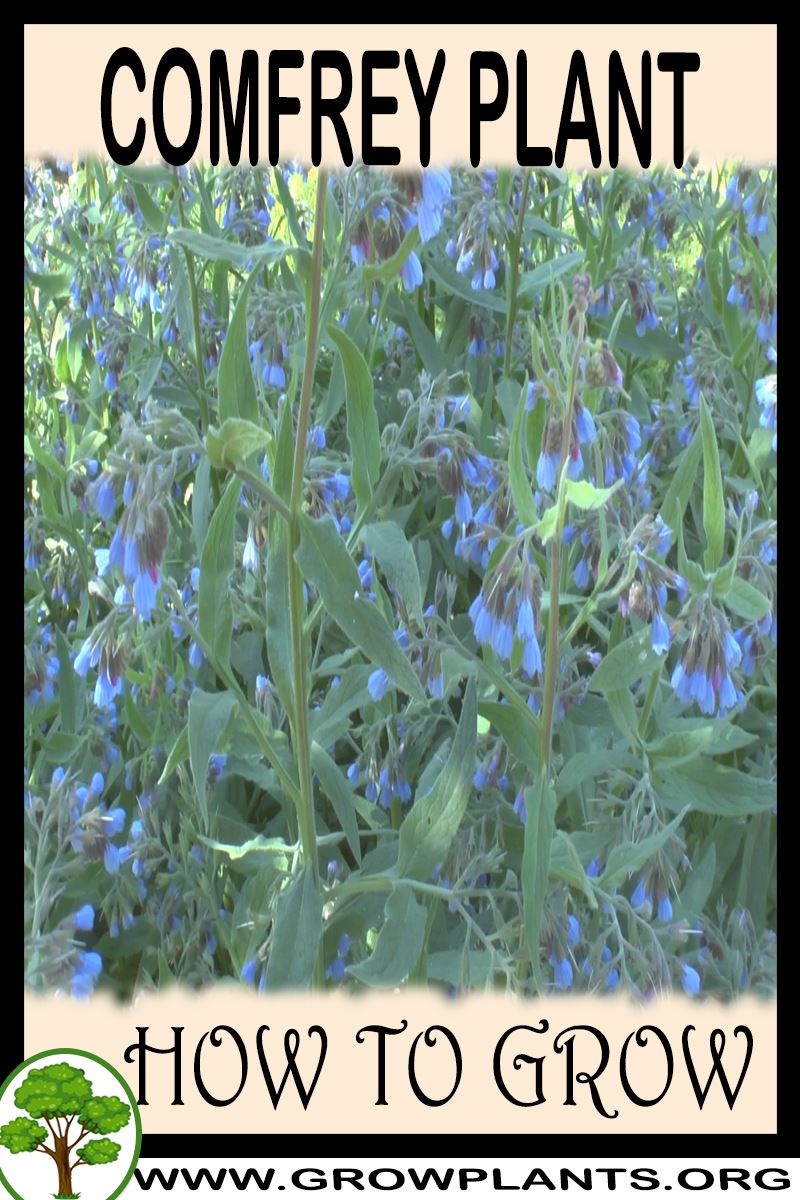
Plant Profile & Key Characteristics
Overview: Comfrey (Symphytum officinale) is a vigorous herbaceous perennial 30-50 cm tall with a deep taproot, grown mainly for medicinal and garden uses. It is a pollinator plant for temperate, subtropical and Mediterranean climates.
Quick Specifications
| Specification | Attribute |
|---|---|
| Plant Type / Life Cycle | Perennial (herbaceous) |
| Foliage Type | Deciduous (dies back in winter; evergreen in mild areas) |
| Mature Size | 30-50 cm (12-20 in); flowering stems taller |
| Growth Rate | Moderate to fast |
| Root System | Deep taproot |
| Toxicity | Contains pyrrolizidine alkaloids – not for internal consumption |
| Hardiness | USDA zones 3-9 |
Growth Form & Structure
- Height & Spread: 30-50 cm (12-20 in) clump; grows well in a container.
- Growth Habit & Form: Vigorous clump-forming herbaceous perennial with a deep taproot.
- Lifespan & Maturity: Long-lived; regrows readily from root fragments and can spread.
Anatomy & Physical Features
- Leaves & Foliage: Large elliptic, spoon-shaped leaves in a basal rosette, coarse and hairy.
- Flower Characteristics: Nodding bell / cone-shaped flowers in purple, pink or blue in clusters (full detail in the Bloom guide).
Primary Uses & Landscape Value
- Functional & Ornamental Roles: Medicinal (topical) herb, pollinator plant, and a garden ‘green manure’ / compost activator; ornamental.
Care Guide: Planting, Soil & Watering
Overview: Comfrey is a fast-growing, deep-rooted perennial that thrives in full sun to partial shade with moist, fertile, well-draining soil. It is a thirsty plant that likes generous, regular watering and copes best where the soil stays reliably moist.
Quick Care Requirements
| Requirement | Ideal Condition |
|---|---|
| Planting Season | Spring to summer |
| Growth Rate | Fast to moderate |
| Soil Type | Moist, fertile, well-draining soil |
| Water Need | Moderate to high – keep the soil reliably moist |
Planting & Establishment
- Best Planting Season: Plant in spring or summer once the soil has warmed; suited to hardiness zones 3–9, it benefits from cold winters.
- How to Plant:
- Hole Preparation: Dig a generous hole to accommodate the fleshy roots, loosening the surrounding soil so the deep taproot can drive down.
- Soil Amendments: Work in plenty of compost or well-rotted manure – comfrey is a hungry plant that rewards rich, moisture-holding soil.
- Planting Depth: Set the crown at or just below the soil surface at the same depth it grew before; do not bury it deeply.
- Growth Speed & Expectations: Growth is fast, forming a large leafy clump in a single season; it returns vigorously each year and spreads from the roots.
Soil, Watering & Drainage Care
- Soil Mix & Drainage Needs: Provide deep, fertile, moisture-retentive soil that still drains; comfrey tolerates heavier ground than most, but avoid stagnant waterlogging.
- Watering Schedule & Technique:
- Young / Newly Planted: Water freely after planting to keep the soil moist while the deep roots establish.
- Established: Water regularly so the soil stays moist, especially in warm weather; well-rooted plants are fairly resilient but grow lushest with steady moisture.
- Seasonal Adjustments: Water generously through the warm growing season and reduce watering in autumn and winter as the top growth dies back.
Climate, Light & Hardiness
Comfrey is a cold-hardy herbaceous perennial for temperate, subtropical, and Mediterranean climates; it prefers full sun to half shade and needs a genuinely cold winter to complete its dormancy cycle, tolerating USDA zone 3–9.
Quick Climate Specifications
| Climate Zones | Temperate, subtropical, Mediterranean |
|---|---|
| USDA Hardiness Zones | 3–9 |
| Frost Tolerance | High (dormant rootstock) |
| Light Conditions | Full Sun to Half Shade |
Sunlight & Light Exposure
Optimal Light Setup
Full sun gives the most vigorous growth.
Temperature Extremes & Hardiness
USDA Hardiness & Regional Limits
Zone 3–9. The plant's own care notes call for a cold winter, meaning it is naturally suited to climates with a genuine winter dormancy rather than a mild, frost-free one.
Frost Sensitivity
Topgrowth dies back with frost, but the deep taproot and crown are very hardy.
Extreme Heat Tolerance
Tolerates warm-temperate and subtropical summers with adequate moisture.
Wind, Humidity & Microclimate
Rainfall & Seasonal Moisture
Prefers consistently moist, well-drained soil; not well suited to climates with prolonged drought.
Growing in Pots, Balconies & Indoors
Comfrey (Symphytum officinale) is not a houseplant – the grower confirms – but it grows well in a large container, useful for keeping this vigorous, deep-rooted herb from spreading and for having its leaves handy as a garden feed. It is a hardy perennial (30-50 cm) that needs a cold winter, so it belongs outdoors.
Quick Details
- Container Size: A large, deep pot – the fleshy taproot needs room and the plant is vigorous
- Indoor Suitability: Not a houseplant; a hardy herb that needs a cold winter and open air
- Best Spot: Full sun to part shade
- Soil & Drainage: Moist, well-drained, rich soil
- Watering in Pots: Average to plenty – it is thirsty and likes steady moisture
Indoors & On the Windowsill
- Why not indoors: The grower does not rate it as a houseplant – it is a large, hungry, cold-loving perennial that needs a winter chill and far more root room than a room allows.
- Why a pot helps: In open ground comfrey spreads hard and is difficult to remove; a deep pot contains it while keeping its leaves close by for use as mulch or liquid feed.
- Overwintering: Fully hardy, it dies back and rests over winter; the pot stays outside and reshoots in spring.
On a Balcony or Patio
- Light & wind: Give it sun or part shade and keep the pot well watered – a big-leaved comfrey wilts fast if it dries out in summer heat.
- Safety: Comfrey is valued in the garden and traditionally on the skin, but it should not be eaten – its leaves and roots contain liver-toxic alkaloids. Keep it clearly separate from edible herbs.
Choosing the Pot, Soil & Long-Term Care
- Pot & drainage: Use a large, deep pot with strong drainage holes; skip a standing-water saucer to avoid root rot. Terracotta breathes and dries faster, while glazed or plastic pots hold moisture longer, which suits this thirsty herb.
- Potting mix: A rich, well-aerated organic mix – peat or coir with plenty of compost or organic matter, lightened with perlite or vermiculite for drainage.
- Feeding: Potted plants exhaust their soil quickly as nutrients leach out – feed lightly but regularly through the growing season.
- Repotting: Refresh the mix or pot up about every two years; for clumping perennials, lift and divide, trimming the roots and old top growth as you go.
Fertilizing & Feeding
A moderate feeder: this fast-growing leafy herb rewards a nitrogen-forward feeding while it is producing new growth, then rests through the cold winter when growth stops.
Quick Fertilizing Specs
| Feeding Level | Moderate feeder |
|---|---|
| Main Nutrient Priority | A nitrogen-forward complete fertilizer to support this herb’s vigorous leafy growth |
| Best Feeding Period | Spring through the active growing season |
| Organic Options | Compost or well-rotted organic matter worked into moist, well-drained soil |
| Reduce/Stop Feeding | Hold off feeding once the plant dies back for winter |
| Micronutrients | Usually adequate from a complete fertilizer and organic matter |
| Soil pH | Tolerates a range of moist, well-drained soil |
Feeding by Growth Stage
Establishment after planting or division
Help newly planted or divided crowns root in before pushing top growth.
| Nutrient direction | A balanced fertilizer supports root establishment as the plant settles in. |
|---|---|
| Timing | After planting, dividing, or transplanting, typically in spring. |
| Frequency | A light feeding at planting helps the plant establish. |
| Fertilizer types | A balanced complete fertilizer, Compost worked into the planting soil |
| Precautions | Keep soil consistently moist while roots establish; avoid overfeeding stressed young divisions. |
Active leafy growth
Support this herb’s characteristically vigorous, fast leaf production through the growing season.
| Nutrient direction | A nitrogen-forward fertilizer fuels this fast-growing, leafy plant’s characteristic vigor. |
|---|---|
| Timing | Through spring and summer while the plant is actively growing. |
| Frequency | Regular light feeding through the growing season supports its fast, leafy habit. |
| Fertilizer types | A nitrogen-forward complete fertilizer, Compost or organic matter as a top-dressing |
| Precautions | Keep soil consistently moist alongside feeding, since this plant favors moist, well-drained ground. |
Cold-season dieback and rest
Let the plant die back to the ground through cold winter weather without pushing new growth.
| Nutrient direction | No supplemental feeding is needed while the plant is dormant through winter. |
|---|---|
| Timing | Through autumn dieback and the cold winter this plant is noted to need. |
| Frequency | No feeding during this winter dormancy. |
| Fertilizer types | No feeding at this stage; the plant has died back and has no active growth to support through winter. |
| Precautions | Withhold fertilizer until new growth resumes in spring. |
Nutrient Deficiency Signs & Corrections
Leaves are smaller and paler than this normally lush, fast-growing herb’s usual habit.
| Possible causes | low available soil nitrogen for a naturally heavy-feeding leafy herb, leaching from consistently moist soil, thin, low-organic-matter soil |
|---|---|
| Appears first on | older, lower leaves |
| What to check | recent feeding history, soil organic matter, watering and drainage |
| Possible correction | Apply a nitrogen-forward fertilizer and build soil organic matter. |
New leaves yellow between the veins while veins stay green.
| Possible causes | high soil pH limiting iron availability, waterlogged soil from consistently moist conditions, compacted soil restricting roots |
|---|---|
| Appears first on | newest leaves |
| What to check | soil pH and drainage, standing water after rain or irrigation, root health |
| Possible correction | Improve drainage and soil pH balance; apply a chelated iron product per its label if the issue persists. |
Leaf margins brown or scorch despite consistently moist soil.
| Possible causes | fertilizer salt buildup from frequent feeding of this fast grower, inconsistent watering concentrating salts, excessive feeding relative to actual growth rate |
|---|---|
| Appears first on | leaf margins and tips |
| What to check | recent fertilizer amounts, watering consistency, drainage of the bed |
| Possible correction | Ease off feeding, water thoroughly to flush salts, then resume lighter feeding. |
Pruning, Training & Seasonal Maintenance
Comfrey is a vigorous herbaceous perennial that regrows from a deep taproot and basal crown, so its pruning is really repeated whole-clump cutting back rather than any shaping of woody growth. It tolerates hard cutting extremely well – gardeners routinely cut it to the ground several times through the growing season to harvest leaves for mulch, compost activator, or medicinal use – and a final cutback in autumn or winter removes dying foliage. Cutting does not meaningfully affect flowering, since new bloom stems arise from the crown after every cut.
Quick Pruning & Maintenance Specs
| Pruning Tolerance | High |
| Primary Pruning Window | Spring–Autumn (repeated harvest cutbacks) |
| Secondary Maintenance Window | Autumn/Winter dieback cleanup |
| Typical Frequency | 3–4 whole-clump cuts per growing season, plus one autumn/winter tidy |
| Main Objective | Biomass harvest, foliage renewal, sanitation |
| Young Plant Priority | Let the taproot and crown establish before the first hard cut |
| Mature Plant Priority | Repeated chop-and-drop cutback cycles through the season |
| Best Tool Type | Hedge shears or bypass secateurs for the whole clump |
| Avoid Heavy Pruning During | Prolonged drought stress; late enough in autumn that regrowth can’t recover before frost |
Pruning by Plant Age & Size
Newly Established
Avoid cutting back hard in the first few months after planting or division; let the taproot and crown establish first.
Young / Formative
No structural training applies – comfrey is a basal-clump herbaceous perennial, not a trained plant.
Mature / Established
Once established, cut the whole clump back to ground level repeatedly through the growing season for harvest, and again in autumn/winter for dieback cleanup.
Seasonal Pruning Schedule
Post-Flowering / Ongoing: deadhead or cut flowering stems as part of a harvest cut, ideally before seed sets, since comfrey self-seeds and root fragments regenerate readily; what NOT to remove is the crown itself.
Summer Canopy Management: repeated chop-and-drop harvest cuts to a stub 5–10cm above the crown; expected response is a fresh flush of leaves within 2–3 weeks in warm weather.
Dormant/Winter: cut down dying autumn foliage to reduce rust (Melampsora) overwintering on old leaves.
Structural Pruning & Training
Not applicable – comfrey has no persistent framework; the only ‘structural’ concern is renewing the clump through repeated cutback rather than letting old growth flop and shade the crown.
Special Growth to Remove
- Spent flower stems – cut before seed-set to limit self-sowing spread.
- Rust-affected or otherwise diseased leaves – remove and dispose of (do not compost) rather than leaving on the clump.
- Faded outer leaves at any harvest cut.
Container & Small-Space Pruning
Comfrey is sometimes grown in containers specifically to contain its spreading, regenerating roots; in a pot, cut back on the same frequent harvest schedule, and expect to cut somewhat more often to keep the confined clump in scale.
Tools
Bypass secateurs for individual flower stems or selective cuts; hedge shears are a practical, fast option for a whole-clump chop-and-drop cutback, since the cut is uniform across soft herbaceous stems rather than selective.
Tool Hygiene & Disease Risk
Increased – comfrey is susceptible to rust; wipe or disinfect blades after cutting visibly rusted foliage before moving to the next plant, and avoid composting rust-affected material.
Cut Placement & Technique
Cut the whole clump down to about 5–10cm above the crown; take care not to damage the crown or emerging growing points, since regrowth comes from there.
Heavy Pruning & Rejuvenation
Very well tolerated – the standard chop-and-drop harvest cut to a low stub is itself a repeatable ‘heavy’ cut, not a rare rejuvenation measure, and the clump regrows vigorously through the warm season; avoid a final hard cut so late in autumn that there isn’t time to recover before a hard frost.
Post-Pruning Care
Water after cutback to support fast regrowth; no feeding is generally needed, since comfrey is more often used as a fertilizer input than fed itself; watch regrowth for renewed rust symptoms.
Common Pruning Mistakes
- Cutting too low and damaging the crown, weakening regrowth.
- Letting flower stems go to seed before cutting, encouraging unwanted spread.
- Disturbing or tilling the roots during other garden work – root fragments readily resprout, which is how comfrey becomes locally invasive.
When NOT to Prune
Avoid cutting back during drought without follow-up watering; avoid disturbing/tilling the root zone, since fragmented roots resprout into new plants.
Recommended Tools (by task)
- bypass_secateurs – cutting individual flower stems or selective foliage.
- hedge_shears – fast whole-clump chop-and-drop harvest cutbacks on this uniform herbaceous mass.
- blade_disinfectant – wiping blades after cutting rust-affected foliage before moving to another plant.
Pruning Troubleshooting
| Problem | Possible Cause | What to Check | Corrective Action |
| Weak regrowth after cutback | Cut too late in the season or during drought stress | Soil moisture and season timing | Water well; wait for the next warm-season flush rather than re-cutting immediately |
| Orange pustules / rust on leaves | Fungal rust disease, worse in dense, damp foliage | Undersides of leaves for orange spore pustules | Cut affected leaves to the base, dispose of them (do not compost), improve airflow around the clump |
| Unwanted seedlings spreading nearby | Flower stems left to set seed before cutting | Flower stems for seed development before cutting | Deadhead/cut promptly after bloom; consider a low-seeding cultivar if spread is a concern |
Propagation Guide
Comfrey is best propagated using root cuttings and crown/root division when the goal is to preserve the current plant form.
Quick Propagation Specs
| Preferred Method | Root cuttings and crown/root division |
| Seed | Seed is possible, but vegetative methods are the practical route for rapid increase |
Root Cuttings and Division
Use healthy root sections or divide an established crown so each new piece has viable root and shoot tissue. Replant into fertile, moisture-retentive but well-drained soil.
Seed Propagation
Seed is possible, but vegetative methods are the practical route for rapid increase. When seed is used, sow mature viable seed in a clean, free-draining medium.
Aftercare
Protect newly propagated plants from severe drought, heat and waterlogging until new roots and shoots are established.
Bloom & Flower Guide
Quick Details
- Bloom Season: Spring into summer
- Flower Appearance: Nodding, bell-to-tubular flowers in purple, pink or blue, in curved clusters
- Edibility: Not for eating – despite its herbal use, comfrey contains liver-harming alkaloids; grow it for pollinators, not the plate
Detailed Blooming Overview
Comfrey flowers from spring into summer, carrying nodding clusters of little bell-to-tube shaped blooms in purple, pink or blue that uncurl along the stem as they open. Bees adore them. Though comfrey has a long history in herbal medicine and is a favourite of pollinator gardeners, it contains compounds (pyrrolizidine alkaloids) that can harm the liver, so the flowers and plant are not eaten.
Flower Characteristics
- Nodding, bell-to-tubular flowers in purple, pink or blue.
- Carried in curved clusters that unfurl as they open.
- An exceptional bee and pollinator plant.
Bloom Care & Thinning
- Managing the bloom: Cut back spent flower stems – this can prompt fresh growth and repeat bloom – and remove them before heavy self-seeding if you want to contain it.
- Safety: Do not eat the flowers or any part; comfrey’s alkaloids can harm the liver.
Fruit & Uses
The young leaves of comfrey have traditionally been eaten cooked (steamed, sauteed, or dipped in batter and fried) and brewed as a tea, and the leaves remain popular today as a nutrient-rich mulch and compost activator. However, all parts of the plant — especially the root — contain pyrrolizidine alkaloids (PAs) that are toxic to the liver, so modern herbal-safety and extension guidance advises against eating comfrey leaves or drinking comfrey tea, even though this was common practice in the past.
Quick Edible Specs
| Edible Parts | Young leaves (historically eaten; internal use now discouraged) |
|---|---|
| Main Use(s) | Historically culinary (cooked greens, fritters, tea); today mainly non-food — mulch, compost activator, and traditional external skin preparations |
| Eaten Raw or Cooked | Traditionally cooked only, never raw; not recommended for eating today in any form |
| Preparation Required | Cooking was traditional but does not remove the pyrrolizidine alkaloid content, so no preparation makes internal use safe |
| Harvest Season | Spring to summer, when leaves are young and tender |
| Time to First Harvest | Leaves become usable soon after the plant is established (qualitative only) |
| Storage | Not typically stored as food; used fresh as mulch or added directly to compost, or dried only for external preparations |
| Safety/Toxicity Caveat | Contains hepatotoxic pyrrolizidine alkaloids, most concentrated in the root; internal use (leaf or root, fresh or as tea) is advised against by modern herbal-safety and extension sources, especially for pregnant or breastfeeding people, children, and anyone with liver conditions |
Leaves & Greens
The elliptic, spoon-shaped leaves that grow in a basal rosette were historically picked young and cooked as a spinach-like green, added to soups, or battered and fried; older leaves were considered less palatable because of their coarse, bristly hairs. Because of the pyrrolizidine alkaloid content described above, this traditional food use is no longer recommended — today the leaves are mainly cut for mulch or added whole to compost, where the plant’s fast regrowth provides a renewable source of organic matter rather than a food crop.
Harvesting
Where leaves are still cut (for mulch or compost rather than food), the youngest outer leaves can be harvested repeatedly through spring and summer as the rosette regrows; flowering stems are usually removed at the same time to keep leaf production going, see Pruning for general cutting timing.
Preparation, Uses & Safety
Safety comes first with comfrey: because the leaves, and especially the roots, contain hepatotoxic pyrrolizidine alkaloids, herbal-safety references and extension services advise against eating the leaves, drinking comfrey tea, or taking root preparations internally, even though this was traditional practice historically. The plant’s widely accepted uses today are non-culinary — as a fast-growing mulch, a compost ‘activator’, or in traditional externally applied ointments and poultices for bruises and minor sprains on unbroken skin, described here only as traditional use, not a medical recommendation. If leaves are ever eaten, this should be limited to small amounts of young, well-cooked leaf and never the root, and should not be a regular practice.
Pests, Diseases & Troubleshooting
Overview: Comfrey is an exceptionally tough, vigorous Boraginaceae perennial that is essentially pest-free – its coarse, bristly, alkaloid-rich leaves deter almost everything. Honesty here means keeping this section short: its only regular problem is comfrey rust, with slugs bothering seedlings and occasional aphids. Its real ‘management’ challenge is often its own spreading vigour rather than any pest.
Quick Troubleshooting Overview
| Issue / Pest | Main Symptom | Primary Solution |
|---|---|---|
| Comfrey rust | Orange-brown pustules on leaf undersides | Cut plant to the ground, remove leaves, let it regrow clean |
| Slugs & snails | Grazed seedlings and soft young leaves | Iron-phosphate bait on young plants; mature plants shrug it off |
| Aphids | Occasional clusters on flower stems | Rinse off; natural enemies keep them in check |
| Powdery mildew | White film on leaves in humid crowding | Improve airflow; cut back, regrows clean |
| Invasive vigour | Spreads by root fragments, hard to remove | Site carefully, use sterile ‘Bocking’ cultivars, contain roots |
Common Pests & Management
- Slugs and snails:
- Symptoms: Grazed holes and slime trails on seedlings and the softest young leaves in damp conditions; only young or newly divided plants are really at risk.
- Prevention & Control: Protect seedlings and fresh divisions with iron-phosphate bait and by clearing debris; established comfrey with its coarse bristly foliage is rarely touched and needs no protection.
- Aphids (Aphis spp.):
- Symptoms: Occasional clusters of soft insects on the flower stems and soft new growth, with a little sticky honeydew.
- Prevention & Control: Usually trivial and quickly cleaned up by lady beetles, lacewings and hoverflies, which comfrey flowers actually attract; rinse off heavy clusters with water if wanted, and avoid sprays that would harm those beneficials.
- Leaf-mining and chewing insects (minor):
- Symptoms: Occasional mines or chewed patches from generalist insects; comfrey tolerates them without meaningful harm.
- Prevention & Control: No action is normally needed – the plant’s vigour easily outgrows minor feeding; simply cut it back and it regrows clean.
Diseases & Fungal Issues
- Comfrey rust (Melampsorella symphyti):
- Symptoms: Numerous small orange to reddish-brown powdery pustules on the leaf undersides with yellow flecking above; heavily infected leaves yellow and wither. This is comfrey’s one regular disease.
- Treatment & Management: Cut the whole plant down to the ground and remove and destroy (do not compost) the rusted foliage; the vigorous crown quickly regrows clean, healthy leaves. Improve airflow, avoid overcrowding, and repeat the cut-back if rust returns – this is far more effective than any spray on such a fast-regrowing plant.
- Powdery mildew (Erysiphe spp.):
- Symptoms: A white powdery film on the leaves in humid, crowded, still conditions late in the season.
- Treatment & Management: Improve air movement and spacing, and simply cut the plant back – it regrows clean. Fungicide is essentially never warranted on comfrey.
- Sclerotinia / crown rot (rare):
- Symptoms: Occasional soft rotting of the crown in cold, wet, poorly drained soil.
- Treatment & Management: Grow in reasonably drained soil and avoid waterlogging; remove any rotted material. This is uncommon on such a robust plant.
Growing Difficulties & Abiotic Problems
- Invasive vigour / hard to remove:
- Cause & Symptoms: Spreads strongly by seed and, crucially, regenerates from the smallest root fragment left in the ground, making it very hard to dig out once established.
- Correction Strategy: Site it deliberately where its spread is welcome or contain the roots, and grow sterile, non-seeding cultivars (the ‘Bocking’ Russian comfreys) where self-seeding is a concern; remove all root pieces when digging, as any fragment resprouts.
- Drought wilting:
- Cause & Symptoms: Large leaves wilt dramatically in hot dry spells but the plant is rarely harmed.
- Correction Strategy: Water in prolonged drought if you want it to keep producing leaf, or simply let it wilt and cut it back – the deep taproot lets it recover fully once moisture returns.
- Frost dieback (normal):
- Cause & Symptoms: Top growth is knocked back by hard frost and the plant dies down for winter.
- Correction Strategy: No action needed; it is a hardy herbaceous perennial that resprouts vigorously from the crown in spring.
What Helps – Products & Tools
Comfrey barely needs anything: iron-phosphate slug bait only for seedlings, and for comfrey rust the ‘tool’ is simply shears – cut the plant to the ground and remove the infected leaves so it regrows clean. No routine insecticide or fungicide is warranted; if anything, the challenge is containing the plant, not protecting it.