
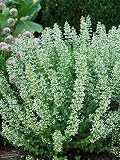


Plant Profile & Key Characteristics
Overview: An aromatic low, spreading perennial herb (calamint) reaching about 30-60 cm, evergreen in mild climates and dying back where winters are cold. It is grown as a fragrant edible herb, ornamental and groundcover.
Quick Specifications
| Specification | Attribute |
|---|---|
| Plant Type / Life Cycle | Perennial (herbaceous subshrub) |
| Foliage Type | Evergreen in mild climates; deciduous where winters are cold |
| Mature Size | 30-60 cm (12-24 in) |
| Growth Rate | Fast to moderate |
| Toxicity | Non-toxic — aromatic culinary herb, leaves edible |
| Hardiness | USDA zone 5-10 |
Growth Form & Structure
- Height & Spread: 30-60 cm (12-24 in) tall with a spreading habit; well suited to containers and can be grown indoors as a houseplant
- Growth Habit & Form: Bushy, spreading herbaceous subshrub forming a fragrant groundcover; can be vigorous to aggressive
- Lifespan & Maturity: Fast-establishing perennial reaching full size within a season or two
Anatomy & Physical Features
- Leaves & Foliage: Small green oval-to-elliptic leaves, aromatic — the scent recalls mint with marjoram
- Flower Characteristics: Masses of small white flowers on upright stems that can cover the whole plant in season
Primary Uses & Landscape Value
- Edible Uses: Leaves used as a culinary herb and spice and for herbal tea and beverages
- Functional & Ornamental Roles: Fragrant ornamental and groundcover; attracts pollinators; grown as a container herb
Care Guide: Planting, Soil & Watering
Overview: Calamintha nepeta ‘White Cloud’ is a fast-growing, aromatic Mediterranean sub-shrub (hardy roughly zones 5–10) that thrives in full sun to half shade. It wants light, well-draining soil and only modest watering — once established it is quite drought-tolerant and can spread vigorously.
Quick Care Requirements
| Requirement | Ideal Condition |
|---|---|
| Planting Season | In spring, summer or autumn |
| Growth Rate | Moderate to Fast |
| Soil Type | Light, well-draining; tolerates lean, gritty soil |
| Water Need | Low to Moderate – let the soil dry between waterings |
Planting & Establishment
- Best Planting Season: Plant in spring, summer or autumn while the soil is workable and warm.
- How to Plant:
- Hole Preparation: Dig a hole a little wider than the root ball and loosen the surrounding soil for drainage.
- Soil Amendments: Add grit or coarse material to heavy soil to sharpen drainage; it needs little feeding and dislikes soggy ground.
- Planting Depth: Set the crown at soil level so the root collar is not buried.
- Growth Speed & Expectations: A quick, bushy grower reaching 30–60 cm (12–24 in) that spreads readily — give it room or contain it, as it can be aggressive.
Soil, Watering & Drainage Care
- Soil Mix & Drainage Needs: Sharp drainage is essential to prevent root rot; in containers use a free-draining, gritty potting mix.
- Watering Schedule & Technique:
- Young / Newly Planted: Water young plants regularly until the roots take hold over the first few weeks.
- Established: Water established plants sparingly and deeply, letting the top of the soil dry out first.
- Seasonal Adjustments: A little extra in prolonged summer heat; keep drier in winter, especially in cold zones.
Climate, Light & Hardiness
Calamintha White cloud (Clinopodium nepeta) is an aromatic perennial ground cover suited to Mediterranean, desert, subtropical, and temperate climates in full sun to half shade, and it also adapts well to container or indoor growing. It is moderately cold hardy, remaining evergreen in mild climates and dying back to the roots where winters are cold.
Quick Climate Specifications
| Climate Zones | Mediterranean, Desert, Subtropical, Temperate |
|---|---|
| USDA Hardiness Zones | 5–10 |
| Frost Tolerance | Moderate |
| Light Conditions | Full Sun / Half Shade |
Sunlight & Light Exposure
Optimal Light Setup
Full sun to half shade both suit this ground-cover herb, whether grown outdoors or as a houseplant near a bright window.
Direct Sun Requirement
Tolerates direct sun for most of the day; half shade is also acceptable, especially in hotter climates.
Temperature Extremes & Hardiness
USDA Hardiness & Regional Limits
Hardy from zone 5 through zone 10, a fairly broad range that spans cold-winter temperate climates through mild Mediterranean and subtropical ones; it can also be grown indoors year-round outside this range.
Cold Damage & Winter Protection
In colder parts of its outdoor range, top growth dies back with winter cold (cold deciduous) and regrows from the roots in spring; in milder climates it stays evergreen year-round.
Frost Sensitivity
Tolerates frost within its hardiness range, with the foliage response varying between evergreen and deciduous depending on winter severity.
Extreme Heat Tolerance
Handles hot, dry Mediterranean and subtropical summer conditions well.
Growing in Pots, Balconies & Indoors
Calamint ‘White Cloud’ (Calamintha nepeta) is a compact, minty-aromatic herb the grower rates as fine for indoors – on a bright windowsill it makes a fragrant, easy potted herb, and it’s just as happy on a balcony or patio.
Quick Details
- Container Size: A 3-10 L (roughly 1-3 gal) pot suits these compact herbs
- Indoor Suitability: A good potted herb indoors – give it the brightest window you have
- Best Spot: Full sun to half shade
- Soil & Drainage: Free-draining potting mix; happy in ordinary soil, dislikes waterlogging
- Watering in Pots: Light to moderate – let the top dry slightly; pots dry faster than open ground
Indoors & On the Windowsill
- A good indoor herb: The grower rates it as suitable for indoors. Keep it on your brightest, sunniest windowsill so it stays compact and fragrant, turning the pot now and then; the minty leaves are handy in the kitchen.
- Overwintering: A hardy perennial – it dies back and returns each year; a potted plant can be sheltered through hard winters.
On a Balcony or Patio
- Light & wind: A sunny to lightly shaded spot suits it; the aromatic foliage and flowers are a magnet for bees. Pots dry faster against warm walls, so check moisture in hot spells.
- Practicalities: It stays compact, so it’s easy on a balcony; just make sure water drains away freely rather than pooling under the pot.
Choosing the Pot, Soil & Long-Term Care
- Pot & drainage: A pot with strong drainage holes; skip a standing-water saucer to avoid root rot. Terracotta breathes and dries faster, while glazed or plastic holds moisture longer.
- Potting mix: A good free-draining potting mix kept open with a little perlite; these herbs aren’t fussy but dislike soggy roots.
- Feeding: Feed lightly through the growing season – a dilute general feed every few weeks, as nutrients wash out of pots faster than open ground.
- Repotting: Refresh the mix and pot up every year or two; divide congested clumps and trim the roots to keep them vigorous.
Fertilizing & Feeding
A light feeder: this white-flowered Calamintha nepeta selection is grown as much for its long cloud of summer bloom as for its edible, fragrant leaves, and it performs best with modest feeding that favors flowering and fragrance over lush leafy bulk.
Quick Fertilizing Specs
| Feeding Level | Light feeder |
|---|---|
| Main Nutrient Priority | Balanced feeding with nitrogen kept modest, to support the long white bloom without forcing soft growth |
| Best Feeding Period | Spring through the summer-to-autumn active growth and bloom period |
| Organic Options | Compost or well-rotted organic matter worked into the well-drained bed or container mix |
| Reduce/Stop Feeding | Ease off and stop as growth slows or the plant dies back for winter |
| Micronutrients | Rarely an issue in well-drained soil; correct only a diagnosed deficiency |
| Soil pH | Tolerates a wide range; does well in neutral to slightly alkaline, well-drained soil |
Feeding by Growth Stage
Establishment after planting
Root a newly planted or newly potted Calamintha White cloud into its well-drained bed or container without forcing soft top growth.
| Nutrient direction | A light, balanced feeding supports root establishment; there is no benefit to pushing rapid growth this early. |
|---|---|
| Timing | At planting and through the first season, in spring, summer, or autumn. |
| Frequency | A single light feeding at planting is usually enough while roots establish. |
| Fertilizer types | A balanced, complete fertilizer used at a light rate, Compost or organic matter mixed into the planting hole or potting mix |
| Precautions | This spreading herb settles in quickly, so avoid heavy feeding, which only pushes rank, floppy growth. |
Active growth and the long white bloom
Sustain fragrant foliage and the white summer-to-autumn bloom that this selection is prized for, whether grown in the ground or as a houseplant.
| Nutrient direction | Keep nitrogen modest; a restrained, balanced approach favors bloom and fragrance over soft, watery growth. |
|---|---|
| Timing | Through the spring-to-autumn active growing and flowering season. |
| Frequency | In-ground plants rarely need feeding; container and houseplant specimens benefit from an occasional light feeding as the potting mix is used up. |
| Fertilizer types | A balanced, complete fertilizer used sparingly, Compost or a light top-dressing in place of frequent feeding |
| Precautions | Overfeeding produces lush but weaker-flavored, floppier growth on this ornamental and culinary herb; less is more here. |
Winter rest / cold-season die-back
Let outdoor plantings rest through winter, when they can die back to the ground in colder parts of the range.
| Nutrient direction | None – withhold fertilizer while the plant is dormant or has died back for winter. |
|---|---|
| Timing | Winter, especially where the plant behaves as cold-deciduous rather than evergreen. |
| Frequency | No feeding during this rest period. |
| Fertilizer types | No feeding at this stage; do not fertilize dormant or die-back growth. |
| Precautions | Do not fertilize until new growth resumes in spring; feeding dormant roots wastes nutrients and can invite rot. |
Nutrient Deficiency Signs & Corrections
Older leaves fade to a pale, uniform green or yellow and flowering weakens.
| Possible causes | low available soil or potting-mix nitrogen, nutrient leaching after heavy watering or rain, an aging, exhausted potting mix in container-grown plants |
|---|---|
| Appears first on | older, lower leaves |
| What to check | recent feeding history, age and condition of the potting mix, if container-grown, drainage and watering pattern |
| Possible correction | Refresh the potting mix or work in compost, then apply a balanced complete fertilizer at a light rate. |
New leaves at the shoot tips turn yellow between veins that stay green.
| Possible causes | high soil or potting-mix pH tying up available iron, waterlogged or compacted soil limiting root uptake, naturally alkaline garden soil |
|---|---|
| Appears first on | newest growth at the shoot tips |
| What to check | soil or potting-mix pH and drainage, recent overwatering or compaction, whether the same pattern shows on nearby plants |
| Possible correction | Improve drainage, avoid overwatering, and apply a chelated iron product per its label if the pattern persists. |
Leaf margins brown or scorch, particularly in pots, despite regular watering.
| Possible causes | fertilizer salt buildup from too-frequent feeding in a container, under-watering that concentrates salts in the root zone, excessive feeding relative to this light-feeding herb’s needs |
|---|---|
| Appears first on | leaf margins and tips |
| What to check | recent fertilizer amounts and frequency, watering consistency, drainage, especially for container and houseplant specimens |
| Possible correction | Ease off feeding, water thoroughly to flush accumulated salts, then return to lighter, less frequent feeding. |
Pruning, Training & Seasonal Maintenance
‘White Cloud’ calamint is a compact, mounding herbaceous subshrub (30–60cm) that responds well to a hard annual cutback – without one it tends to flop open at the center and self-seed heavily once its white summer–autumn bloom fades, a known difficulty for this species. Since it is suited to being grown indoors as well as outdoors, timing and technique are much the same either way: cut back hard in late winter to very early spring, just before new growth resumes, so the coming season’s flush of white flowers – produced on new growth – is never sacrificed to the cut.
Quick Pruning & Maintenance Specs
| Pruning Tolerance | High – recovers from a hard cutback like a herbaceous perennial |
| Primary Pruning Window | Late winter to very early spring |
| Secondary Maintenance Window | Deadheading through summer–autumn bloom |
| Typical Frequency | One hard cutback yearly, plus ongoing deadheading |
| Main Objective | Prevent legginess and reduce self-seeding |
| Young Plant Priority | Pinch tips to build a dense, many-stemmed mound |
| Mature Plant Priority | Annual near-base cutback for renewal |
| Best Tool Type | Precision snips / light hand shears |
| Avoid Heavy Pruning During | Peak bloom and hard frost |
Pruning by Plant Age & Size
Newly Established
Trim only damaged growth; let the young plant fill out before any hard cutback, whether it is grown as a houseplant or outdoors.
Young / Formative
Pinch tips through the first season to build low branching into a dense mound rather than a few leggy stems.
Mature / Established
Annual hard cutback near the base, with deadheading of spent white flower stems through the bloom season to curb reseeding.
Seasonal Pruning Schedule
| Stage | Objective | Remove | Do Not Remove | Response / Bloom Impact |
| Dormant / Pre-Growth (late winter–early spring) | Renewal | Cut the whole clump back to a few centimeters above the woody base; clear winter-damaged stems | Emerging basal shoots | Rapid, full regrowth; bloom is unaffected since flowers form on new growth |
| Ongoing Sanitary (bloom period) | Tidy & limit reseeding | Spent white flower spikes as they fade | Unopened buds and healthy foliage | Curbs the volunteer seedlings this species tends to produce |
Special Growth to Remove
- Spent flower stems – deadhead to reduce self-sowing.
- Winter-killed stems – cleared at the annual cutback.
- Ground-hugging stems rooting past the intended footprint if grown outdoors as a ground cover.
Container & Small-Space Pruning
Well suited to containers and indoor growing per its data; indoor specimens should be pinched a little more often to counter the legginess lower indoor light can cause, and still benefit from the annual hard cutback to keep the base from thinning. Water lightly after cutting back, matching this species’ modest water needs.
Tools
- Precision snips – pinching, deadheading, and indoor/container maintenance.
- Bypass secateurs – the once-yearly whole-clump renewal cut for outdoor-grown plants.
Tool Hygiene & Disease Risk
Routine – clean, sharp tools are enough; listed pests (aphids, slugs, snails) are not spread by pruning cuts, though indoor plants merit closer aphid checks in the absence of outdoor predators.
Cut Placement & Technique
Deadhead just above a leaf node beneath the spent flower spike. For the annual cutback, cut the whole clump to a uniform low height so regrowth flushes evenly.
Heavy Pruning & Rejuvenation
Well tolerated – the hard near-base cutback is routine yearly practice, not an occasional rescue, whether grown indoors or out, with full regrowth typically within the same season.
Post-Pruning Care
Water lightly if dry after cutting back; skip feeding, since the cutback itself drives vigorous regrowth. Watch fresh growth for aphids, slugs and snails, and check indoor foliage for aphids more closely.
Common Pruning Mistakes
- Skipping the annual cutback for multiple years, letting the clump flop and self-seed more heavily.
- Letting indoor specimens grow leggy without the extra pinching lower light calls for.
- Cutting back hard mid-bloom instead of the dormant/pre-growth window.
When NOT to Prune
Avoid a hard cutback while the plant is in full bloom. Avoid cutting into the base of outdoor plants during hard frost.
Recommended Tools (by task)
- precision_snips – deadheading and tip pinching on thin, soft stems, indoors or out.
- bypass_secateurs – the annual near-base renewal cutback for outdoor-grown clumps.
Propagation Guide
‘White Cloud’ is a compact white-flowered selection of Clinopodium nepeta, best kept true by division or stem cuttings, since seedlings can drift back toward the more variable wild species; seed is still viable if only generic plants are wanted. Propagation is easy, and site notes describe the plant as spreading and self-seeding readily once established.
Quick Propagation Specs
| Best Propagation Method | Division or softwood cuttings |
| Alternative Methods | Seed (does not reliably reproduce the cultivar) |
| Propagation Difficulty | Easy |
| Seed True-to-Type | Cultivar-dependent – seedlings may not match ‘White Cloud’s compact habit |
| Vegetative True-to-Type | Yes |
| Best Propagation Season | Spring or autumn |
| Cutting Rooting Time | Typically a few weeks under warm, humid conditions |
| Germination Temperature | About 18–22°C (64–72°F) |
| Seed Sowing Depth | Surface sow or barely cover |
Growing from Seed
Seed Handling & Viability
Collected seed is useful mainly for raising generic Clinopodium nepeta plants rather than true ‘White Cloud’ plants.
Sowing Season
Spring, within the plant’s general spring–summer–autumn planting window.
Sowing Depth & Orientation
Surface sow or just barely cover.
Germination Conditions
Warm (about 18–22°C / 64–72°F), consistently moist, bright position.
Germination Time
Typically a couple of weeks, sometimes uneven.
Seedling Care
Prick out once true leaves form; grow on in well-drained soil.
Stem Cuttings
Cutting Type
Softwood tip cuttings, about 5–10 cm.
Best Timing
Spring through summer, during active growth.
Cutting Preparation
Take non-flowering shoot tips, strip the lower leaves, cut just below a node.
Rooting Setup
Free-draining, evenly moist cutting mix.
Rooting Hormone
Optional; roots readily without it.
Rooting Time
Typically a few weeks.
Division, Offsets, Pups & Suckers
Lift and split established clumps in spring or autumn, keeping roots and shoots together on each section – the most reliable way to multiply true ‘White Cloud’ plants and keep the noted vigorous spread in check.
Bloom & Flower Guide
Quick Details
- Bloom Season: Summer into autumn
- Flower Appearance: Masses of small white flowers along the stems, often covering the whole plant
- Edibility: Grown for its fragrant, edible leaves; the flowers are a strong pollinator draw
Detailed Blooming Overview
White Cloud calamint gives a long, misty bloom of small white flowers from summer into autumn. The flowers line the stems so freely that they can cover the whole plant, above aromatic mint-and-marjoram-scented foliage. It is a magnet for bees through the season.
Flower Characteristics
- Small white tubular flowers carried in whorls along the stems
- So freely borne that they can cover the whole plant in season
- Highly attractive to bees and other pollinators
Bloom Care & Thinning
- Managing the bloom: Shear the plant over after the first flush to freshen it and encourage a repeat show.
- Pollination: By bees and other pollinators.
Fruit & Uses
Calamintha White Cloud (Clinopodium nepeta) is grown as a culinary herb for its aromatic leaves, often described as tasting like a cross between mint and marjoram. Leaves are used fresh or dried, chiefly steeped as an herbal beverage or used as a seasoning.
Quick Edible Specs
| Edible Parts | Leaves |
|---|---|
| Main Use(s) | Culinary – beverage (herbal tea), fresh or dried herb/spice |
| Eaten Raw or Cooked | Mostly infused as tea or used as a fresh/dried seasoning; small amounts can be used raw |
| Preparation Required | None beyond rinsing; can be air-dried for storage |
| Harvest Season | Spring, summer, autumn |
| Storage | Best used fresh, or air-dried and kept airtight |
Leaves & Greens
The green, oval-to-elliptic leaves carry the plant’s mint-and-marjoram fragrance. Once established, leaves are harvested by cutting them together with their stems, through spring, summer and autumn. Pinching out the flowering stems before bloom is a common way to keep leaf quality up for kitchen use (see Pruning).
Preparation, Uses & Safety
Leaves are used fresh or dried as a flavouring herb and most commonly steeped as an herbal beverage. No preparation beyond washing is required. No specific food-safety concerns are documented for this plant.
Pests, Diseases & Troubleshooting
Overview: Calamints and their relatives are aromatic mint-family plants and among the most pest-free things you can grow – their volatile oils repel most insects and even deter deer and rabbits. The few issues that arise are minor: sap-suckers on stressed plants, slug grazing on tender spring shoots, and fungal problems only where air is stagnant or soil stays wet.
Quick Troubleshooting Overview
| Issue / Pest | Main Symptom | Primary Solution |
|---|---|---|
| Aphids | Occasional clusters on soft shoot tips | Water jet, insecticidal soap |
| Spider mites | Stippling in hot, dry, sheltered spots | Hose foliage, raise humidity |
| Slugs & snails | Young spring shoots grazed | Hand-pick, barriers, iron-phosphate bait |
| Powdery mildew | White coating in humid, crowded stands | Thin/divide, improve airflow |
| Rust | Pale or orange spots on leaves | Remove affected foliage, airflow |
| Root/crown rot | Wilting, blackened base in wet soil | Sharpen drainage, avoid overwatering |
Common Pests & Management
- Aphids (Aphis spp.):
- Symptoms: Small clusters of soft insects on the softest new tips, mostly on stressed or over-fed plants, with slight curling and honeydew.
- Prevention & Control: Usually self-correcting; hose off or use insecticidal soap if numbers climb; avoid lush over-feeding and conserve predators.
- Two-spotted spider mite (Tetranychus urticae):
- Symptoms: Fine stippling and a dull look to leaves in hot, dry, sheltered positions, with faint webbing beneath.
- Prevention & Control: Hose foliage and raise humidity; horticultural or neem oil if persistent; keep plants from drought stress.
- Slugs & snails (Deroceras / Cornu spp.):
- Symptoms: Tender emerging spring shoots grazed, with slime trails; established aromatic growth is largely left alone.
- Prevention & Control: Hand-pick after dark, use grit or copper barriers, and scatter iron-phosphate bait around new growth.
- Leafhoppers (Cicadellidae):
- Symptoms: Occasional pale flecking or stippling on leaves as they feed; they hop away when disturbed.
- Prevention & Control: Rarely need action; a jet of water or insecticidal soap on heavy numbers; encourage general predators.
Diseases & Fungal Issues
- Powdery mildew (Erysiphe / Golovinomyces):
- Symptoms: White powdery patches on leaves and stems in humid, crowded, still conditions late in the season.
- Treatment & Management: Thin or divide congested clumps, improve airflow, avoid overhead watering; sulfur or potassium-bicarbonate spray if needed.
- Mint rust (Puccinia menthae):
- Symptoms: Small orange to brown pustules on leaf undersides with pale spots above, distorting young shoots.
- Treatment & Management: Remove and destroy affected shoots, avoid wetting foliage, and improve spacing; cut back and remove debris in dormancy.
- Root/crown rot (Rhizoctonia / Pythium):
- Symptoms: Wilting, browning and collapse from the base in wet, poorly drained soil.
- Treatment & Management: Grow in sharply drained soil, water sparingly once established, and avoid winter wet, which these Mediterranean-type herbs resent.
Growing Difficulties & Abiotic Problems
- Legginess / flopping:
- Cause & Symptoms: Too rich a soil or too much shade produces soft, sprawling growth that flops and looks untidy.
- Correction Strategy: Grow in lean soil in full sun, shear after the first flush to keep compact, and avoid heavy feeding.
- Reduced aroma & bloom:
- Cause & Symptoms: Insufficient sun weakens the oils and flowering that make these herbs valuable to pollinators.
- Correction Strategy: Site in full sun with good air movement; the more sun and sharp drainage, the stronger the scent and bloom.
- Winter wet rot:
- Cause & Symptoms: Cold, wet, heavy soil in dormancy rots the crown of these drought-adapted herbs.
- Correction Strategy: Improve drainage, add grit, and avoid waterlogging; container plants should never sit in standing water.
What Helps – Products & Tools
These aromatic herbs rarely need chemicals – airflow, sharp drainage and a night slug patrol handle almost everything. If pressed, insecticidal soap or neem/horticultural oil manages aphids and mites, iron-phosphate bait deals with slugs, and a sulfur or potassium-bicarbonate spray checks mildew or rust.