Plant Profile & Key Characteristics
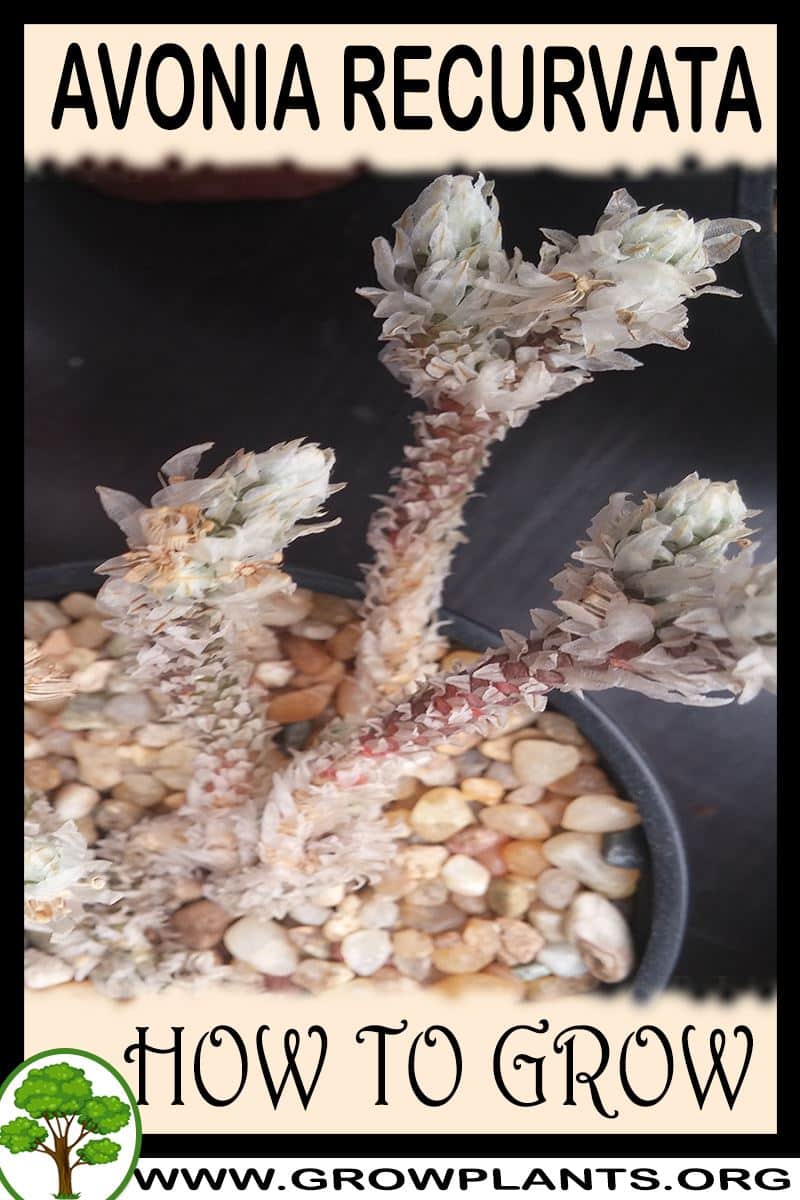
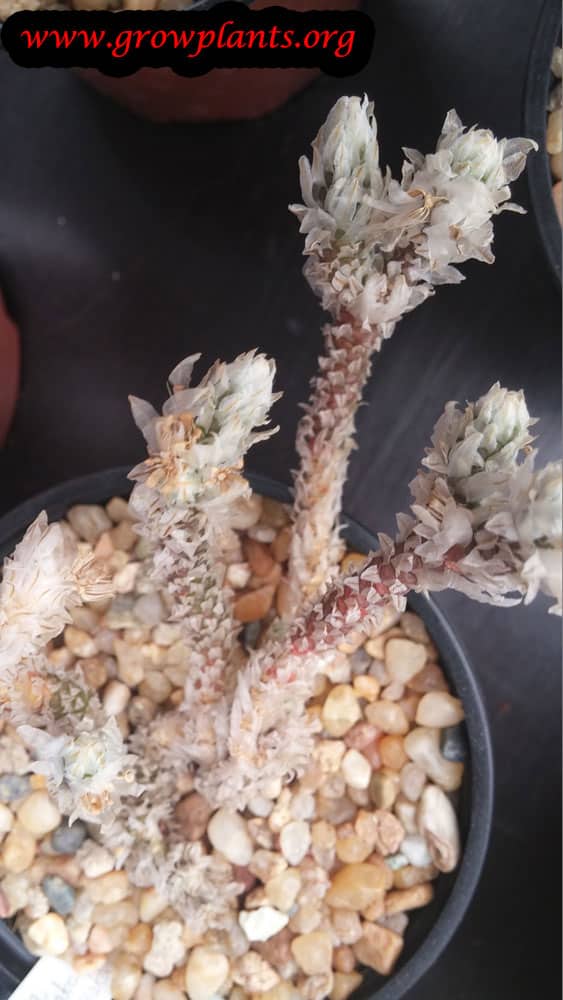
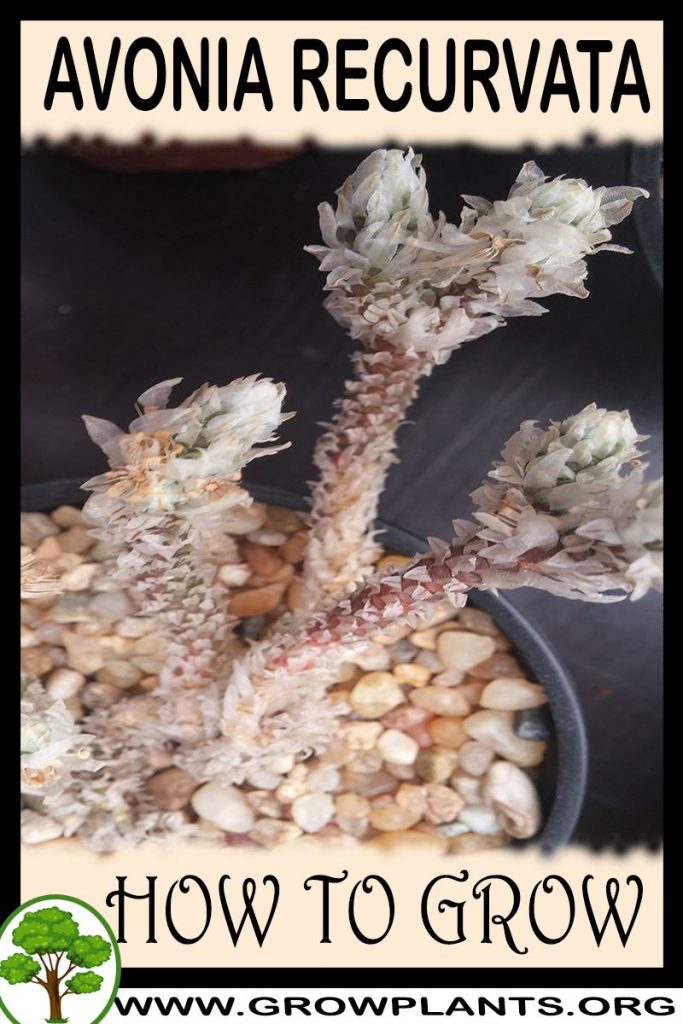
Overview: Avonia recurvata is a slow-growing, dwarf evergreen succulent reaching about 10-25 cm (4-10 in), with winding stems clothed in white papery scales. It is grown as a collector’s curiosity and drought-tolerant houseplant.
Quick Specifications
| Specification | Attribute |
|---|---|
| Plant Type / Life Cycle | Perennial |
| Foliage Type | Evergreen (succulent) |
| Mature Size | 10-25 cm (4-10 in) tall |
| Growth Rate | Slow |
| Hardiness | USDA zone 10+ |
Growth Form & Structure
- Height & Spread: 10-25 cm (4-10 in) tall; naturally small and well suited to containers and as a houseplant
- Growth Habit & Form: Dwarf, clump-forming succulent with slender, winding (recurved) stems
- Lifespan & Maturity: Long-lived; very slow-growing
Anatomy & Physical Features
- Stems & Foliage: Green or grey stems that grow in a winding, linear form, built up from overlapping white papery scales; the true leaves are tiny, white or green, and hidden beneath the scales
- Flower Characteristics: Small pink, white or yellow flowers, one per stem tip, with five petals and many stamens (see the Bloom guide)
Primary Uses & Landscape Value
- Functional & Ornamental Roles: Drought-tolerant ornamental for succulent collections, containers and as a houseplant
Care Guide: Planting, Soil & Watering
Overview: This Avonia is a slow-growing, drought-tolerant succulent that needs full sun to light shade and sharply drained, gritty or sandy soil. It stores water in its stems and wants only small, infrequent watering, tolerating light frost (to around -3°C) but never wet, heavy soil.
Quick Care Requirements
| Requirement | Ideal Condition |
|---|---|
| Planting Season | In spring and summer during active growth |
| Growth Rate | Slow |
| Soil Type | Very well-draining, gritty or sandy succulent soil |
| Water Need | Low – water sparingly and let the soil dry fully between waterings |
Planting & Establishment
- Best Planting Season: Plant in spring and summer, in the warm growing period, in a bright, sharply drained spot; keep it above about -3°C.
- How to Plant:
- Hole Preparation: Make a hole about the size of the root ball in a hot, free-draining position.
- Soil Amendments: Mix plenty of grit, coarse sand or pumice into the soil for maximum drainage; no rich feeding is required.
- Planting Depth: Set the base level with the soil surface and keep the stem crown proud of the mix to avoid rot.
- Growth Speed & Expectations: Slow, forming a compact plant of about 10–25 cm.
Soil, Watering & Drainage Care
- Soil Mix & Drainage Needs: Use a very gritty, fast-draining succulent mix; in pots add drainage holes and inert grit in the base so roots never sit wet.
- Watering Schedule & Technique:
- Young / Newly Planted: Water lightly and only occasionally until established, always letting the soil dry first.
- Established: Water sparingly and deeply, allowing the soil to dry out completely between waterings.
- Seasonal Adjustments: A little more in warm active growth; keep nearly dry in cool weather and winter.
Climate, Light & Hardiness
Avonia recurvata is a small, dandruff-scaled succulent adapted to warm, dry mediterranean, desert and subtropical climates, and it also does well as a houseplant. It needs strong light to flower well and tolerates only very light frost, briefly surviving to around −3°C (27°F) once established.
Quick Climate Specifications
| Climate Zones | Mediterranean, desert, subtropics, or indoors as a houseplant |
|---|---|
| USDA Hardiness Zones | Approximately 10+ outdoors |
| Optimal Temp Range | Approximately 18–28°C (64–82°F) during active growth |
| Approx. Survival Minimum | Established plants may briefly tolerate temperatures down to about −3°C (27°F) |
| Frost Tolerance | Very Low |
| Light Conditions | Full sun to half shade; full shade keeps the plant alive but it will not bloom |
Sunlight & Light Exposure
Optimal Light Setup
Bright light is best - full sun to half shade keeps its winding, linear stems compact and encourages flowering.
Direct Sun Requirement
Some direct sun is needed for flowering; in full shade the plant survives but will not bloom.
Shade & Heat Management
Tolerates half shade with a looser growth habit; in very hot, intensely sunny climates light midday shade can prevent scorching of the delicate scaled stems.
Best Exposure / Orientation
A bright south-facing windowsill indoors, or an open, sunny to lightly shaded spot outdoors in mild climates.
Temperature Extremes & Hardiness
USDA Hardiness & Regional Limits
Outdoors it suits mild, frost-free to nearly frost-free climates (roughly zone 10+); in colder regions it is grown as a houseplant instead, since the site's own data confirms it does well indoors.
Cold Damage & Winter Protection
Even light frost below about −3°C threatens the fleshy, papery-scaled stems. Keep it dry and protected in winter, since cold combined with wet soil is far more damaging than cold alone.
Frost Sensitivity
High - move container plants indoors or under cover before the first frost in marginal climates.
Extreme Heat Tolerance
Naturally adapted to hot mediterranean, desert and subtropical summers and tolerates high heat well as long as watering stays sparing.
Wind, Humidity & Microclimate
Humidity Preferences
Adapts to average to low humidity; it is not a plant that benefits from high atmospheric moisture.
Dry-Air Tolerance
High - coming from arid habitats, it is well suited to the dry air of both desert gardens and centrally heated indoor rooms.
Rainfall & Seasonal Moisture
Adapted to climates with a pronounced dry season; well-drained soil and restrained watering matter more than ambient rainfall, since excess moisture around the stems and roots leads to rot.
Microclimate Recommendations
A bright windowsill or a sheltered, sunny rockery spot outdoors works well; in winter, keep it away from cold, damp corners where frost and moisture can combine.
Growing in Pots, Balconies & Indoors
Avonia is a miniature, slow-growing succulent that makes an easy, undemanding houseplant – its compact size suits a bright windowsill or a small container perfectly, indoors or out.
Quick Details
- Container Size: Small – a 0.5-2 L pot or shallow bowl; it stays tiny and likes a snug root run
- Indoor Suitability: A good houseplant given strong light – a bright, sunny windowsill is ideal
- Best Spot: Bright light to full sun; it tolerates shade but will not flower there
- Soil & Drainage: Gritty, very free-draining cactus/succulent mix
- Watering in Pots: Sparingly – let the mix dry out between waterings, and keep it nearly dry during dormancy
Indoors & On the Windowsill
- A genuine houseplant: The grower confirms Avonia can be grown indoors. A ready-made cactus and succulent soil mix provides that structure without mixing it yourself. Its tiny size and low water needs make it one of the easiest succulents for a windowsill – just give it the brightest spot you have.
- Light for colour and flowers: In full shade it survives but will not bloom; a sunny sill, or a spell outdoors in warm weather, keeps it compact and encourages flowering.
- Cool, dry rest: Like most succulents it appreciates a cooler, drier dormant period with very little water.
On a Balcony or Patio
- Light & shelter: Happy in a bright to sunny spot outdoors in warm weather; being tiny it dries out fast in a small pot, so check it often, and protect it from cold and prolonged wet.
- Practicalities: Feather-light and space-saving – ideal on a sunny shelf or grouped with other small succulents; bring it in before cold, damp weather arrives.
Choosing the Pot, Soil & Long-Term Care
- Pot & drainage: A small pot with strong drainage holes; never leave it standing in water. Terracotta suits it well – it breathes and dries fast, which these caudex succulents love.
- Potting mix: A gritty, mineral cactus/succulent mix – add extra perlite, pumice or coarse sand for sharp drainage.
- Feeding: Very little – a weak succulent feed once or twice during active growth is plenty.
- Repotting: Only every few years; it grows slowly and resents disturbance, so pot on only when it is really needed.
Fertilizing & Feeding
Avonia recurvata is a light feeder – like other Avonia, this small, slow-growing caudex succulent needs only occasional, dilute, low-nitrogen feeding while actively growing and none while resting.
Quick Fertilizing Specs
| Feeding Level | Light feeder |
|---|---|
| Main Nutrient Priority | Low-nitrogen feeding only during active growth |
| Best Feeding Period | Spring and summer active growth leading into summer bloom |
| Reduce/Stop Feeding | Stop feeding entirely once growth slows |
| Soil pH | Prefers well-drained soil and tolerates a wide pH range |
Feeding by Growth Stage
Active Growing Season
Support slow, steady growth of the winding, linear, dandruff-like stems and encourage the small five-petaled flowers on this slow-growing caudex succulent.
| Nutrient direction | A light, low-nitrogen feeding is usually enough for this slow-growing, drought-tolerant succulent. |
|---|---|
| Timing | Spring and summer, while the plant is actively growing. |
| Frequency | An occasional light feeding through the active growing season is usually enough. |
| Fertilizer types | A diluted, low-nitrogen fertilizer formulated for succulents or cacti |
| Precautions | Avoid overfeeding, which can cause soft, misshapen stem growth on this naturally slow-growing plant; water well after feeding. |
Dormant / Rest Period
Let the plant rest through cooler weather without added nutrition, since it is sensitive to cold below a few degrees of frost.
| Nutrient direction | None – withhold fertilizer while the plant is resting. |
|---|---|
| Timing | Cooler months, when growth slows or stops. |
| Frequency | No feeding at this stage. |
| Fertilizer types | No feeding at this stage; resume light feeding when active growth returns |
| Precautions | Do not fertilize during this rest period; reduce watering instead and protect the plant from cold. |
Nutrient Deficiency Signs & Corrections
Unusually soft, stretched stem growth that loses the plant’s typical compact, winding form.
| Possible causes | excess nitrogen encouraging soft growth this slow-growing succulent isn’t adapted to use, insufficient light causing stretching, overwatering softening tissue |
|---|---|
| Appears first on | newest stem growth |
| What to check | recent feeding amount and frequency, light exposure, watering frequency and soil drainage |
| Possible correction | Reduce or pause feeding, provide fuller sun, and let the soil dry between waterings. |
Yellowing, mushy lower stem tissue and stalled growth.
| Possible causes | root rot from waterlogged, poorly drained soil limiting nutrient uptake, overwatering, fertilizing on top of already wet soil |
|---|---|
| Appears first on | lower stems and base |
| What to check | soil drainage and moisture level, firmness of stems at the base, recent watering and feeding timing |
| Possible correction | Improve drainage, let the soil dry out, and resume only light feeding once healthy new growth appears. |
Pale yellowing on new stem growth.
| Possible causes | iron deficiency linked to alkaline or waterlogged soil, high soil pH reducing micronutrient availability, root stress limiting nutrient uptake |
|---|---|
| Appears first on | newest growth |
| What to check | soil pH tendency and drainage, whether the yellowing is diffuse or interveinal, recent watering pattern |
| Possible correction | Improve drainage and correct soil pH; apply a chelated iron product per its label only if chlorosis persists. |
Pruning, Training & Seasonal Maintenance
Avonia recurvata is a small, slow-growing succulent (10–25 cm) whose linear, scale-covered stems grow in a winding, recurved shape rather than straight up. Like the rest of its genus it builds no woody framework and no persistent flowering wood, so it tolerates only light, occasional trimming; its own care data allows cutting year-round and treats it purely as cosmetic tidying, never as a structural regime.
Quick Pruning & Maintenance Specs
| Pruning Tolerance | Low — light shaping/sanitary trims only |
| Primary Pruning Window | Any time of year (per its own care data) |
| Typical Frequency | Occasional, as needed |
| Main Objective | Remove dead or rotten tissue; guide or tidy the winding stem growth for display |
| Young Plant Priority | Leave untouched to establish its natural winding habit |
| Mature Plant Priority | Remove dead/rotten segments; trim stray stems that outgrow the display |
| Best Tool Type | Precision snips / grafting knife |
| Avoid Heavy Pruning During | Not applicable — never heavily pruned |
Pruning by Plant Age & Size
Newly Established
No pruning; remove only damaged or rotten tissue present at planting.
Young / Formative
No structural training in the trellis/leader sense — the winding stem habit is natural to the species; at most, stems can be lightly guided within a pot for a fuller display, not cut to force a shape.
Mature / Established
Trim only to remove dead or rotten stem sections or to shorten stems that have wound beyond the display area.
Special Growth to Remove
- Dead or shriveled stem tissue.
- Rotten sections — cut back to clean, firm growth promptly; overwatering-driven rot is a bigger risk to this drought-adapted plant than any pruning stress.
Container & Small-Space Pruning
Well suited to pots and indoor growing. Because the stems wind and can trail over a pot’s edge, container trimming is mostly about keeping the display tidy — shortening an overly long winding stem rather than shaping a canopy; fast-draining mix and light are otherwise the main container concerns, not pruning.
Tools
Precision snips or a small grafting knife for occasional clean removal of dead, rotten, or overly long winding stem sections.
Tool Hygiene & Disease Risk
Routine. Keep the blade clean and sharp; wipe it after cutting into rotten tissue before touching healthy growth, since rot rather than tool-borne pathogens is the main real risk to this plant.
Cut Placement & Technique
When removing rot, cut into clean, firm tissue rather than stopping at the visibly damaged edge; when shortening a winding stem for display, cut just above a healthy segment joint and let the cut dry/callus in bright, indirect light before resuming normal watering.
Heavy Pruning & Rejuvenation
Not tolerated and not needed — there is no overgrown woody framework to rejuvenate. If the plant sprawls too far, propagate a cutting from a healthy winding stem instead of hard-cutting the parent.
Post-Pruning Care
Withhold water for a few days after any cut into stem tissue to let the wound dry; keep out of intense direct sun while healing.
Common Pruning Mistakes
- Trying to straighten or force the naturally winding stems into a fixed shape by cutting — the recurved habit is normal, not a fault to correct.
- Watering immediately after removing rotten tissue, before it has dried.
- Using a dull blade that bruises rather than cleanly severs the soft stems.
When NOT to Prune
- During extended wet or high-humidity spells, when cuts are slow to callus and rot risk climbs.
- Right after repotting, while roots are settling.
Recommended Tools (by task)
- precision_snips — clean, controlled removal of dead, rotten, or overlong winding stem sections.
- grafting_knife — a sterile fine blade for precise cuts into rot without crushing the surrounding soft tissue.
Propagation Guide
Avonia recurvata is most easily increased from cuttings or self-rooted offsets of its low, winding stems; seed propagation works but is slower and less predictable. Vegetative propagation isn’t required to keep the species true but is the more reliable route, and overall difficulty is moderate since the twisting stems are thin and easy to damage.
Quick Propagation Specs
| Best Propagation Method | Stem Cuttings / Offset Division |
| Alternative Methods | Seed |
| Propagation Difficulty | Moderate |
| Seed True-to-Type | Usually true-to-type |
| Vegetative True-to-Type | Yes |
| Best Propagation Season | Spring to summer |
| Seed Germination Time | Several weeks, often slow and uneven |
| Cutting Rooting Time | A few weeks once calloused |
| Germination Temperature | Warm, roughly 20–25°C (68–77°F) |
| Seed Sowing Depth | Surface-sown – seed is dust-fine and should not be buried |
Growing from Seed
Seed Handling & Viability
Very fine seed, typical of the genus; sow reasonably fresh.
Sowing Depth & Orientation
Surface-sow on a gritty, free-draining mix without covering.
Germination Conditions
Warm, bright, and evenly moist but never waterlogged.
Germination Time
Often several weeks and can be uneven.
Seedling Care
Small, delicate seedlings prone to damping off; keep moisture moderate and pot on once large enough to handle.
Stem Cuttings
Cutting Type
Short sections cut from the winding stems.
Best Timing
Spring through summer.
Cutting Preparation
Let the cut end callus for a few days before inserting.
Rooting Setup
A gritty, very free-draining succulent mix, watered sparingly until rooted.
Rooting Hormone
Not necessary; optional.
Rooting Time
Typically a few weeks.
Division, Offsets, Pups & Suckers
Stem sections that have rooted naturally along their length can be separated with roots attached and replanted directly, with minimal watering until established.
Bloom & Flower Guide
Quick Details
- Bloom Season: Summer.
- Flower Appearance: Pink, white or yellow – small, five-petalled flowers with many stamens, one carried at the tip of each stem.
- Edibility: Ornamental only; not grown or used as an edible flower.
Detailed Blooming Overview
Avonia recurvata is a caudex-forming succulent – despite the common “cactus” label it belongs to the purslane family (Anacampserotaceae/Portulacaceae) rather than the true cacti. In summer it produces small, delicate flowers at the stem tips. A characteristic quirk of these plants is that the blooms typically open for only a few hours, usually in the warmth of the afternoon, so catching them in flower takes a little timing.
Flower Characteristics
- Colour: Pink, white or yellow.
- Form: small flower with five petals and a boss of many stamens.
- Position: single flower borne at the end of each stem.
- Habit: short-lived blooms that tend to open only briefly in bright, warm conditions.
Bloom Care & Thinning
- Light and warmth: the most reliable way to see flowers is plenty of direct sun and summer heat – these plants simply will not open in dull, cool spells.
- Keep it lean and dry: a gritty, free-draining mix and restrained watering suit the plant and encourage it to bloom rather than sit soft.
- Little to remove: the flowers are tiny and self-tidying, so no real deadheading is needed – leave spent blooms if you hope for seed.
Pests, Diseases & Troubleshooting
Overview: Avonia is a group of very small, slow, caudiciform succulents clothed in papery silvery stipules, and it is essentially pest-free in cultivation – the overwhelming risk is rot from overwatering or poor drainage, with the occasional mealybug (especially root mealybug), scale or spider mite. Treat it as a specialist alpine-succulent: extremely gritty mineral mix, careful stingy watering, strong light and excellent airflow.
Quick Troubleshooting Overview
| Issue / Pest | Main Symptom | Primary Solution |
|---|---|---|
| Root mealybug | White waxy deposits on roots, unexplained slow decline | Bare-root, wash, repot in fresh gritty mix; systemic drench |
| Mealybugs | White fluff among the papery stipules | Alcohol swab, insecticidal soap/oil |
| Scale | Tiny hard bumps on the caudex/stems | Scrape off, light horticultural oil |
| Spider mites | Fine stippling/bronzing on hot dry plants | Raise humidity, miticidal soap/oil |
| Rot (the killer) | Soft, shrivelling or blackening caudex/stems | Withhold water, improve drainage; rescue firm growth as cuttings |
| Etiolation | Loose, stretched, pale growth | Increase light gradually |
Common Pests & Management
- Root mealybug (Rhizoecus spp.):
- Symptoms: No visible top pest, yet the plant slowly declines, refuses to grow and looks thirsty; on unpotting, white waxy ‘mealy’ deposits coat the roots and inner pot wall – the classic hidden killer of collection succulents.
- Prevention & Control: Bare-root the plant, wash all soil from the roots, trim damaged roots, and repot in fresh gritty mineral mix in a clean pot. A systemic insecticide drench or repeated soil soak with insecticidal soap clears survivors. Inspect roots at every repot and quarantine new plants.
- Mealybugs (Pseudococcus spp.):
- Symptoms: White cottony specks hidden among the papery stipules and in growth crevices, with slowed growth; easy to miss on such a small, textured plant.
- Prevention & Control: Spot-treat with a fine brush dipped in rubbing alcohol, then use a light insecticidal soap or horticultural oil, taking care not to leave the tiny plant sitting wet. Repeat to catch the next generation.
- Scale insects (Diaspididae):
- Symptoms: Minute hard brown or grey bumps on the caudex and stems, sucking sap and sapping vigour.
- Prevention & Control: Scrape off with a fine tool and apply a light horticultural oil sparingly. Given the plant’s size, physical removal is usually enough.
- Spider mites (Tetranychus urticae):
- Symptoms: Fine stippling and a dull bronzed cast at the growing points on plants kept too hot, dry and airless.
- Prevention & Control: Improve airflow and slightly raise humidity, and rinse gently. Treat with insecticidal soap or a light miticidal oil if it persists.
Diseases & Fungal Issues
- Rot (fungal / bacterial) (Fusarium / Pythium / Erwinia):
- Symptoms: Soft, discoloured, collapsing or blackening tissue at the caudex, roots or stem base – almost always following overwatering, cold-wet conditions or a poorly draining mix.
- Treatment & Management: Prevention is the only reliable cure: keep the mix mineral and free-draining, water sparingly and never leave the caudex wet or cold. If rot starts, cut away all soft tissue and try to re-root the firm remainder dry; discard the rest and its soil.
Growing Difficulties & Abiotic Problems
- Overwatering rot (the main killer):
- Cause & Symptoms: These slow desert plants rot readily if watered like ordinary houseplants or grown in a moisture-retentive mix, especially in cool or dark conditions.
- Correction Strategy: Use a very gritty, predominantly mineral mix; water lightly only when bone dry and the plant is in active growth; keep dry during dormancy and in cold weather.
- Etiolation:
- Cause & Symptoms: Too little light makes the compact caudiciform stretch into loose, pale, weak growth and lose its papery neatness.
- Correction Strategy: Provide bright light or gentle grow-lighting, increasing exposure gradually to avoid scorch.
- Shrivelling / desiccation:
- Cause & Symptoms: Excessive underwatering or root loss (often after a root-mealybug episode) causes the plant to shrink and pucker.
- Correction Strategy: Check the roots are healthy, then resume light, careful watering; a plant with damaged roots must be re-rooted before it can take up water.
- Cold damage:
- Cause & Symptoms: Prolonged cold, especially when damp, causes translucent, mushy tissue.
- Correction Strategy: Overwinter dry and frost-free at the recommended minimum; dry plants tolerate cold far better than wet ones.
What Helps – Products & Tools
Care is almost entirely cultural: a gritty mineral mix, stingy watering, bright light, airflow, and checking the roots at repotting. If pests appear, alcohol spot-treatment, insecticidal soap and light horticultural oil handle mealybug, scale and mites, and a systemic drench deals with root mealybug. Withhold water the moment any softness appears.