Plant Profile & Key Characteristics
Overview: A deciduous cormous geophyte 30–60 cm tall, grown as an ornamental and cut flower. It sends up grassy foliage and airy flower umbels, then dies back to the corm after blooming.
Quick Specifications
| Specification | Attribute |
|---|---|
| Plant Type / Life Cycle | Herbaceous perennial (cormous geophyte) |
| Foliage Type | Deciduous |
| Mature Size | 30–60 cm H (12–24 in) |
| Growth Rate | Moderate to fast |
| Root System | Cormous geophyte |
| Hardiness | USDA zones 6–10 |
Growth Form & Structure
- Height & Spread: Slender stems 30–60 cm tall; grows well in planters and containers.
- Growth Habit & Form: Upright, grassy clump topped by loose flower umbels; foliage dies back after flowering.
- Lifespan & Maturity: Perennial corm; multiplies by offsets and can be raised from seed.
Anatomy & Physical Features
- Leaves & Foliage: Green, linear (grass-like) leaves.
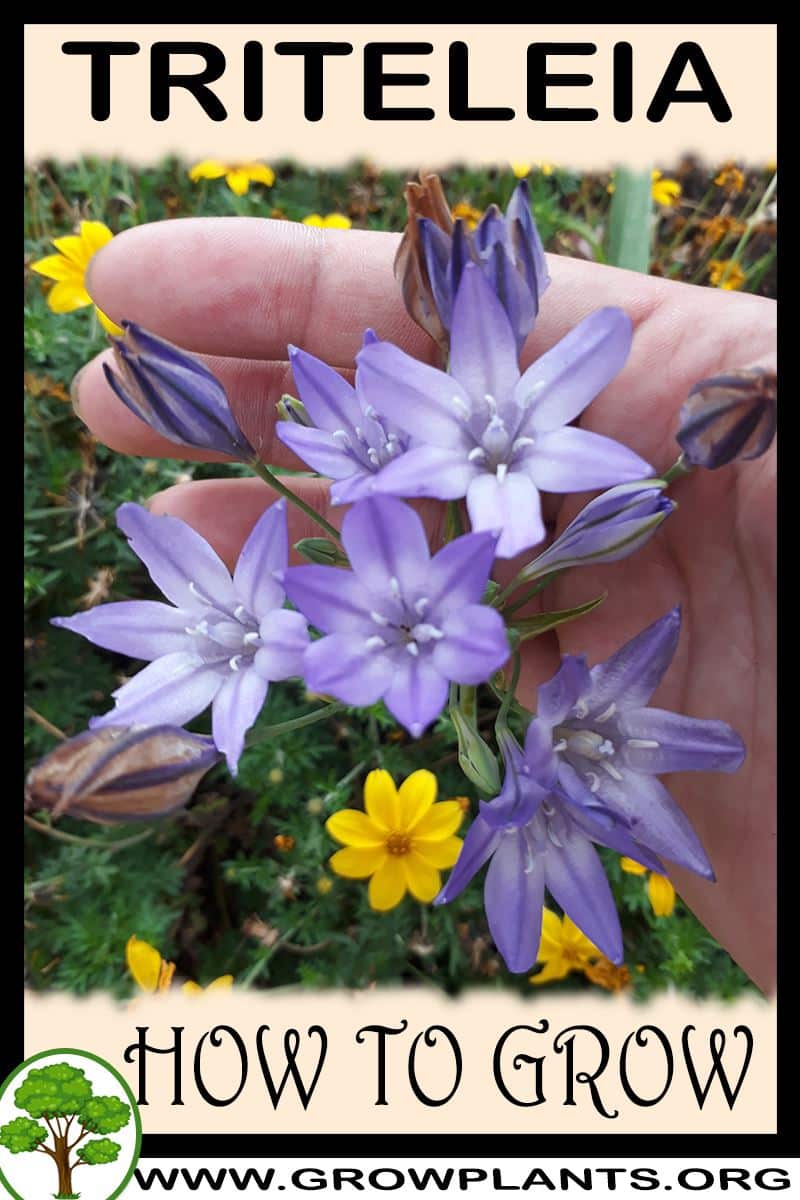
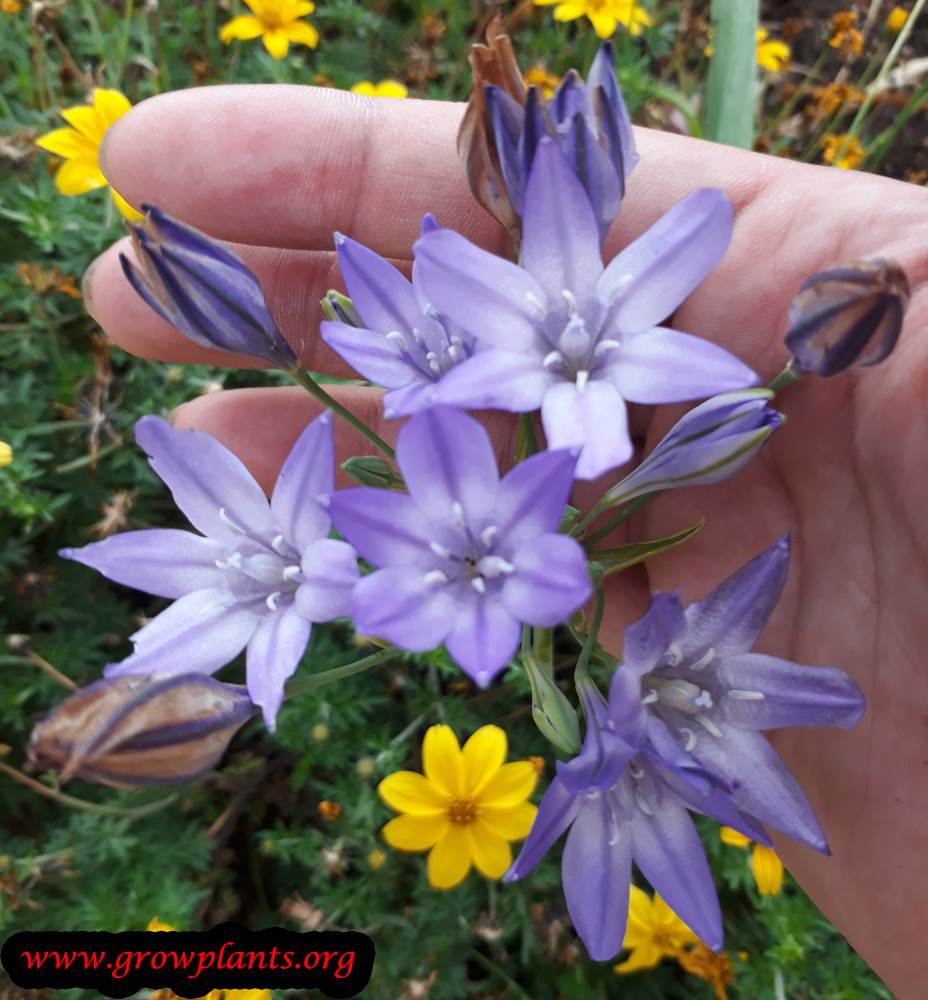
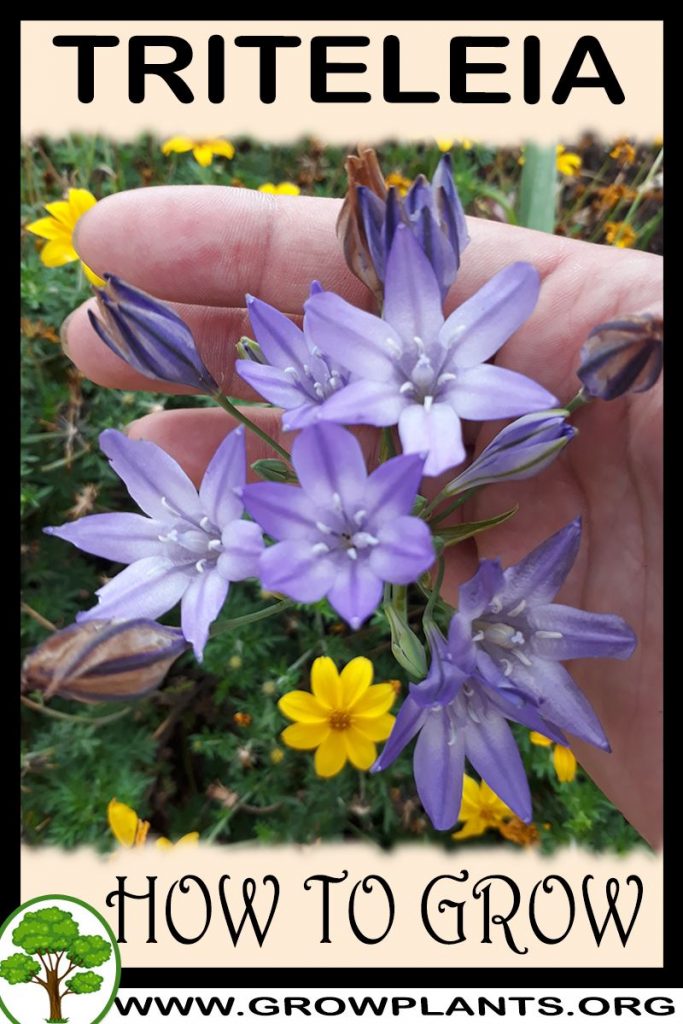
- Flower Characteristics: Funnel-shaped six-petalled flowers in yellow, purple, blue, white or mixed shades, some with a central stripe (full detail in the Bloom accordion).
Primary Uses & Landscape Value
- Functional & Ornamental Roles: Ornamental border bulb and long-lasting cut flower for well-drained, sunny positions.
Care Guide: Planting, Soil & Watering
Overview: Triteleia (triplet lily) is a summer-dormant bulb that grows best in full sun to light shade in light, well-drained soil. It needs only low to moderate watering while in active growth and prefers to be kept dry once the foliage dies back.
Quick Care Requirements
| Requirement | Ideal Condition |
|---|---|
| Planting Season | In spring as growth begins, or in summer |
| Growth Rate | Moderate to fast |
| Soil Type | Light, well-drained soil |
| Water Need | Low to moderate — water while in growth, then keep dry during summer dormancy |
Planting & Establishment
- Best Planting Season: Set out corms in spring as growth begins, or in summer.
- How to Plant:
- Hole Preparation: Plant the corms in loosened soil a few times their own depth.
- Soil Amendments: Keep the soil light and gritty; work in sand or grit if the ground is heavy.
- Planting Depth: Set each corm several centimetres deep with the pointed end facing up.
- Growth Speed & Expectations: Moderate to fast once in growth, flowering and then dying back to dormancy.
Soil, Watering & Drainage Care
- Soil Mix & Drainage Needs: Sharp-draining, light soil is essential to stop the corms rotting, especially while dormant.
- Watering Schedule & Technique:
- Young / Newly Planted: Water moderately as growth and flowering proceed.
- Established: Water sparingly, letting the soil dry between waterings.
- Seasonal Adjustments: Keep on the dry side after flowering, when the foliage dies back and through summer dormancy.
Climate, Light & Hardiness
Triteleia is hardy to roughly zone 6–10 across Mediterranean, subtropical, and temperate climates, doing best in full sun to half shade with well-drained soil and modest water.
Quick Climate Specifications
| Climate Zones | Mediterranean, subtropical, temperate |
|---|---|
| USDA Hardiness Zones | Approximately 6–10 |
| Light Conditions | Full sun; half shade |
Temperature Extremes & Hardiness
USDA Hardiness & Regional Limits
Hardy roughly zone 6–10.
Growing in Pots, Balconies & Indoors
Triteleia is a spring-flowering corm for sun or light shade, not a houseplant. The grower confirms it will not grow indoors as one, but it takes happily to pots, making an easy container plant for a patio or balcony.
Quick Details
- Container Size: A free-draining pot of about 2-4 L (0.5-1 gal); plant several corms together for a good show
- Indoor Suitability: Not a houseplant – it needs real sun and a dry summer rest; a bright sill is the most it will tolerate, and only briefly
- Best Spot: Full sun to light (half) shade, in the open air
- Soil & Drainage: Free-draining; let it dry out during summer dormancy
- Watering in Pots: Moderate while in leaf and flower; keep dry once foliage dies back
Indoors & On the Windowsill
- Houseplant limits: Marked as not an indoor plant – it flowers on strong light and needs a dry dormant period a warm room won’t provide.
- Windowsill option: A very bright, cool sill can carry it in bloom for a short spell, but it belongs outdoors for the bulk of its cycle.
- Overwintering: The corms are fairly hardy; in pots keep them cool and on the dry side through dormancy and protect from hard, wet freezes.
On a Balcony or Patio
- Light & wind: Give it the sunniest spot you have. On an exposed balcony, walls and railings reflect heat and wind dries pots quickly, so check moisture often and shelter or stake taller growth.
- Seasonal display: Grow it as a seasonal container plant – full colour in the growing season, then rest the pot dry until the next cycle.
Choosing the Pot, Soil & Long-Term Care
- Pot & drainage: A 2-4 L pot with good drainage holes. Use strong drainage holes and skip a standing water saucer, which invites root rot; terracotta breathes and dries fast, while glazed or plastic pots hold moisture longer.
- Potting mix: A light, aerated mix – potting compost, or peat/coir with added perlite or vermiculite for drainage.
- Feeding: A light feed while in active growth is plenty; stop as the leaves fade.
- Repotting: Lift and refresh the corms every couple of years when dormant, replanting into fresh free-draining mix.
Fertilizing & Feeding
A light feeder for well-drained soil; modest feeding through active growth supports the funnel-shaped flowers prized as cut blooms.
Quick Fertilizing Specs
| Feeding Level | Light feeder |
|---|---|
| Main Nutrient Priority | Balanced feeding with adequate nitrogen for foliage and flower-stalk development |
| Best Feeding Period | From leaf emergence through flowering in spring and summer |
| Organic Options | Compost worked into well-drained soil at planting |
| Reduce/Stop Feeding | Stop once flowering finishes and the leaves begin to fade |
| Micronutrients | Generally supplied by a complete fertilizer; correct only a diagnosed issue |
| Soil pH | Tolerates a wide range as long as the soil drains freely |
Feeding by Growth Stage
Leaf growth through funnel-flower bloom
Support the linear leaves and the clustered funnel-shaped flowers valued for cutting.
| Nutrient direction | A balanced fertilizer with modest nitrogen carries this fast-growing bulb from leaf-out through its cut-flower bloom. |
|---|---|
| Timing | From when the linear leaves emerge through flowering, and while foliage stays green afterward. |
| Frequency | A single light feeding early in growth is usually enough, with a light follow-up feeding as flower stalks develop. |
| Fertilizer types | A balanced complete fertilizer used at a modest rate, Compost worked into the soil at planting |
| Precautions | Avoid heavy feeding, which can push soft, floppy foliage at the expense of sturdy flower stalks. |
Post-bloom dieback
Let the bulb store reserves and go dormant without new growth being forced.
| Nutrient direction | None – withhold fertilizer as flowering ends and the leaves begin to fade. |
|---|---|
| Timing | After flowering, once the leaves begin to yellow and die back toward summer dormancy. |
| Frequency | No feeding at this stage. |
| Fertilizer types | No feeding at this stage; allow the foliage to die back naturally before the bulb’s dormant rest. |
| Precautions | Do not fertilize during dieback; the bulb cannot use the nutrients while it is shutting down. |
Nutrient Deficiency Signs & Corrections
Leaves are pale and thin and overall growth is slower than expected for the season.
| Possible causes | low available soil nitrogen, light, fast-draining soil, nutrient leaching after watering or rain |
|---|---|
| Appears first on | older leaves first |
| What to check | recent feeding history, soil organic matter content, watering and drainage pattern |
| Possible correction | Apply a modest balanced fertilizer and work in organic matter to help the soil hold nutrients. |
Flower stalks are weak or lean and flower color or size is disappointing.
| Possible causes | low soil potassium, leaching from well-drained soil, an unbalanced, nitrogen-heavy feeding routine |
|---|---|
| Appears first on | flower stalks and older leaf margins |
| What to check | balance of the fertilizer used, soil texture and drainage, flowering performance over recent seasons |
| Possible correction | Use a balanced fertilizer rather than a nitrogen-only product and avoid excess watering that leaches nutrients. |
Older leaves show yellowing between the veins while the veins stay green.
| Possible causes | low soil magnesium, leaching in light, well-drained soil, heavy potassium feeding competing with magnesium uptake |
|---|---|
| Appears first on | older, lower leaves |
| What to check | soil magnesium status, recent fertilizer balance, soil texture and leaching |
| Possible correction | Apply a labeled magnesium source such as Epsom salt and rebalance the feeding program. |
Pruning, Training & Seasonal Maintenance
Triteleia needs no structural pruning – it grows from a corm that goes fully dormant after its spring/summer bloom, dying back to the ground, so the only maintenance is clearing the dead leaves and flower stems once dormancy is complete, which for this plant falls in autumn/winter rather than immediately after flowering. Because it is also grown as a cut flower, removing flower stems for cutting doubles as routine deadheading during the bloom season.
Quick Pruning & Maintenance Specs
| Pruning Tolerance | Low – no structural cuts; dead-growth removal only, once fully dormant |
| Primary Pruning Window | Autumn/winter, after the corm has gone fully dormant |
| Secondary Maintenance Window | Spring/summer, during bloom – cut flower stems for use or deadhead spent ones |
| Typical Frequency | 1 pass per year for dead-growth cleanup, plus cut-flower harvesting through bloom |
| Main Objective | Let the corm store reserves through summer dormancy before clearing old growth |
| Young Plant Priority | None – let the corm establish through its first full cycle |
| Mature Plant Priority | Autumn/winter cleanup of fully dead leaves and stems; cut-flower harvest during bloom |
| Best Tool Type | Precision snips |
| Avoid Heavy Pruning During | Spring/summer while leaves are green and the corm is actively photosynthesizing |
Pruning by Plant Age & Size
Newly Established
Remove only damaged or broken planting stock; let the first season’s foliage run its full course before any cutting.
Young / Formative
No structural training applies – a single grass-like leaf cluster and flower stem per corm.
Mature / Established
Harvest or deadhead flower stems through bloom; clear fully dead leaves and stems in autumn/winter once dormancy is complete.
Seasonal Pruning Schedule
Post-Flowering (cut-flower harvest / deadhead)
Objective: use the flowers (this species is grown as a cut flower) and/or stop seed formation. Cut stems for the vase as blooms open, or remove spent stems at the base once flowering is finished. Leaves are left untouched at this stage.
Dormant/Winter
Once leaves and stems have died back completely into summer dormancy, cut away the dead growth in autumn/winter. Removing green leaves earlier, before natural dieback, reduces the corm’s reserves for next year’s bloom.
Special Growth to Remove
- Flower stems – cut for use as a cut flower, or removed at the base once spent.
- Dead leaves and flower stems, cleared in autumn/winter once fully dry.
Container & Small-Space Pruning
Suits a planter. Container corms dry down for dormancy faster than in-ground plantings, but the same rule applies: wait for leaves to fully die back before clearing them; lift and divide congested corm clusters at dormancy if the pot becomes crowded.
Tools
Precision snips for cutting flower stems (for the vase or once spent) and for the autumn/winter dead-growth cleanup; no loppers or saws needed for this slender, herbaceous corm plant.
Tool Hygiene & Disease Risk
Routine: the noted pest is snails rather than a tool-transmissible disease, so clean sharp tools are sufficient.
Cut Placement & Technique
Cut flower stems at the base, angled if harvesting for the vase, to maximize stem length while leaving the leaf cluster intact. Cut dead leaves/stems near ground level once fully dry rather than pulling, which can disturb the corm.
Heavy Pruning & Rejuvenation
Not applicable in the woody sense – there is no framework to cut back hard. Renewal means lifting and dividing crowded corm clusters at dormancy every few years, a spacing task rather than a pruning cut.
Post-Pruning Care
Continue normal watering while leaves are green through spring/summer; once foliage dies back, withhold extra water through the dormant autumn/winter cleanup period. Do not fertilize immediately after cutting back.
Common Pruning Mistakes
- Clearing away leaves before they have fully died back, cutting short the corm’s reserve-building period.
- Cutting flower stems for the vase so low or so heavily that it strips the leaf cluster along with them.
- Leaving spent flower stems to set seed instead of removing them if not harvesting for cutting.
When NOT to Prune
Not while leaves are still green and the corm is actively growing; not by pulling dead growth instead of cutting, which can disturb the dormant corm.
Recommended Tools (by task)
- precision_snips – cutting flower stems for use or deadheading, and the autumn/winter dead-growth cleanup; slender growth needs a small clean cut.
Propagation Guide
Triteleia grows readily from seed, which the site notes is not strictly necessary to supplement with vegetative propagation – but dividing the cormlets that form around the mother corm is easier and gives flowering-size plants sooner. Overall propagation difficulty is Easy.
Quick Propagation Specs
| Best Propagation Method | Corm division |
| Alternative Methods | Seed |
| Propagation Difficulty | Easy |
| Seed True-to-Type | Usually true-to-type for the species; variable for named selections |
| Vegetative True-to-Type | Yes |
| Best Propagation Season | Corms divided at the start of dormancy after flowering; seed sown in autumn or spring (site notes spring/summer as the general planting season) |
| Seed Germination Time | Several weeks to a few months, can be irregular |
| Germination Temperature | Around 15–20°C (59–68°F) |
| Seed Sowing Depth | Shallow, lightly covered |
Growing from Seed
Seed Handling & Viability
Collect seed once the papery capsules dry; sow reasonably promptly for best results.
Sowing Season
Autumn is typical for this Mediterranean-climate genus, or spring in colder areas.
Sowing Depth & Orientation
Sow shallowly in a free-draining mix and cover lightly.
Germination Conditions
Cool, evenly moist conditions around 15–20°C (59–68°F); germination can be staggered.
Seedling Care
Let seedlings die back naturally with the corm’s summer dormancy; expect a couple of seasons before corms reach flowering size.
Rhizomes, Tubers, Bulbs & Corms
Corm Division
As the foliage dies back after flowering, lift the corm and remove the small cormlets (‘cormels’) that have formed around its base. Replant these at the start of the next growing season; larger cormlets may flower within a season or two, while the smallest are best grown on in a nursery bed first.
Bloom & Flower Guide
Quick Details
- Bloom Season: Spring and summer
- Time to First Bloom: The first spring or summer after the corms are planted
- Flower Appearance: Funnel-shaped, six-petalled flowers in yellow, purple, blue, white or mixes, some with a stripe down each petal, held in open clusters
- Edibility: Ornamental / cut flower – not grown for eating
Detailed Blooming Overview
Triteleia (triplet lily) is a corm-grown plant prized as a cut flower for its airy, long-stemmed clusters of star-to-funnel-shaped blooms in late spring and summer. The flowers open a few at a time in each loose head, giving a long display, and last well in the vase.
Flower Characteristics
- Funnel-shaped flowers with six petals.
- Colours yellow, purple, blue, white or mixed; some with a contrasting stripe down each petal.
- Carried several together in an open, airy cluster on a tall stem.
Bloom Care & Thinning
- Encouraging bloom: Full sun and free-draining soil suit it; allow the foliage to die back naturally after flowering so the corm can build up for next year.
- For cutting: Cut when the first flowers in the head are opening, in the cool of the morning.
Fruit & Uses
Triteleia is grown today purely as an ornamental bulb and cut flower, but its underground corm has a documented history as a foraged food, dug and cooked by Indigenous peoples of the western United States. This is a historical wild-food use rather than a recognised food crop, and eating it needs real caution.
Quick Edible Specs
| Edible Parts | Corm |
|---|---|
| Main Use(s) | Historical/traditional food use (foraging); not a commercial food crop |
| Eaten Raw or Cooked | Traditionally cooked (roasted or boiled) |
| Preparation Required | Cook; positively identify before eating |
| Harvest Season | Corms are easiest to identify and lift after the foliage and flower stems have died back |
| Storage | Best used soon after lifting |
| Safety/Toxicity Caveat | grows in similar habitat to toxic lookalike bulbs such as death camas; do not forage or eat without expert identification, and do not eat corms from ornamental nursery stock |
Bulbs, Corms & Rhizomes
The edible part is the small underground corm. Historically, corms were dug once the leaves and flower stems had died back, then roasted or boiled, similarly to other native California geophytes such as Brodiaea and Camassia. This is not how the plant is used or sold today — nursery bulbs are grown, and often treated, for ornamental display rather than eating.
Preparation, Uses & Safety
several deadly-poisonous bulbous plants (notably death camas, Toxicoscordion/Zigadenus species) grow in similar habitats and closely resemble edible geophyte corms before flowering — expert positive identification is essential before any wild corm is eaten, and this is not a use to attempt with a garden-grown ornamental plant. Where eaten historically, corms were always cooked, never raw.
Pests, Diseases & Troubleshooting
Overview: Triteleia are summer-dry, corm-forming bulbs (Themidaceae/Asparagaceae) from Mediterranean-climate regions and are remarkably pest-resistant when their dormancy is respected. Their real weakness is corm and basal rot when the soil stays wet during summer dormancy; above ground, molluscs, aphids and rust are the occasional callers, and rodents dig the corms.
Quick Troubleshooting Overview
| Issue / Pest | Main Symptom | Primary Solution |
|---|---|---|
| Slugs & snails | Grazed shoots and flower stalks | Handpick, grit barriers, iron-phosphate bait |
| Aphids | Sticky, distorted growth; virus spread | Water jet, insecticidal soap, beneficials |
| Rodents / gophers | Missing corms, disturbed soil | Wire baskets, gravel, deterrents |
| Basal / corm rot | Failure to emerge, soft mouldy corms | Sharp drainage, dry summer rest |
| Rust | Orange pustules on leaves | Remove leaves, airflow, sulphur if severe |
Common Pests & Management
- Slugs and snails (Gastropoda):
- Symptoms: Grazed, ragged emerging shoots and chewed flower stalks with slime trails in damp spring conditions.
- Prevention & Control: Handpick at night, clear debris, set grit or copper barriers around clumps, and use iron-phosphate bait where seedling shoots are being lost.
- Aphids (Aphidoidea):
- Symptoms: Green or grey soft-bodied insects on flower stems and buds, causing sticky honeydew, distortion and – importantly – spreading bulb-borne viruses.
- Prevention & Control: Wash off with water, encourage lady beetles and lacewings, remove badly virused plants, and use insecticidal soap or neem on persistent colonies.
- Bulb mites (Rhizoglyphus spp.):
- Symptoms: Tiny pale mites tunnelling into already damaged or rotting corms in storage or wet soil, accelerating decay.
- Prevention & Control: Lift and store corms dry and cool, discard soft or damaged ones, and keep growing soil free-draining so healthy corms are not invaded.
- Rodents and gophers (Rodentia):
- Symptoms: Corms dug up and eaten, with disturbed soil and clumps that simply fail to reappear.
- Prevention & Control: Plant corms in wire mesh baskets, add sharp gravel around them, and use humane deterrents; cats and owls are helpful natural controls.
Diseases & Fungal Issues
- Basal rot and corm rot (Fusarium / Sclerotium / Botrytis spp.):
- Symptoms: Corms that fail to sprout, or that are soft, discoloured and mouldy at the base; the leading cause of loss, driven by wet soil during summer dormancy.
- Treatment & Management: Plant in very free-draining soil, keep corms dry through their summer rest, avoid summer irrigation, and lift, dry and store corms in cool airy conditions in wet climates, discarding any that are soft.
- Rust (Uromyces / Puccinia spp.):
- Symptoms: Orange to brown powdery pustules on the grassy leaves, with yellow flecking and premature dieback.
- Treatment & Management: Remove infected leaves, improve air movement, avoid overhead watering, and apply a sulphur fungicide only if rust becomes damaging.
- Grey mould (Botrytis spp.):
- Symptoms: Fuzzy grey growth on flowers and foliage in cool, damp, still weather, with spotting and collapse.
- Treatment & Management: Improve airflow, remove faded flowers and dead leaves promptly, and keep foliage dry; fungicides are rarely needed in the garden.
Growing Difficulties & Abiotic Problems
- Summer-dormancy rot from wrong watering:
- Cause & Symptoms: These bulbs need a dry summer rest; watering during dormancy is the classic killer, rotting the corms so they never re-emerge.
- Correction Strategy: Grow in sharply drained soil, withhold water once foliage yellows and dies back, and site away from lawns or beds that are irrigated in summer.
- Poor flowering:
- Cause & Symptoms: Deep shade, overcrowding or corms lifted before the leaves ripen leave too little stored energy for good bloom.
- Correction Strategy: Grow in full sun, let foliage die down naturally to recharge the corm, and divide congested clumps during dormancy.
What Helps – Products & Tools
Triteleia rarely need much: iron-phosphate slug bait and grit barriers for molluscs, insecticidal soap for aphids, wire baskets against rodents, and sharp drainage as the main defence against corm rot. Keep a sulphur fungicide only for occasional rust. The most valuable ‘tool’ is a dry summer rest.