
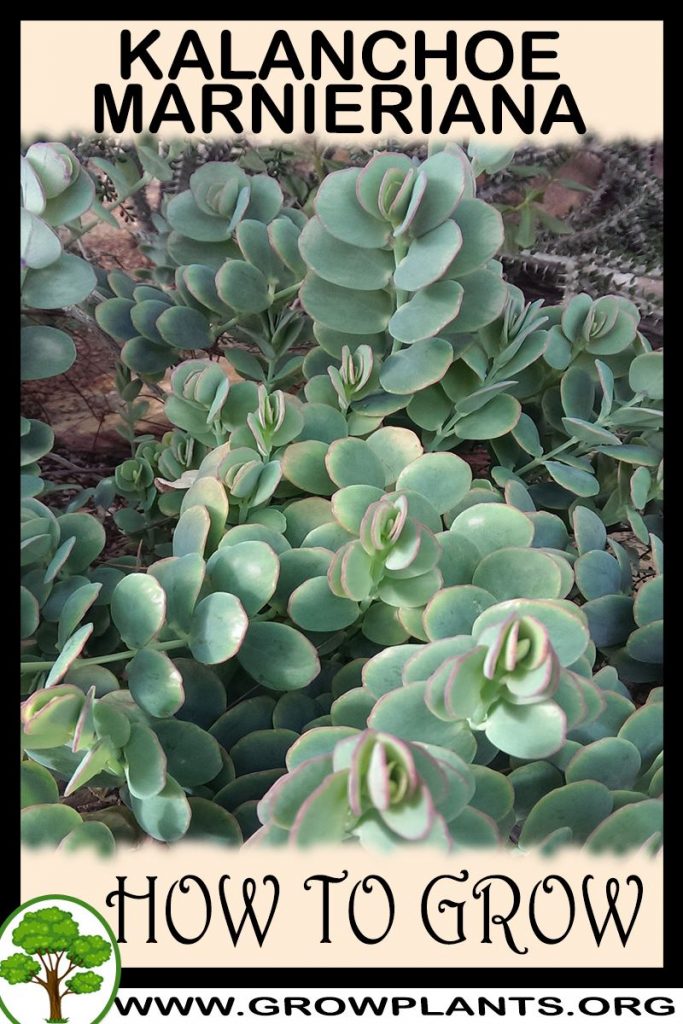
Plant Profile & Key Characteristics
Overview: Kalanchoe marnieriana is a perennial evergreen succulent subshrub, 30-50 cm (12-20 in), grown as an ornamental groundcover. It is drought-tolerant and slow-growing, but the plant is toxic.
Quick Specifications
| Specification | Attribute |
|---|---|
| Plant Type / Life Cycle | Perennial (succulent subshrub) |
| Foliage Type | Evergreen (succulent) |
| Mature Size | 30-50 cm (12-20 in) tall |
| Growth Rate | Slow |
| Root System | Shallow, fibrous |
| Toxicity | Toxic (Bryophyllum/Kalanchoe contain cardiac bufadienolides; poisonous to pets and livestock) |
| Hardiness | USDA zones 10-12 |
Growth Form & Structure
- Height & Spread: 30-50 cm (12-20 in); spreads as a groundcover and also grows well in a planter or container.
- Growth Habit & Form: Low, spreading succulent subshrub; drought-tolerant groundcover.
- Lifespan & Maturity: Long-lived perennial; slow-growing.
Anatomy & Physical Features
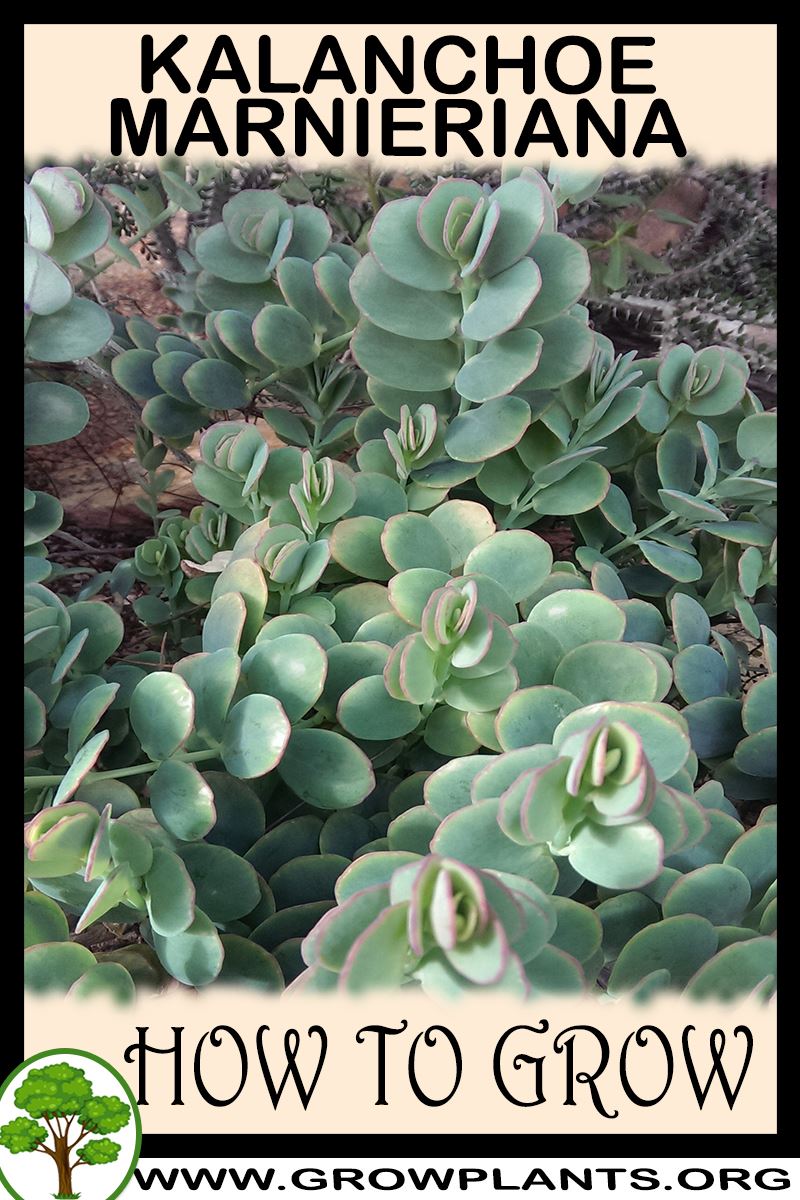
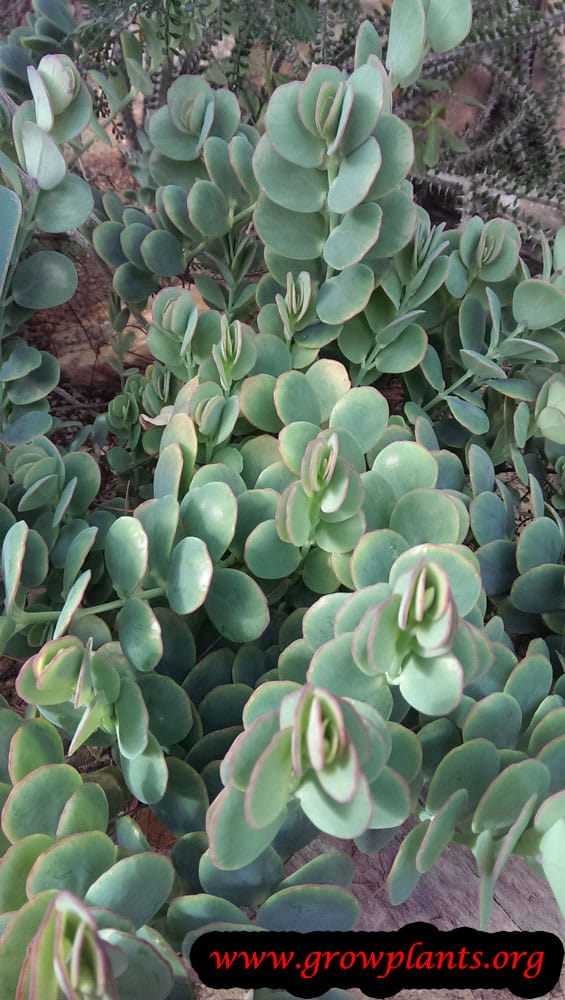
- Leaves & Foliage: Round, sometimes lobed-margined leaves, green with red edges in some forms.
- Flower Characteristics: Red bell-shaped flowers borne in clusters on upright stems.
Primary Uses & Landscape Value
- Functional & Ornamental Roles: Ornamental drought-tolerant groundcover for rockeries, dry gardens and containers.
Care Guide: Planting, Soil & Watering
Overview: Kalanchoe marnieriana is a slow-growing, drought-tolerant succulent that needs full sun to light shade and, above all, sharply drained soil. Water it sparingly and let the soil dry out completely between waterings – it stores its own moisture and rots in wet ground.
Quick Care Requirements
| Requirement | Ideal Condition |
|---|---|
| Planting Season | Warm season – spring through autumn |
| Growth Rate | Slow |
| Soil Type | Sharp-draining gritty or cactus/succulent mix |
| Water Need | Low – let the soil dry out completely between waterings |
Planting & Establishment
- Best Planting Season: Plant in the warm growing season, spring through autumn. It is frost-tender (hardy to about zone 10), so avoid planting going into cold weather.
- How to Plant:
- Hole Preparation: Make a shallow hole in gritty, fast-draining mix; these plants have small root systems and resent sitting wet.
- Soil Amendments: Blend plenty of coarse sand, grit or perlite into the mix for sharp drainage rather than rich, moisture-holding soil.
- Planting Depth: Set the plant at the same level it sat before, keeping the base and lower leaves clear of the soil surface to prevent rot.
- Growth Speed & Expectations: Growth is slow, so there is no need to push it; avoid overwatering or overfeeding, which do more harm than good.
Soil, Watering & Drainage Care
- Soil Mix & Drainage Needs: Sharp drainage is everything – use a gritty cactus/succulent mix or add sand, grit or perlite, and always plant in a pot with drainage holes. Wet, heavy soil quickly rots the roots.
- Watering Schedule & Technique:
- Young / Newly Planted: Water sparingly after planting and let it settle in; too much early moisture rots the young roots.
- Established: Soak thoroughly, then let the soil dry out completely before watering again – when in doubt, wait.
- Seasonal Adjustments: A little water through the warm growing months, and very little in winter when growth stalls.
Climate, Light & Hardiness
Kalanchoe marnieriana (Bryophyllum marnierianum) is a drought-tolerant succulent groundcover for desert, subtropical, and Mediterranean climates, growing best in full sun to half shade. It is frost-tender and reliably grown outdoors only where winters stay essentially frost-free, within its zone 10–12 range.
Quick Climate Specifications
| Climate Zones | Desert, Subtropical, Mediterranean |
| USDA Hardiness Zones | Approximately 10–12 |
| Optimal Temp Range | Approximately 18–29°C (65–85°F) |
| Cold Damage Begins | As temperatures approach freezing (around 0°C / 32°F) |
| Approx. Survival Minimum | Established plants may briefly tolerate a light frost, but a hard freeze is likely to cause significant damage |
| Frost Tolerance | Low |
| Light Conditions | Full Sun / Half Shade |
Sunlight & Light Exposure
Optimal Light Setup
Full sun to half shade suits its groundcover habit best, encouraging compact growth and good leaf coloring, including the red-edged forms.
Direct Sun Requirement
Direct sun is well tolerated and generally beneficial for a dense groundcover effect.
Shade & Heat Management
Half shade is a reasonable option in the hottest climates to prevent leaf scorch; otherwise no special heat management is needed.
Best Exposure/Orientation
An open, sunny to lightly shaded bed suits it as groundcover.
Temperature Extremes & Hardiness
USDA Hardiness & Regional Limits
The site places it in hardiness zone 10–12, meaning it is best suited to essentially frost-free climates.
Cold Damage & Winter Protection
Keep it frost-free where possible; young or newly propagated plants are more cold-sensitive than mature groundcover mats.
Frost Sensitivity
Low frost tolerance - frost damages the fleshy foliage and should be avoided.
Extreme Heat Tolerance
Good - as a drought-tolerant succulent it handles warm-climate summer heat well.
Wind, Humidity & Microclimate
Humidity Preferences
Tolerates both dry and average humidity; it does not require the higher humidity that some other Kalanchoe relatives prefer.
Dry-Air Tolerance
High - suited to arid and semi-arid climates.
Wind Tolerance
Moderate; its low, spreading groundcover habit copes reasonably well in open sites.
Rainfall & Seasonal Moisture
Best suited to climates with a dry season and well-drained soil; in wetter climates, drainage becomes more important to avoid rot.
Microclimate Recommendations
A sunny, well-drained, frost-free site suits it best as a groundcover.
Growing in Pots, Balconies & Indoors
Kalanchoe marnieriana is a compact, sun-loving succulent – a natural for pots and troughs on a bright patio or balcony. It is not a true deep-room houseplant (it wants more direct sun than most interiors offer), but it does well on a very sunny windowsill.
Quick Details
- Container Size: A pot a size or two larger than the root ball, with strong drainage holes
- Indoor Suitability: Best outdoors or on a sunny sill, not deep indoors
- Best Spot: Bright light to full sun
- Soil & Drainage: Free-draining cactus/gritty mix – drainage is everything
- Watering in Pots: Water only when the mix has dried out; pots must never stay soggy
Indoors & On the Windowsill
- As a houseplant: Not really a deep-room plant – it wants more direct sun than most interiors give and will stretch and weaken in low light. A ready-made cactus and succulent soil mix provides that structure without mixing it yourself.
- Windowsill growing: It still does well on your sunniest windowsill (south or west facing) with several hours of direct sun; keep it in the brightest spot you have.
- Overwintering: A pot makes it easy to shelter indoors on a bright, cool sill through frosty months.
- Keep it safe: Kalanchoe is toxic if eaten – keep it out of reach of children and pets.
On a Balcony or Patio
- Light, heat & wind: Give it the brightest spot you have; walls and railings throw back a lot of heat and pots dry fast, so check the mix often in warm weather. Move tender succulents under cover before frost.
- Practicalities: Raise the pot on feet so water drains away freely and does not pool on the balcony floor.
Choosing the Pot, Soil & Long-Term Care
- Pot & drainage: Use a pot with strong drainage holes and skip a standing saucer of water – wet feet are the fastest way to rot a succulent. Terracotta breathes and dries quickly, which suits it well; glazed or plastic holds moisture longer, so water more sparingly.
- Potting mix: A free-draining cactus/succulent mix, or a standard mix opened up with plenty of perlite, pumice or coarse sand; a layer of gravel, lava rock or pebbles in the base helps water clear.
- Feeding: Potted plants use up their soil, so feed lightly once or twice through the growing season with a dilute cactus or balanced feed – far less than a leafy houseplant needs.
- Refreshing the mix: After a couple of years the mix stops draining freely – tip the plant out, trim any tired roots and repot into fresh gritty mix.
Growing this plant in a greenhouse
A greenhouse can give kalanchoe marnieriana frost protection and cold protection.
Greenhouse at a glance
| Greenhouse suitability | Conditional - depends on your climate |
|---|---|
| Main benefits | frost protection, cold protection |
| Outdoor protection advisable below | about 2°C |
| Maintain greenhouse minimum | around 2°C for active growth |
| Suitable types | unheated greenhouse, polycarbonate greenhouse |
| Heating | Heating is optional - useful mainly for winter growing in cold areas. |
Related greenhouse guides
- Greenhouses: How to Choose the Right Greenhouse
- Polycarbonate Greenhouses: What to Look for Before Buying
- Greenhouse Climate Control: Temperature, Ventilation and Humidity
Fertilizing & Feeding
A light feeder: this evergreen succulent groundcover is grown for its dense, drought-tolerant mat of foliage, and modest feeding is all it takes to keep it healthy without pushing it soft.
Quick Fertilizing Specs
| Feeding Level | Light feeder |
|---|---|
| Main Nutrient Priority | Low-nitrogen feeding that favors dense, compact foliage over soft, stretched stems |
| Best Feeding Period | Through the active growing months of spring, summer, and autumn |
| Organic Options | A light compost amendment worked into the bed before planting |
| Reduce/Stop Feeding | Taper off feeding as the plant’s growth visibly slows in cooler weather |
| Micronutrients | Rarely needed in well-drained garden soil; treat only a diagnosed issue |
| Soil pH | Tolerates a wide range; drainage matters more than exact pH |
Feeding by Growth Stage
Active growing season
Maintain a dense, healthy mat of foliage without forcing soft, stretched growth.
| Nutrient direction | A light, low-nitrogen feeding is sufficient for this thrifty groundcover succulent. |
|---|---|
| Timing | Across the warm growing season, spring through autumn. |
| Frequency | Light, occasional feeding suits this slow-growing plant. |
| Fertilizer types | A diluted low-nitrogen or balanced fertilizer applied with routine watering, Compost worked into well-drained garden soil |
| Precautions | Avoid rich or frequent feeding; it encourages lanky, sprawling stems instead of a tidy mat. |
Cooler-season rest
Allow the plant to rest through its slower season without pushing new growth.
| Nutrient direction | None – withhold fertilizer while growth has slowed for the year. |
|---|---|
| Timing | During the cooler months when active growth clearly slows. |
| Frequency | No feeding at this stage. |
| Fertilizer types | No feeding at this stage; do not fertilize until active growth resumes. |
| Precautions | Do not fertilize during this rest period; unused nutrients accumulate as salts in the soil. |
Nutrient Deficiency Signs & Corrections
Foliage looks pale and thin overall, and new stem growth is sparse.
| Possible causes | low available nitrogen in lean, fast-draining soil, nutrients washing away with routine watering, root stress limiting nutrient uptake |
|---|---|
| Appears first on | older, lower leaves |
| What to check | feeding history, soil condition, root and base condition |
| Possible correction | Apply a light, diluted low-nitrogen feeding during active growth rather than a strong dose. |
Newest leaves emerge pale yellow while the veins remain green.
| Possible causes | high soil pH tying up available iron, compacted or waterlogged soil limiting root uptake, alkaline irrigation water reducing nutrient availability |
|---|---|
| Appears first on | newest growth |
| What to check | soil or water pH, drainage and root health, recent soil amendments |
| Possible correction | Improve drainage and check pH first; apply a chelated iron product per its label only if the pattern persists. |
Leaf margins yellow or scorch and stems seem weaker than expected.
| Possible causes | low potassium relative to nitrogen in recent feeding, an imbalanced or overly diluted feeding routine, lean garden soil that supplies little potassium on its own |
|---|---|
| Appears first on | older leaf margins |
| What to check | recent fertilizer balance, soil condition, overall plant vigor |
| Possible correction | Shift to a balanced, low-nitrogen feeding during active growth rather than a nitrogen-heavy one. |
Pruning, Training & Seasonal Maintenance
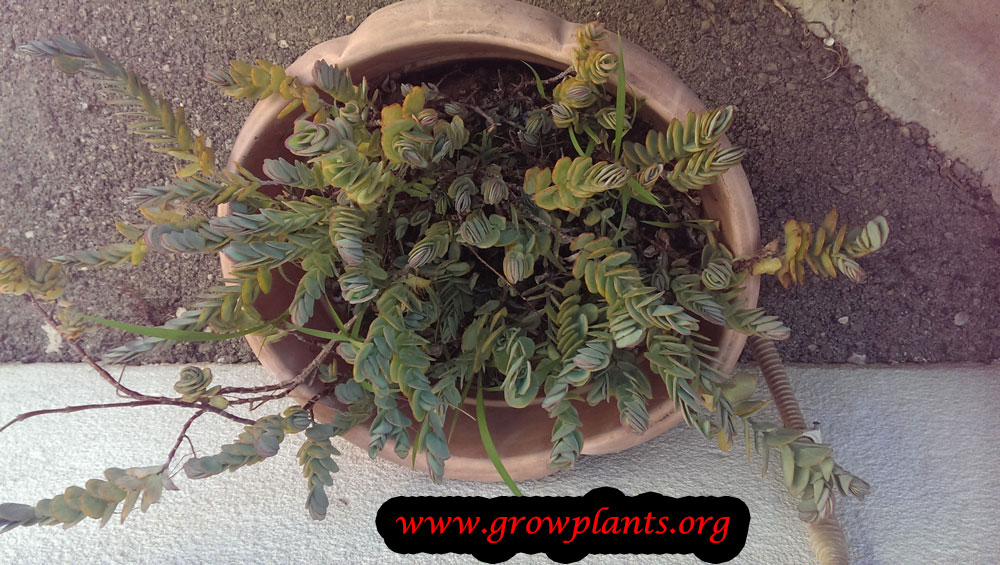
Kalanchoe marnieriana has a distinctly pendant, cascading habit – more strongly trailing than its close relative K. fedtschenkoi – which makes it a favorite for hanging baskets and spilling over rockery edges rather than as a flat ground cover. Pruning tolerance is moderate to high, and the objective is managing cascade length and stem density for display rather than containing spread within a bed.
Quick Pruning & Maintenance Specs
| Pruning Tolerance | Moderate to High – tolerates pinching and cutback well |
| Primary Pruning Window | Spring through summer active growth |
| Secondary Maintenance Window | Any time, for removing damaged/dead stems |
| Typical Frequency | Pinch/trim occasionally through the growing season to manage cascade length |
| Main Objective | Manage cascade length and stem density in hanging or trailing display |
| Young Plant Priority | Pinch to build multiple trailing stems from the base rather than one long runner |
| Mature Plant Priority | Trim overlong or bare trailing stems; thin a congested base |
| Best Tool Type | Precision snips (soft, thin trailing stems throughout) |
| Avoid Heavy Pruning During | Cooler months at the low end of its zone 10–12 range, when regrowth is slow |
Pruning by Plant Age & Size
Newly Established
Pinch the growing tip early to encourage several trailing stems to develop from the base instead of a single long strand.
Young / Formative
No formal training – pinching multiplies trailing stems for a fuller cascade over time.
Mature / Established
Trim back any trailing stem that has become bare toward its base or has outgrown the display; thin a crowded crown occasionally so new trailing growth keeps regenerating rather than all growth aging in place.
Seasonal Pruning Schedule
| Summer Canopy Management | Objective: keep the cascade full and proportionate. Remove: overlong or bare-based trailing stems; crowded interior growth. Response: prompts fresh trailing shoots from the cut point. |
| Ongoing Sanitary | Objective: tidy appearance. Remove: dead or snail/slug-damaged parts. Avoid: shortening healthy trailing stems still filling out the display. |
Structural Pruning & Training
No staking or framework – in hanging baskets, gravity does the “training”. The only structural decision is how long to let individual trails grow before pinching them back to keep the display balanced and to keep the base from going bare.
Special Growth to Remove
- Overlong or bare-based trailing stems – cut back to a lower node to renew the cascade.
- Snail/slug-damaged growth – remove damaged tissue and address the pest.
- Dead stem sections – cut back to healthy tissue.
Container & Small-Space Pruning
This species is essentially always grown in a container or hanging basket rather than in open ground. Pinch trailing tips periodically to keep multiple stems developing rather than one stem running far past the basket edge, and use the trimmed tips as propagation material to fill the basket further or start new ones.
Tools
- Precision snips – the only tool needed; all growth is thin and soft.
Tool Hygiene & Disease Risk
Routine – no significant disease pressure noted for this species; its main issue is physical damage from snails/slugs rather than fungal disease, so clean, sharp snips are sufficient.
Cut Placement & Technique
Pinch or cut just above a leaf node so a new trailing shoot branches cleanly from that point; retain healthy trimmed tips as cuttings, since vegetative propagation is how true-to-type plants are produced.
Heavy Pruning & Rejuvenation
Tolerated: a sparse or overly long, bare-based cascade can be cut back hard near the crown in active season and will typically resprout new trailing stems given warmth and light. Expect a stubby, bare-looking basket for a few weeks while new trails develop.
Post-Pruning Care
No feeding required to force regrowth. Keep watering modest (this species prefers a small amount of water) even after cutback; watch for slug/snail damage on tender new growth.
Common Pruning Mistakes
- Letting all trailing stems run unchecked until the base goes bare and the display looks top-heavy and sparse near the crown.
- Discarding healthy pinched tips instead of using them as propagation material.
- Cutting back hard in cool weather when regrowth is slow.
When NOT to Prune
Avoid hard cutback during cooler weather at the lower end of its zone 10–12 range, when the plant is slowest to regenerate new trails.
Recommended Tools (by task)
- precision_snips – all pinching, cascade-length control, and cutback on this soft-stemmed trailer.
Propagation Guide
Kalanchoe marnieriana (Bryophyllum marnierianum) roots readily from stem or leaf cuttings, the fastest way to increase it; the site notes vegetative propagation is needed to keep this particular form true, since seed will not reliably reproduce it. Overall an Easy plant to propagate.
Quick Propagation Specs
| Best Propagation Method | Stem or leaf cuttings |
| Alternative Methods | Seed (plain species only); division of spreading clumps |
| Propagation Difficulty | Easy |
| Seed True-to-Type | Variable — this colour/leaf form does not reliably come true from seed |
| Vegetative True-to-Type | Yes |
| Best Propagation Season | Spring to summer; can be done through much of the year in warm climates |
| Cutting Rooting Time | Often just a couple of weeks |
| Germination Temperature | About 21–24°C (70–75°F) |
| Seed Sowing Depth | Surface-sow; the seed is very fine |
Growing from Seed
Seed is fine and dust-like, as is typical for the genus; surface-sow and keep warm and lightly moist. Seed is mainly useful for raising the plain species rather than reproducing this particular selected form.
Stem Cuttings
Cutting Type
Node or tip cuttings.
Cutting Preparation
Let the cut end callus briefly before inserting.
Rooting Setup
Insert into a well-drained mix, kept lightly moist.
Rooting Hormone
Unnecessary.
Rooting Time
Often just a couple of weeks.
Leaf & Root Cuttings
Individual leaves root readily, similar to other Bryophyllum species, when their cut base is inserted or laid onto moist, well-drained soil after a brief callusing period.
Division, Offsets, Pups & Suckers
As a spreading ground cover, established clumps can be lifted and divided in the growing season as an alternative to taking cuttings.
Bloom & Flower Guide
Quick Details
- Bloom Season: Winter into spring
- Flower Appearance: Pendant, bell-shaped red flowers dangling from arching stems
- Edibility: Not edible – this kalanchoe (Bryophyllum) is toxic to pets and people, and the flowers are among the most toxic parts
Detailed Blooming Overview
Kalanchoe marnieriana carries neat, paired blue-green leaves along trailing stems, and in the cool of winter into spring it hangs clusters of tubular, bell-shaped red flowers from the stem tips. The nodding, lantern-like blooms are the highlight of the season on this easy ground-cover succulent.
Flower Characteristics
- Tubular, bell-shaped flowers in warm red, often flushed with pink or orange
- Hanging in loose clusters from arching stems
- A cool-season bloomer, at its best in winter and early spring
Bloom Care & Thinning
- Encouraging bloom: Bright light and the natural shortening days of autumn set it up to flower through winter.
- Aftercare: Trim back the spent flowering stems once the display ends to keep the plant compact.
- Safety: All parts are toxic if eaten and the flowers especially – keep it out of reach of cats, dogs and children.
Pests, Diseases & Troubleshooting
Overview: Kalanchoe marnieriana (Bryophyllum marnierianum) is a succulent kalanchoe, and like most succulents it is fairly pest-resistant: the real killers are overwatering and poor drainage, while the insect pests are the usual soft-bodied opportunists — mealybugs above all, plus aphids, scale and mites — that exploit stressed or crowded plants. Keep it in gritty, free-draining mix, water only when dry, and give bright light and airflow, and problems stay rare. Note the sap contains cardiac glycosides and is toxic to pets and livestock.
Quick Troubleshooting Overview
| Issue / Pest | Main Symptom | Primary Solution |
|---|---|---|
| Mealybugs | White cottony tufts in leaf axils & on roots, honeydew | Alcohol swab, oil/soap; repot if in roots |
| Aphids | Colonies on flower stalks & new growth, sticky honeydew | Rinse off, insecticidal soap |
| Scale insects | Brown waxy bumps on stems & leaves | Scrape/prune, horticultural oil |
| Spider mites | Fine stippling & webbing in hot dry air | Raise humidity, rinse; hort oil |
| Stem / root rot | Mushy blackening base, collapse | Cut to clean tissue, dry out, re-root; less water |
| Powdery mildew | White powdery film on leaves | Airflow, remove leaves; sulfur/bicarbonate |
Common Pests & Management
- Mealybugs (Planococcus citri, Pseudococcus spp.):
- Symptoms: The signature kalanchoe pest: white cottony clusters wedge into leaf axils, between clustered leaves and around the stem base, and root mealybugs infest the root ball, causing unexplained stunting and decline; honeydew and sooty mould follow.
- Prevention & Control: Dab visible clusters with a cotton bud dipped in 70% isopropyl alcohol, then spray horticultural oil or insecticidal soap and repeat weekly. If growth stalls with no top pest visible, unpot and check the roots — wash them, discard old mix and repot into fresh gritty medium. Isolate new plants first.
- Aphids (Aphis, Myzus spp.):
- Symptoms: Green, grey or black soft-bodied colonies gather on the flowering stalks and tender new growth, distorting them and leaving sticky honeydew; kalanchoes are especially aphid-prone when in bloom.
- Prevention & Control: Rinse colonies off with a water jet, wipe over the flower stems, and spray insecticidal soap or neem. Encourage ladybirds and lacewings, and avoid over-feeding, which drives soft aphid-friendly growth.
- Scale insects (soft & armoured scales):
- Symptoms: Immobile brown, tan or waxy bumps on stems and along the leaves; soft scales drip honeydew, armoured scales cause yellow flecking and weaken the plant.
- Prevention & Control: Scrape off light infestations or prune out badly encrusted stems, then apply horticultural oil to smother the crawler stage, repeating to catch later hatchlings.
- Spider mites (Tetranychus urticae):
- Symptoms: Fine pale stippling and a dull, bronzed look to the leaves, with faint webbing in hot, dry, still air; more a problem indoors and under glass than outdoors.
- Prevention & Control: Raise humidity and airflow and rinse the foliage. Spray horticultural oil or insecticidal soap, repeating every few days; mites rarely become serious on well-grown succulents with good air movement.
- Fungus gnats (Bradysia spp.):
- Symptoms: Small dark flies hovering over the soil and running across the surface; their larvae live in persistently wet mix and can nibble fine roots and seedlings, a sign the plant is being kept too wet.
- Prevention & Control: Let the mix dry out between waterings (the primary fix), top-dress with grit or sand, use yellow sticky traps for the adults, and drench with Bacillus thuringiensis var. israelensis (BTI) or beneficial nematodes for the larvae.
Diseases & Fungal Issues
- Stem, crown & root rot (Phytophthora, Pythium, Fusarium):
- Symptoms: The main killer of kalanchoes: the stem base or crown turns soft, brown-black and mushy and the plant collapses, almost always from overwatering, a too-heavy mix or water sitting among the leaves.
- Treatment & Management: Prevent with gritty, fast-draining mix, careful watering (only when the mix is dry), and by keeping water off the crown. If rot appears, cut back to firm clean tissue, dust with sulfur, let it callus, and re-root the healthy top as a cutting — often the surest rescue.
- Powdery mildew (Sphaerotheca / Erysiphe):
- Symptoms: White powdery patches on leaves and stems in humid, crowded, poorly ventilated conditions, causing distortion and yellowing of affected growth.
- Treatment & Management: Improve airflow and spacing, avoid wetting the foliage, and remove affected parts; a sulfur or potassium-bicarbonate spray helps in persistent cases.
- Botrytis / grey mould (Botrytis cinerea):
- Symptoms: Fuzzy grey mould on flowers, dead leaf tips and soft growth in cool, damp, still air.
- Treatment & Management: Increase ventilation, remove faded flowers and dead material, and keep the foliage dry when watering.
- Southern blight / crown collapse (Sclerotium rolfsii):
- Symptoms: Rapid wilting with white fungal threads and small tan sclerotia at the soil line in warm, wet, humid conditions.
- Treatment & Management: Remove and destroy affected plants and the surrounding soil or mix, improve drainage and airflow, and avoid mulch piled against the stem.
Growing Difficulties & Abiotic Problems
- Overwatering & poor drainage:
- Cause & Symptoms: Soft, translucent, yellowing lower leaves and a mushy stem — the single most common cause of kalanchoe failure, from too-frequent watering or a water-retentive mix.
- Correction Strategy: Use a gritty succulent/cactus mix in a pot with drainage holes, water thoroughly only when the mix has dried, and reduce watering sharply in cool or low-light periods. Never leave the pot standing in a saucer of water.
- Etiolation (stretching in low light):
- Cause & Symptoms: Pale, weak, elongated growth with widely spaced leaves that lean toward the light; poor or no flowering.
- Correction Strategy: Move to a brighter spot with several hours of bright light (some gentle direct sun), turn the plant regularly, and prune leggy growth to restack a compact shape.
- Sunburn from sudden strong sun:
- Cause & Symptoms: Bleached white or scorched brown patches on leaves moved abruptly from shade into full sun, or pressed against hot glass.
- Correction Strategy: Acclimatise gradually to brighter conditions over a couple of weeks and provide light shade during the fiercest midday sun; damaged leaves will not recover but new growth will be fine.
- Cold / frost damage:
- Cause & Symptoms: Blackened, water-soaked, collapsing leaves after exposure below about 5 C; these are frost-tender succulents.
- Correction Strategy: Keep above 10 C where possible, bring plants under cover before cold snaps, and remove damaged growth once warmth returns.
What Helps — Products & Tools
The essentials are 70% isopropyl alcohol and cotton buds for spot-treating mealybugs and scale, horticultural or neem oil and insecticidal soap for the general pest set, and yellow sticky traps plus BTI or nematodes for fungus gnats. A sulfur or potassium-bicarbonate spray covers powdery mildew, and sulfur dust helps callus rot cuts. The most important ‘tool’, though, is a gritty free-draining mix and a restrained watering can — most kalanchoe problems trace back to water. The sap is toxic to pets, so site accordingly; spray oils in the evening.