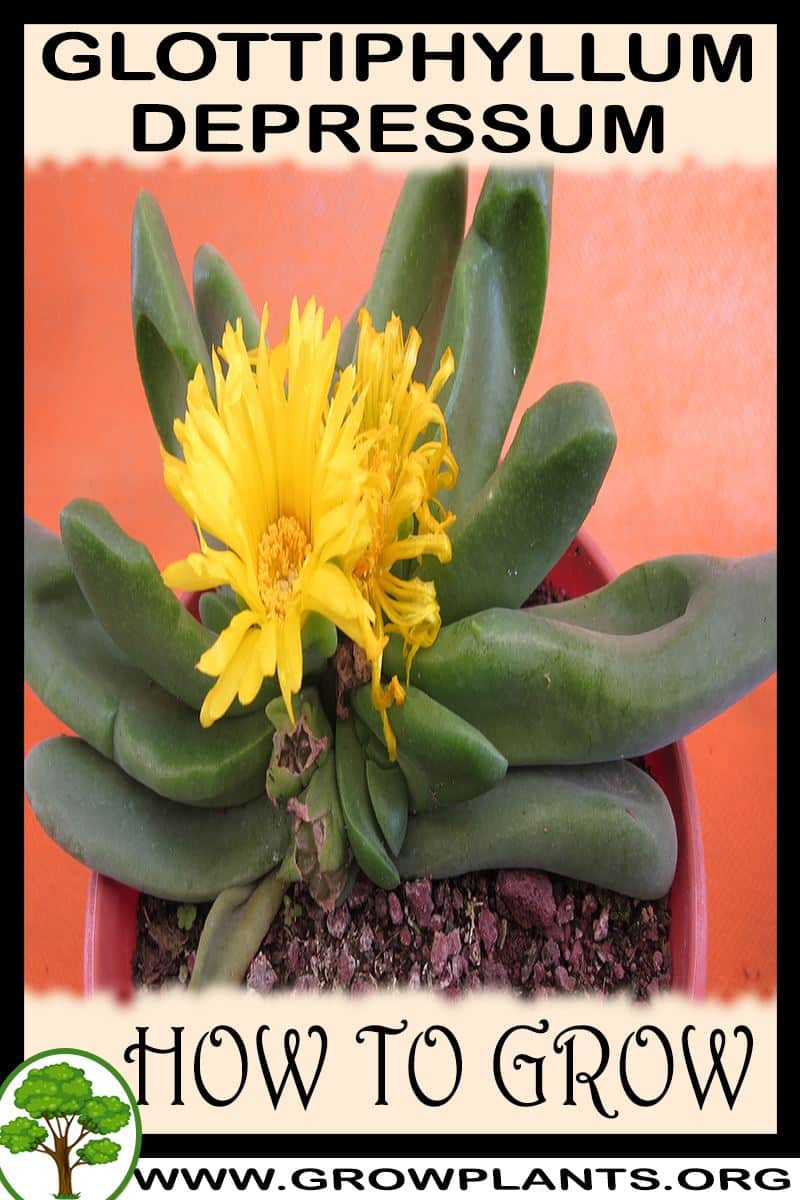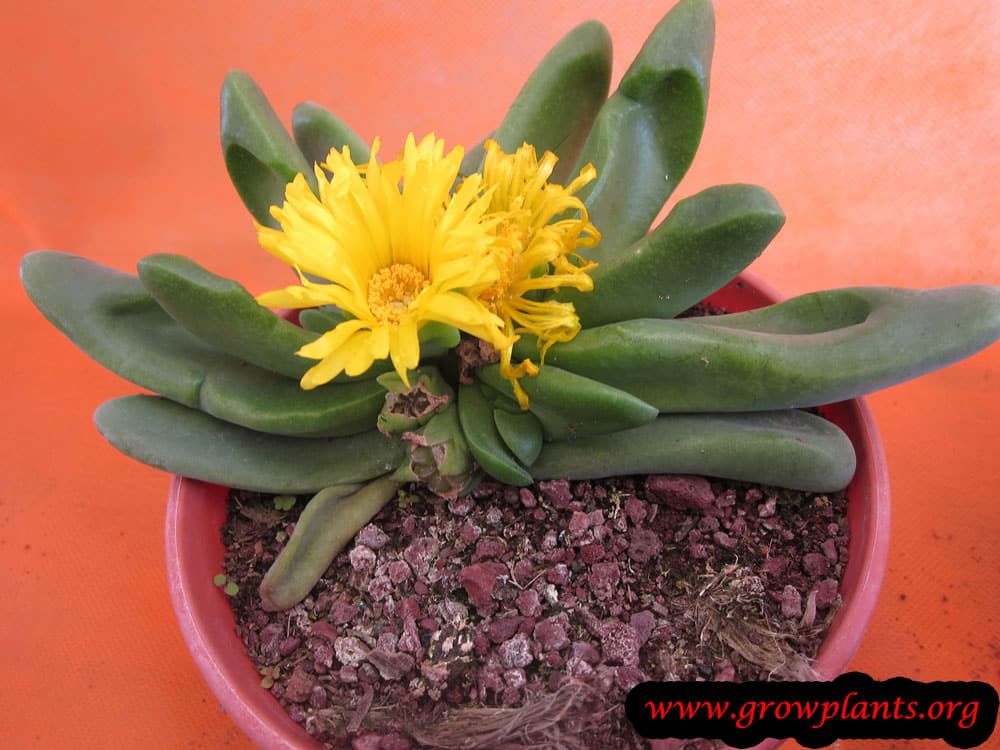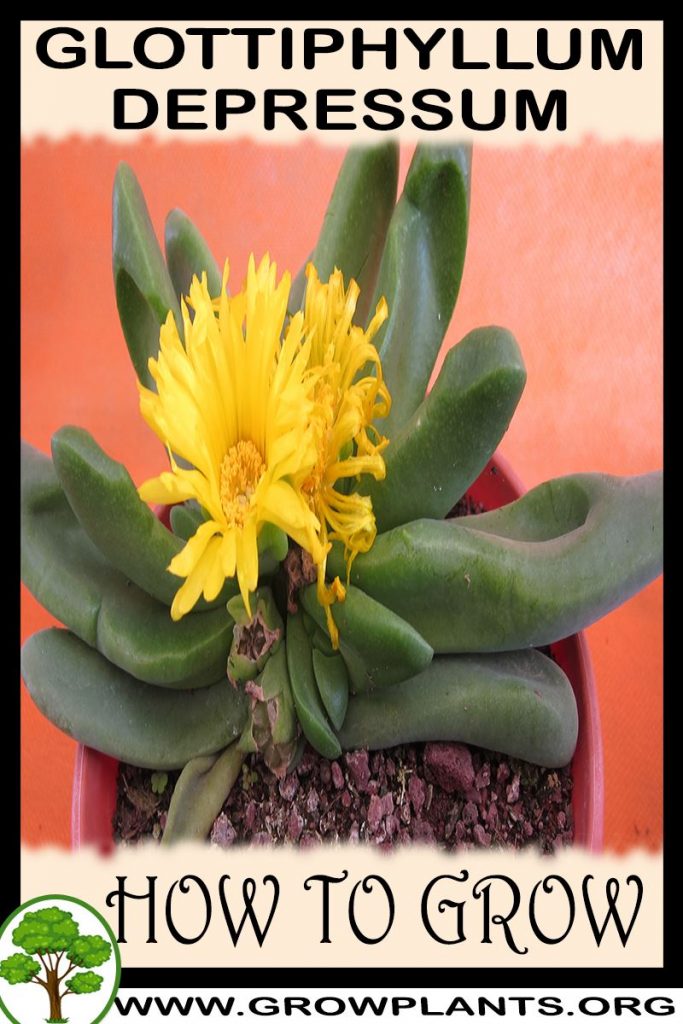
Plant Profile & Key Characteristics
Overview: Glottiphyllum depressum is a dwarf, mat-forming succulent subshrub only 4-5 cm (1.8-2 in) tall, grown as an ornamental, drought-tolerant plant and houseplant. It has fleshy, tongue-like leaves and yellow daisy-like flowers.
Quick Specifications
| Specification | Attribute |
|---|---|
| Plant Type / Life Cycle | Evergreen perennial succulent (subshrub) |
| Foliage Type | Evergreen (succulent) |
| Mature Size | 4-5 cm (1.8-2 in) tall, spreading along the ground |
| Growth Rate | Slow |
| Root System | Shallow, fibrous roots |
| Hardiness | USDA zones 10-12 |
Growth Form & Structure
- Height & Spread: Very low, 4-5 cm (1.8-2 in) high, creeping across the soil; ideal for shallow pots and as a houseplant.
- Growth Habit & Form: Ground-hugging succulent forming spreading clumps of fleshy leaves.
- Lifespan & Maturity: A slow-growing, long-lived succulent.
Anatomy & Physical Features
- Leaves & Foliage: Bright green, waxy, fleshy, tongue-shaped (linear to shapeless) leaves.
- Flower Characteristics: Glossy yellow, many-petalled daisy-like flowers with narrow, needle-like petals.
Primary Uses & Landscape Value
- Functional & Ornamental Roles: A rockery, succulent-collection and container/houseplant ornamental for hot, dry positions.
Care Guide: Planting, Soil & Watering
Overview: Glottiphyllum (tongue plant) is a slow-growing, mat-forming succulent (hardiness zone 10–12, or a houseplant) for full sun to shade, thriving in gritty, sandy, sharply drained soil. It stores water in its fleshy leaves and needs only occasional watering.
Quick Care Requirements
| Requirement | Ideal Condition |
|---|---|
| Planting Season | Warm season — spring, summer or autumn |
| Growth Rate | Slow |
| Soil Type | Gritty, sandy, sharply drained (cactus/succulent) mix |
| Water Need | Low — let the soil dry out fully between waterings |
Planting & Establishment
- Best Planting Season: Plant in the warm months of spring through autumn, keeping it frost-free and above about 5°C.
- How to Plant:
- Hole Preparation: Dig a hole just large enough for the root ball and settle the plant gently.
- Soil Amendments: Mix in plenty of coarse sand or grit; this succulent wants lean, fast-draining soil, not rich ground.
- Planting Depth: Set the plant at the same level it grew, with the fleshy leaves resting on the soil surface, not buried.
- Growth Speed & Expectations: Slow — forms a low, creeping clump of fleshy, tongue-like leaves over time.
Soil, Watering & Drainage Care
- Soil Mix & Drainage Needs: Use a gritty cactus or succulent mix with excellent drainage; in containers a pot with drainage holes is essential to prevent rot.
- Watering Schedule & Technique:
- Young / Newly Planted: Water lightly after planting, then only once the soil has dried, while the roots establish.
- Established: Water sparingly on a soak-and-dry cycle, letting the soil dry out completely between waterings.
- Seasonal Adjustments: Water very little in winter and only occasionally in summer; overwatering rots the roots.
Climate, Light & Hardiness
Glottiphyllum depressum is a creeping, waxy-leaved ice-plant relative suited to subtropical, Mediterranean, and desert climates or life as a houseplant. It accepts full sun through full shade and survives brief cold down to roughly 5°C (41°F), so it is best kept well above freezing.
Quick Climate Specifications
| Climate Zones | Subtropics, Mediterranean, desert, or indoor as a houseplant |
| USDA Hardiness Zones | 10-12 |
| Approx. Survival Minimum | Roughly 5°C (41°F) |
| Frost Tolerance | None |
| Light Conditions | Full Sun / Half Shade / Full Shade |
Sunlight & Light Exposure
Optimal Light Setup
This species is flexible with light, tolerating anything from full sun to full shade, which makes it easy to place in a garden bed, rockery, or bright indoor spot.
Best Exposure / Orientation
Full sun gives the most compact, waxy growth and best flowering, while shadier spots are also workable.
Temperature Extremes & Hardiness
USDA Hardiness & Regional Limits
Outdoor culture is reliable from about USDA zone 10 through 12; outside this range it needs to be grown as a houseplant.
Cold Damage & Winter Protection
The plant is more cold-sensitive than many of its ice-plant relatives, tolerating only brief dips to around 5°C (41°F); keep it well above freezing rather than relying on frost tolerance.
Frost Sensitivity
Frost tolerance is essentially none; bring container plants indoors or under cover well before temperatures approach freezing.
Wind, Humidity & Microclimate
Dry-Air Tolerance
As a succulent from arid South African habitats, it tolerates dry air well and needs no extra humidity.
Microclimate Recommendations
Sandy, well-drained soil is important in any climate to avoid rot, particularly in cooler regions where it can only be grown in containers or under cover.
Growing in Pots, Balconies & Indoors
Glottiphyllum depressum is a small, creeping tongue-leaved succulent that takes anything from full sun to shade, which makes it an easy, adaptable houseplant as well as a neat pot or rockery plant outdoors. In a small, free-draining pot it stays compact and long-lived.
Quick Details
- Container Size: A small pot about 30% wider than the root ball; at 4-5 cm (1.8-2 in) it stays happy in a snug pot
- Indoor Suitability: A good, undemanding houseplant
- Best Spot: Adaptable – full sun to shade; bright light indoors keeps it compact and colourful
- Soil & Drainage: Gritty, free-draining succulent mix; strong drainage holes
- Watering in Pots: Small amounts; let the mix dry between waterings
Indoors & On the Windowsill
- An easy houseplant: The grower confirms yes – it adapts to a wide range of light, so a bright room or windowsill suits it well.
- Light indoors: The brighter the spot the more compact and colourful it stays, though it will also cope with lower light.
- Overwintering: Tender (hardiness zone 10-12), so keep it as an indoor pot plant over winter in cold regions.
On a Balcony or Patio
- Bright summer spot: In the warm season it enjoys a balcony or patio in full sun to part shade.
- Heat & watering: Pots dry fast in reflected heat, so check the mix – but water only when dry, and shelter from heavy rain so it never sits wet.
- Bring it in: Move it back indoors before cold nights.
Choosing the Pot, Soil & Long-Term Care
- Pot & drainage: Choose a pot only about 30% wider than the root ball – an oversized pot holds wet soil around the roots. Rather than starting big, pot up every few years as it fills out; the mix loses structure over time, though a sharp, sandy mix that never sits wet can go five years or more between changes. Use strong drainage holes and skip a standing water saucer to avoid root rot.
- Pot material: Terracotta breathes and dries fast, which suits these rot-prone succulents; glazed or plastic pots hold moisture longer, so water even more sparingly.
- Potting mix: A gritty, free-draining mix – sandy or cactus/succulent mix, or peat/coir with perlite, with coarse lava grit at the base.
- Feeding: Feed only lightly – a dilute low-strength feed once or so during active growth, as frequent watering leaches nutrients from pots faster than from open ground.
- Watch for rot: Overwatering is the one real danger – in a rainy spot stand the pot in lava grit so water drains straight through, and always let the mix dry before watering again.
Fertilizing & Feeding
This is a light-feeding succulent – a dilute, balanced or low-nitrogen fertilizer during the warm active growing season is plenty, and it is best left unfed while dormant.
Quick Fertilizing Specs
| Feeding Level | Light feeder |
|---|---|
| young_feeding | Go easy while young; light, dilute feeding during active growth |
| mature_feeding | An occasional light feeding in the active season is enough |
| Main Nutrient Priority | A balanced, low-nitrogen approach |
| Best Feeding Period | The warm active growing season |
| Organic Options | A little worm castings or a gentle, well-diluted organic liquid |
| Micronutrients | Not usually needed; a complete fertilizer covers trace requirements |
| Soil pH | Tolerates a slightly acidic to near-neutral range |
| Reduce/Stop Feeding | Stop feeding during dormancy and rest |
Feeding by Growth Stage
Active growth (warm season)
Support steady, compact growth during the warm active season without forcing soft, weak growth.
| Nutrient direction | A dilute, balanced fertilizer that leans low in nitrogen, applied gently and infrequently. |
|---|---|
| Timing | During the warm active growing season. |
| Frequency | Feed sparingly through the active season; light feeding is usually enough. |
| Fertilizer types | A dilute balanced or low-nitrogen liquid fertilizer, A gentle controlled-release product formulated for cacti and succulents |
| Precautions | Avoid heavy or high-nitrogen feeding, which drives soft, stretched, rot-prone growth; keep feeding light. |
Dormancy and rest
Let the plant rest during cold or low-light dormancy when it is not actively growing.
| Nutrient direction | None – withhold fertilizer during dormancy. |
|---|---|
| Timing | During cold-season dormancy or hot-season rest when growth stalls. |
| Frequency | No feeding at this stage. |
| Fertilizer types | No feeding at this stage; do not fertilize while the plant is resting. |
| Precautions | Do not fertilize until active growth resumes; feeding a dormant succulent invites salt buildup and rot. |
Nutrient Deficiency Signs & Corrections
Older, lower leaves turn pale or yellow and overall growth slows.
| Possible causes | Low general fertility or nitrogen shortage in long-unfed mix, Root problems from overwatering or compacted, poorly drained soil, Natural aging of the oldest leaves |
|---|---|
| Appears first on | Oldest, lowest leaves. |
| What to check | Whether the plant has gone a long time without any feeding, Drainage and whether the mix stays wet, Root health when unpotting |
| Possible correction | Improve drainage and let the mix dry between waterings, then give a light, dilute feeding during active growth if fertility is genuinely low. |
Growth becomes soft, elongated and floppy with weak coloration.
| Possible causes | Too much nitrogen or over-rich feeding, Too little light causing etiolation, Overwatering keeping tissues soft |
|---|---|
| Appears first on | New growth at the tips. |
| What to check | Recent feeding strength, Light levels, Watering habits |
| Possible correction | Reduce feeding strength and move the plant to brighter light; keep any feeding light and dilute. |
Leaf tips or edges brown and dry, sometimes with a whitish crust on the soil surface.
| Possible causes | Salt buildup from over-feeding or hard water, Underwatering and a dry root zone, Excess fertilizer concentration |
|---|---|
| Appears first on | Leaf tips and margins. |
| What to check | Whether a salt crust has formed on soil or pot, Fertilizer concentration and how often it is applied, How thoroughly the plant is watered |
| Possible correction | Flush the pot thoroughly to leach accumulated salts, then feed only lightly and dilute during active growth. |
Pruning, Training & Seasonal Maintenance
Glottiphyllum depressum is a tiny (4–5 cm), slow-growing, mat-forming leaf succulent that spreads by creeping along the ground, so it tolerates only very light maintenance rather than real structural pruning. The main task is removing spent, shrivelled leaf pairs as they naturally die back, best done in spring or summer while the plant is in active growth — its documented pruning window — so cut tissue heals quickly; pruning has essentially no effect on the summer–autumn flowers, which form at the growing tips regardless of leaf removal.
Quick Pruning & Maintenance Specs
| Pruning Tolerance | Low — maintenance only, not shaping |
| Primary Pruning Window | Spring – Summer (active growth) |
| Typical Frequency | Occasional, as spent leaves appear |
| Main Objective | Remove dead/shrivelled leaves; keep the creeping mat tidy |
| Young Plant Priority | None — let the rosette establish and spread |
| Mature Plant Priority | Clear spent leaf pairs; trim bare trailing stems if the mat gets leggy |
| Best Tool Type | Fine precision snips, or pinch by hand |
| Avoid Heavy Pruning During | Cold below about 5°C (its stated minimum) and while in flower |
Pruning by Plant Age & Size
Newly Established
Do not cut; let the small rosette root and begin its creeping spread undisturbed.
Young / Formative
No structural training applies to this creeping habit — it fills in on its own. If a stem stretches thin from low light, pinch the tip to encourage a bushier, more compact spread.
Mature / Established
Remove spent or shrivelled leaf pairs at their base, and trim back bare, overextended trailing stems where the centre of an older mat has thinned, using the trimmed pieces as cuttings to start fresh plants.
Structural Pruning & Training
Because it spreads by creeping stems rather than building a woody framework, the only structural task is containing spread and thinning a congested or bare-centred mat — not canopy thinning or branch selection as on a shrub.
Special Growth to Remove
Remove shrivelled, dead leaf pairs as normal succulent leaf turnover, and any stem sections stretched thin (etiolated) from insufficient light.
Container & Small-Space Pruning
Grown as a houseplant in a shallow, wide, well-drained pot, keep the mat within the container edge by trimming trailing stems before they overspill, and use a sandy, mineral mix that supports the shallow roots without holding excess moisture.
Tools
Fine precision snips for the occasional leaf or stem trim; nothing larger is ever needed on a plant this small.
Tool Hygiene & Disease Risk
Risk level: Increased. Like other soft, water-storing leaf succulents this plant can rot from a cut left wet, so use a clean blade and let any cut surface dry before it meets moist soil.
Cut Placement & Technique
Cut cleanly at the base of the leaf or stem being removed rather than tearing, and avoid crushing the waxy, fleshy tissue, which is slow to heal if bruised.
Heavy Pruning & Rejuvenation
Not tolerated. There is no woody framework to cut back hard; a mat that has become bare or leggy in the centre is better refreshed by rooting cuttings from the healthy outer growth than by hard-pruning the original plant.
Post-Pruning Care
Hold off watering for a few days after any cut so the wound can dry, keep the plant in bright but not scorching light while it recovers, and watch for slugs and snails — its documented pests — finding the fresh cut tissue.
Common Pruning Mistakes
- Watering immediately after trimming, inviting rot in the fleshy tissue.
- Cutting during cold weather near or below its 5°C minimum.
- Treating it like a woody shrub and attempting a structural or rejuvenation cut it cannot recover from.
When NOT to Prune
Avoid cutting while the plant is flowering (summer–autumn) if you want to keep the display, in cold weather near its 5°C minimum, or when the soil is wet.
Recommended Tools (by task)
- precision_snips — the only cut this plant ever needs: removing a spent leaf pair or taking a stem-tip cutting.
- blade_disinfectant — keeps cuts clean on a soft, rot-prone succulent.
Propagation Guide
Glottiphyllum depressum is most reliably propagated by dividing its creeping mat into rooted sections or by rooting short stem and leaf-tip cuttings, since fertile seed is genuinely uncommon for this species in cultivation. When seed can be sourced it is generally true-to-type, as this is a true species rather than a hybrid, but vegetative propagation remains the practical route for most growers, and it is an easy technique to master.
Quick Propagation Specs
| Best Propagation Method | Division of clumps / stem & leaf-tip cuttings |
| Alternative Methods | Seed (uncommonly available) |
| Propagation Difficulty | Easy |
| Seed True-to-Type | Yes (true species, not a hybrid) |
| Vegetative True-to-Type | Yes |
| Best Propagation Season | Spring through autumn |
| Seed Germination Time | Several weeks, often slow and uneven |
| Cutting Rooting Time | A few weeks |
| Germination Temperature | Warm, roughly 20–25°C (68–77°F) |
| Seed Sowing Depth | Surface-sow on fine, sandy mix; do not bury |
Growing from Seed
Seed Handling & Viability
Seed of this species is genuinely hard to obtain from cultivated plants; when available, sow it promptly rather than storing it for long periods.
Sowing Season
Sow in spring through autumn, matching the plant’s active growing period.
Sowing Depth & Orientation
Sow on the surface of a well-drained, sandy mix and press in lightly rather than covering, as is typical for fine mesemb seed.
Germination Conditions
Keep warm and bright in a well-drained sandy medium; let the surface dry slightly between waterings to avoid damping-off, since this species naturally needs only a small amount of water.
Germination Time
Germination can be slow and irregular, often taking several weeks, in keeping with this slow-growing species.
Seedling Care
Grow seedlings on in the same sandy, well-drained mix with careful, sparing watering; expect slow early growth.
Stem Cuttings
Cutting Type
Short stem or leaf-tip segments taken from the trailing, mat-forming growth.
Best Timing
Spring through autumn, during active growth.
Cutting Preparation
Let the cut end callous over for a few days before inserting it, as with most succulents, to reduce the risk of rot.
Rooting Setup
Insert into the same well-drained, sandy soil the species is normally grown in; keep only lightly moist.
Rooting Hormone
Not necessary – this succulent roots readily on its own; optional if faster rooting is wanted.
Rooting Time
Typically a few weeks to establish roots.
Division, Offsets, Pups & Suckers
Established mats can be divided into sections during the growing season; each division should include some stem with roots attached. Keep newly divided pieces on the dry side until new roots take hold, since this species tolerates only a small amount of water.
Bloom & Flower Guide
Quick Details
- Bloom Season: Summer into autumn
- Flower Appearance: Glossy yellow, many-petalled flowers with fine needle-like petals
- Edibility: Ornamental only
Detailed Blooming Overview
Glottiphyllum depressum is a low, spreading succulent with soft, tongue-shaped green leaves, and in summer and autumn it produces relatively large, glossy yellow flowers packed with fine, needle-like petals. The waxy blooms open in sunshine and close again as the light fades, sitting almost stalkless among the leaves.
Flower Characteristics
- Large, glossy yellow flowers.
- Many fine, waxy, needle-like petals.
- Open in bright sun, close in dull weather and at night.
Bloom Care & Thinning
- Encouraging bloom: Full sun and lean, sharply drained soil bring the best flowering; overwatering and rich soil favour leaves over blooms.
- Managing the bloom: Little is needed; remove spent flowers to keep the plant tidy.
Bloom Health & Protection
- Mealybugs and aphids can gather around the buds; a cotton bud of neem oil, or a little insecticidal soap, keeps them in check.
Pests, Diseases & Troubleshooting
Overview: Glottiphyllum are soft, tongue-leaved mesemb succulents (Aizoaceae) from South Africa, and their overwhelming problem is not a pest but overwatering: too much water or feed makes them bloat, split, lose form and rot. Insect pests are the usual succulent set – mealybugs, scale and root mealybugs – plus slugs on soft leaves. Grow them hard and lean in gritty, sharply drained mix with minimal water, and most troubles disappear.
Quick Troubleshooting Overview
| Issue / Pest | Main Symptom | Primary Solution |
|---|---|---|
| Root & basal rot (abiotic) | Soft, mushy, translucent leaves and collapse from overwatering | Gritty sharp drainage, minimal water, never waterlog |
| Bloating & splitting (abiotic) | Swollen, cracked leaves and loss of form | Cut water and feed; grow lean and hard |
| Mealybugs | Cottony white masses in leaf joints and on roots | Wipe/alcohol dab, soap/oil; check roots at repotting |
| Scale insects | Small bumps on leaves; honeydew | Scrape off, horticultural oil |
| Slugs & snails | Grazed, holed soft leaves; slime trails | Grit barriers, hand-collect at night |
| Sunburn (abiotic) | Bleached, scorched patches after sudden full sun | Acclimatise gradually to strong light |
Common Pests & Management
- Mealybugs (Pseudococcus / Planococcus spp.):
- Symptoms: Cottony white tufts nestled in the leaf joints and crown, plus root mealybugs on the roots, with honeydew and slow decline; the main succulent pest.
- Prevention & Control: Wipe off with a cotton bud dipped in dilute alcohol, treat with insecticidal soap or horticultural oil, and inspect and wash roots when repotting into fresh gritty mix; discard heavily infested plants.
- Scale insects (Diaspididae / Coccidae):
- Symptoms: Small immobile brown or grey bumps on leaves and stems, with honeydew and sooty mould; foliage yellows.
- Prevention & Control: Scrape off gently, apply horticultural oil to smother scale, and repeat to catch crawlers; encourage natural predators outdoors.
- Slugs & snails (Deroceras / Cornu spp.):
- Symptoms: Ragged holes and grazing on the soft, fleshy leaves, with slime trails, especially in damp, sheltered conditions.
- Prevention & Control: Use grit or sharp gravel top-dressing, hand-collect at night, keep the plant dry and airy, and set iron-phosphate pellets if pressure is high.
- Aphids (Aphis / Myzus spp.):
- Symptoms: Soft-bodied colonies on flower buds and stalks, with distortion and honeydew; mostly a flowering-time nuisance.
- Prevention & Control: Hose off or wipe away, encourage predators, and use insecticidal soap only if persistent.
- Fungus gnats (Bradysia spp.):
- Symptoms: Small dark flies over constantly moist mix, with larvae in the top layer that can damage roots of overwatered plants.
- Prevention & Control: Let the mix dry out well between waterings (which the plant needs anyway), top-dress with grit, and use yellow sticky traps; drying out usually solves it.
Diseases & Fungal Issues
- Root & basal rot (Pythium / Fusarium / Phytophthora):
- Symptoms: Leaves turn soft, translucent, yellow or mushy and the plant collapses from the base, almost always following overwatering or wet, cold conditions; the number-one killer.
- Treatment & Management: Grow in a very gritty, free-draining succulent mix, water sparingly and only when dry, and never let the plant sit wet or cold. Remove rotted tissue, dry the plant out, and re-root a firm offset if the base is lost.
- Fungal leaf spot & Botrytis (Botrytis / various):
- Symptoms: Grey mould or dark soft spots on leaves in humid, still, cold conditions, especially on overwatered plants.
- Treatment & Management: Improve airflow, keep foliage dry, and reduce watering; remove affected leaves promptly. Rarely needs a fungicide if watering is corrected.
Growing Difficulties & Abiotic Problems
- Overwatering: bloating, splitting & rot:
- Cause & Symptoms: The defining problem: too much water or feed makes the fleshy leaves swell, crack and split, lose their compact form, and eventually rot.
- Correction Strategy: Grow lean and hard – gritty, sharply drained mix, minimal water (especially in the cool dormant period), and no rich feeding; let the plant firm up and keep its shape.
- Etiolation in low light:
- Cause & Symptoms: Pale, stretched, floppy leaves that lose their tight form in too little light.
- Correction Strategy: Give bright light to gentle direct sun; strong light keeps the leaves compact and coloured.
- Sunburn:
- Cause & Symptoms: Bleached or scorched patches after a sudden move into strong, direct sun.
- Correction Strategy: Acclimatise gradually to stronger light over a couple of weeks, and provide light shade in the fiercest midday heat.
- Cold/frost damage:
- Cause & Symptoms: Mushy, translucent, collapsed leaves after frost or prolonged cold-wet.
- Correction Strategy: Keep frost-free and dry in the cool season; these are tender succulents that rot in cold, wet conditions.
What Helps – Products & Tools
The key ‘tool’ is restraint: a gritty free-draining mix and a light hand with the watering can prevent almost everything. Keep insecticidal soap or horticultural oil for mealybugs and scale, dilute alcohol on a cotton bud for spot-treating, grit top-dressing against slugs and fungus gnats, and iron-phosphate pellets where slugs are relentless.