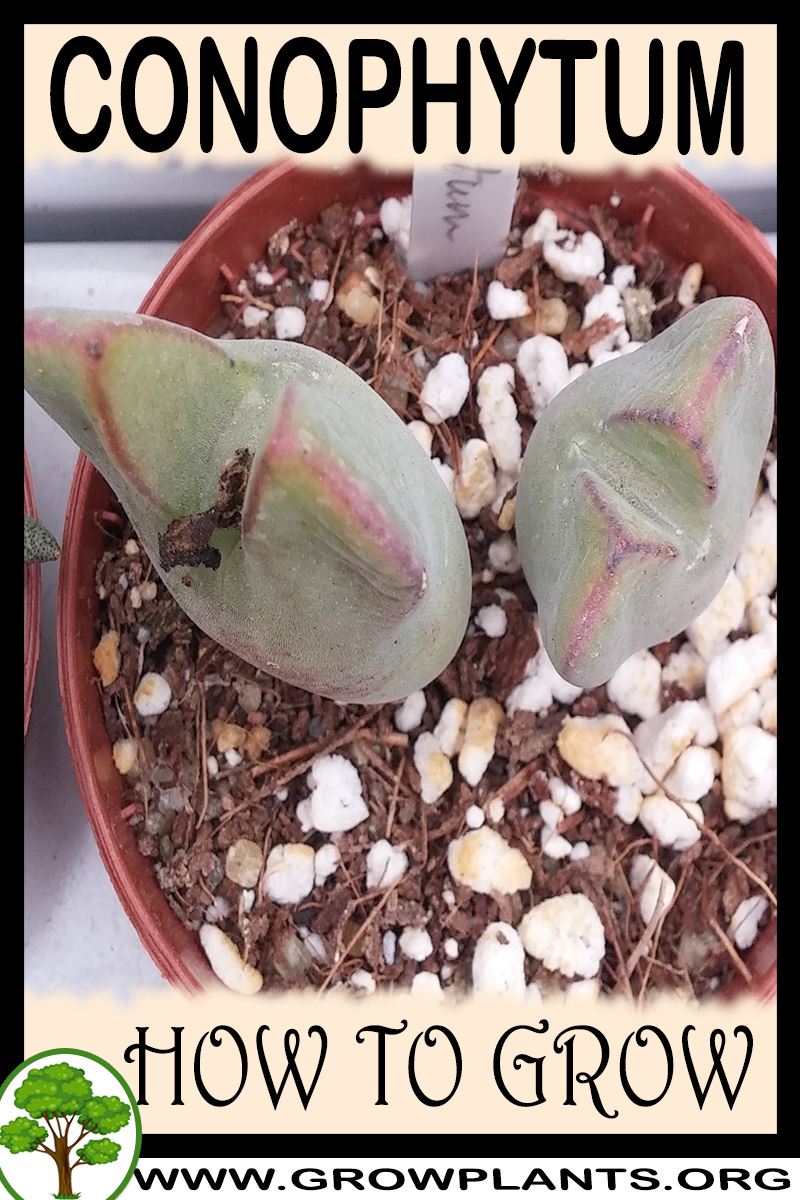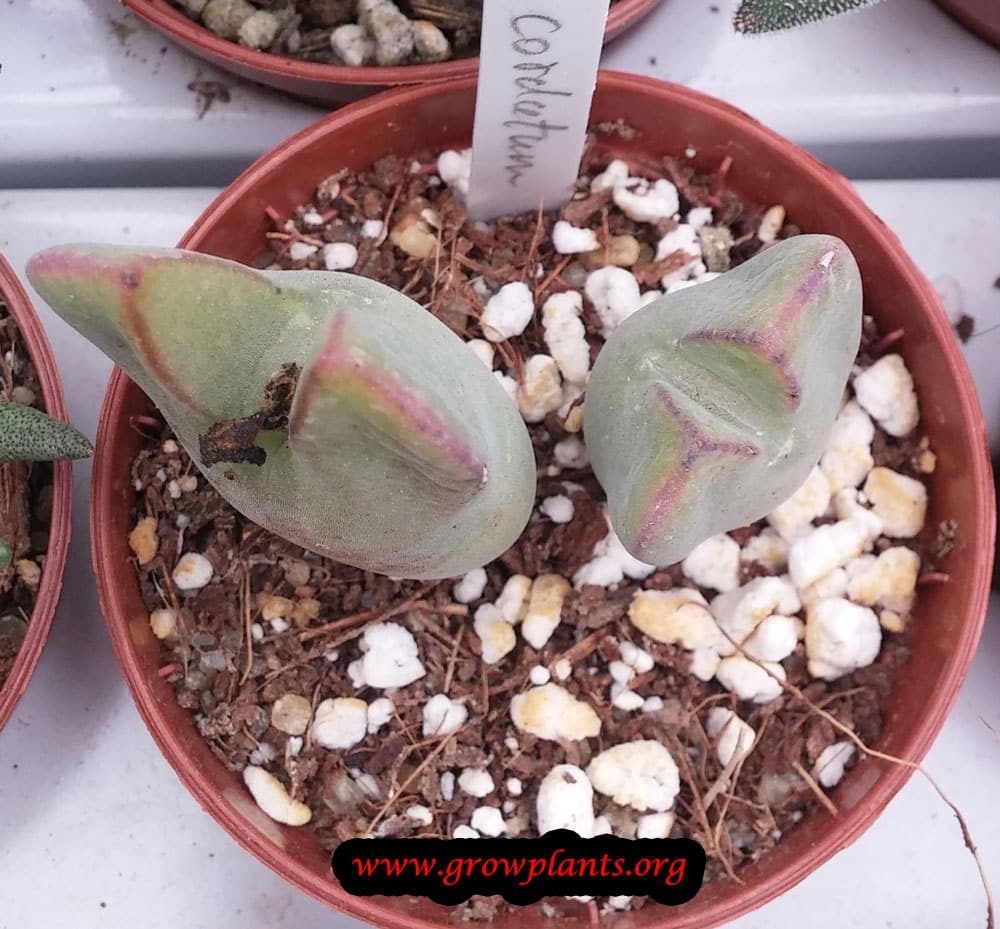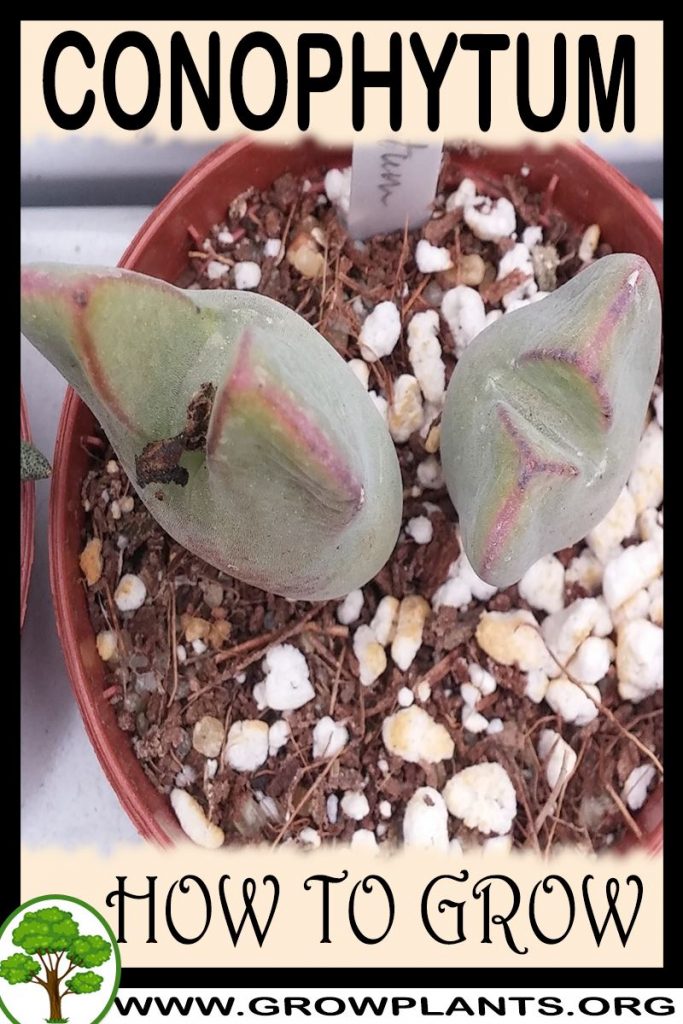
Plant Profile & Key Characteristics
Overview: Conophytum (split rock) is a dwarf leaf succulent just 3-7 cm (1-3 in) across, forming clumps of paired, stone-like bodies. It is an evergreen perennial grown as an ornamental groundcover, rockery plant or windowsill houseplant.
Quick Specifications
| Specification | Attribute |
|---|---|
| Plant Type / Life Cycle | Perennial |
| Foliage Type | Evergreen (succulent) |
| Mature Size | 3-7 cm (1-3 in) |
| Growth Rate | Slow |
| Root System | Fine, shallow fibrous roots |
| Toxicity | Non-toxic |
| Hardiness | USDA zones 10-12 |
Growth Form & Structure
- Height & Spread: A miniature succulent of 3-7 cm (1-3 in) that slowly clusters into low cushions; ideal for shallow pots and dish gardens.
- Growth Habit & Form: Clump-forming dwarf succulent made up of fused pairs of fleshy bodies, resembling small pebbles.
- Lifespan & Maturity: Slow-growing and long-lived, gradually building into a mounded colony over many years.
Anatomy & Physical Features
- Leaves & Foliage: Fleshy paired bodies, often green but ranging through red, white, blue, orange, brown, purple and pink, sometimes spotted; shaped like little cleft stones.
- Flower Characteristics: Daisy-like, many-rayed flowers in yellow, white, pink, orange or purple, one rising from each pair of leaves, mainly in autumn.
Primary Uses & Landscape Value
- Functional & Ornamental Roles: Ornamental groundcover and collector’s succulent for rock gardens, troughs, containers and bright windowsills.
Care Guide: Planting, Soil & Watering
Overview: A tiny split-rock succulent (mesemb) that demands gritty, sharply drained soil and very sparing water. It grows in the cooler season and rests dry through hot summer.
Quick Care Requirements
| Requirement | Ideal Condition |
|---|---|
| Planting Season | Year-round in frost-free conditions (zone 10-12); best during the cool-season growth period |
| Growth Rate | Slow |
| Soil Type | Gritty, very well-draining mineral succulent mix |
| Water Need | Low – highly water-sensitive; let the soil dry thoroughly |
Planting & Establishment
- Best Planting Season: Plant year-round in frost-free climates, ideally during its active growth in the cooler season.
- How to Plant:
- Hole Preparation: A shallow hole matching the small root system is all that is needed.
- Soil Amendments: Blend in coarse sand, pumice or grit; avoid rich, moisture-holding organic matter.
- Planting Depth: Set the plant bodies at soil level with the neck just above the mix, and do not bury them.
- Growth Speed & Expectations: Slow-growing, forming slowly expanding clumps over time.
Soil, Watering & Drainage Care
- Soil Mix & Drainage Needs: Extremely sharp drainage is essential; a mineral-based succulent mix in a pot with drainage holes prevents rot.
- Watering Schedule & Technique:
- Young / Newly Planted: Water very lightly, just to settle it in.
- Established: Water sparingly and only when the soil is fully dry – this species is highly sensitive to overwatering.
- Seasonal Adjustments: Keep nearly dry during its summer rest and increase only modestly during the cool growing season.
Climate, Light & Hardiness
Conophytum, the split-rock succulent, is adapted to Mediterranean, desert, and subtropical climates with hot, dry summers and cool, dry winters, and it also grows well as a houseplant with adequate light. It prefers half shade to full shade and is sensitive to combined cold and wet conditions.
Quick Climate Specifications
| Climate Zones | Mediterranean, desert, subtropics, or indoor as a houseplant |
| USDA Hardiness Zones | 10-12 |
| Light Conditions | Half Shade / Full Shade |
Sunlight & Light Exposure
Optimal Light Setup
Conophytum grows best in half shade to full shade with bright ambient light rather than intense direct sun.
Best Exposure / Orientation
A bright but lightly shaded spot, such as a rock garden crevice or an east-facing windowsill, suits its small, stone-like bodies well.
Temperature Extremes & Hardiness
USDA Hardiness & Regional Limits
Outdoor culture is reliable from about USDA zone 10 through 12; outside this range it should be grown as a houseplant.
Cold Damage & Winter Protection
The species is adapted to a seasonal rhythm of hot, dry summers and cool, dry winters - the key risk is cold combined with moisture rather than cold alone, since the plant is described as sensitive to water.
Frost Sensitivity
Given its zone 10-12 rating and sensitivity to water, this succulent should be kept both frost-protected and dry through any cool season it experiences.
Wind, Humidity & Microclimate
Dry-Air Tolerance
As a desert-adapted succulent, Conophytum tolerates dry air well and does not need extra humidity.
Rainfall & Seasonal Moisture
It is adapted to a dry-winter, dry-summer rhythm typical of its native semi-desert habitat, so climates or growing setups that keep it dry through its dormant cool season suit it best.
Microclimate Recommendations
Sharp drainage is essential; in wetter or more humid climates, grow it in a raised bed, rock garden, or gritty container to keep excess moisture away from the roots, particularly during cooler weather.
Growing in Pots, Balconies & Indoors
Conophytum (split rock) is a tiny, clustering ‘living stone’ succulent grown for its pebble-like paired leaves. It can be kept as a houseplant on a bright windowsill, but it is very sensitive to overwatering, so a shallow, sharply drained pot and a careful wet/dry rhythm are essential.
Quick Details
- Container Size: A small, shallow pan about 30% wider than the clump; these 3-7 cm (1-3 in) plants like a snug pot
- Indoor Suitability: A houseplant for a bright windowsill – it needs good light
- Best Spot: The brightest sill you have (bright light to light shade)
- Soil & Drainage: Very sharply drained, gritty mineral mix; strong drainage holes
- Watering in Pots: Very sparing – it is highly sensitive to overwatering; keep it nearly dry during dormancy
Indoors & On the Windowsill
- A windowsill houseplant: The grower confirms yes, with good light – a bright sill is essential or the little bodies stretch and distort.
- Water with great care: It is very sensitive to water; err on the dry side and follow its natural wet/dry dormancy cycle.
- Overwintering: Tender (hardiness zone 10-12), so keep it indoors on a bright sill in cold climates.
On a Balcony or Patio
- Bright, sheltered spot: In the warm season it enjoys a bright balcony or patio, in bright light to light shade.
- Heat & watering: Pots dry fast in reflected heat, but water only when the mix is dry, and above all keep the rain off – it rots easily if it sits wet.
- Bring it in: Move it back to a bright sill before cold nights.
Choosing the Pot, Soil & Long-Term Care
- Pot & drainage: Choose a pot only about 30% wider than the root ball – an oversized pot holds wet soil around the roots. Rather than starting big, pot up every few years as it fills out; the mix loses structure over time, though a sharp, sandy mix that never sits wet can go five years or more between changes. Use strong drainage holes and skip a standing water saucer to avoid root rot.
- Pot material: Terracotta breathes and dries fast, which suits these rot-prone succulents; glazed or plastic pots hold moisture longer, so water even more sparingly.
- Potting mix: A gritty, free-draining mix – sandy or cactus/succulent mix, or peat/coir with perlite, with coarse lava grit at the base. A ready-made cactus and succulent soil mix provides that structure without mixing it yourself.
- Feeding: Feed only lightly – a dilute low-strength feed once or so during active growth, as frequent watering leaches nutrients from pots faster than from open ground.
- Watch for rot: Overwatering is the one real danger – in a rainy spot stand the pot in lava grit so water drains straight through, and always let the mix dry before watering again.
Fertilizing & Feeding
A very light feeder: an occasional dilute, low-nitrogen feeding while the plant is in active growth is all it needs, and feeding is stopped during dormancy.
Quick Fertilizing Specs
| Feeding Level | Very light feeder |
|---|---|
| Main Nutrient Priority | A little nitrogen for slow, compact growth; avoid rich feeding |
| Best Feeding Period | During active growth only |
| Organic Options | A little compost or worm castings worked into a gritty, well-drained mix |
| Reduce/Stop Feeding | Stop feeding during dormancy and cool, low-light periods |
| Micronutrients | Usually adequate in a complete fertilizer; correct only a diagnosed deficiency |
| Soil pH | Slightly acidic to near neutral |
Feeding by Growth Stage
Active growth
Support steady, compact growth while the succulent is actively growing.
| Nutrient direction | A dilute, low-nitrogen complete fertilizer; succulents grow slowly and take very little feeding. |
|---|---|
| Timing | While the plant is in active growth. |
| Frequency | Occasional light feeding during active growth is plenty. |
| Fertilizer types | A dilute balanced or low-nitrogen complete fertilizer, A cactus and succulent fertilizer |
| Precautions | Feed sparingly; overfeeding forces soft, weak growth and can burn the roots. |
Dormancy / rest period
Let the plant rest without pushing growth during its dormant period.
| Nutrient direction | None – withhold fertilizer while the plant is dormant. |
|---|---|
| Timing | During the plant’s dormant rest period, and whenever growth stops. |
| Frequency | No feeding during dormancy; resume only when active growth returns. |
| Fertilizer types | No feeding at this stage; hold off fertilizing until active growth resumes. |
| Precautions | Do not fertilize a resting succulent; feeding now wastes nutrients and risks salt buildup and rot. |
Nutrient Deficiency Signs & Corrections
Soft, mushy or scorched growth, browning leaf tips, or sudden collapse after feeding.
| Possible causes | excess fertilizer and salt buildup in the root zone, overwatering combined with feeding, feeding while the plant is dormant |
|---|---|
| Appears first on | root zone and lower leaves |
| What to check | recent feeding and watering, drainage and container conditions, whether the plant is in active growth or dormant |
| Possible correction | Ease off feeding, flush the mix with water to leach accumulated salts, and feed only lightly during active growth. |
Older leaves fade to pale green and growth becomes weak and stunted.
| Possible causes | depleted nitrogen in an old, spent mix, never feeding over a long period, nutrients leached by frequent watering |
|---|---|
| Appears first on | older, lower leaves |
| What to check | age of the potting mix, feeding history, watering frequency and drainage |
| Possible correction | Refresh the mix or apply a dilute low-nitrogen complete fertilizer during active growth. |
New leaves yellow between the green veins while older leaves stay greener.
| Possible causes | iron or manganese made unavailable by an overly wet mix, high soil pH limiting micronutrient uptake, cold, soggy roots reducing uptake |
|---|---|
| Appears first on | newest leaves |
| What to check | drainage and how wet the mix stays, soil pH, root health |
| Possible correction | Improve drainage and correct pH; if it persists, apply a chelated iron or manganese product per its label. |
Pruning, Training & Seasonal Maintenance
Conophytum is a highly specialized dwarf succulent that grows as fused pairs of stone-like leaves rather than a conventional stem-and-leaf structure, only 3–7cm tall. It does not tolerate any structural or shaping pruning at all. Its one real pruning-adjacent task follows the plant’s own biology: each growth cycle, a new leaf-pair body forms inside the old one, which then dries into a thin papery sheath around the new growth. That sheath should be left in place until it is fully dry and loose — removing it too early, while any tissue is still moist, risks introducing rot into the new body. Beyond that, the only other task is removing spent flower stems after bloom.
Quick Pruning & Maintenance Specs
| Pruning Tolerance | Low |
| Primary Pruning Window | After the old leaf-pair sheath is fully dry, following the growth/molt cycle |
| Secondary Maintenance Window | Autumn, after flowering, for spent flower stems |
| Typical Frequency | Once per molt cycle, plus occasional flower-stem removal |
| Main Objective | Clear fully dried old-leaf sheaths and spent flower stems without disturbing new growth |
| Young Plant Priority | Do not disturb; young bodies should not be handled or cleaned |
| Mature Plant Priority | Remove only fully dry, loose old sheaths from around each head |
| Best Tool Type | Fingers where possible; precision snips only for flower stems |
| Avoid Heavy Pruning During | Not applicable — this plant is never heavily pruned |
Pruning by Plant Age & Size
Newly Established
Do not touch or clean; let a young plant complete its own growth cycle undisturbed.
Young / Formative
No training or shaping applies — there is no stem or canopy, only a low cluster of paired leaf-bodies.
Mature / Established
As the clump multiplies into more heads over the years, the only recurring task per head is clearing the fully dried old sheath after each molt and removing spent flower stems.
Seasonal Pruning Schedule
| Ongoing Sanitary | Objective: keep the clump clean without risking rot. Remove: only old-leaf sheaths that are completely dry and papery, and fully spent flower stems. Do not remove: any sheath tissue that is still soft, green, or damp, or a body that has not finished forming inside. Response: a tidy clump; premature removal instead risks introducing moisture and rot into the fresh new leaf-pair. |
Special Growth to Remove
Fully dried old-leaf sheaths (once completely papery, not before) and spent flower stems. There is no other special growth — no suckers, watersprouts, or runners on this plant.
Container & Small-Space Pruning
Always grown in shallow, well-drained containers; as a clump matures and heads multiply, division at repotting is the way to manage size, not cutting — individual heads should not be cut apart casually, since damaged tissue on a Conophytum body does not reliably regenerate.
Tools
Fingers are usually enough to gently lift away a fully dry sheath; use precision snips only for cutting a spent flower stem, and a grafting knife (sterile blade) only if dividing offsets for propagation.
Tool Hygiene & Disease Risk
Increased: this plant is described as sensitive to water, and any cut or wound on the fleshy body is a rot entry point in a genus with essentially no capacity to regenerate damaged tissue, so use a clean, sharp, disinfected blade for the rare cuts that are made (flower-stem removal, offset division), and avoid touching the body itself with a blade.
Cut Placement & Technique
When removing a spent flower stem, cut it at its base without nicking the leaf body beneath. Old sheaths should be peeled or lifted away by hand once fully dry, not cut.
Heavy Pruning & Rejuvenation
Not tolerated. A Conophytum body cannot be cut back and expected to regrow branches the way a shrub would; a damaged or rotting head should simply be removed to protect the rest of the clump, not “rejuvenated.”
Post-Pruning Care
Hold off watering for several days after removing any sheath or making a cut, to let the area dry and reduce rot risk — this lines up with the plant’s normal dry, low-water dormancy period around the molt.
Common Pruning Mistakes
Pulling off the old leaf sheath before it is fully dry, which can tear or expose the new body to moisture and rot; watering heavily right after a molt or after any cut; attempting to “tidy” a plant that is mid-molt.
When NOT to Prune
Never remove a sheath that is still even slightly soft or green, and never handle or clean the plant while a new body is still visibly forming inside the old one.
Recommended Tools (by task)
- precision_snips – for cutting a fully spent flower stem at its base
- grafting_knife – for a clean, sterile cut only if dividing offsets for propagation
Propagation Guide
Conophytum is most commonly raised from seed, which for species (non-hybrid) plants comes true and is the standard way collectors build up stock, though established clumps can also be increased by carefully separating individual rooted heads. Vegetative propagation isn’t required to keep the plant true; seed simply takes longer to reach a mature-looking clump. Because these are slow-growing, dormancy-driven plants, propagation by either method is a patient, moderate rather than quick process.
Quick Propagation Specs
| Best Propagation Method | Division of clustered heads |
| Alternative Methods | Seed |
| Propagation Difficulty | Moderate – slow growth and sensitivity to overwatering make both methods unforgiving of mistakes |
| Seed True-to-Type | Usually true-to-type |
| Vegetative True-to-Type | Yes |
| Best Propagation Season | Autumn, matching the plant’s active growth and flowering period rather than its summer rest |
Growing from Seed
Sowing Season
Autumn is most appropriate, aligning sowing with the plant’s natural growth cycle rather than its dormant summer rest.
Sowing Depth & Orientation
Sow the fine seed on the surface of a well-drained, gritty mix without burying it.
Germination Conditions
Keep the surface lightly and evenly moist without letting water pool on the plant bodies; avoid overwatering, since this genus is noted as sensitive to excess water.
Seedling Care
Seedlings are tiny and slow-growing; keep them lightly moist through their first growing season and allow the normal dry summer rest once they’re established enough to tolerate it.
Division, Offsets, Pups & Suckers
Conophytum plants naturally multiply into clusters of separate “heads” (each a fused pair of leaves over its own root) rather than producing conventional offsets. Once a cluster has several rooted heads, individual heads can be carefully separated, each with roots attached, and potted into well-drained soil; do this outside the summer dormancy period, and let any cut/separation surfaces dry briefly before potting to avoid rot.
Bloom & Flower Guide
Quick Details
- Bloom Season: Autumn
- Time to First Bloom: Once the plant reaches flowering size, usually after a couple of years
- Flower Appearance: A single many-petalled, daisy-like flower with fine needle-like petals from the split of each leaf-pair; colours yellow, white, pink, orange or purple
- Edibility: Ornamental only
Detailed Blooming Overview
Conophytum, the split rock, produces one small, many-petalled flower from the cleft of each fused leaf-pair, typically in autumn as the plant breaks its summer dormancy. The blooms – in yellow, white, pink, orange or purple – carry fine, needle-thin petals and can look surprisingly large for such a tiny plant. Many open in the afternoon or evening.
Flower Characteristics
- Daisy-like flowers with many fine, needle-like petals.
- One flower rises from the split of each leaf-pair.
- Colours yellow, white, pink, orange or purple.
Bloom Care & Thinning
- Encouraging bloom: Flowering follows the natural cycle – a dry summer rest, then a little water as cooler autumn weather arrives, cues the buds.
- Managing the bloom: Very little is needed; let spent flowers dry and remove them gently.
Bloom Health & Protection
- Mealybugs can tuck into the crevice between the leaf-pairs near the buds; a cotton bud dipped in neem oil or insecticidal soap removes them.
- In cool, damp spells gray mould (Botrytis) can spot the flowers – good airflow and removing faded blooms help prevent it.
Pests, Diseases & Troubleshooting
Overview: Conophytum are tiny, highly succulent “living stone” mesembs with a strict wet/dry seasonal rhythm, and their pests are the classic succulent trio – mealybugs (including hidden root mealybug), scale and spider mites. But the overwhelming cause of loss is cultural: overwatering and watering during dormancy, which rots these plants almost overnight. Match the natural cycle (water in the growing season, keep dry when resting) and they are nearly trouble-free.
Quick Troubleshooting Overview
| Issue / Pest | Main Symptom | Primary Solution |
|---|---|---|
| Overwatering / rot | Bodies turn mushy, translucent, collapse | Fast-draining mix, water only in growth, none in dormancy |
| Mealybugs (incl. root) | Cottony tufts between bodies and on roots | Alcohol swab, root wash, systemic for roots |
| Scale | Tiny waxy bumps on bodies | Scrape off, horticultural oil |
| Spider mites | Fine russeting/scarring on skin | Improve airflow, miticidal oil |
| Slugs / snails | Chewed notches on soft bodies | Hand-pick at night, iron-phosphate bait |
| Edema / splitting | Corky marks or split bodies from erratic water | Water evenly during growth only |
Common Pests & Management
- Mealybugs (Pseudococcus/Planococcus), incl. root mealybug (Rhizoecus spp.):
- Symptoms: White cottony specks nestled in the crevice between paired bodies and under old sheaths; the root form leaves white waxy dust on roots and pot walls, causing slow, unexplained shrivel and decline.
- Prevention & Control: Spot-treat foliar mealybugs with an alcohol-dipped brush; for root mealybug, unpot, wash all soil from the roots, discard the old mix, and repot into fresh gritty mix. A soil drench with a systemic is justified for stubborn root infestations because the pest is so hard to reach.
- Scale insects (armored scale):
- Symptoms: Tiny limpet-like brown or grey bumps stuck to the skin of the bodies; feeding causes pale spots and weakens small plants quickly.
- Prevention & Control: Scrape off gently with a soft brush or toothpick and dab with horticultural oil or dilute alcohol; check new acquisitions carefully before adding to a collection.
- Spider mites (Tetranychus spp.):
- Symptoms: Fine russeting, silvery scarring or a dull sheen on the epidermis, with faint webbing in hot, dry, stagnant air; the cosmetic scarring is permanent.
- Prevention & Control: Increase airflow and avoid baking, dusty conditions; rinse plants and apply a light miticidal horticultural oil or insecticidal soap, repeating to catch new hatchlings.
- Slugs, snails & sciarid (fungus gnat) larvae:
- Symptoms: Slugs and snails rasp notches out of the soft bodies overnight; fungus-gnat larvae in constantly damp mix nibble roots and signal that the soil is too wet.
- Prevention & Control: Hand-pick molluscs after dark and use iron-phosphate bait; for fungus gnats, let the mix dry out, top-dress with grit, and use sticky traps — dryness alone usually ends them.
- Aphids (on flowers & new growth):
- Symptoms: Small clusters on the flower buds and fresh bodies during the growing season, with sticky honeydew.
- Prevention & Control: Rinse off or wipe away, and use insecticidal soap sparingly; keep sprays off the bodies in strong sun to avoid marking.
Diseases & Fungal Issues
- Rot from overwatering (Pythium/Phytophthora/Fusarium) – the main killer:
- Symptoms: Bodies turn soft, translucent, yellow-brown and mushy, often collapsing from the base; it strikes fastest when plants are watered during dormancy, kept in a heavy mix, or left cold and wet.
- Treatment & Management: There is no real cure once rot is advanced — prevention is everything. Use a gritty, mostly mineral mix, water only during the active growing season and withhold water in dormancy, and give bright light with strong airflow. Remove any rotting body immediately and treat neighbors as suspect.
- Fungal leaf/body spot (Botrytis and others):
- Symptoms: Fuzzy grey mould or sunken dark spots on bodies kept too damp with poor air movement, especially in cool, humid winters.
- Treatment & Management: Improve ventilation, reduce humidity, avoid overhead watering, and remove affected bodies; a light dusting of sulfur helps in a persistently damp collection.
- Sooty mold (secondary):
- Symptoms: Black film where mealybug or aphid honeydew has settled on bodies.
- Treatment & Management: Control the honeydew-producing insects and wipe the film away; it is cosmetic and clears once pests are gone.
Growing Difficulties & Abiotic Problems
- Overwatering / dormancy watering (the killer)
- Cause & Symptoms: Watering while the plant is resting, or simply too often, causes the bodies to swell, split and rot — the number-one cause of death.
- Correction Strategy: Follow the seasonal rhythm: water during active growth, taper as new bodies form, and keep bone-dry through dormancy in a gritty mineral mix.
- Etiolation & loss of color
- Cause & Symptoms: In too little light, bodies stretch tall, pale and floppy and lose their compact, colorful form.
- Correction Strategy: Give bright light (with only slight shade from the fiercest midday sun) so bodies stay squat, firm and well-colored.
- Sunburn / scorch
- Cause & Symptoms: Bleached tan or white scorched patches when unacclimatized plants meet intense direct sun.
- Correction Strategy: Acclimatize gradually and provide light shade in peak summer heat; the marks are permanent, so prevent them.
- Edema & splitting
- Cause & Symptoms: Corky marks or a split skin when a dry plant is suddenly given a lot of water.
- Correction Strategy: Water evenly and moderately during growth only, so old bodies deflate naturally as new ones form.
What Helps – Products & Tools
Success here is about culture, not spraying: a gritty mineral mix, disciplined seasonal watering, bright light and airflow prevent the rot that kills most plants. For the succulent pest trio, use horticultural oil or insecticidal soap on scale and mealybugs, a systemic soil drench plus root washing for root mealybug, and iron-phosphate bait for slugs; a light sulfur dusting curbs damp-season mould. Follow the label and keep sprays off the bodies in strong sun.