Plant Profile & Key Characteristics
Overview: An evergreen, clump-forming terrestrial orchid reaching 0.5-1 m (20-40 in), with tall reed-like canes carrying pleated foliage. It is grown purely as an ornamental, prized for its large, fragrant, though short-lived flowers and for cutting.
Quick Specifications
| Specification | Attribute |
|---|---|
| Plant Type / Life Cycle | Herbaceous perennial (terrestrial reed-stem orchid) |
| Foliage Type | Evergreen |
| Mature Size | 0.5–1 m (20–40 in) |
| Growth Rate | Slow to moderate |
| Hardiness | USDA zones 10b–12 (subtropical, frost-free) |
Growth Form & Structure
- Height & Spread: Reaches 0.5–1 m (20–40 in) in the ground and grows equally well in a container, where the clump stays more compact; it also adapts to indoor culture in a bright spot.
- Growth Habit & Form: Upright, clump-forming orchid; slender bamboo-like canes rise from the base and multiply into a dense tuft.
- Lifespan & Maturity: A long-lived perennial that expands its clump year on year once established; individual canes flower at their tips.
Anatomy & Physical Features
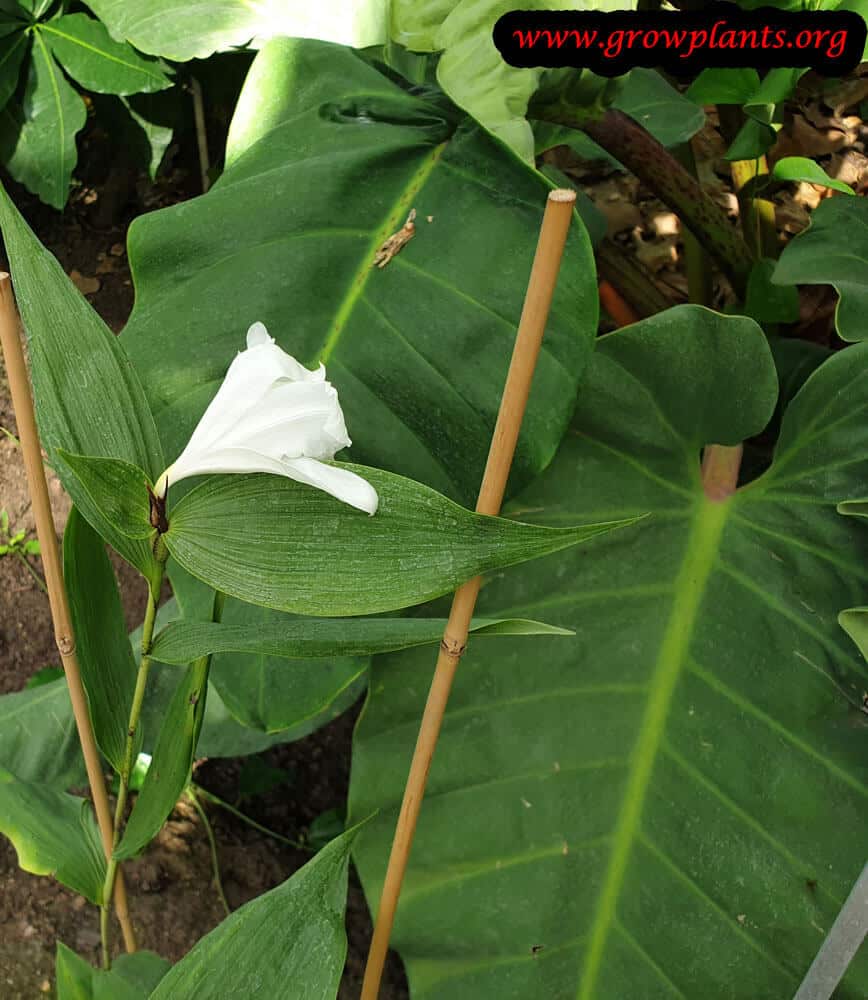
- Leaves & Foliage: Green, lance-shaped, pleated (plicate) leaves arranged alternately along the length of the cane-like stems.
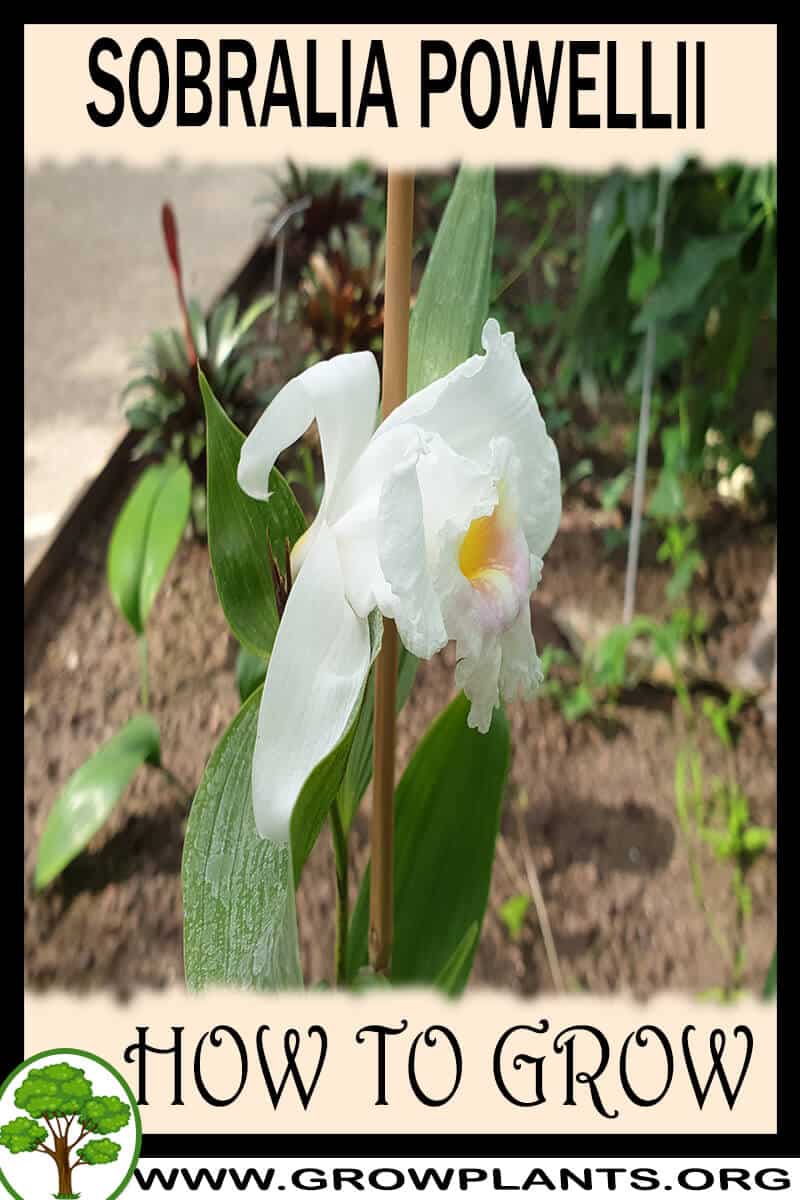
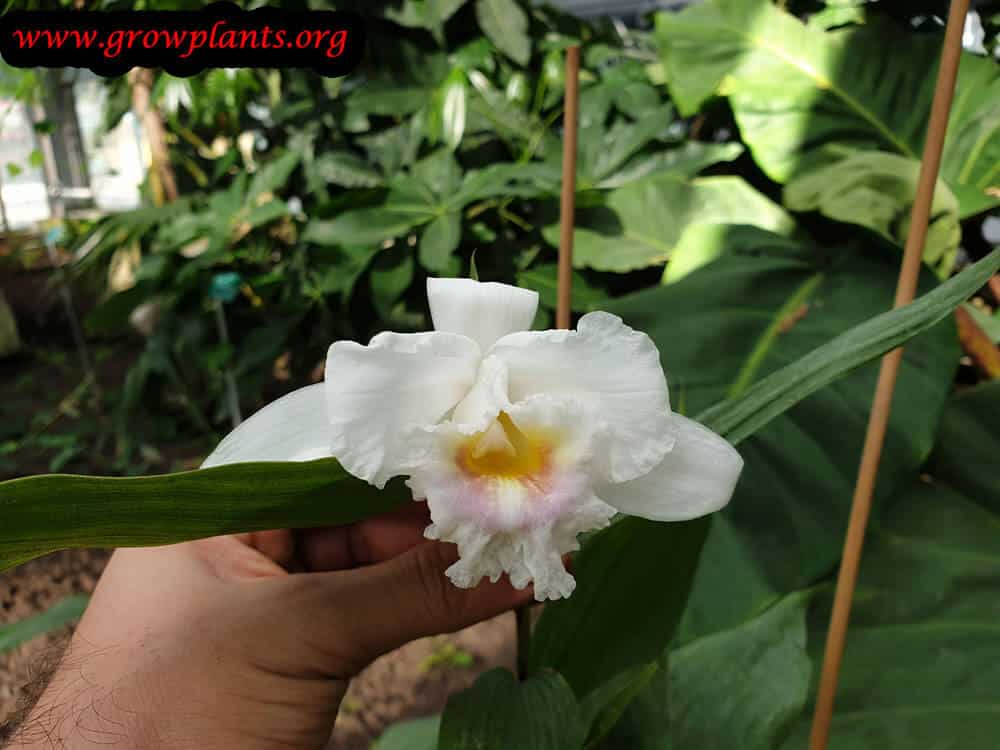
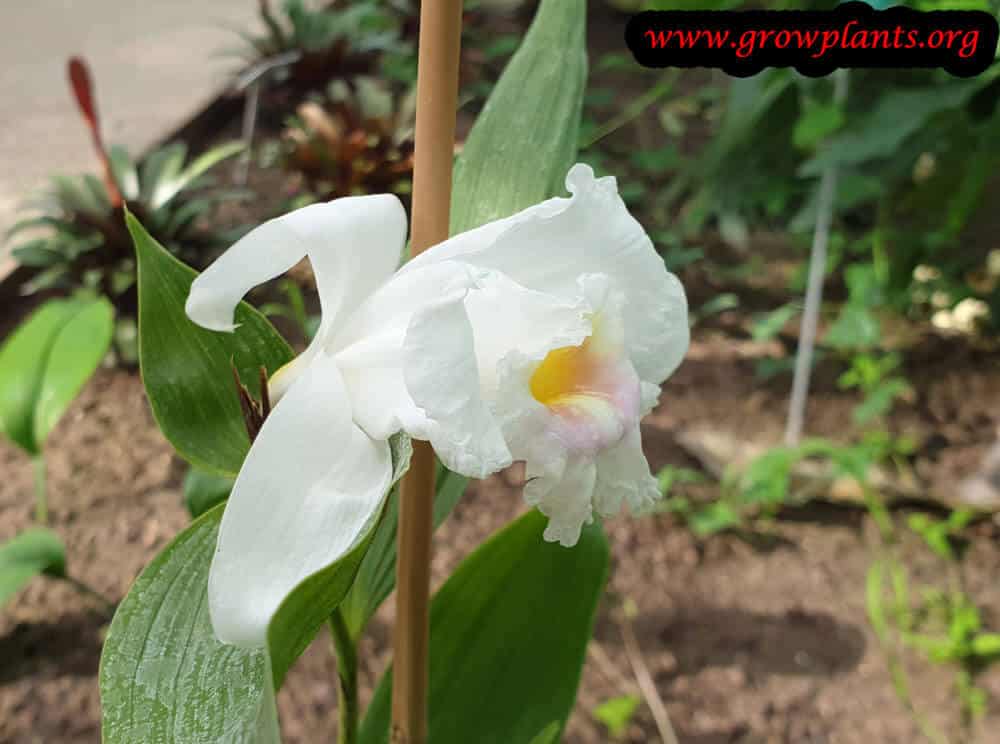
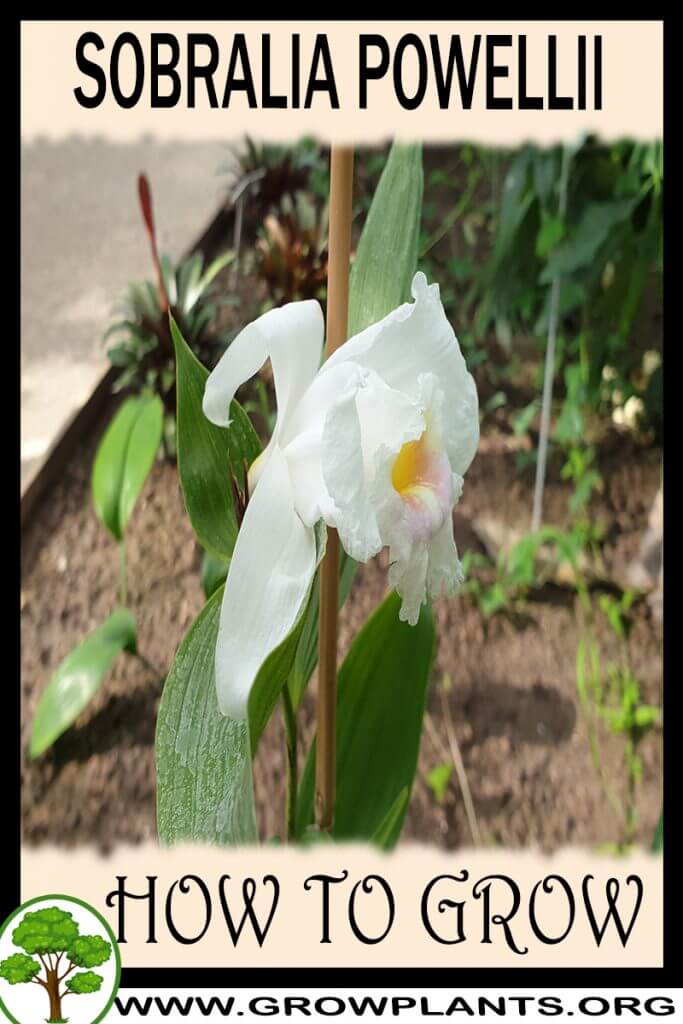
- Flower Characteristics: Fragrant white blooms of five spreading petals around a yellow-and-purple inner trumpet-shaped lip; each flower is short-lived.
Primary Uses & Landscape Value
- Functional & Ornamental Roles: A specimen and collector’s ornamental for warm, frost-free gardens, greenhouses and conservatories; suits large containers and indoor culture, and the fragrant blooms are used for cutting.
Care Guide: Planting, Soil & Watering
Overview: Sobralia powellii (Sob orchid) is a tropical orchid that grows best in bright, filtered light and warm, stable temperatures in a coarse, free-draining bark-based medium. It likes generous moisture and clean, soft water, but the open mix must drain fast so the roots get plenty of air.
Quick Care Requirements
| Requirement | Ideal Condition |
|---|---|
| Planting Season | In spring or summer during active growth |
| Growth Rate | Slow to moderate |
| Soil Type | Coarse orchid medium — bark, bark chips or cork; not ordinary soil |
| Water Need | High — keep evenly moist with clean, soft water while draining freely |
Planting & Establishment
- Best Planting Season: Repot or divide in spring or summer during active growth; it is suited to zones 10b–12 and warm, stable, subtropical conditions, and dislikes sudden temperature swings.
- How to Plant:
- Hole Preparation: Use a pot (ideally transparent) only just big enough for the roots, not oversized; a snug pot with an open medium suits it.
- Soil Amendments: Pot into a free-draining orchid medium of bark or bark chips with cork; adding some inert material such as Styrofoam pieces keeps air around the roots.
- Planting Depth: Settle the plant so the base of the growths sits at the surface of the medium, spreading the roots through the bark — do not bury the crown.
- Growth Speed & Expectations: Slow to moderate growth into a 50–100 cm cane orchid; refresh the medium before it breaks down and turns acidic, trimming any dead roots when you repot.
Soil, Watering & Drainage Care
- Soil Mix & Drainage Needs: Use an open, airy bark or cork medium in a pot that drains instantly; replace the medium once it starts to compost so the roots never sit in stale, acidic, soggy material.
- Watering Schedule & Technique:
- Young / Newly Planted: After potting, keep the medium evenly moist with clean, room-temperature water while new roots establish.
- Established: Water generously and regularly so the bark stays moist, always using clean, soft or rain water and letting it drain right through.
- Seasonal Adjustments: Water more in warm, active growth; ease back a little when temperatures cool, keeping conditions stable and avoiding cold, stagnant water at the roots.
Climate, Light & Hardiness
Sob orchid (Sobralia powellii) is a warm, subtropical-climate orchid that adapts to a wide range of light, from full sun to full shade, but has only modest cold tolerance and dislikes abrupt temperature swings.
Quick Climate Specifications
| Climate Zones | Subtropics |
|---|---|
| USDA Hardiness Zones | 10b–12 |
| Optimal Temp Range | Approximately 18–30°C (64–86°F) |
| Approx. Survival Minimum | Around 2°C (35°F) for brief periods |
| Frost Tolerance | Very Low |
| Light Conditions | Full Sun to Full Shade (adaptable) |
Sunlight & Light Exposure
Optimal Light Setup
Unusually adaptable for an orchid, this species performs across the full spectrum from full sun through half shade to full shade, making it forgiving of imperfect placement.
Shade & Heat Management
Tolerates full shade well, so it suits spots under tree canopy or indoors away from direct windows without a major growth penalty.
Temperature Extremes & Hardiness
USDA Hardiness & Regional Limits
Suited to hardiness zones 10b–12, reflecting a subtropical-to-tropical comfort range; outside these zones it is best grown as a container or indoor plant.
Cold Damage & Winter Protection
This orchid is notably sensitive to changing temperature, so gradual, stable conditions matter more than the absolute minimum - avoid placing it near doors, vents, or drafts where temperatures fluctuate quickly.
Frost Sensitivity
Has essentially no frost tolerance; established plants may briefly tolerate temperatures down to around 2°C (35°F), but any frost is likely to cause damage.
Extreme Heat Tolerance
Grows well into the low 30s°C (high 80s°F) range, but as with cold, sudden jumps are more stressful than the peak temperature itself.
Wind, Humidity & Microclimate
Humidity Preferences
Prefers consistently moist, humid air typical of subtropical growing conditions.
Microclimate Recommendations
Because of its sensitivity to temperature swings, container culture is an advantage - plants can be moved indoors or to a sheltered spot ahead of cold snaps or heat spikes rather than left to weather abrupt changes in place.
Growing in Pots, Balconies & Indoors
Sobralia powellii is a reed-stemmed terrestrial orchid that the grower confirms can be grown as a houseplant, and it also grows well in containers. Its bamboo-like canes and short-lived but repeated blooms make it a rewarding potted orchid.
Quick Details
- Container Size: A medium pot for the 50-100 cm clump of canes – it likes a snug root run
- Indoor Suitability: A genuine houseplant orchid – happy in bright, indirect indoor light
- Best Spot: Full sun to shade – very adaptable; bright, indirect light suits it well indoors
- Soil & Drainage: Open, free-draining orchid/terrestrial mix that holds some moisture
- Watering in Pots: Generous water in growth – it likes plenty of moisture but must drain freely
Indoors & On the Windowsill
- A houseplant orchid: The grower confirms it can be grown indoors. Give it bright, indirect light, warmth and steady moisture, in an open orchid-style mix that never stays sodden.
- Humidity: Like most orchids it appreciates humid air – a pebble tray or grouping with other plants helps.
On a Balcony or Patio
- Light & shelter: It adapts from sun to shade but does best in bright, sheltered, dappled light outdoors; it is tender and needs warmth.
- Practicalities: Pots dry faster in open air – keep the mix moist through active growth and bring it in before cold weather.
Choosing the Pot, Soil & Long-Term Care
- Pot & drainage: Use a pot with strong drainage holes and skip a standing-water saucer, which invites root rot. Terracotta breathes and dries faster, while glazed or plastic pots hold moisture longer. Orchids prefer to be a little pot-bound in an open mix.
- Potting mix: An open, free-draining terrestrial-orchid mix – bark and coarse organic matter with perlite.
- Feeding: Feed regularly but weakly through the growing season – ‘weakly, weekly’ suits orchids.
- Repotting: Repot into fresh mix as it outgrows the pot or the mix breaks down, dividing large clumps of canes.
Fertilizing & Feeding
A light feeder fed frequently but weakly: because this orchid is grown in a fast-draining bark or cork mix, nutrients wash through quickly, so dilute feeding on a regular basis suits it better than occasional heavy applications.
Quick Fertilizing Specs
| Feeding Level | Light feeder, fed on a frequent but dilute basis |
|---|---|
| Main Nutrient Priority | Balanced feeding, kept dilute, shifting toward potassium as flower spikes develop |
| Best Feeding Period | Through active growth leading up to and during bloom |
| Organic Options | Not typically applicable; this orchid is grown in bark, cork, or a similar inorganic mix rather than garden soil |
| Reduce/Stop Feeding | Ease off feeding when growth slows or the plant is under temperature stress, to which it is notably sensitive |
| Micronutrients | Usually supplied by a complete orchid fertilizer; correct only a diagnosed deficiency |
| Soil pH | Not applicable in a bark or cork growing medium; medium freshness matters more than a soil pH figure |
Feeding by Growth Stage
Active growth in bark or cork medium
Support new cane and leaf growth in a fast-draining growing medium that holds little residual nutrition.
| Nutrient direction | A dilute, balanced orchid fertilizer applied often works better here than a strong feeding applied rarely, since the bark medium holds little reserve nutrition. |
|---|---|
| Timing | Through the warm active growing season. |
| Frequency | Light, dilute feedings on a regular basis suit this plant better than infrequent heavy ones. |
| Fertilizer types | A balanced fertilizer formulated for orchids, diluted and applied via the container feeding approach, Fresh bark or cork medium, replaced periodically since it breaks down and turns acidic over time |
| Precautions | This species is notably sensitive to temperature swings; avoid feeding during any period of temperature stress, which compounds the shock. |
Bud development and fragrant bloom
Support the white, yellow, and purple trumpet-form flowers without forcing more cane growth at the expense of bloom.
| Nutrient direction | A dilute fertilizer with a potassium lean alongside balanced nutrition favors flower quality. |
|---|---|
| Timing | As flower spikes form and through the bloom period. |
| Frequency | Continue light, dilute feedings through bud development, easing off once flowers are fully open. |
| Fertilizer types | A dilute, potassium-leaning orchid fertilizer via the container feeding approach |
| Precautions | Avoid switching fertilizers or disturbing the roots while buds are forming; this orchid does not tolerate disruption well. |
Rest during slow growth or temperature stress
Protect the plant during vulnerable periods rather than push growth it cannot support.
| Nutrient direction | None – withhold fertilizer while growth is stalled or the plant is under temperature stress. |
|---|---|
| Timing | Whenever growth clearly slows or conditions turn unusually cold or hot for this temperature-sensitive orchid. |
| Frequency | No feeding at this stage. |
| Fertilizer types | No feeding at this stage; do not fertilize until conditions stabilize and active growth resumes. |
| Precautions | Do not fertilize during stress; feeding a stalled or stressed orchid mainly builds up salts in the medium and can worsen root damage. |
Nutrient Deficiency Signs & Corrections
Older leaves and canes turn pale yellow-green and new growth is thin and weak.
| Possible causes | depleted or broken-down bark medium no longer holding nutrients, long gap since the last feeding, root loss limiting nutrient uptake |
|---|---|
| Appears first on | older leaves and canes |
| What to check | condition and age of the bark or cork medium, recent feeding history, root health at repotting |
| Possible correction | Refresh the growing medium and resume dilute, regular balanced feeding. |
Interveinal yellowing shows on older leaves while the veins stay green.
| Possible causes | low magnesium in the fertilizer used, heavy leaching from a very fast-draining bark mix, imbalanced feeding favoring other nutrients |
|---|---|
| Appears first on | older leaves |
| What to check | fertilizer formulation used, how often the medium is flushed with water, medium age and drainage |
| Possible correction | Switch to a complete orchid fertilizer that includes magnesium and rebalance feeding. |
Root and cane tips blacken or die back, and leaf tips may brown, despite otherwise attentive care.
| Possible causes | fertilizer salt buildup in the bark medium from consistent feeding without flushing, infrequent leaching with plain water, an aging medium that no longer drains freely |
|---|---|
| Appears first on | root tips and cane bases |
| What to check | how often the medium is flushed with plain water between feedings, medium age and drainage, recent fertilizer strength and frequency |
| Possible correction | Flush the medium thoroughly with water, resume feeding at a lighter dilution, and refresh the medium if it is old or broken down. |
Pruning, Training & Seasonal Maintenance
Sob Orchid is a reed-caned terrestrial orchid whose “pruning” is really orchid-specific maintenance: removing individual spent flowers, and cutting entire canes only once they have fully finished flowering and died back or browned, since green canes may continue flowering in succession or keep contributing to the plant’s vigor.
Quick Pruning & Maintenance Specs
| Pruning Tolerance | Low (limited to dead material) |
| Primary Pruning Window | Any time a cane fully browns/dies (year-round) |
| Secondary Maintenance Window | During bloom – remove individual spent flowers |
| Typical Frequency | As needed, light |
| Main Objective | Remove spent flowers and fully dead canes, redirect energy to new basal growth |
| Young Plant Priority | None – let new canes establish undisturbed |
| Mature Plant Priority | Remove only fully brown/dead canes at the base |
| Best Tool Type | Precision snips with a sterile blade |
| Avoid Heavy Pruning During | Cutting any cane that still has green tissue or recent/active flowering |
Pruning by Plant Age & Size
Newly Established
No pruning – allow new canes to grow undisturbed.
Young / Formative
No structural training – this species has a reed-like, clump-forming growth habit rather than a trained form; simply allow new basal canes to develop.
Mature / Established
Remove fully dead, browned canes at the base once they’ve finished contributing, tidying the clump and redirecting energy into new growth.
Seasonal Pruning Schedule
Ongoing Sanitary
Objective: tidiness and redirect energy. Remove: individual spent flowers as they fade (many Sobralia flowers last only a day each, opening in succession over an extended bloom period), and fully dead/browned canes, cut at the base. Do not remove: any cane retaining green tissue. Response: energy redirected to new basal cane production. This species does not have a strict seasonal pruning window tied to a single dormant period.
Structural Pruning & Training
None – no formal training system. Simply thin fully dead canes from the base of the clump periodically to maintain airflow and a tidy appearance.
Special Growth to Remove
- Individual spent flowers
- Fully dead/browned canes only – leave green canes even after they’ve flowered, since they may rebloom or continue supporting the plant
Container & Small-Space Pruning
Typically grown in pots; when repotting or changing media, trim only fully dead roots, not living roots or canes.
Tools
- Precision snips (sterile) – flower and dead-cane removal
Tool Hygiene & Disease Risk
High-risk – orchids are commonly susceptible to virus transmission (such as Cymbidium mosaic or Odontoglossum ringspot-type viruses) via cutting tools moved between plants. Sterilize the blade between cuts and especially between different orchid specimens.
Cut Placement & Technique
Remove spent flowers with a clean snip at the base of the individual flower stalk; cut fully dead canes at the base, at soil/media level.
Heavy Pruning & Rejuvenation
Not applicable/not tolerated – this orchid is not rejuvenated by hard pruning. Overcrowded clumps are better managed by dividing the cane clusters at repotting rather than cutting back live growth.
Post-Pruning Care
Avoid disturbing the root zone right after cutting. This species is noted as very sensitive to temperature change, so keep conditions stable after any maintenance cut and maintain consistent moisture and humidity.
Common Pruning Mistakes
- Cutting back green, still-viable canes as if they were spent, when they may flower again
- Using unsterilized tools between orchid plants, risking virus spread
- Disturbing the sensitive root system unnecessarily during cane removal
When NOT to Prune
Avoid cutting any cane with green tissue remaining. Avoid pruning or repotting during periods of temperature instability, given this species’ noted sensitivity.
Recommended Tools (by task)
- Precision snips – deadheading individual flowers and removing fully dead canes
- Blade disinfectant – sterilizing between cuts and between plants to prevent virus transmission
Propagation Guide
Division of the clump into rooted canes is by far the most practical way to propagate Sobralia powellii, consistent with the site’s own note that vegetative reproduction is necessary because sowing is very hard. Orchid seed of this kind is dust-like and, like most orchids, typically needs specialist sterile (asymbiotic) flask sowing or a compatible mycorrhizal fungus to germinate at all, so it is a specialist-only method rather than a realistic home option. Overall this orchid is moderately easy to propagate by division, but difficult to specialist by seed.
Quick Propagation Specs
| Best Propagation Method | Division of the cane clump |
| Alternative Methods | Seed (specialist, lab-level technique only) |
| Propagation Difficulty | Moderate (by division); Specialist (by seed) |
| Seed True-to-Type | Usually true-to-type (species orchid), but germination itself is the limiting factor |
| Vegetative True-to-Type | Yes |
| Best Propagation Season | Spring to summer, matching the plant’s own planting season |
Growing from Seed
Orchid seed such as this is extremely fine and lacks the food reserves most seeds have, so in practice it needs sterile, nutrient-rich flask (asymbiotic) sowing, or germination alongside a compatible symbiotic fungus, to succeed at all – matching the site’s own statement that sowing is very hard. This is essentially a laboratory/specialist technique rather than something practical for typical home growing, so it is not recommended as a general propagation route for this plant.
Division, Offsets, Pups & Suckers
Divide an established clump when it has several mature canes, cutting or pulling apart sections so that each division retains a healthy cluster of canes with roots attached – single canes without roots are unlikely to establish reliably. Pot divisions into a well-aerated orchid medium such as bark or cork chips, trimming away any dead roots as the site’s own care notes describe for repotting. Because this orchid is noted as very sensitive to temperature changes, keep new divisions in stable, moderate conditions while they re-establish rather than exposing them to fluctuating temperatures.
Bloom & Flower Guide
Quick Details
- Bloom Season: Spring into summer
- Flower Appearance: White flowers with a yellow-and-purple trumpet lip; five petals around an inner trumpet
- Edibility: Ornamental – a fragrant cut-flower orchid
Detailed Blooming Overview
Sobralia powellii is a reed-stemmed orchid grown as a fragrant ornamental and cut flower. Its showy blooms carry five white segments around a central trumpet-shaped lip marked in yellow and purple. As with other Sobralia orchids, the individual flowers are short-lived, but the plant opens them in succession over the season.
Flower Characteristics
- Five white petals framing an inner trumpet-shaped lip.
- The trumpet is coloured yellow and purple at its throat.
- Fragrant, and borne at the tips of the tall canes.
Bloom Care & Thinning
- Enjoying the blooms: Each flower lasts only a short time, so watch for the buds – new flowers follow on in succession.
- Cutting: Well suited as a fragrant cut flower; take stems as the blooms open.
Pests, Diseases & Troubleshooting
Overview: Sobralia powellii is a reed-stemmed orchid that is far more prone to cultural rot and sap-sucking insects than to true infestations. Its greatest vulnerabilities are soft-bodied pests that hide in the leaf axils and new growth, plus fungal and bacterial rots when the crown or roots stay wet in poor air movement. Manage it culturally first – sharp drainage, bright airy conditions and clean tools – and reserve sprays for confirmed problems.
Quick Troubleshooting Overview
| Issue / Pest | Main Symptom | Primary Solution |
|---|---|---|
| Scale & mealybugs | White cottony fluff or brown limpets in leaf axils; sticky honeydew and sooty mould | Wipe off, isolate, treat with horticultural oil |
| Spider mites | Fine stippling and silvery webbing on undersides in dry air | Raise humidity, rinse foliage, apply oil/soap |
| Aphids & thrips | Distorted new growth; silvery streaks and deformed buds | Rinse, use blue sticky traps, spot-spray |
| Snails & slugs | Chewed new shoots, roots and flower spikes at night | Hand-pick, iron-phosphate bait, barriers |
| Black & crown rot | Blackened water-soaked base collapsing rapidly | Cut into clean tissue, dry out, improve airflow |
| Root rot | Mushy dark roots, yellow lower canes, stalled growth | Repot into open mix, reduce watering |
Common Pests & Management
- Scale insects (Coccidae / Diaspididae):
- Symptoms: Brown, tan or white limpet-like bumps clinging to canes, leaf sheaths and undersides; sticky honeydew and black sooty mould follow. Easily mistaken for natural leaf markings until scraped.
- Prevention & Control: Inspect new plants and quarantine them. Wipe individual scales off with a cloth or alcohol-dipped swab, then coat with horticultural or neem oil, repeating every 1–2 weeks to catch crawlers. Good airflow and avoiding over-feeding keep populations low.
- Mealybugs (Pseudococcus spp.):
- Symptoms: White cottony masses tucked into leaf axils, sheaths and among roots; honeydew and stunted, distorted new canes.
- Prevention & Control: Dab colonies with an alcohol swab, rinse the plant, and follow with insecticidal soap or oil. Check the root zone at repotting, as root mealybugs hide in the medium.
- Spider mites (Tetranychus urticae):
- Symptoms: Fine pale stippling on leaf uppersides, a dull bronzed cast, and fine webbing on undersides in hot, dry, still air.
- Prevention & Control: Raise humidity and improve airflow, rinse foliage undersides regularly, and treat persistent cases with insecticidal soap or horticultural oil. Predatory mites work well in a collection.
- Aphids (Aphidoidea):
- Symptoms: Clusters of soft green or black insects on emerging shoots and flower spikes, causing curl and honeydew; they also spread orchid viruses.
- Prevention & Control: Knock them off with a firm water spray, encourage ladybirds and lacewings, and spot-treat with insecticidal soap.
- Thrips (Thysanoptera):
- Symptoms: Silvery streaking and pale flecking on leaves and petals, deformed buds, and black specks of frass.
- Prevention & Control: Hang blue sticky traps to monitor, remove spent flowers promptly, and use insecticidal soap or spinosad-type sprays for confirmed outbreaks.
- Snails & slugs (Gastropoda):
- Symptoms: Ragged holes in soft new growth, grazed root tips and chewed flower spikes, with slime trails; damage appears overnight.
- Prevention & Control: Hunt at night, keep the growing area free of debris, use copper barriers around pots, and scatter iron-phosphate bait where needed.
Diseases & Fungal Issues
- Bacterial black rot (Erwinia / Pectobacterium spp.):
- Symptoms: Fast-spreading, water-soaked black patches on leaves and canes that turn slimy and foul-smelling, often destroying the crown within days.
- Treatment & Management: Cut well back into clean green tissue with a sterile blade, keep foliage dry, boost air movement, and reduce overhead watering. A copper-based bactericide can help protect neighbouring plants.
- Botrytis / grey mould (Botrytis cinerea):
- Symptoms: Small brown or black spots on petals in cool, damp, still air, sometimes with grey fuzz on decaying tissue.
- Treatment & Management: Remove affected flowers, improve ventilation, avoid wetting blooms, and reduce humidity at night.
- Fungal leaf spots & anthracnose (Colletotrichum, Cercospora):
- Symptoms: Yellow-ringed brown or black spots that may merge, often beginning at leaf tips.
- Treatment & Management: Trim off affected areas, keep leaves dry, space plants for airflow, and apply a copper or broad-spectrum fungicide if spread continues.
- Orchid viruses (Cymbidium mosaic & Odontoglossum ringspot):
- Symptoms: Mottling, chlorotic streaks, ringspots or colour breaks that never resolve; growth weakens over time.
- Treatment & Management: No cure – isolate and usually destroy confirmed plants, sterilise cutting tools between every plant, and control sap-sucking insects that spread virus.
Growing Difficulties & Abiotic Problems
- Root & crown rot from overwatering:
- Cause & Symptoms: A dense, stale or waterlogged medium suffocates roots – they turn brown and mushy, lower canes yellow, and growth stalls.
- Correction Strategy: Repot into a fresh, open, free-draining orchid mix, water only as the medium approaches dryness, and never let the crown sit wet.
- Leaf-tip browning & bud blast:
- Cause & Symptoms: Low humidity, salt build-up or sudden changes cause brown crispy tips and buds that shrivel before opening.
- Correction Strategy: Raise humidity, flush the medium periodically with clean water to leach salts, and keep conditions stable while in bud.
- Sunburn:
- Cause & Symptoms: Bleached white or brown scorched patches on leaves exposed to harsh direct sun.
- Correction Strategy: Provide bright but filtered light and acclimatise gradually to stronger conditions.
What Helps – Products & Tools
For Sobralia powellii the useful toolkit is gentle and cultural: horticultural/neem oil and insecticidal soap for scale, mealybugs, mites and aphids; isopropyl alcohol swabs for spot removal; blue sticky traps for thrips monitoring; iron-phosphate slug bait and copper barriers; a copper bactericide/fungicide for rots and leaf spots; plus sterile blades and a fast-draining orchid mix as the foundation of good health. Treat exactly as other Sobralia; watch leaf axils on the tall canes for scale and mealybugs.