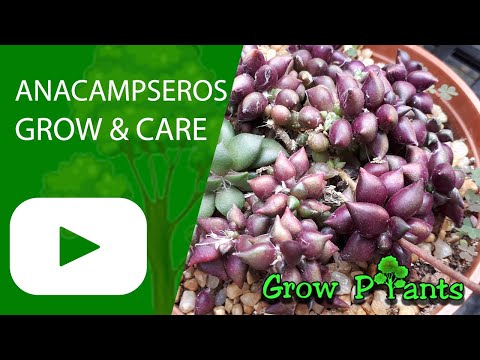

Plant Profile & Key Characteristics
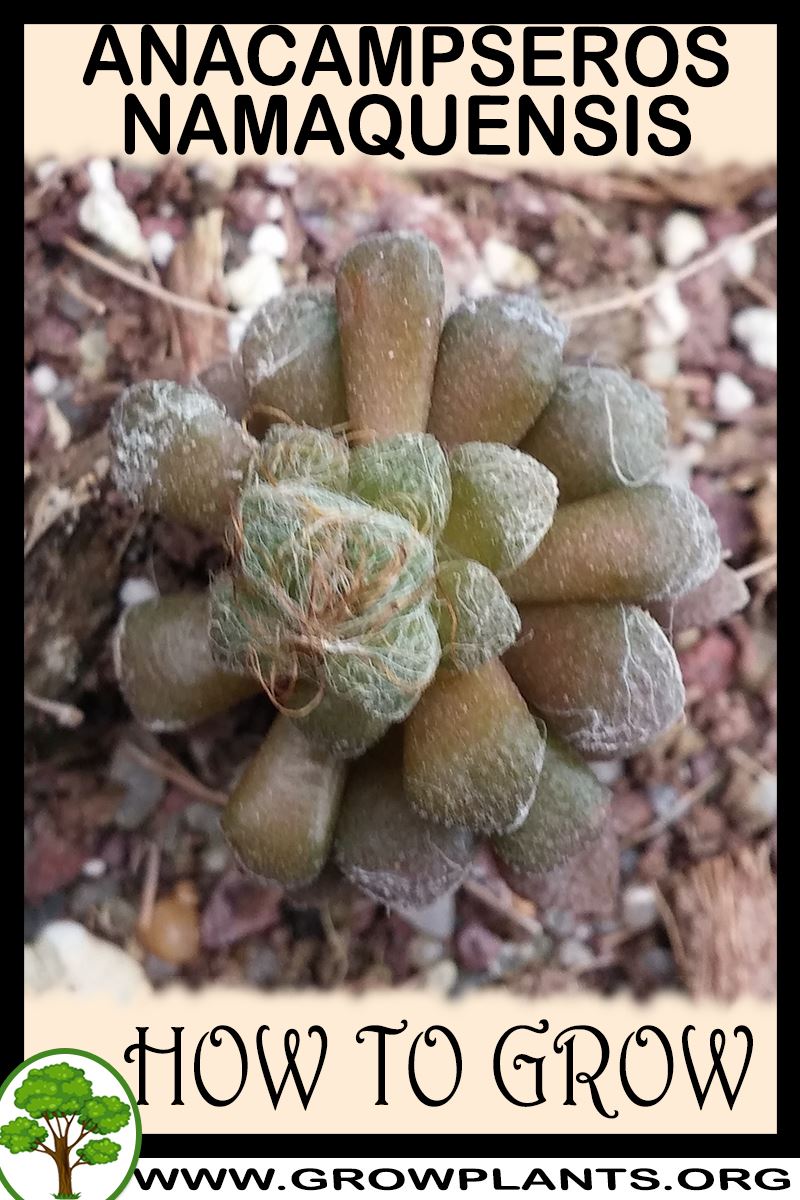
Overview: Anacampseros namaquensis is a small, slow-growing evergreen succulent subshrub, only 5-20 cm (2-8 in) tall. It is grown as a drought-tolerant ornamental and houseplant.
Quick Specifications
| Specification | Attribute |
|---|---|
| Plant Type / Life Cycle | Perennial (succulent subshrub) |
| Foliage Type | Evergreen |
| Mature Size | 5-20 cm (2-8 in) tall |
| Growth Rate | Slow |
| Toxicity | Toxic (source notes the plant is poisonous) |
| Hardiness | USDA zone 10b-12 |
Growth Form & Structure
- Height & Spread: 5-20 cm (2-8 in) tall in the ground; well suited to small pots 15-30% larger than the root ball
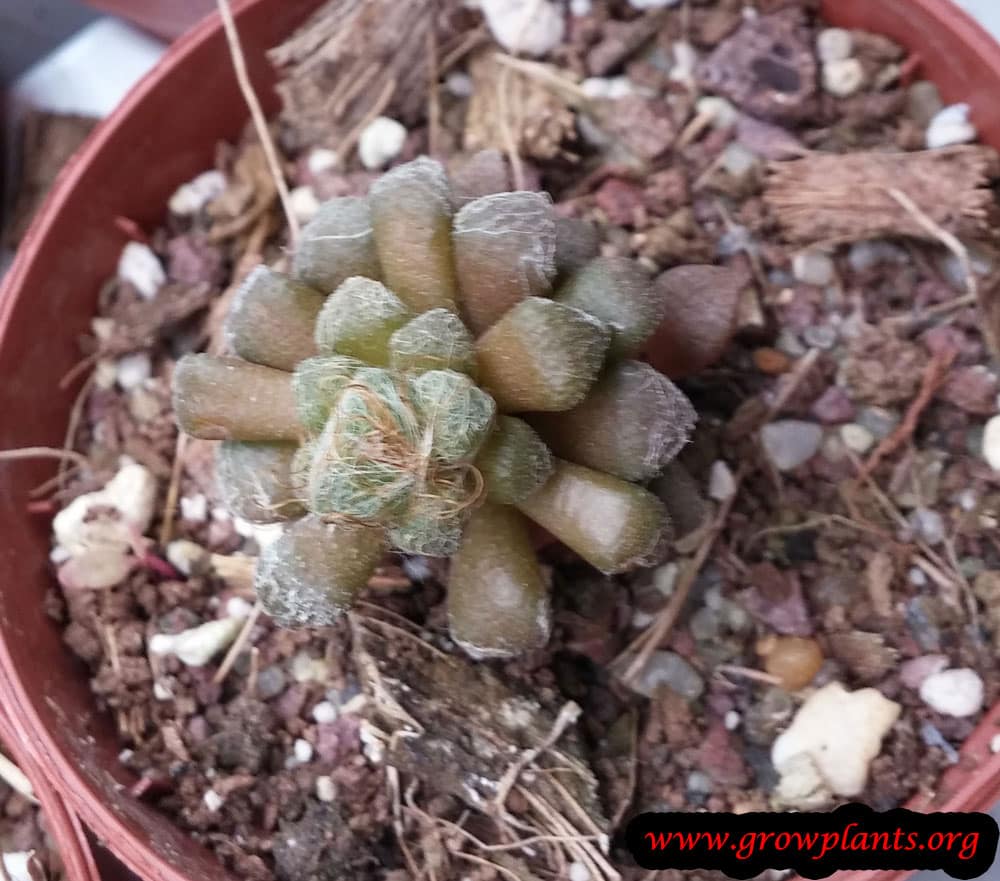
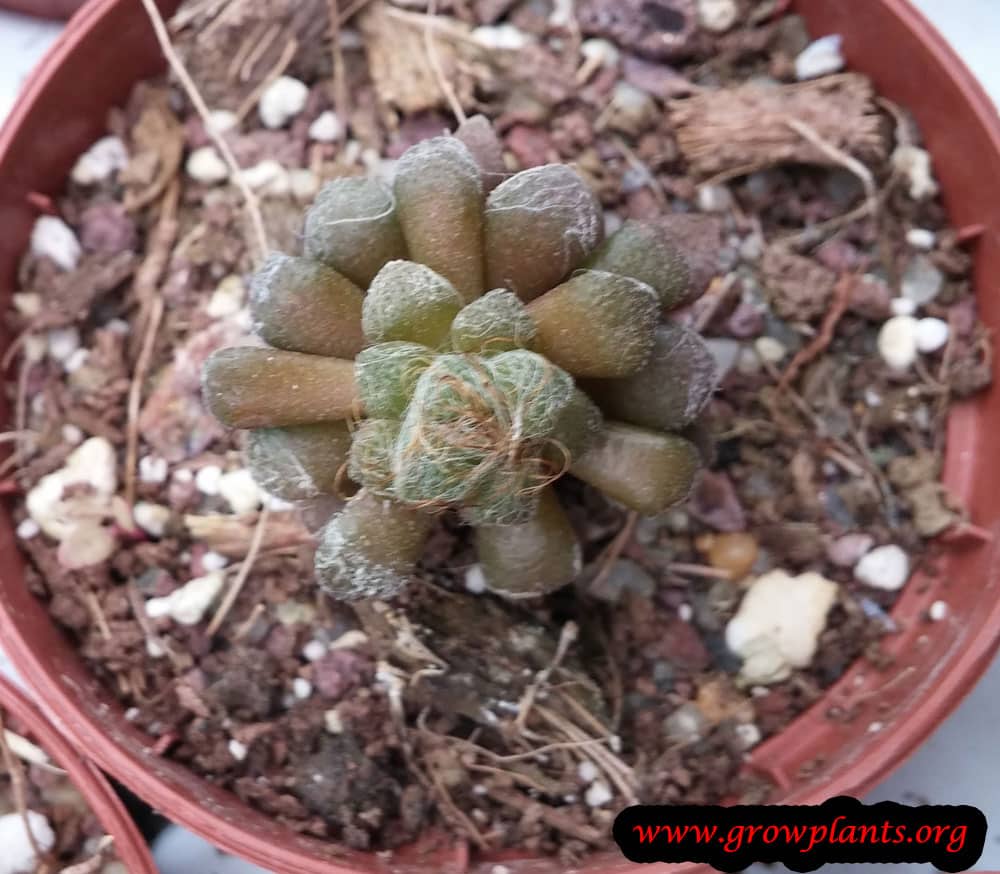
- Growth Habit & Form: Low, clustering succulent subshrub with hairy leaves
- Lifespan & Maturity: Slow-growing perennial that remains compact for years
Anatomy & Physical Features
- Leaves & Foliage: Fleshy, wedge-shaped leaves in green, or red with green, covered in fine hairs
- Flower Characteristics: Purple flowers with five petals and yellow stamens borne on the stems (see the Bloom guide)
Primary Uses & Landscape Value
- Functional & Ornamental Roles: Drought-tolerant ornamental succulent for rock gardens, dishes and as a houseplant
Care Guide: Planting, Soil & Watering
Overview: Anacampseros namaquensis is a small, slow-growing succulent subshrub that thrives in bright, warm, frost-free conditions (hardiness zone 10b-12) or as a houseplant. It needs gritty, sharply-draining soil and very little water, as overwatering is the quickest way to kill it.
Quick Care Requirements
| Requirement | Ideal Condition |
|---|---|
| Planting Season | Spring to autumn in warm zones, and year-round in the warmest frost-free areas |
| Growth Rate | Slow |
| Soil Type | Gritty, sharply-draining succulent or sandy soil |
| Water Need | Low – let the soil dry out fully between waterings |
Planting & Establishment
- Best Planting Season: Plant in the warm growing season, spring to autumn where it is frost-free (year-round in the very mildest zones).
- How to Plant:
- Hole Preparation: Plant into a snug hole in gritty, free-draining soil; if potting, choose a container only 15-30% larger than the root ball.
- Soil Amendments: Use a sandy or cactus-type mix, adding lava grit or similar to keep it open and fast-draining.
- Planting Depth: Set the plant at its original soil level, keeping the base of the stem and leaves clear of damp soil.
- Growth Speed & Expectations: A very slow grower that stays small – usually well under 20 cm – so it is easily kept in a small pot for years.
Soil, Watering & Drainage Care
- Soil Mix & Drainage Needs: Drainage is everything: a sandy or cactus mix, ideally with grit, so water runs straight through. Never leave the pot standing in a saucer of water.
- Watering Schedule & Technique:
- Young / Newly Planted: Water sparingly, keeping the soil only lightly moist while cuttings or young plants root.
- Established: Water lightly and let the soil dry out fully between waterings, as overwatering rots the roots. Indoors it needs even less, since the soil dries more slowly.
- Seasonal Adjustments: Water a little more in the warm growing season and keep it nearly dry in cool weather.
Climate, Light & Hardiness
Anacampseros namaquensis is a small, slow-growing succulent suited to warm, frost-free to nearly frost-free climates - Mediterranean and subtropical regions, or as a houseplant - and like the rest of its genus it prefers half shade to full shade rather than intense full sun. It is generally reliable outdoors in about USDA zone 10b–12.
Quick Climate Specifications
| Climate Zones | Mediterranean and subtropical; also widely grown as a houseplant |
|---|---|
| USDA Hardiness Zones | Typically zone 10b–12 |
| Optimal Temp Range | Warm, frost-free conditions above about 7°C (44.6°F) |
| Approx. Survival Minimum | Can briefly survive light frost, but this is stressful and best avoided |
| Frost Tolerance | Very Low |
| Light Conditions | Half Shade (morning sun in desert climates) to Full Shade with bright light |
| Wind Tolerance | Low |
Sunlight & Light Exposure
Optimal Light Setup
Prefers half shade to full shade rather than intense full sun; in desert climates, morning sun with afternoon shade works well for its hairy, wedge-shaped leaves.
Direct Sun Requirement
Direct midday sun is not required and can be harsh; bright, indirect or filtered light is generally preferred.
Shade & Heat Management
In hot climates, provide afternoon shade to protect the foliage from stress and keep the plant from overheating.
Best Exposure / Orientation
An east-facing position with morning sun and afternoon shade, or a bright but shaded spot, suits this species well.
Temperature Extremes & Hardiness
USDA Hardiness & Regional Limits
Reliable outdoors year-round in roughly USDA zone 10b–12; below about 7°C (44.6°F) the plant is stressed, and while it can briefly survive light frost, this is not recommended for its long-term health. In cooler climates it is best grown as a houseplant or given winter shelter.
Cold Damage & Winter Protection
Keep above roughly 7°C (44.6°F) where possible; in marginal climates, grow in a container that can be brought indoors or under cover before cold weather arrives.
Frost Sensitivity
Very frost-sensitive; light frost may be survived but is best avoided altogether.
Extreme Heat Tolerance
Tolerates warm climates well provided it is given some shade protection from the most intense sun and heat.
Wind, Humidity & Microclimate
Humidity Preferences
Adapts to a range of humidity levels, including typical indoor conditions.
Dry-Air Tolerance
Tolerates dry indoor air reasonably well, though heaters and air conditioning that dry the air significantly warrant closer attention to watering.
Wind Tolerance
As a low, small subshrub, it has limited wind tolerance and benefits from a sheltered position.
Rainfall & Seasonal Moisture
Prefers climates or care regimes without prolonged wet spells; it is easily overwatered and does best where the soil can dry between waterings.
Microclimate Recommendations
A sheltered, partly shaded spot with fast-draining soil suits it best; container growing gives the most control over cold and light outside of naturally warm climates.
Growing in Pots, Balconies & Indoors
Anacampseros namaquensis is a tiny, slow-growing succulent, only about 5-20 cm (2-8 inches) tall. That small size makes it a lovely little houseplant and a natural for small pots – grown on a bright windowsill or a sheltered balcony, it asks for very little.
Quick Details
- Container Size: A small pot only 15-30% bigger than the root ball; move up a size once it fills the pot
- Indoor Suitability: Yes – a good little indoor succulent; give it the brightest spot and go easy on water
- Best Spot: Bright light with some shade – gentle morning sun and light shade suit it; harsh all-day desert sun can be too much
- Soil & Drainage: Free-draining – a sandy mix or a succulent/potting mix with grit; sandy gives the best long-term result
- Watering in Pots: Small amounts, letting it dry between waterings – overwatering will kill it; don’t leave water standing in a saucer
Indoors & On the Windowsill
- A genuine houseplant: The grower confirms it grows well indoors. Because a room has fewer drying influences than the open garden, water even less than you would outside.
- Dry indoor air: Watch it near a fan, air conditioner or heater – these dry the air, so keep an eye on the little plant and don’t let it shrivel.
- Windowsill: A bright sill with morning sun is ideal; its tiny size means it never outgrows the spot.
On a Balcony or Patio
- Light & shelter: Bright light with a little shade suits it – gentle morning sun, with protection from scorching afternoon sun and heavy rain. Small pots dry fast against warm walls, so check them.
- Practicalities: Being tiny, it is easy to move – bring it under cover in cold or very wet spells.
Choosing the Pot, Soil & Long-Term Care
- Pot & drainage: A small container 15-30% bigger than the root ball with good drainage holes; step up a size when the plant fills it. Skip a saucer, or empty any run-off so the base isn’t left wet.
- Potting mix: Good drainage is essential – a sandy mix or a succulent/potting mix. Lava grit works but breaks down and should be refreshed after a few years; ordinary potting mix also loses structure over time.
- Feeding: Feed lightly – just a small amount of fertilizer, since a lean sandy mix holds few nutrients.
- Repotting: Pot up when it fills the container and refresh the mix every couple of years.
Grower’s Container Tip
- Sandy mix for the long run: The grower finds sandy soil gives the best long-term result – lava grit needs replacing after a few years and ordinary potting mix gradually loses its ability to hold water, so a sandy mix (with a little added fertilizer) keeps the plant healthiest over time.
Fertilizing & Feeding
A very light feeder; this drought-adapted succulent grows slowly and needs only occasional, dilute feeding during active growth, and none while resting. Overfeeding does more harm than too little.
Quick Fertilizing Specs
| Feeding Level | Light |
|---|---|
| Main Nutrient Priority | Lean, nitrogen-light feeding; avoid rich, high-nitrogen fertilizers |
| Best Feeding Period | Warm, active growing season only |
| Organic Options | A little compost or worm castings worked into a gritty mix; slow-release granular made for cacti and succulents |
| Micronutrients | Not routinely needed; correct only if a specific deficiency appears |
| Soil pH | Tolerates a wide range; prefers sharply drained, gritty media |
| Reduce/Stop Feeding | Taper off as growth slows and stop entirely during dormancy |
Feeding by Growth Stage
Active growth (warm season)
Support steady, compact growth without forcing soft, leggy stems.
| Nutrient direction | Lean, nitrogen-light feeding using a dilute balanced or low-nitrogen fertilizer; this succulent stores water and grows slowly, so it feeds sparingly. |
|---|---|
| Timing | During the warm, actively growing months when new leaves or stems are forming. |
| Frequency | Infrequent, light feeding through the growing season is usually enough; err toward under-feeding. |
| Fertilizer types | A dilute, balanced or low-nitrogen liquid fertilizer, A slow-release granular formulated for cacti and succulents |
| Precautions | Overfeeding is the main risk; excess fertilizer and salts scorch roots and cause soft, floppy growth. Feed less rather than more, and never feed dry, stressed plants. |
Dormant rest (cool or dry season)
Let the plant rest; growth halts and nutrient demand disappears.
| Nutrient direction | None – withhold fertilizer while the plant is dormant. |
|---|---|
| Timing | During cool winter months or hot, dry rest periods when the plant is not actively growing. |
| Frequency | No feeding at this stage. |
| Fertilizer types | No feeding at this stage; resume only when active growth returns. |
| Precautions | Do not fertilize until warm weather and active growth resume. |
Nutrient Deficiency Signs & Corrections
Pale, stretched, or unusually soft new growth with washed-out color.
| Possible causes | Insufficient light causing etiolation, Low nitrogen availability in an exhausted mix, Root confinement in a small pot |
|---|---|
| Appears first on | Newest growth at the stem tips. |
| What to check | Light exposure and day length, How long since the plant was last repotted or fed, Whether roots fill the container |
| Possible correction | Move to brighter light, refresh the mix, and offer a light, dilute low-nitrogen feeding during active growth rather than heavy fertilizing. |
Browned, dried leaf tips or edges and crusty deposits on the soil surface or pot.
| Possible causes | Accumulated fertilizer salts from overfeeding, Poor drainage or infrequent leaching, Underwatering that concentrates salts in the mix |
|---|---|
| Appears first on | Leaf tips and margins, oldest leaves first. |
| What to check | Recent fertilizer amounts and how often it was fed, Drainage and how freely the mix dries, Salt crust on the soil or container rim |
| Possible correction | Stop feeding, flush the mix thoroughly with plain water to leach salts, and resume only very light feeding once the plant recovers. |
Yellowing between the veins on newer leaves while the veins stay greener.
| Possible causes | Iron becoming unavailable in alkaline or overly wet mix, Waterlogged, poorly aerated roots, High soil pH reducing micronutrient uptake |
|---|---|
| Appears first on | Newest leaves. |
| What to check | Alkalinity of the mix and the irrigation water, Drainage and root health, Whether the mix stays wet too long |
| Possible correction | Improve drainage and correct alkalinity; if it persists, apply a chelated iron product according to its label. |
Pruning, Training & Seasonal Maintenance
Anacampseros namaquensis is a small (5–20cm) mat-forming succulent subshrub with distinctive wedge-shaped, hairy leaves, so cutting is limited to dead-leaf removal and occasional pinching – there is no woody structure to train or thin. Cuts can be made year-round as leaves finish, though winter, when growth slows, is the easiest time to judge a light design trim without cutting into anything still actively growing.
Quick Pruning & Maintenance Specs
| Pruning Tolerance | Low – dead-leaf removal and light pinching only |
| Primary Pruning Window | All year for dead leaves; winter is easiest for shaping |
| Typical Frequency | Light, occasional touch-ups |
| Main Objective | Remove dead leaves; pinch to keep the small mound dense |
| Young Plant Priority | Leave alone while establishing |
| Mature Plant Priority | Remove dead leaves; pinch leggy growth |
| Best Tool Type | Precision snips only |
| Avoid Heavy Pruning During | Not applicable at this scale |
Pruning by Plant Age & Size
Newly Established
Remove only clearly dead or shrivelled leaves and let the plant fill out on its own.
Young / Formative
No training applies – growth is left to form its natural low, wedge-leaved mound.
Mature / Established
Pinch back any leggy or sparse stems to keep the mound dense, and remove dead leaves as they accumulate among the hairy foliage, where they can be less immediately visible.
Seasonal Pruning Schedule
Ongoing Sanitary
Objective: keep the small mound tidy and check through the hairy leaf clusters for hidden dead material. Remove: dead, shrivelled leaves, any time of year. Do not remove: healthy leaves. Expected response: a denser, cleaner mound. Flowering impact: none.
Special Growth to Remove
- Dead or shrivelled leaves – remove as noticed, checking carefully among the hairy foliage where they can hide.
- Leggy, thinning stems – pinch back; the cuttings root readily if propagation is wanted.
Container & Small-Space Pruning
Given its 5–20cm scale, this species is essentially always grown in a small pot or rock-garden setting. Favour frequent light pinching over any heavier cut – a plant this size has little reserve to recover from over-trimming.
Tools
- Precision snips – the only tool needed for dead-leaf removal and pinching.
Tool Hygiene & Disease Risk
Routine – clean, sharp snips are enough; the listed pests (aphids, slugs) are not tool-transmitted. As with the genus generally, this species is noted as poisonous, so wash hands after handling trimmings and keep them away from children and pets.
Cut Placement & Technique
Pinch or snip just above a leaf node. Work gently given the hairy leaf texture, which bruises more visibly than a smooth-leaved succulent if handled roughly, and avoid crushing the fleshy stems.
Heavy Pruning & Rejuvenation
Not applicable – too small for rejuvenation pruning; propagate fresh cuttings to renew a bare or leggy plant rather than hard-cutting it back.
Post-Pruning Care
No feeding needed after a light trim. Keep on the normal dry-between-waterings routine; cut fleshy tissue is more prone to rot if kept wet.
Common Pruning Mistakes
- Over-trimming a naturally small, mounding plant.
- Missing hidden dead leaves tucked among the hairy foliage.
- Handling cut material without washing hands afterward, given its toxicity.
When NOT to Prune
- Avoid pinching heavily while the plant is still newly established.
- Avoid cutting in prolonged wet conditions, when cut tissue is more prone to rot.
Recommended Tools (by task)
- precision_snips – dead-leaf removal and shaping pinches; the only cut this small succulent needs.
Propagation Guide
Like its genus relatives, this species roots quickest from a leaf or stem cutting, which is faster than raising it from seed. Seed is a workable secondary option for the straight species, so this plant is generally easy to propagate either way.
Quick Propagation Specs
| Best Propagation Method | Leaf or stem cuttings |
| Alternative Methods | Seed; division of established clumps |
| Propagation Difficulty | Easy |
| Seed True-to-Type | Usually true-to-type for the species |
| Vegetative True-to-Type | Yes |
| Best Propagation Season | Spring for sowing (possible in autumn/winter in hot climates, shifting to full shade in summer); cuttings best started indoors |
| Seed Germination Time | Typically around 2–4 weeks (based on the same-genus overview data in this dataset) |
| Cutting Rooting Time | A few weeks to about a month |
| Germination Temperature | Typically around 18–24°C (65–75°F), a general estimate for this succulent group |
| Seed Sowing Depth | About 0.5cm (0.25in), based on the same-genus overview data |
Growing from Seed
Seed Handling & Viability
Keep seed in a cool, dry, dark spot until sowing, as with other Anacampseros.
Sowing Season
Best in spring, possible in autumn or winter in hot climates; site in full shade if sowing in summer, and favor a sunnier spot in cooler seasons.
Sowing Depth & Orientation
Sow shallowly, about 0.5cm (0.25in) deep, spacing seedlings roughly 20–30cm (8–12in) apart in trays or nursery rows.
Germination Conditions
Half shade to full shade with light, in well-ventilated, well-drained soil kept lightly moist without letting it dry out fully.
Germination Time
Typically around 2–4 weeks.
Seedling Care
Bright but filtered light in evenly moist, well-ventilated soil.
Stem Cuttings
Cutting Type
A stem tip cutting.
Best Timing
Best started indoors in sterile soil to reduce rot risk.
Cutting Preparation
Cut cleanly and let it callus for a few days before potting.
Rooting Setup
Well-drained soil watered lightly every few days, kept just short of fully dry.
Rooting Hormone
Not necessary.
Rooting Time
A few weeks to about a month.
Leaf & Root Cuttings
A leaf can be removed by hand and, after callusing for at least 24 hours (longer if cut with a sharp tool), set into well-drained soil and watered lightly every few days; it typically roots and forms a new plantlet within a few weeks to about a month. Site guidance notes this is faster than growing from seed, and recommends starting cuttings indoors in sterile soil to reduce rot and pest problems.
Division, Offsets, Pups & Suckers
As a mat-forming, multi-stemmed subshrub, an established clump can generally also be lifted and divided into rooted sections, in much the same way as taking a stem cutting.
Bloom & Flower Guide
Quick Details
- Bloom Season: Spring and summer
- Time to First Bloom: On established plants, generally within a year or two
- Flower Appearance: Purple flowers with five petals and a boss of yellow stamens
- Edibility: Not eaten; grown purely as an ornamental succulent
Detailed Blooming Overview
Anacampseros namaquensis is a small clustering succulent whose flowers appear on short stems in spring and summer. Like others in the genus, the blooms are fleeting – they tend to open on warm, sunny afternoons and close again the same day, so it pays to catch them when the light is right.
Flower Characteristics
- Purple flowers, each with five petals.
- A prominent cluster of yellow stamens at the centre.
- Borne on the stems, opening briefly in warm afternoon sun.
Bloom Care & Thinning
- Managing the bloom: Bright light, warmth and a lean, gritty mix bring the best flowering.
- Seed: Flowers can set fine seed; leave a few heads if you would like to raise more plants, otherwise tidy them away.
Pests, Diseases & Troubleshooting
Overview: Anacampseros namaquensis is a tiny, slow-growing succulent that is essentially pest-free when grown correctly. Its only regular pests are mealybugs (including root mealybugs) and the occasional aphid or scale, and by far its greatest danger is rot from overwatering. The whole management philosophy is very sharp drainage, careful watering and good light rather than any spraying.
Quick Troubleshooting Overview
| Issue / Pest | Main Symptom | Primary Solution |
|---|---|---|
| Mealybugs | White cottony tufts in crevices and roots | Alcohol swab, systemic-free wash, horticultural oil |
| Root mealybugs | White waxy specks on roots, slow decline | Bare-root, wash, repot in fresh gritty mix |
| Aphids | Sticky, clustered soft insects on new growth | Wipe/wash off, insecticidal soap |
| Fungus gnats | Tiny flies from wet mix; larvae in soil | Let mix dry, sand top-dressing, sticky traps |
| Root / stem rot | Soft, translucent, collapsing plant | Stop watering, sharp drainage, take clean cuttings |
| Etiolation | Stretched, pale, floppy growth | More light, avoid overfeeding |
Common Pests & Management
- Mealybugs (Pseudococcus / Planococcus spp.):
- Symptoms: Small white cottony, waxy tufts tucked among the leaves, at the growing point and in crevices, with honeydew and slow decline (matching the source pest note).
- Prevention & Control: Dab each insect with an alcohol-dipped swab, wash the plant, isolate new plants, and use horticultural oil for repeat infestations; check regularly as they hide well on tight succulents.
- Root mealybugs (Rhizoecus spp.):
- Symptoms: White waxy specks and ‘mould-like’ deposits on the roots and inside the rootball, causing unexplained stalling, yellowing and poor growth.
- Prevention & Control: Unpot and bare-root the plant, wash the roots clean, discard old soil, and repot into fresh gritty mix; a horticultural-oil root soak helps in bad cases.
- Aphids (Aphis spp.):
- Symptoms: Small soft insects clustering on the softest new growth and any flower stalks, with sticky honeydew (matching the source note).
- Prevention & Control: Wipe or wash them off, conserve ladybirds and lacewings, and use insecticidal soap for persistent groups.
- Scale insects (Diaspididae spp.):
- Symptoms: Tiny brown or grey limpet-like bumps stuck to leaves and stems, sucking sap and weakening the plant.
- Prevention & Control: Scrape off with a soft brush or cocktail stick, wipe with alcohol, and treat with horticultural oil if they recur.
- Fungus gnats (Bradysia spp.):
- Symptoms: Small dark flies drifting up from constantly moist mix; their larvae feed in soggy soil and can nibble fine roots of small succulents.
- Prevention & Control: Let the mix dry out between waterings, top-dress with coarse sand or grit, use yellow sticky traps, and improve drainage – mainly a symptom of overwatering.
Diseases & Fungal Issues
- Root and stem (basal) rot (Pythium / Fusarium / Phytophthora spp.):
- Symptoms: The plant turns soft, translucent, brown or black and collapses from the base or roots, almost always after overwatering, cold-wet conditions or poor drainage – the number-one killer of these succulents.
- Treatment & Management: Water sparingly and only when the mix is dry, grow in a very gritty, fast-draining mix with excellent drainage, keep cool in winter and drier, and if rot appears, cut back to clean, firm tissue and re-root healthy cuttings.
- Fungal leaf spot / botrytis (Botrytis / various fungi):
- Symptoms: Occasional brown or grey spotting or fuzzy mould on leaves kept too damp, humid and still.
- Treatment & Management: Improve airflow and light, keep water off the plant body, remove affected leaves, and only rarely is a fungicide justified.
Growing Difficulties & Abiotic Problems
- Overwatering rot:
- Cause & Symptoms: Too-frequent watering or a moisture-retentive mix suffocates roots and triggers fatal rot.
- Correction Strategy: Use a gritty, free-draining mix, water only when thoroughly dry, and cut watering right back in cool or dark spells.
- Etiolation (stretching):
- Cause & Symptoms: Insufficient light causes pale, elongated, floppy growth and loss of compact form.
- Correction Strategy: Give bright light with some direct sun, and avoid high-nitrogen feeding that forces soft growth.
- Sunburn:
- Cause & Symptoms: A sudden move from shade into fierce direct sun scorches the leaves with pale or brown patches.
- Correction Strategy: Acclimatise gradually to stronger light and provide light shade during the most intense midday sun in hot climates.
- Cold / frost damage:
- Cause & Symptoms: These small succulents are frost-tender and turn mushy after freezing.
- Correction Strategy: Keep above freezing, bring under cover in winter, and keep them dry when cold to reduce damage.
What Helps – Products & Tools
This plant needs very little: sharp, gritty mix and disciplined watering do most of the work. Keep on hand isopropyl alcohol swabs and horticultural/neem oil for mealybugs, root mealybugs and scale; insecticidal soap for the odd aphid; yellow sticky traps for fungus gnats; and, rarely, a fungicide if rot or leaf spot appears. Spray any oils in the evening and follow the label.