Plant Profile & Key Characteristics
Overview: An evergreen epiphytic hybrid orchid (Brassavola × Laelia × Cattleya) grown as an ornamental for its large fragrant white-to-yellow flowers striped in pink or purple. It reaches about 20–60 cm and is usually kept as a potted houseplant or greenhouse plant.
Quick Specifications
| Specification | Attribute |
|---|---|
| Plant Type / Life Cycle | Perennial (epiphytic orchid) |
| Foliage Type | Evergreen |
| Mature Size | 20–60 cm (12–24 in) |
| Growth Rate | Slow |
| Root System | Epiphytic – thick aerial roots (grown in bark, not soil) |
| Toxicity | Non-toxic |
| Hardiness | USDA zones 11–12 |
Growth Form & Structure
- Height & Spread: 20–60 cm (12–24 in); best grown in a snug transparent pot only 20–40% larger than the root ball so the roots can be seen.
- Growth Habit & Form: Sympodial orchid forming a row of pseudobulbs, each topped with a fleshy leaf.
- Lifespan & Maturity: Long-lived and slow to establish; divides into daughter plants once it has several leaves.
Anatomy & Physical Features
- Leaves & Foliage: Green, oval, fleshy leaves.
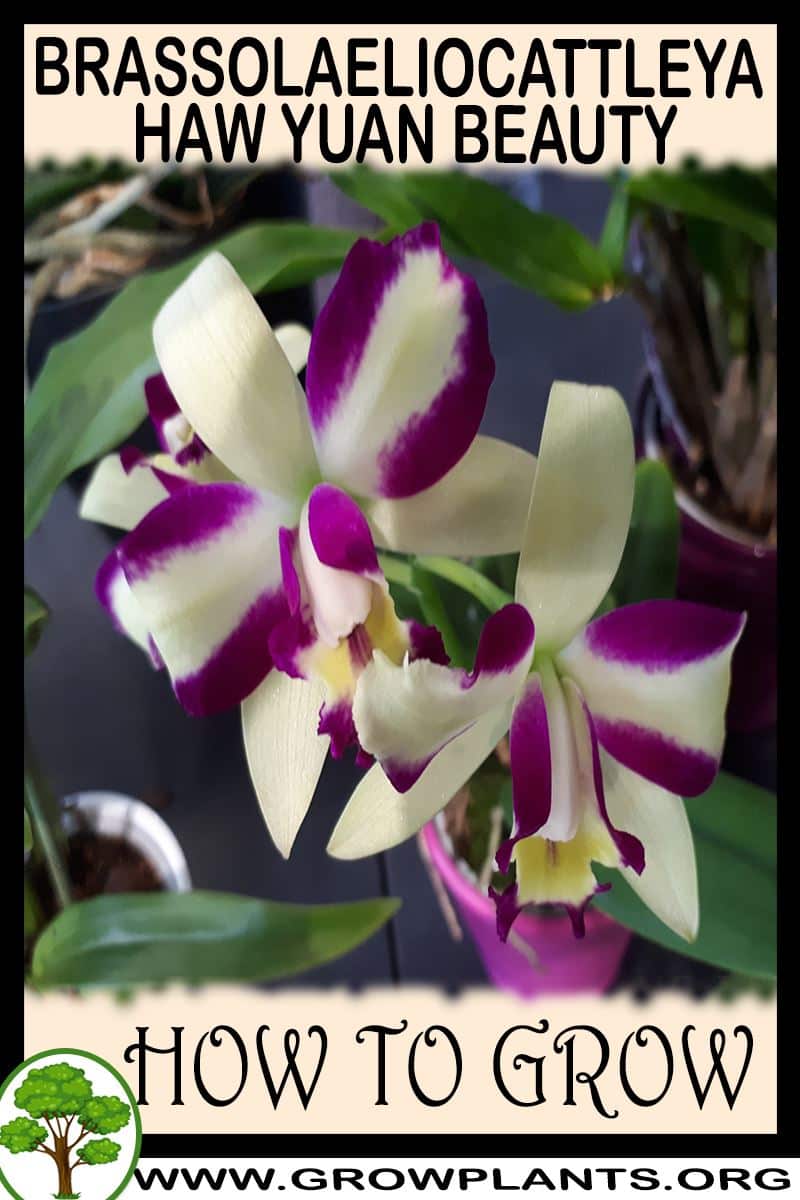
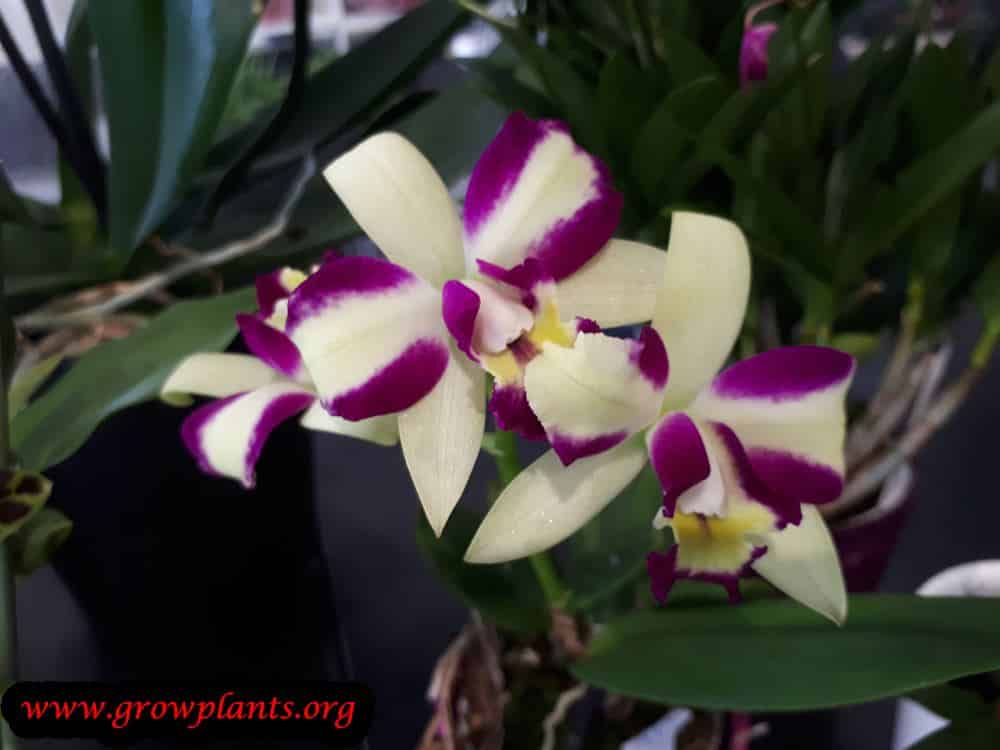
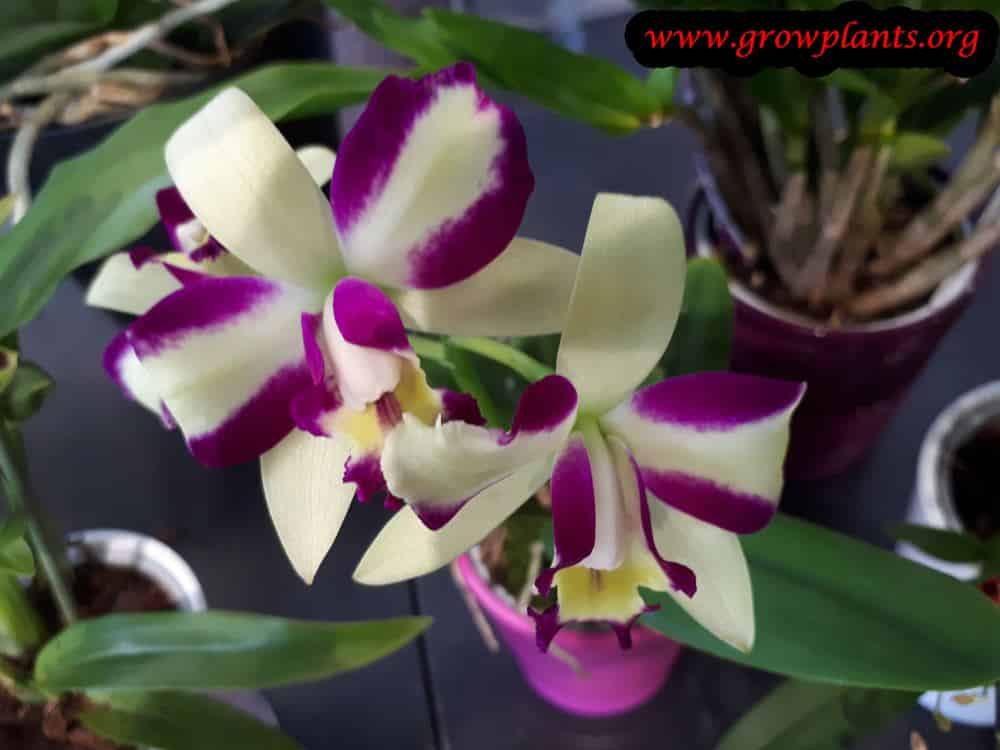
- Flower Characteristics: Large white or yellow blooms striped pink or purple; flowering is triggered by a day-to-night temperature drop and shorter days.
Primary Uses & Landscape Value
- Functional & Ornamental Roles: Ornamental flowering houseplant or greenhouse orchid, grown in bark chips or cork in transparent pots.
Care Guide: Planting, Soil & Watering
Overview: This Cattleya-type orchid is an epiphyte that grows best in warm, bright but shaded conditions (around 50% humidity) potted in an open bark or cork medium rather than soil. Water with clean water and let the roots dry a little between waterings — the medium must drain fast and stay airy.
Quick Care Requirements
| Requirement | Ideal Condition |
|---|---|
| Planting Season | Year-round |
| Growth Rate | Slow |
| Soil Type | Open bark or cork orchid mix, never garden soil |
| Water Need | Moderate — water, then let the medium dry slightly before the next |
Planting & Establishment
- Best Planting Season: Repot or start year-round.
- How to Plant:
- Hole Preparation: Pot into a snug transparent pot (about 20–40% larger than the root ball) with plenty of drainage holes; do not over-pot.
- Soil Amendments: Use bark chips or cork, adding Styrofoam for aeration; refresh the medium before it breaks down and turns acidic, and feed a few times a year.
- Planting Depth: Seat the pseudobulbs at the surface with roots in the open medium; do not bury them.
- Growth Speed & Expectations: Slow, building a clump of pseudobulbs that flowers over much of the year, most in autumn and winter, aided by a day–night temperature difference.
Soil, Watering & Drainage Care
- Soil Mix & Drainage Needs: An open, sharply draining bark/cork medium in a well-vented transparent pot is essential; free drainage and airflow keep the roots from rotting.
- Watering Schedule & Technique:
- Young / Newly Planted: After repotting, water lightly with rain or distilled water, keeping the medium just damp.
- Established: Water with clean (rain or distilled) water, letting the medium dry a little between waterings; keep humidity around 50%.
- Seasonal Adjustments: Water a little more in warm growth; reduce when cool, always letting the medium dry between waterings.
Climate, Light & Hardiness
This Cattleya-alliance hybrid orchid (Brassavola × Laelia × Cattleya) needs warm, humid, essentially frost-free conditions and is realistically grown outdoors only in zone 11–12, or in a greenhouse/indoors elsewhere. It flowers best with warm days, distinctly cooler nights (about a 10°C/18°F swing), and bright, indirect light in half shade rather than direct sun.
Quick Climate Specifications
| Climate Zones | Subtropics, Mediterranean, or greenhouse/indoors as houseplant |
|---|---|
| USDA Hardiness Zones | 11–12 |
| Optimal Temp Range | Day approximately 22–30°C (71–85°F); night approximately 13–16°C (55–60°F) |
| Frost Tolerance | None |
| Light Conditions | Half Shade (bright, full light but not direct sun) |
Sunlight & Light Exposure
Optimal Light Setup
Bright light in half shade - plenty of light without direct, scorching sun.
Shade & Heat Management
Protect from harsh midday direct sun, especially in warm subtropical or mediterranean outdoor settings; filtered brightness is the goal.
Temperature Extremes & Hardiness
USDA Hardiness & Regional Limits
Realistically an outdoor plant only in essentially frost-free zone 11–12; in cooler climates it needs a greenhouse or bright indoor spot year-round.
Cold Damage & Winter Protection
Keep within roughly the 13–30°C (55–85°F) day/night range given by the source data; sustained cold outside this range stresses or damages the plant even without frost.
Frost Sensitivity
No frost tolerance; must be fully protected from any freezing temperature.
Extreme Heat Tolerance
Tolerates warm days up to about 30°C (85°F), but consistently hot nights - without the roughly 10°C (18°F) day-night drop the source data calls for - can suppress flowering even if the plant survives.
Wind, Humidity & Microclimate
Humidity Preferences
Prefers moderate-high humidity, around 50% per the source care data.
Microclimate Recommendations
A bright, humid, half-shaded spot with a clear day-to-night temperature swing - such as a greenhouse, shaded patio, or humid bright room - supports both healthy growth and reliable blooming.
Growing in Pots, Balconies & Indoors
This Cattleya-alliance orchid is, in the grower’s words, much better grown in a pot, and he rates it as a good houseplant. It wants bright, filtered light – strong light but sheltered from scorching direct sun.
Quick Details
- Container Size: A pot 20-40% larger than the root ball – the bigger the root ball, the smaller the extra (grower’s value)
- Indoor Suitability: A good houseplant in bright, filtered light
- Best Spot: Half shade with full, bright light – no harsh direct midday sun
- Soil & Drainage: Coarse bark or cork chips (even a little styrofoam) for sharp drainage; plenty of holes
- Watering in Pots: Average – water with rain or distilled water, then let it approach dryness
Indoors & On the Windowsill
- A genuine houseplant: Grow it in a bright window with strong, filtered light; it flowers best when well lit but shielded from burning sun.
- Windowsill growing: Its modest size suits a bright sill; steady warmth and some humidity help.
- Care: Keep it clear of hot, drying air from heaters and air-conditioning.
On a Balcony or Patio
- Light & wind: Outdoors give bright shade with shelter from direct sun and wind; it enjoys fresh air and humidity but must not bake or dry out.
- Practicalities: A clear or slotted pot drains fast and is easy to move under cover.
Choosing the Pot, Soil & Long-Term Care
- Pot & drainage: Grow in a pot 20-40% bigger than the root ball with plenty of drainage holes; the grower prefers bark chip or cork (even some styrofoam) for the freest drainage. Skip a standing-water saucer.
- Potting mix: An open, coarse bark/cork orchid medium – never ordinary soil.
- Feeding: The grower feeds a few times a year; use a dilute orchid feed through growth as nutrients wash from the open mix.
- Repotting: Change the medium whenever the plant fills the pot, or after about two years if it has not – the mix breaks down and loses viability over time.
Grower’s Container Tip
- Clear pot & pure water: The grower chooses a transparent pot so he can watch the root condition, and waters with distilled or rain water rather than tap water.
Fertilizing & Feeding
This intergeneric Cattleya-alliance orchid hybrid is a light feeder – a dilute, balanced feeding while it is actively producing new growth and roots is enough, with a rest from fertilizer between growth cycles, which for this orchid can recur more than once across the year.
Quick Fertilizing Specs
| Feeding Level | Light feeder |
|---|---|
| Main Nutrient Priority | Balanced feeding while new growth is active; no need for a high-phosphorus bloom formula |
| Best Feeding Period | While new leaves, pseudobulbs, or roots are visibly forming, tapering off around each bloom cycle |
| Organic Options | Not applicable – this orchid is grown in bark, cork, or a similar open medium rather than garden soil |
| Soil pH | Grown in bark or a similar open medium rather than soil, so garden soil pH guidance does not apply |
| Reduce/Stop Feeding | Stop feeding once a bloom cycle finishes and the plant enters its rest period before the next growth flush |
Feeding by Growth Stage
Active Growth and New Root Development
Support the plant in producing new growth and roots between bloom cycles, building strength for the next round of flowers.
| Nutrient direction | A balanced, dilute feeding supports steady new growth without pushing weak, overly soft tissue. |
|---|---|
| Timing | While the plant is actively producing new leaves, pseudobulbs, or roots, typically outside a bloom period. |
| Frequency | Feed lightly and regularly while new growth is visibly active, easing back once growth slows. |
| Fertilizer types | A balanced fertilizer formulated for orchids, diluted and applied lightly, Fertilizer suited to the bark or cork medium this orchid is grown in |
| Precautions | Periodically water with plain water to avoid salt buildup in the medium, and ease off feeding once new growth stops. |
Bud Formation and Flowering
Support strong bud development and long-lasting blooms each time a flowering cycle begins, without disrupting the temperature cues this orchid needs to flower.
| Nutrient direction | Continue a balanced, dilute feeding; there is no need to switch to a high-phosphorus bloom formula to get this orchid to flower well. |
|---|---|
| Timing | From visible bud formation through each flowering period; this orchid can produce multiple flowering periods across the year. |
| Frequency | Continue light, regular feeding through bud development, then ease off as flowers fully open. |
| Fertilizer types | A balanced fertilizer formulated for orchids, diluted and applied lightly |
| Precautions | Avoid disturbing the plant’s temperature or light routine during bud formation, since this orchid needs cooler nights than days to bloom well. |
Rest Between Bloom Cycles
Let the plant rest between bloom cycles without stressing the roots with unused fertilizer salts.
| Nutrient direction | None – withhold fertilizer while the plant is resting between bloom cycles. |
|---|---|
| Timing | Immediately after a bloom cycle finishes, before the next new growth flush resumes. |
| Frequency | No feeding at this stage. |
| Fertilizer types | No feeding at this stage – water sparingly and let the plant rest |
| Precautions | Do not fertilize while the plant is resting; unused fertilizer salts can build up in the medium and injure roots during a period of reduced uptake. |
Nutrient Deficiency Signs & Corrections
Roots turn brown or mushy and lose their firm, healthy appearance; leaves may yellow or wrinkle.
| Possible causes | overwatering or a growing medium that stays wet too long, a breakdown of old bark or cork medium that no longer drains well, poor pot drainage |
|---|---|
| Appears first on | the roots, then older leaves |
| What to check | condition and age of the growing medium, pot drainage, watering frequency |
| Possible correction | Trim away dead roots, repot into fresh bark or cork medium, and let the medium approach dryness between waterings; hold off on feeding until new roots appear. |
The plant grows well but produces few or no flowers.
| Possible causes | insufficient day-to-night temperature difference needed to trigger blooming, too little light, nitrogen-heavy feeding continued through the period when bud formation should be encouraged |
|---|---|
| Appears first on | whole-plant flowering performance rather than any single leaf |
| What to check | day and night temperatures, light levels, recent feeding balance |
| Possible correction | Provide the cooler nights and adequate light this orchid needs to initiate bloom, and avoid continuing heavy feeding once the plant should be shifting toward bud formation. |
New leaves develop yellowing between the veins while the veins stay green.
| Possible causes | iron or other micronutrient deficiency linked to medium pH or breakdown, salt buildup in the growing medium from unflushed fertilizer, root stress from a soggy or degraded medium |
|---|---|
| Appears first on | new leaves |
| What to check | age and condition of the growing medium, recent flushing with plain water, root health |
| Possible correction | Flush the medium with plain water to clear excess salts, refresh old medium, and apply a chelated micronutrient product per its label if yellowing continues. |
Pruning, Training & Seasonal Maintenance
This Brassolaeliocattleya (BLC) hybrid is a sympodial epiphytic orchid built from pseudobulbs, with no woody trunk to structurally prune. Maintenance centers on removing the spent flower stem after each bloom finishes and clearing old yellow leaves; both are best done right after flowering rather than while a spike is still active. Division for propagation is possible but only once a new growth has at least three leaves, so it should not be forced early.
Quick Pruning & Maintenance Specs
| Pruning Tolerance | Low – sanitation only, no structural cutting |
| Primary Pruning Window | Immediately after bloom finishes |
| Typical Frequency | Once per bloom cycle, plus ongoing removal of old yellow leaves |
| Main Objective | Remove the spent flower stem and old yellow leaves |
| Young Plant Priority | Leave pseudobulbs and leaves intact to build size before any division |
| Mature Plant Priority | Cut the spent stem after bloom; retain older pseudobulbs as reserve unless dividing a clump with enough growths |
| Best Tool Type | Precision snips (sterile) |
| Avoid Heavy Pruning During | While a spike is still green, budding or in bloom |
Pruning by Plant Age & Size
Newly Established
No pruning beyond removing any damaged tissue on arrival; let it settle and build pseudobulbs.
Young / Formative
No structural training applies. Do not divide until a new growth has developed at least three leaves, per this hybrid’s propagation needs.
Mature / Established
After bloom, cut out the spent flower stem; remove old yellow leaves as they occur; when repotting, only separate the clump into divisions that each retain enough pseudobulbs/leaves to stay viable.
Special Growth to Remove
- Spent flower stem, cut after the bloom is fully finished.
- Old yellow (senescing) leaves.
Container & Small-Space Pruning
Always container-grown, ideally in a see-through pot with a coarse, fast-draining bark or cork mix. Step up pot size by roughly 20–40% rather than jumping large, and only refresh the growing medium or divide the clump once it has filled its current pot – not before.
Tools
- Precision snips for cutting the spent flower stem and removing old leaves.
Tool Hygiene & Disease Risk
Increased risk: this orchid is noted as susceptible to cattleya mite and spider mite as well as aphids, and orchids generally can carry transmissible viruses/rots on shared blades – disinfect the cutting tool between plants.
Cut Placement & Technique
Cut the flower stem back to the pseudobulb once bloom is over; remove yellow leaves where they detach cleanly rather than tearing them; when dividing, separate at the rhizome connection between growths, keeping each division intact.
Heavy Pruning & Rejuvenation
Not applicable in the woody sense – there is no hard rejuvenation cut. Renewal comes from new pseudobulb growth each cycle; older leafless backbulbs can be divided off to start new plants once a division has enough growths to survive on its own.
Post-Pruning Care
After cutting the spent spike, resume normal watering; keep humidity around 50% as usual and watch new growth for the mite and aphid pressure this hybrid is prone to.
Common Pruning Mistakes
- Cutting the flower stem while it is still capable of producing more blooms.
- Dividing the clump before a new growth has at least three leaves.
- Reusing an unclean blade between plants, risking mite or virus spread.
When NOT to Prune
- Do not cut a spike while still actively blooming or budding.
- Avoid dividing or heavy root work outside of active new growth.
Recommended Tools (by task)
- Cutting spent spikes / removing old leaves (mature plants): precision_snips – all cuts on this orchid are fine, at the pseudobulb.
- Between-plant sanitation, given cattleya mite/spider mite pressure: blade_disinfectant.
Propagation Guide
This Cattleya-alliance hybrid is propagated by separating a rooted daughter growth from an established clump, since named cultivars like ‘Haw Yuan Beauty’ will not come true from seed and orchid seed needs sterile laboratory culture to germinate at all. The site itself notes that division here is genuinely tricky and seed essentially impractical for home growers, so this plant should be treated as moderate-to-difficult to propagate even by its best method.
Quick Propagation Specs
| Best Propagation Method | Division (separating a rooted daughter growth from the clump) |
| Alternative Methods | Seed (laboratory flask culture only) |
| Propagation Difficulty | Moderate–Difficult (division); Specialist (seed) |
| Seed True-to-Type | Hybrid offspring vary; named cultivar identity is not reproduced from seed |
| Vegetative True-to-Type | Yes |
| Best Propagation Season | At repotting, once the new daughter growth has developed at least 3 leaves |
Growing from Seed
The site describes seed propagation of this hybrid as really hard. Orchid seed is dust-like with no significant nutrient reserves, so it requires either a symbiotic mycorrhizal fungus or sterile in-vitro (flask) culture to germinate at all – a specialist technique out of reach for ordinary home propagation.
Division, Offsets, Pups & Suckers
Minimum Viable Size
Wait until the new daughter growth has developed at least 3 leaves before attempting to separate it – younger growths are not yet ready.
Technique
Carefully remove the plant from its pot and clear away the surrounding potting medium so the connection between the mother plant and the daughter growth is fully visible, then cut that connection cleanly, taking care not to damage the roots of either piece.
Establishment Care
Pot each division separately. This orchid’s roots typically fill the pot and need attention about once a year; avoid moving a fresh division directly into an oversized container.
Bloom & Flower Guide
Quick Details
- Bloom Season: Possible year-round, with the main flush in autumn and winter
- Flower Appearance: Large flowers in white or yellow marked with pink or purple striping
- Edibility: Ornamental only – this Cattleya-type orchid is grown for its showy flowers
Detailed Blooming Overview
Brassolaeliocattleya Haw Yuan Beauty is a Brassavola-Laelia-Cattleya cross grown for its big, colourful blooms. Flowering can appear at various times, but the strongest show comes in the cooler autumn and winter months. A distinct day-to-night temperature swing of around 10C, together with shorter days, is what nudges mature plants into bud.
Flower Characteristics
- Large and showy, in white or yellow overlaid with pink to purple stripes.
- The broad, ruffled lip is the centrepiece typical of Cattleya-type orchids.
Bloom Care & Thinning
- Triggering bloom: Provide about a 10C drop between day and night, along with shortening days, to initiate flowering.
- Supporting the blooms: Give bright light and let the mix approach dryness between waterings while spikes develop.
- After flowering: Remove the spent spike once the flowers fade.
Bloom Health & Protection
- Botrytis petal blight: Cool, damp, still conditions can spot the open flowers. Good airflow and keeping water off the blooms are the best safeguards; a suitable fungicide can be used if needed.
Pests, Diseases & Troubleshooting
Overview: ‘Haw Yuan Beauty’ is a showy intergeneric Cattleya-alliance orchid (a Brassolaeliocattleya / Rhyncholaeliocattleya hybrid) grown as an epiphyte in bark on thick pseudobulbs. Its main threats are sap-sucking pests that hide on pseudobulbs and leaf axils, and rots that follow overwatering or water trapped in new growth. Management is prevention-led: good airflow, careful watering, quarantine of new plants, and gentle organic treatments before anything stronger.
Quick Troubleshooting Overview
| Issue / Pest | Main Symptom | Primary Solution |
|---|---|---|
| Scale insects | Brown or white bumps on pseudobulbs and leaf undersides | Wipe off with alcohol swab, horticultural oil |
| Mealybugs | White cottony masses in crevices, sticky honeydew | Alcohol swab, isopchol/soap, repeat treatments |
| False spider / cattleya mite | Silvery-pitted, stippled leaf undersides | Raise humidity, wipe leaves, miticidal oil |
| Aphids & thrips | Distorted buds, streaked or dropped flowers | Rinse, insecticidal soap, remove infested buds |
| Black rot (Phytophthora) | Spreading soft blackened leaf/pseudobulb rot | Cut out into clean tissue, drier culture, copper |
| Overwatering root rot | Mushy brown roots, shrivelled pseudobulbs | Repot in fresh bark, water less, more airflow |
Common Pests & Management
- Scale Insects (Boisduval scale, Diaspis boisduvalii and soft scales):
- Symptoms: Small brown limpet-like bumps or fluffy white male colonies clustered on pseudobulbs, leaf undersides and under old sheaths; yellowing, sticky honeydew and sooty mould. The most persistent cattleya pest.
- Prevention & Control: Quarantine and inspect new plants; strip old dry sheaths where scale hides; wipe insects off with an alcohol-dipped cotton swab or soft toothbrush. Follow up with horticultural oil or insecticidal soap, repeating every 1–2 weeks to catch crawlers.
- Mealybugs (Pseudococcus and Planococcus spp.):
- Symptoms: White cottony tufts tucked into leaf axils, sheaths, new growth and among roots; sticky honeydew, sooty mould and weakened, distorted growth.
- Prevention & Control: Dab clusters with an alcohol swab; rinse the plant; check the rootball and repot if roots are infested. Treat with insecticidal soap or horticultural oil, repeating to break the life cycle, and isolate the plant until clear.
- False Spider Mite / Cattleya Mite (Brevipalpus spp.) & Two-Spotted Mite (Tetranychus urticae):
- Symptoms: Fine silvery or reddish pitting and stippling on leaf undersides, later sunken and leathery; two-spotted mite adds faint webbing. Worst in hot, dry, still air. The source note of “cattleya mite / spider mite” matches this exactly.
- Prevention & Control: Raise humidity and improve airflow; wipe leaves top and bottom and rinse regularly; release predatory mites where practical. Use a miticidal horticultural oil for stubborn cases, treating undersides thoroughly.
- Aphids & Thrips (Aphis spp.; Thrips / Frankliniella spp.):
- Symptoms: Aphids cluster on soft buds and flower spikes causing distortion and honeydew; thrips rasp buds and petals, leaving silvery streaks, spotting and deformed, short-lived flowers. Both can spread virus.
- Prevention & Control: Rinse off aphids and use insecticidal soap; use blue sticky traps for thrips, remove infested buds, and treat with horticultural oil or spinosad, always with clean tools to avoid virus spread.
- Slugs, Snails & Fungus Gnats:
- Symptoms: Slugs and snails chew new roots, buds and flowers at night, leaving slime trails; fungus gnat larvae in constantly wet mix nibble tender roots.
- Prevention & Control: Handpick at night, set traps and use iron-phosphate bait; let the mix dry between waterings and use sticky traps or Bti/beneficial nematodes to curb fungus gnats.
Diseases & Fungal Issues
- Black Rot (Phytophthora / Pythium spp.):
- Symptoms: Fast-spreading soft, watery, blackened patches on leaves, new growth and pseudobulbs, often starting where water sits; can kill a plant quickly in warm, wet, stagnant conditions.
- Treatment & Management: Cut well back into clean, firm green tissue with a sterile blade; keep foliage and crowns dry, water in the morning and boost airflow. Dust cuts and drench with a copper or phosphonate fungicide; isolate the plant.
- Bacterial Brown / Soft Rot (Erwinia / Pectobacterium spp.):
- Symptoms: Soft, sunken, water-soaked blister that turns brown-black and smells foul, spreading rapidly through leaves and pseudobulbs in hot, humid, wet conditions.
- Treatment & Management: Excise infected tissue with a sterile tool, reduce humidity around the plant and improve air movement, keep water off foliage; treat cuts with copper and isolate to prevent spread.
- Fungal Leaf Spots (Cercospora, Colletotrichum anthracnose):
- Symptoms: Yellow to brown or black spots and blotches, sometimes sunken with concentric rings, usually on older or stressed leaves in humid, crowded conditions.
- Treatment & Management: Remove affected leaves, space plants and improve airflow, avoid overhead watering and keep plants vigorous. Apply a copper or general fungicide if spotting spreads.
- Botrytis Petal Blight (Botrytis cinerea):
- Symptoms: Tiny brown or pinkish flecks on open flowers that multiply in cool, damp, still air, spoiling the blooms.
- Treatment & Management: Increase airflow and warmth around flowering plants, avoid wetting the blooms, and remove spent or spotted flowers promptly.
- Orchid Viruses (Cymbidium mosaic virus, ORSV):
- Symptoms: Colour-break streaking or necrotic flecks and mottling on leaves and flowers, with gradual decline; incurable and spread by sap on tools and sucking pests.
- Treatment & Management: Sterilise cutting tools between plants (flame or fresh blades), control aphids and thrips, quarantine new plants, and destroy confirmed virus-positive plants to protect the collection.
Growing Difficulties & Abiotic Problems
- Overwatering & Root Rot:
- Cause & Symptoms: Soggy, broken-down bark suffocates roots; they turn brown and mushy, pseudobulbs shrivel and leaves yellow despite a wet pot.
- Correction Strategy: Repot into fresh coarse bark every 1–2 years (the source notes this orchid dislikes big pots and repotting), water only as the mix approaches dry, and ensure fast drainage and airflow to the roots.
- Sunburn & Leaf Scorch:
- Cause & Symptoms: Too much direct sun bleaches or blackens patches on leaves; healthy cattleya foliage should be a light apple-green, not dark green or scorched.
- Correction Strategy: Give bright but filtered light, acclimatise gradually to stronger light, and provide light shade during the fiercest midday sun.
- Crown / New-Growth Rot from Trapped Water:
- Cause & Symptoms: Water pooling in developing sheaths and new leads leads to soft, blackening rot of the tender growth.
- Correction Strategy: Water early in the day so plants dry by night, avoid pouring into new growths and sheaths, and keep air moving around the plant.
- Poor Flowering / Bud Blast:
- Cause & Symptoms: Buds yellow and drop before opening, or plants fail to bloom, from insufficient light, sudden temperature or humidity swings, or gas fumes.
- Correction Strategy: Provide adequate light and a day–night temperature difference to trigger flowering, keep conditions stable during budding and avoid ethylene sources such as ripening fruit and heaters.
What Helps – Products & Tools
For cattleya-type orchids the toolkit is gentle and preventative: isopropyl alcohol swabs and horticultural oil or insecticidal soap for scale, mealybugs and mites, blue and yellow sticky traps for thrips and fungus gnats, sterile blades for clean cuts, fresh coarse orchid bark for repotting, and copper or phosphonate fungicide for black rot and leaf spots. Good airflow, correct watering and quarantine of new plants prevent most problems before they start.