

Plant Profile & Key Characteristics
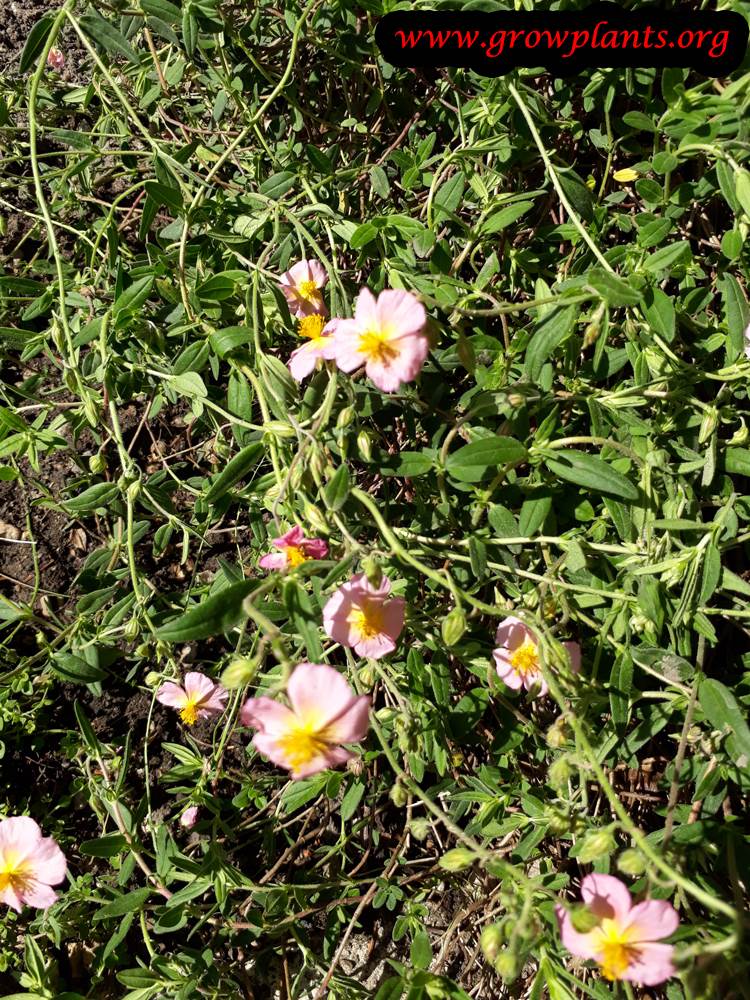
Overview: A low evergreen subshrub/perennial 15-30 cm (6-12 in) tall, grown as a drought-tolerant ornamental ground cover. It carries masses of saucer-shaped flowers over a sunny mat of narrow foliage.
Quick Specifications
| Specification | Attribute |
|---|---|
| Plant Type / Life Cycle | Perennial |
| Foliage Type | Evergreen |
| Mature Size | 15-30 cm (6-12 in) |
| Growth Rate | Moderate to fast |
| Toxicity | Non-toxic |
| Hardiness | USDA zones 6-10a |
Growth Form & Structure
- Height & Spread: Low spreading mat 15-30 cm (6-12 in) tall; also suited to containers.
- Growth Habit & Form: Spreading, mat-forming evergreen subshrub.
- Lifespan & Maturity: Short-lived perennial of moderate to fast growth.
Anatomy & Physical Features
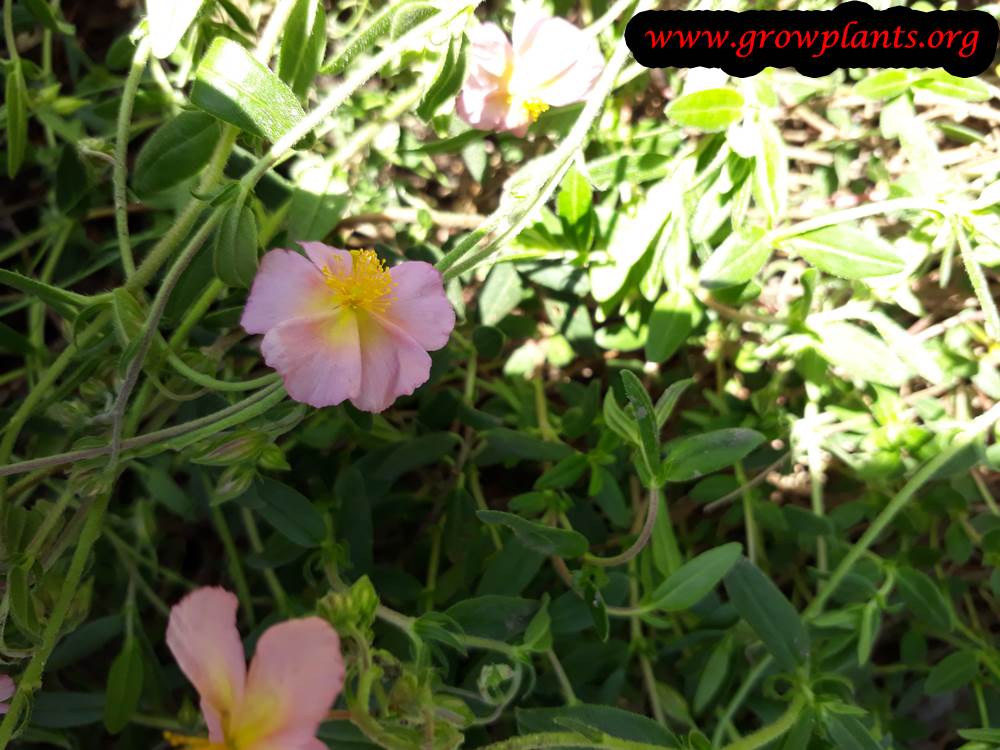
- Leaves & Foliage: Narrow, linear green leaves.
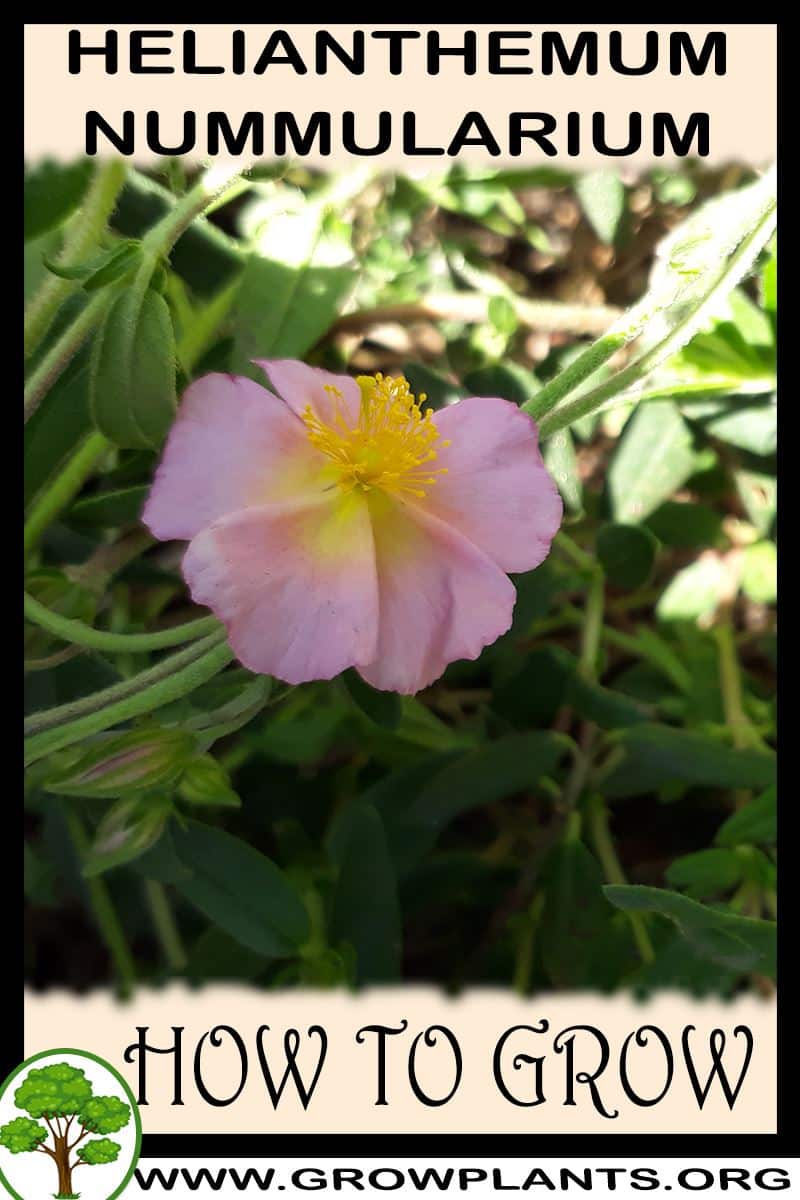
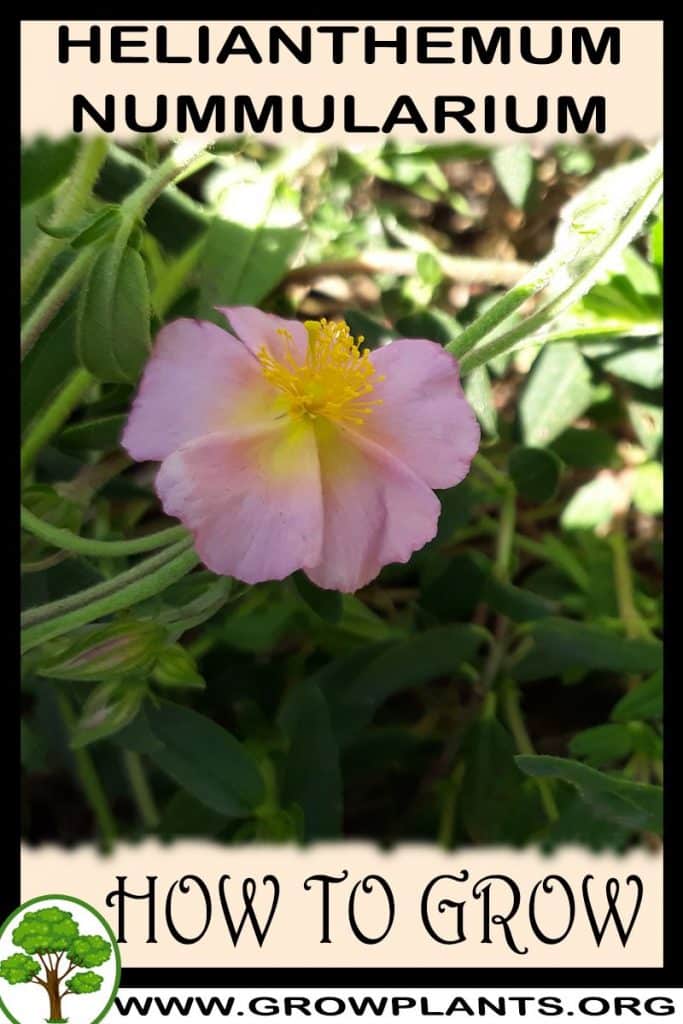
- Flower Characteristics: Saucer-shaped flowers in yellow, pink, orange, red or white with a yellow centre.
Primary Uses & Landscape Value
- Functional & Ornamental Roles: Drought-tolerant ground cover for sunny banks, rock gardens, gravel and containers.
Care Guide: Planting, Soil & Watering
Overview: Common rock rose (Helianthemum nummularium) is a low, spreading evergreen that thrives in full sun and sharply drained soil. Once established it is drought-tolerant and dislikes rich, wet ground.
Quick Care Requirements
| Requirement | Ideal Condition |
|---|---|
| Planting Season | In spring or summer during warm weather |
| Growth Rate | Moderate to Fast |
| Soil Type | Well-draining, lean and gritty |
| Water Need | Low to Moderate – let soil dry between waterings |
Planting & Establishment
- Best Planting Season: Plant in spring or summer in a sunny, open spot with excellent drainage.
- How to Plant:
- Hole Preparation: Dig a hole slightly wider than the root ball on free-draining ground, ideally a slope or raised bed where water runs off.
- Soil Amendments: Keep the soil lean and gritty — add sand or grit to sharpen drainage rather than rich organic matter, which this plant dislikes.
- Planting Depth: Set the root ball level with the soil surface; do not bury the crown.
- Growth Speed & Expectations: A moderate-to-fast grower forming a low mat about 15-30 cm (6-12 in) tall.
Soil, Watering & Drainage Care
- Soil Mix & Drainage Needs: Sharp drainage is essential; on heavy soils add grit or plant on a mound to prevent root rot.
- Watering Schedule & Technique:
- Young / Newly Planted: Water moderately after planting to help it root in, without keeping the soil soggy.
- Established: Once established it is drought-tolerant; water sparingly, letting the soil dry between waterings.
- Seasonal Adjustments: Give a little extra water in prolonged heat and keep it on the dry side through winter.
Climate, Light & Hardiness
The common rock rose is a low, evergreen Mediterranean-type sub-shrub for temperate and subtropical gardens, thriving in full sun on sharply drained ground. It is hardy to roughly USDA zone 6 and tolerates frost well once established, while resenting hot, humid and poorly drained conditions.
Quick Climate Specifications
| Climate Zones | Temperate, subtropical (Mediterranean-type) |
|---|---|
| USDA Hardiness Zones | Approximately 6–10a |
| Optimal Temp Range | Mild temperate conditions, roughly 15–24 °C (59–75 °F) |
| Cold Damage Begins | Hardy through typical zone-6 winters; damage in harder or prolonged wet freezes |
| Frost Tolerance | Moderate to High (established plants) |
| Light Conditions | Full sun |
| Wind Tolerance | High |
| Salt / Coastal Tolerance | Moderate (suited to exposed, sunny sites) |
Sunlight & Light Exposure
Optimal Light Setup
Full sun gives compact growth and free flowering; in shade it becomes leggy and shy to bloom.
Direct Sun Requirement
Needs full, direct sun.
Best Exposure / Orientation
Open, sunny, well-ventilated banks and slopes are ideal.
Temperature Extremes & Hardiness
USDA Hardiness & Regional Limits
Hardy to about zone 6; the evergreen mat survives frost, though prolonged wet cold is more damaging than dry cold.
Cold Damage & Winter Protection
Sharp drainage matters as much as cold-hardiness - waterlogged, frozen soil is the main winter risk.
Frost Sensitivity
Low for established plants.
Extreme Heat Tolerance
Tolerates heat where the air is dry, but dislikes hot, humid summers, which encourage rot.
Wind, Humidity & Microclimate
Humidity Preferences
Prefers drier air; humid heat promotes rot.
Dry-Air Tolerance
Good.
Wind Tolerance
High - naturally a plant of exposed habitats.
Coastal / Salt Tolerance
Reasonably tolerant of exposed, coastal-type positions (salt spray, distinct from saline irrigation).
Growing in Pots, Balconies & Indoors
Helianthemum nummularium (rock rose or sun rose) is a low, spreading, sun-loving shrublet ideal for a gritty trough, alpine pan or the front of a container. It is not a houseplant – it wants full sun and sharp drainage – but its small size means it can sit on a very sunny sill, and it truly excels on a hot, bright balcony or patio.
Quick Details
- Container Size: Shallow pan or trough, 5-15 L, gritty and free-draining
- Indoor Suitability: Not a true houseplant; only a very sunny, airy sill
- Best Spot: Full sun
- Soil & Drainage: Lean, gritty, sharply draining mix – it dislikes rich, wet soil
- Watering in Pots: Water lightly; let it dry between drinks and never leave it soggy
Indoors & On the Windowsill
- Houseplant limits: The grower marks it as not an indoor plant – it needs strong sun and moving air to stay tight and flower well.
- Windowsill growing: A young plant can grow on the sunniest, airiest sill you have; keep it lean and dry rather than lush and wet.
- Overwintering: In cold, wet winters a potted plant is best kept in a bright, airy, frost-free spot so it does not sit damp.
On a Balcony or Patio
- Light & wind: Give it the hottest, sunniest, airiest spot you have – it thrives on the fast-drying conditions of a sunny balcony. Reflected heat from walls and railings suits it, but check the pot in the peak of summer so it never bakes bone dry for long.
- Practicalities: Make sure the filled pot’s weight is safe for the balcony and that water drains away freely rather than sitting in the base.
Choosing the Pot, Soil & Long-Term Care
- Pot & drainage: A shallow 5-15 L pan or trough with plenty of drainage holes; never leave it standing in a saucer of water – wet roots are the quickest way to kill it. Terracotta suits it well, breathing and drying faster than glazed or plastic.
- Potting mix: A sharp, free-draining mix – potting soil or peat/coir cut with extra perlite, grit or sand so water runs straight through.
- Feeding: Feed only lightly; this is a lean-soil plant, and too much food in a pot gives soft, floppy growth. A little through the growing season is plenty.
- Repotting: Refresh the mix or pot up about every couple of years, trimming the roots and shaping the top as you go.
Fertilizing & Feeding
Common rock rose is a drought-tolerant Mediterranean-type groundcover that thrives in lean, well-drained soil; it rarely needs feeding and blooms best without rich fertilizer.
Quick Fertilizing Specs
| Feeding Level | Light |
|---|---|
| Main Nutrient Priority | Very little; a light balanced feed at most. |
| Best Feeding Period | A single light feed as spring growth begins is plenty. |
| Organic Options | A thin compost topdressing if the soil is very poor. |
| Micronutrients | Rarely needed; correct iron only if new growth yellows on limy soil. |
| Soil pH | Prefers well-drained, neutral to slightly alkaline soil; dislikes rich, wet ground. |
| Reduce/Stop Feeding | Feed sparingly, if at all; lean soil gives the best flowering. |
Feeding by Growth Stage
Spring growth flush
Support fresh shoots and leaves as the plant wakes up in spring.
| Nutrient direction | A balanced complete feed with adequate nitrogen fuels healthy new growth. |
|---|---|
| Timing | As new growth begins in spring. |
| Frequency | Feed sparingly as growth begins; light feeding is usually enough. |
| Fertilizer types | A balanced complete fertilizer, Compost or well-rotted organic matter |
| Precautions | This is a lean, drought-adapted plant that rarely needs much feeding. Avoid heavy nitrogen, which drives leaves at the expense of flowers. |
Flowering
Sustain flowering without pushing excess foliage.
| Nutrient direction | A balanced feed supports steady bloom; adequate nitrogen, not high phosphorus, drives flowering. |
|---|---|
| Timing | Through the flowering season. |
| Frequency | Feed sparingly through the flowering period. |
| Fertilizer types | A balanced complete fertilizer |
| Precautions | High-phosphorus ‘bloom booster’ feeds are unnecessary; a balanced feed and full sun give better flowering. Avoid heavy nitrogen, which drives leaves at the expense of flowers. |
Dormancy or winter rest
Let the plant rest through cold or dormant months without forcing growth.
| Nutrient direction | None – withhold fertilizer while the plant is not actively growing |
|---|---|
| Timing | During dormancy or cool-season rest when growth has stopped |
| Frequency | No feeding at this stage |
| Fertilizer types | No feeding at this stage – resume only when active growth returns |
| Precautions | Do not fertilize until active growth resumes; feeding a resting plant risks salt buildup and root injury |
Nutrient Deficiency Signs & Corrections
Older, lower leaves fade to pale green or yellow overall and growth slows.
| Possible causes | Low soil nitrogen or thin organic matter, Nitrogen leached out by heavy watering or rain on light soils, Cold, waterlogged roots limiting uptake |
|---|---|
| Appears first on | older, lower leaves |
| What to check | soil organic matter and recent feeding, whether heavy rain or irrigation may have leached nutrients, overall plant vigor and colour |
| Possible correction | Topdress with compost or apply a balanced complete fertilizer at label strength; keep watering steady but not excessive so nutrients are not washed away. |
Youngest leaves yellow between the veins while the veins stay green.
| Possible causes | High or alkaline soil pH locking up iron, Cold or waterlogged soil slowing root uptake, Genuinely low available iron |
|---|---|
| Appears first on | newest leaves at the shoot tips |
| What to check | soil pH and drainage, whether the soil is cold or saturated, overall root health |
| Possible correction | Correct soil pH and improve drainage first; if the youngest growth stays chlorotic, apply a chelated iron product following its label. |
Lush leafy growth but few flowers.
| Possible causes | Too much nitrogen from over-feeding, Overly rich soil relative to light levels, Insufficient sunlight for the demand created by heavy feeding |
|---|---|
| Appears first on | new leafy shoots at the expense of buds |
| What to check | recent feeding rate and fertilizer type, light exposure, balance of leaf growth versus budding |
| Possible correction | Ease back on nitrogen and switch to a balanced feed; ensure full sun so the plant channels energy into flowering rather than foliage. |
Pruning, Training & Seasonal Maintenance
Helianthemum nummularium (common rock rose) is a low, spreading evergreen sub-shrub (15–30 cm) grown as drought-tolerant ground cover. It tolerates light pruning well but not hard cutting into old wood, so the goal is shaping and containing the mound rather than renewing it. Its own care notes place pruning in winter, done specifically “for design and control” – i.e. to keep the low mound neat and compact ahead of its spring–summer flowering flush, not to force new growth.
Quick Pruning & Maintenance Specs
| Pruning Tolerance | Moderate – light shaping only, not hard renewal |
| Primary Pruning Window | Winter |
| Main Objective | Keep the low mound compact and shapely ahead of spring–summer bloom |
| Young Plant Priority | Light tip-pinching to encourage a dense, mounded habit |
| Mature Plant Priority | Trim spread and shape without cutting into old, leafless wood |
| Best Tool Type | Bypass secateurs or light hand shears |
| Avoid Heavy Pruning During | Spring–summer flowering period |
Pruning by Plant Age & Size
Newly Established
Minimal cutting; pinch soft tips lightly if needed to encourage branching, but avoid disturbing a young plant still spreading into its space.
Young / Formative
No leader or framework training applies – this is a low, mounding sub-shrub, so formative work is limited to tip-pinching for density rather than any of the classic tree/shrub training systems.
Mature / Established
Trim the mound lightly each winter to control size and keep it tidy, cutting into the current season’s soft growth only – older, woodier stems at the base do not reliably resprout if cut back hard.
Structural Pruning & Training
- Height & spread control: light winter trimming keeps the low mound within its space; this is the main structural task for a groundcover this size.
- Renewal pruning: not recommended into old wood – unlike plants that resprout freely from hard cuts, this sub-shrub’s older stems are unreliable at regenerating once cut back to bare wood, so shaping should stay within live, leafy growth.
Container & Small-Space Pruning
In a pot, the same light winter trim keeps growth compact; because hard cutting into old wood is risky, favor frequent light trims over one big cutback if the plant is outgrowing its container.
Tools
- Bypass secateurs – for controlled, selective shaping cuts.
- Hedge shears – acceptable only for a light, uniform trim across the whole mound, since this is a dense groundcover shape rather than a plant needing selective branch-by-branch cuts.
Tool Hygiene & Disease Risk
Routine hygiene; clean, sharp tools are sufficient, with no specific transmissible disease risk noted for this species.
Cut Placement & Technique
Cut back into green, leafy growth rather than into bare older wood, which this sub-shrub does not reliably regenerate from.
Heavy Pruning & Rejuvenation
Not recommended. Unlike plants that tolerate a hard renewal cut, Helianthemum’s older wood does not reliably resprout, so a badly overgrown or leggy plant is generally better replaced than hard-pruned back to bare stems.
Common Pruning Mistakes
- Cutting hard into old, leafless wood expecting it to resprout, leaving bare, dead patches in the mound.
- Pruning during the spring–summer bloom period instead of winter, sacrificing the flower display for no shaping benefit.
When NOT to Prune
- Avoid pruning during the spring–summer flowering season.
- Avoid hard cuts into bare, older stems at any time.
Recommended Tools (by task)
- bypass_secateurs – selective shaping cuts within live growth.
- hedge_shears – light, even trimming of the whole mound for design/control, as noted in its own care guidance.
Propagation Guide
Common rock rose is best increased from soft or semi-ripe cuttings, which are the only way to reproduce the many named colour forms exactly, as seedlings vary. Seed raises the species reliably; overall a Moderate plant, mainly because the cuttings and seedlings resent root disturbance and rot in wet conditions.
Quick Propagation Specs
| Best Propagation Method | Soft/semi-ripe stem cuttings |
| Alternative Methods | Seed (species); self-layering of low stems |
| Propagation Difficulty | Moderate |
| Seed True-to-Type | Variable — named colour forms do not come true; propagate them by cuttings |
| Vegetative True-to-Type | Yes — a cutting reproduces the parent, including flower colour |
| Best Propagation Season | Late spring to summer (cuttings); spring (seed) |
| Grafting Required | No |
Growing from Seed
Seed Handling & Sowing
Sow in spring into a free-draining mix. The small seed generally germinates without special pre-treatment; keep it lightly moist rather than wet, as damping-off is a risk.
Seedling Care
Prick out and pot on while young — rock rose resents having established roots disturbed — and grow on hard in full sun with sharp drainage.
Stem Cuttings
Cutting Type & Timing
Take soft or semi-ripe cuttings from non-flowering shoots from late spring through summer.
Rooting Setup
Root in a gritty, free-draining medium and keep it just moist — these Mediterranean plants rot easily if kept wet. Rooting hormone is optional and only mildly beneficial.
Air & Ground Layering
Low, spreading stems often root where they rest on the ground; a stem can be pinned into gritty soil and, once rooted, separated from the parent — a simple, low-effort way to gain a few extra plants of a named form.
Bloom & Flower Guide
Quick Details
- Bloom Season: Spring into summer
- Flower Appearance: Saucer-shaped flowers with a yellow centre, in yellow, pink, orange, red or white
- Edibility: Grown as an ornamental; not eaten
Detailed Blooming Overview
Common rock rose is a low, drought-tolerant evergreen that covers itself in flat, saucer-shaped flowers through late spring and summer. Each bloom is short-lived – often lasting a day – but they open in such numbers that the plant stays colourful for weeks.
Flower Characteristics
- Open, saucer-shaped flowers with a bright yellow centre.
- Available in yellow, pink, orange, red or white; petals have a slightly crinkled, tissue-paper look.
Bloom Care & Thinning
- Managing the bloom: A light shear after the first flush tidies the plant and can encourage a second, lighter show.
- Pollination: Visited by bees and other insects drawn to the open flowers.
Pests, Diseases & Troubleshooting
Overview: Rock roses are tough, sun-loving evergreen sub-shrubs of lean, sharply-drained ground, and they are genuinely among the more trouble-free garden plants – few pests bother them. Their real weakness is the opposite of most plants: they resent rich, wet, heavy soil, where root rot and fungal problems set in. Grow them hard and dry and they stay healthy.
Quick Troubleshooting Overview
| Issue / Pest | Main Symptom | Primary Solution |
|---|---|---|
| Aphids | Curled soft new shoots, honeydew | Water jet, insecticidal soap |
| Root rot | Wilting, dieback, blackened roots in wet soil | Sharp drainage; avoid rich/wet ground |
| Powdery mildew | White coating on leaves in humid, crowded sites | Airflow, sun, sulfur if needed |
| Leaf spot | Brown fungal spots in damp conditions | Remove leaves, improve airflow |
| Legginess | Open, sprawling, bare-centred growth | Trim after flowering |
Common Pests & Management
- Aphids (Aphididae):
- Symptoms: Occasional clusters of green or grey soft-bodied insects on soft new shoots and flower buds, with curling and honeydew – the most likely (and minor) pest of an otherwise pest-resistant plant.
- Prevention & Control: Usually needs nothing beyond a water jet or a quick insecticidal soap spray; natural predators keep them in check in a sunny open position.
- Spider mites (Tetranychus spp.):
- Symptoms: Fine stippling and slight webbing in very hot, dry, dusty spells, mainly a minor concern.
- Prevention & Control: Rinse the foliage; horticultural oil or insecticidal soap if it persists. Rarely a serious issue in the open.
- Slugs & snails (young plants) (Gastropoda):
- Symptoms: Rasped, ragged holes in soft new growth of young plants, with slime trails – established plants are rarely bothered.
- Prevention & Control: Protect new plantings with grit, wool pellets, traps or iron-phosphate bait; the sharp, dry conditions rock roses prefer are naturally unfriendly to slugs.
Diseases & Fungal Issues
- Root & crown rot (Phytophthora / Rhizoctonia / Pythium spp.):
- Symptoms: Wilting, yellowing and sudden dieback of shoots or whole plants growing in rich, heavy or wet soil, with dark decayed roots – the principal killer of rock roses.
- Treatment & Management: Prevention is everything: plant in poor, gritty, free-draining soil in full sun, never overwater or over-feed, and avoid heavy clay and wet winters. Affected plants seldom recover; improve drainage before replanting.
- Powdery mildew (Erysiphales):
- Symptoms: White powdery film on leaves and shoots in crowded, humid or shaded conditions.
- Treatment & Management: Give full sun and airflow, avoid crowding, and remove affected growth; sulfur or potassium bicarbonate for stubborn cases.
- Fungal leaf spot (various fungi):
- Symptoms: Brown or grey spots on leaves in prolonged damp, still conditions.
- Treatment & Management: Improve airflow and light, remove affected leaves; rarely needs fungicide in a well-sited plant.
Growing Difficulties & Abiotic Problems
- Wet, rich soil (the core problem):
- Cause & Symptoms: Rock roses evolved on lean, dry, stony ground; in fertile, moist or waterlogged soil they grow soft, rot at the roots and are short-lived.
- Correction Strategy: Plant in poor, gritty, sharply-drained soil in full sun, keep feeding to a minimum, and avoid mulching wet against the crown. Lean and dry is the goal.
- Legginess & short life:
- Cause & Symptoms: Plants sprawl open and become woody and bare-centred with age, and are naturally short-lived sub-shrubs.
- Correction Strategy: Shear lightly after the main flush to keep compact and encourage a second flush; avoid cutting into old bare wood, and propagate replacements from cuttings.
- Frost damage:
- Cause & Symptoms: Hard frost can scorch foliage and damage plants in cold, wet ground.
- Correction Strategy: Ensure sharp drainage (wet cold is deadlier than dry cold), site in a warm sunny spot, and choose hardier selections in cold areas.
What Helps – Products & Tools
Very little is needed for this plant beyond siting it correctly. Keep insecticidal soap on hand for the odd aphid or mite, iron-phosphate slug bait for young plantings, and sulfur for rare powdery mildew. The best ‘tool’ is sharp drainage and full sun.