

Plant Profile & Key Characteristics
Overview: Tragopogon (salsify or goat’s-beard) is a herbaceous genus grown both as an ornamental wildflower and, in the case of salsify (T. porrifolius), as a root vegetable. Plants form a grassy rosette in the first year and send up branching flower stems the next, opening dandelion-like blooms that close by midday.
Quick Specifications
| Specification | Attribute |
|---|---|
| Plant Type / Life Cycle | Biennial or short-lived perennial (some species grown as annuals) |
| Foliage Type | Deciduous — herbaceous, dies back after seeding |
| Mature Size | 10-120 cm (4-48 in) tall in flower |
| Growth Rate | Fast to moderate |
| Root System | Long, fleshy taproot (the edible ‘salsify’ root in T. porrifolius) |
| Hardiness | USDA 4-9 |
Growth Form & Structure
- Height & Spread: Reaches 10-120 cm (4-48 in) tall when flowering, from a low first-year rosette; can also be grown in a planter or container.
- Growth Habit & Form: Upright herbaceous plant forming a basal grassy rosette, then a branching flowering stalk; taprooted and mostly single-crowned.
- Lifespan & Maturity: First-year rosette, flowering in the second year (or first year in mild climates); the fleshy taproot is harvested for eating before the plant flowers.
Anatomy & Physical Features
- Leaves & Foliage: Long, linear, grass-like green leaves clasping the stem.
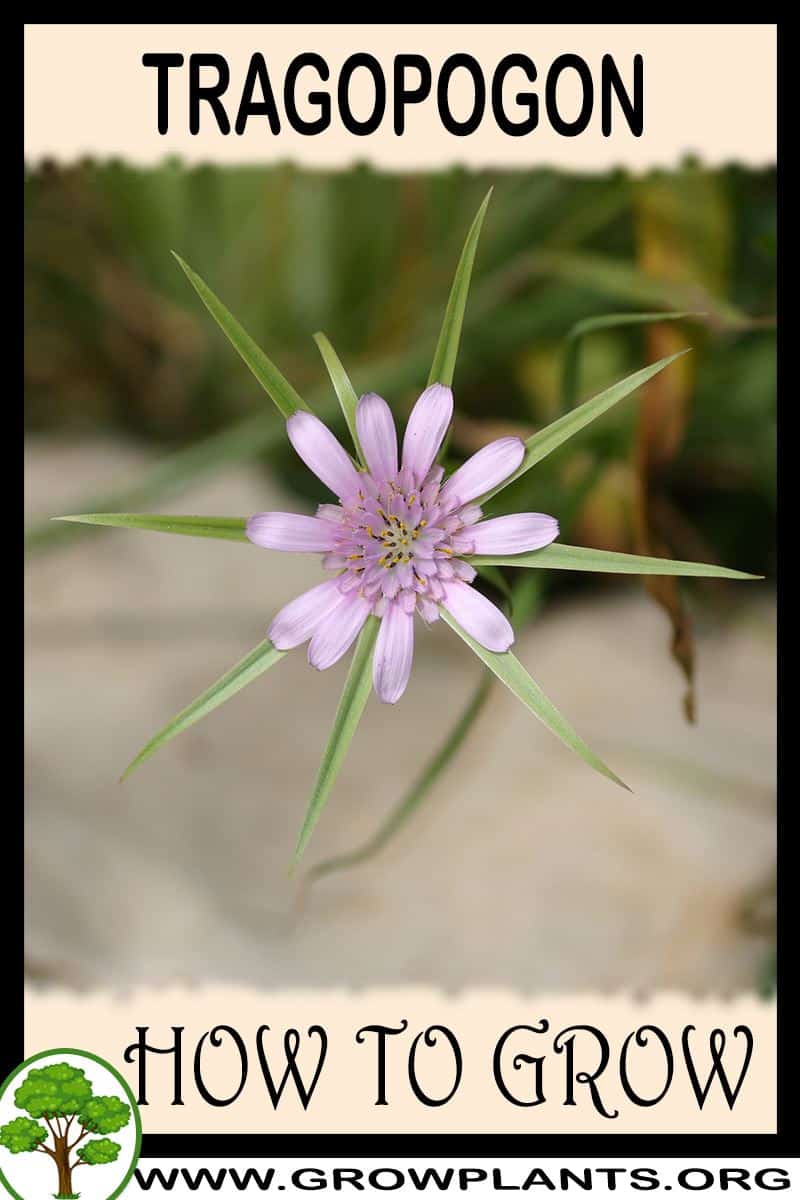
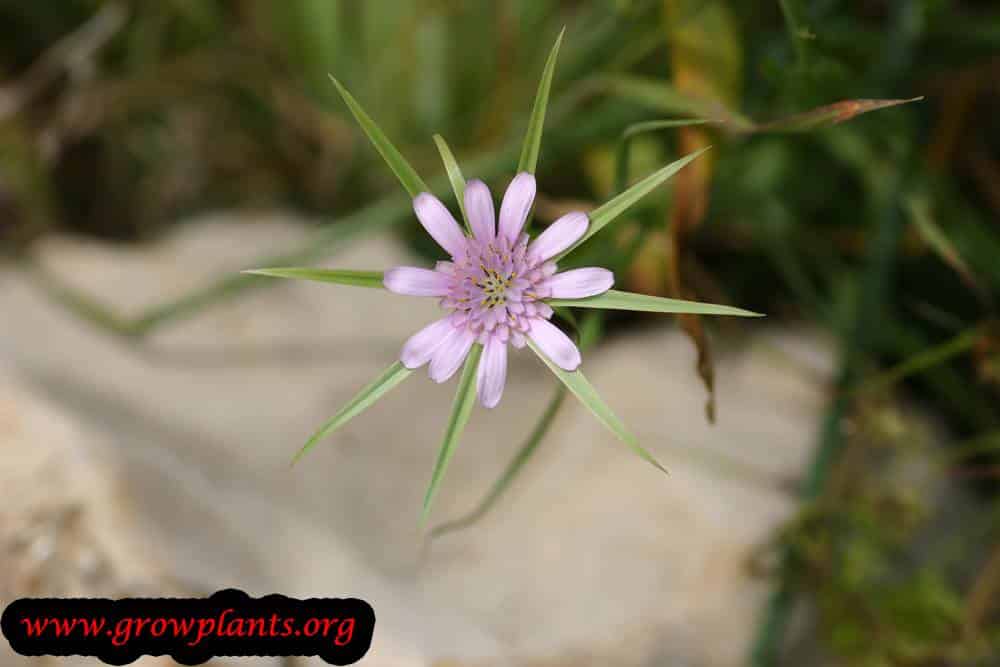
- Flower Characteristics: Solitary, dandelion-like composite flowers in purple, yellow, white or pink backed by long green spear-shaped bracts; blooms open in the morning and close by midday, followed by a large spherical seed-head (a giant ‘dandelion clock’) dispersed by wind.
Primary Uses & Landscape Value
- Edible Uses: Salsify (T. porrifolius) is grown for its edible, oyster-flavoured taproot; young shoots, and the flower buds and roots of several species, are also eaten cooked.
- Functional & Ornamental Roles: Cottage-garden, meadow and pollinator wildflower; ornamental grown for its flowers and striking seed-heads; some species self-seed freely and can be weedy.
Care Guide: Planting, Soil & Watering
Overview: Tragopogon (salsify / goatsbeard) is an easy, sun-loving plant that asks for little more than a position in full sun to light shade and light, well-drained soil. It is fairly drought-tolerant once established, needing only low to moderate watering.
Quick Care Requirements
| Requirement | Ideal Condition |
|---|---|
| Planting Season | In spring or early summer, once the soil has warmed |
| Growth Rate | Moderate to fast |
| Soil Type | Light, well-drained soil |
| Water Need | Low to moderate — let the soil dry somewhat between waterings; tolerant of dry spells |
Planting & Establishment
- Best Planting Season: Plant in spring or early summer, once the soil has warmed and the risk of hard frost has passed.
- How to Plant:
- Hole Preparation: Loosen and cultivate the soil deeply so the long taproot can develop freely.
- Soil Amendments: Keep the soil light and free-draining; avoid heavy, waterlogged ground that rots the root.
- Planting Depth: Set the plant at the same depth it was growing, with the crown at soil level.
- Growth Speed & Expectations: Moderate to fast, quickly forming a clump and sending up flowering stems.
Soil, Watering & Drainage Care
- Soil Mix & Drainage Needs: Light, sandy or loamy free-draining soil; good drainage is the main safeguard against taproot rot.
- Watering Schedule & Technique:
- Young / Newly Planted: Keep lightly moist until the plant establishes and roots down.
- Established: Water only when the soil dries; established plants are notably drought-tolerant.
- Seasonal Adjustments: Water a little more during prolonged heat and taper off in cool, wet weather.
Climate, Light & Hardiness
Salsify/goatsbeard is an exceptionally cold-hardy, adaptable plant, grown as a perennial, biennial, or annual across an unusually wide climate range from cold-temperate to desert and mediterranean regions (USDA zone 2–11). It grows well in full sun to half shade and shrugs off both hard winters and hot, dry summers.
Quick Climate Specifications
| Climate Zones | Mediterranean, Desert, Subtropical, Temperate |
|---|---|
| USDA Hardiness Zones | 2–11 |
| Frost Tolerance | High |
| Light Conditions | Full Sun to Half Shade |
Sunlight & Light Exposure
Optimal Light Setup
Full sun gives the strongest growth and best flowering/seed set; half shade is tolerated without major issue.
Temperature Extremes & Hardiness
USDA Hardiness & Regional Limits
One of the more cold-hardy plants in this range, growing as a perennial, biennial, or annual anywhere from zone 2 (severe continental winters) to zone 11 (essentially frost-free). Winter cold is largely what determines whether it persists as a longer-lived perennial or behaves as an annual/biennial in the harshest climates.
Cold Damage & Winter Protection
Established plants tolerate hard freezes with little to no protection needed; in the coldest zones top growth dies back over winter and the plant regrows from the root or crown.
Frost Sensitivity
Low - this is a genuinely frost-hardy plant, not merely frost-tolerant.
Extreme Heat Tolerance
Good; its suitability for desert and mediterranean climates shows real tolerance of hot, dry summer conditions.
Wind, Humidity & Microclimate
Rainfall & Seasonal Moisture
Comfortable in both drier mediterranean/desert rainfall patterns and wetter temperate ones, reflecting its unusually wide climate range.
Growing in Pots, Balconies & Indoors
Tragopogon (salsify / goat’s beard) is a sun-loving biennial, 10-120 cm, grown for its edible taproot and pretty daisy-like flowers. It is not a houseplant, but the grower confirms it grows in containers – a deep pot on a sunny patio or balcony suits its long root.
Quick Details
- Container Size: A deep pot (at least 30 cm / 12 in deep) to accommodate the long taproot
- Indoor Suitability: Not an indoor plant – it needs full outdoor sun
- Best Spot: Full sun to part shade, outdoors
- Soil & Drainage: Deep, loose, free-draining mix so the root can grow straight
- Watering in Pots: Small to average – keep lightly moist; avoid waterlogging
Indoors & On the Windowsill
- Not a houseplant: The grower marks it ‘No’ – it is a sun-loving root crop, unsuited to a room interior.
- Windowsill: Not a windowsill plant; grow it outdoors in a deep container for a usable root.
- Season: As a biennial it makes its root the first year and flowers the next – grow it in a deep pot and lift the root as needed.
On a Balcony or Patio
- Light & depth: Give it full sun and a deep pot; the loose, stone-free mix lets the taproot grow long and straight.
- Watering: Keep the deep pot evenly but lightly moist – steady moisture gives the best roots without splitting.
Choosing the Pot, Soil & Long-Term Care
- Pot & drainage: A deep pot with good holes; skip a standing water saucer to avoid root rot. Depth matters more than width for the taproot.
- Potting mix: A loose, free-draining, stone-free blend – potting mix with added sand for a smooth root.
- Feeding: Feed modestly; too much nitrogen gives leaf at the expense of root.
- Longevity: Grown for its root, it needs no long-term repotting – sow fresh each season.
Fertilizing & Feeding
A light feeder that grows well in average, well-drained soil; it needs little more than occasional balanced feeding to flower reliably.
Quick Fertilizing Specs
| Feeding Level | Light feeder |
|---|---|
| Main Nutrient Priority | Balanced, general-purpose feeding used sparingly |
| Best Feeding Period | Spring, as new growth begins ahead of flowering |
| Organic Options | Compost worked into well-drained soil at planting |
| Micronutrients | Usually adequate from average garden soil; correct specific issues only when diagnosed |
| Soil pH | Tolerates a wide range provided the soil is well drained |
| Reduce/Stop Feeding | Stop feeding once flowering and seed set finish for the season |
Feeding by Growth Stage
Spring growth
Support steady leaf and stem growth ahead of flowering.
| Nutrient direction | A balanced, general-purpose fertilizer to support even growth. |
|---|---|
| Timing | In spring as new growth begins. |
| Frequency | Light, occasional feeding is usually enough for this easy-growing plant. |
| Fertilizer types | A balanced general-purpose garden fertilizer, Compost worked into well-drained soil |
| Precautions | Keep feeding light; this plant grows well in average soil and heavy feeding tends to produce lank, floppy growth. |
Flowering period
Support good flower production through the bloom period.
| Nutrient direction | Continue with light, balanced feeding rather than switching to a specialty bloom formula. |
|---|---|
| Timing | Through the spring-to-summer bloom period. |
| Frequency | Rarely needs feeding beyond what was applied earlier in the season. |
| Fertilizer types | Generally very little additional feeding beyond the earlier balanced application, A very light balanced feed only if growth looks weak |
| Precautions | Avoid heavy or high-phosphorus feeding for bloom; a balanced approach with adequate overall nutrition supports flowering better than pushing any single nutrient. |
Post-bloom decline and rest
Let the plant wind down naturally after flowering and seed set.
| Nutrient direction | None – withhold fertilizer once flowering and seed formation finish. |
|---|---|
| Timing | From late summer through autumn and winter, after flowering and seed dispersal. |
| Frequency | No feeding at this stage. |
| Fertilizer types | No feeding at this stage – allow the plant to decline naturally or rest through winter |
| Precautions | Do not fertilize after bloom finishes; late feeding does not benefit a plant that is naturally winding down or going dormant. |
Nutrient Deficiency Signs & Corrections
Stems grow tall, thin, and floppy, sometimes with reduced flowering.
| Possible causes | excess nitrogen feeding, insufficient sun exposure, overcrowded planting |
|---|---|
| Appears first on | overall stem growth |
| What to check | recent feeding amounts, hours of direct sun, spacing between plants |
| Possible correction | Reduce or pause supplemental feeding and confirm the planting gets full sun; this plant generally performs well in average, unenriched soil. |
Foliage yellows and wilts and the plant may collapse despite otherwise adequate care.
| Possible causes | poorly drained or waterlogged soil, overwatering, root disease favored by consistently wet conditions |
|---|---|
| Appears first on | lower leaves and the root crown |
| What to check | soil drainage, recent watering, planting site grading |
| Possible correction | Improve drainage and reduce watering; this plant prefers well-drained soil and does not tolerate wet conditions. |
Leaves appear uniformly pale or yellowish rather than healthy green, with weak overall growth.
| Possible causes | nutrient-poor or depleted soil, compacted soil restricting root growth, insufficient sunlight |
|---|---|
| Appears first on | overall foliage color |
| What to check | soil richness and structure, root growth and compaction, light exposure |
| Possible correction | Work compost into the soil and confirm light and drainage are adequate before adding fertilizer. |
Pruning, Training & Seasonal Maintenance
Tragopogon is a fast-growing, herbaceous, largely biennial wildflower with no woody structure, so pruning is limited to light seasonal tidying rather than any shaping or renewal cuts. Because many Tragopogon plants flower and set their windborne, puffball-style seed heads in their second year and then decline, most of what looks like pruning is really end-of-cycle cleanup, done in autumn/winter once top growth has died back, not a cut meant to stimulate fresh regrowth.
Quick Pruning & Maintenance Specs
| Pruning Tolerance | Low |
| Primary Maintenance Window | Autumn/Winter, once foliage has died back |
| Main Objective | Remove dead top growth; optionally deadhead spent flower/seed stalks to limit self-seeding |
| Best Tool Type | Precision snips |
| Avoid Heavy Handling During | Active flowering, since cutting then removes the bloom (and pollinator interest) the plant is grown for |
Pruning by Plant Age & Size
Newly Established
No cutting needed.
Young / Formative
No training applies – this is a taprooted wildflower with no branching framework to shape.
Mature / Established
After bloom, choose whether to deadhead spent flower stalks before their wind-dispersed seed heads mature (to control spread, since some species in this genus can be regionally invasive) or leave them, since both the flowers and the ornamental puffball seed heads have display and wildlife value.
Seasonal Pruning Schedule
Dormant/Winter
Objective: clear dead top growth once foliage has died back, including from biennial plants that have finished flowering their second year. Remove: collapsed, dead stems. Do not remove: the basal rosette of a first-year (non-flowering) plant, which needs to overwinter before it can bloom.
Special Growth to Remove
- Spent flower/seed stalks – the main thing worth managing, since the wind-dispersed seed heads are how this genus self-sows and, in some species, naturalizes beyond where it was planted.
Container & Small-Space Pruning
Where grown in a container or a bed where volunteer seedlings are unwanted, deadhead more assertively before seed heads open to prevent it self-sowing into surrounding soil.
Tools
- Precision snips – the only tool this soft-stemmed wildflower’s tidying and deadheading calls for.
Tool Hygiene & Disease Risk
Routine: clean, sharp snips are sufficient; no significant transmissible disease risk is documented for this genus.
Cut Placement & Technique
Cut spent flowering stems near the base of the plant, close to the basal rosette, once bloom has finished.
Heavy Pruning & Rejuvenation
Not applicable – this taprooted wildflower is not renewed by cutting back. A declining plant after its flowering cycle is simply cleared away and replaced by self-sown or freshly sown seedlings, not rejuvenated by pruning.
Post-Pruning Care
No special aftercare beyond normal watering; feeding is not needed.
Common Pruning Mistakes
- Deadheading so aggressively that the genus’s signature ornamental seed puffballs never get to form and display.
- Leaving all seed heads to mature and disperse where self-seeding or spread is unwanted.
When NOT to Prune
Avoid cutting flower stems while still in bloom if grown for its flowers or for pollinators, and avoid disturbing a first-year rosette, which must persist through winter before it can flower.
Recommended Tools (by task)
- precision_snips – covers the only cuts this plant needs: deadheading spent flower/seed stalks and clearing dead top growth.
Propagation Guide
Tragopogon is grown from seed – it is not propagated vegetatively – and, sown where it is to grow, is an easy plant to raise. Several Tragopogon species readily cross-pollinate where grown near each other (the genus is well known among botanists for producing natural hybrids), so seed saved from a garden with more than one species may not come fully true to the parent.
Quick Propagation Specs
| Best Propagation Method | Seed |
| Propagation Difficulty | Easy |
| Seed True-to-Type | Usually true-to-type when only one species is grown; hybrid offspring may occur where multiple species are grown together |
| Best Propagation Season | Spring to summer |
Growing from Seed
Sowing Season
Spring to summer.
Sowing Depth & Orientation
Direct-sow where the plant is to grow. Like other taprooted plants, Tragopogon develops a long central taproot early on and generally transplants poorly once established, so starting seed in place (or in deep cells/pots if starting under cover) is preferable to bare-root transplanting.
Germination Conditions
Well-drained soil. The seed’s feathery, dandelion-like pappus is adapted for wind dispersal, so sow it promptly rather than storing it loose for long periods.
Bloom & Edible Flower Guide
Quick Details
- Bloom Season: Late spring into summer
- Time to First Bloom: Usually in its second year (it is often biennial)
- Flower Appearance: Dandelion-like daisy heads in purple, yellow, white or pink, backed by long pointed green bracts
- Edibility: Flower buds and petals are edible
Detailed Blooming Overview
Salsify opens its starry, dandelion-like flowers in the morning and often closes them again by midday. The long green bracts poking out past the petals are a sure sign of the genus.
Flower Characteristics
- Single daisy-like heads in purple, yellow, white or pink.
- Narrow, pointed bracts extend beyond the ray florets; the flowers open with the sun.
Bloom Care & Thinning
- Conditions: little is needed beyond sun and free drainage.
- Edible use: young flower buds and petals can be added to salads.
- For interest: leave some heads to form the ornamental seed “clocks”.
Fruit & Uses
Within the genus Tragopogon, the cultivated salsify (Tragopogon porrifolius) is grown for its long tapering root, which is cooked before eating, and the young shoots and leaves of several Tragopogon species have a history of being eaten as a foraged spring green. This site entry is genus-level rather than naming a single confirmed species, so treat any specific plant as edible only after you have confirmed exactly which Tragopogon species it is.
Quick Edible Specs
| Edible Parts | Root (notably in cultivated salsify); young shoots and leaves in some species |
|---|---|
| Main Use(s) | Culinary – root vegetable; shoots/leaves as a cooked green |
| Eaten Raw or Cooked | Root: cooked (boiled, roasted or mashed). Young shoots/leaves: usually cooked, occasionally eaten raw when very young and tender |
| Preparation Required | Peel root; cook to soften and mellow bitterness; hold peeled root in water to limit browning |
| Harvest Season | Roots are traditionally lifted in autumn to winter, before the plant bolts and flowers in spring (see the site’s own Bloom season data for this plant’s flowering time) |
| Time to First Harvest | Roots reach usable size within a single growing season in species grown as biennials/annuals for their root |
| Storage | Roots store similarly to other root vegetables – cool, humid conditions for a period of weeks |
| Safety/Toxicity Caveat | Confirm the exact Tragopogon species before eating – edible use is best documented for cultivated salsify (T. porrifolius); do not assume every Tragopogon species or wild-collected plant is equally safe or palatable, and take care with identification among similar-looking composite (daisy-family) wildflowers |
Roots & Tubers
The edible root is a single long, tapering taproot, harvested before the plant flowers (once it bolts, the root becomes woodier and more fibrous). It is dug rather than pulled to avoid snapping, peeled, and typically boiled, roasted or mashed like a parsnip; the cut surface and sap can discolour hands and darken quickly, so some cooks hold peeled roots in water until cooking.
Shoots & Stems
Young spring shoots and leaves, gathered before flowering, have a history of being cooked as a mild green in a similar way to spinach or chard; once the plant sends up its flowering stalk the foliage toughens and turns bitter, so harvesting leaves/shoots and leaving the plant to flower and set its wind-dispersed seed heads are competing uses.
Preparation, Uses & Safety
Peel and cook the root before eating; young shoots and leaves are best cooked as well, though very young growth is sometimes eaten raw. Because this listing covers the genus rather than one named species, do not forage or eat any Tragopogon plant without first confirming the species – the culinary track record is strongest for cultivated salsify, and using an unconfirmed wild plant is not recommended.
Pests, Diseases & Troubleshooting
Overview: Tragopogon (salsify and goat’s-beard) is a tough, largely self-reliant biennial in the daisy family, grown for its edible taproot or its meadow flowers. Its signature problems are white blister (a downy-mildew relative almost unique to this genus), the usual soft-bodied sap-suckers, and cultural root faults borrowed from other root crops. Prioritise clean rotation, open airy spacing and good soil preparation, treating chemicals as a last resort.
Quick Troubleshooting Overview
| Issue / Pest | Main Symptom | Primary Solution |
|---|---|---|
| White blister / white rust | Glistening white, blister-like pustules on leaves and stems | Remove infected leaves, rotate crop, space for airflow |
| Aphids | Colonies on shoot tips and flower buds; honeydew, distorted growth | Water jet, encourage beneficials, insecticidal soap if severe |
| Slugs & snails | Seedlings and young leaves grazed; slime trails | Hand-pick, barriers, iron-phosphate bait |
| Powdery mildew | White powdery film on leaves in dry, crowded conditions | Improve spacing and airflow; sulphur if persistent |
| Forked / split roots | Distorted, branched, or cracked taproots | Deep, stone-free, un-manured soil; even watering |
| Bolting | Premature flower stalk; root turns woody | Sow in season, keep evenly watered, avoid stress |
Common Pests & Management
- Aphids (Aphis / Uroleucon spp.):
- Symptoms: Soft green or dark colonies on growing tips, leaf undersides and flower buds; sticky honeydew, sooty mould and puckered new growth. They can also spread viruses.
- Prevention & Control: Dislodge with a water jet and squash small colonies. Encourage ladybirds, lacewings and hoverflies with nearby flowers. Use insecticidal soap or a light neem spray only for heavy infestations, coating the undersides.
- Slugs & snails:
- Symptoms: Emerging seedlings and tender young leaves grazed to stumps, with tell-tale silvery slime trails; worst in damp, cool spells.
- Prevention & Control: Hand-pick after dark, clear damp hiding places, protect seedlings with grit or copper barriers, and use iron-phosphate bait where pressure is high.
- Leaf miners (Agromyzid flies):
- Symptoms: Pale, winding tunnels or blotches inside the grassy leaves where larvae feed between the surfaces.
- Prevention & Control: Pick off and destroy mined leaves, hoe out related weeds that host them, and use insect-proof mesh over young rows; damage is usually cosmetic on an established plant.
- Thrips (Thrips spp.):
- Symptoms: Silvery flecking and tiny black excrement spots on leaves and flowers in hot, dry weather.
- Prevention & Control: Keep plants unstressed and watered, hang blue sticky traps, support predatory mites and pirate bugs, and spray insecticidal soap only if numbers surge.
Diseases & Fungal Issues
- White blister / white rust (Albugo tragopogonis):
- Symptoms: The signature disease of this genus — shiny, raised, chalk-white pustules that burst to release powdery spores on leaves and stems, sometimes with distorted, swollen tissue.
- Treatment & Management: Remove and bin affected leaves at first sight, never compost them, rotate away from where salsify or wild goat’s-beard grew, and space plants for fast drying. Avoid overhead watering; copper can help in a bad, wet season.
- Powdery mildew (Erysiphe cichoracearum):
- Symptoms: Dusty white patches spreading over leaves in warm, dry, crowded conditions, leading to yellowing and early leaf loss.
- Treatment & Management: Thin and weed for airflow, water at the roots, and remove the worst leaves. A sulphur or potassium-bicarbonate spray checks stubborn cases.
- Downy mildew:
- Symptoms: Yellow blotches on the upper leaf with grey-purple fuzzy growth beneath during cool, wet, humid spells.
- Treatment & Management: Improve drainage and spacing, avoid wetting foliage, clear infected debris, and rotate crops; resistant sowing sites help more than sprays.
- Sclerotinia / crown & root rot (Sclerotinia sclerotiorum):
- Symptoms: Wilting plants with soft, watery rot at the crown or root, often bearing white cottony mould and hard black resting bodies.
- Treatment & Management: Remove and destroy infected plants with surrounding soil, avoid waterlogged ground, rotate widely, and never replant salsify into infected beds.
Growing Difficulties & Abiotic Problems
- Forked, split or hairy roots:
- Cause & Symptoms: Like carrots and parsnips, salsify roots fork and distort in stony, compacted or freshly manured soil, and split with erratic watering.
- Correction Strategy: Grow in deep, loose, stone-free soil manured for the previous crop (not fresh), and keep moisture even so roots swell steadily.
- Bolting (premature flowering):
- Cause & Symptoms: As a biennial, stress, heat, drought or a too-early sowing pushes it to throw a flower stalk in year one, turning the root woody and bitter.
- Correction Strategy: Sow in the proper season, keep plants evenly watered and unstressed, and lift roots before the stalk drains them.
- Poor or erratic germination:
- Cause & Symptoms: Salsify seed is short-lived and germinates unevenly if old, sown too dry, or too deep.
- Correction Strategy: Use fresh seed each season, sow into a fine, moist seedbed at the right depth, and keep the surface damp until seedlings appear.
- Waterlogging / root rot:
- Cause & Symptoms: Heavy, poorly drained soil rots the taproot and invites crown diseases; roots turn soft and foul.
- Correction Strategy: Improve drainage with grit and organic matter, grow on a raised bed if the ground is heavy, and avoid overwatering.
What Helps — Products & Tools
Most of the toolkit here is cultural: deep, stone-free soil preparation, sensible crop rotation and airy spacing prevent the worst. For pests, keep insecticidal soap and neem oil for aphids and thrips, iron-phosphate slug bait and copper or grit barriers for seedlings, and blue sticky traps for thrips. On the disease side, a copper spray helps against white blister and downy mildew in wet seasons, while sulphur or potassium-bicarbonate checks powdery mildew. Always follow the label and protect pollinators when the plant is in flower.