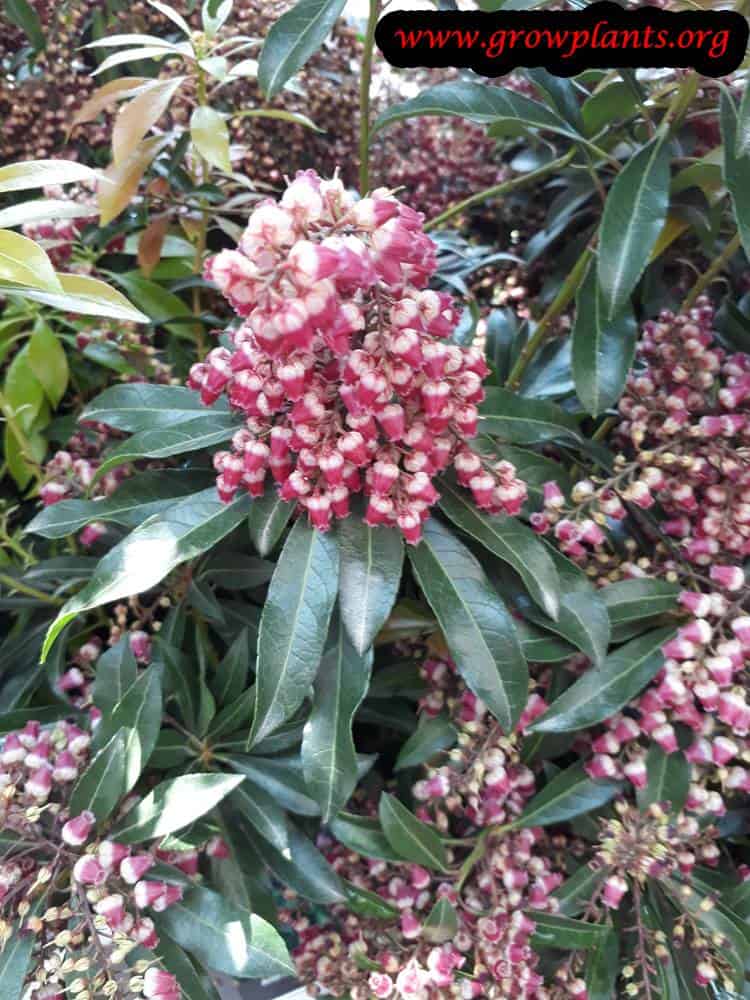
Plant Profile & Key Characteristics
Overview: Japanese pieris (Pieris japonica) is an evergreen shrub to small tree of 1–4 m (3–12 ft), grown for its cascading sprays of bell flowers and colourful red new growth. It is a popular ornamental and bonsai subject for acid, woodland-style plantings.
Quick Specifications
| Specification | Attribute |
|---|---|
| Plant Type / Life Cycle | Perennial evergreen shrub to small tree |
| Foliage Type | Evergreen |
| Mature Size | 1–4 m (3–12 ft) tall |
| Growth Rate | Slow to moderate |
| Root System | Shallow, fibrous root system (typical of the heath family) |
| Toxicity | Toxic — all parts contain grayanotoxins and are poisonous to people and pets if eaten |
| Hardiness | USDA zones 5–9 |
Growth Form & Structure
- Height & Spread: Usually a 1–4 m (3–12 ft) shrub; pruning decides whether it stays a dense shrub or is trained up as a small tree. It grows well in a container or as an indoor plant given acid, rich, moist soil.
- Growth Habit & Form: Bushy, rounded evergreen shrub with tiered branches; can be shaped into a multi-stemmed small tree or bonsai.
- Lifespan & Maturity: A long-lived perennial shrub that builds slowly to full size over several years.
Anatomy & Physical Features
- Leaves & Foliage: Glossy, elliptic pointed leaves that emerge bright red before maturing green; some forms are variegated with white or yellow margins.
- Flower Characteristics: Drooping clusters of small bell-shaped flowers in white, pink, purple or bicolours.
Primary Uses & Landscape Value
- Functional & Ornamental Roles: Ornamental shrub for acid borders, woodland edges and foundation plantings, prized for spring flowers and vivid new foliage; also grown as a container plant, houseplant and bonsai.
Care Guide: Planting, Soil & Watering
Overview: Pieris japonica is an ericaceous evergreen shrub that grows best in part shade in rich, acidic, moist but well-drained soil. It has shallow roots that like steady moisture, and it needs acid soil to thrive.
Quick Care Requirements
| Requirement | Ideal Condition |
|---|---|
| Planting Season | Spring to summer in the growing season |
| Growth Rate | Slow to moderate |
| Soil Type | Rich, humus-rich, moist but well-drained |
| Soil pH | Acidic (ericaceous, like azaleas and rhododendrons) |
| Water Need | Moderate — keep evenly moist, never letting the shallow roots dry out |
Planting & Establishment
- Best Planting Season: Plant in spring or summer during the active growing season.
- How to Plant:
- Hole Preparation: Dig a hole as deep as and about twice as wide as the root ball to loosen soil for the shallow roots.
- Soil Amendments: Enrich the backfill with acidic organic matter such as composted bark, leaf mould or ericaceous compost, and mulch to keep the roots cool and moist; avoid lime.
- Planting Depth: Set the root ball level with or barely above the surface, keeping the crown at soil level; the roots are shallow and dislike deep planting.
- Growth Speed & Expectations: Expect slow-to-moderate growth to a shrub or small tree 1–4 m tall.
Soil, Watering & Drainage Care
- Soil Mix & Drainage Needs: Acidic, humus-rich, well-drained soil is essential; in alkaline ground use ericaceous compost, and in a container use an acidic (ericaceous) potting mix.
- Watering Schedule & Technique:
- Young / Newly Planted: Keep the soil evenly moist while young plants establish, and mulch to conserve moisture around the shallow roots.
- Established: Water regularly so the root zone never dries out fully; it is not drought-tolerant. Use rainwater where the tap water is hard/alkaline.
- Seasonal Adjustments: Water more in summer heat and dry spells; reduce it in cool, wet weather.
Climate, Light & Hardiness
Japanese Andromeda is an evergreen flowering shrub for temperate and subtropical climates, growing well from full sun through half shade to full shade (though it flowers less in deep shade); it can also be grown as a houseplant. It is reliably hardy outdoors through USDA zones 5–9.
Quick Climate Specifications
| Climate Zones | Temperate, Subtropical |
|---|---|
| USDA Hardiness Zones | 5–9 |
| Frost Tolerance | High |
| Light Conditions | Full Sun / Half Shade / Full Shade (reduced flowering) |
Sunlight & Light Exposure
Optimal Light Setup
Grows across a wide light range from full sun to full shade, but flowering is best in full sun to half shade; deep shade keeps the plant healthy but reduces bloom.
Indoor Note
When kept as a houseplant, the site's own care notes recommend periodically moving it outdoors into full sun and then back inside - indoor light alone is not enough for it to thrive long-term.
Temperature Extremes & Hardiness
USDA Hardiness & Regional Limits
Hardy outdoors through USDA zones 5–9. RETAIN this outdoor cold limit even for plants kept indoors or in containers, since it describes how the plant would fare if moved outside in a given climate.
Frost Sensitivity
As an evergreen shrub within its hardy zone range, established plants tolerate winter frost well; fresh spring growth and flower buds are the more frost-sensitive stage.
Wind, Humidity & Microclimate
Microclimate Recommendations
A site sheltered from harsh winter wind helps protect flower buds and evergreen foliage from desiccation at the colder end of its range.
Growing in Pots, Balconies & Indoors
Pieris is an acid-loving evergreen shrub with showy new growth and lily-of-the-valley flowers. The grower rates it as both a houseplant and a container plant; indoors it does best in a cool, bright room, and it makes a fine long-term container shrub for a patio.
Quick Details
- Container Size: A large, deep pot – it is a shrub that grows 1-4 m over time
- Indoor Suitability: Rated a houseplant by the grower; best in a cool, bright room, not a hot one
- Best Spot: Full sun to part shade (it flowers less in deep shade)
- Soil & Drainage: Acid / ericaceous, free-draining, organic-rich mix – it will not tolerate lime
- Watering in Pots: Average to generous; keep evenly moist, ideally with soft, low-lime water
Indoors & On the Windowsill
- Houseplant, with conditions: The grower lists it as a houseplant; to succeed indoors give it a cool, bright spot and ericaceous compost – it dislikes hot, dry rooms.
- Overwintering: As an evergreen shrub it is easily kept in a pot and can be sheltered under cover in the hardest weather.
- Safety: Every part is highly toxic if eaten (it contains grayanotoxins) – keep it well away from children and pets, indoors or out.
On a Balcony or Patio
- Light & wind: A sunny to part-shaded balcony suits it; shelter it from cold, drying winds that scorch the evergreen leaves, and never let the acidic mix dry out.
Choosing the Pot, Soil & Long-Term Care
- Pot & drainage: A large pot with strong drainage holes; use rainwater where your tap water is hard.
- Acid mix: Ericaceous (lime-free), organic-rich, free-draining potting mix is essential.
- Feeding: Feed with an ericaceous fertiliser through the growing season, as potted soil is soon depleted.
- Repotting: Pot on or refresh the ericaceous mix every couple of years.
Fertilizing & Feeding
A moderate feeder that does best with an acid-forming fertilizer formulated for shrubs like azalea and rhododendron, applied lightly in spring rather than through repeated heavy feedings.
Quick Fertilizing Specs
| Feeding Level | Moderate – benefits from a light spring feeding as an acid-loving evergreen shrub |
|---|---|
| Main Nutrient Priority | Balanced, acid-forming feeding rather than any single nutrient push |
| Best Feeding Period | Early spring as new growth begins |
| Soil pH | Needs distinctly acidic soil; an acid-forming fertilizer helps maintain the right conditions |
| Reduce/Stop Feeding | Stop feeding by late summer so new growth has time to harden off before winter |
Feeding by Growth Stage
Spring flush and root establishment
Support new leaf growth and root establishment as red new growth flushes out on this acid-loving evergreen shrub
| Nutrient direction | A balanced, acid-forming fertilizer formulated for acid-loving shrubs supports steady growth without pushing too much soft new growth at once |
|---|---|
| Timing | In early spring as new growth begins, before flower buds fully open |
| Frequency | A light feeding at the start of spring growth is usually enough for an established shrub |
| Fertilizer types | A balanced fertilizer formulated for acid-loving shrubs (azalea/rhododendron/pieris type), Compost or acidic organic mulch worked lightly into the root zone |
| Routine trace nutrients | iron, manganese |
| Precautions | Keep fertilizer off the trunk and away from the root crown, and avoid heavy feeding that pushes excess soft growth susceptible to lace bugs or dieback |
Bell-flower bloom period
Maintain nutrition through the bell-shaped flower display without forcing extra late growth
| Nutrient direction | Continue a balanced, acid-forming feed at a light rate; heavy feeding during bloom is not needed |
|---|---|
| Timing | During the spring bloom period |
| Frequency | Light feeding is usually enough during bloom, and established shrubs often need little beyond the spring feeding |
| Fertilizer types | A balanced acid-forming shrub fertilizer, only if spring feeding was skipped or growth looks weak |
| Precautions | Avoid fertilizing directly onto open flowers or foliage, and don’t force late-season growth that won’t harden off before winter |
Winter rest for this evergreen shrub
Let growth slow naturally through the cooler months so the shrub is ready for its spring flush
| Nutrient direction | None – withhold fertilizer through the winter rest period |
|---|---|
| Timing | From late autumn through winter |
| Frequency | No feeding at this stage |
| Fertilizer types | No feeding at this stage; resume a light acid-forming feed as spring growth begins |
| Precautions | Do not fertilize during winter dormancy; late feeding can push tender growth that’s vulnerable to cold damage |
Nutrient Deficiency Signs & Corrections
New leaves emerge yellow with distinctly green veins, most visible on the newest growth
| Possible causes | Iron deficiency triggered by soil pH that’s too high (not acidic enough) for this acid-loving shrub, Poor drainage or waterlogged roots limiting nutrient uptake, Root damage from planting too deep or heavy mulch against the trunk |
|---|---|
| Appears first on | Newest leaves at branch tips |
| What to check | Soil pH – acid-loving shrubs need it on the acidic side, Drainage and whether roots sit in standing water, Mulch depth and whether it’s piled against the trunk |
| Possible correction | Correct pH toward acidic if testing shows it’s too high, and consider a chelated iron product per its label |
Overall pale, undersized leaves and a sparser-looking canopy than usual
| Possible causes | Nitrogen deficiency, Root competition or compacted soil restricting nutrient and water uptake, Too little organic matter in the root zone |
|---|---|
| Appears first on | Older, interior leaves and overall shrub density |
| What to check | Soil organic matter and mulch condition, Whether roots are compacted or the shrub was recently transplanted, How the canopy compares with previous seasons |
| Possible correction | Apply a balanced acid-forming fertilizer per its label and refresh the mulch/organic layer over the root zone |
Interveinal yellowing on older leaves, sometimes with a reddish or purplish tint
| Possible causes | Magnesium deficiency, more likely in sandy, well-leached soil, Potassium or calcium excess interfering with magnesium uptake, Natural autumn leaf coloring being mistaken for a deficiency |
|---|---|
| Appears first on | Older leaves lower and interior on the shrub |
| What to check | Leaf color pattern and whether it’s seasonal, Soil type and fertilizing history, Whether new growth still looks healthy green |
| Possible correction | Apply a balanced acid-forming fertilizer that includes magnesium per its label if the pattern persists outside of normal autumn coloring |
Pruning, Training & Seasonal Maintenance
Pieris japonica is a slow-to-medium growing broadleaf evergreen that flowers on wood formed the previous season, so pruning timing directly controls next spring’s bloom. It tolerates moderate pruning – light shaping, deadheading and occasional rejuvenation – but the single most important rule is to prune immediately after flowering, before the plant sets next year’s flower buds later in the season. Left alone it keeps a naturally neat, mounded to small-tree form, so structural work is mostly about maintaining that shape rather than imposing one.
Quick Pruning & Maintenance Specs
| Pruning Tolerance | Moderate |
| Primary Pruning Window | Immediately after flowering (spring) |
| Secondary Maintenance Window | Light deadheading/tidying through summer |
| Typical Frequency | Once a year, plus occasional light tidying |
| Main Objective | Maintain natural form; remove spent flower trusses; decide/maintain shrub vs. small-tree habit |
| Young Plant Priority | Select a single leader if a tree form is wanted, or leave multi-stemmed for a shrub form |
| Mature Plant Priority | Deadhead; remove crossing/weak interior growth; control size |
| Best Tool Type | Bypass secateurs; precision snips for deadheading |
| Avoid Heavy Pruning During | Late summer through winter, once next year’s flower buds have set |
Pruning by Plant Age & Size
Newly Established
Remove only damaged or dead growth in the first year or two; avoid shaping cuts until the root system is established.
Young / Formative
Decide early whether to grow it as a multi-stemmed shrub or train it toward a single-leader small-tree form (a popular use for this species, including as bonsai) by selecting one strong central stem and removing competing leaders.
Mature / Established
Focus on deadheading spent flower trusses, thinning crossing or overly twiggy interior growth for light and air movement, and keeping the plant within its 1–4 m size range.
Seasonal Pruning Schedule
Post-Flowering (old-wood bloomer): as soon as the flowers fade, remove spent trusses and do any shaping or size-reduction cuts. This is the only real structural window – because flower buds for the following spring form on this year’s new growth shortly after bloom, pruning any later in the year (including autumn or winter) removes next year’s flowers before they open.
Ongoing Sanitary: remove dead, diseased or winter-damaged twigs as noticed, any time of year.
Flowering & Fruiting Wood
Pieris japonica blooms on wood formed during the previous growing season – flower buds are set on new shoots not long after the current bloom finishes. Pruning right after flowering removes none of next year’s buds; pruning in autumn, winter or early spring cuts off wood that is already carrying the coming season’s flowers.
Structural Pruning & Training
Remove crossing or rubbing branches and thin dense interior twiggy growth to keep airflow through the canopy. Height and spread can be controlled by cutting back leaders just after flowering; because the species holds a naturally tidy mounded form, only light corrective thinning is usually needed rather than heavy reshaping.
Special Growth to Remove
- Spent flower trusses (deadheading) – improves appearance and redirects energy from seed production into next season’s growth.
- Dead, weak or crossing interior twigs.
Container & Small-Space Pruning
Also grown in containers and as a houseplant taken outdoors seasonally, and popular for bonsai. Container specimens benefit from the same post-flowering timing but slightly harder annual shaping to keep the plant in scale with the pot; watch root-to-canopy balance and repot before roots become congested rather than compensating with heavier top pruning.
Tools
Bypass secateurs for stem and truss removal; precision snips for fine deadheading work.
Tool Hygiene & Disease Risk
Increased – Pieris and other Ericaceae are susceptible to Phytophthora root and stem dieback, especially in poorly drained soil. Remove and dispose of any dieback wood promptly and clean tools before moving between plants if any dieback or canker symptoms are present.
Cut Placement & Technique
Use thinning cuts back to a healthy bud or side shoot rather than shearing the whole canopy – shearing destroys the natural mounded form and indiscriminately removes flower buds. Deadhead by cutting the spent truss stem back to just above the nearest healthy bud or leaf whorl.
Heavy Pruning & Rejuvenation
Tolerates a harder rejuvenation cut-back on leggy or overgrown plants, best done right after flowering; expect a lighter bloom for a season or two while the plant regrows and resets its flower-bud cycle.
Post-Pruning Care
Water normally through the post-pruning flush; if a significant amount of canopy was opened up, watch new interior growth for sunscald until it hardens off. No need to fertilize specifically in response to pruning.
Common Pruning Mistakes
- Pruning in autumn or winter, which removes the flower buds already set for next spring.
- Shearing into a ball shape instead of selective thinning, which spoils the natural form and reduces flowering.
- Cutting in poorly drained, waterlogged soil conditions without addressing drainage, which increases Phytophthora risk.
When NOT to Prune
Avoid pruning from mid-summer through winter, once next year’s flower buds have formed; avoid pruning during active flowering if the current display is wanted.
Recommended Tools (by task)
- Bypass secateurs – for stem shaping and rejuvenation cuts on woody growth.
- Precision snips – for deadheading spent flower trusses without damaging nearby buds.
Pruning Troubleshooting
| Problem | Possible Cause | What to Check | Corrective Action |
| Few or no flowers the following spring | Pruned in the wrong season | Was pruning done in autumn/winter instead of right after flowering? | Shift pruning to immediately after bloom going forward |
| Branch dieback | Phytophthora root/stem disease, often linked to wet soil | Discolored wood, wilting sections, soil drainage | Prune well below symptomatic wood, dispose of debris, improve drainage |
| Sparse, leggy interior | Insufficient light or lack of renewal pruning | Canopy density, surrounding shade | Thin crossing/twiggy growth after flowering to open the interior |
| Flat, sheared appearance with poor bloom | Sheared instead of selectively thinned | Cut pattern on the plant | Switch to thinning cuts back to buds/side shoots |
Propagation Guide
Pieris japonica is best propagated from semi-ripe (semi-hardwood) stem cuttings, which preserve a named cultivar’s flower color and colorful new growth exactly. Seed is possible for the species but is very fine, slow to raise, and will not reproduce cultivar traits true-to-type, so cuttings are strongly preferred for garden-worthy plants. Rooting takes patience and humidity control, making this a moderate-difficulty plant to propagate at home.
Quick Propagation Specs
| Best Propagation Method | Semi-Hardwood Stem Cuttings |
| Alternative Methods | Seed (species only) |
| Propagation Difficulty | Moderate |
| Seed True-to-Type | Cultivar-dependent – species seed is usually true, named cultivars are not |
| Vegetative True-to-Type | Yes |
| Best Propagation Season | Mid to late Summer, once new growth has firmed up |
| Cutting Rooting Time | Typically several weeks to a few months under warm, humid conditions |
Growing from Seed
Seed Handling & Viability
Seed is very fine and dust-like; sow it reasonably soon after collection for best results.
Sowing Depth & Orientation
Surface-sow onto a moist, acidic seed mix and do not cover, as light aids germination.
Germination Conditions
Warm, humid conditions with consistent moisture; an acidic, well-drained mix matching the plant’s preferred rich, slightly acid soil helps.
Seedling Care
Seedlings are slow to develop and are best left undisturbed for some time before pricking out.
Stem Cuttings
Cutting Type
Semi-hardwood tip cuttings, roughly 8–12cm, taken from the current season’s growth once it has begun to firm at the base.
Best Timing
Mid to late summer.
Cutting Preparation
Remove the lower leaves, wound the base lightly, and dip the cut end in rooting hormone.
Rooting Setup
A free-draining, acidic cutting mix (for example peat/perlite) under high humidity (mist or a covered propagator) roots best.
Rooting Hormone
Beneficial – Pieris can be slow to root and hormone treatment improves success.
Rooting Time
Often several weeks to a few months; keep humidity high throughout.
Bloom & Flower Guide
Quick Details
- Bloom Season: Late winter into spring
- Flower Appearance: Cascading clusters of small urn-shaped bells in white, pink or bicoloured
- Edibility: None — all parts are highly toxic, do not eat
Detailed Blooming Overview
Pieris japonica opens drooping panicles of lily-of-the-valley-like bells from late winter, often set off by bright red new foliage. The flower buds form in autumn and colour up through winter before opening.
Flower Characteristics
- Small urn- or bell-shaped flowers in white, pink or purple, sometimes two-toned.
- Carried in long, drooping sprays that can smother the shrub.
Bloom Care & Thinning
- Conditions: acid soil and shelter from cold drying winds protect the overwintering buds.
- Safety: every part, including the flowers and nectar, contains grayanotoxins and is highly toxic — never eat any part.
Pests, Diseases & Troubleshooting
Overview: Pieris (Japanese andromeda) is an acid-loving evergreen whose classic problems are the andromeda lace bug on sun-stressed plants and Phytophthora root rot in heavy, wet soils. Like its relatives rhododendron and azalea it insists on acidic, humus-rich, sharply drained ground and a cool, part-shaded root run; most trouble traces back to soil that is too wet, too alkaline, or a site that is too hot and dry. Get the site right and it is largely self-caring.
Quick Troubleshooting Overview
| Issue / Pest | Main Symptom | Primary Solution |
|---|---|---|
| Andromeda lace bug | Coarse yellow-white stippling on upper leaves; dark tar-spots beneath | Wash off; horticultural oil/insecticidal soap on leaf undersides; shade & moisture reduce it |
| Spider mites | Fine bronzing and stippling in hot, dry spots | Rinse foliage; horticultural oil; keep plant cool and moist |
| Scale | Bumps on stems, sticky honeydew, sooty mold | Prune heavy infestations; horticultural oil, dormant and on crawlers |
| Phytophthora root rot | Wilting, dull foliage, dark rotted roots in wet soil | Improve drainage; never overwater; remove badly affected plants |
| Leaf spot | Round brown/purple-edged spots | Improve airflow, remove spotted leaves; copper if persistent |
| Chlorosis | Yellow leaves with green veins in limy soil | Acidify soil; apply iron chelate and sulfur |
Common Pests & Management
- Andromeda lace bug (Stephanitis takeyai):
- Symptoms: The signature pest: adults and dark spiny nymphs feed on leaf undersides, giving a coarse yellow-white stippling on the upper surface and telltale shiny black ‘tar spots’ (excrement) beneath; badly hit plants look bleached and weak. Worst on plants in too much sun and drought stress.
- Prevention & Control: Site in cool part-shade with steady moisture, which greatly reduces attack. Inspect leaf undersides from spring and knock down early generations with a firm water spray; treat undersides with insecticidal soap or horticultural oil, repeating for successive generations. Spray in the evening to protect pollinators.
- Spider mites (Oligonychus ilicis, Tetranychus urticae):
- Symptoms: Fine pale stippling and bronzing of foliage in hot, dry positions, sometimes with faint webbing; leaves lose luster.
- Prevention & Control: Relieve heat and drought stress and rinse foliage undersides. Horticultural oil or insecticidal soap controls outbreaks; avoid broad insecticides that kill the predatory mites keeping them in check.
- Scale insects (Coccidae / Diaspididae):
- Symptoms: Immobile brown or waxy bumps along stems and leaf midribs, with sticky honeydew and sooty mold from soft scales.
- Prevention & Control: Prune out heavily encrusted wood, and treat crawlers and overwintering stages with horticultural oil (a dormant application plus a follow-up when crawlers are active); encourage parasitic wasps and lady beetles.
- Root-knot nematode (Meloidogyne spp.):
- Symptoms: Poor vigor, yellowing and dieback disproportionate to top growth, with galls or knots on fine roots in warm sandy soils.
- Prevention & Control: There is no rescue spray; improve soil organic matter, keep plants vigorous, and avoid moving infested soil. Replace badly affected plants and choose clean stock.
Diseases & Fungal Issues
- Phytophthora root and crown rot (Phytophthora cinnamomi):
- Symptoms: The major killer: foliage dulls, wilts and yellows despite moist soil, branches die back, and roots turn brown and mushy; common in heavy or waterlogged ground.
- Treatment & Management: Prevention is everything — plant high in sharply drained, acidic, organic soil, never let the root zone stay saturated, and avoid deep mulching against the stem. Remove and destroy collapsing plants; soil drenches only slow, not cure, established infections.
- Leaf spot (Phyllosticta, Pestalotiopsis, Alternaria spp.):
- Symptoms: Round brown to purple-bordered spots, sometimes merging, on older or stressed leaves in humid conditions.
- Treatment & Management: Improve air movement, avoid overhead watering, and remove and destroy spotted and fallen leaves. A copper-based fungicide helps only where spotting is persistent and severe.
- Dieback / stem blight (Botryosphaeria, Phytophthora spp.):
- Symptoms: Individual shoots or branches wilt, brown and die back, often from a stressed or wounded point.
- Treatment & Management: Prune dead wood back to healthy tissue in dry weather, sanitizing tools between cuts, and correct the underlying stress (drainage, drought, sunscald) rather than relying on sprays.
Growing Difficulties & Abiotic Problems
- Lime-induced chlorosis:
- Cause & Symptoms: In alkaline soil the plant cannot take up iron, so new leaves yellow between green veins; a direct consequence of the wrong pH.
- Correction Strategy: Test and acidify the soil with elemental sulfur, mulch with an acidic organic mulch, and apply iron chelate for a quick correction; long-term, keep pH low and use rainwater where tap water is very hard.
- Leaf scorch / sun stress:
- Cause & Symptoms: Hot afternoon sun and drought brown leaf margins and predispose the plant to lace bug and mites.
- Correction Strategy: Site in cool dappled shade with a moisture-retentive, mulched root zone and shelter from drying wind; keep evenly moist but never waterlogged.
- Frost damage to buds and new growth:
- Cause & Symptoms: Late frosts brown the conspicuous flower buds and tender new shoots.
- Correction Strategy: Plant in a sheltered spot out of frost pockets and early-morning sun; damaged growth is pruned out and usually replaced the same season.
What Helps — Products & Tools
Useful tools are insecticidal soap and horticultural oil for lace bug, mites and scale, a copper fungicide for stubborn leaf spot, and soil sulfur plus iron chelate to keep the soil acidic; the most important ‘product’ is sharp drainage and an acidic, organic mulch. Spray oils and soaps in the evening to protect bees.