



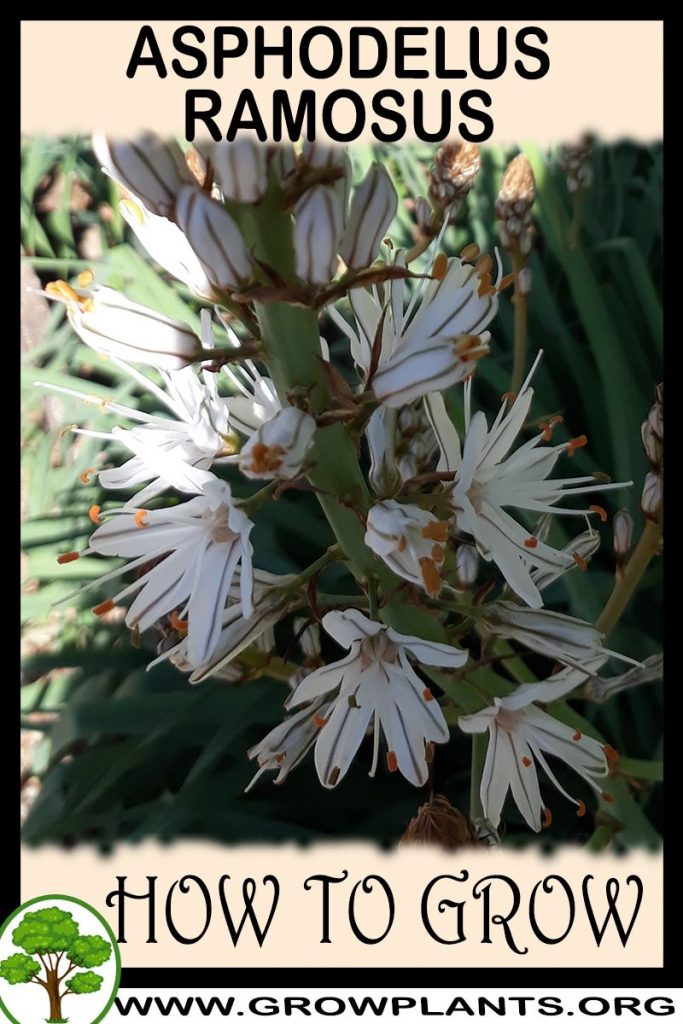
Plant Profile & Key Characteristics
Overview: Branched asphodel is a herbaceous perennial or annual forming a rosette 30-60 cm (12-24 in) tall with tall branched flower spikes. It is grown as an ornamental in dry, mediterranean-style gardens.
Quick Specifications
| Specification | Attribute |
|---|---|
| Plant Type / Life Cycle | Perennial or annual (herbaceous) |
| Foliage Type | Deciduous |
| Mature Size | 30-60 cm tall (12-24 in) |
| Growth Rate | Fast to moderate |
| Root System | Fleshy tuberous roots |
| Hardiness | USDA zones 7-10 |
Growth Form & Structure
- Height & Spread: 30-60 cm (12-24 in) tall in leaf with much taller branched flower spikes; can be grown in containers.
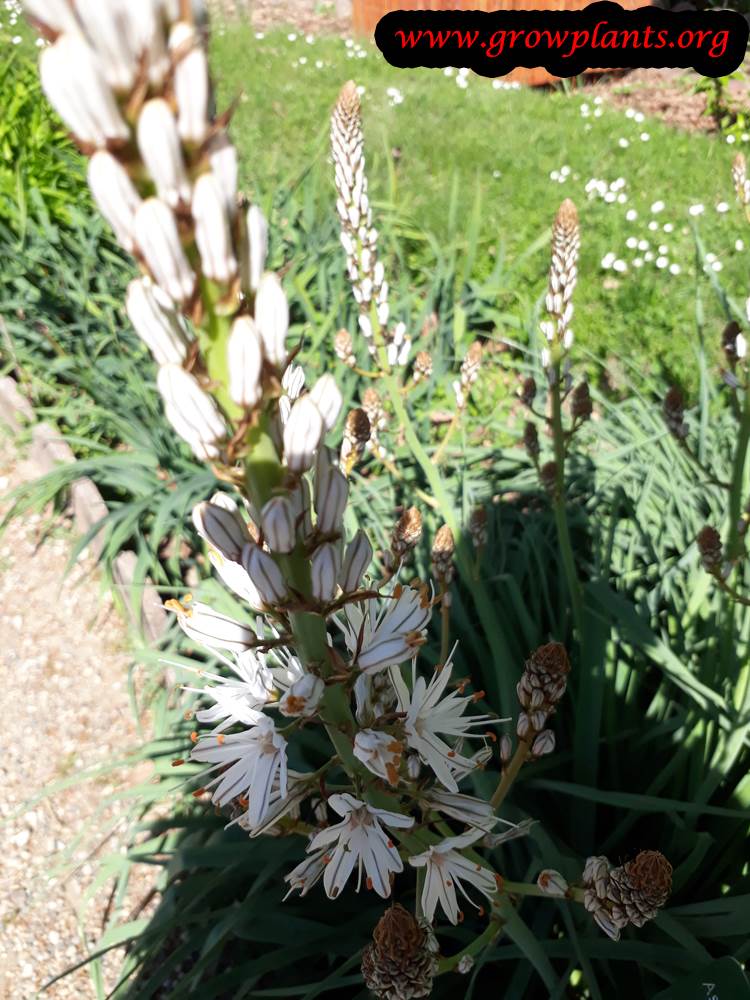
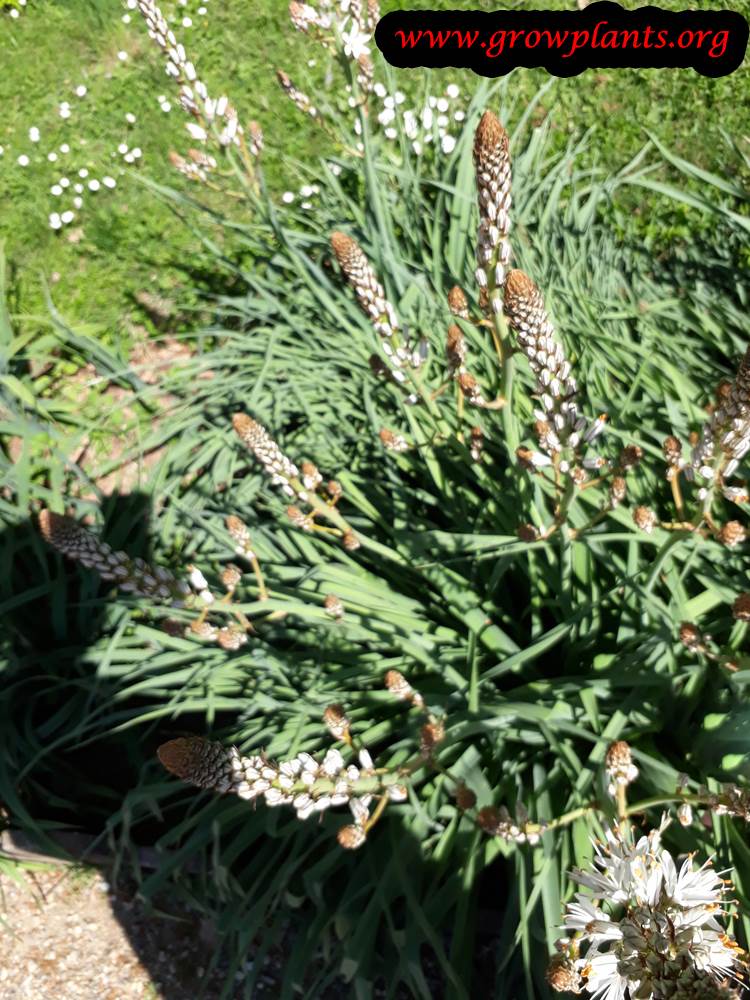
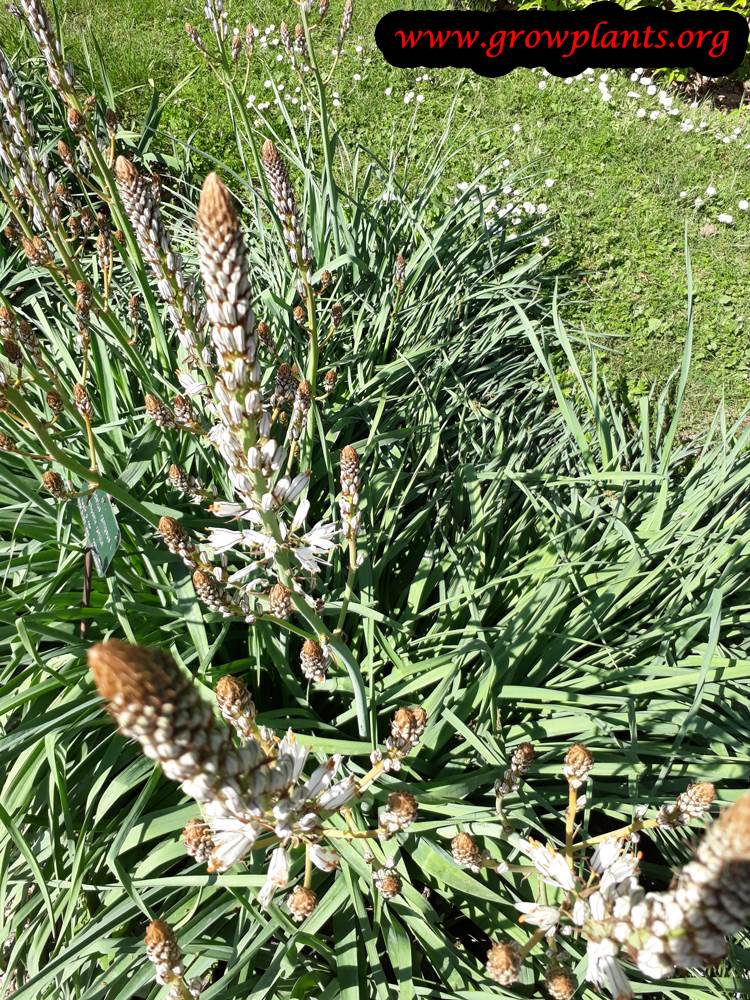
- Growth Habit & Form: Rosette-forming herbaceous perennial with tall, branching inflorescences; spreads readily and can be invasive.
- Lifespan & Maturity: Perennial from fleshy tuberous roots, sometimes grown as an annual.
Anatomy & Physical Features
- Leaves & Foliage: Green linear leaves arranged in a basal rosette.
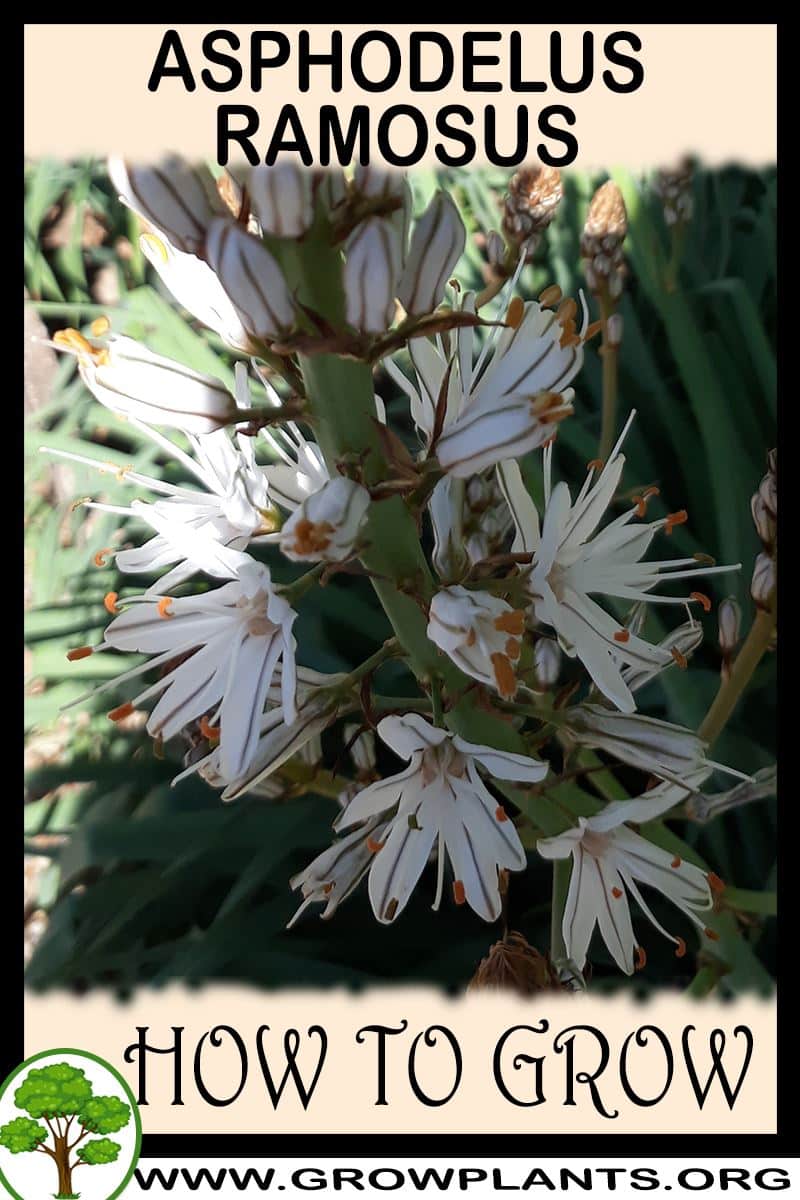
- Flower Characteristics: White flowers with purple stripes and six petals on tall branched stems (see Bloom guide).
Primary Uses & Landscape Value
- Functional & Ornamental Roles: Ornamental wildflower for dry, poor-soil and mediterranean gardens.
Care Guide: Planting, Soil & Watering
Overview: Asphodelus ramosus is a robust Mediterranean and desert perennial (hardiness zone 7–10) for full sun to part shade. It is drought tolerant and thrives in well-drained soil with only light watering.
Quick Care Requirements
| Requirement | Ideal Condition |
|---|---|
| Planting Season | Spring, summer or autumn |
| Growth Rate | Moderate to fast |
| Soil Type | Well-drained |
| Water Need | Low to moderate – drought tolerant |
Planting & Establishment
- Best Planting Season: Plant in spring, summer or autumn.
- How to Plant:
- Hole Preparation: Dig a hole about the width of the root system in free-draining ground.
- Soil Amendments: It tolerates poor, lean soil; work in a little organic matter but prioritise sharp drainage.
- Planting Depth: Set the crown at soil level.
- Growth Speed & Expectations: Growth is moderate to fast, forming a 30–60 cm clump; note it can be invasive, so site it carefully.
Soil, Watering & Drainage Care
- Soil Mix & Drainage Needs: Free-draining soil is essential; it tolerates poor ground and rots if kept wet. It grows well in containers with free-draining mix.
- Watering Schedule & Technique:
- Young / Newly Planted: Water young plants occasionally to establish them without keeping the soil wet.
- Established: Once established it is drought tolerant, needing only a small to average amount of water.
- Seasonal Adjustments: Water lightly in summer heat and withhold in wet or cool periods.
Climate, Light & Hardiness
A Mediterranean-basin native, branched asphodel is well adapted to hot, dry summers and cool, wet winters, growing best in full sun to half shade with good winter cold tolerance for a Mediterranean perennial.
Quick Climate Specifications
| Climate Zones | Mediterranean, Desert, Subtropical, Temperate |
|---|---|
| USDA Hardiness Zones | 7–10 |
| Cold Damage Begins | Foliage may be damaged by hard freezes below approximately −5°C (23°F) |
| Approx. Survival Minimum | Established rootstock typically survives brief cold into the zone 7 range, roughly −15°C (5°F) |
| Frost Tolerance | Moderate |
| Light Conditions | Full Sun to Half Shade |
| Wind Tolerance | Moderate to High |
| Salt / Coastal Tolerance | Moderate |
Sunlight & Light Exposure
Optimal Light Setup
Full sun brings the best flowering and most compact rosettes; tolerates half shade with slightly looser growth.
Direct Sun Requirement
Needs a good share of direct sun for reliable spring flowering.
Shade & Heat Management
Very heat tolerant through the dry Mediterranean summer; often goes summer-dormant in extreme heat and drought rather than suffering damage.
Best Exposure / Orientation
Open, sunny slopes and rocky ground mimic its native habitat.
Temperature Extremes & Hardiness
USDA Hardiness & Regional Limits
Hardy in zones 7–10, matching its native Mediterranean-basin winter climate.
Cold Damage & Winter Protection
Foliage can be damaged by hard, prolonged freezes; the fleshy rootstock is more cold-tolerant than the leaves and typically resprouts after a cold winter.
Frost Sensitivity
Tolerates light frost; protection is rarely needed within its hardiness range.
Extreme Heat Tolerance
Excellent; adapted to hot, dry Mediterranean and desert-fringe summers, often going summer-dormant.
Wind, Humidity & Microclimate
Humidity Preferences
Prefers the relatively dry air of Mediterranean and desert-fringe climates.
Dry-Air Tolerance
Good; well suited to low-humidity summers.
Wind Tolerance
Generally wind tolerant on open hillsides.
Coastal / Salt Tolerance
Occurs naturally on rocky Mediterranean slopes near the coast and is generally tolerant of coastal exposure, though it has not specifically been tested for direct salt spray.
Rainfall & Seasonal Moisture
Adapted to a wet-winter/dry-summer rainfall pattern; good drainage in winter matters more than summer irrigation.
Growing in Pots, Balconies & Indoors
Branched asphodel is a sun-loving Mediterranean perennial, not a houseplant, but it grows happily in a container on a sunny patio or balcony where its tall flower spikes stand out.
Quick Details
- Container Size: A medium pot for a 30-60 cm (12-24 in) clump
- Indoor Suitability: Not a houseplant – it needs strong outdoor light and a summer-dry rest
- Best Spot: Full sun to half shade
- Soil & Drainage: Free-draining, even lean soil; it dislikes wet feet
- Watering in Pots: Small to average – let it dry between waterings, keeping it dry during its dormant rest
Indoors & On the Windowsill
- Houseplant limits: Not an indoor plant; it needs full outdoor sun and a natural dry dormancy to flower well.
- Windowsill note: A very sunny sill could hold a young plant briefly, but it truly belongs outside.
On a Balcony or Patio
- Light & wind: Give it the sunniest spot; walls and paving reflect heat and dry pots fast, so check moisture in warm spells – but avoid keeping it soggy.
- Practicalities: Let it dry right down after flowering as it goes dormant; ease off water then.
Choosing the Pot, Soil & Long-Term Care
- Pot & drainage: A pot with strong drainage holes and no standing-water saucer; gritty, free-draining mix suits it best.
- Potting mix: A well-aerated, organic-rich mix – peat or coir blended with perlite or vermiculite so it drains freely.
- Feeding: Potted plants need feeding more often than those in open ground, since frequent watering leaches nutrients from the mix – feed regularly through the growing season.
- Repotting: Refresh the top of the mix each year and pot up about every two years; for perennials, lightly prune the root ball and top growth when you do.
Fertilizing & Feeding
A light feeder well suited to lean, well-drained Mediterranean-style plantings: balanced feeding through spring growth and into bloom supports its white, purple-striped flower spikes, then feeding stops as the rosette dies back for its summer or seasonal rest.
Quick Fertilizing Specs
| Feeding Level | Light – a lean feeder once established |
|---|---|
| Main Nutrient Priority | Balanced feeding through leaf growth and into bloom |
| Best Feeding Period | Spring growth through the spring-to-summer bloom period |
| Organic Options | A little compost worked into well-drained soil is usually enough |
| Reduce/Stop Feeding | Stop feeding as the rosette dies back after bloom |
| Micronutrients | Rarely an issue in average garden soil; correct only a diagnosed deficiency |
| Soil pH | Tolerates a wide range provided the soil drains well |
Feeding by Growth Stage
Spring rosette growth
Support fresh, linear rosette leaves as growth resumes for the season.
| Nutrient direction | A light, balanced fertilizer supports steady leaf growth without pushing lush, floppy foliage in this naturally lean-growing plant. |
|---|---|
| Timing | As new rosette growth begins in spring. |
| Frequency | A light feeding as growth resumes is usually enough to start the season. |
| Fertilizer types | A balanced complete fertilizer used at a light rate, Compost worked lightly into well-drained soil |
| Precautions | This plant self-seeds readily and can naturalize; avoid heavy feeding that pushes excess seed-bearing growth beyond the intended planting area. |
Flower spike bloom period
Support the white, purple-striped flower spikes that open from spring into summer.
| Nutrient direction | Continue light, balanced feeding through bloom rather than switching to a bloom-specific high-phosphorus product. |
|---|---|
| Timing | Through the spring-to-summer bloom window. |
| Frequency | An occasional light feeding is usually enough to sustain bloom on an established planting. |
| Fertilizer types | A balanced fertilizer used lightly, Container-grown plants may follow a container-specific feeding routine |
| Precautions | Avoid overwatering alongside feeding; this plant prefers well-drained soil and does not tolerate consistently wet conditions. |
Post-bloom dieback and rest
Let the plant rest undisturbed as the rosette dies back after flowering, in keeping with its Mediterranean growth cycle.
| Nutrient direction | None – withhold fertilizer once flowering finishes and the rosette begins to die back. |
|---|---|
| Timing | Summer into autumn, as spent bloom stems and dead leaves are pruned away. |
| Frequency | No feeding at this stage. |
| Fertilizer types | No feeding at this stage – allow the plant to rest without fertilizer until new growth resumes. |
| Precautions | Do not fertilize while the plant is dying back or resting; resume feeding only once new rosette growth restarts. |
Nutrient Deficiency Signs & Corrections
Pale, yellowish rosette leaves and noticeably weak flower spikes.
| Possible causes | very lean or low-organic-matter soil, an extended period without any feeding, nitrogen leaching from heavy rain or watering |
|---|---|
| Appears first on | older, outer rosette leaves |
| What to check | recent feeding history, soil organic matter, overall leaf color compared to expectations |
| Possible correction | Apply a light, balanced fertilizer during active spring growth. |
Leaf tips scorch or brown and flower spikes are weak or sparse despite adequate leaf growth.
| Possible causes | low soil potassium, heavy nitrogen feeding without balance, drought stress limiting nutrient uptake |
|---|---|
| Appears first on | older leaf tips |
| What to check | recent fertilizer balance, watering consistency, flower spike quality compared to leaf growth |
| Possible correction | Switch to a balanced, potassium-inclusive fertilizer and maintain even watering. |
New rosette leaves emerge pale yellow while the veins stay green.
| Possible causes | high soil pH tying up available iron, common in Mediterranean-type alkaline soils, poorly drained or waterlogged soil, root stress limiting nutrient uptake |
|---|---|
| Appears first on | newest rosette growth |
| What to check | soil pH and drainage, recent watering pattern, root health |
| Possible correction | Improve drainage where possible and apply a chelated iron product per its label. |
Pruning, Training & Seasonal Maintenance
Asphodelus ramosus is an herbaceous rosette-forming geophyte, not a woody plant, so “pruning” here means routine grooming: removing faded leaves and spent bloom stalks. This can be done whenever growth looks tired, though the two jobs are best timed differently – the flower stalk is cut once bloom has finished, while foliage is only removed once it has yellowed on its own, since green leaves are still feeding the underground rootstock.
Quick Pruning & Maintenance Specs
| Pruning Tolerance | Moderate (grooming, not structural) |
| Primary Pruning Window | After flowering – remove the spent bloom stalk |
| Secondary Maintenance Window | Ongoing – remove individual leaves only once they yellow/die |
| Typical Frequency | A few times per year as needed |
| Main Objective | Tidy appearance and prevent unwanted self-seeding of an invasive-leaning species |
| Best Tool Type | Precision snips or bypass secateurs |
Pruning by Plant Age & Size
Newly Established
Leave foliage untouched while the plant establishes its rootstock; do not remove green leaves in the first season.
Young / Formative
No structural training applies – the plant simply builds its basal rosette on its own.
Mature / Established
Routine deadheading of finished flower stalks and periodic removal of yellowed outer leaves is all that’s needed.
Seasonal Pruning Schedule
Post-Flowering
Objective: tidy the plant and stop it self-seeding, since this species is noted as capable of becoming invasive. Remove the spent flower stalk down to its base once the white-and-purple blooms have faded and before seed capsules mature. Do not remove the surrounding green rosette leaves at the same time – they are unrelated to the flower stalk and are still photosynthesizing.
Ongoing Sanitary
Objective: keep the rosette clean. Remove individual leaves only once they have yellowed or died back naturally; cutting green leaves early reduces the energy the plant can store in its rootstock for next year’s growth.
Special Growth to Remove
- Spent flower stems – cut at the base after bloom, primarily to prevent excess seed set given this species’ invasive tendency.
- Dead or yellowed leaves – remove individually once fully senesced.
Container & Small-Space Pruning
Asphodelus ramosus can be grown in a container; deadheading is the same as in-ground, but because the plant can self-seed, spent stalks are worth removing promptly in a shared bed or border to limit its spread from a pot into surrounding ground.
Tools
- Precision snips or bypass secateurs – for cutting the slender flower stalks and individual leaves; no larger tool is ever needed on this herbaceous plant.
Tool Hygiene & Disease Risk
Routine: no transmissible disease risk is noted for this species, so ordinary clean, sharp tools are sufficient.
Cut Placement & Technique
Cut flower stalks at their base at the rosette rather than partway up. Remove individual dead leaves at the point where they join the rosette rather than tearing them away.
Common Pruning Mistakes
- Cutting back green leaves for tidiness before they’ve yellowed, which weakens the rootstock’s reserves for the next growing season.
- Leaving spent flower stalks in place until seed has fully set, which encourages this already invasive-leaning plant to spread further.
When NOT to Prune
Avoid cutting healthy green foliage while it is still actively growing; wait until it yellows on its own.
Recommended Tools (by task)
- precision_snips – for deadheading the slender flower stalks and trimming individual dead leaves cleanly.
Propagation Guide
Asphodelus ramosus is easiest to increase from seed, which comes true to the species, or by lifting and dividing the clumps of thickened, fleshy roots that established plants form – a good option for reaching flowering size faster and for controlling its spread, since this species can be invasive. Overall propagation difficulty is easy.
Quick Propagation Specs
| Best Propagation Method | Division of the fleshy rootstock |
| Alternative Methods | Seed |
| Propagation Difficulty | Easy |
| Seed True-to-Type | Yes |
| Vegetative True-to-Type | Yes |
| Best Propagation Season | Sow seed in autumn or spring; divide clumps in the dormant season (autumn–winter) |
| Seed Germination Time | Several weeks; site gives no exact figure and timing can vary |
| Germination Temperature | Cool to mild, roughly 10–20°C (50–68°F) |
| Seed Sowing Depth | Shallow – just cover the seed |
Growing from Seed
Sowing Season
The site lists spring, summer, and autumn as the general planting season for this species; for seed specifically, sowing in autumn or early spring (avoiding summer heat) is a cautious, reasonable choice.
Sowing Depth & Orientation
Sow shallowly, just covering the seed.
Germination Conditions
Well-drained soil, matching this species’ stated soil preference, in a sunny to lightly shaded spot.
Germination Time
Not specified by the site; allow several weeks and expect some variability.
Seedling Care
Grow seedlings on in the same well-drained soil and small-to-average watering as mature plants until large enough to plant out.
Division, Offsets, Pups & Suckers
Established plants form clusters of thickened, fleshy roots and can spread readily, which is why this species is flagged as invasive; clumps can be lifted and divided in the dormant season. Each division should include a portion of the fleshy root mass and at least one growing point/leaf rosette. Cutting back some of the leaves at replanting helps reduce moisture loss while new roots establish.
Bloom & Flower Guide
Quick Details
- Bloom Season: Spring into summer.
- Flower Appearance: Star-shaped white flowers with six petals, each marked by a purple-brown stripe, along branched stems.
- Edibility: Ornamental only – not grown as an edible flower.
Detailed Blooming Overview
Branched asphodel throws up statuesque, candelabra-like spikes crowded with six-petalled white flowers. A darker stripe runs down each petal, giving the tall inflorescences a fine pinstriped texture that opens from the base upward through spring and summer.
Flower Characteristics
- White, six-petalled, star-shaped flowers.
- A purple stripe down each petal.
- Massed on branching spikes.
Bloom Care & Thinning
- Managing the bloom: Remove faded spikes before seed sets if you want to limit self-seeding.
Fruit & Uses
Safety caveat first: the tuberous roots of Asphodelus ramosus have a history of use as a famine food in the Mediterranean, but they are bitter raw and contain alkaloid compounds; this is not an everyday food and should not be foraged and eaten without expert identification and thorough cooking. No other part of the plant is eaten – it is grown here as an ornamental for its flowers and foliage.
Quick Edible Specs
| Edible Parts | Tubers/roots – historical famine-food use only, not a recommended everyday food |
| Main Use(s) | Historical famine food (crude bread); traditionally the leaves were also used to wrap fresh cheese, a non-food packaging use, not for eating |
| Eaten Raw or Cooked | Cooked only – traditionally roasted under ash or boiled; never eaten raw |
| Preparation Required | Cook (roast or boil) to reduce bitterness before eating; traditional recipes then mashed the cooked tuber together with figs |
| Safety/Toxicity Caveat | Contains bitter alkaloid compounds (asphodeline); not established as safe for regular modern consumption – treat as a historical curiosity rather than a food to forage |
Roots & Tubers
The starchy tuberous roots are the only part of this plant with any documented edible history. In ancient Greece and Rome, and later during famines in parts of rural Italy, the tubers were roasted under hot ash or boiled, then sometimes mashed with figs into a crude bread known as “bread of the poor.” Raw tubers are bitter and were never eaten without this cooking step.
Preparation, Uses & Safety
Any edible use of this plant is historical rather than a current recommendation: the tubers were only ever eaten after roasting or boiling, never raw, because of their bitterness and alkaloid content. Some sources also note the leaves can be mildly toxic to grazing sheep and goats during wet winter months, though they lose this toxicity once dried in summer. Given the limited, dated evidence for safe modern consumption, treat this species as ornamental – grown for its flower spikes and rosette foliage, not as a foraged food crop.
Pests, Diseases & Troubleshooting
Overview: Branched asphodel (Asphodelus ramosus) is a robust Mediterranean perennial that is largely pest-free, with winter-wet crown and root rot the principal concern. Asphodels are tough, drought-adapted Mediterranean perennials that are naturally low-pest; their main enemy is not an insect but wet, poorly drained soil, which rots the fleshy roots and crown. Grow them lean and dry with excellent drainage and full sun, protect emerging spring shoots from slugs, and they will largely look after themselves – after flowering they die back into a natural summer dormancy, which is normal, not disease.
Quick Troubleshooting Overview
| Issue / Pest | Main Symptom | Primary Solution |
|---|---|---|
| Slugs & snails | Chewed young shoots and flower spikes, slime trails | Handpick at night, barriers/traps, iron-phosphate bait |
| Aphids | Sticky, distorted new growth and flower stems | Hose off, encourage predators, insecticidal soap if needed |
| Crown & root rot | Collapse, yellowing, rotten roots in wet soil | Sharp drainage, dry siting, remove affected plants |
| Rust | Orange-brown pustules on leaves | Remove affected leaves, improve airflow, avoid wetting foliage |
| Summer dieback | Foliage yellows and dies down after flowering | Normal dormancy – reduce water and let it rest |
Common Pests & Management
- Slugs & snails (Gastropoda):
- Symptoms: Ragged holes and chewed tissue on emerging spring shoots and young flower spikes, with tell-tale slime trails, worst in damp, mild conditions.
- Prevention & Control: Handpick after dark, clear damp hiding places, and protect new growth with grit or copper barriers, traps, or iron-phosphate bait around the crown.
- Aphids (Aphididae):
- Symptoms: Small colonies of soft green or black insects on tender new leaves and flower stems, causing sticky, distorted growth.
- Prevention & Control: Dislodge with a water jet, encourage ladybirds and lacewings, and spot-treat persistent clusters with insecticidal soap, mainly on the flower stems.
- Thrips (Thysanoptera):
- Symptoms: Silvery flecking and fine distortion on leaves and within flowers in hot, dry weather.
- Prevention & Control: Usually minor; remove badly affected flowers, monitor with sticky traps, and treat only heavy infestations with insecticidal soap or neem.
- Spider mites (Tetranychus urticae):
- Symptoms: Fine stippling and a dull cast on foliage in prolonged hot, dry spells, occasionally with fine webbing.
- Prevention & Control: Rarely serious outdoors; a strong water spray and improved conditions usually suffice, with horticultural oil for stubborn cases.
Diseases & Fungal Issues
- Crown & root rot (Phytophthora / Sclerotinia / Rhizoctonia spp.):
- Symptoms: Sudden wilting, yellowing and collapse with soft, dark, decayed roots and crown – the principal risk, driven by wet, heavy or poorly drained soil, especially over winter.
- Treatment & Management: Plant in sharply drained, gritty soil in full sun, avoid winter wet and overwatering, do not mulch heavily over the crown, and remove and destroy rotted plants; do not replant into the same spot.
- Rust (Uromyces / Puccinia spp.):
- Symptoms: Orange-brown to rusty pustules on leaves, sometimes with yellowing, mainly in humid or crowded plantings.
- Treatment & Management: Remove and destroy affected leaves, improve air movement and spacing, avoid overhead watering, and apply a sulphur-based fungicide only if it becomes severe.
Growing Difficulties & Abiotic Problems
- Winter-wet root rot:
- Cause & Symptoms: The dominant problem: fleshy roots rot in cold, wet, poorly drained soil, causing crown collapse.
- Correction Strategy: Site in raised, gritty, free-draining ground in full sun, keep dry in winter, and improve drainage with grit rather than watering more.
- Post-flowering summer dormancy:
- Cause & Symptoms: Foliage yellows and dies back after flowering – this is natural summer dormancy for these Mediterranean plants, not a disease.
- Correction Strategy: Reduce watering and allow the plant to rest and die down; growth returns in the cooler, moister season.
- Chlorosis in heavy soil:
- Cause & Symptoms: Pale, weak foliage where grown in dense, wet, or unsuitable soil.
- Correction Strategy: Improve drainage and lighten the soil with grit; these plants prefer lean, well-drained conditions to rich, moist ones.
What Helps – Products & Tools
Asphodels are a low-input plant: the key ‘tools’ are grit for drainage and slug protection for spring shoots. Useful products are iron-phosphate slug bait or copper barriers, insecticidal soap for the occasional aphid or thrip, and – only if rust appears – a sulphur fungicide. Focus on siting and drainage rather than spraying.