
Plant Profile & Key Characteristics
Also known as: Hollow-stemmed asphodel, Onionweed, Onion-leafed asphodel, Pink asphodel
Overview: Onionweed is a short-lived herbaceous perennial or annual forming a rosette 30-60 cm (12-24 in) tall. It is grown mainly as an ornamental and has edible roots and leaves, though it can be invasive.
Quick Specifications
| Specification | Attribute |
|---|---|
| Plant Type / Life Cycle | Perennial or annual (herbaceous) |
| Foliage Type | Deciduous |
| Mature Size | 30-60 cm tall (12-24 in) |
| Growth Rate | Fast to moderate |
| Root System | Fibrous roots |
| Toxicity | Roots and leaves edible |
| Hardiness | USDA zones 7-10 |
Growth Form & Structure
- Height & Spread: 30-60 cm (12-24 in) tall, forming a low rosette with slender flower stems; can be grown in containers.
- Growth Habit & Form: Rosette-forming herbaceous plant with hollow, onion-like flower stalks; self-seeds readily and can become invasive.
- Lifespan & Maturity: Short-lived perennial, often grown as an annual.
Anatomy & Physical Features
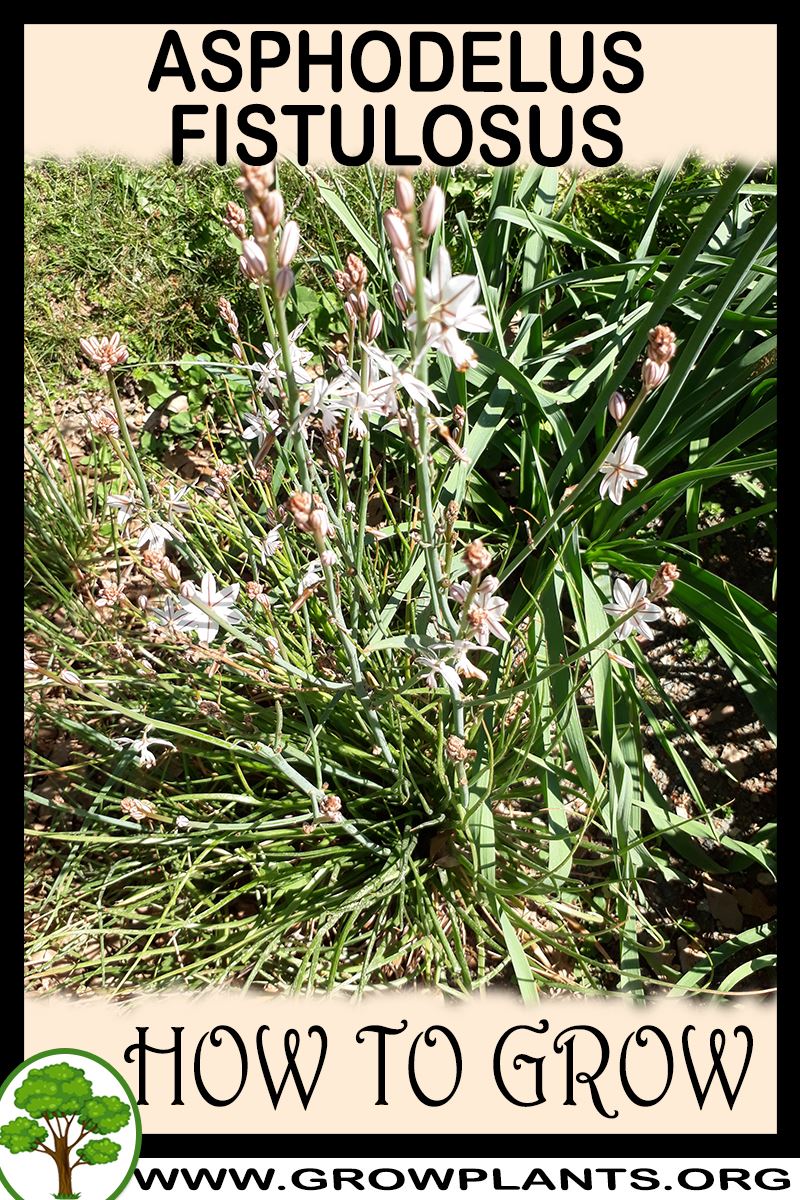
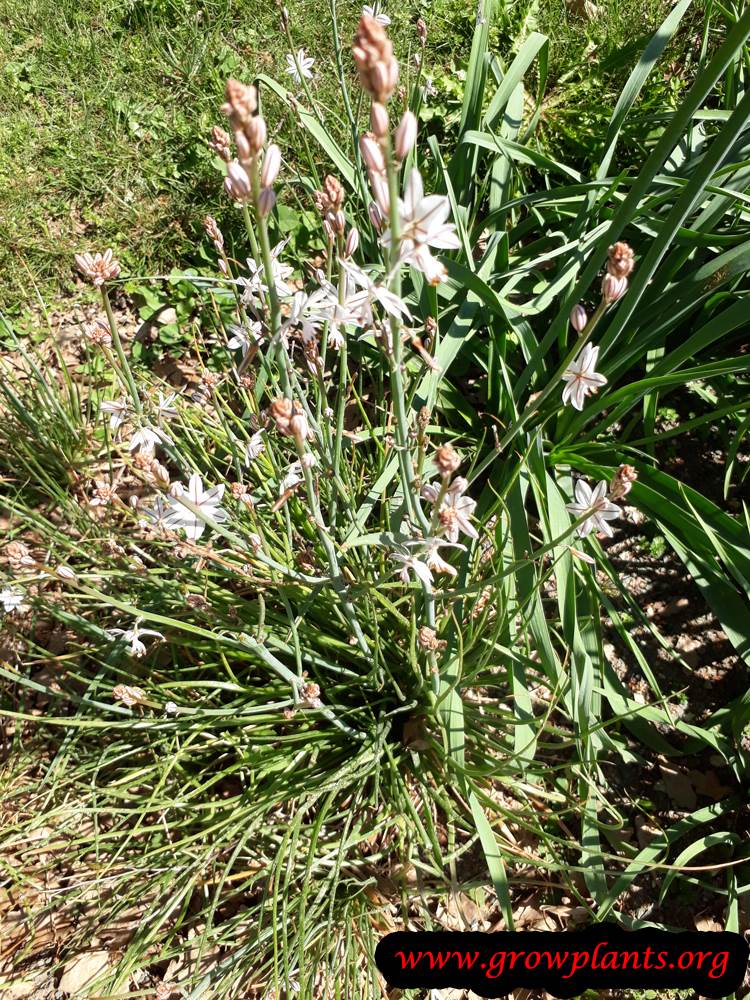
- Leaves & Foliage: Green linear leaves arranged in a basal rosette.
- Flower Characteristics: White flowers with pink stripes and six petals on branching stems (see Bloom guide).
Primary Uses & Landscape Value
- Edible Uses: Roots and leaves are edible.
- Functional & Ornamental Roles: Ornamental for dry gardens; note its weedy, invasive tendency.
Care Guide: Planting, Soil & Watering
Overview: Asphodelus fistulosus is a tough Mediterranean and desert perennial (hardiness zone 7–10) for full sun to part shade. It is drought tolerant and needs well-drained soil with light watering.
Quick Care Requirements
| Requirement | Ideal Condition |
|---|---|
| Planting Season | Spring, summer or autumn |
| Growth Rate | Moderate to fast |
| Soil Type | Well-drained |
| Water Need | Low to moderate – drought tolerant |
Planting & Establishment
- Best Planting Season: Plant in spring, summer or autumn.
- How to Plant:
- Hole Preparation: Dig a hole about the width of the root system in free-draining ground.
- Soil Amendments: It tolerates poor, lean soil; work in a little organic matter but prioritise sharp drainage.
- Planting Depth: Set the crown at soil level.
- Growth Speed & Expectations: Growth is moderate to fast, forming a 30–60 cm clump; note it can be invasive, so site it carefully.
Soil, Watering & Drainage Care
- Soil Mix & Drainage Needs: Free-draining soil is essential; it tolerates poor ground and rots if kept wet. It grows well in containers with free-draining mix.
- Watering Schedule & Technique:
- Young / Newly Planted: Water young plants occasionally to establish them without keeping the soil wet.
- Established: Once established it is drought tolerant, needing only a small to average amount of water.
- Seasonal Adjustments: Water lightly in summer heat and withhold in wet or cool periods.
Climate, Light & Hardiness
Asphodelus fistulosus (onionweed) grows across Mediterranean, desert, subtropical, and temperate climates in full sun to half shade. It is hardy across USDA zones 7–10, behaving as a deciduous perennial or, in harsher conditions, as an annual.
Quick Climate Specifications
| Climate Zones | Mediterranean, Desert, Subtropical, Temperate |
|---|---|
| USDA Hardiness Zones | 7–10 |
| Frost Tolerance | Moderate |
| Light Conditions | Full Sun to Half Shade |
Sunlight & Light Exposure
Optimal Light Setup
Full sun to half shade both suit this rosette-forming plant well.
Temperature Extremes & Hardiness
USDA Hardiness & Regional Limits
Hardy across USDA zones 7–10. Depending on climate severity it behaves as a deciduous perennial, dying back and resprouting, or is treated as an annual where conditions are harsher than its comfortable range.
Frost Sensitivity
Established plants tolerate typical zone 7 winter frost; harder or more prolonged freezes outside this range are likely to kill it.
Growing in Pots, Balconies & Indoors
Onionweed (Asphodelus fistulosus) is a 30-60 cm (12-24 in) grassy-leaved perennial that the grower grows in containers but not as a houseplant. It is a tough, drought-tolerant sun plant; note it is invasive, so a pot with deadheading helps keep its seeding in check.
Quick Details
- Container Size: A 10-20 L (3-5 gal) pot
- Indoor Suitability: Not a houseplant; it needs full sun
- Best Spot: Full sun to half shade
- Soil & Drainage: Free-draining mix; it takes lean, dry conditions
- Watering in Pots: Modest – let the surface dry between waterings; it is drought tolerant
Indoors & On the Windowsill
- Houseplant limits: Not an indoor plant – it needs full sun and dislikes the low light of a room.
- Containing it: Growing it in a pot and removing spent flowers helps stop this invasive seeder from spreading.
On a Balcony or Patio
- Light & wind: Give it the sunniest spot; walls, railings and paving throw back heat so pots dry quickly – check moisture often and shelter or stake it on an exposed, windy balcony.
- Practicalities: Account for the weight of a full pot and make sure drainage water can run away freely without staining the balcony.
Choosing the Pot, Soil & Long-Term Care
- Pot & drainage: Use a pot with strong drainage holes and skip a standing-water saucer to avoid root rot; terracotta breathes and dries faster, while glazed or plastic holds moisture longer.
- Potting mix: Well-aerated and organic-rich – a quality potting mix, or peat/coir with perlite or vermiculite.
- Feeding: Potted plants use up their soil faster as nutrients leach out with each watering – feed lightly through the growing season.
- Repotting: Refresh the surface mix each year and pot on or divide every couple of years, trimming the roots lightly once it fills the container.
Fertilizing & Feeding
A light feeder – this tough, self-sufficient plant thrives on lean soil and rarely benefits from more than minimal feeding
Quick Fertilizing Specs
| Feeding Level | light |
|---|---|
| Main Nutrient Priority | Light, balanced feeding – extra phosphorus does not improve flowering |
| Best Feeding Period | Spring through summer during active growth and bloom |
| Soil pH | Adapts well to lean, well-drained soil |
| Reduce/Stop Feeding | Stop feeding once the plant finishes flowering and foliage dies back |
| Organic Options | Compost worked lightly into the soil at planting |
Feeding by Growth Stage
Spring Rosette Growth
Support rosette and leaf growth as the plant breaks dormancy or establishes from seed
| Nutrient direction | Light, balanced feeding to support rosette and leaf growth |
|---|---|
| Timing | Spring through early summer as the plant is actively growing |
| Frequency | Minimal feeding is usually enough through the growing season |
| Fertilizer types | A balanced, complete fertilizer applied sparingly, if at all, Compost worked lightly into the soil at planting |
| Precautions | This tough, self-sufficient plant rarely needs feeding; minimal input is usually enough |
Bloom
Sustain the plant through its flowering display
| Nutrient direction | A light, balanced feeding is enough to sustain bloom; extra phosphorus does not improve flowering |
|---|---|
| Timing | During the flowering period in spring and summer |
| Frequency | Minimal feeding is usually enough through bloom |
| Fertilizer types | A balanced, complete fertilizer applied sparingly, if at all |
| Precautions | Skip high-phosphorus bloom-booster products; this plant flowers well on lean soil |
Dormancy or Rest
Let the plant rest through its dormant or off-season period
| Nutrient direction | None – withhold fertilizer while the plant is dormant or between growth cycles |
|---|---|
| Timing | Once flowering ends and foliage dies back |
| Frequency | No feeding at this stage |
| Fertilizer types | No feeding at this stage – the plant rests until its next growth cycle |
| Precautions | Do not fertilize during dormancy or die-back; resume only once active growth returns |
Nutrient Deficiency Signs & Corrections
Pale, sparse rosette growth and reduced flowering
| Possible causes | Low nitrogen availability, though uncommon given this plant’s minimal needs, Competition from surrounding weeds or crowding plants, Very poor or long-depleted soil |
|---|---|
| Appears first on | Older leaves in the rosette |
| What to check | Leaf color and rosette density, Plant competition and crowding, General soil condition |
| Possible correction | Apply a light, balanced feeding only after ruling out competition or crowding as the cause |
Interveinal yellowing on new leaves while the veins stay green
| Possible causes | High soil pH limiting iron availability, Waterlogged or poorly drained soil restricting root function, Root stress from recent disturbance |
|---|---|
| Appears first on | Newest leaves |
| What to check | Soil pH and drainage, Whether yellowing is interveinal and limited to new growth, Recent waterlogging or root disturbance |
| Possible correction | Correct soil pH toward neutral where practical and apply a chelated iron product according to its label |
Weak flower stalks and reduced bloom
| Possible causes | Low potassium availability in the soil, Unusually severe drought stress, Sandy or leached soil low in retained nutrients |
|---|---|
| Appears first on | Flower stalks and older leaves |
| What to check | Watering pattern during bloom, Soil texture and drainage, Flower stalk strength |
| Possible correction | Apply a balanced fertilizer with adequate potassium and maintain consistent care |
Pruning, Training & Seasonal Maintenance
Asphodelus fistulosus (onionweed) is a rosette-forming herbaceous perennial, sometimes grown as an annual, with no woody structure. “Pruning” here is simple and can be done year-round – removing dead leaves as they brown and cutting spent bloom stalks. Because this species is documented as invasive, removing flower stems before seed drop also serves as a control measure to limit unwanted spread.
Quick Pruning & Maintenance Specs
| Pruning Tolerance | High for foliage/flower-stem removal – the basal rosette regrows readily |
| Primary Pruning Window | Ongoing, year-round |
| Main Objective | Tidy the rosette and limit unwanted seeding given the plant’s invasive tendency |
| Young Plant Priority | None – let the rosette establish |
| Mature Plant Priority | Remove dead leaves and spent bloom stalks; deadhead before seed drop if spread is a concern |
| Best Tool Type | Precision snips |
| Avoid Heavy Pruning During | No strong restriction, though avoid stripping all the green leaves off a young, still-establishing rosette |
Pruning by Plant Age & Size
Newly Established
No pruning; let the rosette settle in.
Young / Formative
No structural training – this is a basal rosette habit.
Mature / Established
Routine removal of dead leaves and spent flower stalks, year-round.
Seasonal Pruning Schedule
| Stage | Objective | Remove | Do Not Remove | Response / Impact |
| Spring – Summer (bloom) | Control self-seeding | Spent flower stalks after bloom, especially before seed disperses given this species’ invasive habit | A stalk or two, if seed is actually wanted for propagation | No impact on the rosette’s return; cutting one spike doesn’t stop later ones from the same clump |
| Ongoing (year-round) | General tidiness | Dead or browned leaves | Green rosette leaves | Continued rosette growth from the base |
Special Growth to Remove
- Dead or browned leaves
- Spent bloom stems – removing these before seed drop helps control this species’ documented invasive tendency
Container & Small-Space Pruning
This species can be grown in a container, and the same light, ongoing tidy-up applies there. Contained growing is also a sensible way to help manage this species’ invasive tendency in the first place.
Tools
- Precision snips, for removing dead leaves and spent bloom stalks
Tool Hygiene & Disease Risk
Routine – clean tools are sufficient; no specific disease risk is flagged for this species.
Cut Placement & Technique
Cut dead leaves and spent stalks near the base of the rosette.
Post-Pruning Care
No special aftercare needed. Given this species’ documented invasiveness, don’t leave removed flower stalks with viable seed in the garden or compost pile, where they could spread further.
Common Pruning Mistakes
- Letting spent flower stalks stand and drop seed when spread isn’t wanted, given this species’ documented invasive/aggressive habit
When NOT to Prune
No strong seasonal restriction is noted; avoid stripping a very young, still-establishing rosette of all its leaves.
Recommended Tools (by task)
- precision_snips – for removing dead leaves and cutting spent bloom stalks at the base
Propagation Guide
Asphodelus fistulosus is most easily grown from seed, which it produces and self-sows freely enough that the site flags the plant as invasive; dividing an established rosette clump is a workable alternative but is not required. Seed germinates readily and the plant establishes fast to medium quickly, making this an Easy plant to propagate.
Quick Propagation Specs
| Best Propagation Method | Seed |
| Alternative Methods | Division of rooted rosette offsets |
| Propagation Difficulty | Easy |
| Seed True-to-Type | Usually true-to-type for the species |
| Vegetative True-to-Type | Yes |
| Best Propagation Season | Spring through autumn, matching the site’s planting season |
| Seed Germination Time | Generally a few weeks under warm conditions |
Growing from Seed
Sowing Season
Spring through autumn, matching the site’s own planting season window.
Sowing Depth & Orientation
Sow shallowly, just lightly covering the seed, in well-drained soil (matching the site’s care overview).
Germination Conditions
Warm temperatures and well-drained soil; this species self-sows readily where conditions suit it (consistent with the site’s invasive note), so germination is generally not difficult.
Germination Time
Typically a few weeks.
Seedling Care
Seedlings form a linear-leaved rosette before flowering; thin or transplant while young, and note the plant can self-seed aggressively once established, so deadheading spent bloom stems (part of the site’s pruning guidance) helps control unwanted spread.
Division, Offsets, Pups & Suckers
Established clumps can be lifted and divided into rooted rosette sections, each with its own portion of the fleshy root cluster; replant promptly in well-drained soil. This is not the site’s primary recommended method (division/vegetative propagation is possible but not necessary), and is mainly useful for multiplying a specific clump quickly rather than as the standard route.
Bloom & Flower Guide
Quick Details
- Bloom Season: Spring into summer.
- Flower Appearance: Star-shaped white flowers, each with six petals marked by fine pink stripes, held on branched stems.
- Edibility: Ornamental only – not grown as an edible flower.
Detailed Blooming Overview
Asphodelus fistulosus sends up airy, wand-like stems studded with delicate six-petalled flowers. Each white bloom is pencilled with a pink stripe down every petal, giving the spike a soft, striped effect that opens progressively over spring and summer.
Flower Characteristics
- White, six-petalled, star-shaped flowers.
- Each petal carries a fine pink stripe.
- Borne along slender, branching stems.
Bloom Care & Thinning
- Managing the bloom: This plant self-seeds readily; removing spent flower stems before seed sets helps keep it in bounds.
Pests, Diseases & Troubleshooting
Overview: Hollow-stemmed asphodel (Asphodelus fistulosus) is an exceptionally tough Mediterranean perennial (a weed in some regions) with few pests; wet-soil crown rot is its main risk. Asphodels are tough, drought-adapted Mediterranean perennials that are naturally low-pest; their main enemy is not an insect but wet, poorly drained soil, which rots the fleshy roots and crown. Grow them lean and dry with excellent drainage and full sun, protect emerging spring shoots from slugs, and they will largely look after themselves – after flowering they die back into a natural summer dormancy, which is normal, not disease.
Quick Troubleshooting Overview
| Issue / Pest | Main Symptom | Primary Solution |
|---|---|---|
| Slugs & snails | Chewed young shoots and flower spikes, slime trails | Handpick at night, barriers/traps, iron-phosphate bait |
| Aphids | Sticky, distorted new growth and flower stems | Hose off, encourage predators, insecticidal soap if needed |
| Crown & root rot | Collapse, yellowing, rotten roots in wet soil | Sharp drainage, dry siting, remove affected plants |
| Rust | Orange-brown pustules on leaves | Remove affected leaves, improve airflow, avoid wetting foliage |
| Summer dieback | Foliage yellows and dies down after flowering | Normal dormancy – reduce water and let it rest |
Common Pests & Management
- Slugs & snails (Gastropoda):
- Symptoms: Ragged holes and chewed tissue on emerging spring shoots and young flower spikes, with tell-tale slime trails, worst in damp, mild conditions.
- Prevention & Control: Handpick after dark, clear damp hiding places, and protect new growth with grit or copper barriers, traps, or iron-phosphate bait around the crown.
- Aphids (Aphididae):
- Symptoms: Small colonies of soft green or black insects on tender new leaves and flower stems, causing sticky, distorted growth.
- Prevention & Control: Dislodge with a water jet, encourage ladybirds and lacewings, and spot-treat persistent clusters with insecticidal soap, mainly on the flower stems.
- Thrips (Thysanoptera):
- Symptoms: Silvery flecking and fine distortion on leaves and within flowers in hot, dry weather.
- Prevention & Control: Usually minor; remove badly affected flowers, monitor with sticky traps, and treat only heavy infestations with insecticidal soap or neem.
- Spider mites (Tetranychus urticae):
- Symptoms: Fine stippling and a dull cast on foliage in prolonged hot, dry spells, occasionally with fine webbing.
- Prevention & Control: Rarely serious outdoors; a strong water spray and improved conditions usually suffice, with horticultural oil for stubborn cases.
Diseases & Fungal Issues
- Crown & root rot (Phytophthora / Sclerotinia / Rhizoctonia spp.):
- Symptoms: Sudden wilting, yellowing and collapse with soft, dark, decayed roots and crown – the principal risk, driven by wet, heavy or poorly drained soil, especially over winter.
- Treatment & Management: Plant in sharply drained, gritty soil in full sun, avoid winter wet and overwatering, do not mulch heavily over the crown, and remove and destroy rotted plants; do not replant into the same spot.
- Rust (Uromyces / Puccinia spp.):
- Symptoms: Orange-brown to rusty pustules on leaves, sometimes with yellowing, mainly in humid or crowded plantings.
- Treatment & Management: Remove and destroy affected leaves, improve air movement and spacing, avoid overhead watering, and apply a sulphur-based fungicide only if it becomes severe.
Growing Difficulties & Abiotic Problems
- Winter-wet root rot:
- Cause & Symptoms: The dominant problem: fleshy roots rot in cold, wet, poorly drained soil, causing crown collapse.
- Correction Strategy: Site in raised, gritty, free-draining ground in full sun, keep dry in winter, and improve drainage with grit rather than watering more.
- Post-flowering summer dormancy:
- Cause & Symptoms: Foliage yellows and dies back after flowering – this is natural summer dormancy for these Mediterranean plants, not a disease.
- Correction Strategy: Reduce watering and allow the plant to rest and die down; growth returns in the cooler, moister season.
- Chlorosis in heavy soil:
- Cause & Symptoms: Pale, weak foliage where grown in dense, wet, or unsuitable soil.
- Correction Strategy: Improve drainage and lighten the soil with grit; these plants prefer lean, well-drained conditions to rich, moist ones.
What Helps – Products & Tools
Asphodels are a low-input plant: the key ‘tools’ are grit for drainage and slug protection for spring shoots. Useful products are iron-phosphate slug bait or copper barriers, insecticidal soap for the occasional aphid or thrip, and – only if rust appears – a sulphur fungicide. Focus on siting and drainage rather than spraying.