



Care Guide: Planting, Soil & Watering
Overview: Monkeyflowers are moisture-loving perennials for full sun to part shade that thrive in consistently damp, rich soil. They grow quickly and dislike drying out, making them ideal for pond margins and bog gardens.
Quick Care Requirements
| Requirement | Ideal Condition |
|---|---|
| Planting Season | In spring through autumn |
| Growth Rate | Moderate to fast |
| Soil Type | Rich, consistently moist |
| Water Need | Moderate to high; keep the soil constantly damp |
Planting & Establishment
- Best Planting Season: Plant from spring through autumn.
- How to Plant:
- Hole Preparation: Loosen a hole wider than the root ball in moisture-retentive soil.
- Soil Amendments: Work in plenty of organic matter to help the soil hold water.
- Planting Depth: Set the root ball at soil level and firm gently.
- Growth Speed & Expectations: Moderate to fast, reaching 30-60 cm.
Soil, Watering & Drainage Care
- Soil Mix & Drainage Needs: Rich, water-retentive soil; it is happy in boggy ground and at water margins, and in pots the mix should be kept moist at all times.
- Watering Schedule & Technique:
- Young / Newly Planted: Keep the soil constantly moist while establishing.
- Established: Water frequently and never let it dry out.
- Seasonal Adjustments: More in heat while keeping it damp, and less in the cool of winter.
Climate, Light & Hardiness
Mimulus (monkeyflower) is a moisture-loving perennial suited to temperate, subtropical, and mediterranean climates, hardy in USDA zones 5–11a. It grows well in full sun to half shade with consistently moist soil.
Quick Climate Specifications
| Climate Zones | Temperate, subtropical, mediterranean |
|---|---|
| USDA Hardiness Zones | 5–11a |
| Approx. Survival Minimum | Dormant plants typically survive winter minimums consistent with zone 5 (roughly −29°C to −23°C / −20°F to −10°F) |
| Frost Tolerance | High |
| Light Conditions | Full sun to half shade |
Sunlight & Light Exposure
Optimal Light Setup
Full sun to half shade.
Direct Sun Requirement
Tolerates full sun, especially with adequate moisture.
Shade & Heat Management
Half shade helps in hotter climates, since keeping the soil consistently moist is easier out of intense sun.
Best Exposure / Orientation
Sunny to part-shaded beds with reliable moisture.
Temperature Extremes & Hardiness
USDA Hardiness & Regional Limits
Hardy zone 5–11a, an unusually broad range for a single genus.
Cold Damage & Winter Protection
Dies back in autumn/winter (consistent with its autumn/winter pruning); the dormant crown is very cold hardy at the cold end of its range.
Frost Sensitivity
Low; well adapted to winter freezes typical of zone 5 and up.
Extreme Heat Tolerance
Performs into the warmer end of its range (zone 10–11a) provided consistent moisture is available.
Wind, Humidity & Microclimate
Humidity Preferences
Benefits from consistently moist conditions, in keeping with its preference for moist soil.
Rainfall & Seasonal Moisture
Needs regular moisture; not drought tolerant.
Microclimate Recommendations
Streamside, bog-garden, or consistently irrigated beds suit it well.
Growing in Pots, Balconies & Indoors
Monkey flower is a moisture-loving flowering plant, not a houseplant, but it makes a bright, easy container plant for a patio, pot-pond edge, or partly shaded balcony.
Quick Details
- Container Size: A roomy pot sized to the plant, potting on as it grows
- Indoor Suitability: Not a true houseplant; grows best outdoors
- Best Spot: Full sun to half shade
- Soil & Drainage: Aerated, organic-rich mix (peat or coir with perlite or vermiculite); must drain freely
- Watering in Pots: Keep the mix consistently moist – monkey flower dislikes drying out and pots dry fast
Indoors & On the Windowsill
- Houseplant limits: It needs strong outdoor light and cool, moist air to flower well; indoor rooms are too dark and dry.
On a Balcony or Patio
- Light & wind: It enjoys sun with steady moisture; on a hot balcony give it a little afternoon shade so the pot doesn’t bake dry. Walls and paving reflect heat, so pots dry quickly – check moisture often in hot weather.
- Practicalities: Set the pot where drainage runoff won’t stain, and remember a full, wet container is heavy to move.
Choosing the Pot, Soil & Long-Term Care
- Pot & drainage: A container with strong drainage holes and no standing-water saucer, to avoid root rot; terracotta breathes and dries faster, glazed or plastic holds moisture longer.
- Potting mix: A well-aerated, organic-rich mix – peat or coir with perlite or vermiculite.
- Feeding: Potted plants exhaust their soil quickly – feed a little more often, since watering leaches nutrients away.
- Repotting: Refresh the top of the mix each year and pot on every couple of years, trimming the root ball lightly.
Fertilizing & Feeding
A fast-growing flowering perennial that likes consistently moist soil and benefits from steady, balanced feeding through its long bloom season rather than a high-phosphorus bloom booster.
Quick Fertilizing Specs
| Feeding Level | Moderate feeder |
|---|---|
| Main Nutrient Priority | Balanced feeding through the growing season to support foliage and the long, colorful bloom display |
| Best Feeding Period | Spring into the extended spring-through-autumn bloom season |
| Organic Options | Compost or well-rotted organic matter worked into consistently moist, rich beds |
| Reduce/Stop Feeding | Reduce feeding as bloom slows and growth dies back going into the cooler season |
| Soil pH | Prefers consistently moist, humus-rich soil rather than a dry or lean bed |
Feeding by Growth Stage
Spring growth
Support fast leaf and stem growth as the plant breaks into active growth in moist soil.
| Nutrient direction | A balanced, complete fertilizer supports the vigorous early growth typical of this fast grower. |
|---|---|
| Timing | In spring as new growth begins. |
| Frequency | An early-season feeding gets this fast grower off to a strong start. |
| Fertilizer types | A balanced, complete flowering perennial fertilizer, Compost or organic matter worked into the moist bed |
| Precautions | Keep the soil consistently moist alongside feeding; fertilizer applied to dry soil can stress or burn roots. |
Extended bloom season
Sustain the long, colorful, mouth-shaped flower display through spring, summer, and into autumn.
| Nutrient direction | Continued balanced feeding, not a high-phosphorus bloom product, supports steady flowering through this extended bloom season. |
|---|---|
| Timing | Through the main spring-to-autumn bloom period. |
| Frequency | A light, repeated feeding through the bloom season keeps flowering going without excess. |
| Fertilizer types | A balanced liquid or granular flowering perennial fertilizer, Compost top-dressing refreshed during the bloom season |
| Precautions | Avoid letting the bed dry out between feedings; this species is sensitive to drought stress, which can cut bloom short regardless of feeding. |
Cooler-season dieback and rest
Let growth die back and the plant rest through the coldest part of the year, especially at the cooler end of its hardiness range.
| Nutrient direction | None – withhold fertilizer once growth dies back for the season. |
|---|---|
| Timing | Late autumn through winter. |
| Frequency | No feeding at this stage. |
| Fertilizer types | No feeding at this stage; do not fertilize until new growth resumes in spring. |
| Precautions | Fertilizing dying-back or dormant growth wastes nutrients and can encourage tender growth vulnerable to cold. |
Nutrient Deficiency Signs & Corrections
Pale green, undersized leaves and weaker-than-expected growth for this normally fast grower.
| Possible causes | insufficient nitrogen in the bed, soil that has dried out, reducing nutrient uptake, leaching from consistently wet or heavily irrigated soil |
|---|---|
| Appears first on | older, lower leaves |
| What to check | soil moisture consistency, how recently the bed was fed or amended, drainage and irrigation pattern |
| Possible correction | Apply a balanced feed and keep soil consistently moist rather than letting it dry out between waterings. |
Healthy leafy growth but a light or short-lived flower display.
| Possible causes | excess nitrogen pushing leafy growth over flowering, insufficient light for a plant that flowers best with good sun exposure, drought stress from soil drying out between waterings |
|---|---|
| Appears first on | overall bloom density rather than a single leaf |
| What to check | recent feeding rate, light exposure of the planting, soil moisture consistency |
| Possible correction | Favor balanced, moderate feeding over heavy nitrogen and keep the soil consistently moist; a high-phosphorus product is not needed to improve bloom. |
Yellowing between the veins of new leaves while the veins themselves stay green.
| Possible causes | high soil pH limiting iron availability, waterlogged soil restricting root uptake despite this species’ preference for moisture, naturally low soil iron |
|---|---|
| Appears first on | newest leaves |
| What to check | soil pH, drainage relative to the plant’s need for consistent but not stagnant moisture, whether older leaves remain normal |
| Possible correction | Correct soil pH and drainage where practical, and apply a chelated iron product per its label if chlorosis persists. |
Pruning, Training & Seasonal Maintenance
Monkeyflower is a soft, herbaceous perennial (30–60cm) that flowers over an unusually long spring-through-autumn season. Its pruning needs are entirely herbaceous, not structural: regular deadheading keeps the long bloom run going, a mid-season cutback prevents the sprawling stems from becoming leggy and bare at the base, and a rest-period tidy resets the plant for the next season. Its behaviour differs by climate – in the milder end of its hardiness range it stays evergreen and only needs tidying, while in colder parts of its range top growth dies back and is best cut to the base once frost has finished it off.
Quick Pruning & Maintenance Specs
| Pruning Tolerance | High – soft stems recover quickly from cutting back |
| Primary Pruning Window | Autumn/Winter tidy or cutback, once flowering has finished for the season |
| Secondary Maintenance Window | Ongoing deadheading, plus a mid-season cutback after the first flush fades |
| Typical Frequency | Deadhead every 1–2 weeks through bloom; one seasonal cutback |
| Main Objective | Prolong flowering and prevent legginess |
| Young Plant Priority | Pinch young stems once to encourage bushier growth before the first bloom flush |
| Mature Plant Priority | Deadhead regularly; cut back hard mid-season if stems sprawl or thin out |
| Best Tool Type | Precision snips |
| Avoid Heavy Pruning During | Peak flowering (deadhead instead of cutting back hard) and hard frost |
Pruning by Plant Age & Size
Newly Established
Skip cutting back in the first season beyond removing any damaged growth; let the plant establish a full root system first.
Young / Formative
No structural training applies to this soft perennial. A single pinch of young shoot tips before flowering starts encourages a bushier, more floriferous habit.
Mature / Established
Deadhead continually through the long bloom season; if stems get sparse or floppy after the first flush, cut the clump back by about half to force fresh, more compact growth and a second wave of flowers.
Seasonal Pruning Schedule
Post-Flowering
Once autumn flowering tapers off, cut spent flowering stems back; in mild climates this is a light tidy, while in colder parts of its range frost will already have collapsed the top growth, so this becomes a full cutback to the base.
Ongoing Sanitary
Remove spent flowers through spring, summer and autumn to keep the display going and prevent the plant from putting energy into seed instead of more bloom.
Special Growth to Remove
- Spent flower stems, removed continually to extend blooming.
- Dead or frost-collapsed top growth, cut to the base at the start of the rest period in colder climates.
Container & Small-Space Pruning
Suits containers well; the same deadheading and mid-season cutback routine keeps a potted plant compact, and pot-grown specimens tend to need the cutback slightly more often since they dry out and stress into legginess faster than ones in the ground.
Tools
- Precision snips – deadheading and the mid-season cutback on soft, non-woody stems.
No secateurs, loppers, saw or hedge shears are needed on this size of herbaceous stem.
Tool Hygiene & Disease Risk
Routine – clean, sharp snips are enough. The facts note aphids as a pest; inspect cut stems and new growth after a cutback, since the flush of tender regrowth can attract them.
Cut Placement & Technique
Deadhead by snipping the spent flower stem back to just above the next leaf pair or side-shoot. For the mid-season cutback, cut stems back by about half their length rather than shearing the whole clump flat.
Heavy Pruning & Rejuvenation
Tolerates a hard cutback well when it is genuinely needed – either the seasonal cut to the base after frost dieback, or a mid-season reset if the plant has sprawled and thinned. Regrowth from the base is reliable.
Post-Pruning Care
Water in after a cutback, especially in containers, to support the new flush. Watch new growth for aphids, which are drawn to the soft regrowth. No feeding is needed purely for pruning recovery.
Common Pruning Mistakes
- Letting spent flowers sit uncut, which shortens the overall bloom display.
- Never cutting back mid-season, leading to a bare-based, sprawling plant by late summer.
- Cutting hard back in cold climates before frost has actually finished the top growth, wasting still-useful late bloom.
When Not to Prune
Avoid a hard cutback in the middle of a strong bloom flush – deadhead instead. Hold off on the seasonal cutback in colder zones until frost has genuinely ended flowering.
Recommended Tools (by task)
- Deadheading and the seasonal/mid-season cutback – precision_snips: the only tool needed for this soft-stemmed herbaceous perennial.
Propagation Guide
Mimulus is easy from seed for the species, but stem cuttings are the better choice when a specific flower color or a named hybrid needs to be kept exact, since seed-grown offspring of hybrids can vary in bloom color. Overall difficulty is easy – this genus roots and germinates readily given consistent moisture.
Quick Propagation Specs
| Best Propagation Method | Seed for the species; stem cuttings for named color forms/hybrids |
| Alternative Methods | Division of established clumps for spreading types |
| Propagation Difficulty | Easy |
| Seed True-to-Type | Usually true-to-type for the species; hybrid offspring may vary in flower color |
| Vegetative True-to-Type | True-to-type |
| Best Propagation Season | Spring through autumn, matching the site’s planting season |
| Seed Germination Time | Typically 1–3 weeks in warmth |
| Cutting Rooting Time | Often just a couple of weeks given this genus’s naturally moist habitat |
| Germination Temperature | Around 18–24°C (64–75°F) |
| Seed Sowing Depth | Surface-sow – the fine seed needs light and should not be covered |
Growing from Seed
Sowing Season
Sow in spring through autumn, matching the site’s planting season.
Sowing Depth & Orientation
Press the fine, dust-like seed onto the surface of the mix without covering it, since it needs light to germinate.
Germination Conditions
Keep the surface constantly moist – never let it dry out – reflecting this genus’s preference for moist soil; moderate warmth and bright light speed germination.
Germination Time
Usually about 1–3 weeks under warm, consistently moist conditions.
Seedling Care
Keep seedlings evenly moist and pot on once large enough to handle; avoid letting the mix dry between waterings.
Stem Cuttings
Cutting Type
Soft, non-flowering stem tip cuttings.
Best Timing
Spring through summer, during active growth.
Rooting Setup
Root in a consistently moist mix, or even in water, given how readily this genus roots when kept damp.
Rooting Hormone
Not necessary – cuttings generally root readily without it.
Rooting Time
Often just a couple of weeks.
Division, Offsets, Pups & Suckers
Spreading, clump-forming types can also be divided in spring; separate rooted sections and replant promptly into moist soil.
Bloom & Flower Guide
Quick Details
- Bloom Season: Spring through autumn
- Time to First Bloom: From seed, plants usually flower in their first year
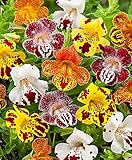
- Flower Appearance: Two-lipped, open-mouthed flowers in yellow, orange, red, peach or white, often with more than one colour and a spotted throat
- Edibility: Grown as an ornamental
Detailed Blooming Overview
Monkeyflower takes its name from the little face-like bloom, with a flared, two-lipped mouth. Given steady moisture it flowers generously over a long season, from spring right through autumn.
Flower Characteristics
- Mouth-shaped, two-lipped flowers in yellow, orange, red, peach, white or combinations of these.
- Throats are often freckled or contrastingly marked.
Bloom Care & Thinning
- Keep it flowering: Deadhead spent blooms to encourage a steady succession of flowers.
- Moisture: These are moisture-lovers – never let them dry out while in bud and bloom.
- Shape: Pinch young plants to build a bushier, more floriferous mound.
Pests, Diseases & Troubleshooting
Overview: Monkey flowers are moisture-loving, soft-tissued plants that are largely trouble-free but attract sap-suckers and slugs, and they resent both drought and stale, humid air. Grow them in steady moisture with good light and spacing, and most problems stay minor and cultural rather than needing chemicals.
Quick Troubleshooting Overview
| Issue / Pest | Main Symptom | Primary Solution |
|---|---|---|
| Aphids | Curled shoot tips, sticky honeydew, clustering insects | Rinse off, encourage beneficials, use insecticidal soap |
| Spider mites | Stippling and webbing in hot, dry spells | Raise moisture, rinse, apply soap or oil |
| Slugs and snails | Ragged holes in leaves and flowers, slime trails | Trap, hand-pick at night, use barriers or iron-phosphate bait |
| Powdery mildew | White powder on leaves in crowded plantings | Improve airflow, avoid overhead watering, sulfur spray |
| Heat wilt | Sudden collapse and browning in hot, dry weather | Shade, mulch and keep soil evenly moist |
Common Pests & Management
- Aphids (Aphis / Myzus spp.):
- Symptoms: Soft green, pink or black insects massed on new shoots and flower stems, causing curling, stunting and sticky honeydew with sooty mold.
- Prevention & Control: Wash off with a firm water spray, encourage ladybugs and lacewings, and avoid heavy nitrogen feeding. Insecticidal soap or a light oil handles stubborn colonies; treat undersides.
- Spider mites (Tetranychus urticae):
- Symptoms: Fine pale stippling and faint webbing on undersides during hot, dry weather, with a dusty bronze cast; the moisture-loving plant is especially prone when it dries out.
- Prevention & Control: Keep soil and air moist, rinse foliage, and improve conditions. Insecticidal soap or horticultural oil in the evening controls active mites; predatory mites suit protected plantings.
- Slugs and snails (Deroceras / Cornu spp.):
- Symptoms: Irregular holes in soft leaves and petals, especially on seedlings, with tell-tale silvery slime trails and worst damage after rain or watering.
- Prevention & Control: Hand-pick after dark, set beer or yeast traps, use copper or grit barriers, and remove daytime hiding places. Iron-phosphate bait is a pet-safe option for persistent pressure.
- Whiteflies (Trialeurodes vaporariorum):
- Symptoms: Tiny white flies lifting off when disturbed, with honeydew and yellowing leaves in sheltered or greenhouse plantings.
- Prevention & Control: Use yellow sticky traps, improve airflow, and rinse undersides. Insecticidal soap or oil, repeated, keeps numbers down.
- Thrips (Frankliniella spp.):
- Symptoms: Silvery flecking on petals and leaves with dark specks, and distorted, streaked flowers.
- Prevention & Control: Monitor with blue sticky traps, deadhead damaged blooms, and treat with spinosad or soap in the evening while protecting pollinators.
Diseases & Fungal Issues
- Powdery mildew:
- Symptoms: White powdery coating on upper leaf surfaces, mainly in crowded plantings with warm days and cool, humid nights.
- Treatment & Management: Space plants for airflow, water at the base early in the day, and remove affected leaves. Sulfur or potassium-bicarbonate sprays control spread; choose airy sites.
- Downy mildew (Peronospora spp.):
- Symptoms: Yellow blotches on upper surfaces with grey-purple fuzzy growth beneath in cool, wet conditions.
- Treatment & Management: Improve drainage and airflow, avoid prolonged leaf wetness, and remove infected material. Copper-based fungicide helps in persistent damp spells.
- Gray mold (Botrytis cinerea):
- Symptoms: Brown, collapsing flowers and stems with fuzzy grey spores in cool, humid, still air.
- Treatment & Management: Deadhead spent blooms promptly, thin growth, and improve ventilation; remove and bin affected tissue rather than composting it.
- Rust (Puccinia spp.):
- Symptoms: Orange to brown pustules on leaf undersides with yellow spots above.
- Treatment & Management: Remove infected leaves, avoid overhead watering, and space plants; a sulfur or copper fungicide can be used if it spreads.
Growing Difficulties & Abiotic Problems
- Heat and drought stress:
- Cause & Symptoms: As a bog-margin plant, Mimulus wilts, browns and can die back quickly in hot, dry conditions.
- Correction Strategy: Site in part shade in warm climates, mulch, and keep soil consistently moist; treat many types as cool-season or short-lived.
- Leggy, sparse growth:
- Cause & Symptoms: Too much shade or lack of pinching gives thin, floppy stems and few flowers.
- Correction Strategy: Grow in good light, pinch young plants, and deadhead to prolong bloom.
- Yellowing from waterlogging:
- Cause & Symptoms: Although moisture-loving, stagnant waterlogged soil starves roots and yellows leaves.
- Correction Strategy: Provide moist but not stagnant soil; ensure containers drain.
What Helps — Products & Tools
Cultural care carries most of the load here: steady moisture, airflow and slug control. Reach for insecticidal soap or light horticultural oil for aphids, mites and whiteflies, blue or yellow sticky traps for thrips and whiteflies, iron-phosphate slug bait or simple traps for molluscs, and a sulfur or copper fungicide for mildew and rust. Spray in the evening to spare pollinators.