


Plant Profile & Key Characteristics
Overview: Abyssinian gladiolus (Gladiolus murielae) is a cormous perennial about 50-100 cm (20-40 in) tall, grown as an ornamental and cut flower for its fragrant white, purple-centred, star-shaped blooms. Foliage dies back after summer flowering.
Quick Specifications
| Specification | Attribute |
|---|---|
| Plant Type / Life Cycle | Cormous perennial (geophyte) |
| Foliage Type | Deciduous (dies back after flowering) |
| Mature Size | 50-100 cm (20-40 in) tall |
| Growth Rate | Fast to moderate |
| Root System | Corm (underground storage organ) |
| Toxicity | Toxic — gladiolus (especially the corms) is listed as toxic to cats, dogs and horses and can irritate skin on handling |
| Hardiness | USDA zones 7-10 |
Growth Form & Structure
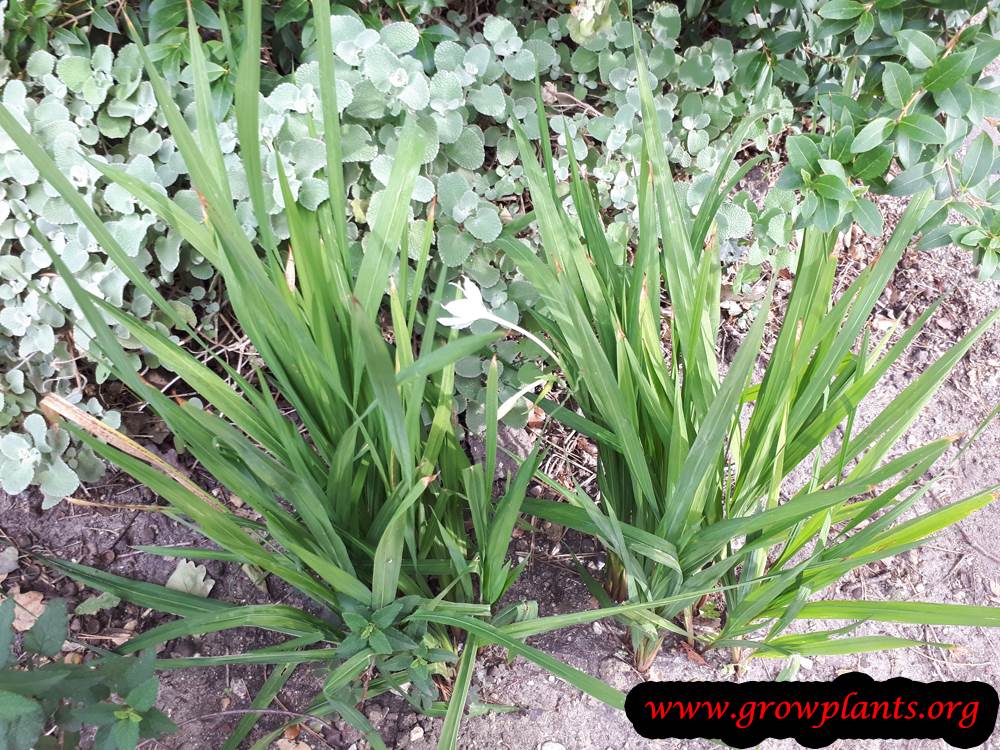
- Height & Spread: An upright, narrow plant 50-100 cm (20-40 in) tall from a single corm; grows well in pots.
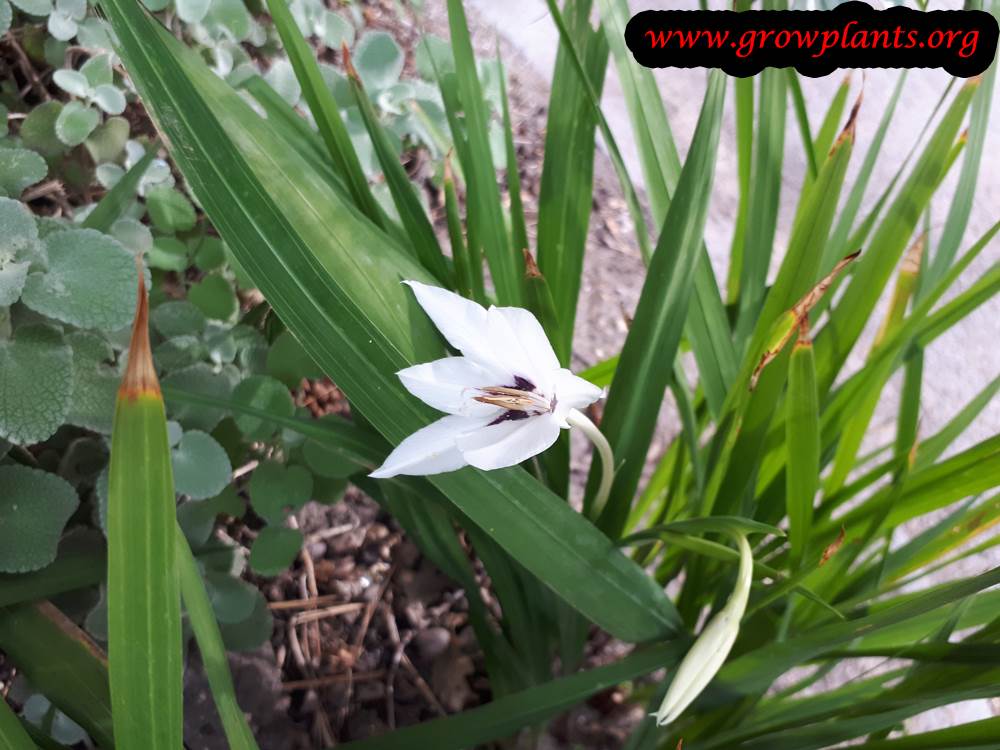
- Growth Habit & Form: Erect fans of sword-shaped leaves topped by a tall, one-sided flower spike.
- Lifespan & Maturity: The corm is perennial, multiplying over the years; the foliage dies back after summer flowering.
Anatomy & Physical Features
- Leaves & Foliage: Green, stiff, sword-shaped (linear) leaves in a flat fan.
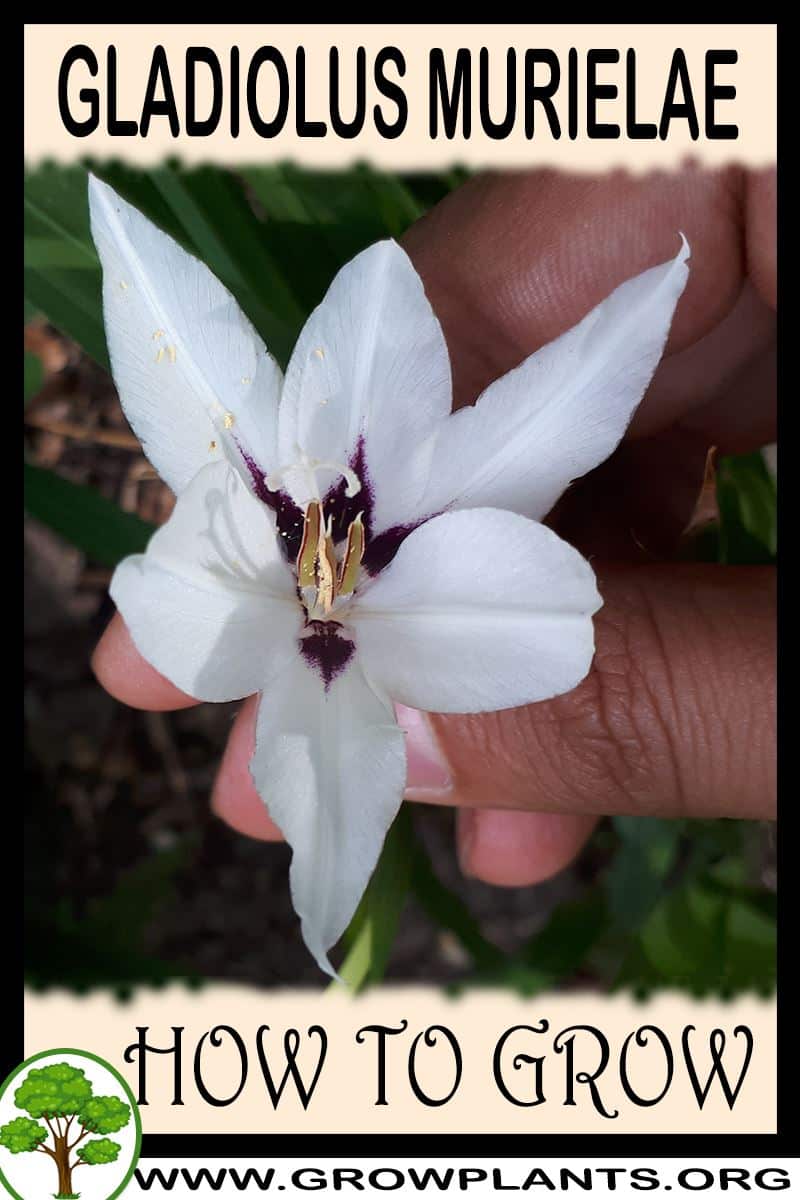
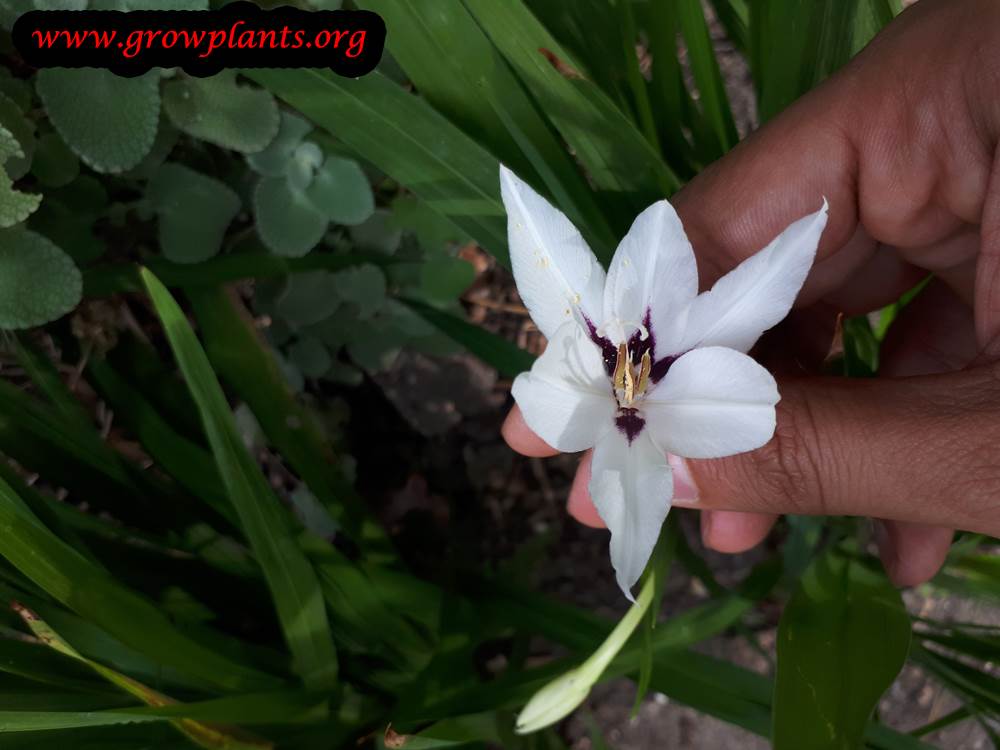
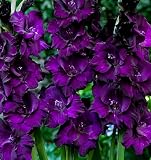
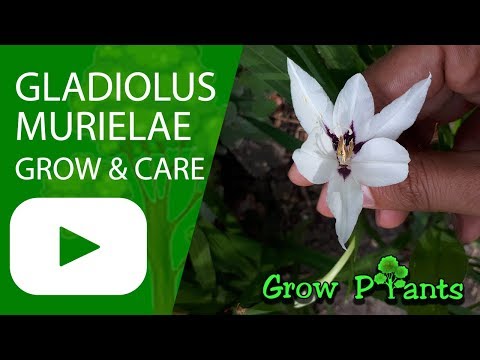
- Flower Characteristics: Fragrant, star-shaped white flowers with a deep purple central blotch, borne on arching stems.
Primary Uses & Landscape Value
- Functional & Ornamental Roles: A border and cut-flower ornamental prized for its tall flower spikes.
Care Guide: Planting, Soil & Watering
Overview: Gladiolus murielae (Abyssinian gladiolus) is a fast-growing, cormous perennial (hardiness zone 7–10) for full sun and fertile, well-drained soil. It wants steady moisture through summer growth and flowering, then drier conditions as it dies back.
Quick Care Requirements
| Requirement | Ideal Condition |
|---|---|
| Planting Season | Spring to summer, once the soil has warmed |
| Growth Rate | Fast to Moderate |
| Soil Type | Fertile, well-draining soil (sandy loam ideal) |
| Water Need | Low to Moderate — steady moisture in growth, drier as it dies back |
Planting & Establishment
- Best Planting Season: Plant corms in spring or summer once the soil has warmed and frost has passed.
- How to Plant:
- Hole Preparation: Loosen the bed deeply and plant corms about 10–15 cm (4–6 in) deep and 10–15 cm apart, pointed growing tip facing up.
- Soil Amendments: Work in compost and, on heavy ground, coarse sand or grit to guarantee the sharp drainage corms need.
- Planting Depth: The 10–15 cm planting depth also helps support the tall flower spikes; taller types benefit from staking.
- Growth Speed & Expectations: Fast — corms sprout and reach flowering size within a single season.
Soil, Watering & Drainage Care
- Soil Mix & Drainage Needs: Corms must have free-draining soil; waterlogged ground rots them. In containers use a free-draining mix and a deep pot.
- Watering Schedule & Technique:
- Young / Newly Planted: Water in newly planted corms and keep the soil lightly moist as shoots emerge.
- Established: Water regularly and deeply through active growth and flowering, keeping the soil evenly moist.
- Seasonal Adjustments: Taper off watering as the foliage yellows and dies back; keep corms dry during dormancy, and lift them where winters are wet or freezing.
Climate, Light & Hardiness
Gladiolus murielae (Abyssinian gladiolus) is a summer-flowering cormous perennial suited to mediterranean, subtropical, and temperate climates, hardy in USDA zones 7–10, and grows best in full sun on well-drained soil.
Quick Climate Specifications
| Climate Zones | Mediterranean, subtropical, temperate |
|---|---|
| USDA Hardiness Zones | 7–10 |
| Frost Tolerance | Moderate |
| Light Conditions | Full sun |
Sunlight & Light Exposure
Optimal Light Setup
Full sun for the best flowering.
Direct Sun Requirement
Needs strong direct sun.
Best Exposure / Orientation
An open, sunny bed.
Temperature Extremes & Hardiness
USDA Hardiness & Regional Limits
Hardy in the ground in zones 7–10. Toward the colder end of this range, deep planting and a heavy mulch improve corm survival; in regions colder than zone 7 the corms are commonly lifted in autumn and stored over winter, as with other tender summer bulbs.
Cold Damage & Winter Protection
Foliage dies back naturally in autumn/winter (consistent with its autumn/winter pruning of dead leaves). The below-ground corm is the cold-surviving structure, and a hard freeze reaching the corm can kill it outside its hardy zones.
Frost Sensitivity
Moderate; foliage is frost-tender, but the dormant corm has some cold tolerance within zones 7–10.
Extreme Heat Tolerance
Not specifically documented, but consistent with the mediterranean and subtropical summer heat found across its suitable climate zones.
Wind, Humidity & Microclimate
Rainfall & Seasonal Moisture
Grown with a small to average amount of water in well-drained soil; avoid waterlogging, which can rot the corm.
Microclimate Recommendations
A warm, sunny, well-drained bed; in marginal zones, deep planting and mulch (or lifting the corms for winter storage) improve reliability.
Growing in Pots, Balconies & Indoors
Gladiolus murielae (Abyssinian gladiolus) is a fragrant, sun-loving corm that flowers beautifully in a deep pot, but the grower confirms it is not a houseplant. Grow it outdoors in full sun on a balcony or patio.
Quick Details
- Container Size: Medium to deep – a pot with room to plant a cluster of corms for the best show.
- Indoor Suitability: No – not a houseplant; a very sunny sill at most while in leaf.
- Best Spot: Full sun.
- Soil & Drainage: Rich but free-draining mix.
- Watering in Pots: Small to moderate – steady moisture in growth, easing right off after flowering.
Indoors & On the Windowsill
- Not a houseplant: The grower’s answer is no – indoors the light is too weak and the still, dry air does not suit it. It belongs outdoors in a container.
- A bright sill at most: If you want to try it inside, only a very bright, sunny windowsill comes close, and even then it is happier out on a balcony or patio.
- Overwintering: In cold climates the corms are tender – lift and store them dry over the cold season, or keep the pot in a frost-free spot, and restart as it warms.
On a Balcony or Patio
- Sun, wind and heat: Give it your sunniest, most open spot; walls and railings throw back heat and wind dries pots fast, so check moisture daily in hot weather and stake tall stems on an exposed balcony. A drip irrigation kit with a timer can take over that watering check automatically.
- Support: The tall, slender flower stems appreciate a little support and shelter from wind on an exposed balcony.
Choosing the Pot, Soil & Long-Term Care
- Pot & drainage: Choose a pot with strong drainage holes and skip a standing-water saucer, which invites root rot; terracotta breathes and dries quickly, while glazed or plastic hold moisture longer.
- Potting mix: Fill with a well-aerated, organic-rich medium – a good potting mix, or peat/coir blended with perlite or vermiculite for drainage.
- Feeding: Container plants run through nutrients fast because watering washes them out, so feed a little more often through the growing season than you would in open ground.
- Repotting: Refresh the mix or pot up about every couple of years; for perennials, lightly trim the roots and top growth at the same time.
Fertilizing & Feeding
A corm-forming plant grown for its flowers and as a cut flower: light, balanced feeding while leaves and flower spikes are actively growing is enough, tapering off once bloom finishes so the corm can ripen and rest.
Quick Fertilizing Specs
| Feeding Level | Light feeder |
|---|---|
| Main Nutrient Priority | Balanced early, shifting toward potassium as flower spikes develop |
| Best Feeding Period | From active leaf growth through flowering |
| Organic Options | Well-rotted organic matter worked into well-drained soil before planting |
| Micronutrients | Usually adequate from a complete fertilizer in well-drained garden soil; correct specific issues only when diagnosed |
| Reduce/Stop Feeding | Reduce and stop feeding once flowering finishes and the foliage begins to yellow and die back |
Feeding by Growth Stage
Active leaf growth through flowering
Support strong sword-shaped foliage and a well-formed flower spike, while also building the corm for next season.
| Nutrient direction | Balanced feeding as leaves emerge, shifting emphasis toward potassium as the flower spike develops to support blooming and corm quality. |
|---|---|
| Timing | From shoot emergence in spring through the summer bloom period. |
| Frequency | A light feeding at planting, with one or two further light feedings as the flower spike develops. |
| Fertilizer types | A balanced complete fertilizer at planting, A potassium-leaning complete fertilizer as flower spikes form |
| Precautions | Avoid heavy nitrogen once spikes are forming, since it can produce weak stems that flop or bend. |
Post-bloom foliage dieback
Let the foliage finish ripening the corm undisturbed before the plant is cut back or lifted.
| Nutrient direction | None – withhold fertilizer once flowering ends and the leaves begin to yellow and die back. |
|---|---|
| Timing | From the end of flowering through autumn and winter foliage dieback. |
| Frequency | No feeding at this stage. |
| Fertilizer types | No feeding at this stage – allow the foliage to die back naturally without fertilizer. |
| Precautions | Do not fertilize once the foliage is dying back; let it yellow fully before cutting it away at the base, since it is still feeding the corm. |
Nutrient Deficiency Signs & Corrections
Leaves are pale green to yellow and overall growth and spike development are weak.
| Possible causes | low available soil nitrogen, nutrients leaching from sandy, well-drained soil, insufficient feeding for the corm’s active growth period |
|---|---|
| Appears first on | older, lower leaves |
| What to check | recent feeding history, soil texture and drainage, overall foliage color and vigor |
| Possible correction | Apply a light, balanced fertilizer during active leaf growth and monitor for improved color. |
Leaf margins yellow or scorch on older leaves and flower spikes are weak or prone to bending.
| Possible causes | low soil potassium, leaching in light, well-drained soil, heavy nitrogen feeding relative to potassium |
|---|---|
| Appears first on | older leaf margins |
| What to check | soil potassium status, recent feeding balance, stem strength and spike quality |
| Possible correction | Shift toward a potassium-leaning fertilizer as spikes form and avoid excess nitrogen. |
New leaves emerge pale to yellow while the veins remain green.
| Possible causes | high soil pH tying up available iron, waterlogged soil despite this plant’s preference for well-drained conditions, root stress from disturbance during corm planting |
|---|---|
| Appears first on | newest leaves |
| What to check | soil drainage, soil pH if known, planting depth and recent root disturbance |
| Possible correction | Improve drainage and soil conditions, and apply a chelated iron product per its label if the pattern persists. |
Pruning, Training & Seasonal Maintenance
Gladiolus murielae grows from a corm and produces only strap-like leaves and a single flowering stem each season, so there is no woody framework to shape and essentially nothing to prune while the plant is actively growing. The only real maintenance is cutting flower stems for use as cut flowers during summer bloom, and cutting the whole clump down at the base once the foliage yellows and dies back in autumn.
Quick Pruning & Maintenance Specs
| Pruning Tolerance | Low – no structural pruning applies; only post-bloom and post-dieback cutback |
| Primary Pruning Window | Autumn/winter, once the leaves have died back |
| Typical Frequency | Once per season, at foliage die-back; plus flower-stem cuts during summer bloom if used as cut flowers |
| Main Objective | Remove spent foliage and flower stems; keep the corm clean going into dormancy |
| Best Tool Type | Precision snips or bypass secateurs |
| Avoid Heavy Pruning During | While leaves are still green – they are feeding the corm for next year’s bloom |
Special Growth to Remove
- Spent flower stems, cut after bloom fades if not already harvested as cut flowers.
- Dead, yellowed foliage once it has fully died back – cut at the base rather than pulling, which can disturb the corm.
Tools
- Precision snips for cutting individual flower stems for the vase.
- Bypass secateurs for the base cutback of the whole dying clump in autumn.
Tool Hygiene & Disease Risk
Routine – clean, sharp tools are enough; the main risks noted for this species (spider mites, rust, thrips) are pest/foliar issues rather than pruning-transmitted, so no special disinfection routine is needed.
Cut Placement & Technique
When harvesting as a cut flower, cut the stem low, leaving as much healthy leaf as possible on the plant so it can keep feeding the corm. When cutting back for the season, cut the dead leaves at the base near soil level.
Common Pruning Mistakes
- Cutting back green, still-photosynthesizing foliage right after bloom, which starves the corm of the reserves it needs for next year’s flowering.
- Pulling dead leaves instead of cutting them, risking disturbance to the corm.
When NOT to Prune
Do not remove foliage while it is still green after flowering – let it die back naturally so the corm can store energy for next season; if lifting corms for winter storage in colder parts of the hardiness range, wait until foliage has yellowed before cutting back and digging.
Recommended Tools (by task)
- precision_snips – cutting individual flower stems for cut-flower use.
- bypass_secateurs – end-of-season cutback of the dying foliage clump.
Propagation Guide
Gladiolus murielae is most reliably propagated by separating the small cormels that form around the base of the parent corm, which the site notes is easier than raising it from seed. Seed reproduces the species reasonably true-to-type but takes appreciably longer to reach flowering size, so propagation overall is easy when corm division is used.
Quick Propagation Specs
| Best Propagation Method | Corm division (cormels) |
| Alternative Methods | Seed |
| Propagation Difficulty | Easy |
| Seed True-to-Type | Usually true-to-type |
| Vegetative True-to-Type | Yes |
| Best Propagation Season | Corms are lifted and divided once the foliage dies back in autumn, and replanted in spring |
Growing from Seed
Seed can be sown in spring, matching the plant’s general planting season, but seedlings take several years to build up a corm large enough to flower, so it is a much slower route than dividing cormels.
Rhizomes, Tubers, Bulbs & Corms
Corm Division (Cormels)
When the foliage dies back in autumn, the site’s own pruning guidance is to cut it back at the base; this is also the point to lift the corms in climates where they aren’t left in the ground over winter, separating the small cormels that form around the base of the parent corm.
Larger cormels may flower the following season, while very small ones often need a year or two of growing on before they reach flowering size. Each corm or cormel used for planting should have an intact growing point.
Where corms are lifted for winter storage, let them air-dry briefly in a cool, airy spot before storing; replant in spring, per the plant’s general planting season, with the pointed growth end facing upward.
Bloom & Flower Guide
Quick Details
- Bloom Season: Late summer
- Time to First Bloom: In its first season, usually a few months after the corms are planted out
- Flower Appearance: Fragrant, star-shaped white flowers with a deep purple central blotch, several per arching stem
- Edibility: Grown as an ornamental and cut flower — not eaten
Detailed Blooming Overview
Abyssinian gladiolus is prized for its sweetly scented, brilliant white flowers, each marked with a striking maroon-purple throat, nodding gracefully on slender arching stems in late summer. The blooms open in succession up the stem and make an elegant, fragrant cut flower.
Flower Characteristics
- Star-shaped flowers with six tepals, white with a dark purple centre.
- Noticeably fragrant, especially in the evening.
- Carried several to a stem, rising from the sword-shaped leaves.
Bloom Care & Thinning
- Site for best flowering: Full sun and free-draining soil; plant the corms once the soil has warmed after frost.
- Managing the bloom: Cut stems for the vase as the first buds show colour; deadhead spent flowers; lift and store corms over winter in cold climates.
- Pollination: Worked by long-tongued insects and moths drawn to the evening scent.
Pests, Diseases & Troubleshooting
Overview: Gladioli are corm plants whose signature enemy is the gladiolus thrips, which can wreck both foliage and flower spikes, closely followed by soil- and corm-borne rots that are best beaten through clean stock, crop rotation and careful lifting and curing. The single most important habit is corm hygiene: inspect, dust and cure corms before storage, and never replant into infected ground. Lead with rotation, sanitation and healthy corms before any chemical control.
Quick Troubleshooting Overview
| Issue / Pest | Main Symptom | Primary Solution |
|---|---|---|
| Gladiolus thrips | Silvery-white flecking on leaves; streaked, browned, blasted flowers | Clean corms, hot-water/insecticidal corm treatment, blue sticky traps |
| Fusarium corm rot / yellows | Yellowing fans, stunting; brown rotted corms in store | Plant clean corms, rotate ground, cure corms dry; discard infected |
| Gladiolus rust | Orange-brown pustules on leaves | Remove infected leaves, airflow, avoid wet foliage; fungicide if severe |
| Botrytis | Spotted, rotting flowers and leaf/corm rot in wet weather | Airflow, deadhead, dry curing of corms; fungicide under persistent wet |
| Aphids | Sticky, distorted growth; spreads mosaic viruses | Hose off, encourage predators, soap/neem; control for virus |
| Spider mites | Fine stippling and bronzing in hot dry spells | Hose foliage, raise humidity, predatory mites; oil if severe |
Common Pests & Management
- Gladiolus thrips (Thrips simplex):
- Symptoms: The signature pest: tiny slender insects that rasp leaves and flowers, leaving silvery-white flecking and streaks; buds may fail to open, and blooms emerge browned, streaked and ‘blasted’. They also infest corms in storage.
- Prevention & Control: Start with clean, treated corms; set blue sticky traps and remove badly infested spikes. Under warm storage, thrips multiply on corms, so cure and store corms cool and dust or dip them; insecticidal soap, neem or a labelled insecticide during active growth if needed.
- Aphids (Myzus persicae / Aphis spp.):
- Symptoms: Soft-bodied colonies on leaves and flower stalks causing distortion and honeydew; importantly, they transmit mosaic viruses between plants.
- Prevention & Control: Hose off, support ladybirds and lacewings, and treat persistent colonies with insecticidal soap or neem; controlling aphids is central to limiting virus spread.
- Spider mites (Tetranychus urticae):
- Symptoms: Fine pale stippling that bronzes leaves, with webbing in hot, dry, still conditions; foliage dulls and dries prematurely.
- Prevention & Control: Raise humidity, hose foliage, and encourage predatory mites; use horticultural oil or a labelled miticide for heavy infestations.
- Bulb / corm mites (Rhizoglyphus spp.):
- Symptoms: Tiny pale mites that tunnel into stored or planted corms, especially those already damaged or rotting, worsening decay.
- Prevention & Control: Store only sound, cured corms in cool dry conditions, discard damaged ones, and rotate planting sites; a corm dip can help with valued stock.
- Cutworms & corn borers (Agrotis / Ostrinia spp.):
- Symptoms: Chewed stems at soil level (cutworms) or bored, weakened flower stalks that topple (borers).
- Prevention & Control: Clear weeds, use collars for cutworms, and remove and destroy bored stems; hand-pick and encourage predators.
Diseases & Fungal Issues
- Fusarium corm rot & yellows (Fusarium oxysporum f. sp. gladioli):
- Symptoms: Yellowing, curling leaf fans and stunting in the row; corms develop firm brown-to-black rot from the base and shrivel in storage. The commonest and most damaging disease.
- Treatment & Management: Plant only clean, firm corms, rotate away from infected ground for several years, and cure corms rapidly and dry after lifting. Discard any soft or discoloured corms; there is no cure once corms are infected.
- Botrytis blight & corm rot (Botrytis gladiolorum):
- Symptoms: Water-soaked, then brown spotting and rot of leaves and flowers in cool wet weather, and a soft brown corm rot in storage; grey mould in humidity.
- Treatment & Management: Space for airflow, deadhead, and avoid overhead watering; cure and store corms cool and dry. A preventive fungicide helps under persistent wet conditions.
- Gladiolus rust (Uromyces transversalis):
- Symptoms: Yellow flecks then orange-brown, transversely arranged pustules on leaves; heavy infection browns and kills foliage and weakens corms. A notifiable disease in some regions.
- Treatment & Management: Remove and destroy infected leaves, improve airflow, avoid wetting foliage, and use clean stock; apply a suitable fungicide under pressure and follow local quarantine guidance.
- Dry rot & core rot (Stromatinia gladioli / Penicillium):
- Symptoms: Dark sunken lesions and dry rot on corms in the ground or store, or blue-green mould core rot on bruised corms.
- Treatment & Management: Lift, cure and store carefully to avoid bruising, discard affected corms, and rotate ground; sanitation is the main defence.
- Mosaic & aster yellows viruses (Bean yellow mosaic / Cucumber mosaic virus):
- Symptoms: Mottling, streaking and ‘colour breaking’ in flowers, with stunting; spread by aphids (and leafhoppers for aster yellows).
- Treatment & Management: Control aphids and leafhoppers, rogue out symptomatic plants, and start from clean stock; viruses cannot be cured.
Growing Difficulties & Abiotic Problems
- Toppling flower spikes:
- Cause & Symptoms: Tall, top-heavy spikes lodge and snap in wind or rain, especially on rich soil or in shade.
- Correction Strategy: Stake individually or plant in blocks for mutual support, site in full sun, and plant corms deeply enough to anchor them.
- Crooked or one-sided spikes:
- Cause & Symptoms: Spikes bend toward the light or curve after being knocked over.
- Correction Strategy: Give even, full sun, avoid moving pots once buds show colour, and stand or stake spikes upright.
- Flower failure / bud blast:
- Cause & Symptoms: Buds fail to open or blooms are distorted from thrips, heat stress or dryness at spike development.
- Correction Strategy: Manage thrips, keep soil evenly moist during spiking, and avoid extreme heat; healthy large corms flower most reliably.
- Poor corm storage:
- Cause & Symptoms: Corms shrivel, rot or fail to sprout after a badly managed dormancy.
- Correction Strategy: Lift after foliage yellows, cure warm and airy for a couple of weeks, clean off old corms, and store cool, dry and airy over dormancy.
What Helps – Products & Tools
The most valuable ‘tools’ are cultural: clean firm corms, a rotation plan, and good curing and dry storage. Add blue sticky traps for thrips monitoring, insecticidal soap or neem for thrips and aphids, horticultural oil for mites, and a suitable fungicide (for rust or Botrytis) only when pressure is high. A corm dust/dip protects valued stock in storage.