Plant Profile & Key Characteristics
Also known as: Wax gourd, Ash gourd, White gourd, Winter gourd, Tallow gourd, Ash pumpkin
Overview: A vigorous annual cucurbit grown as a sprawling or trellised vine reaching 2-6 m (6-19 ft), cultivated for its large edible fruit. It is grown as a warm-season vegetable rather than as an ornamental.
Quick Specifications
| Specification | Attribute |
|---|---|
| Plant Type / Life Cycle | Annual |
| Mature Size | 2-6 m (6-19 ft) vine length |
| Growth Rate | Fast to moderate |
| Root System | Fibrous |
| Toxicity | Non-toxic / edible |
| Hardiness | USDA zone 5+ (may need extra care to fruit in zones 5-7) |
Growth Form & Structure
- Height & Spread: Trailing or climbing vine 2-6 m (6-19 ft) long; can be trellised or grown in containers of at least 20 L (5 gal).
- Growth Habit & Form: Semi-vine to vine with lobed, hairy foliage; sprawls on the ground or climbs supports.
- Lifespan & Maturity: Completes its cycle in one season; fruit is ready about 100-140 days from sowing.
Anatomy & Physical Features
- Leaves & Foliage: Green, heart-shaped and lobed leaves with wavy margins.
- Flower Characteristics: Yellow five-lobed flowers; female flowers carry a small melon-like ovary, males are smaller (full detail in the Bloom section).
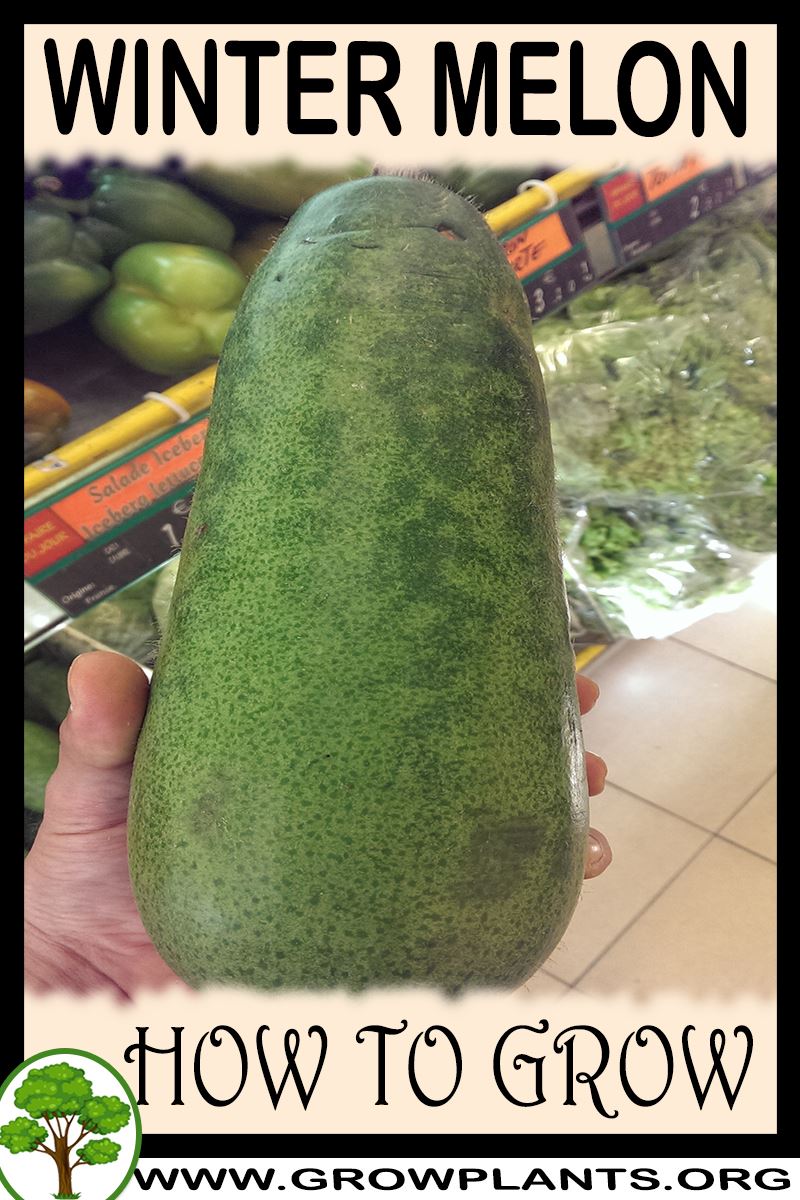
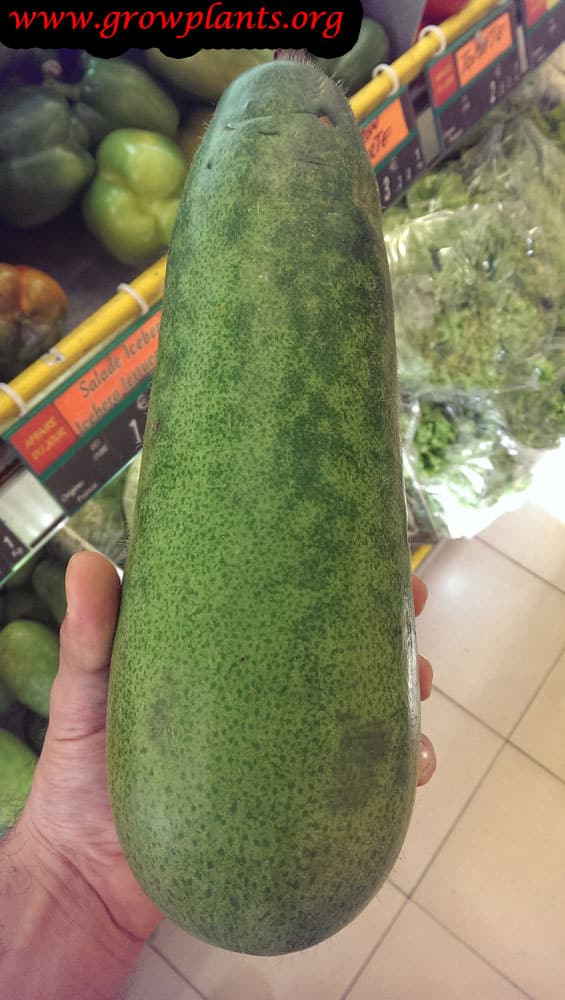
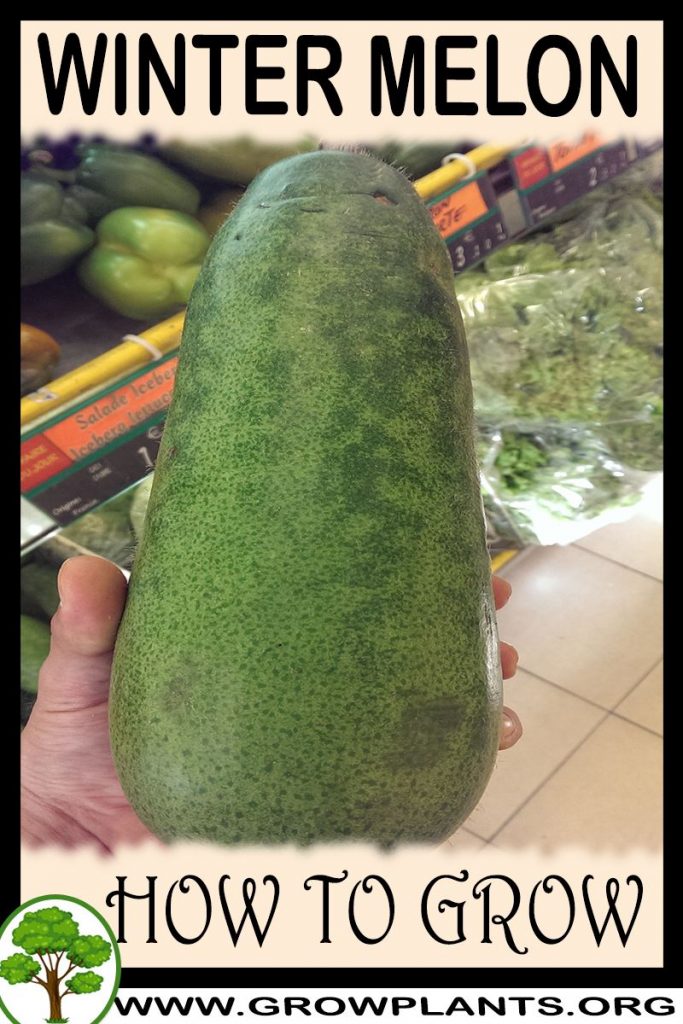
- Fruit Profile: Large green fruit, round to elongated and 10-80 cm long; sweet when young, later used as a vegetable, with edible seeds (full detail in the Fruit section).
Primary Uses & Landscape Value
- Edible Uses: Fruit eaten cooked or pickled; young fruit is sweet while mature fruit is used as a vegetable; the seeds are also edible.
- Functional & Ornamental Roles: Grown as a food crop, on the ground or trellised, and in large containers.
Care Guide: Planting, Soil & Watering
Overview: Winter melon (wax gourd) is a fast-growing warm-season annual vine needing full sun, a long warm summer (at least about three months from flowering), and a rich, light, well-ventilated soil. It is a thirsty crop that wants plenty of water at the roots yet sharp drainage, and it resents water sitting on its stem base, leaves or fruit.
Quick Care Requirements
| Requirement | Ideal Condition |
|---|---|
| Planting Season | In spring, once frost has passed and the soil is warm |
| Growth Rate | Moderate to fast |
| Soil Type | Rich, light, well-ventilated and well-draining (amended with organic matter) |
| Water Need | High – abundant water at the roots, but never waterlogged |
Planting & Establishment
- Best Planting Season: Plant in spring after the last frost, when the soil has warmed; it needs a long, warm summer to ripen fruit.
- How to Plant:
- Hole Preparation: Dig a hole larger than the root ball in loose, well-ventilated soil.
- Soil Amendments: Mix in organic matter, humus and chopped dead leaves; lighten heavy soil with material such as vermiculite to keep it airy and moisture-retentive.
- Planting Depth: Set the seedling at its original soil level and keep the stem base at the surface (not buried) to reduce the risk of basal rot.
- Growth Speed & Expectations: Fast to moderate; a vigorous vine that can reach 2–6 m (6–19 ft) in a season, so give it room or a trellis (small-fruited types especially).
Soil, Watering & Drainage Care
- Soil Mix & Drainage Needs: Needs airy, sharply drained soil; in containers use at least 20 L (5 gal) with ample drainage holes and a potting or peat mix opened up with perlite – the plant reacts badly to being overwatered.
- Watering Schedule & Technique:
- Young / Newly Planted: Keep the soil consistently moist as plants establish.
- Established: Water deeply and often at the base; direct water to the ground, not onto the leaves or fruit, to limit fungal disease and basal rot.
- Seasonal Adjustments: Water heavily through the hot growing and fruiting season; ease off as growth slows.
Climate, Light & Hardiness
Winter melon (wax gourd) is a vigorous warm-season tropical vine that demands heat and full sun and is killed by frost. Its large vines and fruit need a long, hot, frost-free season with ample summer warmth to mature.
Quick Climate Specifications
| Climate Zones | Mediterranean, desert, subtropical, and tropical (temperate with care) |
| USDA Hardiness Zones | Grown from about zone 5 upward as a summer annual (site data); care needed to fruit in zones 5–7 |
| Optimal Temp Range | Approximately 18–30 °C (65–86 °F) |
| Cold Damage Begins | Chilling stress below roughly 10–13 °C (50–55 °F) |
| Approx. Survival Minimum | No frost tolerance - killed at or near 0 °C (32 °F) |
| Frost Tolerance | None |
| Light Conditions | Full sun |
| Wind Tolerance | Low |
Sunlight & Light Exposure
Optimal Light Setup
Full sun - give at least 6–8 hours of direct light a day for strong growth, good flowering, and well-ripened fruit. Shade reduces yield and delays or prevents ripening.
Direct Sun Requirement
Yes - a genuinely sun-demanding crop. Too little direct sun gives leggy growth, weak fruit set, and fruit that fails to ripen.
Best Exposure & Orientation
In cool-summer regions a warm, sheltered south- or west-facing aspect that stores heat gives the best ripening; open, sunny ground is ideal elsewhere.
Temperature Extremes & Hardiness
USDA Hardiness & Regional Limits
The site's data lists this crop as grown from about USDA zone 5 upward. That figure reflects where it can be raised as a summer annual, not winter cold survival: it is frost-tender and completes its cycle in a single frost-free season, so it is grown as an annual wherever winters freeze and can grow year-round only in frost-free climates. The site notes it may need special care to fruit in zones 5–7. It is a heat-demanding tropical/subtropical gourd that ripens only in a long, hot season. Hardiness and growing habit are separate here - the plant is frost-sensitive, yet fully cultivable as a warm-season annual across a wide zone range.
Cold Damage & Winter Protection
Growth slows sharply and chilling injury - pitting, yellowing, stalled growth - appears below roughly 10–13 °C (50–55 °F). There is no winter to protect against in outdoor culture: the plant is grown only through the frost-free season, and young seedlings are especially cold-sensitive, so wait until nights are reliably warm before transplanting out.
Frost Sensitivity
None - frost tolerance is nil. Even a light frost at or near 0 °C (32 °F) kills leaves and vines, so all outdoor growth must fall within the frost-free window.
Extreme Heat Tolerance
High - thrives in summer heat and full sun. Very high temperatures above about 35 °C (95 °F) can still cause blossom drop and poorer fruit set, particularly under moisture stress.
Frost-Free Growing Season
Needs about 100–140 days to fruit and at least around three months of warmth from flowering to ripen its large gourds. This long, hot, frost-free requirement - not winter cold - is what limits where it can be grown; in cooler areas start indoors and give the warmest possible site.
Wind, Humidity & Microclimate
Humidity Preferences
Tolerates a range of summer humidity but does best in warm, airy conditions. High humidity with wet foliage encourages powdery mildew.
Dry-Air Tolerance
Tolerates moderately dry air well as long as soil moisture is kept up in the watering routine.
Wind Tolerance
Low - large soft leaves and brittle vines tear in strong wind, and wind knocks off flowers and deters pollinators. Give a sheltered site and support long vines.
Rainfall & Seasonal Moisture
As a thirsty, fast-growing warm-season crop it wants a steadily moist, warm growing period, but keep foliage and fruit dry - wet leaves in humid weather invite fungal disease. This describes its seasonal climate need, not a watering schedule.
Microclimate Recommendations
A warm, sheltered, sun-facing spot - for example a south-facing wall or slope in cooler climates - traps heat and lengthens the effective warm season, and dark mulch or plastic warms the soil early. Container root-zones heat, dry, and chill faster and are more wind- and frost-exposed, so shelter pots in extreme weather.
Growing in Pots, Balconies & Indoors
Winter melon is a large, vigorous sun-loving vine that thrives in full sun, so it is not a houseplant – but grown in a large, free-draining pot it does well on a sunny balcony, patio or terrace. It is a vigorous, space-hungry climber, so give it a large, deep container and sturdy support.
Quick Details
- Container Size: 20 L (5 gal)
- Indoor Suitability: Not an indoor houseplant – it needs full sun; at most a compact cultivar on the very sunniest windowsill
- Best Spot: Full sun – the brightest, warmest spot on a balcony or patio
- Soil & Drainage: Well-drained, well-ventilated mix (potting mix, or peat/coir with perlite) with plenty of drainage holes
- Watering in Pots: Keep evenly moist but never waterlogged – it dislikes overwatering, and pots dry fast in the sun
Indoors & On the Windowsill
- Not a houseplant: The grower keeps it out of the house – indoor light is far too weak for this sun-loving crop.
- Windowsill limits: Only the very sunniest windowsill could support a compact cultivar; most plants of this size are better off outdoors.
- Annual, so no overwintering: This is a warm-season annual – rather than overwintering it, simply resow when the weather warms.
On a Balcony or Patio
- Light & wind: Give it the sunniest, most sheltered spot; train the vine up a strong trellis, netting or stake and shelter it from wind; walls and paving reflect a lot of heat, so containers dry quickly – check moisture daily in warm weather. A drip irrigation kit with a timer can take over that watering check automatically.
- Practicalities: A full, wet pot is heavy, so make sure the balcony can take the weight, and manage drainage runoff.
Choosing the Pot, Soil & Long-Term Care
- Pot & drainage: Use a 20 L (5 gal) pot with plenty of drainage holes; the grower stresses this crop does not tolerate overwatering, so never leave it standing in water (root rot). Terracotta breathes and dries faster; glazed or plastic holds moisture longer.
- Potting mix: A well-aerated, well-ventilated mix – potting mix, or peat/coir with perlite – as the grower recommends.
- Feeding: Potted plants need feeding more often than those in the ground, since watering leaches nutrients from the mix – feed regularly through the growing season.
Grower’s Container Tip
- Watch the saucer: If you stand the pot on a tray or saucer, make sure it dries out the same day – never let the roots sit in collected water.
Growing this plant in a greenhouse
A greenhouse can give winter melon plant frost protection, cold protection, a longer growing season and controlled production.
Greenhouse at a glance
| Greenhouse suitability | Excellent - a major practical advantage |
|---|---|
| Main benefits | frost protection, cold protection, a longer growing season, controlled production |
| Season extension | can grow through winter |
| Outdoor protection advisable below | about 13°C |
| Maintain greenhouse minimum | around 15°C for active growth |
| Suitable types | heated greenhouse, polycarbonate greenhouse, lean-to |
| Heating | Heating is recommended in cold climates for continuous growth. |
Related greenhouse guides
- Greenhouses: How to Choose the Right Greenhouse
- Best Greenhouse Heaters
- Greenhouse Climate Control: Temperature, Ventilation and Humidity
- Best Lean-To Greenhouses
Fertilizing & Feeding
This is a productive, appreciably hungry crop that responds to steady, balanced feeding and generous organic matter, leaning on nitrogen while the vines grow and favoring potassium as fruit develops. A fertilizer formulated for tomatoes and vegetables supports that feeding pattern through harvest.
Quick Fertilizing Specs
| Feeding Level | Fairly heavy |
|---|---|
| Main Nutrient Priority | Balanced overall, nitrogen for the vines and potassium as fruit forms |
| Best Feeding Period | Through the warm active growing season |
| Organic Options | Compost, well-rotted manure, and general organic vegetable fertilizers |
| Soil pH | Slightly acidic to near neutral |
| Micronutrients | Usually supplied by compost and a complete fertilizer, and corrected only if a deficiency shows |
Feeding by Growth Stage
Establishment of young plants
Settle young plants and build a healthy root system and first true leaves.
| Nutrient direction | A balanced, complete feeding that supports steady root and early leaf growth without pushing soft, excessive top growth. |
|---|---|
| Timing | From transplanting or seedling establishment through the first flush of vine growth. |
| Frequency | Light, regular feeding while young plants establish. |
| Fertilizer types | A balanced complete vegetable fertilizer, Compost or other organic matter worked into the bed |
| Precautions | Avoid heavy nitrogen early, which encourages lush foliage at the expense of sturdy establishment. |
Vegetative vine growth
Build ample leaf area and strong vines ahead of flowering.
| Nutrient direction | A nitrogen-forward complete feeding to drive vigorous leaf and vine expansion. |
|---|---|
| Timing | During active spreading of the vines before heavy flowering. |
| Frequency | Steady feeding through the main growth phase. |
| Fertilizer types | A nitrogen-leaning complete fertilizer, Well-rotted compost as a supplement |
| Precautions | Keep feeding balanced overall, since runaway nitrogen can delay flowering and fruit set. |
Flowering and fruit development
Support abundant flowers, good fruit set, and quality fruit development.
| Nutrient direction | Shift toward a balanced feeding with strong potassium to support flowering, fruit set, and fruit filling. |
|---|---|
| Timing | From first flowering through fruit sizing and ripening. |
| Frequency | Regular feeding that continues through fruit development. |
| Fertilizer types | A balanced fertilizer with good potassium, Compost or a vegetable fertilizer suited to fruiting crops |
| Precautions | Keep watering even and consistent during fruiting to help calcium reach developing fruit and reduce blossom-end problems. |
Nutrient Deficiency Signs & Corrections
Older, lower leaves turn pale green to yellow and overall growth slows.
| Possible causes | Low soil nitrogen, Cold, wet soil that limits nitrogen uptake, Nitrogen leaching from sandy soil or heavy watering |
|---|---|
| Appears first on | Older, lower leaves |
| What to check | The color gradient from old to new leaves, Recent watering and rainfall, Whether any nitrogen has been applied during rapid growth |
| Possible correction | Apply a nitrogen-containing complete fertilizer and improve organic matter, and make sure soil is warm and well-drained so roots can take up nitrogen. |
Yellowing between the veins of older leaves while the veins themselves stay green.
| Possible causes | Low soil magnesium, High potassium levels competing with magnesium uptake, Acidic or heavily leached, sandy soil |
|---|---|
| Appears first on | Older, lower leaves |
| What to check | The pattern of interveinal yellowing versus whole-leaf yellowing, Soil acidity and recent high-potassium feeding, Drainage and leaching history |
| Possible correction | Correct soil acidity if needed and apply a magnesium source such as a soluble or chelated magnesium product per its label. |
A sunken, dark, leathery patch forms at the blossom end of developing fruit.
| Possible causes | Disrupted calcium movement into the fruit, Uneven or irregular watering, Excess nitrogen driving fast leafy growth |
|---|---|
| Appears first on | Blossom end of young, developing fruit |
| What to check | Consistency of soil moisture, Recent high-nitrogen feeding, Mulch and watering routine |
| Possible correction | Keep soil moisture even, mulch to buffer drying, and avoid excess nitrogen so calcium can reach developing fruit. |
Pruning, Training & Seasonal Maintenance
Winter melon is a large, long-season vine (2–6m) that can take 100–140 days to bear fruit weighing several kilograms each. It tolerates trimming throughout the growing season, but unlike the squashes in this family, the source guidance for it is explicit and specific: never cut the growing tip. This plant’s single growth vertex drives the vine’s whole extension, and damaging it can stall the plant before its unusually long fruiting period is complete. Pruning here is entirely about sanitation and support – not shaping and not tip control.
Quick Pruning & Maintenance Specs
| Pruning Tolerance | Moderate for leaf/side growth – but the main growing tip must never be cut |
| Primary Pruning Window | Throughout the growing season (source-confirmed “all the season”) |
| Typical Frequency | Weekly inspection, more often once fruit are sizing and need support |
| Main Objective | Disease sanitation and physically supporting very heavy fruit – not shaping the vine |
| Young Plant Priority | Protect the single growing tip; train the main vine onto sturdy support |
| Mature Plant Priority | Sling or cradle each fruit as it sizes; remove diseased leaves; still never touch the growing tip |
| Best Tool Type | Precision snips / bypass secateurs |
| Avoid Heavy Pruning During | Any time on the growing tip; avoid leaf removal during flowering/fruit set |
Pruning by Plant Age & Size
Newly Established
No pruning; remove only damaged transplant leaves. With such a long path to harvest (100–140 days), the young vine needs uninterrupted growth from the start and its single growing point must be left completely alone.
Young / Formative
Train the main vine onto strong support (fence, arbor, or sturdy trellis capable of eventually bearing large fruit) as it extends; smaller-fruited cultivars can be trellised throughout, while the largest-fruited types are usually better left to run on the ground. Side-shoots need no early removal.
Mature / Established
Once fruit begin sizing, priority shifts entirely to support (a sling or platform under each developing fruit, since they can weigh several kilograms) and sanitary leaf removal – the growing tip is still left untouched so the vine can keep extending and feeding the long fruiting cycle.
Seasonal Pruning Schedule
| Stage | Objective | Remove | Do Not Remove | Expected Response / Fruiting Impact |
| Early Growth (post-transplant) | Establishment | Only damaged/dead seedling leaves | The growing tip – explicitly protected; any healthy leaf | Continuous extension is essential given the 100–140-day maturity window |
| Ongoing Sanitary (throughout active growth) | Disease control; fruit support | Infected/yellowing leaves; guide new growth onto its support | The growing tip; healthy leaves near a developing fruit | Cleaner canopy, better airflow; damaging the tip risks stalling vine extension and delaying/losing fruit |
Structural Pruning & Training
Structure here is entirely about support, not shaping: train the vine onto a strong trellis, arbor, or fence able to carry heavy fruit, or let it sprawl on the ground with fruit lifted onto mulch or a board to prevent rot. Side-shoots can be thinned where they crowd the main vine or shade a sizing fruit, but the single main growing point is never touched.
Special Growth to Remove
Infected or yellowing leaves should be removed at the petiole as soon as seen. Excess side-shoots competing heavily with the main vine for resources can be thinned, but always leaving the primary growing tip intact. Male flowers can be left to drop naturally.
Container & Small-Space Pruning
Winter melon’s size (a 2–6m vine bearing multi-kilogram fruit) makes it a poor fit for most containers; where attempted, use the largest practical pot with a very sturdy trellis, sling every fruit without exception, and still never prune the growing tip – a container plant has even less capacity to recover from a stalled growth point than an in-ground vine.
Tools
Precision snips or bypass secateurs for leaf removal on the soft vine tissue; no saw or lopper is needed. Sturdy sling material is essential given the fruit’s weight.
Tool Hygiene & Disease Risk
Increased – like other cucurbits, winter melon is susceptible to sap-transmissible viruses and to powdery mildew; wipe blades after cutting diseased tissue.
Cut Placement & Technique
Cut infected leaves at the petiole close to the vine rather than tearing. Never cut into or pinch the growing tip – this is the one technique point that overrides the general cucurbit playbook for this plant.
Heavy Pruning & Rejuvenation
Not tolerated and not applicable – this is a single-season annual vine with one critical growing point; there is no rejuvenation practice, and cutting back the main vine risks losing the crop rather than renewing it.
Post-Pruning Care
Keep water off remaining foliage after leaf removal to slow disease spread. Do not fertilize in response to pruning. Check fruit slings/supports regularly as fruit gain weight through the long ripening period – a failed support is a far greater risk here than on smaller-fruited squash.
Common Pruning Mistakes
- Pinching or damaging the main growing tip, which can stall the vine mid-way through its unusually long fruiting cycle
- Under-supporting the heavy fruit, leading to vine breakage or fruit rot where it contacts wet ground
- Removing leaves near a sizing fruit, slowing its development during an already long maturation period
When NOT to Prune
Never prune the growing tip, at any stage. Avoid removing healthy leaves during flowering/fruit set. Avoid pruning in wet weather, which spreads powdery mildew.
Recommended Tools (by task)
- precision_snips – clean removal of diseased leaves and side-shoots without disturbing the main growing tip
- soft_ties_stakes – training the vine onto sturdy support and slinging heavy fruit
- blade_disinfectant – limits sap-transmitted virus spread between cuts
Pruning Troubleshooting
| Problem | Possible Cause | What to Check | Corrective Action |
| Vine stops extending / growth stalls | Growing tip was accidentally cut, pinched, or damaged | Condition of the vine’s tip and most recent growth | Avoid all cutting near the tip; if damaged, allow a side-shoot to take over as the new leader |
| Fruit splitting or rotting on the vine | Inadequate support for the fruit’s weight, or ground contact on wet soil | Sling/platform condition under each fruit | Add or reinforce support as soon as fruit begin sizing |
| Fruit not maturing before season ends | Late planting or cool-season delay against the 100–140-day requirement | Days remaining vs. fruit development stage | Prioritize the earliest-set fruit; remove clearly non-viable late flowers rather than the growing tip |
Propagation Guide
Winter melon is grown from seed, sown directly or started as transplants, with no grafting or vegetative propagation used for this species. Seed sows easily without special treatment, and while the plant needs a long, warm growing season (at least 3 months from flowering) to fruit well, propagation itself is easy.
Quick Propagation Specs
| Best Propagation Method | Seed (direct sow or transplant seedlings) |
| Alternative Methods | None commonly used – vegetative propagation and grafting are not used for this species |
| Propagation Difficulty | Easy |
| Seed True-to-Type | Usually true-to-type when isolated from other winter melon (Benincasa hispida) varieties |
| Best Propagation Season | Spring |
| Seed Germination Time | 4–20 days |
| Germination Temperature | Not specified in site data; like other warm-season cucurbits it germinates best in warm soil, roughly 21–30°C (70–86°F) |
| Seed Sowing Depth | 1–2cm (0.5–1 inch) from the top |
Growing from Seed
Seed Handling & Viability
Save seed at room temperature in a dry place until sowing; no special treatment is required.
Dormancy & Pre-Sowing Treatment
No pre-sowing treatment is needed – seed sows easily without scarification or stratification.
Sowing Season
Sow in spring.
Sowing Depth & Orientation
Sow about 1–2cm (0.5–1 inch) deep in a light, well-ventilated soil mix that holds moisture, such as a vermiculite blend; seeds don’t need burying any deeper.
Germination Conditions
Keep soil moist in full sun. The site does not give an exact germination temperature for this species; as a warm-season cucurbit it should germinate best in warm soil, roughly 21–30°C (70–86°F).
Germination Time
Germination typically takes 4–20 days.
Seedling Care
Keep seedlings warm, well watered and in full sun; space seed trays about 5x5cm (2×2 inches) apart, moving to a final spacing of about 40x50cm (16×20 inches) if trellised (recommended for the smaller-fruited types), or 1×1.25m (40–50 inches) if left to crawl.
Bloom & Flower Guide
Quick Details
- Bloom Season: Late spring and summer
- Time to First Bloom: Within the first season, several weeks after sowing once the vines are established
- Flower Appearance: Yellow blooms with five lobes; separate male and female flowers on the same plant, the female carrying a tiny immature ovary behind the bloom
- Edibility: The flower is not usually eaten; this plant is grown for its fruit
Detailed Blooming Overview
Winter melon (wax gourd) is monoecious. Small male flowers usually open first, followed by female blooms that each carry a tiny immature fruit behind the petals. Bees and other pollinators move pollen between them, and hand-pollination helps in still or cool weather.
Flower Characteristics
- Yellow, five-lobed blooms
- Separate male and female flowers on the same plant; the female shows a miniature fruit at its base
- Male flowers are usually smaller and often open first
Bloom Care & Thinning
- Pollination: Carried out by bees and other pollinators; where they are scarce you can hand-pollinate by brushing pollen from a male bloom onto a female.
- Flower drop & poor set: Blooms sometimes fail or drop after disease or a dry spell; steady watering and, if pollinators are scarce, a little hand-pollination usually put it right.
Bloom Health & Protection
- Aphids: Gather on tender buds and shoot tips; a jet of water or insecticidal soap keeps them in check.
- Powdery mildew: Can coat the leaves and sap flowering vigour in humid spells; better airflow and a sulfur- or neem-based treatment help.
- Spider mites can build up in hot, dry spells and weaken flowering shoots; keeping plants watered and hosing the leaf undersides discourages them
Fruit & Uses
Winter melon (wax gourd) is grown for its large fruit, used as a cooked vegetable once mature, and for its edible seeds. Young fruit has a mild sweetness, but the plant is grown mainly for the mature fruit, which is always cooked.
Quick Edible Specs
| Edible Parts | Fruit (flesh); seeds |
| Main Use(s) | Culinary – cooked in soups and stir-fries, pickled; also candied in some cuisines |
| Eaten Raw or Cooked | Fruit: cooked (or pickled). Seeds: cooked/dried before eating |
| Preparation Required | Peel the thick rind and remove pulp/seeds before cooking the flesh; clean and dry seeds before eating |
| Harvest Season | Summer to autumn |
| Time to First Harvest | A full stretch of warm summer weather after flowering (see Sowing/Care for typical timing) |
| Storage | The thick, waxy-skinned mature fruit keeps for a long time (weeks to months) in a cool, dry place |
| Safety/Toxicity Caveat | None specific beyond the general cucurbit caution: discard fruit that tastes bitter or soapy rather than eating it |
Fruit
The green fruit can be round or elongated and shapeless, sized anywhere from about 10 to 80 cm (4 to 32 in). It is grown mainly to full maturity, when the outer skin develops a waxy, whitish bloom and the flesh becomes the mild, absorbent vegetable used in East and Southeast Asian cooking – typically simmered in soups, stir-fried, or pickled. Once picked, mature fruit can be stored and used over time rather than needing to be eaten immediately.
Seeds, Pods & Nuts
The seeds inside the fruit are also edible. Clean off the surrounding pulp, dry them, and cook (e.g. dry-roast) before eating, as is standard practice for large cucurbit seeds.
Harvesting
Harvest through summer into autumn once fruit has sized up and the rind has developed its characteristic waxy coating, which is a sign of maturity and good keeping quality; the crop needs a long run of warm weather from flowering to reach this stage.
Preparation, Uses & Safety
Peel the thick rind, scoop out the pulp and seeds, then cook the flesh – it is a classic soup vegetable (notably winter melon soup) and is also stir-fried or pickled; in some cuisines it is candied as a sweet. Keep the cleaned seeds separately, dry them, and cook before eating. As with other cucurbits, avoid eating any fruit that tastes bitter or soapy.
Pests, Diseases & Troubleshooting
Overview: Wax gourd is a vigorous cucurbit and shares the family’s classic vulnerabilities: chewing cucumber beetles and squash bugs, sap-sucking aphids and whitefly that also vector viruses, and the twin mildews – powdery and downy – on the sprawling foliage. Wilts and fruit flies round out the risks. Grow it with crop rotation, row covers early, resistant seed and good airflow, and reserve sprays for real outbreaks.
Quick Troubleshooting Overview
| Issue / Pest | Main Symptom | Primary Solution |
|---|---|---|
| Powdery mildew | White powdery coating on leaves and stems | Airflow, resistant lines, sulphur or potassium bicarbonate |
| Downy mildew | Angular yellow spots, greyish-purple mould beneath | Improve airflow, remove debris, copper fungicide |
| Cucumber beetles | Chewed leaves and flowers; spread bacterial wilt | Row covers early, handpick, kaolin clay |
| Aphids | Curled leaves, honeydew; virus vectors | Insecticidal soap or neem, reflective mulch, predators |
| Squash bug | Wilting runners; bronze egg clusters beneath leaves | Crush eggs, handpick, row covers, sanitation |
| Melon fruit fly | Maggots and rot inside developing fruit | Bait/lure traps, bag fruit, remove fallen fruit |
Common Pests & Management
- Cucumber beetles (Diabrotica / Acalymma spp.):
- Symptoms: Yellow-and-black striped or spotted beetles chewing leaves, flowers and young fruit; more seriously they transmit bacterial wilt and mosaic viruses, and larvae feed on roots.
- Prevention & Control: Cover young plants with floating row cover (lift at flowering for pollination), handpick, use yellow sticky traps and kaolin clay, keep the patch weed-free, and rotate crops away from last year’s cucurbits.
- Aphids (Aphis gossypii / Myzus persicae):
- Symptoms: Colonies on shoot tips and leaf undersides curl and yellow the foliage, coat it in honeydew and sooty mould, and – most importantly – spread mosaic viruses.
- Prevention & Control: Blast with water, spray insecticidal soap or neem on undersides, lay reflective mulch to deter them, and support ladybirds and lacewings; avoid excess nitrogen.
- Squash bug (Anasa tristis):
- Symptoms: Grey-brown shield bugs whose feeding wilts and blackens runners; look for bronze egg clusters and grey nymphs on leaf undersides.
- Prevention & Control: Crush egg masses, handpick adults into soapy water, use row covers and trap boards laid at night, and clear crop debris where they overwinter.
- Whitefly (Bemisia tabaci):
- Symptoms: Tiny white flies rising in clouds; nymphs on undersides excrete honeydew that blackens with sooty mould, and they transmit viruses.
- Prevention & Control: Use yellow sticky traps, spray insecticidal soap or neem on undersides in the evening, and encourage Encarsia and predatory beetles.
- Melon / fruit flies (Zeugodacus (Bactrocera) cucurbitae):
- Symptoms: Females sting young fruit to lay eggs; maggots tunnel inside causing distortion, oozing and rot, and premature drop.
- Prevention & Control: Hang cue-lure or protein-bait traps, bag developing fruit, harvest promptly, and collect and destroy fallen infested fruit to break the cycle.
- Spider mites (Tetranychus spp.):
- Symptoms: Fine stippling, bronzing and webbing on leaf undersides in hot, dry weather.
- Prevention & Control: Hose foliage, maintain even moisture, and apply insecticidal soap or horticultural oil to undersides.
Diseases & Fungal Issues
- Powdery mildew (Podosphaera xanthii / Erysiphe cichoracearum):
- Symptoms: White powdery patches on upper and lower leaf surfaces and stems, spreading until leaves yellow, brown and die, weakening the vine and sun-scalding fruit.
- Treatment & Management: Plant resistant lines, space for airflow, avoid overhead water, remove affected leaves, and spray sulphur, potassium bicarbonate or a labelled fungicide on a preventive rotation.
- Downy mildew (Pseudoperonospora cubensis):
- Symptoms: Angular yellow spots on the upper surface bounded by veins, with grey-to-purple downy growth beneath in humid conditions; leaves brown and collapse quickly.
- Treatment & Management: Improve airflow and drainage, water early so leaves dry, remove debris, and apply copper or a labelled downy-mildew fungicide; choose tolerant varieties.
- Fusarium wilt (Fusarium oxysporum f. sp.):
- Symptoms: Yellowing and one-sided wilting of runners, with brown vascular streaking in the stem; plants collapse, often at fruiting.
- Treatment & Management: Rotate on a long cycle, use resistant rootstock or varieties, improve drainage, and remove and destroy infected plants – the soil-borne fungus is not curable in place.
- Anthracnose (Colletotrichum orbiculare):
- Symptoms: Water-soaked leaf spots turning tan with dark borders, stem lesions, and sunken dark spots on fruit in wet weather.
- Treatment & Management: Use clean seed, rotate, remove debris, avoid working plants when wet, and apply copper or a labelled fungicide preventively.
- Gummy stem blight / black rot (Didymella bryoniae):
- Symptoms: Dark, sometimes gum-oozing lesions on stems and crowns, leaf blotches, and black fruit rot in storage.
- Treatment & Management: Rotate, use treated seed, keep foliage dry, remove infected tissue, and apply a labelled fungicide.
- Mosaic viruses (CMV / WMV / ZYMV):
- Symptoms: Mottled, blistered and distorted leaves, stunting, and warty, misshapen fruit; spread by aphids and beetles.
- Treatment & Management: Control aphid and beetle vectors, remove infected plants promptly, manage weeds, and use reflective mulch and tolerant varieties.
Growing Difficulties & Abiotic Problems
- Poor fruit set / blossom drop:
- Cause & Symptoms: Insufficient pollination or heat stress leaves flowers unset and dropping, since separate male and female flowers need insect transfer.
- Correction Strategy: Encourage bees, avoid insecticides during bloom, hand-pollinate in the cool morning, and keep moisture even.
- Blossom-end rot:
- Cause & Symptoms: Uneven watering and calcium movement issues cause a sunken brown-black patch at the fruit’s blossom end.
- Correction Strategy: Water evenly and mulch to buffer moisture, avoid drought-flood swings, and correct low calcium only if soil tests confirm it.
- Sunscald:
- Cause & Symptoms: Exposed fruit and defoliated vines let sun bleach and blister the rind.
- Correction Strategy: Keep the canopy healthy to shade fruit and manage mildew that causes premature leaf loss.
- Bitterness / cracking:
- Cause & Symptoms: Heat and irregular watering can cause off-flavour and split fruit.
- Correction Strategy: Maintain steady moisture and harvest at proper maturity.
What Helps – Products & Tools
Useful tools here include neem oil and insecticidal soap for aphids, whitefly and mites; kaolin clay and floating row covers against beetles and squash bugs; sulphur or potassium bicarbonate for powdery mildew and copper fungicide for downy mildew, anthracnose and gummy stem blight; and cucurbit fruit-fly lure or protein-bait traps. Spray in the evening to protect the bees this crop depends on.