
Plant Profile & Key Characteristics
Overview: A deciduous-to-evergreen spiny shrub or small tree of the prickly-ash genus (Zanthoxylum), 2-7 m (6-23 ft) tall. Grown chiefly for its edible fruit – the source of Sichuan peppercorns – as well as medicinally and as an ornamental.
Quick Specifications
| Specification | Attribute |
|---|---|
| Plant Type / Life Cycle | Deciduous or evergreen shrub / small tree (perennial) |
| Foliage Type | Deciduous to evergreen |
| Mature Size | 2-7 m (6-23 ft) |
| Growth Rate | Moderate |
| Hardiness | USDA zones 5-10 |
Growth Form & Structure
- Height & Spread: 2-7 m (6-23 ft) as a large shrub or small tree, kept lower and more open by pruning; can be container-grown when young.
- Growth Habit & Form: Upright, thorny, open-branched shrub or small tree; the interior is pruned open to make picking the fruit easier.
- Lifespan & Maturity: A moderate-growing woody plant that takes about 5-7 years from planting to bear its first fruit.
Anatomy & Physical Features
- Trunk & Bark: Stems and branches are armed with sharp prickles, giving the plant its ‘prickly ash’ name.
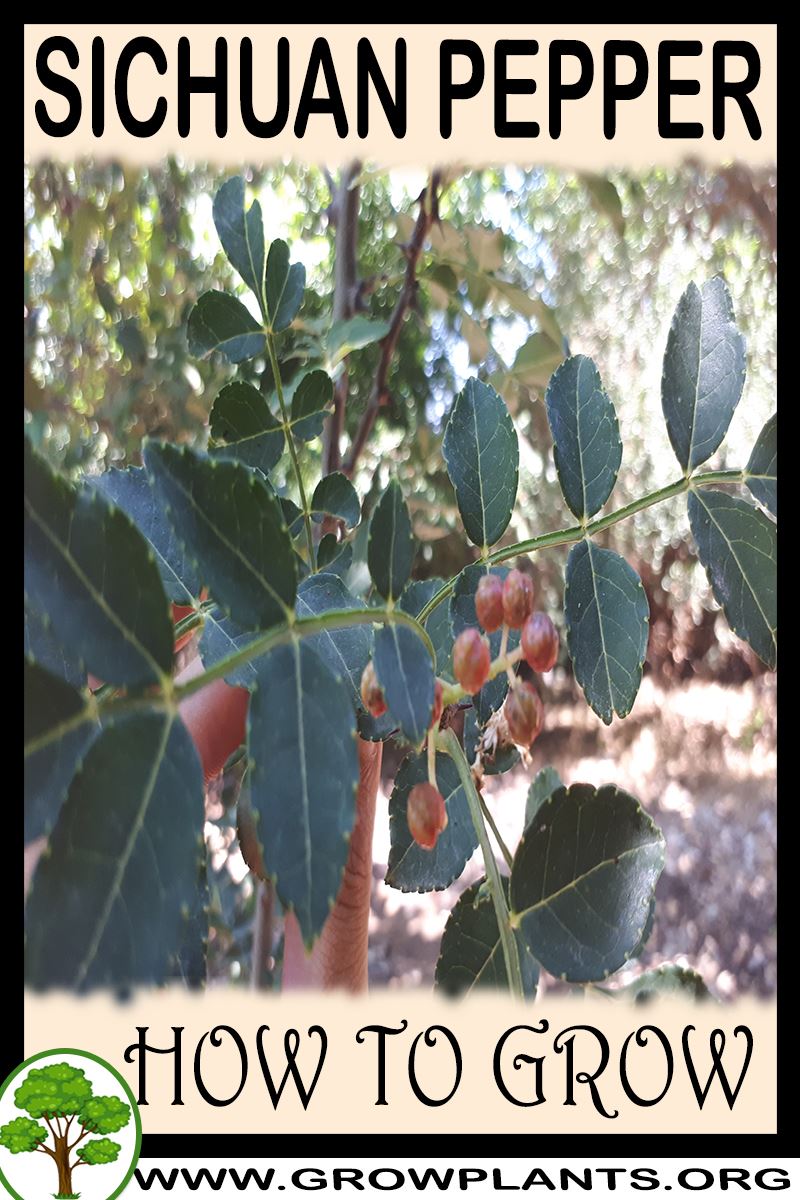
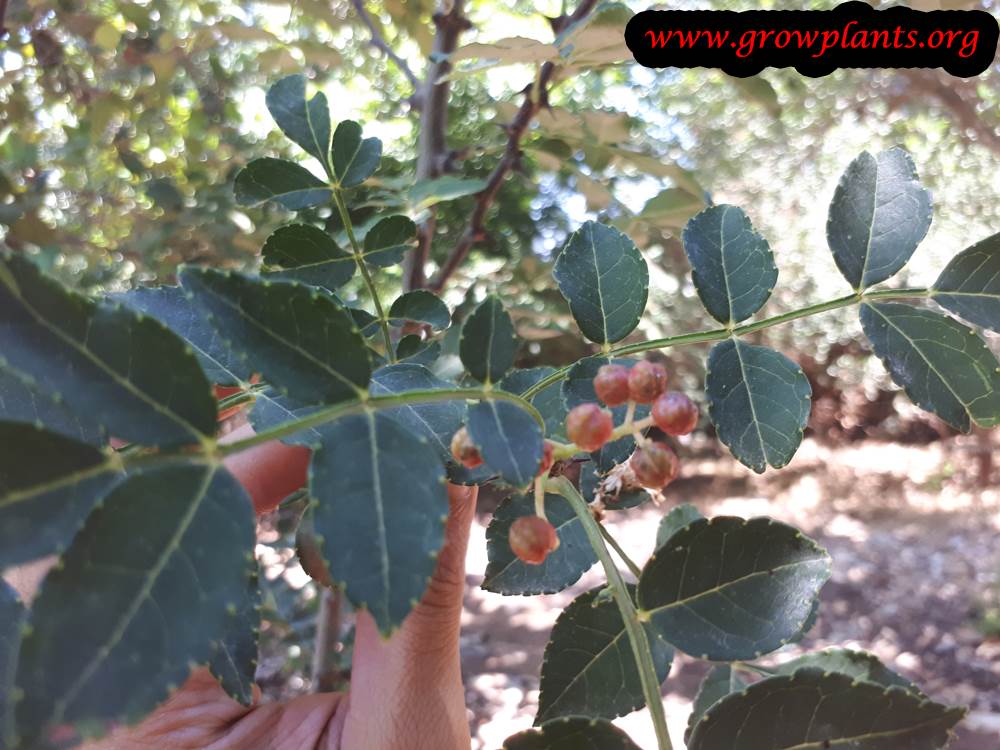
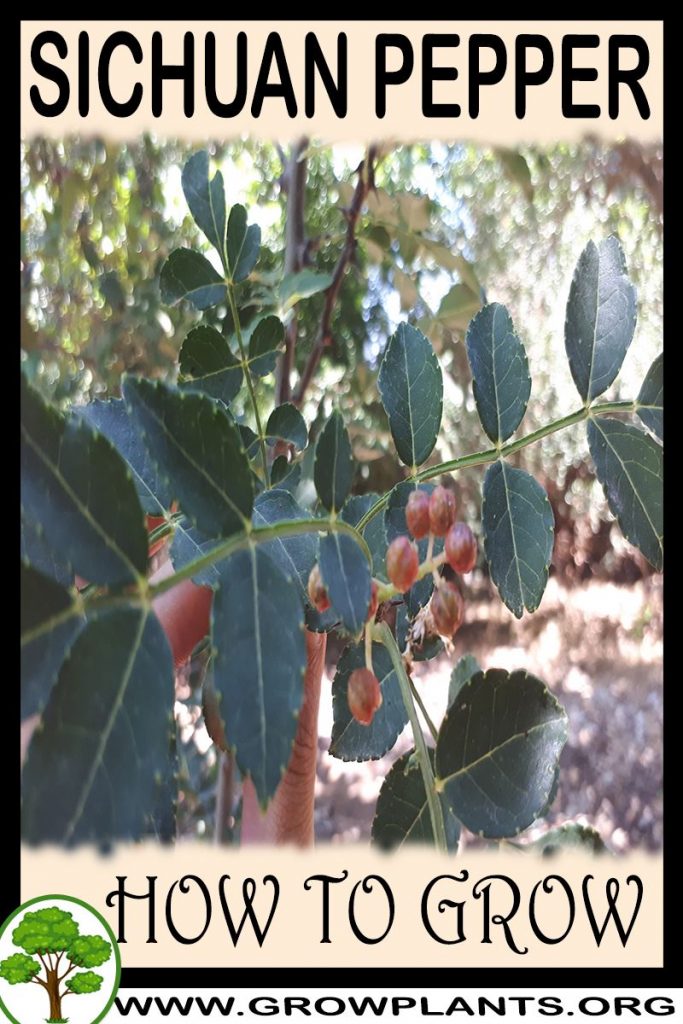
- Leaves & Foliage: Green, elliptic to oval leaflets in pinnate (feather-like) compound leaves, aromatic when crushed.
- Flower Characteristics: Small white, star-shaped flowers in clusters; the plant is dioecious, with male and female flowers usually on separate plants.
- Fruit Profile: Small, round, red-brown husks that split open; the aromatic pericarp is peppery and citrusy with a characteristic mouth-tingling quality.
Primary Uses & Landscape Value
- Edible Uses: The dried fruit husks (harvested in autumn) are used whole or ground as the Sichuan pepper spice; the plant is also valued medicinally.
- Functional & Ornamental Roles: Ornamental and hedge or barrier shrub – its prickly stems make an effective stock-proof screen.
Care Guide: Planting, Soil & Watering
Overview: Sichuan pepper (Zanthoxylum) is a hardy shrub or small tree that grows best in full sun to part shade with rich, moist, well-drained soil. It appreciates steady moisture through the season while needing good drainage to keep its roots healthy.
Quick Care Requirements
| Requirement | Ideal Condition |
|---|---|
| Planting Season | In winter, spring or summer during the dormant-to-warm season |
| Growth Rate | Moderate |
| Soil Type | Rich, moist, well-drained soil |
| Water Need | Moderate — keep the soil evenly moist but not waterlogged |
Planting & Establishment
- Best Planting Season: Plant while dormant to early in the warm season (winter through summer); it is hardy across zones 5–10, so bare-root planting in the cool season establishes it well.
- How to Plant:
- Hole Preparation: Dig a hole about twice the width of the root ball and no deeper, loosening the sides so the roots spread out.
- Soil Amendments: Work compost or well-rotted organic matter into the backfill to enrich the soil and help it hold moisture while draining freely.
- Planting Depth: Set the tree so the root collar sits level with the surrounding soil — do not bury the trunk base.
- Growth Speed & Expectations: Moderate growth into a 2–7 m shrub or small tree; fruiting begins after about 5–7 years, and space plants so the branches do not grow into each other for easier harvest.
Soil, Watering & Drainage Care
- Soil Mix & Drainage Needs: Provide rich, well-drained soil that holds some moisture; in containers use a quality mix that drains freely so the roots never sit wet.
- Watering Schedule & Technique:
- Young / Newly Planted: Water regularly after planting to keep the soil evenly moist while the young tree establishes its roots.
- Established: Water deeply during dry spells to keep the soil moist through the growing and fruiting season, letting the surface dry slightly between waterings.
- Seasonal Adjustments: Increase watering in summer heat, especially as fruit develops; reduce in autumn and winter as growth slows.
Climate, Light & Hardiness
Sichuan pepper (Zanthoxylum simulans / Z. bungeanum) grows across temperate, Mediterranean, and subtropical climates in full sun to half shade. It is a cold-hardy shrub for a fruiting plant, tolerating winters through USDA zone 5, and may be evergreen in mild climates or deciduous where winters are colder.
Quick Climate Specifications
| Climate Zones | Temperate, Mediterranean, Subtropical |
|---|---|
| USDA Hardiness Zones | 5–10 |
| Frost Tolerance | Moderate to High |
| Light Conditions | Full Sun to Half Shade |
Sunlight & Light Exposure
Optimal Light Setup
Full sun to half shade both suit this shrub; more sun generally supports better flowering and fruit set.
Temperature Extremes & Hardiness
USDA Hardiness & Regional Limits
Hardy across USDA zones 5–10, an unusually wide range for a fruiting shrub. In the colder part of its range it drops its leaves and goes dormant for winter; in milder zones it can stay evergreen.
Frost Sensitivity
Established plants tolerate normal winter frost within their hardiness range; young plants are more vulnerable to hard freezes and benefit from some winter shelter in their first years.
Growing in Pots, Balconies & Indoors
Sichuan pepper is a spiny small tree reaching 2-7 m, grown for its aromatic peppercorns. It is not a houseplant, but a young or pot-restricted tree crops well in a large tub on a sunny patio, and being deciduous and fairly hardy it can stay outside year-round in many climates.
Quick Details
- Container Size: Start ~20-40 L (5-10 gal) and pot up; a large tub restricts and crops it
- Indoor Suitability: Not a houseplant – a sun-loving fruiting tree
- Best Spot: Full sun to half shade
- Soil & Drainage: Free-draining, organic-rich mix
- Watering in Pots: Average and steady through the growing season
Indoors & On the Windowsill
- Houseplant limits: Not a houseplant – it is a full-size tree needing strong sun and a cool winter dormancy that no room can supply.
- Containers while young: A young tree, or one deliberately kept small in a large tub, will still flower and set peppercorns on a sunny patio; the pot naturally restricts its size.
- Hardy outdoors: Deciduous and fairly hardy, a potted tree stays outside all year in most climates – just protect the pot from hard freezes.
On a Balcony or Patio
- Light & warmth: Give it the sunniest, most sheltered spot for the best crop; mind the sharp thorns when siting it near seating.
- Practicalities: A filled pot is heavy once watered – check the balcony can take the load, and stand it where drainage runoff will not be a nuisance.
Choosing the Pot, Soil & Long-Term Care
- Pot & drainage: Pot up progressively into a large tub with strong drainage holes and never leave it standing in a saucer of water, or the roots rot. Terracotta breathes and dries faster; glazed or plastic holds moisture longer.
- Potting mix: A well-aerated, organic-rich mix – potting compost, or peat/coir with perlite or vermiculite.
- Feeding: Potted plants use up their feed quickly as nutrients leach away with each watering, so feed more often than plants in open ground through the growing season.
- Repotting: Refresh the mix and root-prune every couple of years to keep a potted tree productive and to size.
Fertilizing & Feeding
A moderate feeder like most fruiting shrubs and small trees: light nitrogen-forward feeding while young shifts to balanced feeding as the plant matures, then to balanced feeding with attention to potassium once it begins bearing its peppercorn fruit.
Quick Fertilizing Specs
| Feeding Level | Moderate feeder |
|---|---|
| Main Nutrient Priority | Nitrogen-forward feeding while young, shifting to balanced feeding with potassium support once fruiting begins |
| Best Feeding Period | Spring into the early growing season |
| Organic Options | Compost or well-rotted organic matter worked into the root zone |
| Reduce/Stop Feeding | Ease off feeding later in the growing season so new growth can harden off before dormancy |
| Micronutrients | Iron, manganese, and zinc are typically supplied by a complete fruit-tree fertilizer; correct only if a specific deficiency is diagnosed |
Feeding by Growth Stage
Newly planted
Support root establishment without stressing a young, newly transplanted tree or shrub.
| Nutrient direction | A light, balanced feeding helps roots establish without forcing top growth ahead of the root system. |
|---|---|
| Timing | In the first growing season after planting. |
| Frequency | A light feeding once the plant shows active new growth after transplanting. |
| Fertilizer types | A balanced complete fertilizer used at a light rate, Compost or organic matter worked into the planting area |
| Precautions | Avoid heavy feeding immediately at planting; roots damaged in transplanting are easily burned by concentrated fertilizer. |
Young, establishing tree
Build a strong framework of branches and foliage as the young tree grows toward bearing size.
| Nutrient direction | A nitrogen-forward fertilizer supports the vigorous framework growth young trees need before they begin fruiting. |
|---|---|
| Timing | Through the early years of establishment, before the tree begins to flower and fruit. |
| Frequency | Light feedings during the growing season support steady framework development. |
| Fertilizer types | A nitrogen-forward complete fertilizer, Compost or organic matter as an annual soil amendment |
| Routine trace nutrients | iron, manganese, zinc |
| Precautions | Keep nitrogen feeding within the growing season; late-season feeding can leave tender growth vulnerable to cold. |
Established, approaching bearing age
Maintain steady, balanced growth as the tree matures toward its first fruiting.
| Nutrient direction | A balanced complete fertilizer maintains healthy growth without overemphasizing nitrogen as the tree nears bearing age. |
|---|---|
| Timing | As the tree matures and approaches the age at which it typically begins to bear fruit. |
| Frequency | A modest annual feeding at the start of the growing season is usually sufficient. |
| Fertilizer types | A balanced complete fruit-tree fertilizer, Compost or organic matter worked into the root zone |
| Routine trace nutrients | iron, manganese, zinc |
| Precautions | Avoid pushing excess nitrogen at this stage, which can delay the onset of flowering and fruiting. |
Mature, fruit-bearing tree
Support reliable flowering, fruit set, and peppercorn development on a mature, bearing tree.
| Nutrient direction | A balanced fertilizer with attention to potassium supports flowering, fruit set, and fruit development. |
|---|---|
| Timing | Each spring as the mature tree resumes growth and moves toward flowering and fruiting. |
| Frequency | An annual feeding at the start of the growing season, adjusted to the tree’s vigor and fruit load. |
| Fertilizer types | A balanced complete fruit-tree fertilizer, A potassium-inclusive feed to support fruit development |
| Routine trace nutrients | iron, manganese, zinc |
| Precautions | Avoid heavy nitrogen once fruit is developing, which can favor leafy growth over fruit quality. |
Nutrient Deficiency Signs & Corrections
New leaves emerge yellow between green veins while the veins themselves stay green.
| Possible causes | high soil pH limiting iron availability, poorly drained or compacted soil, low soil iron |
|---|---|
| Appears first on | newest, uppermost leaves |
| What to check | soil pH if testable, drainage around the root zone, recent feeding history |
| Possible correction | Improve drainage and correct soil pH toward the tree’s preference, then apply a chelated iron product per its label if the issue persists. |
Older leaves turn pale green to yellow and framework growth is weak, especially on a young tree.
| Possible causes | low available soil nitrogen, competition from nearby vegetation, leaching in sandy or heavily irrigated soil |
|---|---|
| Appears first on | older, lower leaves |
| What to check | recent feeding history, soil organic matter level, overall vigor for the tree’s age |
| Possible correction | Apply a nitrogen-forward fertilizer during the growing season and work in organic matter. |
Flowering occurs but few flowers develop into mature peppercorns.
| Possible causes | lack of pollination where separate male and female plants are needed, boron deficiency affecting flower and fruit development, stress from irregular watering during bloom |
|---|---|
| Appears first on | the developing fruit clusters |
| What to check | presence of both male and fruit-bearing female plants nearby, consistency of watering through bloom and early fruit set, overall tree vigor and recent feeding |
| Possible correction | Confirm pollination needs are met and keep watering consistent through bloom; apply a boron-containing product per its label only if boron deficiency is specifically diagnosed. |
Pruning, Training & Seasonal Maintenance
Sichuan pepper (Zanthoxylum simulans/bungeanum) is a thorny, dioecious shrub or small tree grown mainly for its edible peppercorn fruit; it tolerates moderate structural pruning best during its autumn/winter dormant season, and the growing data is explicit about the main objective – keeping the stems open so they don’t grow into each other, both for airflow and so the thorny branches stay accessible for picking fruit. Because it can take 5-7 years to begin bearing, avoid pruning hard enough in the early years to delay that further.
Quick Pruning & Maintenance Specs
| Pruning Tolerance | Moderate |
| Primary Pruning Window | Autumn to winter (dormant season) |
| Typical Frequency | Annual, light-to-moderate |
| Main Objective | Open, uncrowded framework for fruit access and airflow |
| Young Plant Priority | Build 3-5 well-spaced main branches so mature stems won’t cross |
| Mature Plant Priority | Thin crossing/crowded branches to keep the canopy open for harvest |
| Best Tool Type | Bypass secateurs and loppers (thorny wood) |
| Avoid Heavy Pruning During | Spring flowering/fruit set, and the first few years before it begins bearing |
Pruning by Plant Age & Size
Newly Established
Remove only damaged growth; avoid structural cuts in the first year or two while the plant establishes toward its long 5-7 year path to first fruit.
Young / Formative
Open-center-style framework – select and space out several main scaffold branches early so mature stems don’t grow into and cross each other, exactly as the growing data specifies. Because the plant is dioecious, keep both a male and a female (or confirm a fruiting female) rather than removing one thinking it’s “unproductive” – male plants don’t fruit but are usually needed for pollination.
Mature / Established
Routine thinning of crossing, crowded or inward-growing branches to preserve the open form needed for picking fruit before it drops.
Seasonal Pruning Schedule
Dormant / Winter
Main structural thinning – remove crossing/crowded branches and any dead wood; this is the safest window since the plant is not actively flowering or holding a fruit crop.
Post-Harvest
After the autumn fruit harvest, dormant pruning naturally follows soon after, which is efficient since harvested wood is fully visible.
Flowering & Fruiting Wood
Like other Rutaceae (a family that includes citrus), Sichuan pepper flowers and fruits mainly on the current season’s growth arising from the previous year’s wood, so avoid removing most of last year’s growth in a single pruning – heavy pruning of that wood reduces the coming crop and, combined with the long 5-7 year juvenile period, can meaningfully delay first fruiting on young plants.
Structural Pruning & Training
Thinning cuts to open the canopy are the core structural task here, matching the growing data directly. Watch for crossing/rubbing branches given how densely this species can grow, since rubbing thorny branches can wound bark and invite disease entry.
Special Growth to Remove
- Basal suckers and overly vigorous watersprouts growing straight up through the canopy, since these recreate the crowding the plant is otherwise being trained to avoid.
- If the plant is on its own roots rather than grafted, suckers arising well away from the main stem can be left or removed depending on whether a fuller clump form is wanted.
Container & Small-Space Pruning
In a container, keep structural thinning lighter but more frequent to manage the smaller root volume, and prioritize height control over full-scale scaffold branch selection.
Tools
Bypass secateurs for most cuts; loppers for thicker crossing branches; a pruning saw for larger limb removal on mature specimens; a pole pruner for reaching upper growth on specimens approaching the top of this species’ 2-7m (6-21ft) height range.
Tool Hygiene & Disease Risk
High-risk – citrus canker is listed as a pest/disease risk for this species, and citrus canker is a bacterial disease known to spread readily on contaminated tools and through fresh pruning wounds. Disinfect blades between cuts on any plant showing canker symptoms, and between plants if canker is present in the planting.
Cut Placement & Technique
Use thinning cuts (removing a branch to its point of origin) rather than heading cuts to keep the open form this species needs; cut outside the branch collar and avoid flush cuts. Given the thorns, plan cuts and handle prunings carefully to avoid injury.
Heavy Pruning & Rejuvenation
Tolerated in moderation – an overcrowded mature specimen can be opened up significantly over one dormant season, but avoid removing a large fraction of bearing wood at once, since that both delays cropping and can force excessive vegetative regrowth at the expense of the current fruit set.
Post-Pruning Care
Monitor cut surfaces given the tool-hygiene/canker risk noted above; water normally; avoid feeding specifically in response to pruning, since it isn’t needed to support recovery.
Common Pruning Mistakes
- Letting branches grow into and cross each other unchecked – the exact problem the growing data calls out – which makes harvest difficult and increases disease-entry points from rubbing wounds.
- Removing a male plant by mistake (it won’t show fruit) when it may be needed to pollinate a female.
- Pruning hard while the plant is still young, further delaying its already-long 5-7 year path to first fruit.
When NOT to Prune
Avoid pruning during flowering/fruit set in spring-summer; avoid heavy pruning on young, not-yet-bearing plants beyond light formative shaping.
Recommended Tools (by task)
- bypass_secateurs – most thinning cuts on young and medium wood.
- loppers – thicker crossing branches out of secateur range.
- pruning_saw – larger limb removal on a mature small tree.
- pole_pruner – upper canopy access on taller specimens near the top of this species’ height range.
Pruning Troubleshooting
| Problem | Possible Cause | What to Check | Corrective Action |
| Crowded, tangled branches | Framework not thinned during dormant season | Time since last winter thinning | Thin crossing/crowded branches next dormant season |
| No fruit despite flowering | Plant is male, or a female lacking a pollinator | Sex of the plant(s) in the planting | Ensure a male is nearby, or confirm a self-fruitful female |
| Dieback near pruning cuts | Citrus canker or another tool-transmitted pathogen | Tool hygiene history, canker symptoms on cuts | Disinfect tools between cuts; remove and destroy infected wood |
| Delayed first fruiting | Pruning too hard while young | Plant age vs. the typical 5-7 year bearing window | Limit young plants to light formative pruning only |
Propagation Guide
Sichuan pepper is dioecious, so the site notes vegetative propagation (or planting known male-and-female pairs, or a known fruiting female) is needed to get a reliable fruiting plant – seedlings’ sex cannot be predicted and roughly half may turn out to be non-fruiting males. In practice this makes rooted suckers or cuttings from known stock the most useful method, with overall difficulty moderate because of this sex uncertainty and the care needed to root woody cuttings.
Quick Propagation Specs
| Best Propagation Method | Rooted suckers or cuttings from known male/female stock |
| Alternative Methods | Seed (sex unpredictable); grafting onto seedling rootstock is used in some commercial production |
| Propagation Difficulty | Moderate |
| Seed True-to-Type | Sex of seedlings (male/female) cannot be predicted |
| Vegetative True-to-Type | Yes – the only reliable way to reproduce a known fruiting female or a matched male/female pair |
| Best Propagation Season | Winter to summer, matching this plant’s planting season |
Growing from Seed
Seed can be used to raise new plants, but since the species is dioecious, seedlings will not show their sex until they flower, and only female plants (or a female with a pollinating male nearby) bear fruit. Like many Rutaceae, seed may keep better sown fresh rather than stored dry for long periods; treat any slow or uneven germination as normal for this genus rather than a sign of a problem.
Grafting & Budding
Why Grafting Is Used
To fix a known fruiting female (or a specific flavour/quality selection) onto new rootstock without the sex and quality uncertainty of seedlings.
Preferred Grafting Methods
Standard woody-shrub grafting or budding techniques, as used in other Rutaceae.
Rootstock
Seedling Zanthoxylum rootstock.
Scion Selection
Budwood or scion from a known productive female (or a paired male, where pollination is needed).
Best Grafting Season
Dormant season to early spring, as is typical for woody Rutaceae shrubs.
Note: grafting is used commercially in parts of this species’ native range to fix known-female selections; home growers more commonly rely on rooted suckers or cuttings for the same purpose.
Division, Offsets, Pups & Suckers
This shrub tends to produce root suckers around the base; suckers that have their own root system can be separated and replanted to reproduce a known male or female plant true to type. Suckers without adequate roots of their own are not viable on their own and should be left attached until they root.
Bloom & Flower Guide
Quick Details
- Bloom Season: Spring into summer
- Time to First Bloom: Once the shrub or small tree is a few years old and well established
- Flower Appearance: Small, star-shaped, greenish-white flowers in loose clusters
- Edibility: The flowers are not eaten; the well-known Sichuan-pepper spice comes from the dried fruit husk, a later stage
Detailed Blooming Overview
In spring and early summer the Sichuan pepper carries small, star-shaped, greenish-white flowers in loose clusters among its aromatic, pinnate leaves. As the grower notes, the plant is usually dioecious – male and female flowers sit on separate plants – though some plants are female-only and can still set fruit. Pollination is by insects or, in some plants, self-pollination.
Flower Characteristics
- Small, star-shaped flowers in white to greenish tones.
- Carried in clusters; individually modest but plentiful.
- Usually dioecious (separate male and female plants), sometimes female-only.
Bloom Care & Thinning
- Managing the bloom: No thinning needed; the flowers are the start of the fruiting cycle, so leave them if you want a spice crop.
- Pollination & wildlife: Insects work the flowers, and some plants self-pollinate; for reliable fruit, having a male nearby helps.
Fruit & Uses
Sichuan pepper is grown for its small red fruits, whose dried outer husk is the well-known “Sichuan peppercorn” spice, valued for its citrusy, peppery flavor and distinctive mouth-tingling sensation. The husks are always dried and usually ground before use; the hard black seed inside is not the edible part and is normally discarded.
Quick Edible Specs
| Edible Parts | Fruit – specifically the dried outer husk (pericarp) |
|---|---|
| Main Use(s) | Culinary spice |
| Eaten Raw or Cooked | Used dried, as a spice/seasoning – not eaten as fresh fruit |
| Preparation Required | Dry the husks; separate out and discard the bitter black seeds; grind into powder or use the husks whole |
| Harvest Season | Autumn |
| Time to First Harvest | A young plant needs several years of growth before it fruits reliably (see Propagation) |
| Storage | Store the dried husks in a sealed, airtight container out of light to preserve aroma |
| Safety/Toxicity Caveat | None beyond normal spice use; only female flowers (or self-fertile female plants) bear fruit – see Propagation for plant sex |
Fruit
The fruits are small and round, ripening red; they are picked once fully colored and before they begin to fall or split open on their own, since ripe husks drop quickly. After picking, the husks are dried, which causes them to split and expose the shiny black seed inside. For the kitchen, the dried red/brown husk is the part used – it is either used whole (often lightly toasted) or ground to a powder; the seeds themselves are gritty and lack the characteristic peppery-numbing flavor, so they are typically sifted out and discarded.
Harvesting
Fruit is harvested in autumn as the clusters ripen. Because the husks split and drop once fully ripe, timely picking – rather than letting fruit fall to the ground – preserves the best quality and yield.
Preparation, Uses & Safety
After drying, husks can be used whole (lightly toasted to bring out aroma) or ground into powder for seasoning, most familiar from Sichuan cuisine. No toxicity concerns are associated with normal culinary use of the husk; it is the seed casing (husk), not the black seed, that is valued and eaten.
Pests, Diseases & Troubleshooting
Overview: Sichuan pepper is a spiny Rutaceae shrub/tree closely related to citrus, so it shares citrus-family pests — swallowtail caterpillars, aphids, scale, spider mites and leafminer — and is prone to a distinctive rust as well as citrus-type cankers. Sun, airflow and good drainage underpin its management.
Quick Troubleshooting Overview
| Issue / Pest | Main Symptom | Primary Solution |
|---|---|---|
| Swallowtail caterpillars | Large caterpillars chewing leaves; defoliation | Hand-pick; Bt if severe |
| Aphids | Clusters on new shoots; honeydew, curled leaves | Hose off; insecticidal soap or oil |
| Scale insects | Bumps on stems/leaves; sooty mould, dieback | Horticultural oil; prune out |
| Spider mites | Stippled, bronzed leaves; webbing in heat | Rinse; horticultural oil; raise humidity |
| Rust | Orange-brown pustules; yellow spots; leaf drop | Airflow; remove leaves; copper if severe |
| Canker / dieback | Sunken lesions on bark; wilting shoots | Prune out; sanitise; copper spray |
Common Pests & Management
- Citrus swallowtail caterpillars (Papilio spp.):
- Symptoms: Large caterpillars — young ones bird-dropping-like, older ones green with eyespots — that chew the leaves and can strip young shoots; Zanthoxylum, like other Rutaceae, is a favoured larval host. They emit a forked orange gland (osmeterium) when disturbed.
- Prevention & Control: On a robust plant tolerate light feeding, which supports swallowtail butterflies; otherwise hand-pick the conspicuous caterpillars. Bacillus thuringiensis (Bt) controls heavier infestations selectively. Established plants re-flush readily after defoliation.
- Aphids (Aphis / Toxoptera spp.):
- Symptoms: Green, black or brown clusters on the soft new shoots and leaf undersides, sucking sap, curling and distorting new growth, and leaving honeydew and sooty mould; they can transmit viruses within the citrus family.
- Prevention & Control: Hose off colonies and use insecticidal soap or a light horticultural oil for heavier numbers, spraying in the evening. Control ants that farm them, avoid excess nitrogen, and rely on ladybirds and lacewings, which quickly build up on the plant.
- Scale insects (Coccus / Unaspis / Aonidiella spp.):
- Symptoms: Brown, tan or white limpet-like bumps clamped onto stems, leaf midribs and undersides, sucking sap and producing honeydew and sooty mould; heavy infestation yellows leaves and causes twig dieback.
- Prevention & Control: Scrape or brush off small colonies and treat thoroughly with horticultural oil to smother crawlers, repeating for successive generations. Prune out badly encrusted wood and keep the plant vigorous; parasitic wasps and ladybirds help outdoors.
- Spider mites (Tetranychus / Panonychus spp.):
- Symptoms: Fine pale stippling, a dull bronzed cast and faint webbing on the leaves, worst in hot, dry, dusty conditions; heavy infestation causes leaf drop.
- Prevention & Control: Rinse foliage and raise humidity to discourage them, then treat with horticultural oil or insecticidal soap, covering the undersides and repeating weekly. Avoid drought stress and dusty conditions, and conserve predatory mites.
- Citrus leafminer (Phyllocnistis citrella):
- Symptoms: Silvery, snaking mines winding through the young leaves, which curl and distort; a citrus-family specialist that attacks soft new flushes, particularly on young plants.
- Prevention & Control: Damage is largely cosmetic on established plants, which outgrow it; avoid stimulating excessive soft flushes with heavy feeding or summer pruning. Remove badly mined shoots, and where control is warranted a horticultural-oil spray on new flushes deters egg-laying; conserve parasitic wasps.
Diseases & Fungal Issues
- Sichuan-pepper rust (Coleosporium / Puccinia zanthoxyli):
- Symptoms: A serious and characteristic disease of this crop: yellow flecks on the upper leaf surface with orange-brown powdery pustules beneath, leading to yellowing, premature leaf drop and weakened, less productive plants; worst in warm, humid, crowded conditions.
- Treatment & Management: Improve airflow with spacing and pruning, avoid overhead watering, and rake up and destroy fallen infected leaves to break the cycle. Remove badly affected foliage; a protectant copper or appropriate fungicide applied to new growth helps in wet seasons on valued or productive plants.
- Canker & twig dieback (Xanthomonas / fungal cankers):
- Symptoms: Sunken, cracked or corky lesions on the bark and twigs, sometimes oozing, with wilting and dieback of the shoots beyond; more likely on stressed, wounded or waterlogged plants in the citrus family.
- Treatment & Management: Prune out cankered wood well below the lesion in dry weather, sterilising tools between cuts, and destroy the prunings. Avoid unnecessary wounding and waterlogging, keep the plant vigorous, and apply a copper spray as a protectant where canker is a known problem.
- Root & collar rot (Phytophthora spp.):
- Symptoms: Wilting, yellowing and decline with dark, decaying bark at the collar and roots in wet, poorly drained soil — a common problem across Rutaceae.
- Treatment & Management: Plant on free-draining soil, keep the crown high and dry, and avoid overwatering and mulch piled against the trunk. Improve drainage, remove affected roots where feasible, and treat valued plants with a phosphonate/Phytophthora-targeted fungicide.
Growing Difficulties & Abiotic Problems
- Chlorosis (iron/zinc/manganese):
- Cause & Symptoms: Yellowing between green veins on the newest leaves, common in Rutaceae on alkaline, cold or waterlogged soils where iron, zinc and manganese are locked out.
- Correction Strategy: Improve drainage and soil health, mulch with organic matter, and apply iron and micronutrient chelates or a citrus-type feed to green the new growth. Avoid overly limey soil.
- Poor drainage & waterlogging:
- Cause & Symptoms: Wilting, yellowing and root decline where soil stays wet; the plant prefers well-drained ground and resents wet feet.
- Correction Strategy: Plant on a slope, raised bed or improved free-draining soil, water deeply but allow drying between, and never let it stand waterlogged.
- Frost & wind damage:
- Cause & Symptoms: Cold winds and hard frost scorch or kill soft new growth and shoot tips, though many Sichuan peppers are reasonably hardy once established.
- Correction Strategy: Site in a sheltered, sunny spot, protect young plants over their first winters, and prune out frost-damaged wood in spring once growth resumes.
What Helps – Products & Tools
As a citrus relative it responds to the same toolkit: horticultural and neem oils and insecticidal soap for aphids, scale, mites and leafminer, Bacillus thuringiensis (Bt) for caterpillars, and a copper fungicide for its characteristic rust and for canker protection. An iron/micronutrient chelate or citrus feed corrects chlorosis, and a phosphonate-type product protects against Phytophthora on valued plants. Good drainage, sun, airflow and leaf-litter sanitation do most of the work.