Plant Profile & Key Characteristics
Overview: A tuberous herbaceous perennial 20-40 cm (8-16 in) tall with distinctive narrow, grass-like foliage, grown as an ornamental for its bowl-shaped yellow flowers. It dies back after flowering.
Quick Specifications
| Specification | Attribute |
|---|---|
| Plant Type / Life Cycle | Herbaceous perennial (geophyte) |
| Foliage Type | Deciduous (dies back after flowering) |
| Mature Size | 20-40 cm (8-16 in) |
| Growth Rate | Moderate |
| Root System | Geophyte — tuberous/fibrous rootstock |
| Toxicity | Toxic — contains irritant protoanemonin; the sap irritates skin and it is harmful if eaten |
| Hardiness | USDA zones 7b-11 |
Growth Form & Structure
- Height & Spread: 20-40 cm (8-16 in) in the ground or in pots, where it grows well.
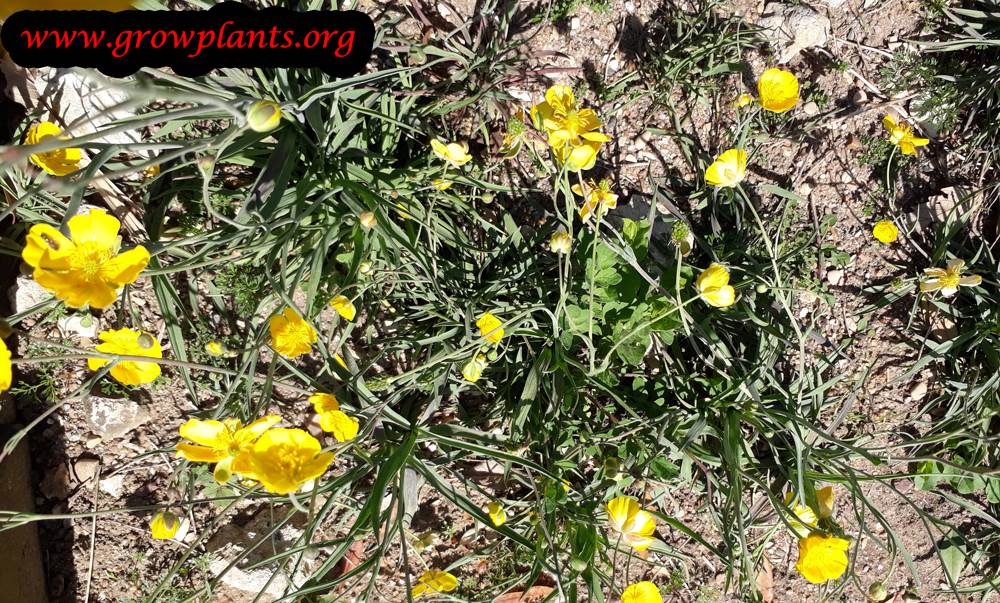
- Growth Habit & Form: Low clump-forming herbaceous plant with tufted grassy foliage rising from an underground rootstock.
- Lifespan & Maturity: Perennial that returns from its rootstock each season.
Anatomy & Physical Features
- Leaves & Foliage: Green, narrow linear (grass-like) leaves.
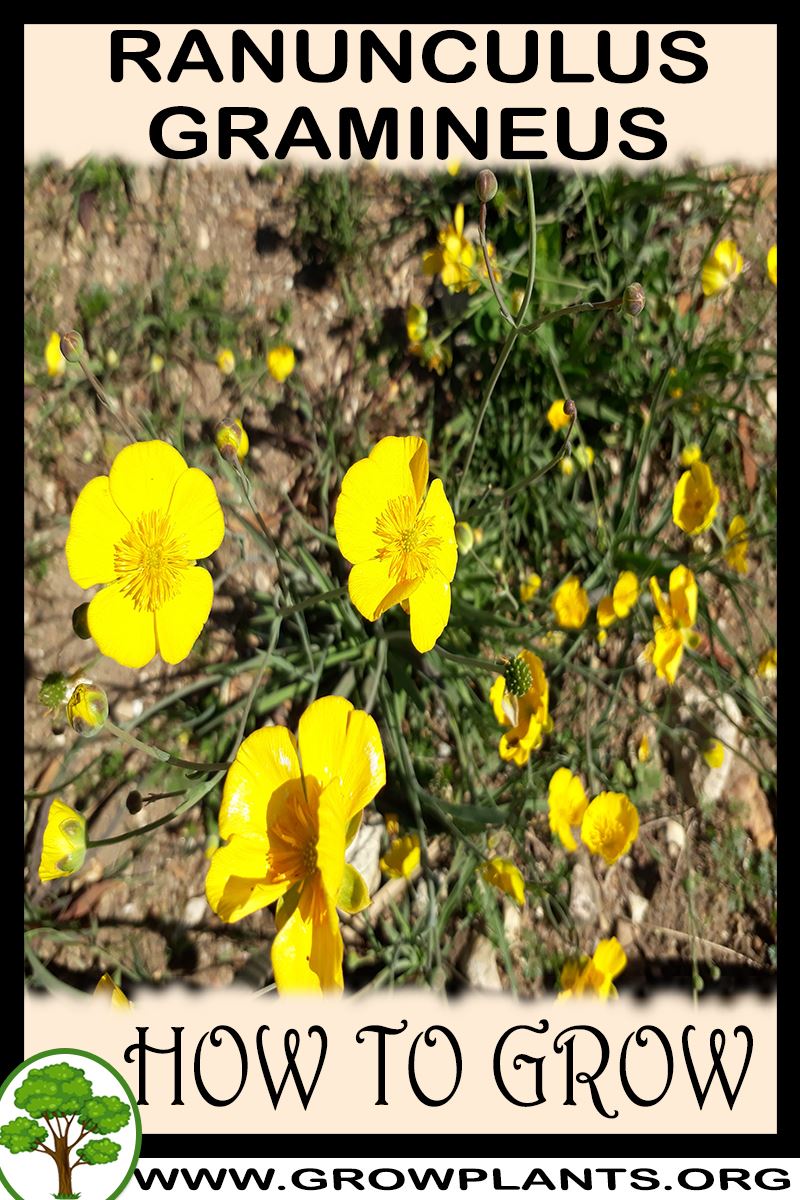
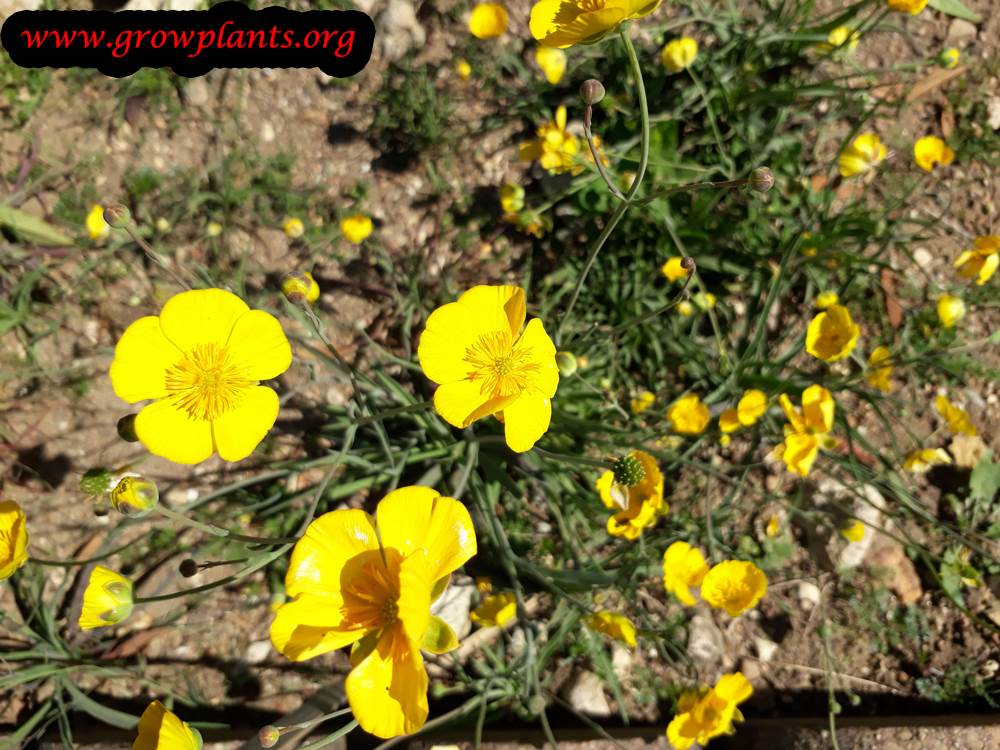
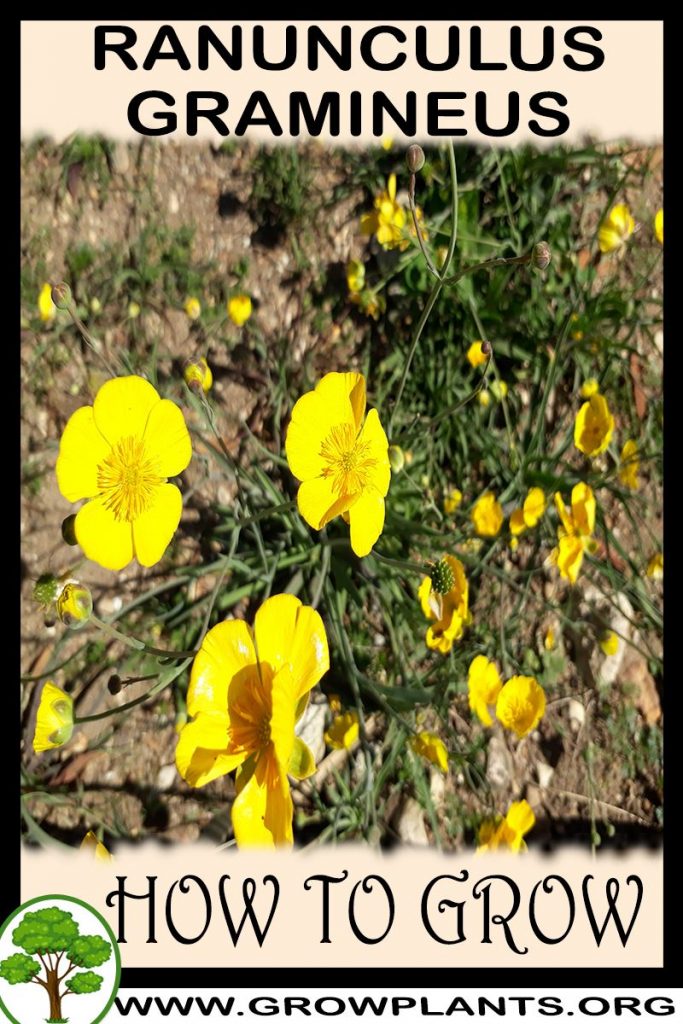
- Flower Characteristics: Yellow bowl-shaped flowers, five-petalled or many-petalled.
Primary Uses & Landscape Value
- Functional & Ornamental Roles: Rock-garden, border and container ornamental valued for its grassy foliage and yellow bloom.
Care Guide: Planting, Soil & Watering
Overview: Ranunculus gramineus (grass-leaved buttercup) is a tuberous, deciduous perennial with slender, grass-like leaves and yellow flowers, for mediterranean, subtropical and temperate climates (hardiness zone 7b-11). A cool-season grower, it wants sharply drained soil in full sun to part shade, takes moderate water while in growth, and rests in summer. All parts are toxic.
Quick Care Requirements
| Requirement | Ideal Condition |
|---|---|
| Planting Season | In spring, or in autumn to winter in mild-winter climates |
| Growth Rate | Moderate |
| Soil Type | Sharply drained, gritty; moderate moisture |
| Water Need | Moderate while in growth; dry when dormant |
Planting & Establishment
- Best Planting Season: Plant in spring in colder areas, or in autumn to winter where winters are mild, so it grows and flowers through the cool season and rests in summer.
- How to Plant:
- Hole Preparation: Choose a sunny, very well-drained spot – it suits a rockery or gritty bed – and loosen a hole a little larger than the roots.
- Soil Amendments: Add grit or coarse sand to sharpen drainage and a little compost for fertility; the tuber rots in cold, wet soil.
- Planting Depth: Set the plant at the level it was growing, keeping the crown at the surface, and firm gently.
- Growth Speed & Expectations: A moderate grower reaching about 20-40 cm; the foliage dies back after flowering and the plant rests through summer.
Soil, Watering & Drainage Care
- Soil Mix & Drainage Needs: Sharp, gritty drainage is essential to keep the tuber from rotting; in containers use a free-draining, grit-rich mix and avoid standing water.
- Watering Schedule & Technique:
- Young / Newly Planted: Keep the soil lightly moist to start growth, without waterlogging.
- Established: Water moderately through the growing and flowering season, letting the surface dry between waterings.
- Seasonal Adjustments: Ease off as the leaves die back and keep it dry through summer dormancy; water a little more in dry spells during active growth.
Climate, Light & Hardiness
This grass-leaved buttercup is a deciduous geophyte for mediterranean, subtropics, and temperate climates, growing in full sun to half shade. It is hardy through USDA zones 7b–11, with bloom timing shifting from late winter in warm climates to early summer in cold ones.
Quick Climate Specifications
| Climate Zones | Mediterranean, Subtropics, Temperate |
|---|---|
| USDA Hardiness Zones | 7b–11 |
| Frost Tolerance | Moderate |
| Light Conditions | Full Sun / Half Shade |
Sunlight & Light Exposure
Optimal Light Setup
Full sun to half shade both suit this bulb-forming perennial through its growing season.
Temperature Extremes & Hardiness
USDA Hardiness & Regional Limits
Hardy through USDA zones 7b–11; this is a mild-to-warm-winter perennial rather than one suited to severe cold climates.
Frost Sensitivity
Top growth dies back naturally as part of its deciduous cycle; the underground rootstock survives winter within its hardiness range.
Wind, Humidity & Microclimate
Microclimate Recommendations
Bloom timing follows the local climate - late winter to early spring where it is warm, spring to early summer where it is colder - so gardeners should expect flowering to shift with their own regional conditions.
Growing in Pots, Balconies & Indoors
This grass-leaved buttercup is a neat rock-garden perennial with bright yellow flowers. It is not a houseplant, but it grows happily in a well-drained outdoor pot or alpine trough, where it gets the light and cool season it needs.
Quick Details
- Container Size: A modest, well-drained pot or alpine pan for this 20-40 cm plant
- Indoor Suitability: Not a houseplant – an outdoor rock-garden perennial
- Best Spot: Full sun to part shade, in the open air
- Soil & Drainage: Gritty, free-draining mix
- Watering in Pots: Average while in growth; it must not sit wet, and it rests after flowering
Indoors & On the Windowsill
- Houseplant limits: The grower does not rate it as an indoor plant; it needs outdoor light and a natural cool season.
- Summer rest: It dies back after flowering – keep the pot on the dry side then, outdoors.
- Note: Buttercups are toxic if eaten and the sap can irritate skin – handle with care.
On a Balcony or Patio
- Light & wind: Suits a bright, breezy balcony in a gritty pot; small pots dry fast, so water while in leaf but ease off as it goes dormant.
Choosing the Pot, Soil & Long-Term Care
- Pot & drainage: A pot with sharp drainage and no standing water – wet crowns rot.
- Gritty mix: Free-draining potting mix cut with grit or perlite.
- Feeding: Feed lightly only; it prefers lean conditions.
- Repotting: Refresh the top of the mix and pot on every couple of years; for perennials, lightly prune the root ball and top growth when you do.
Fertilizing & Feeding
A light feeder – this buttercup relative needs only light, occasional feeding while its strap-like leaves and yellow flowers are actively growing, with no feeding needed once it dies back after bloom.
Quick Fertilizing Specs
| Feeding Level | Light – a modest feeder that needs only light feeding while actively growing and in bloom |
|---|---|
| Main Nutrient Priority | Balanced feeding without pushing extra nitrogen |
| Best Feeding Period | From leaf emergence through bloom |
| Soil pH | Prefers well-drained soil; tolerates a range of pH without special adjustment |
| Reduce/Stop Feeding | Stop feeding once flowering ends and foliage begins to die back |
Feeding by Growth Stage
Leaf growth from the tuberous roots
Support strap-like leaf growth as this buttercup relative emerges from its fleshy roots
| Nutrient direction | A light, balanced feed supports steady leaf growth without pushing soft, floppy foliage |
|---|---|
| Timing | As new leaves emerge and expand, before flower buds form |
| Frequency | A light feeding as growth begins is usually enough |
| Fertilizer types | A balanced, light-strength fertilizer for bulbs and geophytes, Compost worked into well-drained soil at planting |
| Precautions | This plant is toxic if ingested, so keep fertilizer handling and treated areas away from pets and children, and avoid overwatering the well-drained soil it needs |
Flower bloom period
Sustain the five-petal to multi-petal yellow flowers through their bloom window
| Nutrient direction | Continue light, balanced feeding through bloom; heavy feeding isn’t needed for this modest-sized plant |
|---|---|
| Timing | During the bloom period, with timing varying by climate from late winter into early summer |
| Frequency | Light feeding is usually enough while in bloom |
| Fertilizer types | A balanced, light-strength fertilizer if soil is poor |
| Precautions | Avoid overfeeding, which can produce floppy foliage at the expense of flowers |
Post-bloom dieback
Let the foliage yellow and die back naturally after bloom so the plant can store energy for next season
| Nutrient direction | None – withhold fertilizer once flowering finishes and foliage begins to yellow |
|---|---|
| Timing | After flowering ends, as the foliage dies back |
| Frequency | No feeding at this stage |
| Fertilizer types | No feeding at this stage; let foliage die back naturally before removing it |
| Precautions | Do not fertilize or cut back foliage while it’s still green and dying back, since it’s storing energy for next year’s growth |
Nutrient Deficiency Signs & Corrections
Leaves look pale and thin, and flower production is reduced
| Possible causes | Nitrogen deficiency, Poor drainage causing root stress in what needs well-drained soil, Overcrowded plantings competing for nutrients |
|---|---|
| Appears first on | Overall leaf color and flower count |
| What to check | Soil drainage, Planting density and root crowding, Recent fertilizing history |
| Possible correction | Apply a light, balanced fertilizer per its label during active growth and improve drainage if soil stays wet |
Wilting, yellowing, or foliage collapse despite adequate rainfall or watering
| Possible causes | Root or tuber rot from waterlogged, poorly drained soil, Nutrient deficiency secondary to damaged roots, Fungal disease favored by wet conditions |
|---|---|
| Appears first on | Whole plant, often starting with lower leaves |
| What to check | Soil drainage and how wet the planting site stays, Whether roots/tubers look firm versus soft and discolored, Recent rainfall or watering patterns |
| Possible correction | Improve drainage before fertilizing; feeding won’t fix a plant whose roots are rotting in waterlogged soil |
New leaves emerge pale yellow with green veins
| Possible causes | Iron deficiency linked to alkaline soil, Waterlogged soil limiting root uptake, High soil pH reducing nutrient availability |
|---|---|
| Appears first on | Newest leaves |
| What to check | Soil pH and drainage, Whether yellowing is interveinal versus solid, Recent soil amendments |
| Possible correction | Correct pH toward neutral if testing shows it’s too alkaline, and consider a chelated iron product per its label |
Pruning, Training & Seasonal Maintenance
Ranunculus gramineus is a small tuberous-rooted perennial that goes dormant and dies back to the ground after flowering, so it needs no structural pruning at all – its only maintenance is a single seasonal clean-up. The safest and most effective time to remove the foliage is once it has yellowed on its own as the plant enters summer dormancy; cutting green leaves early robs the underground tuber of the energy it needs to flower again next year.
Quick Pruning & Maintenance Specs
| Pruning Tolerance | Low – seasonal dieback removal only |
| Primary Pruning Window | Summer, once foliage has yellowed after flowering |
| Typical Frequency | Once a year |
| Main Objective | Tidy dieback; deadhead spent blooms if seeding is not wanted |
| Young Plant Priority | None – let the tuber establish undisturbed |
| Mature Plant Priority | Deadhead through bloom; clear yellowed foliage once dormancy sets in |
| Best Tool Type | Precision snips |
| Avoid Heavy Pruning During | While foliage is still green and actively growing |
Pruning by Plant Age & Size
Newly Established
No pruning needed beyond removing any damaged leaves; let the tuber build reserves through its first full growing season.
Young / Formative
No structural training applies to this small geophyte.
Mature / Established
Deadhead spent flowers during the bloom period if a longer flowering display or no self-seeding is wanted, then clear the dead foliage once it yellows as the plant goes dormant for summer.
Seasonal Pruning Schedule
Post-Flowering / early summer dormancy: once foliage has fully yellowed and collapsed, cut it back to soil level. Do not remove foliage while it is still green, since the plant is still channeling energy into the tuber below ground for next year’s growth; removing it too early has a direct negative impact on next season’s flowering.
Special Growth to Remove
- Spent flower stems (deadheading) during bloom.
- Fully yellowed, dead foliage once summer dormancy begins.
Container & Small-Space Pruning
Grows well in containers. The same rule applies – let foliage die back naturally before removing it – and keep the pot on the dry side once the tuber goes dormant to avoid rot.
Tools
Precision snips for the soft foliage and flower stems.
Tool Hygiene & Disease Risk
Routine – clean tools are sufficient. The plant’s sap is documented as toxic/irritant, so wear gloves when handling cut material.
Cut Placement & Technique
Cut spent flower stems at the base; when clearing dieback foliage, cut at soil level without digging into or disturbing the dormant tuber just below.
Post-Pruning Care
Keep the dormant tuber on the drier side after the foliage is cleared – overwatering a dormant Ranunculus tuber is a common cause of rot.
Common Pruning Mistakes
- Cutting back green, still-photosynthesizing foliage before it has naturally yellowed, which weakens next year’s bloom.
- Overwatering after cutback, encouraging the dormant tuber to rot.
- Handling the toxic sap without gloves.
When NOT to Prune
Avoid removing any foliage while it is still green; avoid handling cut material without gloves given its documented toxicity.
Recommended Tools (by task)
- Precision snips – for deadheading and clearing soft dieback foliage.
Propagation Guide
Ranunculus gramineus is a geophyte with a tuberous, clump-forming rootstock rather than a true bulb, so the most practical way to increase it is by dividing this rootstock; seed is also a reliable option for the species. Both methods are straightforward, making this an easy plant to propagate.
Quick Propagation Specs
| Best Propagation Method | Division of the Tuberous Rootstock |
| Alternative Methods | Seed |
| Propagation Difficulty | Easy |
| Seed True-to-Type | Usually true-to-type (species) |
| Vegetative True-to-Type | Yes |
| Best Propagation Season | Spring, or Autumn/Winter in warmer climates, matching the plant’s planting season |
Growing from Seed
Sowing Season
Spring, or autumn in mild-winter climates.
Germination Conditions
A gritty, free-draining seed mix kept lightly moist in a cool spot, suiting this species’ well-drained soil preference.
Germination Time
Germination can be slow and somewhat uneven; allow several weeks and be patient.
Rhizomes, Tubers, Bulbs & Corms
The site lists “bulb” among the ways to start this plant, but Ranunculus gramineus actually grows from a tuberous, fibrous-clumping rootstock rather than a true bulb. Divide dormant clumps in spring or autumn, splitting the rootstock into sections that each keep some fibrous roots and a growing point, and replant promptly at the same depth as before. As with other Ranunculus, the sap can mildly irritate skin, so gloves are worth wearing when handling and dividing the roots.
Bloom & Flower Guide
Quick Details
- Bloom Season: Late winter to early spring in mild areas; spring to early summer in colder climates
- Flower Appearance: Glossy yellow, bowl-shaped flowers with five (sometimes more) petals
- Edibility: None — toxic; grown as an ornamental only
Detailed Blooming Overview
This slender, grass-leaved buttercup bears shining, cup-shaped yellow flowers that catch the light through spring, held above narrow foliage.
Flower Characteristics
- Bright, glossy yellow bowl-shaped flowers with five or more petals.
- Carried on wiry stems above grass-like leaves.
Bloom Care & Thinning
- Conditions: full sun and sharp drainage give the freest flowering.
- Safety: like all buttercups, the sap is an irritant and every part is toxic if eaten — wear gloves when handling.
Pests, Diseases & Troubleshooting
Ranunculus are grown from tuberous roots and are generally trouble-free in the open garden, but they resent heat and wet feet: their two biggest enemies are tuber/root rot in soggy soil and sap-sucking insects under cover. Manage them culturally first – sharp drainage, good airflow and cool growing conditions prevent most problems before any spray is needed.
Quick Troubleshooting Overview
| Issue / Pest | Main Symptom | Primary Solution |
|---|---|---|
| Aphids | Sticky, curled new growth and distorted buds; clusters on stems | Blast off with water; insecticidal soap or neem if persistent |
| Spider mites | Fine stippling, dull leaves and faint webbing in hot, dry air | Raise humidity, hose foliage, apply horticultural oil |
| Tuber / root rot | Claws fail to sprout or collapse; mushy, foul roots | Improve drainage, avoid overwatering, plant in raised/free-draining beds |
| Powdery mildew | White powdery film on leaves and stems | Improve airflow, avoid overhead water, sulfur or potassium bicarbonate |
| Botrytis (gray mold) | Fuzzy grey rot on flowers and leaves in cool, damp weather | Remove affected tissue, improve ventilation, avoid wetting blooms |
Common Pests & Management
- Aphids (Aphis / Myzus spp.):
- Symptoms: Soft green, black or peach-coloured insects massing on succulent new shoots, flower stems and buds; they cause curling, stunting and sticky honeydew that turns black with sooty mould. Look-alikes: whitefly (which fly up when disturbed).
- Prevention & Control: Knock colonies off with a firm jet of water and encourage ladybirds, lacewings and hoverflies. Remove badly infested shoot tips. If they persist, treat with insecticidal soap or neem oil, coating the undersides of leaves; spray in the cool of the evening to protect pollinators.
- Two-spotted spider mite (Tetranychus urticae):
- Symptoms: Very fine pale stippling gives leaves a dusty, bleached look; in heavy attacks fine webbing appears on leaf undersides and shoot tips. Worst in hot, dry, still air – common on plants forced under cover.
- Prevention & Control: Raise humidity and hose down foliage regularly, as mites hate moisture. Preserve predatory mites and other natural enemies by avoiding broad-spectrum insecticides. Treat hotspots with horticultural oil or insecticidal soap, repeating every 5–7 days to catch newly hatched mites.
- Greenhouse whitefly (Trialeurodes vaporariorum):
- Symptoms: Tiny white moth-like insects that flutter up in clouds when foliage is disturbed; scale-like nymphs on leaf undersides secrete honeydew and sooty mould, weakening plants grown under glass.
- Prevention & Control: Hang yellow sticky traps to monitor and reduce adults, and improve ventilation. Under cover, the parasitic wasp Encarsia can give good control. For heavier infestations use insecticidal soap or neem, targeting leaf undersides thoroughly.
- Leafminers (Liriomyza spp.):
- Symptoms: Pale, winding or blotchy tunnels mined between the upper and lower leaf surfaces; heavy mining reduces vigour and disfigures foliage.
- Prevention & Control: Pick off and destroy mined leaves as they appear and clear debris that shelters pupae. Natural parasitic wasps usually keep numbers down outdoors; avoid needless spraying. Where damage is severe, sticky traps for the adult flies and a neem drench help break the cycle.
Diseases & Fungal Issues
- Botrytis / gray mould (Botrytis cinerea):
- Symptoms: Fuzzy grey-brown mould on petals, buds and leaves during cool, damp, still weather; flowers rot and stems may collapse.
- Treatment & Management: Space plants for good airflow, avoid overhead watering and remove faded flowers and dead tissue promptly. Water early in the day so foliage dries. A broad copper or biofungicide can protect in persistently wet spells.
- Powdery mildew (Podosphaera / Erysiphe spp.):
- Symptoms: White, powdery patches on upper leaf surfaces and stems, later yellowing and distorting the foliage; worst in crowded, shaded plantings.
- Treatment & Management: Thin and space plants, give full airflow and avoid excess nitrogen. Spray with sulfur, potassium bicarbonate or a light horticultural oil at first signs, repeating as needed.
- Downy mildew (Peronospora spp.):
- Symptoms: Pale yellow blotches on the upper leaf surface with a greyish or purplish downy growth beneath; thrives in cool, wet conditions.
- Treatment & Management: Improve drainage and ventilation, avoid overhead irrigation and remove infected leaves. Copper-based fungicides give protection where the disease is a recurring problem.
- Root & tuber rot (Rhizoctonia / Pythium / Sclerotium spp.):
- Symptoms: Tubers fail to sprout, or plants wilt and collapse with soft, brown, foul-smelling roots and crown; almost always tied to waterlogged soil.
- Treatment & Management: Prevention is everything: plant in sharply drained soil or raised beds, never leave dormant tubers in cold wet ground, and pre-sprout claws in barely-moist media. Discard rotted tubers and do not replant the same spot without improving drainage.
- Mosaic & viral disease (CMV and related viruses):
- Symptoms: Mottled yellow-green leaves, ring patterns, distorted growth and broken flower colour; spread mainly by aphids.
- Treatment & Management: There is no cure – rogue out and destroy affected plants and control aphid vectors. Buy healthy stock and keep tools clean.
Growing Difficulties & Abiotic Problems
- Tuber rot from overwatering:
- Cause & Symptoms: Ranunculus tubers are adapted to a dry summer dormancy; constantly wet soil suffocates and rots them, the single most common cause of failure.
- Correction Strategy: Plant in free-draining soil or containers, water moderately during active growth, and allow the soil to dry between waterings. Lift or keep tubers dry once foliage yellows.
- Heat stress & early dormancy:
- Cause & Symptoms: As temperatures climb the plants naturally yellow, stop flowering and go dormant; premature in hot regions.
- Correction Strategy: Grow as a cool-season plant, provide light afternoon shade where summers are hot, and accept dormancy as normal rather than overwatering to ‘rescue’ them.
- Toxic / irritant sap:
- Cause & Symptoms: All parts contain protoanemonin, an irritant that can blister skin and is poisonous if eaten – not a disease but an important handling caution.
- Correction Strategy: Wear gloves when planting or cutting, wash hands afterwards, and keep the plants and cut stems away from children and pets.
- Poor flowering:
- Cause & Symptoms: Too much shade, excess nitrogen or planting tubers too warm leads to lush leaves but few blooms.
- Correction Strategy: Give full sun in cool conditions, use a balanced or slightly phosphorus-rich feed, and start tubers when the soil is cool.
What Helps – Products & Tools
For Ranunculus the useful toolkit is simple and low-impact: insecticidal soap and horticultural or neem oil for aphids, mites and whitefly; yellow sticky traps for monitoring; sulfur or potassium bicarbonate for powdery mildew; and copper-based fungicide for botrytis and downy mildew in wet spells. The best ‘product’, though, is sharp drainage to prevent tuber rot.