
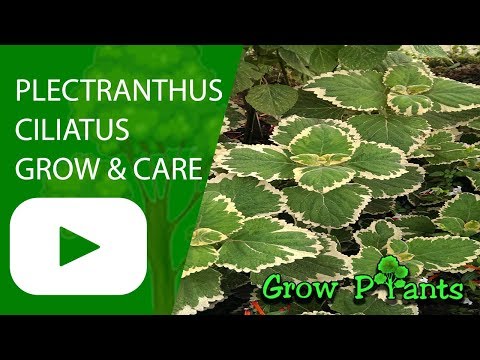

Plant Profile & Key Characteristics
Overview: Plectranthus ciliatus is a spreading evergreen perennial 20–60 cm (8–24 in) tall, grown for its fragrant, often variegated foliage and airy flower spikes. It works as a shade groundcover or trailing container plant and is treated as an annual in cold climates.
Quick Specifications
| Specification | Attribute |
|---|---|
| Plant Type / Life Cycle | Perennial (evergreen) in mild climates; grown as an annual where it freezes |
| Foliage Type | Evergreen (aromatic) |
| Mature Size | 20–60 cm (8–24 in) tall, spreading |
| Growth Rate | Moderate |
| Root System | Fibrous; trailing stems root readily at the nodes to form a spreading mat |
| Hardiness | USDA zone 9 and warmer as a perennial; from zone 5 as an annual |
Growth Form & Structure
- Height & Spread: Low and spreading at 20–60 cm (8–24 in); ideal as groundcover, in hanging baskets and trailing over container edges, indoors or out.
- Growth Habit & Form: Trailing, mat-forming herbaceous perennial whose soft stems root as they spread.
- Lifespan & Maturity: A fast, short-lived perennial that fills space quickly and is easily renewed from cuttings.
Anatomy & Physical Features
- Leaves & Foliage: Aromatic, serrated, elliptic leaves, often variegated — green with white edges, or marked with yellow or purple, and purple-flushed undersides.
- Flower Characteristics: Small white-and-purple flowers held on slender upright stalks.
Primary Uses & Landscape Value
- Functional & Ornamental Roles: Shade groundcover, edging and trailing container or basket plant grown mainly for its coloured, fragrant foliage.
Care Guide: Planting, Soil & Watering
Overview: Plectranthus ciliatus is an evergreen trailing perennial (hardiness zone 9 and warmer; an annual in cold climates) that grows best in moist, well-drained soil in a frost-free, part-shade position. It is fast to cover ground and easy in containers or as a houseplant.
Quick Care Requirements
| Requirement | Ideal Condition |
|---|---|
| Planting Season | In spring as an annual; from spring to autumn where perennial |
| Growth Rate | Moderate |
| Soil Type | Moist, well-drained soil rich in organic matter |
| Water Need | Moderate – keep evenly moist but never waterlogged |
Planting & Establishment
- Best Planting Season: Plant in spring where grown as an annual, or from spring to autumn where it is hardy as a perennial.
- How to Plant:
- Hole Preparation: Dig a hole a little wider than the root ball in loosened, free-draining soil.
- Soil Amendments: Work in compost or leaf mould to enrich the soil and improve moisture retention while keeping drainage sharp.
- Planting Depth: Set the plant at the same depth it grew in its pot, keeping the crown at soil level.
- Growth Speed & Expectations: Growth is moderate, forming spreading, trailing plants 20-60 cm (8-24 in) tall.
Soil, Watering & Drainage Care
- Soil Mix & Drainage Needs: Use a moist but free-draining mix; in containers ensure drainage holes so the soil stays moist without becoming waterlogged, and protect from frost.
- Watering Schedule & Technique:
- Young / Newly Planted: Keep newly planted specimens evenly moist as they establish.
- Established: Water regularly to keep the soil moist, letting the surface dry slightly between waterings.
- Seasonal Adjustments: Water more in warm weather and reduce in cooler months; protect from frost.
Climate, Light & Hardiness
Plectranthus ciliatus is a warm-climate ornamental grown as a perennial in frost-free regions and as an annual in colder climates, thriving in half shade to full shade. It needs frost-free conditions to persist as a perennial.
Quick Climate Specifications
| Climate Zones | Tropics, Mediterranean, temperate, desert, subtropics |
|---|---|
| USDA Hardiness Zones | 9 and warmer as a perennial; can be grown as an annual from zone 5 and warmer |
| Frost Tolerance | None to Low |
| Light Conditions | Half shade / full shade |
Sunlight & Light Exposure
Optimal Light Setup
Grows best in half shade to full shade.
Shade & Heat Management
This species is shade-loving by nature and not suited to hot, unshaded, full-sun exposures.
Best Exposure / Orientation
A shaded or partly shaded position, such as under trees or on an east-facing wall, suits it best.
Temperature Extremes & Hardiness
USDA Hardiness & Regional Limits
Perennial only in zone 9 and warmer, frost-free climates, matching the site data's explicit note that it needs frost-free conditions. In colder regions (zone 5 and warmer) it is commonly grown as an annual; cold is what forces the annual treatment, not an inability to be perennial where winters stay frost-free.
Cold Damage & Winter Protection
Frost and freezing temperatures damage or kill top growth; site data specifically calls for frost-free conditions for reliable perennial survival.
Frost Sensitivity
Frost-sensitive; this is the key factor separating perennial culture (zone 9+) from annual culture (colder zones).
Extreme Heat Tolerance
Tolerates warm subtropical and tropical heat reasonably well, especially with the shade and consistent moisture it prefers.
Wind, Humidity & Microclimate
Humidity Preferences
Adapts across the humidity range from humid tropics to drier Mediterranean and desert climates, provided the soil stays consistently moist and it has some shade.
Microclimate Recommendations
In containers or as a houseplant, it can be moved to a warm, sheltered spot or indoors during cold snaps to extend its life beyond a single season.
Growing in Pots, Balconies & Indoors
Plectranthus ciliatus is a trailing, shade-loving spur flower that the grower marks as a good houseplant as well as a container plant. Low and spreading at 20-60 cm (8-24 in), it is ideal for a hanging pot, a shelf indoors, or a shaded balcony trough.
Quick Details
- Container Size: A small-to-medium pot or hanging basket, potting up as it fills
- Indoor Suitability: A good houseplant in bright, indirect light
- Best Spot: Half to full shade; bright indirect light indoors
- Soil & Drainage: Aerated, free-draining mix
- Watering in Pots: Modest and steady – it likes small to average water; let the surface dry slightly and never waterlog
Indoors & On the Windowsill
- A real houseplant: Grow it in bright, indirect light; its trailing habit suits a hanging pot or a high shelf where the stems can cascade.
- Windowsill: A bright sill out of harsh direct sun keeps the foliage colourful and compact.
- Overwintering: Tender, so keep it as a potted plant indoors over a cold winter; it roots very easily from cuttings if you want backups.
On a Balcony or Patio
- Light & shelter: A shaded or part-shaded balcony suits it best; keep it out of strong midday sun and drying wind, and check pot moisture in warm weather.
Choosing the Pot, Soil & Long-Term Care
- Pot & drainage: A pot or basket with strong drainage holes; skip a standing-water saucer to avoid root rot.
- Potting mix: A well-aerated, organic-rich mix – peat or coir with perlite or vermiculite.
- Feeding: Feed lightly but regularly in growth, as pots leach nutrients faster; pinch tips to keep it full.
- Repotting: Refresh the mix or pot up every couple of years, or simply restart from cuttings.
Fertilizing & Feeding
This spreading, colorful-foliaged Plectranthus grows at a steady medium pace and flowers over summer and autumn, so it does well on light, consistent feeding through the growing season rather than heavy applications.
Quick Fertilizing Specs
| Feeding Level | Moderate – light, regular feeding through the growing season. |
|---|---|
| Main Nutrient Priority | Balanced nutrition to support both its ornamental foliage and its summer-to-autumn bloom. |
| Best Feeding Period | Spring through autumn while the plant is actively growing. |
| Soil pH | Prefers moist, well-drained soil. |
| Reduce/Stop Feeding | Reduce feeding as growth slows going into winter, or as an overwintered plant is cut back. |
| Organic Options | Compost mixed into the planting bed or container soil supports steady nutrition. |
| Micronutrients | No routine micronutrient product is typically needed in moist, well-drained soil. |
Feeding by Growth Stage
Spring Growth
Support fresh stem and leaf growth as the plant resumes active growth in spring.
| Nutrient direction | A balanced, nitrogen-forward feed to build healthy foliage and spreading growth. |
|---|---|
| Timing | As new growth begins in spring, once the risk of frost has passed. |
| Frequency | Light, regular feeding through spring suits this plant’s steady spreading habit. |
| Fertilizer types | A balanced, general-purpose flowering-plant fertilizer, A diluted liquid feed for container specimens |
| Precautions | Avoid overfeeding, which can push soft, floppy growth on this already vigorous spreader. |
Summer to Autumn Bloom
Support the small white-purple flower spikes that appear over summer and autumn.
| Nutrient direction | Maintain light, balanced feeding rather than pushing extra nitrogen, which favors leafy growth over flowers. |
|---|---|
| Timing | Through summer and into autumn as flower spikes form. |
| Frequency | Continue the same light, regular feeding rhythm established in spring. |
| Fertilizer types | A balanced, general-purpose flowering-plant fertilizer, at a light rate |
| Precautions | Avoid a sudden nitrogen boost as flower spikes form, which can push leafy growth instead of bloom. |
Cold-Season Rest
Let the plant slow down through the cold season, whether it persists as a perennial in frost-free climates or is treated as a spent annual in colder ones.
| Nutrient direction | None – withhold fertilizer as growth slows for the season. |
|---|---|
| Timing | Late autumn through winter, or once cold weather ends the growing season for plants grown as annuals. |
| Frequency | No feeding at this stage; resume only with renewed active growth in spring. |
| Fertilizer types | No feeding at this stage – do not apply fertilizer during the cold-season rest. |
| Precautions | Do not fertilize a resting or dormant plant; feeding resumes only once active spring growth begins. |
Nutrient Deficiency Signs & Corrections
Pale, smaller-than-usual leaves and slowed spreading growth.
| Possible causes | Insufficient nitrogen for a plant that depends on regular light feeding, Root-bound container restricting nutrient uptake, Overwatering leaching nutrients from the soil |
|---|---|
| Appears first on | Older, lower leaves first |
| What to check | Recent feeding history, especially for container plantings, Whether the plant is root-bound and due for repotting, Watering frequency and drainage |
| Possible correction | Resume regular light feeding during active growth, and repot a root-bound plant into fresh soil. |
Long, leggy stems with sparse foliage and few flowers.
| Possible causes | Excess nitrogen favoring stem elongation over compact, flowering growth, Insufficient light causing stretching, Lack of pinching or pruning to encourage branching |
|---|---|
| Appears first on | Whole-plant growth habit rather than a single leaf symptom |
| What to check | Recent feeding history for excess nitrogen, Light exposure, since low light encourages stretching, Whether the plant has been pinched back to encourage bushier growth |
| Possible correction | Shift toward balanced rather than high-nitrogen feeding, increase light where possible, and pinch back stems to encourage denser, more floriferous growth. |
Wilting, yellowing, or stem softening despite adequate feeding.
| Possible causes | Waterlogged or poorly drained soil causing root stress, Overfeeding compounding stress on an already struggling root system, Fungal root or stem issues favored by consistently wet conditions |
|---|---|
| Appears first on | Whole-plant decline rather than a single leaf pattern |
| What to check | Soil drainage and recent watering frequency, Signs of root or stem rot at the base, Whether feeding has continued despite visible decline |
| Possible correction | Correct drainage and watering before adjusting fertilizer; this moisture-loving plant still needs soil that drains rather than staying waterlogged. |
Pruning, Training & Seasonal Maintenance
Plectranthus ciliatus is a soft, spreading/trailing subshrub used as groundcover or a trailing container plant, so pruning is mostly about controlling spread and refreshing growth rather than building a framework. It tolerates cutting back well; spring is the main window for shaping before the summer-into-autumn bloom flush, while spent flower stalks and tired trailing stems are tidied up afterward. Pruning does not sacrifice a season’s crop of flowers – cutting back in spring simply delays that year’s bloom slightly while producing denser, better-covered growth.
Quick Pruning & Maintenance Specs
| Pruning Tolerance | High |
| Primary Pruning Window | Spring (shape before the growth flush) |
| Secondary Maintenance Window | Autumn/winter, after summer–autumn bloom (deadhead, tidy) |
| Typical Frequency | One spring cutback, then light tidying through the growing season |
| Main Objective | Control spread, keep foliage dense, remove spent flowers |
| Young Plant Priority | Pinch tips to encourage branching and lateral spread |
| Mature Plant Priority | Cut back trailing stems that have gone bare at the base |
| Best Tool Type | Precision snips (soft stems) |
| Avoid Heavy Pruning During | Cold snaps – this species is frost-sensitive and needs to recover before any chill |
Pruning by Plant Age & Size
Newly Established
Minimal – pinch tips once rooted in to encourage side branching; no structural cuts needed.
Young / Formative
No formal training frame; pinch regularly to build a bushy, multi-branched trailing habit rather than a few long unbranched runners.
Mature / Established
Cut back leggy or bare-based trailing stems in spring to force fresh growth from lower nodes and keep the plant from thinning out in the middle.
Structural Pruning & Training
- Spread control – trim trailing stems back to the desired edge when used as groundcover or in a hanging container.
- Renewal cutback of stems that have become woody and sparse at the base.
Special Growth to Remove
- Old flower stalks, once the summer–autumn bloom fades.
- Dead leaves.
- Overlong trailing stems that have outrun the intended footprint.
Container & Small-Space Pruning
Does well as a houseplant or in pots/hanging baskets; trim trailing growth back by up to a third when it starts to look thin or straggly to keep it compact and encourage new stems from the base rather than letting a container plant get leggy and bare-centred.
Tools
- Precision snips – for pinching and trimming the thin, soft trailing stems.
Tool Hygiene & Disease Risk
Routine – clean, sharp tools are enough. The recorded pest is aphids, not a systemic pathogen, so no special disinfection regime is needed between cuts.
Cut Placement & Technique
Pinch or cut just above a leaf node so the plant branches from that point; remove spent flower stalks back to the nearest set of healthy leaves.
Heavy Pruning & Rejuvenation
Tolerated in spring – a straggly plant can be cut back hard (by half) to force fresh basal growth; keep it frost-free and out of cold drafts while it recovers, since this species has no cold tolerance.
Post-Pruning Care
Keep watering steady (it prefers moist, well-drained soil) and avoid feeding right after a hard cutback; protect from cold immediately after pruning since new soft growth is more frost-tender than established stems.
Common Pruning Mistakes
- Letting trailing stems run bare at the base for a full season before cutting back.
- Hard-pruning right before a cold snap, leaving tender regrowth exposed to chill damage.
- Shearing instead of pinching, which leaves cut ends visible on the soft foliage.
When NOT to Prune
Avoid pruning heading into cold weather – this species is frost-sensitive and needs a warm recovery window; also hold off pruning a fresh division or transplant until it has rooted in.
Recommended Tools (by task)
- precision_snips – pinching tips and trimming soft trailing stems without crushing them; the right scale for this groundcover/container plant’s thin growth.
Propagation Guide
This spreading Plectranthus is grown almost entirely from stem cuttings, which root quickly and keep an individual cultivar’s leaf variegation and flower color consistent. Seed is possible and generally comes true only where a single cultivar is grown in isolation — nearby cross-pollination with other cultivars can produce variable seedlings — so cuttings are preferred whenever a specific plant is being reproduced; propagation overall is easy.
Quick Propagation Specs
| Best Propagation Method | Stem cuttings |
| Alternative Methods | Seed (reliable only where a single cultivar is isolated from others) |
| Propagation Difficulty | Easy |
| Seed True-to-Type | Usually true-to-type only in isolation; otherwise variable from cross-pollination |
| Vegetative True-to-Type | Yes |
| Best Propagation Season | Spring to autumn, frost-free |
| Cutting Rooting Time | Typically 1–3 weeks |
Growing from Seed
Sow in spring once frost danger has passed. Germination timing is not precisely documented for this species; keep the mix moist and frost-free. Because this Plectranthus cross-pollinates readily with other cultivars, seedlings from mixed plantings can vary in leaf pattern and habit.
Stem Cuttings
Cutting Type
Tip or stem cuttings with two to three nodes.
Best Timing
Spring through autumn while frost-free and actively growing.
Cutting Preparation
Cut below a node and strip the lower leaves.
Rooting Setup
Root in water or in the moist, well-drained mix the site recommends for the growing plant; trailing stems that touch moist soil can also root naturally at the nodes and be severed and transplanted once established.
Rooting Hormone
Not necessary.
Rooting Time
Commonly within 1–3 weeks.
Bloom & Flower Guide
Quick Details
- Bloom Season: Summer to autumn
- Flower Appearance: Small white-and-purple flowers carried on upright stalks above the foliage
- Edibility: Ornamental only – grown for foliage and flowers, not eaten
Detailed Blooming Overview
This spurflower is grown mainly as a handsome, shade-tolerant groundcover, but in late summer and autumn it lifts slender spikes of small two-lipped flowers in white washed with purple above the scalloped leaves. As a member of the mint family the blooms are lightly aromatic and draw in bees. The flowering is a gentle, airy accent rather than a bold display.
Flower Characteristics
- Small white-purple two-lipped flowers on upright stalks.
- Typical mint-family shape; lightly aromatic and attractive to bees.
Bloom Care & Thinning
- Tidy up: Cut back old flower stalks in spring along with any tired leaves to keep the planting fresh.
Pests, Diseases & Troubleshooting
Overview: Plectranthus (the coleus and Swedish-ivy relatives) are soft, fast-growing members of the mint family whose main pests are mealybugs and whitefly, backed by aphids, spider mites and thrips; on tender foliage slugs and snails also graze. Plectranthus ciliatus is a vigorous trailing groundcover species whose sprawling stems root as they go, so slugs and damp-soil rot are the main watch-points. They root and grow easily but are frost-tender and prone to rot if overwatered. Keep them warm, airy and evenly (not soggily) watered, and take cuttings as cheap insurance.
Quick Troubleshooting Overview
| Issue / Pest | Main Symptom | Primary Solution |
|---|---|---|
| Mealybugs | White cottony tufts in leaf axils and stems | Alcohol dab; neem/insecticidal soap; control ants |
| Whitefly | Clouds of tiny white flies; sticky, sooty leaves | Yellow sticky traps; insecticidal soap; check undersides |
| Aphids | Sticky, curled new growth | Rinse off; insecticidal soap; encourage predators |
| Spider mites | Fine stippling, dull leaves in dry air | Raise humidity; rinse foliage; horticultural oil |
| Slugs and snails | Ragged holes in tender leaves | Hand-pick; iron-phosphate bait; barriers |
| Root / stem rot | Blackened stem base, wilting in wet soil | Reduce watering; free-draining mix; take cuttings |
Common Pests & Management
- Mealybugs (Planococcus, Pseudococcus spp.):
- Symptoms: White cottony masses in leaf axils, stem joints and undersides, with sticky honeydew, sooty mold and stalled growth — a very common pest of this group.
- Prevention & Control: Dab colonies with rubbing alcohol, then spray neem or insecticidal soap, repeating weekly until clear; control ants that spread them, isolate infested plants, and check roots for root mealybug when repotting.
- Whitefly (Trialeurodes vaporariorum, Bemisia tabaci):
- Symptoms: Tiny white flies that rise in a cloud when the plant is disturbed, with sticky honeydew and sooty mold; nymphs feed on leaf undersides — especially troublesome on coleus.
- Prevention & Control: Hang yellow sticky traps, spray insecticidal soap or neem on the undersides, and repeat every few days to break the life cycle; isolate new plants and encourage Encarsia parasitic wasps where possible.
- Aphids (Aphididae):
- Symptoms: Soft green or black insects on tender shoots and flower spikes, causing curling and honeydew.
- Prevention & Control: Wash off with water, encourage ladybirds and lacewings, and use insecticidal soap for heavy colonies; avoid over-feeding with nitrogen.
- Spider mites (Tetranychus urticae):
- Symptoms: Fine stippling, a dull grey-green cast and faint webbing on leaf undersides in warm, dry air.
- Prevention & Control: Raise humidity, rinse foliage undersides, and treat with insecticidal soap or horticultural oil, repeating to catch hatchlings; avoid broad insecticides that flare mites.
- Slugs and snails (Gastropoda):
- Symptoms: Ragged holes chewed in the soft, often colorful foliage overnight, with slime trails, worst in cool damp conditions.
- Prevention & Control: Hand-pick after dark, use grit or copper barriers and traps, and apply iron-phosphate bait around vulnerable plantings.
Diseases & Fungal Issues
- Root, stem and crown rot (Pythium, Rhizoctonia, Phytophthora spp.):
- Symptoms: Soft, blackened stem bases and wilting despite moist soil, with brown rotted roots — common from overwatering, poor drainage or cold wet conditions.
- Treatment & Management: Water only as the surface dries, use a free-draining mix, and improve airflow and drainage. Take healthy cuttings as insurance, remove rotted material, and repot into fresh medium; correct watering is the real fix.
- Botrytis / grey mold (Botrytis cinerea):
- Symptoms: Fuzzy grey mold on soft, crowded or damaged tissue in cool, damp, still conditions.
- Treatment & Management: Space plants, improve ventilation, remove faded flowers and dead leaves, and avoid wetting foliage in cool weather.
- Leaf spot (Cercospora and related fungi):
- Symptoms: Brown or dark spots on leaves in warm, humid, crowded conditions.
- Treatment & Management: Improve airflow, avoid overhead watering, and remove spotted leaves; rarely needs fungicide.
Growing Difficulties & Abiotic Problems
- Overwatering / rot risk:
- Cause & Symptoms: Soggy soil quickly rots the soft stems and roots — the commonest way these plants fail.
- Correction Strategy: Water only as the surface dries, use a free-draining mix and pots with drainage, and improve airflow; when in doubt, keep on the drier side and take cuttings as backup.
- Frost / cold sensitivity:
- Cause & Symptoms: These are tender plants; frost and cold blacken foliage and kill stems.
- Correction Strategy: Grow as tender perennials or annuals, bring containers under cover before frost, and overwinter rooted cuttings indoors in warmth and light.
- Light and leaf color:
- Cause & Symptoms: Too little light gives leggy, pale, sparse growth; the wrong light also mutes the leaf coloring of ornamental types (and harsh sun can scorch shade-loving ones).
- Correction Strategy: Match the plant to the right light — bright indirect to part sun for good color without scorch — and pinch regularly to keep growth bushy and remove flower spikes to prolong foliage.
What Helps — Products & Tools
The practical toolkit is insecticidal soap, neem or horticultural oil for mealybugs, whitefly, aphids and mites, yellow sticky traps for whitefly (and thrips monitoring), rubbing alcohol for spot-treating mealybugs, and iron-phosphate bait for slugs; a free-draining mix and easy cuttings are the best insurance. Spray in the evening to protect pollinators.


