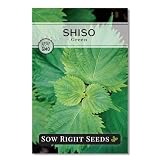


Plant Profile & Key Characteristics
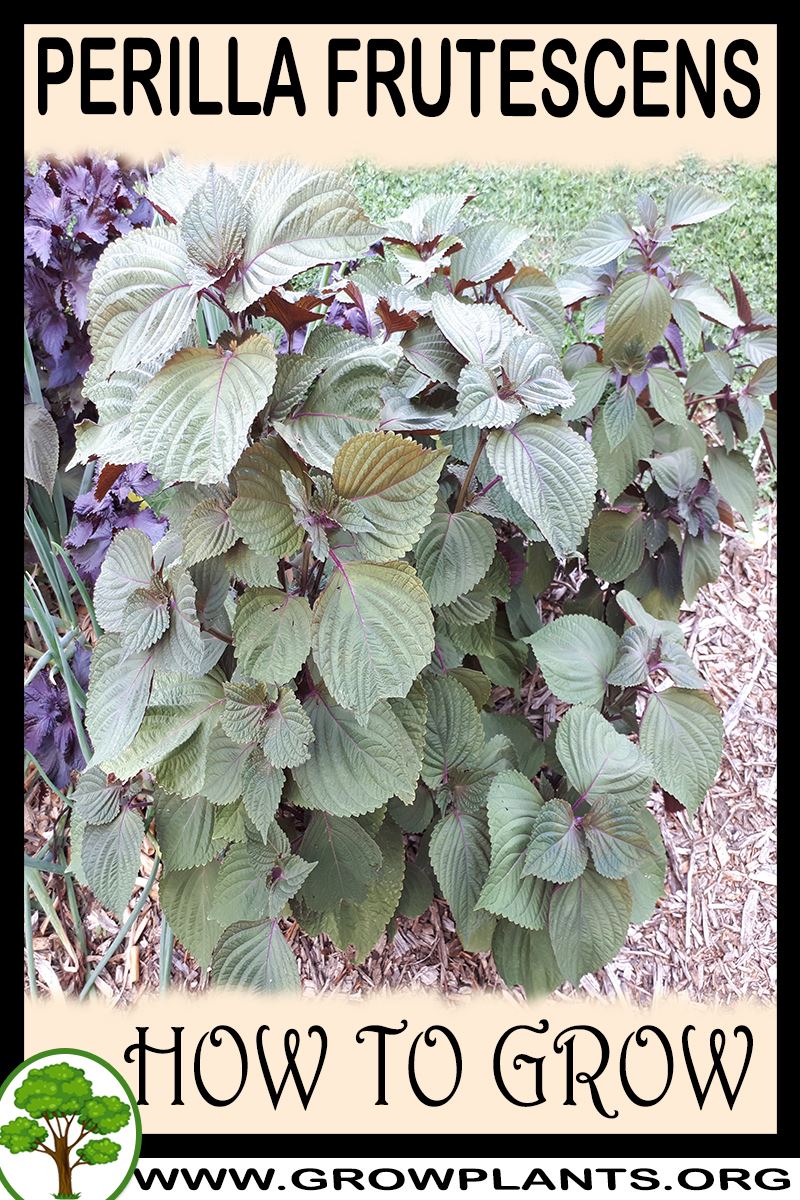
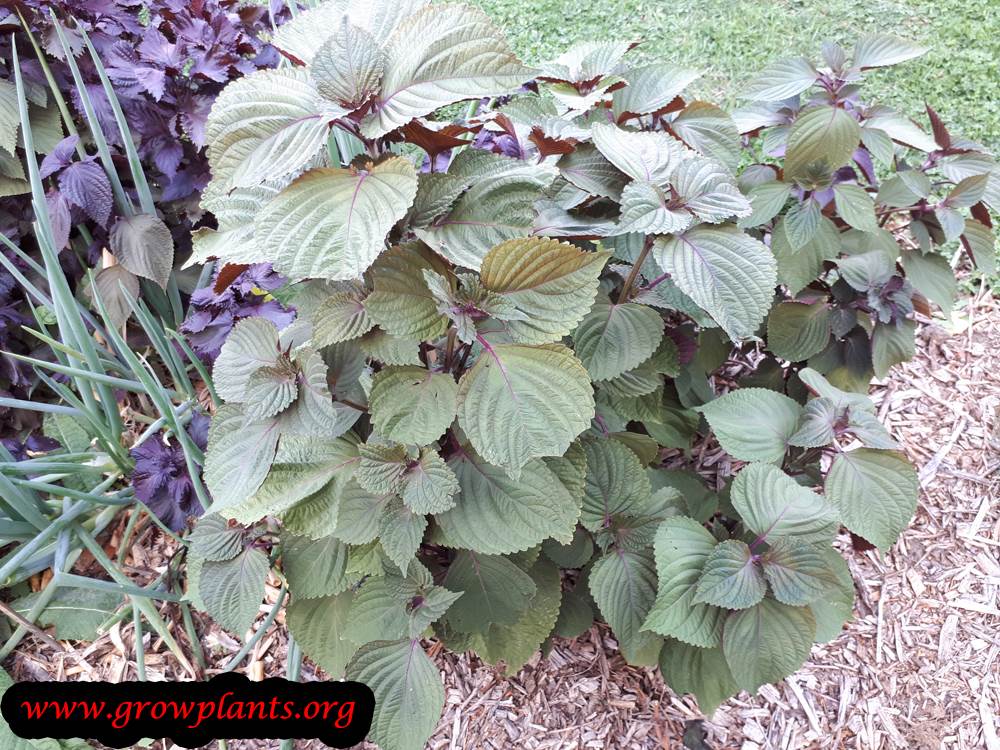
Overview: A fast-growing annual culinary herb of the mint family, reaching about 0.5-1.2 m (20-48 in). It is grown chiefly for its aromatic edible leaves and is also used ornamentally for its colourful green-to-purple foliage.
Quick Specifications
| Specification | Attribute |
|---|---|
| Plant Type / Life Cycle | Annual (self-seeds readily) |
| Foliage Type | Deciduous (soft annual foliage) |
| Mature Size | 0.5-1.2 m (20-48 in) tall |
| Growth Rate | Fast to moderate |
| Toxicity | Edible for people (a widely used culinary leaf); note the foliage can be toxic to grazing cattle and horses |
| Hardiness | Grown as a warm-season annual across USDA zones 3-11 |
Growth Form & Structure
- Height & Spread: Forms an upright, bushy plant 0.5-1.2 m (20-48 in) tall in the ground; grows well in a 5-12 L (1.5-3 gal) container.
- Growth Habit & Form: An erect, branching herbaceous annual on square mint-family stems, best kept leafy by pinching out flower spikes.
- Lifespan & Maturity: Completes its cycle in one season, cropping leaves from roughly 7-10 leaves onward; it self-seeds freely to return the next year.
Anatomy & Physical Features
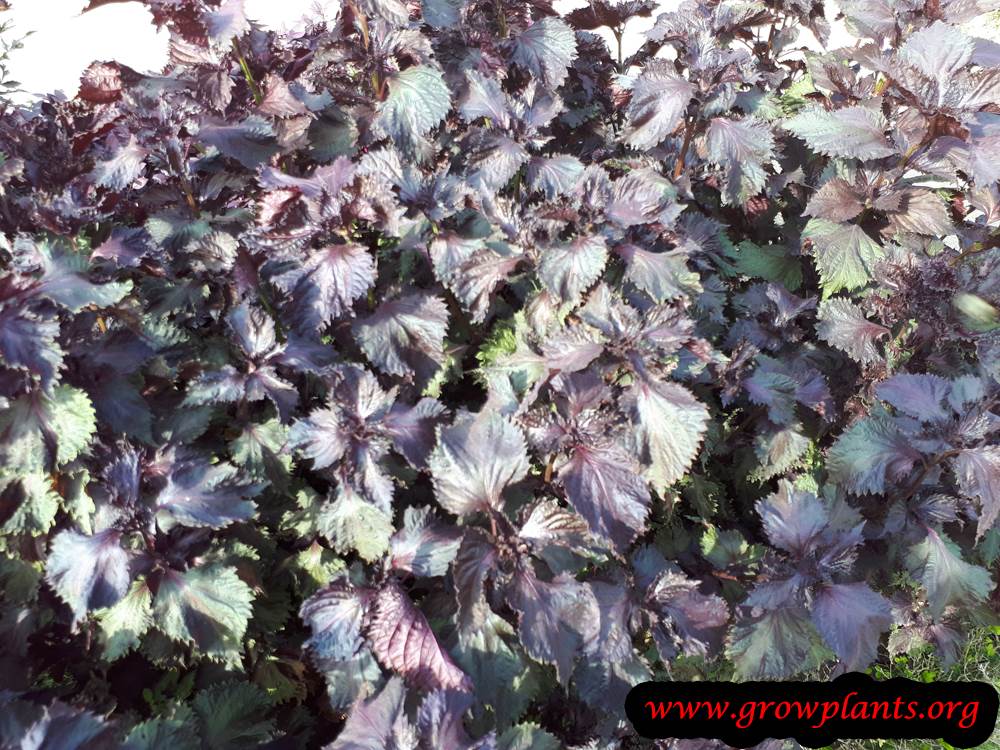
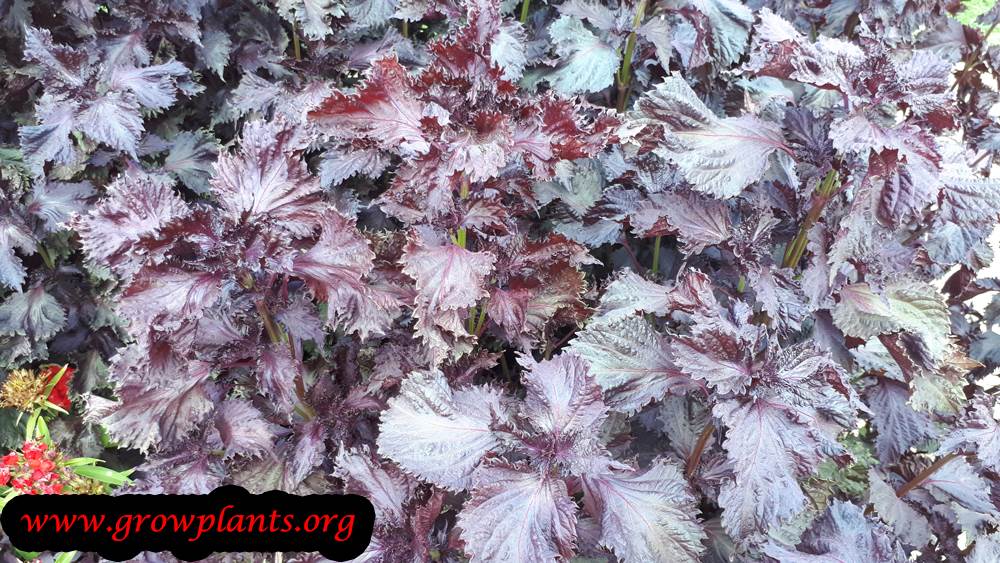
- Leaves & Foliage: Aromatic, broadly deltoid leaves with serrated edges, green or purple (sometimes green above and purple beneath); crinkled in the frilly forms.
- Flower Characteristics: Small flowers on slender spikes, the inflorescence green or purple; usually removed to prolong leaf quality.
Primary Uses & Landscape Value
- Edible Uses: Leaves are used fresh in salads, as a wrap and garnish, and cooked in stir-fries and savoury dishes; a staple herb in East Asian cooking.
- Functional & Ornamental Roles: A dual-purpose herb and colourful foliage plant for kitchen gardens, borders and containers.
Care Guide: Planting, Soil & Watering
Overview: Perilla frutescens (beefsteak plant) is a fast-growing warm-season annual herb (hardiness zones 3–11) grown for its aromatic, colourful edible leaves. It does best in full sun to light shade in rich, slightly acidic, organic soil kept evenly moist.
Quick Care Requirements
| Requirement | Ideal Condition |
|---|---|
| Planting Season | After last frost in cool zones; mid-winter in hot, frost-free zones (10b–11) |
| Growth Rate | Moderate to Fast |
| Soil Type | Rich, light, organic and well-draining |
| Soil pH | Slightly acidic |
| Water Need | Moderate to High – keep evenly moist, more in heat |
Planting & Establishment
- Best Planting Season: Plant after the last frost in cooler zones (3–10a); in hot, frost-free zones (10b–11) plant in mid-winter to get ahead of the summer heat.
- How to Plant:
- Hole Preparation: Better to start from seed or young plants than to move a mature plant, as transplanting established specimens is unreliable; set young plants into loosened, moisture-retentive soil.
- Soil Amendments: Use light soil rich in organic matter; a little vermiculite or mulch helps hold moisture in warm spells.
- Planting Depth: Set young plants at the depth they grew, keep the root collar level with the soil, then mulch around them to conserve moisture.
- Growth Speed & Expectations: A fast grower that bulks up quickly through the warm season; pinch out flower spikes to keep leaves tender.
Soil, Watering & Drainage Care
- Soil Mix & Drainage Needs: Prefers light, rich, well-drained soil high in organic matter and slightly acidic; vermiculite or mulch helps hold moisture. Keep drainage free so roots stay moist but never waterlogged.
- Watering Schedule & Technique:
- Young / Newly Planted: Water generously in the first days after planting – especially during spring heat waves – and mulch to hold moisture.
- Established: Keep the soil evenly moist; water more in hot weather, when the plant’s demand rises sharply.
- Seasonal Adjustments: Increase watering in heat and reduce as temperatures cool toward the end of the season.
Climate, Light & Hardiness
Perilla frutescens is grown across temperate, mediterranean, and subtropical climates as a warm-season annual, preferring full sun with some afternoon shade where summers run hot. Its listed USDA range of zone 3 through 11 reflects where it is cultivated as an annual crop, not year-round outdoor survival, since it is frost-sensitive and also stressed by high heat.
Quick Climate Specifications
| Climate Zones | Temperate, mediterranean, subtropical |
|---|---|
| USDA Hardiness Zones | 3–11 (grown as an annual) |
| Frost Tolerance | Very Low |
| Light Conditions | Full Sun to Half Shade |
Sunlight & Light Exposure
Optimal Light Setup
Full sun suits it where summers aren't extreme; half shade is preferable in hot climates (including hardiness zone 10b–11) both to delay premature flowering and to ease heat stress.
Shade & Heat Management
The site data notes this species is sensitive to high temperatures, so afternoon shade and mulch to keep the root zone cooler are worthwhile in hot-summer gardens.
Temperature Extremes & Hardiness
USDA Hardiness & Regional Limits
Grown as an annual across zone 3 through 11 - freezing winters kill it outright everywhere in this range, so the zone figure describes where it can be raised as a warm-season crop (planted after the last frost, or through the mild winter in the warmest zones) rather than where it survives year-round.
Frost Sensitivity
Frost-tender; even a light frost ends the growing season, which is why sowing and transplanting are timed to start after the last frost date (or in the mild winter itself, in hardiness zone 10b–11).
Extreme Heat Tolerance
Sensitive to high heat - sustained hot spells stress the plant, so part shade and mulch are useful moderating measures in warm climates.
Frost-Free Growing Season
Because it is an annual foliage crop killed by frost, the length of the frost-free window largely determines how long a harvest season a given climate can offer.
Wind, Humidity & Microclimate
Humidity Preferences
Appreciates moist soil and ambient humidity through the growing season, particularly during establishment.
Growing in Pots, Balconies & Indoors
Perilla is a leafy annual herb (0.5-1.2 m). The grower rates it as not a houseplant, but it grows well in pots on a sunny to part-shaded patio or balcony, and a bright sill can raise a smaller leafy plant.
Quick Details
- Container Size: 5-12 L (1.5-3 gal) pot
- Indoor Suitability: Not a houseplant; a bright, sunny sill can grow leaves
- Best Spot: Full sun, or part shade to delay flowering; part shade in very hot climates
- Soil & Drainage: Rich, well-aerated, free-draining mix
- Watering in Pots: Keep the mix moist – more water in heat; let excess drain
Indoors & On the Windowsill
- Not a houseplant: The grower rates it unsuitable indoors; it wants open-air light.
- Windowsill: A very bright, sunny sill can grow a smaller leafy plant for the kitchen.
On a Balcony or Patio
- Sun to part shade: It grows fast in a sunny or lightly shaded spot; part shade helps delay flowering and keep the leaves coming.
- Light & heat: Walls, railings and paving reflect heat and wind dries pots fast, so check moisture often and water more in hot spells.
Choosing the Pot, Soil & Long-Term Care
- Pot & drainage: A 5-12 L pot with good drainage; the grower advises against a water-filled saucer.
- Potting mix: Rich, well-aerated and free-draining – potting mix, or peat with perlite or vermiculite.
- Feeding: Container plants use up food faster because watering washes nutrients out – feed a little and often through the growing season.
- Repotting: If kept on as a perennial in mild areas, refresh the soil about every two years.
Fertilizing & Feeding
A light feeder overall: one modest, nitrogen-leaning feeding once the young plant is well leafed-out carries it through the season, favoring leaf growth over flowering.
Quick Fertilizing Specs
| Feeding Level | Light feeder |
|---|---|
| Main Nutrient Priority | Nitrogen-forward to favor leafy growth over flowering |
| Best Feeding Period | After the seedling is well established with several sets of true leaves |
| Organic Options | Compost or aged organic matter worked into rich soil at planting |
| Reduce/Stop Feeding | Ease off feeding as the plant shifts toward flowering late in the season |
| Micronutrients | Usually unnecessary in organic-rich soil; correct only diagnosed issues |
| Soil pH | Slightly acidic |
Feeding by Growth Stage
Establishment after transplant or germination
Help the young plant root in and build its first true leaves without stressing it.
| Nutrient direction | Minimal feeding is usually enough; rely on rich, organic-matter-amended soil to carry early growth. |
|---|---|
| Timing | From transplanting or germination through the first weeks of establishment. |
| Frequency | Rarely needs supplemental feeding beyond what enriched planting soil provides. |
| Fertilizer types | Compost or aged organic matter mixed into the planting soil |
| Precautions | Avoid heavy feeding on young seedlings, which can scorch tender roots and encourage weak, leggy growth. |
Active leaf production
Build vigorous, colorful, harvestable foliage, which is the main reason the plant is grown.
| Nutrient direction | A nitrogen-forward feeding once the plant is carrying several sets of true leaves pushes leafy growth rather than early flowering. |
|---|---|
| Timing | Once the young plant is clearly established and actively leafing out, continuing through the main growing season. |
| Frequency | A single light feeding is typically enough to sustain the plant through the season, with organic matter renewed as needed. |
| Fertilizer types | A nitrogen-leaning complete fertilizer suited to leafy greens, Compost or other organic matter as a top-dressing |
| Precautions | Choose a fertilizer aimed at foliage rather than bloom, since the goal is leaf production, not flowering. |
Nutrient Deficiency Signs & Corrections
Older leaves turn pale green to yellow and new leaves emerge smaller than usual.
| Possible causes | low available soil nitrogen, nutrient leaching from frequent watering, sandy or organic-matter-poor soil |
|---|---|
| Appears first on | older, lower leaves |
| What to check | recent feeding history, soil organic matter and texture, watering frequency and drainage |
| Possible correction | Apply a nitrogen-forward complete fertilizer suited to leafy crops and refresh organic matter in the soil. |
New leaves show yellowing between the veins while the veins themselves remain green.
| Possible causes | alkaline soil pH limiting iron availability, waterlogged or compacted soil restricting root uptake, true low soil iron |
|---|---|
| Appears first on | newest leaves |
| What to check | soil pH, drainage and soil compaction, recent watering and root health |
| Possible correction | Correct overly alkaline soil conditions and apply a chelated iron product per its label if the issue persists. |
Leaf edges brown or scorch and growth stalls despite regular watering.
| Possible causes | fertilizer salt buildup in the root zone, overfeeding beyond the plant’s light demand, under-watering that concentrates salts |
|---|---|
| Appears first on | leaf margins and tips |
| What to check | how much and how often fertilizer has been applied, watering consistency, container or bed drainage |
| Possible correction | Stop feeding, water thoroughly to flush salts, and resume only with light, occasional feeding. |
Pruning, Training & Seasonal Maintenance
Perilla frutescens is a soft-stemmed annual herb grown for its edible, often colorful leaves – there is no woody structure to train, and “pruning” is really pinching and harvesting. It tolerates frequent tip removal very well, and regular harvest largely functions as the plant’s own maintenance pruning: repeated pinching keeps it bushy and productive rather than tall and thin. The one cut that matters beyond routine harvest is removing the flower spikes as they form, both to keep the plant putting energy into leaves rather than seed, and because this species reseeds itself readily if flowers are left to set seed.
Quick Pruning & Maintenance Specs
| Pruning Tolerance | High (soft annual growth, regrows quickly from pinching) |
| Primary Pruning Window | Ongoing through spring–autumn as part of routine harvest |
| Typical Frequency | Every harvest – effectively continuous light pruning through the growing season |
| Main Objective | Encourage bushy, leafy growth and delay/limit flowering and self-seeding |
| Young Plant Priority | Pinch the growing tip once the plant has several true leaves to force branching |
| Mature Plant Priority | Continue harvest-pinching; remove flower spikes as they appear if seed set is not wanted |
| Best Tool Type | Precision snips, or simply pinching by hand (stems are soft throughout) |
| Avoid Heavy Pruning During | Peak heat stress – this species is noted as sensitive to high temperatures |
Pruning by Plant Age & Size
Newly Established
Pinch the central growing tip once the young plant has 6–8 true leaves to encourage side-branching before regular harvest begins.
Young / Formative
No structural training applies to this soft annual; the only relevant action is tip-pinching to build a bushier plant early on.
Mature / Established
Ongoing harvest-pinching of leaves and stem tips; remove flower spikes as they form through summer–autumn unless seed is specifically wanted.
Seasonal Pruning Schedule
Ongoing Sanitary
Through the growing season, pinch or harvest stem tips regularly – this is both the plant’s maintenance pruning and its productive harvest, and keeps growth compact rather than leggy. Toward autumn, as the plant naturally begins bolting to flower and seed, more of this trimming shifts toward removing flower spikes if continued leaf quality (rather than seed) is the goal.
Special Growth to Remove
- Flower spikes – pinch out as they form if leaf production is the priority; left in place they mature to seed, and this species reseeds itself readily where that is not wanted.
- Any heat-stressed or wilted growth during a hot spell, once conditions ease.
Container & Small-Space Pruning
Grows well in containers of roughly 5–12L. Pot-grown plants benefit from slightly more frequent tip-pinching than an in-ground planting to keep them proportionate to the container and to delay the shift to flowering, which tends to happen sooner in the more limited root run of a pot.
Tools
Precision snips (or simply pinching by hand) are the only tool this soft-stemmed annual ever needs.
Tool Hygiene & Disease Risk
Routine care only – clean, sharp snips. This species’ recorded issues are aphids and caterpillar larvae rather than a pathogen that spreads readily through pruning cuts.
Cut Placement & Technique
Pinch or cut just above a leaf pair or side shoot so the plant branches from that point; when harvesting for the kitchen, taking whole stem tips (rather than stripping individual leaves) both provides the harvest and does the plant’s shaping in one action.
Post-Pruning Care
No special care is needed after routine pinching/harvest beyond normal watering; avoid heavy trimming during a heat wave, when this heat-sensitive species is least able to push fast regrowth. No extra feeding is needed around pruning – this species is already fertilized once a year for vegetative growth rather than bloom, which is the more relevant nutrition lever here.
Common Pruning Mistakes
- Letting flower spikes mature to seed, leading to unwanted self-seeding the following year.
- Never pinching the growing tip, resulting in a single tall, thin stem instead of a bushy, productive plant.
- Heavy trimming during a hot spell, when this heat-sensitive species is slow to recover.
When NOT to Prune
Avoid heavy pinching during extreme heat stress. Avoid disturbing very young seedlings before they have several true leaves.
Recommended Tools (by task)
- precision_snips – tip-pinching, leaf harvest, and flower-spike removal; the only cut this plant ever presents.
Propagation Guide
Perilla frutescens is most easily and most commonly grown from seed, which it produces freely and often self-sows; stem cuttings are also possible when a specific leaf-color form needs to be kept true. Seed-grown plants are generally true-to-type for the species, and propagation overall is easy for a home grower.
Quick Propagation Specs
| Best Propagation Method | Seed |
| Alternative Methods | Stem cuttings |
| Propagation Difficulty | Easy |
| Seed True-to-Type | Usually true-to-type (self-sown seedlings may show some leaf-color variation) |
| Vegetative True-to-Type | Yes |
| Best Propagation Season | Sow indoors in winter; take cuttings in early spring |
| Seed Germination Time | 7–30 days |
| Cutting Rooting Time | Typically a few weeks |
| Germination Temperature | 10–20°C (50–68°F) |
| Seed Sowing Depth | 1–1.5 cm (0.5–0.7 in) |
Growing from Seed
Seed Handling & Viability
Seeds are short-lived, so use fresh seed where possible and keep any saved seed in a cold, dry, dark place until sowing.
Dormancy & Pre-Sowing Treatment
Soak seed in water for 12–24 hours before sowing to improve and even out germination.
Sowing Season
Sow indoors over winter for a spring start; in hardiness zone 3–10a sow/plant out in spring after the last frost, and in zone 10b–11 sow in mid-winter.
Sowing Depth & Orientation
Sow about 1–1.5 cm (0.5–0.7 in) deep; seed does not strictly need to be buried, but covering lightly helps retain moisture. Space seedlings/plants roughly 30 x 30 cm (12 x 12 in) apart.
Germination Conditions
Keep the sowing medium consistently moist and humid, in a sunny spot; germination temperature can range 10–20°C (50–68°F).
Germination Time
Germination is variable, typically 7–30 days.
Seedling Care
Keep seedlings in moist soil and full sun; during heat waves, add mulch around young plants to protect them, since the species is sensitive to high temperatures.
Stem Cuttings
Cutting Type
Softwood stem cuttings taken from young growth.
Best Timing
Begin cuttings in early spring, from stock started indoors over winter; plant rooted cuttings outdoors about 2 weeks after the last frost.
Cutting Preparation
Take a healthy non-flowering shoot tip and insert into a moist, light growing medium.
Rooting Setup
Keep the medium moist and the cutting in a warm, sheltered, humid spot until roots form; harden off before planting outdoors.
Rooting Hormone
Not necessary for this soft-stemmed herb, though a light dip can speed rooting.
Rooting Time
Typically a few weeks under warm, humid conditions.
Bloom & Edible Flower Guide
Quick Details
- Bloom Season: Summer into autumn, triggered as the days shorten
- Time to First Bloom: In its single season — this annual runs up to flower in late summer
- Flower Appearance: Tiny flowers set along a slender spike; the flowering stalk may be green or purple
- Edibility: Edible — the young flower spikes are used in East-Asian cooking as a garnish and seasoning
Detailed Blooming Overview
Perilla frutescens, the beefsteak plant or Korean perilla, flowers late in the season as the days shorten, sending up slim spikes of small flowers. The bloom is a turning point: once the plant runs to flower the leaves lose their tenderness and turn bitter. Growers who want a long leaf harvest pinch the spikes out, while those who value the flowering spikes and seeds let them come.
Flower Characteristics
- Very small flowers arranged in a one-sided spike (a raceme) at the stem tips.
- The spike and calyces may be green or flushed purple, echoing the leaf colour.
- Nectar draws bees and flies.
Bloom Care & Thinning
- Thinning the bloom: If you are not saving seed, pinch out the flower spikes as they appear — this keeps the leaves tender and extends the leaf harvest.
- Using the flowers: The young flowering spikes are edible and prized as a delicate garnish.
- Pollination: Bees and flies visit the flowers; the plant also self-seeds readily if spikes are left to mature.
Fruit & Uses
Perilla frutescens is grown chiefly for its aromatic, deltoid, serrated-edge leaves (green, purple, or bicolor), which are eaten as a leafy herb, either cooked or raw. In some regions the small seeds that follow flowering are also gathered and pressed for oil or used as a spice, though this is a secondary use compared with the leaf harvest.
Quick Edible Specs
| Edible Parts | Leaves (main); seeds (regional/secondary use) |
|---|---|
| Main Use(s) | Culinary herb (leaves, cooked or raw); seed oil/spice (regional) |
| Eaten Raw or Cooked | Leaves: raw in salad or cooked (stir-fry, quiche); seeds: used after processing |
| Preparation Required | None for leaves beyond washing; seeds need roasting or pressing |
| Harvest Season | Leaves: spring, summer, autumn; seeds: after flowering, in autumn |
| Time to First Harvest | Leaves can be picked once the plant is established with a good set of leaves |
| Storage | Best used fresh; leaves wilt quickly and are only briefly refrigerator-stable |
| Safety/Toxicity Caveat | None known for normal culinary use of the leaves |
Leaves & Greens
The edible leaves are deltoid with serrated edges, green or purple (sometimes green on the upper side and purple underneath). Harvest by trimming stems with the attached leaves rather than picking single leaves; picking can continue through spring, summer and autumn as the plant grows. Leaves are used cooked – stir-fried or baked into dishes like quiche – as well as raw in salads. If the plant is allowed to flower and set seed, thinning the flower stalks is recommended when the goal is leaf production rather than seed saving (see Pruning).
Seeds
Once the plant flowers and the small green-or-purple inflorescences mature, seeds can be collected in autumn. In regions where perilla seed is used, it is roasted or pressed for a culinary oil or ground as a spice; this is a general species note rather than a site-specific recommendation, and is secondary to the leaf harvest.
Preparation, Uses & Safety
Leaves need no special preparation beyond washing and are used fresh in salads or cooked into stir-fries and savory dishes such as quiche. No toxicity or safety caveats are noted for culinary use of the leaves. If harvesting seed, let the seed heads dry on the plant before collecting, and roast or press before eating.
Pests, Diseases & Troubleshooting
Shiso is an aromatic Lamiaceae herb that is fairly robust but not immune: its soft leaves attract aphids, flea beetles, caterpillars and slugs, and it is notably vulnerable to Perilla downy mildew and rust plus fungal leaf spots in humid weather. Because the leaves are eaten, favour hygiene, hand-picking and organic controls over sprays.
Quick Troubleshooting Overview
| Issue / Pest | Main Symptom | Primary Solution |
|---|---|---|
| Aphids | Sticky, curled shoots and leaf undersides, honeydew | Hose off; insecticidal soap; encourage beneficials |
| Flea beetles | Tiny round ‘shot-hole’ pits in the leaves | Row cover, sticky traps, keep beds weed-free |
| Caterpillars / larvae | Chewed, holed leaves and frass | Hand-pick; Bacillus thuringiensis (Bt) for outbreaks |
| Slugs & snails | Ragged holes and slime on low leaves | Hand-pick at night, barriers, iron-phosphate bait |
| Downy mildew | Yellow blotches above, grey-purple mould beneath | Airflow, water at base, remove affected leaves |
| Rust / leaf spot | Rusty pustules or brown spots on leaves | Remove foliage, improve spacing, copper fungicide |
Common Pests & Management
- Aphids (Aphidoidea (incl. Myzus persicae)):
- Symptoms: Colonies of soft-bodied insects on tender shoots and leaf undersides, causing curl, honeydew, sooty mould and slowed growth; they can also vector viruses.
- Prevention & Control: Rinse off with water, encourage ladybirds, lacewings and parasitic wasps, and use insecticidal soap on the undersides for heavy colonies—preferring rinsing since the leaves are eaten.
- Flea beetles (Chrysomelidae (Alticini)):
- Symptoms: Tiny jumping beetles that riddle leaves with small round ‘shot-hole’ pits, worst on young plants in warm, dry weather.
- Prevention & Control: Protect seedlings with floating row cover, keep beds weed-free, use sticky traps and a diatomaceous-earth or kaolin-clay barrier, and grow plants on strongly to outpace damage.
- Caterpillars and larvae (Lepidoptera larvae (loopers, cutworms, armyworms)):
- Symptoms: Irregular chewed holes, notched leaf edges and dark frass, sometimes with cut-off seedlings at the soil line.
- Prevention & Control: Hand-pick and check leaf undersides, use collars against cutworms, encourage birds and parasitic wasps, and apply Bacillus thuringiensis (Bt) for persistent outbreaks.
- Slugs and snails (Gastropoda):
- Symptoms: Ragged holes and silvery slime trails on low leaves, especially in damp, shady, mulched beds.
- Prevention & Control: Hand-pick after dark, remove damp hiding places, use grit or copper barriers and beer traps, and scatter iron-phosphate bait if needed.
- Spider mites and whiteflies (Tetranychidae / Aleyrodidae):
- Symptoms: Mites cause fine stippling and webbing in hot, dry spells; whiteflies rise in clouds and leave honeydew, mostly under cover.
- Prevention & Control: Raise humidity and hose the foliage for mites, use yellow sticky traps for whitefly, and treat either with insecticidal soap or horticultural oil if they persist.
Diseases & Fungal Issues
- Perilla downy mildew (Peronospora spp.):
- Symptoms: Angular yellow blotches on the upper leaf with a grey-to-purple downy mould beneath in cool, wet, humid weather; a significant and now-widespread shiso disease.
- Treatment & Management: Space plants for airflow, water at the base, avoid wetting the foliage, remove and destroy affected leaves, and use resistant seed and a copper-based fungicide where pressure is high.
- Rust (Puccinia / Coleosporium spp.):
- Symptoms: Rusty-orange to brown pustules on leaf undersides with yellow flecking above, causing leaf drop in humid conditions.
- Treatment & Management: Improve spacing and airflow, remove infected leaves, and apply a sulfur or copper-based fungicide only if it spreads.
- Leaf spot / blight (Cercospora / Alternaria spp.):
- Symptoms: Brown-to-black spots, sometimes with yellow halos, that merge and brown the leaves in warm, wet weather.
- Treatment & Management: Keep foliage dry, improve airflow, clear debris, and rotate plantings; copper fungicide helps in persistent wet spells.
- Root and stem rot (Pythium / Rhizoctonia / Fusarium spp.):
- Symptoms: Damping-off of seedlings and wilting, blackened stem bases on plants in wet, poorly drained soil.
- Treatment & Management: Sow into well-drained mix, avoid overwatering and overcrowding, and remove affected plants.
Growing Difficulties & Abiotic Problems
- Bolting / early flowering:
- Cause & Symptoms: Long days and heat push shiso to flower, after which leaf quality and flavour decline.
- Correction Strategy: Sow in succession, pinch out flower spikes to prolong leaf harvest, and harvest young leaves regularly.
- Sunscorch and drought stress:
- Cause & Symptoms: Intense sun on dry soil scorches and crisps the tender leaves.
- Correction Strategy: Grow in full sun to light afternoon shade with consistent moisture and mulch to hold soil water.
- Nutrient issues / pale leaves:
- Cause & Symptoms: Poor, dry or waterlogged soil yellows and weakens the foliage.
- Correction Strategy: Grow in fertile, moisture-retentive soil with a balanced organic feed, and correct drainage.
What Helps – Products & Tools
Because the leaves are eaten, lean on hygiene and hand controls. Keep floating row cover and diatomaceous earth or kaolin clay for flea beetles, Bacillus thuringiensis (Bt) for caterpillars, iron-phosphate bait for slugs, insecticidal soap for aphids/mites/whitefly, and a copper-based fungicide for downy mildew, rust and leaf spot. Good spacing and dry foliage prevent most disease.