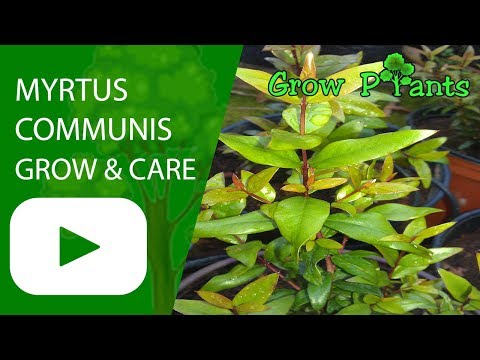

Plant Profile & Key Characteristics
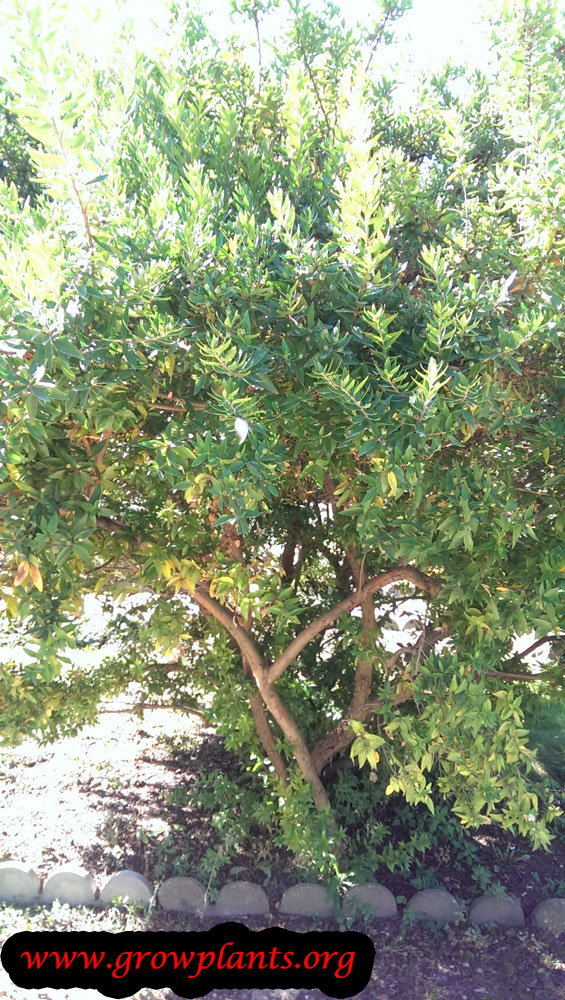
Overview: Common myrtle (Myrtus communis) is a dense evergreen shrub or small tree of 1-5 m (3-16 ft) with highly aromatic foliage, grown as an ornamental, a clipped hedge and for its edible berries. It is a classic Mediterranean plant valued for scent, flowers and culinary use.
Quick Specifications
| Specification | Attribute |
|---|---|
| Plant Type / Life Cycle | Perennial |
| Foliage Type | Evergreen (aromatic) |
| Mature Size | 1-5 m (3-16 ft) |
| Growth Rate | Moderate |
| Toxicity | Non-toxic — berries edible, foliage aromatic and used as a spice |
| Hardiness | USDA zones 8-11 |
Growth Form & Structure
- Height & Spread: Reaches 1-5 m (3-16 ft) in the ground, and stays smaller in a container or as a houseplant with good light; responds well to clipping.
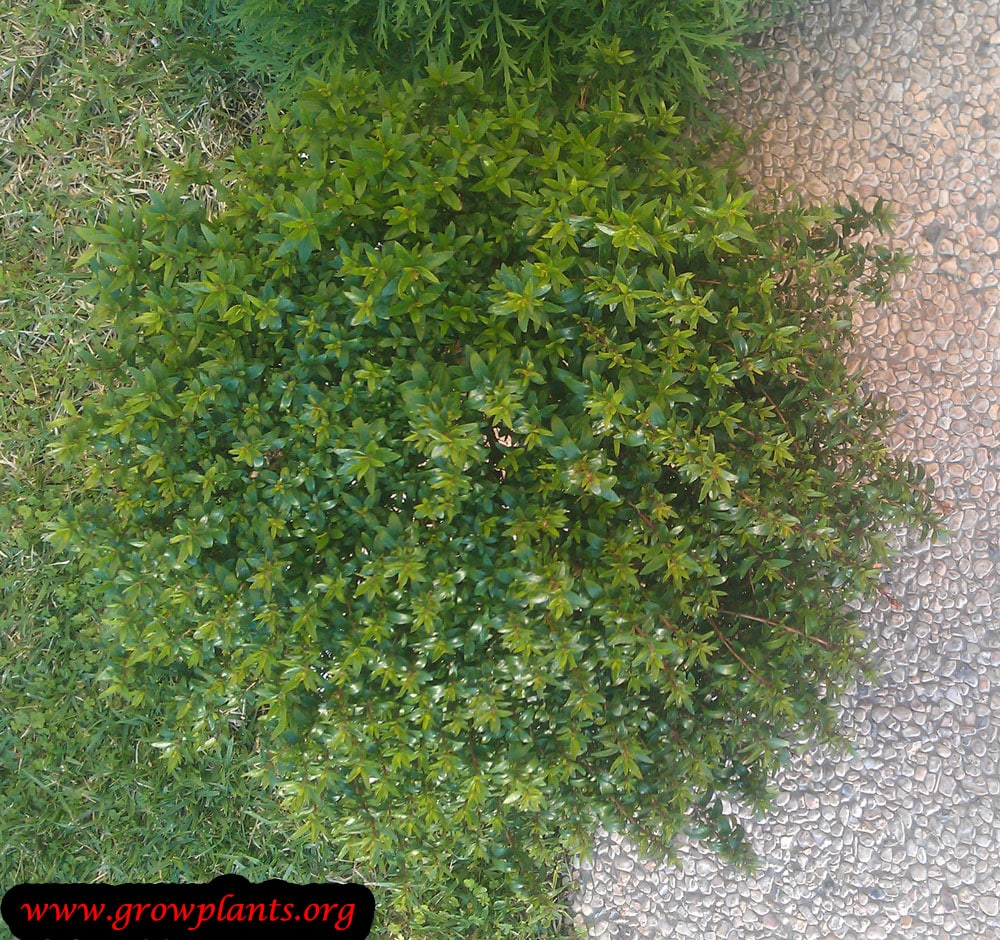
- Growth Habit & Form: Dense, bushy evergreen shrub that can be grown as a small tree; excellent for formal hedging and topiary.
- Lifespan & Maturity: Long-lived shrub that begins to bear fruit about 2-3 years after planting.
Anatomy & Physical Features
- Trunk & Bark: Older stems carry reddish-brown, finely flaking bark.
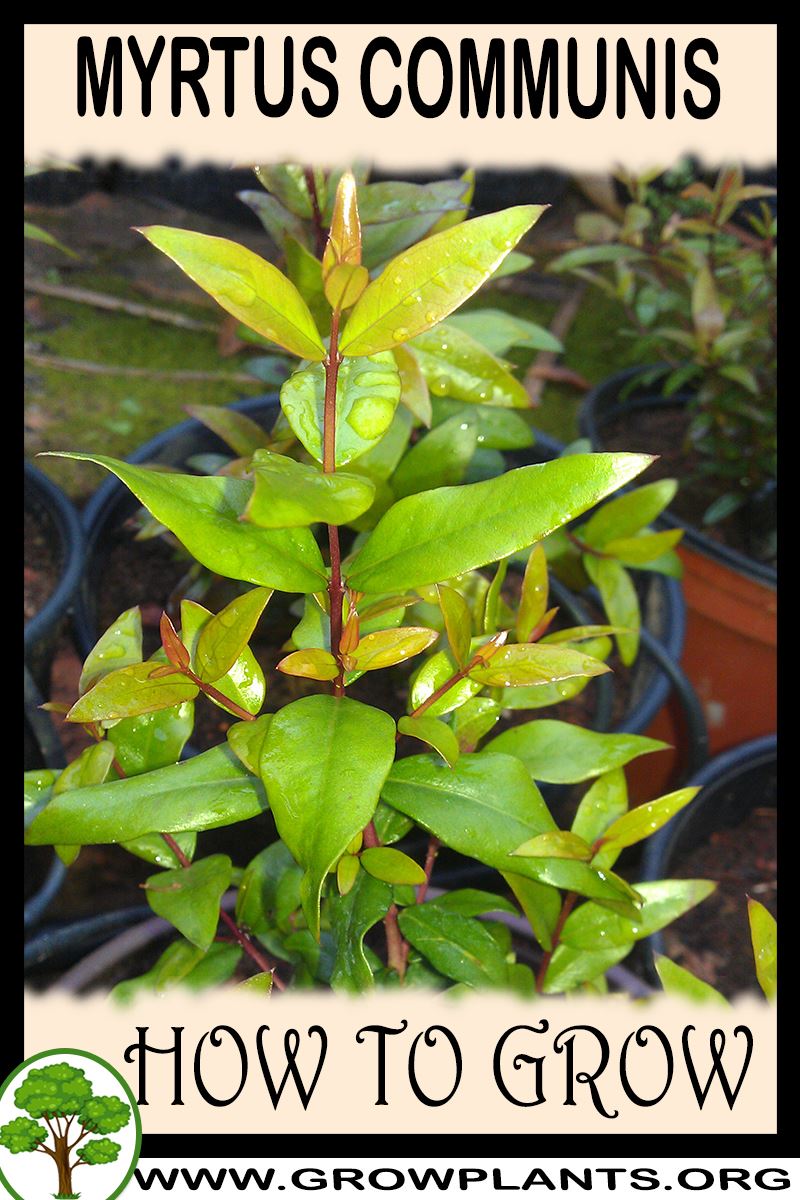
- Leaves & Foliage: Small (2-5 cm), glossy, elliptic pointed leaves in green to dark green, strongly aromatic when crushed.
- Flower Characteristics: Fragrant white flowers with five petals and a prominent brush of many stamens, borne in summer and autumn and pollinated by bees.
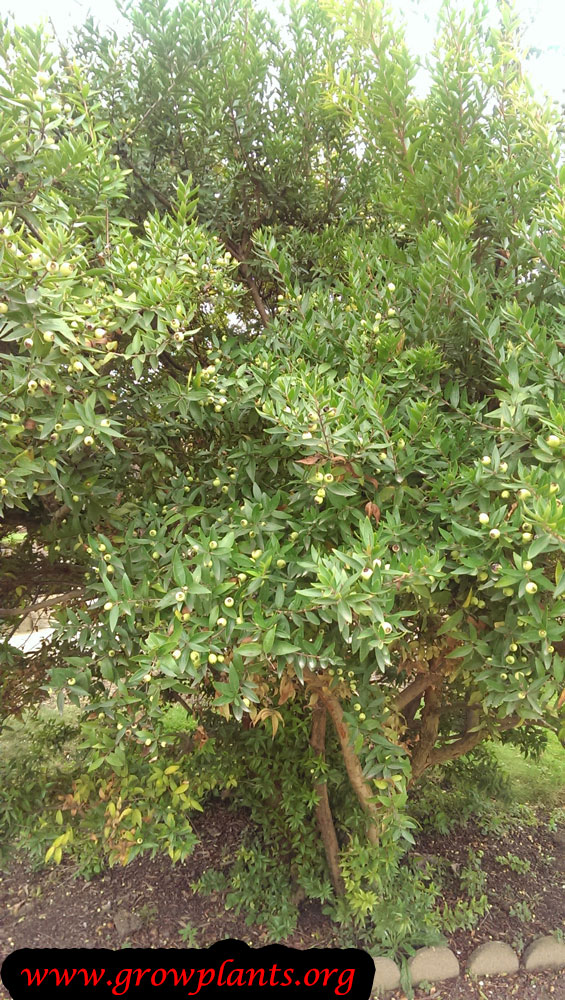
- Fruit Profile: Small round berry (0.5-2 cm) topped by a persistent calyx “crown”, ripening purple (sometimes yellow), and edible.
Primary Uses & Landscape Value
- Edible Uses: Berries are used for jams, spices and liqueur, and the aromatic leaves are used as a flavouring.
- Functional & Ornamental Roles: Grown as an evergreen hedge, topiary and fragrant ornamental, as a container plant or houseplant, and as a medicinal plant.
Care Guide: Planting, Soil & Watering
Overview: Common myrtle is a Mediterranean evergreen shrub for full sun to part shade. It grows best in well-drained soil, appreciates a cool winter, and once established tolerates dry spells with only modest water.
Quick Care Requirements
| Requirement | Ideal Condition |
|---|---|
| Planting Season | In spring, summer or autumn during mild weather |
| Growth Rate | Moderate |
| Soil Type | Well-drained; tolerates poorer soils |
| Water Need | Low to moderate – let the soil dry between waterings once established |
Planting & Establishment
- Best Planting Season: Plant in the milder parts of the year – spring, summer or autumn – so roots establish before extreme heat or cold.
- How to Plant:
- Hole Preparation: Dig a hole about twice the width of the root ball and the same depth, on undisturbed soil at the base.
- Soil Amendments: Improve heavy ground with grit and a little compost for drainage; myrtle is not fussy about fertility.
- Planting Depth: Set the root collar level with the surface and firm; keep the stem base clear of buried soil.
- Growth Speed & Expectations: Growth is moderate, forming a dense, aromatic evergreen shrub that responds well to clipping.
Soil, Watering & Drainage Care
- Soil Mix & Drainage Needs: Good drainage is key – avoid soggy soil, and in pots use a free-draining mix; myrtle dislikes wet roots in winter.
- Watering Schedule & Technique:
- Young / Newly Planted: Water regularly through the first season to build a strong root system.
- Established: Once settled it is fairly drought tolerant – water deeply but let the top few centimetres dry before watering again.
- Seasonal Adjustments: Water more in summer heat and cut back sharply in the cool, wet winter months.
Climate, Light & Hardiness
Myrtus communis (common myrtle) is a versatile mediterranean shrub that tolerates a wide range of light from full sun to full shade and adapts to mediterranean, subtropical, temperate climates, or indoor culture. It has solid cold hardiness for a broad zone 8–11 range and appreciates a cool winter period.
Quick Climate Specifications
| Climate Zones | Mediterranean, subtropical, temperate, or as a houseplant |
| USDA Hardiness Zones | 8–11 |
| Frost Tolerance | Moderate |
| Light Conditions | Full Sun / Half Shade / Full Shade |
Sunlight & Light Exposure
Optimal Light Setup
Adaptable across full sun to full shade, though full sun typically gives the densest, most floriferous growth; indoors, bright light is recommended.
Temperature Extremes & Hardiness
USDA Hardiness & Regional Limits
Hardy across zone 8–11, a solidly mediterranean-shrub range; it actually benefits from a cool winter rather than needing to be shielded from one.
Frost Sensitivity
Moderate frost tolerance, typical of mediterranean-climate shrubs adapted to cool, wet winters and hot, dry summers.
Extreme Heat Tolerance
Tolerates hot, dry mediterranean summers well once established, needing only a small to average amount of water.
Wind, Humidity & Microclimate
Wind Tolerance
Reasonably wind-tolerant, consistent with its use as a hedging shrub in exposed mediterranean gardens.
Rainfall & Seasonal Moisture
Prefers well-drained soil and a cool, moist-enough winter; drought-tolerant once established, needing only modest water.
Microclimate Recommendations
Adaptable to hedge, border, or container/indoor situations; where grown as a houseplant, bright light and a naturally cool winter rest support healthier growth.
Growing in Pots, Balconies & Indoors
Common myrtle (Myrtus communis) is a compact evergreen Mediterranean shrub (about 1-5 m) and one of the better container subjects here – the grower confirms it can be grown indoors as long as it gets good light, and it takes happily to pots on a balcony or patio. It also clips beautifully into a neat shape or standard.
Quick Details
- Container Size: A medium pot to start, potting up as it fills out; easily kept compact by pruning
- Indoor Suitability: Yes, with plenty of light – a genuine option as a bright-room or windowsill plant
- Best Spot: Full sun to part shade; the brightest spot indoors, or sun to light shade outside
- Soil & Drainage: Free-draining, aerated mix (potting soil with perlite); it dislikes soggy roots
- Watering in Pots: Keep lightly moist – modest water; let the surface dry between waterings, never waterlogged
Indoors & On the Windowsill
- A real houseplant, given light: The grower says yes with good light, so place it at your brightest window; too little light makes it thin and leggy.
- Windowsill & shaping: Its small leaves and dense habit make it ideal for a sunny sill, and it responds well to clipping into a ball or topiary.
- Overwintering: Only half-hardy, so in cold areas a potted myrtle is easily moved to a bright, cool, frost-free room for winter.
On a Balcony or Patio
- Light & wind: Loves a warm, sunny balcony; walls and paving reflect heat and dry pots quickly, so check moisture in hot spells and shelter it from cold wind.
Choosing the Pot, Soil & Long-Term Care
- Pot & drainage: Strong drainage holes and no standing water in the saucer; terracotta suits it well as it breathes and dries faster.
- Potting mix: A well-aerated organic mix – potting soil with perlite or grit for sharp drainage.
- Feeding: Feed through the growing season, as potted plants lose nutrients to watering more quickly than those in the ground.
- Repotting: Pot on or refresh the mix about every couple of years, with a light root and top prune to keep it shapely.
Fertilizing & Feeding
Common myrtle is a moderate feeder – nitrogen-forward while building foliage for hedging, then balanced with a potassium-aware approach through bloom and fruiting.
Quick Fertilizing Specs
| Feeding Level | moderate |
|---|---|
| young_feeding | Nitrogen-forward feeding to build dense foliage |
| mature_feeding | Balanced, potassium-aware feeding through bloom and fruiting |
| Main Nutrient Priority | Nitrogen for foliage, shifting to balanced and potassium-aware at bloom and fruit set |
| Best Feeding Period | Warm active growing season |
| Soil pH | Tolerates a range of well-drained soils; avoid heavily alkaline conditions that can limit iron uptake |
Feeding by Growth Stage
Establishment After Planting
Help a newly planted myrtle establish a healthy root system
| Nutrient direction | Keep feeding light while the shrub settles in, favoring root development over top growth |
|---|---|
| Timing | The first growing season after planting |
| Frequency | A light feeding once new growth appears is usually enough to start |
| Fertilizer types | A diluted balanced starter fertilizer or a light compost topdressing |
| Precautions | Avoid feeding immediately at planting; wait for visible new growth |
Vegetative Growth
Build dense, healthy foliage for hedging and overall shrub form before fruiting begins
| Nutrient direction | A nitrogen-forward complete fertilizer encourages full, healthy foliage |
|---|---|
| Timing | Warm active growing months |
| Frequency | Several light feedings spaced through the growing season support steady leafy growth |
| Fertilizer types | A nitrogen-forward balanced fertilizer, Compost or aged organic matter worked into the soil surface |
| Routine trace nutrients | iron, manganese |
| Precautions | Reduce nitrogen as the shrub approaches its bloom period to avoid excess soft growth |
Bloom and Fruiting
Support flowering and the development of the edible berries
| Nutrient direction | A balanced fertilizer with a potassium-aware option supports flowering and fruit development |
|---|---|
| Timing | From bloom through fruit development |
| Frequency | A light feeding as bloom begins is usually enough; avoid heavy feeding once fruit is forming |
| Fertilizer types | A balanced fertilizer, shifting toward a potassium-forward option as fruit develops |
| Routine trace nutrients | iron, manganese |
| Precautions | Avoid heavy nitrogen feeding once flowering starts, as it can reduce fruit set |
Nutrient Deficiency Signs & Corrections
Pale, thin foliage and reduced hedge density
| Possible causes | Nitrogen deficiency, Root competition from nearby hedge plants or turf, Compacted soil limiting root spread |
|---|---|
| Appears first on | Older interior leaves |
| What to check | Feeding history, Soil compaction and drainage, Foliage density compared to prior seasons |
| Possible correction | Resume a nitrogen-forward feeding during the growing season and improve soil aeration if compacted |
Yellowing between leaf veins on new growth
| Possible causes | Iron deficiency from alkaline soil, Waterlogged roots limiting nutrient uptake, High soil pH reducing micronutrient availability |
|---|---|
| Appears first on | Newest leaves |
| What to check | Soil pH and drainage, Watering frequency, Whether yellowing is interveinal |
| Possible correction | Adjust soil pH toward a more neutral range and apply a chelated iron product per its label if needed |
Weak flowering or few berries forming after bloom
| Possible causes | Excess nitrogen relative to potassium around bloom, Insufficient pollinator activity, Water stress during flowering |
|---|---|
| Appears first on | Flower clusters that fail to set fruit |
| What to check | Recent fertilizer balance, Pollinator visits during bloom, Watering consistency |
| Possible correction | Shift to a balanced, potassium-aware feeding around bloom and maintain even soil moisture |
Pruning, Training & Seasonal Maintenance
Common myrtle tolerates frequent, even hard, pruning – it is one of the classic Mediterranean hedge and topiary shrubs and reshoots readily from old wood. The main objective is shaping (formal hedge/topiary or looser natural form) rather than fruit production, since most plants of this size (1–5 m) are grown ornamentally. Because flowers appear on the current season’s new growth, light-to-moderate shearing does not eliminate bloom for the year, but a hard cut made just as flower buds are setting (early-to-mid summer, ahead of the Summer/Autumn bloom) will visibly reduce that season’s flowers and the Autumn/Winter berry crop.
Quick Pruning & Maintenance Specs
| Pruning Tolerance | High |
| Primary Pruning Window | Late winter – early spring, before the main growth flush |
| Secondary Maintenance Window | Light hedge trims through the growing season (Spring–Summer) |
| Typical Frequency | 1–3 shearings/year for formal hedges; 1 shaping cut/year for specimens |
| Main Objective | Form/density (hedge, topiary) or open habit for fruiting specimens |
| Young Plant Priority | Light shaping only; let the plant establish before hard cuts |
| Mature Plant Priority | Maintain density/shape; renewal-thin old leggy wood on unclipped specimens |
| Best Tool Type | Hedge shears (formal hedges) or bypass secateurs (specimen shaping) |
| Avoid Heavy Pruning During | Frost periods (zone 8 is the cold edge of its range) and just before Summer bloom if fruit is wanted |
Pruning by Plant Age & Size
Newly Established
Remove only damaged or crossing growth; do not hard-prune until the root system is established, typically not in the first year.
Young / Formative
Decide the form early: clipped hedge/topiary (shear to a defined outline from a young age to build density) or open, multi-stem natural shrub/small tree (select 3–5 well-spaced leaders, remove weak or inward-crossing shoots).
Mature / Established
Hedges: maintain the sheared outline. Natural specimens: thin congested interior growth occasionally to keep the plant from becoming a dense green mass with only surface foliage, and to let light reach fruiting wood.
Seasonal Pruning Schedule
Pre-Growth/Early-Spring
Objective: main structural or renewal cut. Remove winter-damaged, dead, or frost-browned tips; shape hedges before the spring flush. Expected response: vigorous regrowth that will carry the Summer/Autumn flowers.
Summer Canopy Management
Objective: light touch-up shearing on hedges/topiary to hold the shape. Avoid a heavy cut right as buds are forming, since this removes the wood that would otherwise flower and fruit that year.
Ongoing Sanitary
Remove dead, diseased, or aphid-damaged tips as seen; this can be done any time of year in mild climates.
Flowering & Fruiting Wood
Myrtle flowers on the current season’s new growth, then sets purple or yellow berries that ripen in Autumn/Winter (fruit generally takes 2–3 years to begin on a young plant). Because bloom is on new wood, routine shearing before the spring flush does not remove next season’s flowers – but a hard summer cut, made after buds have already formed, will remove developing flowers/fruit for that cycle.
Structural Pruning & Training
For hedges/topiary: train to a defined outline early and shear to maintain it. For specimen shrubs or small standards: select and retain a strong leader or framework of main stems; remove crossing, rubbing, or overly dense interior growth so light reaches fruiting wood.
Special Growth to Remove
Occasional basal shoots can be removed to maintain a clean single/multi-trunk standard form, or retained if a fuller multi-stem shrub is preferred – myrtle is not grafted, so these are not rootstock suckers and either choice is horticulturally fine.
Container & Small-Space Pruning
Myrtle grows well in pots and indoors with good light. Container plants need more frequent light shaping/pinching to control size and keep a dense habit, since restricted roots slow the vigorous regrowth a hard cut would otherwise produce in open ground.
Tools
Hedge shears for formal hedge/topiary lines; bypass secateurs for selective shaping cuts and deadwood on specimen plants; loppers for renewal cuts on older, thicker basal stems of overgrown, unclipped shrubs.
Tool Hygiene & Disease Risk
Routine – clean, sharp tools are sufficient. Myrtle’s main pest is aphids, not a tool-transmissible disease, so no special disinfection protocol is needed between cuts.
Cut Placement & Technique
On sheared hedges, angle cuts to keep the base slightly wider than the top so lower foliage still receives light. On selective/specimen cuts, use thinning cuts back to a lateral or the branch collar rather than leaving stubs.
Heavy Pruning & Rejuvenation
Myrtle tolerates hard rejuvenation pruning well – an old, leggy, or overgrown plant can be cut back hard in early spring and will reshoot vigorously from old wood. Expect a season with little or no bloom/fruit while the plant recovers; stagger a full rejuvenation over two seasons on very old specimens to avoid excessive stress.
Post-Pruning Care
After a hard cutback, water normally and monitor regrowth; do not fertilize specifically to force growth, since the plant will already flush vigorously on its own. Watch newly exposed interior bark for sunscorch after opening a dense canopy.
Common Pruning Mistakes
Shearing hedges into a tight geometric box repeatedly through the flowering period, which strips off developing flower buds and berries every year; hard-pruning young, unestablished plants; pruning during a hard frost event near the cold edge of its zone 8 range.
When NOT to Prune
Avoid major pruning during frost risk, avoid a heavy cut immediately before or during the Summer/Autumn bloom if berries are wanted, and avoid hard-pruning newly planted, unestablished specimens.
Recommended Tools (by task)
- Formal hedge/topiary shaping (any age, all stem sizes) – hedge_shears: needed for the repeated, even surface shearing this species tolerates well.
- Selective shaping / deadwood on specimen shrubs (thin stems) – bypass_secateurs: clean precise cuts for structural and sanitary work on a natural-form plant.
- Renewal cuts on old, thick basal wood – loppers: needed when rejuvenating an old, leggy, unclipped shrub back to strong wood.
Pruning Troubleshooting
| Problem | Possible Cause | What to Check | Corrective Action |
| Little or no flowering/fruit | Hedge sheared repeatedly through bud-set in early-mid summer | Timing of last shearing relative to bloom season | Shift main shearing to late winter/early spring; allow some unclipped growth through summer if fruit is wanted |
| Bare, twiggy interior with foliage only on the surface | Years of surface-only shearing with no interior thinning | Light penetration into the hedge/shrub interior | Selectively thin a few interior branches to reintroduce light; consider a staged rejuvenation cut |
| Dieback after a hard cutback | Cold snap on tender new regrowth, or over-severe single-season rejuvenation | Timing of the cut versus frost risk; how much of the plant was removed at once | Prune hard only after frost risk has passed; stage rejuvenation over two seasons on very overgrown plants |
Propagation Guide
Common myrtle is most easily and reliably increased from semi-hardwood stem cuttings, which root readily and reach a usable size faster than seedlings; seed also works well since this is a true species rather than a named cultivar, so vegetative propagation is not required to keep the plant true. Overall propagation difficulty is Easy.
Quick Propagation Specs
| Best Propagation Method | Semi-hardwood (semi-ripe) stem cuttings |
| Alternative Methods | Seed sowing |
| Propagation Difficulty | Easy |
| Seed True-to-Type | Usually true-to-type |
| Vegetative True-to-Type | Yes |
| Best Propagation Season | Seed: spring; Cuttings: summer (semi-ripe wood) |
| Seed Germination Time | Typically several weeks, and can be uneven |
| Cutting Rooting Time | Usually within 4–8 weeks |
| Germination Temperature | 18–24°C (64–75°F) |
| Seed Sowing Depth | Shallow, just covering the small seed |
Growing from Seed
Seed Handling & Viability
Seed comes from the ripe, fleshy berries; clean off the pulp before sowing, as leaving it on can encourage mold and slow germination. Sow reasonably fresh for best results.
Dormancy & Pre-Sowing Treatment
No specific pretreatment is normally required once the pulp is removed.
Sowing Season
Spring, once conditions are reliably warm.
Sowing Depth & Orientation
Sow shallow, barely covering the seed; no particular orientation is needed for seed this small.
Germination Conditions
Warm, consistently moist growing medium in bright but not harsh direct light.
Germination Time
Germination is typically spread over several weeks and can be uneven.
Seedling Care
Pot on once true leaves appear, and protect young seedlings from frost until well established.
Stem Cuttings
Cutting Type
Semi-hardwood (semi-ripe) tip cuttings, roughly 10–15 cm long.
Best Timing
Mid-to-late summer, once new growth has begun to firm slightly.
Cutting Preparation
Strip the lower leaves and take the cutting just below a node.
Rooting Setup
Insert into a free-draining propagation mix and keep humidity up (misting or a propagator cover) in bright, indirect light.
Rooting Hormone
Beneficial but not strictly necessary – myrtle roots fairly readily from cuttings without it.
Rooting Time
Usually within 4–8 weeks.
Bloom & Flower Guide
Quick Details
- Bloom Season: Summer into autumn
- Time to First Bloom: Usually within two to three years of planting
- Flower Appearance: White five-petalled flowers with a prominent brush of many stamens, fragrant
- Edibility: Grown as a fragrant ornamental; the plant’s berries (used for flavouring) are covered elsewhere
Detailed Blooming Overview
Common myrtle flowers in the warm months with pretty, sweetly scented white blooms. Five rounded petals open around a dense central tuft of long stamens that gives each flower a soft, brush-like look against the aromatic evergreen foliage.
Flower Characteristics
- White flowers with five petals.
- Many long stamens forming a brush-like centre; fragrant.
Bloom Care & Thinning
- Pruning and bloom: Trim after flowering rather than before, as the flowers form on the current season’s growth.
- Pollination: Carried out by bees.
Fruit & Uses
Myrtus communis (common myrtle) is grown chiefly for its edible purple or yellow berries, eaten fresh or preserved, with the aromatic leaves also traditionally used to flavour dishes and drinks.
Quick Edible Specs
| Edible Parts | Fruit (berries), leaves (aromatic flavouring) |
|---|---|
| Main Use(s) | Culinary – jams, liqueur (traditional ‘mirto’), spice; leaves used as a fragrant flavouring/wrap |
| Eaten Raw or Cooked | Berries eaten raw or processed (jams, liqueur); leaves used as flavouring, not eaten as greens |
| Preparation Required | Berries: none for fresh eating, cooking/steeping for jams and liqueur; leaves: used fresh/dried as an aromatic, not for direct eating |
| Harvest Season | Fruit: autumn/winter |
| Time to First Harvest | The shrub bears fruit within a few years of planting (see the Growing section for detail) |
| Storage | Fresh berries are short-lived; processed into jam or steeped in alcohol for longer storage |
| Safety/Toxicity Caveat | None noted – myrtle berries are a traditional Mediterranean edible fruit |
Fruit
The round, crowned berries (0.5–2 cm), purple or yellow when ripe, are picked in autumn/winter simply by collecting them from the shrub; birds are the main competition. They are eaten fresh or made into jams, spices or the traditional Sardinian/Corsican myrtle liqueur (‘mirto’).
Leaves & Greens
The fragrant green-to-dark-green leaves are not eaten as greens but are traditionally used as a culinary aromatic – for example steeped alongside the berries in myrtle liqueur, or used as a wrap/flavouring for roasted meats.
Harvesting
Berries are simply collected once ripe in autumn/winter; no special processing is required beyond that needed for the intended jam, spice or liqueur use.
Preparation, Uses & Safety
Berries can be eaten fresh or turned into jams, spices or liqueur; leaves are used as a fragrant flavouring rather than eaten directly. No safety concerns are noted for this species.
Pests, Diseases & Troubleshooting
Overview: Common myrtle is a tough, aromatic Mediterranean evergreen that is largely pest-resistant, helped by its oil-rich foliage; its aroma deters many chewers. The real concerns are sap-sucking scale and whitefly, and – as a member of the myrtle family – the serious threat of myrtle rust. Birds enjoy the blue-black berries. Lead with cultural care: full sun, good airflow and sharp drainage prevent most trouble.
Quick Troubleshooting Overview
| Issue / Pest | Main Symptom | Primary Solution |
|---|---|---|
| Scale insects | Brown/white bumps on stems; honeydew, sooty mould | Horticultural oil, prune infested wood |
| Whitefly | Clouds of white flies; yellowing, sticky leaves | Yellow traps, insecticidal soap, oil |
| Thrips | Silvery streaks and stippling on leaves/flowers | Airflow, oil, blue sticky traps |
| Aphids & mealybugs | Sticky, distorted shoots; white cottony masses | Water jet, insecticidal soap, oil |
| Myrtle rust | Bright yellow pustules on new growth | Remove infected growth, airflow, protectant fungicide |
| Root rot (Phytophthora) | Wilting, dieback in wet, heavy soil | Sharp drainage, reduce watering |
Common Pests & Management
- Scale Insects (soft & armoured, incl. myrtle scale):
- Symptoms: Immobile brown, tan or white bumps clamped along stems, twigs and leaf veins; soft scales drip honeydew that blackens with sooty mould, while heavy colonies cause yellowing, leaf drop and twig dieback.
- Prevention & Control: Prune out badly encrusted wood and smother the rest with horticultural oil, repeating to catch newly hatched crawlers. Keep plants unstressed with sensible watering, and conserve parasitic wasps and ladybirds that keep scale in check.
- Whitefly (Trialeurodes / Bemisia spp.):
- Symptoms: Tiny white moth-like insects that rise in clouds when the bush is brushed and cluster on leaf undersides, weakening growth and coating foliage with honeydew and sooty mould.
- Prevention & Control: Monitor and trap adults with yellow sticky cards, encourage Encarsia parasitic wasps, and spray leaf undersides with insecticidal soap or light horticultural oil, repeating every few days in the evening to break the cycle.
- Thrips (Thysanoptera):
- Symptoms: Slender insects that rasp leaves and flowers, leaving silvery streaks, stippling and distorted, discoloured new growth, worst in warm dry weather.
- Prevention & Control: Maintain airflow and hose foliage, hang blue sticky traps, and encourage predatory mites and pirate bugs. Horticultural oil or insecticidal soap suppresses hot-spots; avoid broad-spectrum sprays that remove natural enemies.
- Aphids & Mealybugs (Aphidoidea; Pseudococcus spp.):
- Symptoms: Aphids cluster on soft new shoots causing curling and honeydew; mealybugs form white cottony masses in leaf axils and sheltered crevices, both fouling foliage with sooty mould.
- Prevention & Control: Wash aphids off with water and dab mealybugs with alcohol; follow up with insecticidal soap or horticultural oil. Avoid heavy nitrogen feeding that pushes the soft growth these pests favour.
Diseases & Fungal Issues
- Myrtle Rust (Austropuccinia psidii):
- Symptoms: The most serious disease of the myrtle family – bright yellow-orange powdery pustules on young leaves, shoots, buds and fruit, causing distortion, dieback of new flushes and, with repeated attack, decline of the plant.
- Treatment & Management: Inspect new growth, prune out and carefully bag infected shoots without shaking spores loose, and maximise airflow and sun. Protectant fungicides are used on valued plants where the disease is established; practise strict hygiene, as spores travel on wind, tools and clothing, and check regional quarantine rules.
- Leaf Spot / Anthracnose (fungal, various spp.):
- Symptoms: Brown or purplish spots and blotches on leaves in warm, wet, humid conditions, with premature leaf drop when severe.
- Treatment & Management: Remove affected leaves, improve airflow, and avoid overhead watering; a copper-based fungicide can be applied preventively during prolonged wet weather.
- Phytophthora Root Rot (Phytophthora spp.):
- Symptoms: Wilting, thinning canopy and branch dieback despite moist soil, with darkened, rotted roots – brought on by heavy, poorly drained or overwatered soil.
- Treatment & Management: Prevent with sharp drainage, deep-but-infrequent watering and never siting in boggy ground. Remove badly affected plants; a phosphonate treatment can support valued specimens but cannot substitute for good drainage.
- Gray Mould (Botrytis cinerea):
- Symptoms: Grey fuzzy rot on flowers and soft new growth during cool, damp, still weather, disfiguring blooms and shoot tips.
- Treatment & Management: Improve airflow, remove faded flowers and affected tissue, and avoid overhead watering late in the day; fungicide is rarely needed with good hygiene.
Growing Difficulties & Abiotic Problems
- Root Rot from Overwatering / Poor Drainage:
- Symptoms: Cause & Symptoms: A Mediterranean plant, myrtle resents wet feet – soggy soil causes yellowing, dieback and eventual collapse.
- Correction Strategy: Plant in free-draining soil, water established plants deeply but infrequently, and avoid heavy clay or low, wet sites; containers need sharp-draining mix and good drainage holes.
- Frost / Cold Damage:
- Symptoms: Cause & Symptoms: Hard frost scorches and browns the evergreen foliage and can kill tender young growth on this only moderately hardy shrub.
- Correction Strategy: Site in a warm, sheltered spot against a sunny wall or grow in a movable container in colder areas; delay pruning frost damage until the risk has passed.
- Leaf Yellowing / Chlorosis:
- Symptoms: Cause & Symptoms: Pale, yellowing leaves from waterlogging, cold wet roots, or nutrient shortage on poor soils.
- Correction Strategy: Correct drainage first, mulch, and feed lightly in the growing season; use chelated iron only if true iron chlorosis appears on very alkaline ground (myrtle is fairly lime-tolerant).
- Sunburn on Transplants:
- Symptoms: Cause & Symptoms: Bleached, scorched patches on foliage moved abruptly from shade into intense sun.
- Correction Strategy: Harden plants off gradually into full sun, and keep newly planted specimens well-watered while they establish.
What Helps – Products & Tools
For myrtle, keep light horticultural (neem or paraffinic) oil and insecticidal soap as the core controls for scale, whitefly, thrips, aphids and mealybugs, with yellow and blue sticky traps for monitoring. Hold a copper-based or rust-labelled protectant fungicide for myrtle rust and leaf spot in wet weather. Good drainage and full sun – not a product – are the real defence against root rot; bird netting protects the berries if you want them.