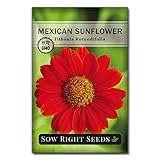




Plant Profile & Key Characteristics
Overview: Mexican sunflower (Tithonia) is a tall, fast-growing daisy-family plant reaching 1-2 m (40-80 in), grown as a bold ornamental and cut flower. It is grown as a warm-climate perennial or as a summer annual and is notably drought tolerant.
Quick Specifications
| Specification | Attribute |
|---|---|
| Plant Type / Life Cycle | Perennial in frost-free zones; grown as an annual elsewhere |
| Foliage Type | Evergreen where perennial |
| Mature Size | 1-2 m x bushy (40-80 in) |
| Growth Rate | Moderate to fast |
| Hardiness | USDA zone 10+ as a perennial; zone 5+ grown as an annual |
Growth Form & Structure
- Height & Spread: Reaches 1-2 m (40-80 in) tall and bushy in the ground; can be grown in a large container but is not an indoor plant
- Growth Habit & Form: Tall, upright, branching shrubby herb that forms a substantial bush in one season
- Lifespan & Maturity: Very fast; reaches full size and flowers within a single growing season
Anatomy & Physical Features
- Leaves & Foliage: Green, lobed leaves with 3-5 lobes
- Flower Characteristics: Large red, orange or yellow daisy-like flowers, excellent for cutting and for pollinators
Primary Uses & Landscape Value
- Functional & Ornamental Roles: Bold ornamental for borders and screens, cut flower, drought-tolerant summer colour, and a strong butterfly/pollinator magnet
Care Guide: Planting, Soil & Watering
Overview: Mexican sunflower (Tithonia) is a big, fast-growing, sun-loving plant grown as an annual in cold areas (hardiness zone 5+) or a tender perennial in frost-free zones (10+). It is easy and drought-tolerant once established, thriving in full sun and ordinary, well-drained soil.
Quick Care Requirements
| Requirement | Ideal Condition |
|---|---|
| Planting Season | In spring after the last frost, through summer |
| Growth Rate | Fast |
| Soil Type | Ordinary, well-drained soil; tolerates poor, dry ground |
| Water Need | Low to moderate; drought-tolerant once established |
Planting & Establishment
- Best Planting Season: Plant out in spring once frost has passed and the soil has warmed; it can go in through summer and, in frost-free zones, on into autumn.
- How to Plant:
- Hole Preparation: Dig a hole a little wider than the root ball; it grows tall (1-2 m), so allow space and some shelter from strong wind.
- Soil Amendments: It performs well even in poor soil – a little compost helps, but avoid over-rich, wet ground that encourages floppy growth.
- Planting Depth: Set the root ball level with the surrounding soil and firm gently.
- Growth Speed & Expectations: A fast, vigorous grower reaching 1-2 m in a single season and flowering profusely – note that it can self-seed and become invasive.
Soil, Watering & Drainage Care
- Soil Mix & Drainage Needs: The one essential is good drainage; it dislikes soggy soil and thrives on the lean side. In containers use a free-draining potting mix.
- Watering Schedule & Technique:
- Young / Newly Planted: Water regularly to establish the young plant.
- Established: Once established it is drought-tolerant and needs watering only in extended dry spells.
- Seasonal Adjustments: More in prolonged summer heat, much less in cool weather; frost kills the top growth.
Climate, Light & Hardiness
Mexican sunflower is a heat-loving, frost-tender plant that thrives in full sun across tropical, desert, and warm temperate climates. It is grown as a true perennial only where winters stay frost-free, and as a fast-growing annual much further north.
Quick Climate Specifications
| Climate Zones | Tropic, mediterranean, desert, subtropical, temperate |
|---|---|
| USDA Hardiness Zones | 10+ as a perennial; grown as an annual from zone 5 up |
| Light Conditions | Full sun to half shade |
| Frost Tolerance | Low – top growth is killed by frost |
Sunlight & Light Exposure
Optimal Light Setup
Full sun gives the strongest stems and most abundant daisy-like blooms; half shade is tolerated but flowering is reduced.
Extreme Heat Tolerance
As a drought-tolerant, sun-loving plant it handles hot summer conditions well once established.
Temperature Extremes & Hardiness
USDA Hardiness & Regional Limits
Only reliably perennial in USDA zone 10 and warmer, frost-free climates; commonly grown as an annual from about zone 5 upward, where cold ends the season rather than the plant persisting outdoors.
Frost Sensitivity
Frost-tender – foliage and stems are damaged or killed at the first freeze, which is why it is treated as an annual outside warm zones.
Cold Damage & Winter Protection
In borderline zones near 10, plants may survive a very light, brief chill with damage to soft growth but generally will not tolerate a hard freeze.
Wind, Humidity & Microclimate
Humidity Preferences
Tolerates a wide humidity range from arid desert to humid tropical conditions.
Wind Tolerance
Tall flowering stems can benefit from a somewhat sheltered position, though the plant is not particularly wind-sensitive.
Growing in Pots, Balconies & Indoors
Mexican sunflower is a tall, fast annual grown for its blazing orange daisies – not a houseplant, but a striking full-sun container plant for a big pot on a patio or balcony.
Quick Details
- Container Size: A large pot – it is a tall, vigorous annual
- Indoor Suitability: Not a true houseplant; grows best outdoors
- Best Spot: Full sun; some tolerance of light shade
- Soil & Drainage: Aerated, organic-rich mix (peat or coir with perlite or vermiculite); must drain freely
- Watering in Pots: Water generously in heat but let the surface dry slightly between drinks; fairly drought-tolerant once established
Indoors & On the Windowsill
- Houseplant limits: It is far too large and sun-hungry for indoor life; it needs strong outdoor sun to flower.
On a Balcony or Patio
- Light & wind: Give it your sunniest spot and stake it on exposed balconies, as the tall stems catch the wind. Walls and paving reflect heat, so pots dry quickly – check moisture often in hot weather.
- Practicalities: Set the pot where drainage runoff won’t stain, and remember a full, wet container is heavy to move.
Choosing the Pot, Soil & Long-Term Care
- Pot & drainage: A container with strong drainage holes and no standing-water saucer, to avoid root rot; terracotta breathes and dries faster, glazed or plastic holds moisture longer.
- Potting mix: A well-aerated, organic-rich mix – peat or coir with perlite or vermiculite.
- Feeding: Potted plants exhaust their soil quickly – feed a little more often, since watering leaches nutrients away.
- Repotting: Refresh the top of the mix each year and pot on every couple of years, trimming the root ball lightly.
Fertilizing & Feeding
This fast-growing bedding and cut-flower annual (or short-lived perennial in warm climates) responds well to steady, moderate feeding through its long bloom season, without needing a heavy fertilizing program.
Quick Fertilizing Specs
| Feeding Level | moderate |
|---|---|
| Main Nutrient Priority | Balanced feeding for steady growth and continuous bloom, not phosphorus-heavy |
| Best Feeding Period | Warm active growing season while flowering |
| Reduce/Stop Feeding | Stop feeding as frost approaches or growth slows for the season |
| Soil pH | Tolerates a wide range in well-drained soil |
| Organic Options | Compost or aged organic matter worked in at planting |
| Micronutrients | Not usually needed beyond a complete balanced fertilizer |
Feeding by Growth Stage
Spring establishment and early growth
Establish a strong root system and push vigorous stem and leaf growth after planting or germination.
| Nutrient direction | A balanced, complete fertilizer that favors steady vegetative growth without pushing excessive soft stems. |
|---|---|
| Timing | From planting or germination through the start of warm weather. |
| Frequency | Feed lightly at planting, then continue with modest regular feedings as the plant establishes. |
| Fertilizer types | A balanced, complete garden fertilizer, Compost or aged organic matter worked into the planting area |
| Precautions | Avoid heavy nitrogen feeding, which can produce lush foliage and floppy stems prone to lodging. |
Summer to autumn bloom period
Sustain the long daisy-flower bloom display and support continued branching for cut-flower stems.
| Nutrient direction | Continue a balanced fertilizer with adequate nitrogen – extra phosphorus is not needed to drive flowering. |
|---|---|
| Timing | Through the summer into autumn while the plant is actively flowering. |
| Frequency | Light, regular feedings support continuous bloom; ease off if growth turns floppy or over-lush. |
| Fertilizer types | A balanced, complete fertilizer, Diluted liquid feed for container-grown plants |
| Precautions | Overfeeding can reduce flower number in favor of foliage and weaken the stems that support the flowers. |
Frost dieback or winter rest
Let growth wind down naturally as the growing season ends, whether the plant is killed by frost as an annual or rests as a perennial in warm zones.
| Nutrient direction | None – withhold fertilizer as growth slows and the season ends. |
|---|---|
| Timing | Autumn frost, or the cooler months in frost-free climates. |
| Frequency | No feeding at this stage. |
| Fertilizer types | No feeding at this stage; do not fertilize as the plant declines or rests. |
| Precautions | Do not fertilize going into dormancy or after frost damage; wait for new spring growth before feeding again. |
Nutrient Deficiency Signs & Corrections
Pale, yellowing lower leaves and weak, slow stem growth.
| Possible causes | Nitrogen deficiency in poor soil, Waterlogged roots limiting nutrient uptake, Compacted or depleted soil |
|---|---|
| Appears first on | Older, lower leaves |
| What to check | Soil richness and drainage, Recent feeding history, Root health |
| Possible correction | Work in a balanced, nitrogen-containing fertilizer or compost and correct any drainage problems. |
New leaves turn yellow while the veins stay green.
| Possible causes | High soil pH limiting iron availability, Waterlogged or compacted soil, Root stress from recent transplanting |
|---|---|
| Appears first on | Newest growth |
| What to check | Soil pH, Drainage, Recent root disturbance |
| Possible correction | Correct pH toward the plant’s preferred range and apply a chelated iron product per its label if the soil is alkaline. |
Leaf margins scorch or brown and stems flop or lodge.
| Possible causes | Potassium deficiency, Excess nitrogen producing soft growth, Drought or wind stress |
|---|---|
| Appears first on | Older leaf edges and overall stem strength |
| What to check | Feeding balance, Recent watering, Staking or support needs |
| Possible correction | Shift toward a more balanced or potassium-aware fertilizer and avoid excess nitrogen. |
Pruning, Training & Seasonal Maintenance
Mexican sunflower (Tithonia) is a fast-growing, soft-wooded shrub or herbaceous plant that tolerates fairly free pruning. In its perennial form (hardy zone 10+) the main jobs are pinching young stems to build a bushier, self-supporting framework, deadheading spent daisy flowers all through its long spring – autumn bloom to keep flowers coming and curb the self-seeding this plant is noted to be prone to, and cutting the semi-woody base back hard in late winter to control size before the spring flush. Where it is grown as an annual (zone 5+), there is no structural framework to build for next year – pruning is limited to pinching for bushiness and deadheading, and the plant is simply cleared at season’s end.
Quick Pruning & Maintenance Specs
| Pruning Tolerance | High (fast regrowth) |
| Primary Pruning Window | Autumn/Winter structural cutback (perennial, zone 10+ form) |
| Secondary Maintenance Window | Ongoing deadheading and shortening through the spring–autumn bloom season |
| Typical Frequency | Continuous light deadheading in season, plus one seasonal cutback where grown as a perennial |
| Main Objective | Control legginess/flopping, prolong bloom, limit self-seeding |
| Young Plant Priority | Pinch the growing tip early to force branching low down |
| Mature Plant Priority | Shorten leggy stems, deadhead, and (perennial form) cut the base back hard annually |
| Best Tool Type | Bypass secateurs / precision snips |
| Avoid Heavy Pruning During | Shortly before an expected frost in marginal zones; while a fresh flush of cut-flower buds is developing |
Pruning by Plant Age & Size
Newly Established
No structural pruning of young seedlings; once the plant has a few sets of leaves, pinch out the growing tip to force side branching – left alone, this fast grower tends to run straight up and go leggy.
Young / Formative
Training system: pinching. Repeated tip-pinching in the first weeks builds a bushier, sturdier base that can better support the large daisy flowers and 1–2m height without needing much staking later.
Mature / Established
Shorten long, floppy stems mid-season and deadhead regularly. In the perennial (zone 10+) form, add an annual hard cutback of the semi-woody base each dormant season.
Seasonal Pruning Schedule
Dormant/Winter
Objective: control size and rejuvenate the perennial form. Remove: cut the semi-woody framework back by roughly half. Not removed: the main basal structure. Expected response: a vigorous new flush given this plant’s fast growth rate. Bloom impact: none lost – flowers form on the new growth that follows. Not applicable to plants grown as true annuals, which are simply cleared at season’s end instead of cut back.
Summer Canopy Management
Objective: keep the plant compact and self-supporting. Remove: overly tall or floppy stems, shortened back to a lower node. Response: bushier regrowth and less lodging under the weight of the flowers.
Ongoing Sanitary / Post-Flowering
Objective: extend the long bloom season and limit self-seeding. Remove: spent daisy flower heads continually through spring – autumn. Response: new terminal buds keep forming; this directly addresses the self-seeding/invasive tendency noted for this plant.
Flowering & Fruiting Wood
Flowers form at the tips of the current season’s new growth, not on old wood, so deadheading and even a fairly hard seasonal cutback (perennial form) do not sacrifice next season’s bloom – the plant simply flowers again from the fresh growth it pushes out afterward.
Structural Pruning & Training
Encourage low branching early through pinching, so the plant doesn’t grow as a single top-heavy stem prone to lodging under its own fast growth and heavy flower heads. Shorten over-long stems mid-season rather than letting them sprawl.
Special Growth to Remove
- Spent flower heads – deadhead promptly, which also curbs the self-seeding/invasive tendency noted in this plant’s facts.
- Weak or overly thin stems unlikely to support flower weight.
- Frost-damaged tips, in marginal zones where the perennial form is grown at its cold limit.
Container & Small-Space Pruning
Container specimens benefit from harder, more frequent pinching to keep a plant that can reach 1–2m in the ground to a manageable pot size. Because this is a fast grower, size control by pruning matters more in a container than in open ground, where root volume can otherwise be quickly outgrown.
Tools
Bypass secateurs for general stem cutting and deadheading of the somewhat thick daisy stems; precision snips for fine pinching of young tips; soft ties/stakes for tall stems in exposed spots where pinching alone doesn’t give enough support.
Tool Hygiene & Disease Risk
Routine: clean, sharp tools are sufficient. No transmissible disease risk is documented beyond general aphid susceptibility, which is a pest issue rather than a pruning-spread pathogen.
Cut Placement & Technique
Pinch just above a leaf node to trigger two new side shoots. Deadhead by cutting the flower stem back to the next bud or leaf junction rather than snapping off just the flower head, which keeps the plant tidy and promotes a clean new break.
Heavy Pruning & Rejuvenation
Well tolerated in the perennial (warm-zone) form: cutting the semi-woody base back by around half in late winter is an effective, fast-recovering rejuvenation given this plant’s fast growth rate, with normal flowering resuming the same season. Not applicable to plants grown as annuals, which are cleared at season’s end rather than rejuvenated.
Post-Pruning Care
After a hard seasonal cutback, normal watering is enough – avoid extra feeding, since the fast-growing habit will push vigorous regrowth on its own. Watch young regrowth for aphids, the main pest noted for this plant.
Common Pruning Mistakes
- Skipping early pinching and ending up with a tall, top-heavy, floppy plant.
- Letting spent flowers go to seed all season, feeding the self-seeding/invasive tendency noted for this plant.
- Hard-pruning shortly before an early frost in marginal zones, which pushes tender new growth that then gets frost-damaged.
When NOT to Prune
Avoid a hard structural cutback shortly before an expected frost in cooler parts of its range, since this forces vulnerable new growth. Avoid pinching or deadheading so hard during peak cut-flower harvest that all developing buds are removed at once – stagger cuts if flowers are wanted for both garden display and vases.
Recommended Tools (by task)
- bypass_secateurs – clean cuts for deadheading and seasonal shortening of the thicker daisy stems.
- precision_snips – for pinching young tips to force branching.
- soft_ties_stakes – light support for tall, 1–2m stems in exposed spots.
Propagation Guide
Mexican sunflower is most easily and reliably started from seed, which the site’s own data confirms is sufficient on its own – grafting or vegetative propagation is not required. Where a specific plant needs to be cloned, such as keeping a good perennial/shrub form through winter in a frost-free garden, stem cuttings are an easy secondary option. Overall difficulty: Easy.
Quick Propagation Specs
| Best Propagation Method | Seed |
| Alternative Methods | Stem cuttings (for perennial/shrub forms) |
| Propagation Difficulty | Easy |
| Seed True-to-Type | Usually true-to-type (species) |
| Vegetative True-to-Type | Yes |
| Best Propagation Season | Spring, after the danger of frost has passed |
| Seed Germination Time | Typically 1–2 weeks in warm soil |
| Cutting Rooting Time | Usually a few weeks under warm, humid conditions |
| Germination Temperature | 21–27°C (70–80°F) |
| Seed Sowing Depth | Shallow – just covered, a few millimeters (about 1/4 inch) |
Growing from Seed
Sowing Season
Spring, once frost danger has passed, matching the plant’s spring–summer–autumn planting season.
Sowing Depth & Orientation
Sow shallowly, only lightly covering the seed.
Germination Conditions
Warm soil in full sun; keep evenly moist until seedlings emerge.
Germination Time
Generally quick, often within one to two weeks in warm conditions.
Seedling Care
Thin or space seedlings as they grow – this is a fast, vigorous grower that can self-seed and become weedy if left unchecked.
Stem Cuttings
Cutting Type
Softwood tip cuttings from actively growing shoots.
Best Timing
Spring to summer, during active growth.
Cutting Preparation
Take a short tip cutting with a couple of leaf nodes and remove the lower leaves.
Rooting Setup
Insert into a moist, free-draining rooting medium and keep warm and humid until roots form.
Rooting Hormone
Not required but may be used to improve rooting speed and consistency.
Rooting Time
Usually a few weeks.
Bloom & Flower Guide
Quick Details
- Bloom Season: Spring through autumn
- Flower Appearance: Bright daisy-like flowers with a central disc, in vivid red, orange or yellow
- Edibility: Grown as an ornamental and cut flower
Detailed Blooming Overview
Mexican sunflower carries big, vivid daisy flowers – a ring of ray petals around a central disc – in hot reds, oranges and yellows. It blooms tirelessly through the warm season and is one of the best plants for drawing butterflies in particular, along with bees. The sturdy stems make good, if short-lived, cut flowers.
Flower Characteristics
- Daisy-form flowers with ray petals around a central disc.
- Colours of red, orange or yellow.
- Held on strong, branching stems.
Bloom Care & Thinning
- Deadheading: Regular removal of spent blooms keeps the long display going.
- Cutting: Harvest just as the flowers open for the best vase life.
- Pollination: A standout for butterflies, with bees and other pollinators also visiting.
Pests, Diseases & Troubleshooting
Overview: The Mexican sunflower is a vigorous, heat-loving annual that is refreshingly tough and largely trouble-free, drawing butterflies and bees rather than serious pests. Its issues are the everyday sap-suckers and chewers of the daisy family plus a few foliar fungi in humid or crowded plantings. Grown in full sun with good spacing and lean soil, it mostly looks after itself.
Quick Troubleshooting Overview
| Issue / Pest | Main Symptom | Primary Solution |
|---|---|---|
| Aphids | Sticky, curled new growth; ants tending colonies | Water blast; encourage beneficials; soap if needed |
| Whiteflies | Clouds of tiny white flies, sooty mould | Sticky traps; insecticidal soap to undersides |
| Spider mites | Stippled, bronzed leaves, webbing in heat/drought | Rinse; raise humidity; insecticidal soap/oil |
| Caterpillars / beetles | Chewed, holed leaves and flowers | Hand-pick; Bt for caterpillars; tolerate light damage |
| Powdery mildew | White coating on leaves late season | Space plants; airflow; sulfur/bicarbonate spray |
| Floppy / lodging | Tall stems bending or breaking | Stake; pinch young; avoid rich soil and overwatering |
Common Pests & Management
- Aphids (Aphidoidea):
- Symptoms: Clusters of green, black or grey soft insects on new shoots and flower buds, with sticky honeydew, curled tips, sooty mould and attendant ants.
- Prevention & Control: Blast off with water and pinch out badly infested tips. Encourage ladybirds, lacewings and hoverflies – Tithonia’s flowers themselves draw these predators. Treat only stubborn colonies with insecticidal soap or light neem oil in the evening.
- Whiteflies (Trialeurodes / Bemisia spp.):
- Symptoms: Tiny white moth-like flies rising in clouds when foliage is disturbed, with yellowing sticky leaves and sooty mould.
- Prevention & Control: Hang yellow sticky traps, encourage parasitic wasps, and spray insecticidal soap or horticultural oil to leaf undersides, repeating to catch successive hatchings.
- Spider Mites (Tetranychus urticae):
- Symptoms: Fine pale stippling, a bronzed, dull cast and delicate webbing, worst in hot, dry spells and on drought-stressed plants.
- Prevention & Control: Keep plants adequately watered, hose foliage, and encourage predatory mites. Treat persistent infestations with insecticidal soap or horticultural oil, covering leaf undersides.
- Caterpillars & Leaf Beetles (Lepidoptera larvae / Chrysomelidae):
- Symptoms: Chewed, holed or skeletonised leaves and nibbled flowers from various caterpillars and beetles; usually cosmetic on such a vigorous plant.
- Prevention & Control: Hand-pick larger caterpillars and beetles, encourage birds and predatory insects, and apply Bacillus thuringiensis (Bt) for heavy caterpillar pressure. Tolerate light damage.
- Slugs & Snails (Gastropoda):
- Symptoms: Ragged holes and shredded seedlings with slime trails, chiefly on young plants in damp conditions.
- Prevention & Control: Protect seedlings with grit or diatomaceous-earth barriers, hand-pick at night, remove hiding places, and use iron-phosphate bait where needed. Established plants outgrow the threat.
Diseases & Fungal Issues
- Powdery Mildew (Erysiphales):
- Symptoms: White powdery coating on leaves, mostly late in the season or on crowded, shaded plants, causing yellowing and early leaf loss.
- Treatment & Management: Space plants generously in full sun for airflow, avoid overhead watering, and treat with a sulfur or potassium-bicarbonate fungicide if it takes hold.
- Leaf Spot (Alternaria / Septoria / Cercospora spp.):
- Symptoms: Brown or black spots and blotches, sometimes with yellow haloes, in warm humid weather or where foliage stays wet.
- Treatment & Management: Avoid wetting foliage, improve air movement, and clear fallen debris. Remove affected leaves; copper fungicide helps where it recurs.
- Rust (Puccinia spp.):
- Symptoms: Orange-brown pustules on leaf undersides with yellow spotting above, in humid conditions.
- Treatment & Management: Remove and destroy affected leaves, improve airflow, and avoid overhead watering; a suitable fungicide can be used in severe cases.
- Root / Stem Rot (Sclerotinia / Rhizoctonia / Pythium spp.):
- Symptoms: Wilting, basal browning and collapse in wet, poorly drained soil, sometimes with white mould at the stem base.
- Treatment & Management: Plant in well-drained soil, avoid overwatering and overcrowding, and remove and destroy collapsed plants promptly.
Growing Difficulties & Abiotic Problems
- Flopping & Lodging:
- Cause & Symptoms: Tall, fast growth – especially in rich soil, shade or after storms – leaves stems weak and prone to bending or snapping.
- Correction Strategy: Pinch young plants to encourage branching, grow in full sun and lean soil, avoid excess nitrogen and water, and stake tall varieties or plant them in supportive groups.
- Self-Seeding / Invasiveness:
- Cause & Symptoms: A prolific seeder that can spread and re-appear widely, becoming weedy in mild climates.
- Correction Strategy: Deadhead before seed sets to control spread, and pull unwanted seedlings while young.
- Root Rot from Overwatering:
- Cause & Symptoms: Rich, wet soil produces soft, disease-prone growth and can rot the roots of this drought-tolerant plant.
- Correction Strategy: Grow lean and on the dry side once established; ensure sharp drainage and let soil dry between waterings.
- Poor Flowering in Shade / Rich Soil:
- Cause & Symptoms: Too much shade or nitrogen gives lush leaves but few flowers.
- Correction Strategy: Site in full sun and avoid heavy feeding; poor-to-average soil produces the best bloom.
What Helps – Products & Tools
Tithonia needs little chemical help. Organic tools cover the pests – a water rinse, insecticidal soap and neem or horticultural oil for aphids, whitefly and mites, Bacillus thuringiensis (Bt) for caterpillars, and iron-phosphate bait with diatomaceous earth for slugs on seedlings. For foliar fungi, keep sulfur or potassium-bicarbonate and a copper fungicide on hand, plus stakes for tall stems.