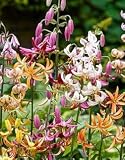


Plant Profile & Key Characteristics
Overview: Lilium henryi (Henry’s lily / tiger lily) is a tall bulbous perennial reaching 1-2.5 m, carrying many nodding orange, recurved flowers. It is a deciduous geophyte grown as a fragrant ornamental and cut flower.
Quick Specifications
| Specification | Attribute |
|---|---|
| Plant Type / Life Cycle | Perennial (bulbous geophyte) |
| Foliage Type | Deciduous |
| Mature Size | 1-2.5 m tall (3-8 ft), about 30-40 cm (12-16 in) wide |
| Growth Rate | Moderate to Fast |
| Root System | Bulb (geophyte) |
| Toxicity | Toxic to cats – lilies cause kidney failure if ingested |
| Hardiness | USDA zones 5-9 (lift bulbs in zone 10) |
Growth Form & Structure
- Height & Spread: Tall stems of 1-2.5 m in the ground, often needing support; can be grown in a large deep container.
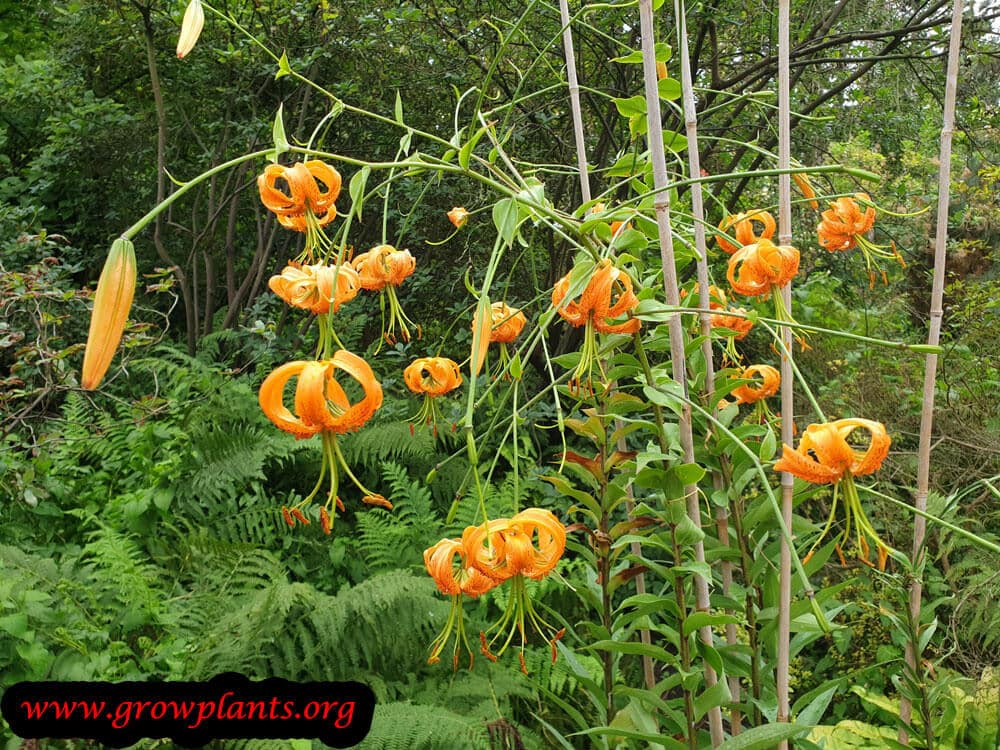
- Growth Habit & Form: Tall, arching flowering stems rising from a bulb, with flowers carried near the top.
- Lifespan & Maturity: Perennial from the bulb, returning and multiplying each year; each stem is annual, dying back for dormancy.
Anatomy & Physical Features
- Leaves & Foliage: Green, elliptic leaves pointed at both ends, arranged radially around the stem.
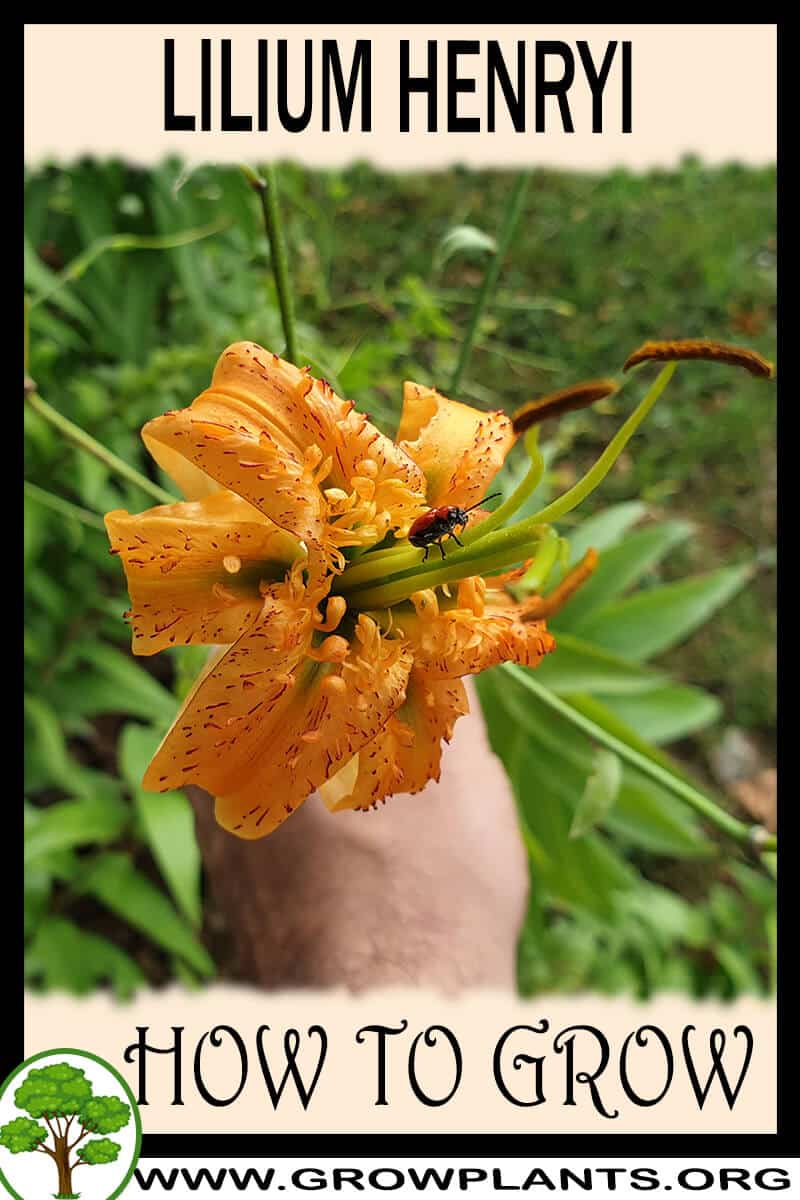
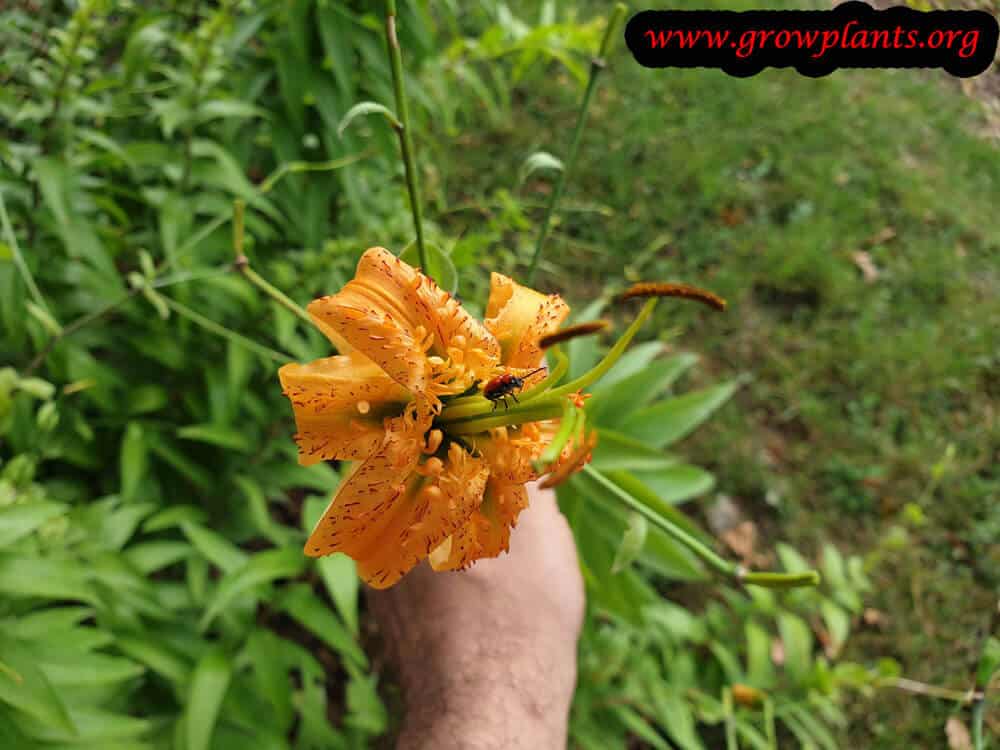
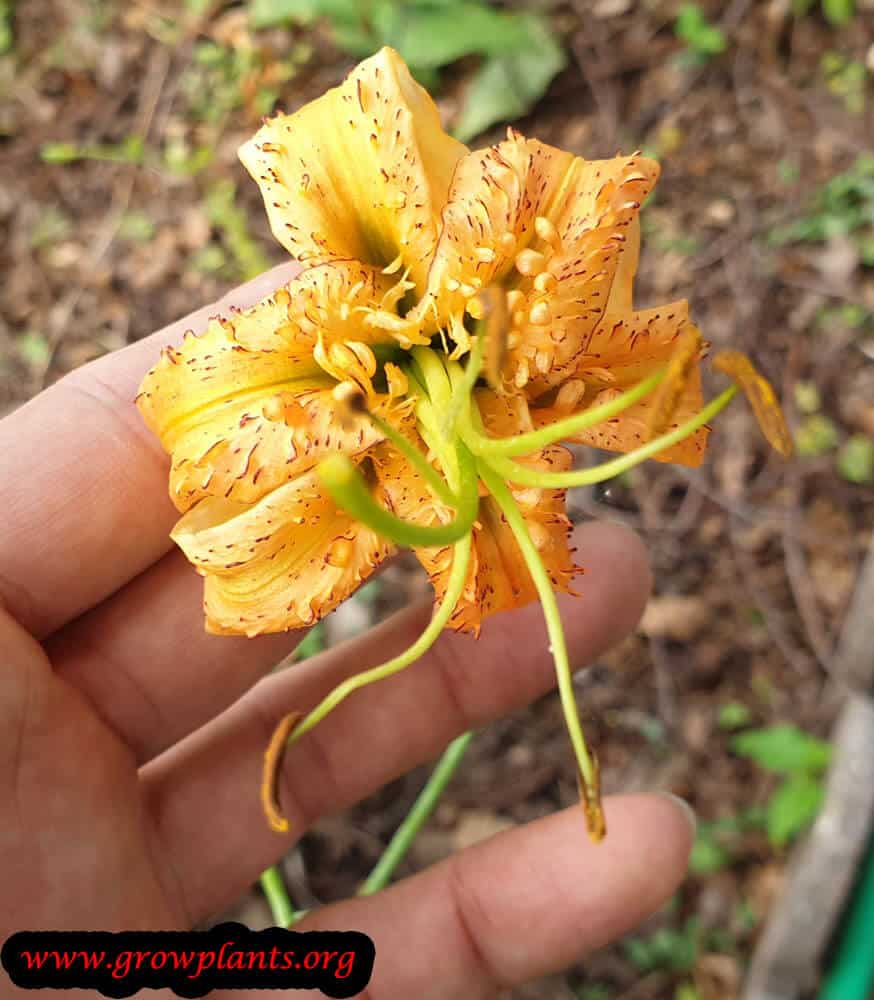
- Flower Characteristics: Recurved, orange (light to dark) flowers with prominent stamens, carried in numbers on each stem.
Primary Uses & Landscape Value
- Functional & Ornamental Roles: Fragrant ornamental for the back of borders and a striking cut flower.
Care Guide: Planting, Soil & Watering
Overview: This deciduous lily grows from a bulb in full sun to part shade in temperate climates (hardiness zone 5-9). It needs a rich, well-drained soil and moderate water, with cool roots and good drainage to protect the bulb.
Quick Care Requirements
| Requirement | Ideal Condition |
|---|---|
| Planting Season | Autumn to winter in warm climates; spring in colder climates |
| Growth Rate | Moderate to fast |
| Soil Type | Rich, well-draining, mulched |
| Water Need | Moderate |
Planting & Establishment
- Best Planting Season: Plant in autumn to winter in warm climates, or in spring in colder climates.
- How to Plant:
- Hole Preparation: Plant the bulb in a hole about two to three times the bulb’s depth.
- Soil Amendments: Enrich with organic matter and mulch, keeping the drainage sharp.
- Planting Depth: Set the bulb two to three times its own height deep, pointed end up.
- Growth Speed & Expectations: A moderate to fast grower.
Soil, Watering & Drainage Care
- Soil Mix & Drainage Needs: Use a rich, well-drained soil; mulch to keep the roots cool and avoid waterlogging that rots the bulb.
- Watering Schedule & Technique:
- Young / Newly Planted: Keep the soil moist after planting.
- Established: Water regularly during active growth and bloom.
- Seasonal Adjustments: Keep it drier during dormancy – in warm areas the bulb can be lifted for a dry rest.
Climate, Light & Hardiness
Lilium henryi (tiger lily / Henry’s lily) is a temperate-climate bulb that thrives with full sun to half shade and a distinct cool-to-cold winter for dormancy. It is reliably frost-hardy across USDA zones 5–9, and while it can be grown in zone 10, the bulbs are generally lifted and stored over summer there rather than left in the ground year-round.
Quick Climate Specifications
| Climate Zones | Temperate |
|---|---|
| USDA Hardiness Zones | 5–9 (possible in 10 with summer bulb-lifting) |
| Cold Damage Begins | Above-ground growth dies back naturally with autumn frost, near 0°C (32°F) |
| Approx. Survival Minimum | Dormant bulbs typically tolerate winter cold to around −29°C (−20°F) or lower in zone 5, with adequate mulch/snow cover |
| Frost Tolerance | High (dormant bulb); Low (emerging shoots and flowers) |
| Light Conditions | Full Sun to Half Shade |
| Wind Tolerance | Low to Moderate |
Sunlight & Light Exposure
Optimal Light Setup
Grow with the flowering stem in full sun to half shade - a classic lily approach of “head in the sun, roots in the shade”, shading the base with low companion planting or mulch, keeps the bulb cool while the stem flowers well.
Direct Sun Requirement
Full sun is not essential; half shade is well tolerated and can even prolong flower color in hot climates.
Shade & Heat Management
In warmer parts of its range, afternoon shade and a cool, mulched root zone help prevent stress during hot spells.
Best Exposure / Orientation
A bed with morning-to-midday sun and light afternoon shade, and shaded, mulched soil at the base, suits it well.
Temperature Extremes & Hardiness
USDA Hardiness & Regional Limits
Reliably hardy in the ground across roughly USDA zones 5–9. In zone 10, summer heat and soil conditions are marginal for the dormant bulb, so the site data indicates lifting and storing bulbs over summer there rather than leaving them planted year-round.
Cold Damage & Winter Protection
Foliage and stems die back with autumn frost as part of normal dormancy; a mulch layer over the bulb bed protects against the coldest winters, particularly toward zone 5.
Frost Sensitivity
Emerging spring shoots and open flowers are frost-tender and can be damaged by a late spring freeze, while the dormant underground bulb is well protected from cold.
Extreme Heat Tolerance
Moderate; prolonged intense heat, especially with dry soil, stresses the plant, which is why bulbs are lifted in the hottest (zone 10) part of its range.
Wind, Humidity & Microclimate
Humidity Preferences
Prefers moderate humidity with consistently but not excessively moist soil.
Wind Tolerance
Low to moderate; the tall flowering stems can be knocked over or snapped in strong wind and benefit from a sheltered position or staking.
Rainfall & Seasonal Moisture
Suited to climates with reliable moisture through spring and summer growth; good drainage is important so the bulb is not sitting in waterlogged soil over winter.
Microclimate Recommendations
A sheltered bed with sun on the flowering stem, shade and mulch over the root zone, and free-draining soil gives the best results; in hot zone-10 climates, plan for summer bulb-lifting.
Growing in Pots, Balconies & Indoors
Lilium henryi is a tall bulbous lily that grows well in a deep container but is not a houseplant – it needs full sun to part shade and open air. A large, deep pot on a patio or balcony shows off its arching, flower-laden stems.
Quick Details
- Container Size: A deep pot to anchor 1-2.5 m stems and give the bulbs root room
- Indoor Suitability: Not a houseplant – too tall and too light-hungry for indoors
- Best Spot: Full sun to half shade, with the base kept cool and shaded
- Soil & Drainage: Free-draining, organic-rich mix – lilies rot in wet, heavy soil
- Watering in Pots: Average water – keep evenly moist in growth, drier once dormant
Indoors & On the Windowsill
- Houseplant limits: The grower does not rate it as a houseplant – its height and need for real sun make it an outdoor container plant, not a room plant.
- Overwintering: The bulbs are hardy but the pot can be moved to a sheltered spot in the harshest winters; keep the dormant pot cool and barely moist, not soggy.
- Safety: Lilies are extremely toxic to cats – even pollen or a chewed leaf can be fatal – so keep plants and any cut stems well away from cats.
On a Balcony or Patio
- Light & wind: Give it sun with its base shaded, and stake the tall stems against wind on an exposed balcony.
- Practicalities: Deep pots dry more slowly but tall stems drink heavily in flower – check moisture regularly.
Choosing the Pot, Soil & Long-Term Care
- Pot & drainage: Use a pot with strong drainage holes and skip a standing-water saucer, which invites root rot. Terracotta breathes and dries faster, while glazed or plastic pots hold moisture longer. Plant the bulbs deep in a tall pot.
- Potting mix: A well-aerated, organic-rich medium – a quality potting mix, or peat/coir loosened with perlite or vermiculite.
- Feeding: Potted plants run through their soil faster as nutrients leach away with each watering, so feed a little more often than plants in open ground. A high-potash feed as buds form improves flowering; let the leaves die back naturally to feed the bulb.
- Repotting: Refresh the mix and split congested bulb clusters every couple of years while dormant.
Fertilizing & Feeding
A moderate feeder while leaves are actively growing toward and through bloom, then feeding stops once flowering ends so the bulb can ripen undisturbed.
Quick Fertilizing Specs
| Feeding Level | Moderate feeder |
|---|---|
| Main Nutrient Priority | Balanced feeding shifting toward potassium as flower buds develop, to support bloom and bulb vigor |
| Best Feeding Period | From emergence through bud development and bloom |
| Organic Options | Compost or well-rotted manure worked into rich soil at planting and as a top-dressing |
| Reduce/Stop Feeding | Stop feeding once bloom finishes and let the foliage die back naturally to recharge the bulb |
| Micronutrients | Usually met by rich, organic-matter soil; correct only a diagnosed deficiency |
| Soil pH | Prefers rich soil described as acid to limey; tolerant of a range when drainage is good |
Feeding by Growth Stage
Emergence and leaf growth
Build strong stems and radial leaf growth to fuel the coming bloom.
| Nutrient direction | A balanced complete fertilizer with adequate nitrogen supports the flush of new foliage. |
|---|---|
| Timing | As shoots emerge and leaves expand in spring. |
| Frequency | A light feeding as growth begins is generally enough to carry the plant toward bud set. |
| Fertilizer types | A balanced complete fertilizer, Compost or well-rotted manure worked into the soil |
| Precautions | Keep the rich soil well drained; lilies planted in heavy, wet ground are prone to rot regardless of feeding. |
Bud development and bloom
Support strong orange, round-form flowers and keep the bulb well provisioned for next year.
| Nutrient direction | A fertilizer with a potassium lean alongside balanced nutrition favors flower quality and bulb strength. |
|---|---|
| Timing | As buds form and through the flowering period. |
| Frequency | One or two light feedings across bud set and bloom are usually sufficient. |
| Fertilizer types | A balanced to potassium-leaning fertilizer |
| Precautions | Avoid heavy nitrogen once buds appear, which can favor foliage over flowers and weaken stems. |
Post-bloom foliage dieback
Let the bulb recharge from the dying foliage without interference from added nutrients.
| Nutrient direction | None – withhold fertilizer while the foliage yellows and dies back naturally. |
|---|---|
| Timing | From the end of flowering through autumn foliage decline. |
| Frequency | No feeding at this stage. |
| Fertilizer types | No feeding at this stage; do not fertilize until new growth emerges next spring. |
| Precautions | Do not fertilize or cut back the foliage early; the dying leaves are recharging the bulb for next year’s bloom. |
Nutrient Deficiency Signs & Corrections
Lower leaves pale to yellow and stem growth is noticeably weaker than expected.
| Possible causes | low available soil nitrogen, nitrogen leaching from heavy watering or rain, thin, low-organic-matter soil |
|---|---|
| Appears first on | older, lower leaves |
| What to check | recent feeding history, soil organic matter, drainage after watering |
| Possible correction | Apply a balanced fertilizer with adequate nitrogen and enrich the soil with organic matter. |
Leaf edges show scorch or browning and flower stems appear weak or prone to flopping.
| Possible causes | low soil potassium, heavy leaching in sandy or fast-draining soil, excess nitrogen feeding diluting relative potassium |
|---|---|
| Appears first on | older leaf margins |
| What to check | soil potassium status, soil texture and drainage, balance of recent feeding |
| Possible correction | Shift toward a potassium-leaning fertilizer and correct any excess nitrogen feeding. |
New leaves near the stem tip yellow between distinctly green veins.
| Possible causes | high soil pH limiting iron availability, waterlogged, poorly drained soil, root stress |
|---|---|
| Appears first on | newest leaves near the growing tip |
| What to check | soil pH, drainage, recent watering |
| Possible correction | Improve drainage and apply a chelated iron product per its label if pH cannot be adjusted. |
Pruning, Training & Seasonal Maintenance
Tiger Lily / Henry’s Lily is a bulbous geophyte with essentially no true pruning – the priority is protecting the green stem and leaves after flowering, since they continue feeding the bulb for next year’s bloom. The only safe removal window is late autumn, once foliage has fully yellowed and died back naturally; cutting green tissue at any other time weakens next season’s flowering.
Quick Pruning & Maintenance Specs
| Pruning Tolerance | Low (limited to spent stems/foliage after natural dieback) |
| Primary Pruning Window | Late Autumn, after full foliage dieback |
| Secondary Maintenance Window | During bloom – deadheading spent flowers only, not stems |
| Typical Frequency | Once per year |
| Main Objective | Tidy spent growth, stop seed-pod energy drain, protect bulb vigor |
| Young Plant Priority | None – do not cut foliage on newly planted bulbs |
| Mature Plant Priority | Deadhead in season; remove the stem only after autumn dieback |
| Best Tool Type | Precision snips |
| Avoid Heavy Pruning During | Any time the stem or leaves are still green, even right after flowering |
Pruning by Plant Age & Size
Newly Established
No pruning – let full foliage develop undisturbed to build bulb reserves.
Young / Formative
No structural training applies to a single upright geophyte stem; in windy or exposed sites, stake the 1-2.5m flowering stem for support rather than pruning it for size.
Mature / Established
Routine deadheading during bloom, followed by full stem removal after autumn dieback.
Seasonal Pruning Schedule
Ongoing Sanitary (Spring/Summer bloom)
Objective: prevent energy loss to seed production. Remove: spent flowers, cut just below the faded bloom. Do not remove: any green leaf or stem tissue. Response: bulb reserves are directed to next year’s growth rather than seed. Flowering impact: protects next season’s bloom.
Dormant/Winter (late Autumn)
Objective: tidy the dormant plant. Remove: the old stem and leaves only once fully yellowed and died back, cut to ground level. Do not remove: any stem/leaf tissue that still shows green. Response: bulb enters dormancy cleanly. Flowering impact: none if timed correctly; premature cutting reduces next year’s flowering.
Structural Pruning & Training
No branching structure to train. The only structural need is physical support – staking tall stems (up to 2.5m) in exposed or windy sites to prevent snapping.
Special Growth to Remove
- Spent flower heads/seed pods (deadhead before seed matures)
- Fully dead, yellowed foliage and stem, removed only in autumn
Container & Small-Space Pruning
Bulbs grown in pots follow the same rule – allow foliage to die back completely before removing it; ensure pot depth doesn’t force premature root/bulb disturbance.
Tools
- Precision snips – deadheading and the autumn stem cut
Tool Hygiene & Disease Risk
Routine under normal conditions. Aphids (a noted pest) can vector lily mosaic virus, so if aphid pressure or mottled-foliage symptoms are present, disinfect tools between plants as an increased-risk precaution.
Cut Placement & Technique
Deadhead just below the spent flower, above the next leaf; cut the dormant stem near ground level once fully senesced in autumn.
Heavy Pruning & Rejuvenation
Not applicable – as a bulb, this species isn’t rejuvenated by pruning. Vigor is renewed by lifting and dividing bulb offsets every few years instead.
Post-Pruning Care
No fertilizing is needed after the autumn stem removal; mulch over winter, especially toward the colder end of its zone 5-9 range.
Common Pruning Mistakes
- Cutting the stem or foliage while still green right after flowering – the single biggest mistake, as it starves the bulb for next year
- Mistaking a developing seed pod for a spent flower and leaving it to mature, wasting bulb energy
When NOT to Prune
Never remove green leaves or stem, even after flowering finishes – wait for natural yellowing. Avoid cutting back soon after transplanting bulbs.
Recommended Tools (by task)
- Precision snips – deadheading blooms and removing the fully dormant autumn stem
- Soft ties/stakes – securing the tall (up to 2.5m) flowering stem in exposed sites
Propagation Guide
Bulb-based propagation – dividing offset bulbs or scaling the main bulb – is the best method for Lilium henryi, matching the site’s own note that vegetative reproduction is necessary; this keeps new plants identical to the parent and reaching flowering size much sooner than seed. Seed is possible and species lilies like this one are usually reasonably true-to-type, but seedlings take considerably longer to build up to blooming size. Overall this is a moderate plant to propagate at home, easy by offsets but more involved by scaling.
Quick Propagation Specs
| Best Propagation Method | Bulb offset division / bulb scaling |
| Alternative Methods | Seed |
| Propagation Difficulty | Moderate |
| Seed True-to-Type | Usually true-to-type (species lily) |
| Vegetative True-to-Type | Yes |
| Best Propagation Season | Autumn (bulb lifting/division), matching the plant’s own autumn/winter planting season |
| Seed Germination Time | Variable, often several weeks to a few months; can be slow and staggered |
| Germination Temperature | Cool to moderate, roughly 10–18°C (50–64°F) |
| Seed Sowing Depth | Shallow – lightly covered |
Growing from Seed
Dormancy & Pre-Sowing Treatment
Many true lilies show delayed or two-stage (epigeal/hypogeal) germination, where root and shoot emerge at different times, sometimes needing a period of cool conditions before top growth appears; treat slow, uneven germination as normal rather than a failure.
Sowing Season
Sow in autumn or early spring.
Germination Conditions
Cool, consistently moist but well-drained medium.
Germination Time
Germination can be slow and irregular, sometimes taking several weeks to a few months.
Seedling Care
Keep seedlings evenly moist and grow on for at least a season before transplanting to their final position, since bulb-forming seedlings need time to build up size.
Rhizomes, Tubers, Bulbs & Corms
The most practical home method is Bulb Division: lift the plant when dormant (after die-back in autumn) and gently separate the small offset bulbs that form naturally around the base of the mother bulb, then replant them at a similar depth in enriched, well-drained soil. Where a faster increase is wanted, individual bulb scales can be removed from a healthy bulb and started in a lightly moist, well-aerated medium in a warm spot – each scale can eventually form a tiny new bulblet, though this scaling method takes patience and is more of a specialist technique than simple offset division.
Bloom & Flower Guide
Quick Details
- Bloom Season: Spring into summer, with the main display in mid to late summer
- Flower Appearance: Rounded, recurved orange flowers shading between light and dark
- Edibility: Not edible – true lilies are toxic, and highly dangerous to cats
Detailed Blooming Overview
Henry’s lily (Lilium henryi) is a bulb-grown lily prized as a fragrant ornamental. Each tall stem carries a succession of nodding, orange flowers with the classic “Turk’s-cap” look, their petals sweeping back to reveal prominent stamens.
Flower Characteristics
- Orange flowers, ranging between lighter and darker tones, in a rounded, recurved form.
- Petals reflex backwards (Turk’s-cap style), exposing the central stamens.
- Several flowers are carried per stem, opening in succession.
Bloom Care & Thinning
- Support: Stake the tall flowering stems in exposed spots so the heavy heads do not bend or snap.
- After flowering: Remove faded blooms, but leave the stem and leaves in place to feed the bulb for next year.
Bloom Health & Protection
- Botrytis (lily disease): Wet weather can spot the buds and petals; improving airflow and avoiding overhead watering helps, and a suitable fungicide can be used if it takes hold.
- Aphids: They gather on buds and can spread lily viruses; a neem-oil or insecticidal-soap spray keeps them in check.
- Safety: All parts are toxic if eaten and pollen and flowers are especially dangerous to cats – keep cut stems and plants away from them.
Fruit & Uses
The bulb of Lilium henryi is the one edible part of this plant, cooked and used as a starchy, potato-like vegetable; it is bitter and not eaten raw. This lily is grown mainly as an ornamental, fragrant garden and cut flower, so bulb harvest for food is a minor, occasional use rather than the plant’s main purpose.
Quick Edible Specs
| Edible Parts | Bulb (cooked) |
|---|---|
| Main Use(s) | Culinary (starchy vegetable, minor/occasional use) |
| Eaten Raw or Cooked | Cooked only |
| Preparation Required | Cook; peel away the outer bulb scales first |
| Harvest Season | Autumn, after foliage has died back and the bulb is dormant |
| Time to First Harvest | Only once the bulb has built up size over more than one growing season; see Propagation |
| Storage | Best cooked soon after digging; not a long-term storage food |
| Safety/Toxicity Caveat | Bitter and unpalatable raw, needs cooking; the whole plant (leaves, pollen, petals) is highly toxic to cats, so keep cut stems and garden plantings away from them |
Bulbs, Corms & Rhizomes
Like other lilies, L. henryi forms a scaly underground bulb made of overlapping fleshy scales. Once dug up in the dormant season and cooked, the scales can be eaten as a bitter, starchy vegetable in the way a potato substitute is used. Removing the whole bulb kills that plant, so this is a use for a spare or thinned-out clump rather than a prized ornamental specimen, and it competes directly with the plant’s own regrowth and with bulb-based propagation (see Propagation).
Preparation, Uses & Safety
Cook the peeled bulb scales before eating; raw bulbs are bitter and not palatable. This species is a lesser-known food lily compared with types more traditionally eaten in East Asian cooking, so treat it as an occasional curiosity rather than a reliable vegetable. Keep pets, especially cats, away from all parts of the growing or cut plant, since lilies are highly toxic to them even in small amounts.
Pests, Diseases & Troubleshooting
Overview: True lilies grown from bulbs are prized but not trouble-free: their chief threats are the scarlet lily leaf beetle, aphids (important as virus carriers), botrytis leaf blight in humid weather, and basal or bulb rot in heavy, poorly drained soil. Lilium henryi is a vigorous, disease-tolerant Asiatic-type species that appreciates light shade and a cool root run. Management is cultural first – plant firm healthy bulbs in fast-draining soil, give good air movement, and scout weekly so problems are caught early.
Quick Troubleshooting Overview
| Issue / Pest | Main Symptom | Primary Solution |
|---|---|---|
| Lily leaf beetle | Bright scarlet beetles and ragged holes; slimy dark larvae on leaves | Handpick adults, eggs and larvae; neem if heavy |
| Aphids | Sticky distorted new growth and buds; can spread virus | Blast off with water, insecticidal soap, control ants |
| Botrytis (lily blight) | Reddish-brown water-soaked leaf spots in wet weather | Improve airflow, remove debris, preventive copper |
| Basal / bulb rot | Yellowing, stunting, soft rotten bulb base | Well-drained soil, avoid waterlogging, discard sick bulbs |
| Lily mosaic virus | Mottled, streaked, distorted foliage | Rogue infected plants, control aphids, use tested stock |
Common Pests & Management
- Lily leaf beetle (Lilioceris lilii):
- Symptoms: Bright red 6–8 mm beetles on leaves and buds; orange-brown larvae hide under a coat of their own excrement and, with the adults, can strip foliage and flower buds rapidly. Rows of orange eggs sit on leaf undersides.
- Prevention & Control: Scout and handpick adults, eggs and larvae (the fastest control), squashing egg rows on leaf undersides; encourage parasitoid wasps; treat heavy pressure with neem. This pest is persistent in temperate gardens, so check daily in the active season.
- Aphids (Myzus persicae & Aphis spp.):
- Symptoms: Soft green, black or pink insects cluster on tender shoots, buds and leaf undersides, leaving sticky honeydew and sooty mould and causing puckered growth. Crucially, they transmit lily mosaic and other viruses.
- Prevention & Control: Dislodge with a firm water jet, then use insecticidal soap or neem on the undersides; conserve ladybirds, lacewings and hoverflies; control the ants that farm them. Because they vector viruses, keep colonies down even when numbers look low.
- Bulb mites (Rhizoglyphus spp.):
- Symptoms: Weak or failed emergence, stunting, and tunnelling within bulb scales that opens the door to rot; the bulb feels soft and looks brown internally.
- Prevention & Control: Plant only firm, blemish-free bulbs, provide sharp drainage, rotate planting sites, and discard any soft bulbs. Avoid wounding bulbs at planting, since mites and rot follow injuries.
- Slugs and snails (Deroceras & Helix spp.):
- Symptoms: Emerging shoots grazed, holes chewed in leaves and buds, and tell-tale silvery slime trails, worst in cool, damp spring conditions.
- Prevention & Control: Hand-collect after dark, set traps, and ring plants with grit or copper barriers; iron-phosphate baits are a low-toxicity option safe around pets and wildlife.
- Thrips (Frankliniella & Thrips spp.):
- Symptoms: Silvery streaking and flecking on leaves and petals, deformed buds, and tiny black frass specks; heavy in hot, dry spells.
- Prevention & Control: Hang blue sticky traps to monitor, keep plants unstressed, remove spent blooms, and treat with insecticidal soap or spinosad if numbers climb.
Diseases & Fungal Issues
- Botrytis / lily blight (Botrytis elliptica):
- Symptoms: Round to oval reddish-brown, water-soaked spots on leaves in wet or humid weather that enlarge, merge and collapse the foliage; a grey fuzzy mould appears in prolonged damp.
- Treatment & Management: Space plants for airflow, avoid overhead evening watering, and clear infected leaves and stem debris promptly (do not compost). Apply a copper or appropriate preventive fungicide before wet spells if the disease recurs.
- Basal rot / Fusarium (Fusarium oxysporum):
- Symptoms: Yellowing lower leaves, stunted growth, and a brown, soft, rotting bulb base and roots; plants may topple.
- Treatment & Management: Plant healthy bulbs in well-drained soil, never in waterlogged ground; lift and destroy infected bulbs, and rotate to fresh soil. Avoid mechanical damage that lets the fungus in.
- Lily viruses (mosaic, LSV, CMV):
- Symptoms: Mottled, streaked or ring-spotted leaves, twisted growth, and gradual decline; symptoms intensify each season.
- Treatment & Management: There is no cure – remove and destroy affected plants, control the aphids that spread them, and buy virus-tested bulbs. Disinfect tools between plants.
Growing Difficulties & Abiotic Problems
- Bulb and root rot from overwatering:
- Cause & Symptoms: Heavy, poorly drained or waterlogged soil suffocates roots and rots the bulb, showing as yellowing, wilting and collapse.
- Correction Strategy: Grow in raised beds or grit-amended soil, water moderately, and let the surface dry between waterings; never leave bulbs sitting in wet.
- Bud blast and leaf scorch:
- Cause & Symptoms: Calcium shortage combined with erratic moisture (common in forced Easter lilies) aborts buds and browns leaf tips.
- Correction Strategy: Keep soil evenly moist, feed with a balanced fertiliser, and provide bright but cool, non-scorching conditions during budding.
- Poor siting (heat and light):
- Cause & Symptoms: Too much reflected heat scorches leaves, while deep shade makes stems weak and floppy.
- Correction Strategy: Give a cool root run (mulch or low planting) with the flowering stems in sun to light shade; stake tall stems in exposed spots.
What Helps – Products & Tools
A short toolkit covers most lily problems: neem oil or insecticidal soap for aphids, thrips and beetle larvae; horticultural oil for scale; iron-phosphate bait and copper barriers for slugs and snails; blue/yellow sticky traps for monitoring; and a copper-based fungicide for botrytis. Spray oils and soaps in the evening to protect pollinators, and always follow the label.