Plant Profile & Key Characteristics
Also known as: Horned melon plant, African horned cucumber plant, Jelly melon, Kiwano melon, Spiked melon, Hedged gourd, Melano
Overview: Kiwano, or horned melon, is a fast-growing annual, herbaceous vine grown for its spiny, yellow-orange fruit filled with green, jelly-like edible pulp. The vining stems reach about 1-4 m (40-160 in).
Quick Specifications
| Specification | Attribute |
|---|---|
| Plant Type / Life Cycle | Annual (herbaceous vine) |
| Mature Size | Vine about 1-4 m (40-160 in) long |
| Growth Rate | Fast to moderate |
| Toxicity | Non-toxic / edible |
| Hardiness | USDA zones 4+ (fruits reliably only where summers are long and hot) |
Growth Form & Structure
- Height & Spread: Vining stems about 1-4 m (40-160 in); grown in the ground with trellising or in large containers (at least 10-20 L / 2.5-5 gal).
- Growth Habit & Form: Vigorous sprawling annual vine with tendrils, best trellised.
- Lifespan & Maturity: Annual; fruit ready about 50-80 days from sowing.
Anatomy & Physical Features
- Leaves & Foliage: Green, heart-shaped leaves that become hairy with age.
- Flower Characteristics: Yellow, five-lobed flowers; separate male and female flowers (bee-pollinated).
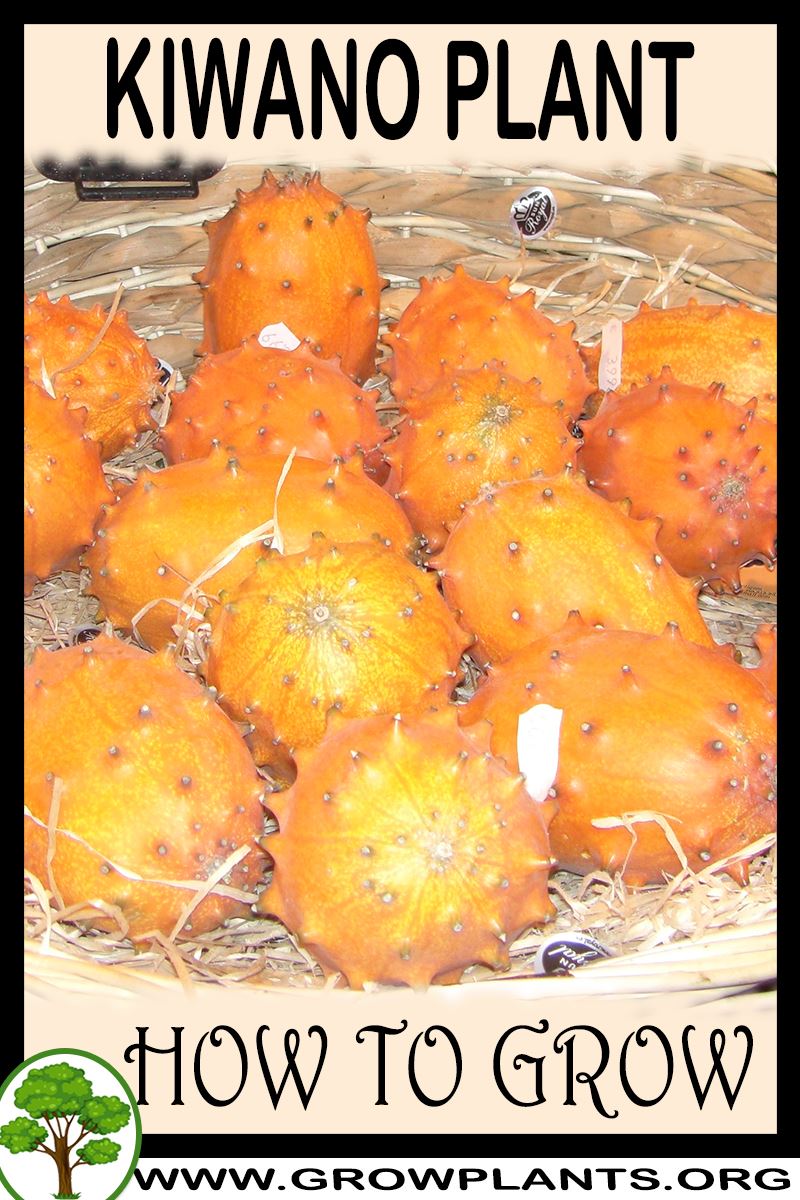
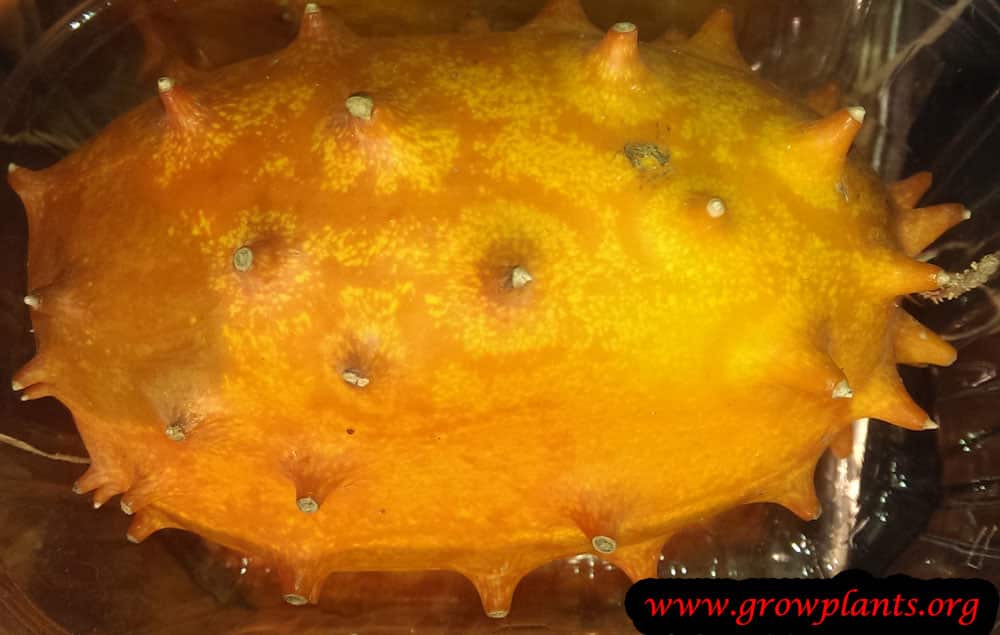
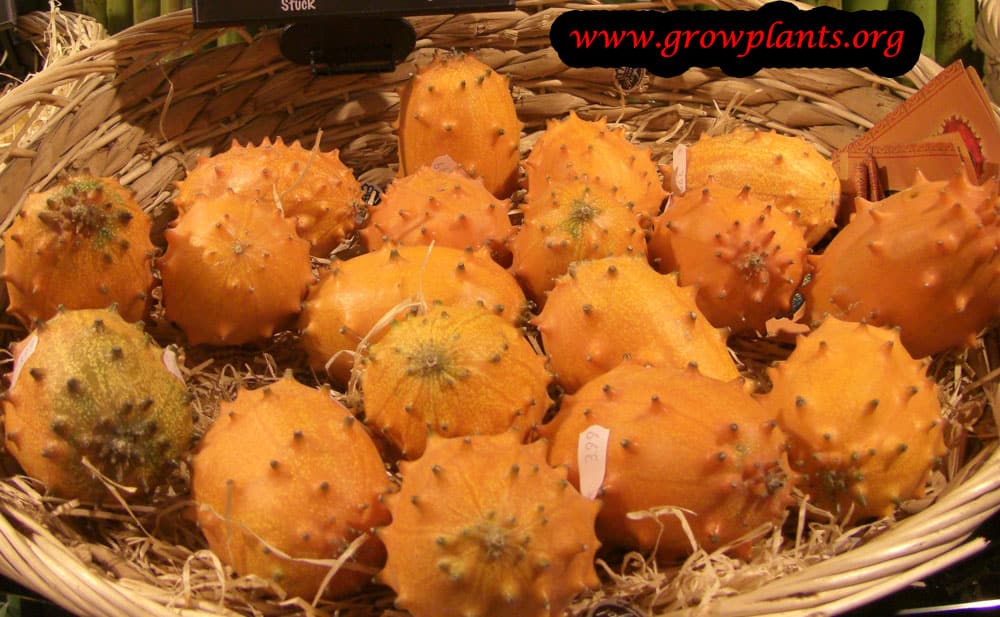
- Fruit Profile: Oval fruit with a spiny yellow-orange rind and green, jelly-like pulp of mild, cucumber-and-banana flavour; seeds edible.
Primary Uses & Landscape Value
- Edible Uses: Pulp eaten raw or in salads.
- Functional & Ornamental Roles: Warm-season novelty fruit crop; the spiny fruit is also decorative.
Care Guide: Planting, Soil & Watering
Overview: Kiwano (horned melon) is a fast-growing, warm-season annual vine for full sun to part shade, happiest in a light, well-ventilated and well-draining soil. Give it modest, steady moisture and support the vines on a trellis.
Quick Care Requirements
| Requirement | Ideal Condition |
|---|---|
| Planting Season | In spring (end of winter to spring in cool climates), after frost |
| Growth Rate | Moderate to fast |
| Soil Type | Light, well-ventilated and well-draining |
| Water Need | Low to moderate – water at the base; avoid overwatering |
Planting & Establishment
- Best Planting Season: Plant out once the soil is warm and frost has passed; in cool zones start seed indoors in late winter so plants get the long, hot season they need to ripen sweet fruit.
- How to Plant:
- Hole Preparation: Plant into light, well-ventilated soil, using a moisture-holding medium such as one lightened with vermiculite.
- Soil Amendments: Enrich with organic matter and keep the mix light and airy for drainage.
- Planting Depth: Set the seedling at the depth it grew in its pot, with the root collar at soil level; do not bury the stem.
- Growth Speed & Expectations: Moderate to fast; a 1-4 m (40-160 in) vine that bears in roughly 50-80 days.
Soil, Watering & Drainage Care
- Soil Mix & Drainage Needs: Provide a light, free-draining soil to prevent root rot; the plant dislikes waterlogging. In containers (at least 10-20 L) use a well-ventilated potting or peat mix with perlite and good drainage holes.
- Watering Schedule & Technique:
- Young / Newly Planted: Keep the soil evenly moist while seedlings establish.
- Established: Give small to moderate amounts of water at the base, letting the top few cm dry between waterings; keep water off the leaves and fruit.
- Seasonal Adjustments: Water more in hot, dry spells; ease back as fruit ripens and in cool weather to concentrate sweetness.
Climate, Light & Hardiness
Kiwano (horned melon) is a warm-season African cucurbit well adapted to heat and drier conditions, in full sun to part shade, and is frost-tender. It tolerates low humidity and part shade but, like other cucurbits, is killed by frost and needs a warm, frost-free season.
Quick Climate Specifications
| Climate Zones | Desert, Mediterranean, subtropical, temperate, and tropical |
| USDA Hardiness Zones | Grown from about zone 4 upward as a summer annual (site data); may not fruit in zones 4–5 without care |
| Optimal Temp Range | Approximately 18–30 °C (65–86 °F) |
| Cold Damage Begins | Chilling stress below roughly 10–13 °C (50–55 °F) |
| Approx. Survival Minimum | No frost tolerance - killed at or near 0 °C (32 °F) |
| Frost Tolerance | None |
| Light Conditions | Full sun (light part shade tolerated) |
| Wind Tolerance | Moderate |
Sunlight & Light Exposure
Optimal Light Setup
Full sun - give at least 6–8 hours of direct light a day for strong growth, good flowering, and well-ripened fruit. Shade reduces yield and delays or prevents ripening. It also accepts light or part shade, though fruiting and sweetness are best in full sun.
Direct Sun Requirement
Yes - a genuinely sun-demanding crop. Too little direct sun gives leggy growth, weak fruit set, and fruit that fails to ripen.
Shade & Heat Management
In extreme desert heat, light afternoon shade or shade cloth during the hottest hours protects leaves and flowers and helps prevent heat-related blossom drop.
Best Exposure & Orientation
In cool-summer regions a warm south- or west-facing aspect that banks heat gives the best ripening; in very hot desert areas an east-facing aspect with light afternoon shade eases heat stress.
Temperature Extremes & Hardiness
USDA Hardiness & Regional Limits
The site's data lists this crop as grown from about USDA zone 4 upward. That figure reflects where it can be raised as a summer annual, not winter cold survival: it is frost-tender and completes its cycle in a single frost-free season, so it is grown as an annual wherever winters freeze and can grow year-round only in frost-free climates. The site notes zones 4–5 may fail to fruit without care. As an African horned melon it is well adapted to heat and drier air and tolerates part shade. Hardiness and growing habit are separate here - the plant is frost-sensitive, yet fully cultivable as a warm-season annual across a wide zone range.
Cold Damage & Winter Protection
Growth slows sharply and chilling injury - pitting, yellowing, stalled growth - appears below roughly 10–13 °C (50–55 °F). There is no winter to protect against in outdoor culture: the plant is grown only through the frost-free season, and young seedlings are especially cold-sensitive, so wait until nights are reliably warm before transplanting out.
Frost Sensitivity
None - frost tolerance is nil. Even a light frost at or near 0 °C (32 °F) kills leaves and vines, so all outdoor growth must fall within the frost-free window.
Extreme Heat Tolerance
Very high - a true heat lover that produces best in long, hot summers with warm nights. Even so, air temperatures above about 35 °C (95 °F) can cause flowers to drop and reduce fruit set, especially if soil moisture runs short.
Frost-Free Growing Season
Needs about 50–80 days of warmth to fruit. In cooler or short-season regions start indoors and transplant after frost; warm, sunny, fairly dry conditions suit it best.
Wind, Humidity & Microclimate
Humidity Preferences
Prefers warm, relatively dry air. High humidity and prolonged leaf wetness encourage powdery mildew and other fungal disease, a recurring problem for this crop.
Dry-Air Tolerance
High - naturally adapted to dry air and dry-summer climates.
Wind Tolerance
Moderate - broad leaves and brittle stems can be damaged by strong wind, and windy conditions during flowering reduce pollinator visits and fruit set. A sheltered spot helps.
Rainfall & Seasonal Moisture
Adapted to hot, dry-summer climates and intolerant of prolonged wet; damp, humid conditions encourage powdery mildew. This describes climate adaptation, not a watering schedule.
Microclimate Recommendations
A warm, sheltered, sun-facing spot - for example a south-facing wall or slope in cooler climates - traps heat and lengthens the effective warm season, and dark mulch or plastic warms the soil early. Container root-zones heat, dry, and chill faster and are more wind- and frost-exposed, so shelter pots in extreme weather.
Growing in Pots, Balconies & Indoors
Kiwano is a climbing, sun-loving vine that thrives in full sun, so it is not a houseplant – but grown in a large, free-draining pot it does well on a sunny balcony, patio or terrace. Give it room to trail and something to climb.
Quick Details
- Container Size: 10-20 L (2.5-5 gal)
- Indoor Suitability: Not an indoor houseplant – it needs full sun; at most a compact cultivar on the very sunniest windowsill
- Best Spot: Full sun – the brightest, warmest spot on a balcony or patio
- Soil & Drainage: Well-drained, well-ventilated mix (potting mix, or peat/coir with perlite) with plenty of drainage holes
- Watering in Pots: Keep evenly moist but never waterlogged – it dislikes overwatering, and pots dry fast in the sun
Indoors & On the Windowsill
- Not a houseplant: The grower keeps it out of the house – indoor light is far too weak for this sun-loving crop.
- Windowsill limits: Only the very sunniest windowsill could support a compact cultivar; most plants of this size are better off outdoors.
- Annual, so no overwintering: This is a warm-season annual – rather than overwintering it, simply resow when the weather warms.
On a Balcony or Patio
- Light & wind: Give it the sunniest, most sheltered spot; train the vine up a trellis or netting and shelter it from wind; walls and paving reflect a lot of heat, so containers dry quickly – check moisture daily in warm weather. A drip irrigation kit with a timer can take over that watering check automatically.
- Practicalities: A full, wet pot is heavy, so make sure the balcony can take the weight, and manage drainage runoff.
Choosing the Pot, Soil & Long-Term Care
- Pot & drainage: Use a 10-20 L (2.5-5 gal) pot with plenty of drainage holes; the grower stresses this crop does not tolerate overwatering, so never leave it standing in water (root rot). Terracotta breathes and dries faster; glazed or plastic holds moisture longer.
- Potting mix: A well-aerated, well-ventilated mix – potting mix, or peat/coir with perlite – as the grower recommends.
- Feeding: Potted plants need feeding more often than those in the ground, since watering leaches nutrients from the mix – feed regularly through the growing season.
Grower’s Container Tip
- Watch the saucer: If you stand the pot on a tray or saucer, make sure it dries out the same day – never let the roots sit in collected water.
Growing this plant in a greenhouse
A greenhouse can give kiwano plant frost protection and cold protection. In the right climate it may also be kept growing through winter, depending on how much warmth and light are provided.
Greenhouse at a glance
| Greenhouse suitability | Good - clearly useful |
|---|---|
| Main benefits | frost protection, cold protection |
| Season extension | earlier spring & later autumn |
| Outdoor protection advisable below | about 13°C |
| Maintain greenhouse minimum | around 15°C for active growth |
| Suitable types | heated greenhouse, glass greenhouse, polycarbonate greenhouse |
| Heating | Heating is recommended in cold climates for continuous growth. |
Related greenhouse guides
- Greenhouses: How to Choose the Right Greenhouse
- Best Greenhouse Heaters
- Greenhouse Climate Control: Temperature, Ventilation and Humidity
- Polycarbonate Greenhouses: What to Look for Before Buying
Fertilizing & Feeding
This is a productive, appreciably hungry crop that responds to steady, balanced feeding and generous organic matter, leaning on nitrogen while the vines grow and favoring potassium as fruit develops. A fertilizer formulated for tomatoes and vegetables supports that feeding pattern through harvest.
Quick Fertilizing Specs
| Feeding Level | Moderate |
|---|---|
| Main Nutrient Priority | Balanced overall, nitrogen for the vines and potassium as fruit forms |
| Best Feeding Period | Through the warm active growing season |
| Organic Options | Compost, well-rotted manure, and general organic vegetable fertilizers |
| Soil pH | Slightly acidic to near neutral |
| Micronutrients | Usually supplied by compost and a complete fertilizer, and corrected only if a deficiency shows |
Feeding by Growth Stage
Establishment of young plants
Settle young plants and build a healthy root system and first true leaves.
| Nutrient direction | A balanced, complete feeding that supports steady root and early leaf growth without pushing soft, excessive top growth. |
|---|---|
| Timing | From transplanting or seedling establishment through the first flush of vine growth. |
| Frequency | Light, regular feeding while young plants establish. |
| Fertilizer types | A balanced complete vegetable fertilizer, Compost or other organic matter worked into the bed |
| Precautions | Avoid heavy nitrogen early, which encourages lush foliage at the expense of sturdy establishment. |
Vegetative vine growth
Build ample leaf area and strong vines ahead of flowering.
| Nutrient direction | A nitrogen-forward complete feeding to drive vigorous leaf and vine expansion. |
|---|---|
| Timing | During active spreading of the vines before heavy flowering. |
| Frequency | Steady feeding through the main growth phase. |
| Fertilizer types | A nitrogen-leaning complete fertilizer, Well-rotted compost as a supplement |
| Precautions | Keep feeding balanced overall, since runaway nitrogen can delay flowering and fruit set. |
Flowering and fruit development
Support abundant flowers, good fruit set, and quality fruit development.
| Nutrient direction | Shift toward a balanced feeding with strong potassium to support flowering, fruit set, and fruit filling. |
|---|---|
| Timing | From first flowering through fruit sizing and ripening. |
| Frequency | Regular feeding that continues through fruit development. |
| Fertilizer types | A balanced fertilizer with good potassium, Compost or a vegetable fertilizer suited to fruiting crops |
| Precautions | Keep watering even and consistent during fruiting to help calcium reach developing fruit and reduce blossom-end problems. |
Nutrient Deficiency Signs & Corrections
Older, lower leaves turn pale green to yellow and overall growth slows.
| Possible causes | Low soil nitrogen, Cold, wet soil that limits nitrogen uptake, Nitrogen leaching from sandy soil or heavy watering |
|---|---|
| Appears first on | Older, lower leaves |
| What to check | The color gradient from old to new leaves, Recent watering and rainfall, Whether any nitrogen has been applied during rapid growth |
| Possible correction | Apply a nitrogen-containing complete fertilizer and improve organic matter, and make sure soil is warm and well-drained so roots can take up nitrogen. |
Yellowing between the veins of older leaves while the veins themselves stay green.
| Possible causes | Low soil magnesium, High potassium levels competing with magnesium uptake, Acidic or heavily leached, sandy soil |
|---|---|
| Appears first on | Older, lower leaves |
| What to check | The pattern of interveinal yellowing versus whole-leaf yellowing, Soil acidity and recent high-potassium feeding, Drainage and leaching history |
| Possible correction | Correct soil acidity if needed and apply a magnesium source such as a soluble or chelated magnesium product per its label. |
A sunken, dark, leathery patch forms at the blossom end of developing fruit.
| Possible causes | Disrupted calcium movement into the fruit, Uneven or irregular watering, Excess nitrogen driving fast leafy growth |
|---|---|
| Appears first on | Blossom end of young, developing fruit |
| What to check | Consistency of soil moisture, Recent high-nitrogen feeding, Mulch and watering routine |
| Possible correction | Keep soil moisture even, mulch to buffer drying, and avoid excess nitrogen so calcium can reach developing fruit. |
Pruning, Training & Seasonal Maintenance
Kiwano is a moderately vigorous vine (1–4 m, more sprawling than a compact melon but far short of caigua’s reach) that tolerates light pruning, mainly for disease sanitation. Whether it needs a trellis depends on the cultivar, so training decisions follow the same fruit-size logic as the other melons here. One genuinely species-specific point: the ripe fruit is covered in spines, so handling care is needed once fruit has set and pruning nearby.
Quick Pruning & Maintenance Specs
| Pruning Tolerance | Low – sanitary removal only |
| Primary Pruning Window | Through the growing season |
| Main Objective | Remove diseased leaves; train onto a trellis if the cultivar warrants it |
| Young Plant Priority | Decide trellis vs. ground culture depending on the specific cultivar |
| Mature Plant Priority | Sanitary leaf removal; handle carefully once spiny fruit has set |
| Best Tool Type | Precision snips |
| Avoid Heavy Pruning During | Fruit set through harvest (summer–autumn) |
Pruning by Plant Age & Size
Newly Established
No pruning; train onto a trellis if the cultivar is a trellising type.
Young / Formative
Light guidance onto support where trellised; tips can be pinched if a more compact, bushier vine is wanted in a small space, though this is optional rather than required.
Mature / Established
Routine sanitary leaf removal; once spiny fruit is present, work around it carefully rather than cutting near it.
Seasonal Pruning Schedule
Ongoing Sanitary
Objective: limit powdery mildew and pest damage. Remove: infected leaves, wiped clean before cutting. Do not remove: healthy laterals carrying flowers/fruit. Expected response: cleaner canopy. Flowering/fruiting impact: minimal if limited to diseased tissue.
Special Growth to Remove
- Diseased or infected leaves only.
Container & Small-Space Pruning
Kiwano suits a container of at least 10–20L. In a small space, light tip pinching can help keep the vine compact, more so than would suit the smaller melons in this batch, since kiwano’s growth habit runs larger (up to 4 m) if left unchecked.
Tools
- Precision snips – for leaf removal and any tip pinching.
Tool Hygiene & Disease Risk
Increased risk: kiwano is susceptible to powdery mildew and cucumber beetles; disinfect the blade between cuts on diseased leaves.
Cut Placement & Technique
Remove diseased leaves at the base of the leaf stalk. When working near the vine after fruit set, keep hands and tools clear of the spiny fruit surface.
Heavy Pruning & Rejuvenation
Not applicable – a single-season annual vine with no rejuvenation pruning.
Post-Pruning Care
Water at the base, not overhead, after removing diseased leaves. No extra feeding is triggered by this light sanitary work.
Common Pruning Mistakes
- Trellising a cultivar/fruit load too heavy for the support.
- Handling ripening fruit carelessly and getting scratched by its spines.
- Reusing an unwiped blade across mildew-affected leaves.
When NOT to Prune
- Avoid cutting near the vine once spiny fruit has set, to avoid injury.
- Avoid pruning wet foliage.
Recommended Tools (by task)
- precision_snips – for leaf removal and tip pinching.
- soft_ties_stakes – for training onto a trellis where used.
- blade_disinfectant – to limit spreading mildew between cuts.
Pruning Troubleshooting
| Problem | Possible Cause | What to Check | Corrective Action |
| Mildew keeps spreading after leaf removal | Unclean blade reused between cuts | Check tool hygiene between cuts | Disinfect blade between cuts on diseased leaves |
| Scratches/injuries when working near the vine | Handling near spiny fruit without care | Check proximity to ripening fruit when pruning | Work around spiny fruit carefully or wear protection |
Propagation Guide
Kiwano is grown from seed, either sown directly once the weather is warm or started as young transplants ahead of a short season; grafting or vegetative propagation is not needed. Sowing is easy with no special pre-treatment required.
Quick Propagation Specs
| Best Propagation Method | Direct sowing (or indoor seed-starting in cool climates) |
| Propagation Difficulty | Easy |
| Seed True-to-Type | Usually true-to-type – a wild-type species with few named cultivars, though it can cross with other Cucumis species growing nearby |
| Best Propagation Season | End of winter into spring; in cold climates start indoors in winter |
| Seed Germination Time | 5–20 days |
| Germination Temperature | 21–25°C (70–77°F) |
| Seed Sowing Depth | 1–2 cm (0.5–1 in) |
The seed doesn’t need to be buried deeply – a light covering is enough.
Growing from Seed
Seed Handling & Viability
Store seed at room temperature in a dry place until sowing time.
Sowing Season
Sow at the end of winter into spring (possible in summer in warm climates); in cold climates start indoors in winter.
Sowing Depth & Orientation
Sow 1–2 cm (0.5–1 in) deep. Space plants 40 x 50 cm (16 x 20 in) apart when trellising, or 1 x 1.25 m (40–50 in) apart when allowed to crawl; seedlings started in trays can be spaced 5 x 5 cm (2 x 2 in) apart before transplanting.
Germination Conditions
Keep the soil consistently moist (don’t let it dry out) in full sun, with an average amount of water.
Germination Time
Typically 5–20 days.
Seedling Care
Seedlings need warm weather, full sun, a generous amount of water, and a trellis or support structure in place as they grow. Trellising helps depending on the vigor of the individual plant.
Bloom & Flower Guide
Quick Details
- Bloom Season: Spring through summer
- Time to First Bloom: Within the first season, several weeks after sowing once the vines are established
- Flower Appearance: Yellow blooms with five lobes; separate male and female flowers on the same plant, the female carrying a tiny immature ovary behind the bloom
- Edibility: The flower is not usually eaten; this plant is grown for its fruit
Detailed Blooming Overview
Kiwano, or horned melon, is monoecious. Small male flowers usually open first, then female blooms that each carry a tiny immature fruit behind the petals. Bees and other pollinators move pollen between them, and only pollinated females develop into the spiky fruit.
Flower Characteristics
- Yellow, five-lobed blooms
- Separate male and female flowers on the same plant; the female shows a miniature fruit at its base
- Male flowers are usually smaller and often open first
Bloom Care & Thinning
- Pollination: Carried out by bees and other pollinators; hand-pollination helps where they are scarce.
- Flower drop & poor set: Blooms sometimes fail or drop after disease or a dry spell; steady watering and, if pollinators are scarce, a little hand-pollination usually put it right.
Bloom Health & Protection
- Aphids: Gather on tender buds and shoot tips; a jet of water or insecticidal soap keeps them in check.
- Powdery mildew: Can coat the leaves and sap flowering vigour in humid spells; better airflow and a sulfur- or neem-based treatment help.
- Cucumber beetles can chew buds and blooms; row covers early on and prompt handpicking keep them off
Fruit & Uses
Kiwano (horned melon) is grown for its fruit; the jelly-like pulp and the seeds embedded in it are scooped out together and eaten raw, similar to passion fruit.
Quick Edible Specs
| Edible Parts | Fruit pulp and seeds (eaten together) |
|---|---|
| Main Use(s) | Culinary – fresh eating, fruit salads |
| Eaten Raw or Cooked | Raw |
| Preparation Required | Cut the fruit open and scoop out the pulp/seeds; the spiny peel is not eaten |
| Harvest Season | Summer to autumn |
| Time to First Harvest | A couple of months after fruit set (see Propagation) |
| Storage | The thick, spiny rind gives whole fruit a longer shelf life than most melons; keep at room temperature |
| Safety/Toxicity Caveat | None noted |
Fruit
The fruit has a spiny, yellow-orange peel, which is not eaten, enclosing bright green, jelly-like pulp studded with seeds – texturally similar to passion fruit. The flavor is often described as cucumber-like with a hint of sweet banana. To eat, cut the fruit open and scoop the pulp and seeds out with a spoon.
Seeds, Pods & Nuts
The seeds sit embedded in the jelly pulp and are eaten together with it raw – there’s no need to pick them out separately.
Preparation, Uses & Safety
Eaten raw, spooned straight from the shell or added to fruit salads. The spiny outer peel is discarded rather than eaten.
Pests, Diseases & Troubleshooting
Overview: Kiwano or horned melon (Cucumis metuliferus) is a tough African cucurbit that is notably more resistant than most relatives — it is even used as a nematode-resistant rootstock — but it still attracts cucumber beetles, aphids, whitefly and spider mites, and can develop powdery mildew and aphid-borne mosaic viruses in poor conditions. Give it warmth, sun and good drainage; its natural resilience means organic monitoring and cultural care usually suffice, with sprays rarely needed.
Quick Troubleshooting Overview
| Issue / Pest | Main Symptom | Primary Solution |
|---|---|---|
| Cucumber beetles + bacterial wilt | Chewed seedlings; whole vine wilts and dies | Row cover early; control beetles; remove wilted plants |
| Powdery / downy mildew | White powder or yellow angular blotches on leaves | Airflow, resistant varieties, sulphur or copper |
| Aphids / whitefly | Sticky honeydew, curling, virus spread | Water jet, soap/neem, encourage beneficials |
| Fusarium wilt | One-sided yellowing, vascular browning, collapse | Resistant/grafted plants, long rotation; no cure |
| Mosaic viruses | Mottled leaves, distorted warty fruit | Control aphids, rogue infected plants |
| Poor pollination / bitterness | Fruit drop; bitter fruit from stress | Hand-pollinate; even watering, avoid heat stress |
Common Pests & Management
- Cucumber Beetles (Acalymma vittatum / Diabrotica undecimpunctata):
- Symptoms: Striped or spotted yellow-and-black beetles (about 6 mm) chewing round holes in cotyledons, leaves and flowers; larvae feed on roots. The critical damage is indirect: beetles transmit Erwinia tracheiphila, the bacterial wilt pathogen. Seedlings are most vulnerable.
- Prevention & Control: Cover young plants with floating row cover until flowering (remove for pollination), clear crop debris and weeds, and use yellow sticky traps or a straw/reflective mulch to disorient beetles. Hand-pick in early morning when sluggish; encourage ground beetles and tachinid flies. If populations explode on seedlings, spot-treat with kaolin clay, pyrethrin or spinosad in the evening to spare bees.
- Melon / Cotton Aphid (Aphis gossypii):
- Symptoms: Dense colonies of tiny green-to-black soft-bodied insects on shoot tips and leaf undersides; causes curling, sticky honeydew, sooty mould and stunting. Aphids are the main vectors of cucurbit mosaic viruses, so even light infestations matter.
- Prevention & Control: Blast colonies off with a jet of water, tolerate and encourage ladybirds, lacewings and parasitic wasps, and avoid excess nitrogen that drives soft growth. Silver reflective mulch deters winged migrants. Escalate only to insecticidal soap or neem oil, covering leaf undersides.
- Whitefly (Bemisia tabaci / Trialeurodes vaporariorum):
- Symptoms: Clouds of tiny white moth-like insects fly up when foliage is disturbed; scale-like nymphs on leaf undersides suck sap, excreting honeydew that fuels sooty mould. Weakens plants and spreads viruses, especially under cover.
- Prevention & Control: Use yellow sticky traps to monitor and mass-trap, keep good spacing and airflow, and remove heavily infested lower leaves. Encourage Encarsia parasitoids. Treat undersides with insecticidal soap, horticultural oil or neem, repeating to catch new hatches.
- Two-Spotted Spider Mite (Tetranychus urticae):
- Symptoms: Fine pale stippling and a bronzed, dusty look on leaves; in bad cases fine webbing on undersides and shoot tips. Thrives in hot, dry, dusty conditions and can defoliate vines quickly.
- Prevention & Control: Raise humidity and hose down undersides, avoid drought stress, and remove badly affected leaves. Release predatory mites (Phytoseiulus persimilis) under cover. Spray insecticidal soap or horticultural/neem oil, targeting undersides and repeating every few days; rotate products to avoid resistance.
Diseases & Fungal Issues
- Powdery Mildew (Podosphaera xanthii):
- Symptoms: White powdery patches on upper leaf surfaces and stems, spreading to coat foliage; leaves yellow, brown and die, exposing fruit to sunscald and cutting yield. Favoured by warm days, humid nights and crowding.
- Treatment & Management: Space and trellis for airflow, water at the base in the morning, and grow resistant/tolerant varieties. Remove first infected leaves. Apply sulphur, potassium bicarbonate, or a horticultural-oil/biofungicide (Bacillus) spray at first sign, covering both leaf surfaces.
- Anthracnose (Colletotrichum orbiculare):
- Symptoms: Water-soaked spots on leaves that enlarge into tan-brown lesions with dark margins; elongated sunken cankers on stems and circular sunken pink-oozing spots on fruit. Worse in warm, wet, splashy conditions.
- Treatment & Management: Use disease-free seed and resistant varieties, rotate away from cucurbits for 2–3 seasons, avoid working plants when wet, and mulch to stop soil splash. Copper or a labelled fungicide helps in wet spells; remove and destroy infected debris.
- Mosaic Viruses (CMV, WMV, ZYMV) (Cucumovirus / Potyvirus spp.):
- Symptoms: Mottled light-and-dark green mosaic, puckered or fern-like distorted leaves, stunting, and warty, mottled, misshapen fruit. Spread mainly by aphids and by handling; no cure once infected.
- Treatment & Management: Control aphids and weeds (virus reservoirs), use resistant/tolerant varieties and reflective mulch, and rogue out infected plants promptly. Disinfect hands and tools; there is no spray that cures a virus, so prevention is everything.
Growing Difficulties & Abiotic Problems
- Poor Pollination & Fruit Abortion:
- Cause & Symptoms: Small fruit that yellow, shrivel and drop at the tip while flowers fall; caused by too few bees, extreme heat, or a shortage of open male flowers early in the season.
- Correction Strategy: Plant bee-friendly flowers and avoid spraying insecticides during bloom, provide steady moisture, and hand-pollinate in the morning by transferring pollen from male to female flowers with a soft brush. Some heat-stress abortion resolves as temperatures moderate.
- Blossom-End & Belly Rot / Fruit Rot:
- Cause & Symptoms: A sunken, water-soaked or leathery rot where fruit contacts wet soil, or at the blossom end; driven by soil moisture on the fruit, poor drainage, or calcium/water imbalance.
- Correction Strategy: Trellis vines or mulch so fruit stays off wet soil, improve drainage, and water evenly at the base. Harvest promptly and remove rotting fruit to protect the rest.
- Sunscald & Heat Stress:
- Cause & Symptoms: Pale, papery, blistered patches on fruit exposed after foliage is lost to mildew or beetles; leaves may scorch and wilt at midday in extreme heat.
- Correction Strategy: Protect the leaf canopy from pests and disease so fruit stays shaded, maintain even moisture, and use light shade cloth during extreme heat waves.
- Nutrient & Watering Disorders:
- Cause & Symptoms: Yellowing older leaves (nitrogen/magnesium shortfall), interveinal yellowing on new growth (iron on alkaline soil), or wilting and root rot from waterlogged soil.
- Correction Strategy: Grow in rich, well-drained soil with balanced organic feeding, side-dress once fruit sets, and correct alkaline chlorosis with chelated iron. Water deeply but let the surface dry between soakings to protect roots.
What Helps – Products & Tools
For Cucumis vines the go-to toolkit is floating row cover (for early beetle exclusion), yellow sticky traps, insecticidal soap and neem or horticultural oil for aphids, whitefly and mites, kaolin clay or spinosad/pyrethrin for beetle and caterpillar flare-ups (evening application to protect bees), Bt (Bacillus thuringiensis) for pickleworm, and on the disease side sulphur or potassium bicarbonate for powdery mildew, copper fungicide for downy mildew, anthracnose and angular leaf spot, plus resistant varieties and grafted rootstock as the real defence against Fusarium wilt and viruses.