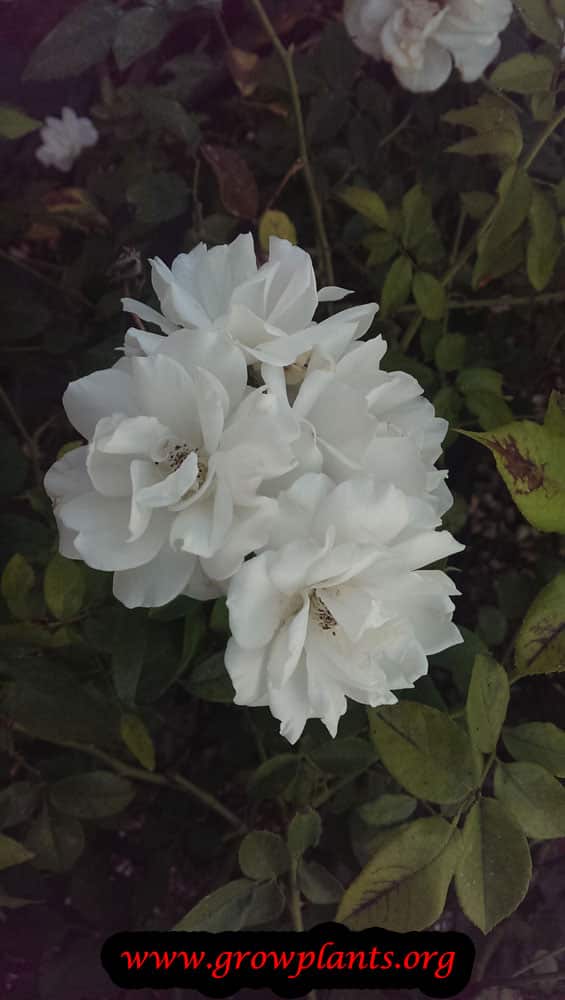
Plant Profile & Key Characteristics
Overview: A deciduous, thorny floribunda rose about 0.5-2 m (20-80 in) tall, grown as an ornamental and cut flower for its profuse, fragrant white flower clusters. It is one of the most free-flowering white roses.
Quick Specifications
| Specification | Attribute |
|---|---|
| Plant Type / Life Cycle | Perennial (deciduous shrub) |
| Foliage Type | Deciduous |
| Mature Size | 0.5-2 m (20-80 in) tall |
| Growth Rate | Fast to moderate |
| Toxicity | Non-toxic to people and pets (petals and hips are edible) |
| Hardiness | USDA zones 4-10a |
Growth Form & Structure
- Height & Spread: 0.5-2 m (20-80 in) tall in the ground; grows well in containers too, kept in scale by regular pruning.
- Growth Habit & Form: Thorny (spiny) deciduous shrub, renewed by pruning after each flush of bloom to keep growth open and healthy.
- Lifespan & Maturity: A long-lived perennial rose that flowers freely once established, repeating through the season with good care.
Anatomy & Physical Features
- Leaves & Foliage: Green, elliptic leaflets arranged in a pinnate (feather-like) structure.
- Flower Characteristics: Fragrant white flowers with 25+ petals, mostly carried in clusters.
Primary Uses & Landscape Value
- Functional & Ornamental Roles: Grown as an ornamental garden and border shrub and as a fragrant cut flower for the vase.
Care Guide: Planting, Soil & Watering
Overview: The ‘Iceberg’ rose thrives in full sun with fertile, well-draining soil enriched with organic matter, and it appreciates a slightly acidic root zone and a spell of cool winter weather. It likes steady, generous moisture through the growing season, so keep the soil evenly moist but never waterlogged.
Quick Care Requirements
| Requirement | Ideal Condition |
|---|---|
| Planting Season | Cold climates in spring; mild/warm climates in winter |
| Growth Rate | Moderate to Fast |
| Soil Type | Fertile, well-draining soil enriched with organic matter |
| Soil pH | Slightly acidic, around 6.0–6.5 |
| Water Need | Moderate to High — keep evenly moist, letting the surface dry slightly between waterings |
Planting & Establishment
- Best Planting Season: In cold-winter climates plant in spring once hard frosts have passed; in mild or warm climates plant through winter into early spring while the plant is dormant.
- How to Plant:
- Hole Preparation: Dig a hole noticeably wider than the root ball and deep enough to spread the roots out comfortably, loosening the soil at the base.
- Soil Amendments: Mix plenty of compost or well-rotted organic matter into the backfill to feed the plant and improve both drainage and moisture retention.
- Planting Depth: Set the plant so the grafted bud union sits at soil level in mild climates, or a few centimetres below the surface where winters are cold; firm the soil and avoid burying the stems.
- Growth Speed & Expectations: A moderate to fast grower that establishes quickly and flowers abundantly in white clusters through the season.
Soil, Watering & Drainage Care
- Soil Mix & Drainage Needs: Give it light, well-aerated soil that drains freely; in containers use a quality free-draining potting mix rather than heavy garden soil, and make sure excess water can escape to prevent root rot.
- Watering Schedule & Technique:
- Young / Newly Planted: Water thoroughly at planting and keep the soil consistently moist while the roots establish, aiming for deep soakings rather than frequent light sprinklings.
- Established: Water deeply and regularly through the growing season — roughly once or twice a week — letting the top few centimetres dry before watering again, and try to water at the base rather than wetting the foliage.
- Seasonal Adjustments: Increase watering during hot, dry spells and cut back in cool weather and winter dormancy, when growth slows.
Climate, Light & Hardiness
The Iceberg rose grows in temperate, Mediterranean and subtropical climates and flowers best in full sun. It is a hardy deciduous shrub - cold-tolerant across roughly 4–10a when dormant - though its blooms can scorch in extreme summer heat.
Quick Climate Specifications
| Climate Zones | Temperate, Mediterranean, subtropical |
|---|---|
| USDA Hardiness Zones | 4–10a |
| Optimal Temp Range | Mild, roughly 15–25°C (59–77°F) |
| Cold Damage Begins | Dormant canes are hardy; late frost damages tender spring growth |
| Approx. Survival Minimum | Zone 4 corresponds to winter lows near −34°C (−29°F); grafted plants benefit from graft-union protection at the cold end |
| Frost Tolerance | Moderate when dormant (varies by cultivar and rootstock) |
| Light Conditions | Full sun (a little less than full sun only in warm climates) |
| Wind Tolerance | Moderate |
Sunlight & Light Exposure
Optimal Light Setup
Give it an open, sunny position with at least six hours of direct sun a day for the strongest flowering.
Direct Sun Requirement
Full sun is needed for good bloom; in only warm climates it accepts a little less than full sun, but heavy shade reduces flowering and encourages weak, disease-prone growth.
Shade & Heat Management
Where summers are very hot, some afternoon shade protects the flowers, whose petals scorch and fade in high temperatures.
Temperature Extremes & Hardiness
USDA Hardiness & Regional Limits
The site data lists hardiness 4–10a. Cold tolerance varies by cultivar and by grafting/rootstock, so match the variety to your winters. This is a robust, widely grown floribunda; even so, cold tolerance varies with siting and grafting.
Cold Damage & Winter Protection
Established dormant canes are cold-hardy within range, but late spring frosts nip tender new shoots. In the coldest zones mound soil or mulch over the graft union for winter.
Frost Sensitivity
The dormant plant is frost-hardy; soft spring growth and open flowers are the frost-sensitive stages.
Extreme Heat Tolerance
The plant takes summer heat, but the flowers burn and fade quickly in high temperatures - blooms last longer in cooler spells or with light afternoon shade.
Wind, Humidity & Microclimate
Wind Tolerance
Wind tolerance is moderate; its bushy habit stands wind reasonably well but shelter improves flower quality.
Humidity Preferences
Open, airy positions with good air movement are preferred; stagnant, humid air stresses the plant. Rainfall and season shift bloom timing - flowering runs spring to autumn in cool climates and through the mild months in warm ones.
Microclimate Recommendations
An open, sunny bed away from frost pockets gives reliable flowering.
Growing in Pots, Balconies & Indoors
The Iceberg rose is a tough, free-flowering white floribunda – an excellent patio and balcony plant but not a houseplant. The grower confirms it grows well in containers, yet indoors the light is far too weak. In a large, free-draining pot in full sun it produces clouds of bloom all season on a patio or sunny balcony.
Quick Details
- Container Size: A roomy pot of about 20-40 L (5-10 gal) for its 0.5-2 m (20-80 in) size; roses want root depth
- Indoor Suitability: Not a houseplant – it needs full sun and fresh air; even a sunny sill rarely gives enough light
- Best Spot: Full sun (a little less only in warm climates, where midday shade protects the blooms)
- Soil & Drainage: Rich, organic, free-draining mix; roses are hungry and dislike waterlogging
- Watering in Pots: Average to generous – keep evenly moist; pots dry fast and roses resent drought when budding
Indoors & On the Windowsill
- Not an indoor plant: The grower marks it as unsuitable indoors. Roses need full sun, air movement and a winter rest they cannot get in a warm room, so they belong outside.
- Windowsill reality: Even the brightest sill gives too little light for healthy flowering and invites mildew – grow Iceberg outdoors, not on a windowsill.
- Overwintering: In containers the roots are more frost-exposed than in the ground; in cold areas move the pot to a sheltered spot or wrap it, as the plant rests leafless over winter.
On a Balcony or Patio
- Light & heat: Give it the sunniest spot; in hot climates a little afternoon shade stops the flowers scorching, which the grower notes roses do in high heat. Iceberg is unusually disease-resistant, but good airflow still helps.
- Water & wind: Walls and paving reflect heat and dry the pot fast, so check moisture daily in summer; shelter tall stems from strong wind.
Choosing the Pot, Soil & Long-Term Care
- Pot & drainage: A deep 20-40 L pot with strong drainage holes; skip a standing water saucer to avoid root rot. Terracotta breathes and dries faster, while glazed or plastic pots hold moisture longer.
- Potting mix: Rich, organic and free-draining – a loam-based potting mix suits roses better than a light, peaty one.
- Feeding: Potted roses are hungry and leach nutrients with watering, so feed regularly through the growing season with a rose or balanced feed for continuous bloom.
- Repotting & pruning: Refresh the top of the mix each year and pot on or renew every couple of years; prune in the dormant season to shape and encourage strong flowering shoots. Mind the spines when handling.
Fertilizing & Feeding
Iceberg rose is a moderate feeder that responds to steady, light feeding with a balanced complete fertilizer through the growing season; it does not need special high-phosphorus bloom products.
Quick Fertilizing Specs
| Feeding Level | Moderate |
|---|---|
| Best Feeding Period | Through the active growing season, from spring into the warm months. |
| Main Nutrient Priority | A balanced complete fertilizer. |
| Soil pH | Slightly acidic to near neutral. |
| Organic Options | Compost, aged manure, or other organic matter. |
| Micronutrients | Usually supplied by a complete fertilizer; iron may need attention on alkaline soils. |
| Reduce/Stop Feeding | Ease off as growth slows into dormancy. |
Feeding by Growth Stage
Spring growth flush
Support the flush of new stems and leaves as growth resumes in spring.
| Nutrient direction | A balanced, complete fertilizer to fuel steady stem and leaf growth. |
|---|---|
| Timing | As new growth begins in spring. |
| Frequency | Begin light, regular feeding through the active growing season. |
| Fertilizer types | Balanced complete garden fertilizer, Compost or other organic matter worked in at the start of the season |
| Precautions | Avoid heavy nitrogen on its own, which pushes soft growth that pests and disease attack easily. |
Main bloom
Sustain flowering without forcing excess soft growth.
| Nutrient direction | A balanced complete fertilizer; adequate nitrogen and potassium support bloom better than high-phosphorus products. |
|---|---|
| Timing | Through the main blooming period. |
| Frequency | Continue light, regular feeding across the bloom season. |
| Fertilizer types | Balanced complete fertilizer, Slow-release complete fertilizer for a steady supply |
| Precautions | High-phosphorus ‘bloom booster’ products are unnecessary and can unbalance the soil. |
Repeat bloom
Encourage successive flushes of flowers after deadheading.
| Nutrient direction | A balanced complete fertilizer to refuel the plant between flushes. |
|---|---|
| Timing | After each flush of flowers fades and is trimmed. |
| Frequency | Light feeding to support the next flush during the growing season. |
| Fertilizer types | Balanced complete fertilizer |
| Precautions | Keep feeding light and even; sudden heavy doses can burn roots and scorch foliage. |
Winter dormancy
Let the plant rest through the cold season without pushing tender growth.
| Nutrient direction | None – withhold fertilizer while the plant is resting. |
|---|---|
| Timing | Through winter dormancy. |
| Frequency | No feeding at this stage. |
| Fertilizer types | No feeding at this stage – a resting plant is not taking up nutrients. |
| Precautions | Do not fertilize until active growth resumes. |
Nutrient Deficiency Signs & Corrections
Older, lower leaves turn uniformly pale green to yellow and overall growth slows.
| Possible causes | Low available nitrogen in the soil, Cold or waterlogged soil limiting root uptake, Nitrogen leached away after heavy watering or rain |
|---|---|
| Appears first on | Older, lower leaves. |
| What to check | Whether paling starts on old lower leaves, Recent feeding history, Soil moisture and drainage |
| Possible correction | Apply a balanced complete fertilizer at a light rate and improve drainage; nitrogen-hungry plants green up as growth resumes. |
Youngest leaves show yellowing between green veins (interveinal chlorosis).
| Possible causes | High or alkaline soil pH locking up iron, Waterlogged or poorly aerated soil, Genuinely low available iron |
|---|---|
| Appears first on | Newest, youngest leaves. |
| What to check | Whether yellowing is on new versus old growth, Soil pH, Soil drainage and watering habits |
| Possible correction | Confirm soil pH and correct it if it is too high, improve drainage, and apply a chelated iron product following its label directions. |
Older leaves show yellowing and browning (scorch) along their margins.
| Possible causes | Low available potassium in the soil, Sandy soils that hold few nutrients, Drought stress limiting uptake |
|---|---|
| Appears first on | Older, lower leaves, starting at the margins. |
| What to check | Leaf margins on older leaves, Soil type and organic matter, Watering consistency |
| Possible correction | Apply a complete fertilizer that also supplies potassium and keep the soil evenly moist; avoid relying on nitrogen-only products. |
Pruning, Training & Seasonal Maintenance
Iceberg is a floribunda rose, grown for its dense clusters of small white blooms rather than single perfect flowers, and its pruning is correspondingly lighter than a hybrid tea’s: instead of cutting hard to just 3-5 canes, keep a fuller framework of stems so the plant can produce the mass of clustered bloom it’s known for. The safest window is the same as other roses in this range — spring in cold climates, autumn/winter in warm climates — and, as with any grafted rose, pruning affects flowering because the plant blooms on new growth produced after the cut.
Quick Pruning & Maintenance Specs
| Pruning Tolerance | High, but moderate in severity (lighter than a hybrid tea’s hard cutback) |
| Primary Pruning Window | Cold climate: spring, before growth resumes. Warm climate: autumn or winter |
| Secondary Maintenance Window | Ongoing deadheading of spent flower clusters through the bloom season(s) |
| Typical Frequency | One moderate structural prune per year, plus truss deadheading after each cluster finishes |
| Main Objective | Open the plant for airflow while retaining enough framework for a full flush of clustered bloom |
| Young Plant Priority | Build a fuller set of well-spaced canes from above the graft union than a hybrid tea would keep |
| Mature Plant Priority | Moderate annual renewal cut, ongoing removal of weak/crossing/diseased wood, truss deadheading |
| Best Tool Type | Bypass secateurs for canes and clusters; thorn-resistant gloves given the plant’s spines |
| Avoid Heavy Pruning During | Active bloom flushes and extreme summer heat, when flowers are noted to burn |
Pruning by Plant Age & Size
Newly Established
In the first season, remove only weak, damaged or dead growth and let the plant build reserves before any structural prune.
Young / Formative
Working from the graft union upward, build a fuller framework than a hybrid tea would carry — several more well-spaced canes rather than a tight 3-5-cane vase — since floribundas like Iceberg flower most impressively as a mass of clustered blooms across a broader structure, not as a few large single flowers.
Mature / Established
Each dormant season, prune moderately: shorten canes and remove crossing, weak or diseased wood, but leave more of the framework intact than a hybrid tea prune would, and keep deadheading spent trusses through the growing season(s).
Seasonal Pruning Schedule
Dormant/Winter or Pre-Growth (cold climate: spring; warm climate: autumn/winter)
Objective: renew flowering wood while preserving the fuller cane framework this class needs for cluster bloom. Remove: dead, damaged, thin or crossing canes; shorten remaining canes moderately to an outward-facing bud. Do not remove: as much wood as a hybrid tea prune would — over-hard pruning reduces the number of flowering shoots and thins out the cluster effect. Expected response: a fuller flush of new growth carrying multiple flower trusses per cane.
Ongoing Sanitary (through the bloom season)
Objective: keep the plant flowering and reduce disease entry points. Remove: whole spent flower trusses once the cluster has finished (rather than picking off individual faded blooms one at a time), cutting back to an outward-facing five-leaflet leaf, and any cane showing fungal dieback. Do not remove: trusses still carrying open or unopened buds.
Flowering & Fruiting Wood
Like other modern roses, Iceberg flowers on new growth produced after pruning rather than on old wood, so the moderate dormant cut shapes how much bloom-bearing growth the plant produces that season — but because the goal here is a mass of clusters rather than a few large blooms, pruning too hard trades away the cluster display a hybrid-tea-style hard cut would be fine sacrificing for. Deadheading whole trusses after they finish (rather than single flowers) keeps the plant cycling into new clusters instead of diverting energy into hip formation from the last few fading blooms in a truss.
Structural Pruning & Training
Still remove growth that crosses into the plant’s center or rubs against other canes, for airflow and disease management, but aim for an open, bushy mass rather than the tightly opened vase of a hybrid tea — the fuller structure is what supports Iceberg’s characteristic abundance of clustered bloom.
Special Growth to Remove
- Rootstock suckers: this class is grafted, so remove growth arising below the bud union promptly before it outcompetes the cultivar.
- Spent flower trusses: deadhead whole clusters once finished, cutting to an outward-facing bud, as noted directly for this plant.
- Weak, thin or diseased canes: remove at the annual prune and whenever fungal dieback appears.
Container & Small-Space Pruning
Container growth (well tolerated per this plant’s data) calls for a somewhat lighter prune than an equivalent in-ground plant, scaling the number of retained canes down to the pot’s size while still keeping more framework than a hybrid tea in the same pot would need.
Tools
- Bypass secateurs for canes, truss deadheading and the annual structural prune.
- Loppers only for old, thick basal canes beyond what secateurs can manage cleanly.
- Thorn-resistant gauntlet gloves given the plant’s spines.
Tool Hygiene & Disease Risk
Increased: this class shares the noted fungal susceptibility of roses generally, so clean blades between cuts when removing diseased wood rather than relying on general routine hygiene alone.
Cut Placement & Technique
Cut at a slight angle just above an outward-facing bud so new growth heads outward rather than into the plant’s center; when deadheading, cut the whole truss stem back to the first outward-facing five-leaflet leaf rather than snapping off individual spent flowers.
Heavy Pruning & Rejuvenation
Tolerated, but a full hybrid-tea-style hard cutback is not the default here: if the plant becomes leggy or overgrown, a harder-than-usual renewal prune can reset it, but expect a temporary reduction in cluster bloom that season as the plant rebuilds framework.
Post-Pruning Care
Water normally after pruning; avoid heavy feeding immediately at cutback time, since the prune itself already stimulates regrowth. Watch new growth for aphids and early fungal symptoms, both noted risks for this class, and expect flowers to need some heat protection in extreme summer conditions independent of pruning.
Common Pruning Mistakes
- Pruning as hard as a hybrid tea, which thins out the cane count this class needs for its characteristic mass of clustered bloom.
- Deadheading single spent flowers within a truss instead of waiting for the whole cluster to finish and removing it as a unit.
- Leaving the plant’s center congested, raising fungal disease risk.
When NOT to Prune
Avoid a structural prune during an active bloom flush and during extreme summer heat, when the plant’s flowers are already noted to burn.
Recommended Tools (by task)
- bypass_secateurs – the annual moderate structural prune and routine truss deadheading.
- loppers – old, thick basal canes beyond what secateurs handle cleanly.
- blade_disinfectant – between cuts on canes showing fungal dieback.
Pruning Troubleshooting
| Problem | Possible Cause | What to Check | Corrective Action |
| Fewer, sparser flower clusters than expected | Pruning too hard, hybrid-tea style, removing too much of the cane framework | How many canes and how much length were retained at the last prune | Prune more moderately next season, keeping a fuller framework |
| Fungal spotting recurring | Congested center blocking airflow, or infected wood left in place | Density of growth at the plant’s center; any retained diseased canes | Open the center further and disinfect tools when removing infected canes |
| Slow repeat bloom after a flush | Spent trusses left in place instead of deadheaded | Whether finished flower clusters have been cut back promptly | Deadhead whole trusses to the first outward-facing five-leaflet leaf |
Propagation Guide
‘Iceberg’ is a single clone, so it must be propagated vegetatively to stay true; happily it strikes very readily from stem cuttings and is widely grown on its own roots, though it is also budded onto a rootstock. Seed does not reproduce the cultivar. For a rose it is among the easier ones to root.
Quick Propagation Specs
| Best Propagation Method | Stem cuttings (own-root) |
| Alternative Methods | Budding (T-budding) onto rootstock |
| Propagation Difficulty | Moderate |
| Seed True-to-Type | No — cultivar clone; seedlings vary |
| Vegetative True-to-Type | Yes |
| Best Propagation Season | Hardwood cuttings in autumn to winter; semi-ripe in late summer; budding in summer |
| Cutting Rooting Time | Several weeks |
Stem Cuttings
Cutting Type
Hardwood cuttings of firm stems in autumn, or semi-ripe cuttings in late summer.
Cutting Preparation
Cut just below a node and strip the lower leaves.
Rooting Setup
Insert in gritty, free-draining medium in a sheltered bed or deep pots; ‘Iceberg’ roots freely, so own-root plants are easily produced.
Rooting Hormone
Beneficial but not essential.
Rooting Time
Rooting takes several weeks; success is good for a rose.
Grafting & Budding
Why Grafting Is Used
Budding onto a vigorous rootstock is used where extra vigour or uniform nursery plants are wanted, and preserves the clone exactly.
Preferred Grafting Methods
T-budding (shield budding).
Rootstock
Standard rose stocks such as Rosa multiflora, R. canina or ‘Dr. Huey’.
Best Grafting Season
Summer, when the rootstock bark lifts.
Bloom & Edible Flower Guide
Quick Details
- Bloom Season: Spring to autumn in cool climates; autumn, winter and spring in warm climates
- Time to First Bloom: Often in the first season after planting, then repeating in flushes
- Flower Appearance: Fragrant, many-petalled white flowers (25+ petals), mostly in clusters
- Edibility: Edible – rose petals are edible when the plant is grown without chemical sprays
Detailed Blooming Overview
Iceberg is a much-loved white floribunda, famous for smothering itself in clean white clusters over a very long season. The flowers are lightly fragrant, and the petals are edible – pretty for garnishes or drying – as long as the plant has been grown without pesticides.
Flower Characteristics
- Pure white, many-petalled flowers (25 or more petals), carried in generous clusters.
- Lightly fragrant and produced in repeated flushes.
Bloom Care & Thinning
- Deadheading: Remove spent clusters to keep the long succession of flushes going.
- Feeding: A balanced rose feed after each flush supports the next round of bloom.
- Using the flowers: Pick freshly opened, unsprayed petals and trim off the bitter white base before use.
Bloom Health & Protection
- Aphids and thrips gather on buds and can distort or mark opening flowers. What helps: a strong jet of water, insecticidal soap or neem oil.
- Powdery mildew and black spot can disfigure buds and foliage in humid spells. What helps: good airflow, watering at the base, and a sulfur- or potassium-bicarbonate-based fungicide if needed.
- Botrytis (grey mould) can rot buds and blooms in damp, cool weather. What helps: removing affected flowers promptly and improving air movement around the plant.
Fruit & Uses
Iceberg rose is grown for its clustered, pure white fragrant blooms, and those petals are edible; if a spent flower is left rather than deadheaded, it will develop into a small hip. Petals are eaten raw or infused; hips are always cooked or strained.
Quick Edible Specs
| Edible Parts | Petals (flowers, white); hips (fruit), only from flowers left unpruned |
| Main Use(s) | Culinary – garnish, syrup, infusion, jam/tea (hips) |
| Eaten Raw or Cooked | Petals raw or infused; hips cooked or steeped, never raw |
| Preparation Required | Trim the bitter white base from each petal; deseed and strain hips to remove irritant seed hairs |
| Harvest Season | Petals during each bloom flush (see Blooming); hips in autumn from flowers not deadheaded |
| Time to First Harvest | Petals from the plant’s first bloom flush – see Blooming for seasonal timing |
| Storage | Petals best fresh or air-dried for tea; hips dried or frozen |
| Safety/Toxicity Caveat | Only eat petals or hips from plants never treated with pesticides or fungicides |
Flowers & Flower Buds
The clustered, high-petal-count white blooms are the edible part. Pick fully open, unblemished flowers in the morning, pull the petals apart, and trim the bitter pale base from each one. Because the petals are pure white with no pigment, they work well as a delicate garnish or crystallised decoration as well as for tea and syrup; only use flowers that have not been sprayed.
Fruit
Where a bloom is left instead of deadheaded (the routine described in Pruning), the flower base swells into a hip that ripens red-orange in autumn. Harvest once fully coloured and slightly soft, halve, and remove the seeds and their fine irritant hairs before cooking into syrup, jam or tea. As with other repeat-flowering roses, letting hips form trades off against further bloom flushes.
Preparation, Uses & Safety
Harvest only from pesticide- and fungicide-free plants. Rinse petals and trim the bitter white base before eating. Hips must be deseeded and strained of the irritant seed hairs; cook into syrup or jam, or steep for tea – never eat raw. Petals and hips have a long tradition of use in teas and skin preparations; no medical claims are implied.
Pests, Diseases & Troubleshooting
Overview: ‘Iceberg’ is a famously free-flowering white floribunda with good vigour but a known tendency to black spot in warm, humid, rainy climates, along with the usual aphids, thrips, spider mites and sawfly larvae, and some powdery mildew and rust. Open pruning, sanitation and clean-up of fallen leaves are the key defences, with sulfur/copper in reserve.
Quick Troubleshooting Overview
| Issue / Pest | Main Symptom | Primary Solution |
|---|---|---|
| Aphids | Sticky, curled shoot tips with clustered insects | Water jet, protect predators, insecticidal soap |
| Black spot | Fringed black spots, yellowing, leaf drop | Sanitation, airflow, resistant types, sulfur/copper |
| Powdery mildew | White powder on new growth and buds | Sun, spacing, sulfur or potassium bicarbonate |
| Spider mites | Stippled, bronzed leaves in heat | Hose undersides, raise humidity, horticultural oil |
| Rust | Orange pustules under leaves | Remove leaves, sanitation, resistant cultivars |
| Balling / botrytis | Buds rot and fail to open in wet weather | Deadhead, improve airflow, full sun |
Common Pests & Management
- Aphids (Macrosiphum rosae):
- Symptoms: Dense clusters of soft green, pink or black insects on tender new shoots, flower buds and the undersides of young leaves. Feeding causes distorted, curled growth and a sticky honeydew that turns black with sooty mould; buds may fail to open. Do not confuse the honeydew shine with disease.
- Prevention & Control: Encourage and protect natural predators (ladybirds, lacewings, hoverfly larvae, parasitic wasps) which usually control light infestations. Blast colonies off with a firm jet of water, and pinch out heavily infested shoot tips. If populations explode, treat with insecticidal soap or a light horticultural oil, spraying undersides thoroughly in the cool of evening to spare pollinators.
- Rose slug (sawfly larvae) (Endelomyia aethiops):
- Symptoms: Small green, slug-like larvae skeletonise the leaf surface, leaving a translucent, window-pane or lacy appearance between the veins; badly hit leaves turn brown and papery. These are sawfly larvae, not caterpillars, so caterpillar-specific bacteria do not affect them.
- Prevention & Control: Inspect leaf undersides at the first sign of window-paning and hand-pick or wipe off larvae, or knock them into soapy water. A firm water spray dislodges many. For heavier attacks use insecticidal soap or horticultural oil on both leaf surfaces; avoid broad-spectrum insecticides that kill the parasitic wasps that keep sawflies in check.
- Two-spotted spider mite (Tetranychus urticae):
- Symptoms: Fine pale stippling and a bronzed, dusty look to leaves, worst in hot dry weather and on plants under eaves or against warm walls; fine webbing appears on undersides and shoot tips in bad cases. Leaves may yellow and drop.
- Prevention & Control: Raise humidity and hose foliage undersides regularly, since mites thrive on dry, dusty plants. Avoid drought stress and excess nitrogen. Release or encourage predatory mites. If needed, apply horticultural oil or insecticidal soap, covering leaf undersides; rotate products and never rely on one miticide, as spider mites resist chemicals quickly.
- Western flower thrips (Frankliniella occidentalis):
- Symptoms: Petals (especially on pale and white roses) show brown streaks, flecks and distorted, browning edges; buds may fail to open cleanly. Silvery scarring and tiny black frass dots appear on foliage. Thrips are hard to see without shaking a bloom over white paper.
- Prevention & Control: Remove and bin spent and damaged blooms to break the breeding cycle, and keep the bed weed-free. Blue sticky traps help monitor and reduce numbers. Encourage predatory mites and minute pirate bugs. For persistent damage use spinosad or insecticidal soap, targeting buds and applied in the evening to protect bees.
- Rose scale (Aulacaspis rosae):
- Symptoms: Older, shaded canes become crusted with small round white or greyish scales; heavy encrustation weakens the cane, and the bush loses vigour.
- Prevention & Control: Prune out and destroy the worst-encrusted old canes to open the plant. Scrub light infestations off with a soft brush. Apply horticultural oil to smother the scales, targeting the crawler stage, and repeat as directed on the label.
Diseases & Fungal Issues
- Black spot (Diplocarpon rosae):
- Symptoms: Rounded black spots with feathery, fringed margins on upper leaf surfaces; surrounding tissue yellows and infected leaves drop, sometimes defoliating a bush from the base up. It is the classic rose disease in warm, humid, rainy climates.
- Treatment & Management: Prune for an open, airy centre and avoid overhead watering so foliage dries fast. Rake up and destroy fallen leaves and prunings, and mulch to stop spores splashing up. Choose resistant varieties. Where pressure is high, apply preventively a copper or sulfur-based fungicide, or a labelled rose fungicide, starting as leaves expand and repeating per label.
- Powdery mildew (Podosphaera pannosa):
- Symptoms: A white, powdery coating on young leaves, shoot tips and buds; new growth becomes twisted, thickened and reddened, and buds may not open. Unlike black spot it thrives in warm days with cool, humid nights rather than in rain.
- Treatment & Management: Improve airflow through correct spacing and pruning, site roses in full sun, and avoid soft, sappy growth from over-feeding with nitrogen. Water at the roots. A firm morning water spray can dislodge spores. Treat with sulfur, potassium bicarbonate or horticultural oil; do not apply sulfur in high heat or close to oil sprays.
- Rose rust (Phragmidium spp.):
- Symptoms: Bright orange-to-rust pustules on leaf undersides with matching yellow flecks on the upper surface; heavy infection yellows and drops leaves. Late in the season the pustules darken to black overwintering spores.
- Treatment & Management: Remove and destroy infected leaves promptly and clear all fallen debris in autumn, as the fungus overwinters on canes and litter. Improve air movement and avoid wetting foliage. Grow resistant cultivars where rust is chronic. Sulfur or a labelled fungicide applied at first signs, with good sanitation, keeps it in check.
- Botrytis blight (grey mould) (Botrytis cinerea):
- Symptoms: Buds droop, brown and fail to open (“balling”), and a fuzzy grey mould coats decaying petals in cool, wet or humid spells; spotting appears on outer petals of pale roses.
- Treatment & Management: Deadhead promptly and remove any rotting blooms and debris. Improve spacing and airflow, and avoid overhead irrigation late in the day. Do not over-fertilise. Fungicides are rarely needed if sanitation and airflow are good, but a botrytis-labelled fungicide can help in persistently damp conditions.
- Rose rosette disease (Emaravirus, spread by Phyllocoptes fructiphilus):
- Symptoms: Alarming red, distorted, witches’-broom growth with excessive soft thorns, thick fasciated stems and small malformed buds; the plant declines and dies over one to two seasons. It is spread by a tiny wind-borne eriophyid mite (and on infected stock), not by pruning tools alone.
- Treatment & Management: There is no cure: dig out and destroy the entire plant, roots included, as soon as symptoms are confirmed, to protect neighbouring roses. Space roses apart, avoid mass plantings, and control the vector mite with horticultural oil on new growth. Buy only clean, certified plants.
Growing Difficulties & Abiotic Problems
- Iron / manganese chlorosis:
- Cause & Symptoms: Youngest leaves yellow between green veins, usually on alkaline or waterlogged soils where the plant cannot take up iron and manganese even when they are present.
- Correction Strategy: Check and correct soil drainage and avoid over-liming. Mulch with organic matter to lower pH gradually, and apply a chelated iron (and manganese) feed as a fast correction. Keep watering even, since both drought and waterlogging worsen the yellowing.
- Blind shoots:
- Cause & Symptoms: Vigorous shoots that grow but end in no flower bud, common after a flush, in low light, or following frost damage to the embryonic bud.
- Correction Strategy: Prune the blind shoot back to a strong outward-facing bud to force a new flowering stem. Ensure at least six hours of sun, balanced feeding (not excess nitrogen) and even moisture to support repeat blooming.
- Balling of blooms:
- Cause & Symptoms: Buds, especially many-petalled roses in wet weather, form but the outer petals fuse into a papery brown shell and the flower never opens.
- Correction Strategy: Site roses in full sun with good airflow so blooms dry quickly, and choose varieties less prone to balling in your climate. Gently peel a stuck bud open if worth saving, and deadhead spoiled ones.
What Helps — Products & Tools
For roses the reliable, gentle toolkit is insecticidal soap and light horticultural or neem oil for aphids, thrips, sawfly larvae and spider mites; sulfur and potassium-bicarbonate fungicides for powdery mildew and rust; and copper or a labelled rose fungicide for black spot. Blue and yellow sticky traps help monitor thrips and aphids, and a chelated iron feed corrects lime-induced yellowing. Cultural care — sun, airflow, clean-up of fallen leaves and choosing disease-resistant varieties — does most of the work; always follow the label and spray oils and soaps in the evening to protect bees.