Plant Profile & Key Characteristics
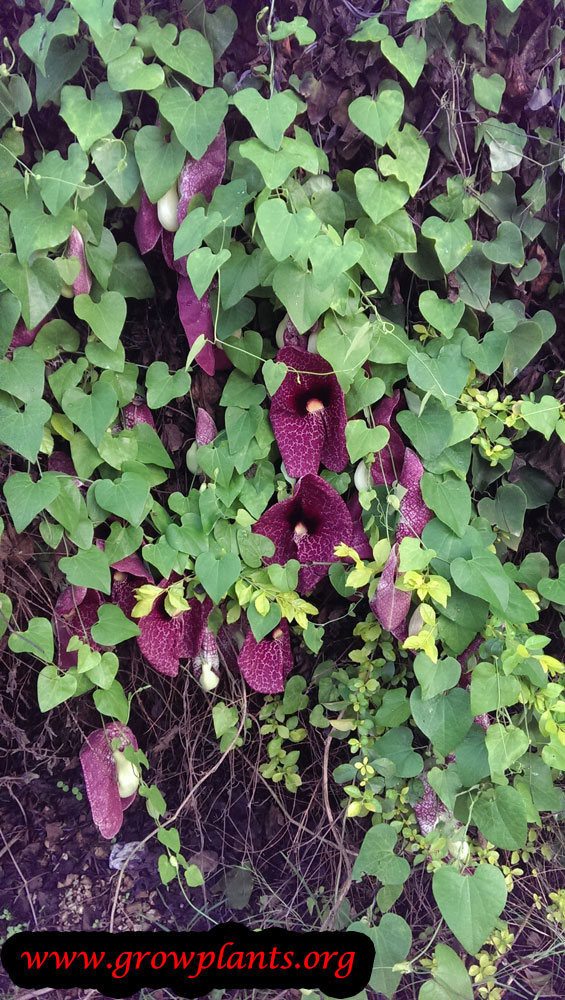
Overview: Dutchman’s pipe / pipevine (Aristolochia) is a vigorous perennial climbing vine reaching 2-10 m, evergreen in warm climates and deciduous where cold, grown as an ornamental screen for its curious pipe-shaped flowers. It is a fast, twining climber best given a trellis.
Quick Specifications
| Specification | Attribute |
|---|---|
| Plant Type / Life Cycle | Perennial (grown as an annual in cold climates) |
| Foliage Type | Evergreen (deciduous in cold climates) |
| Mature Size | 2-10 m long (6-30 ft) |
| Growth Rate | Fast |
| Toxicity | Toxic – contains aristolochic acid (nephrotoxic and carcinogenic); not for ingestion |
| Hardiness | USDA zones 10+ as perennial (5-9 as annual) |
Growth Form & Structure
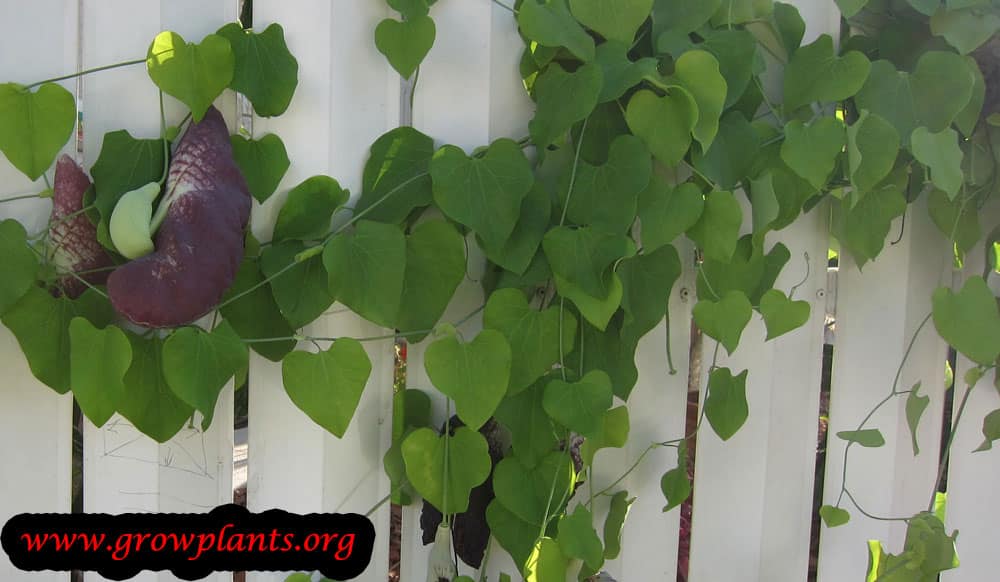
- Height & Spread: Twines to 2-10 m (6-30 ft); needs a trellis or support and can be container-grown.
- Growth Habit & Form: Fast, twining herbaceous-to-woody climbing vine.
- Lifespan & Maturity: Perennial in frost-free climates; fast to cover a support, but can spread invasively.
Anatomy & Physical Features
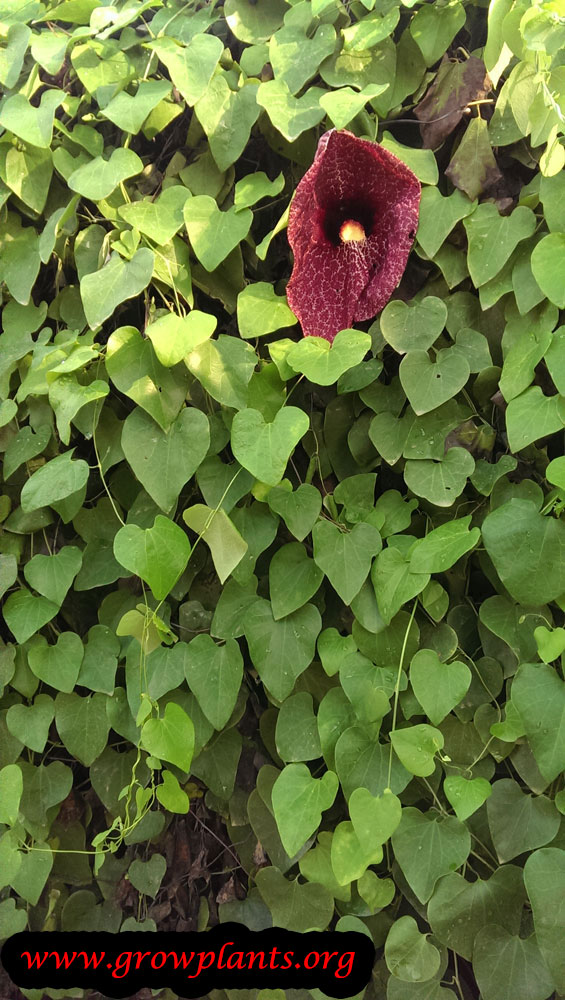
- Leaves & Foliage: Green to light-green heart-shaped leaves.
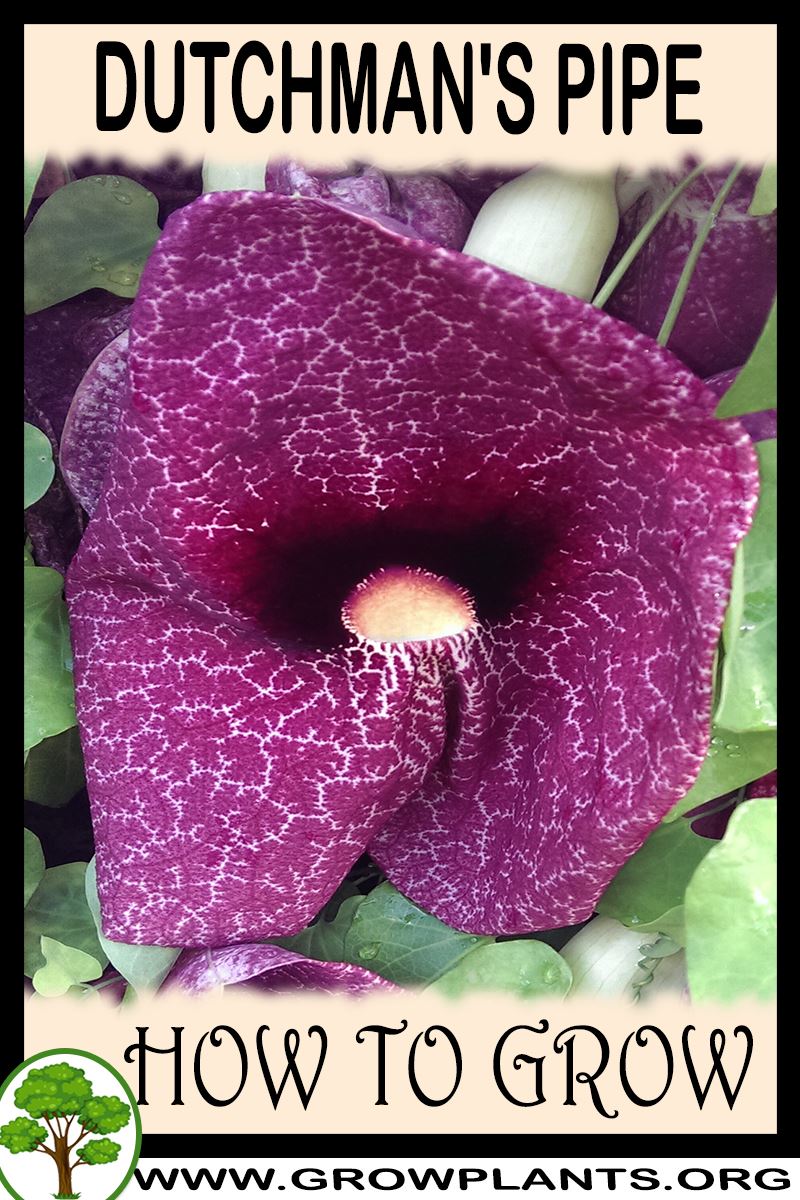
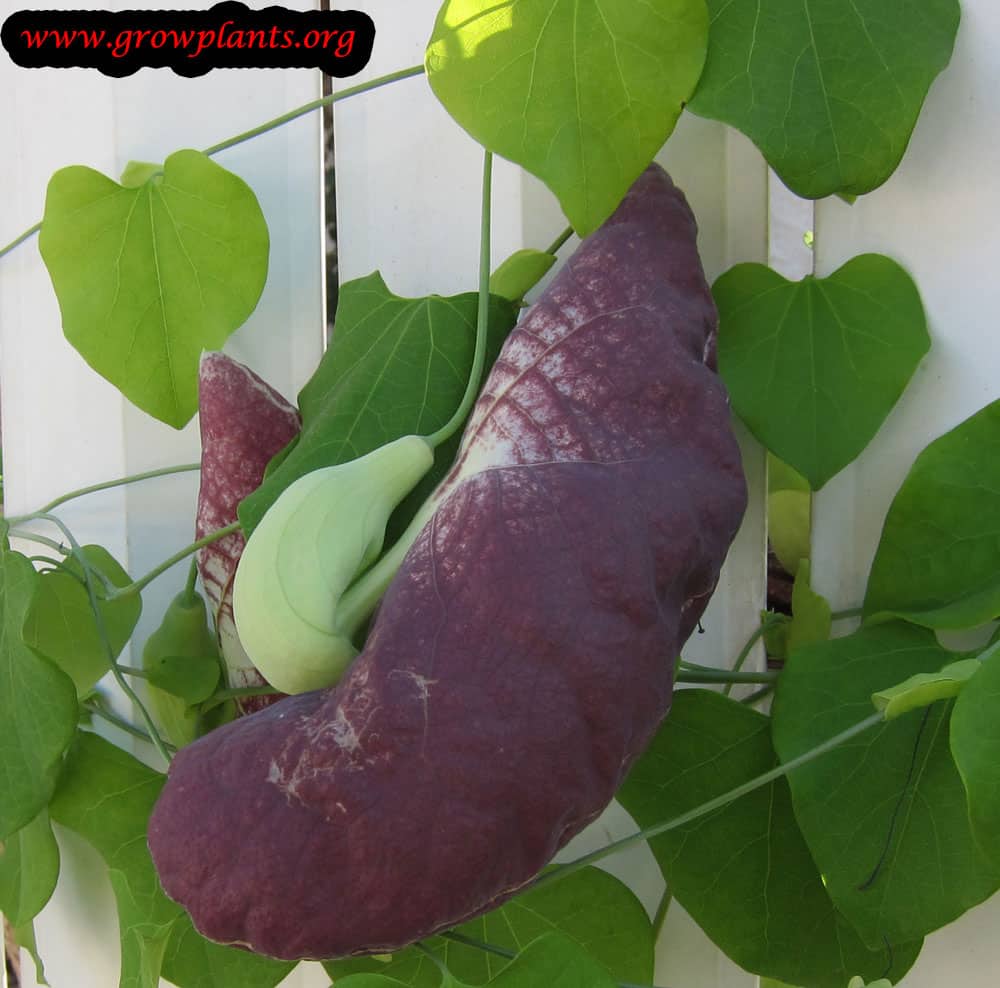
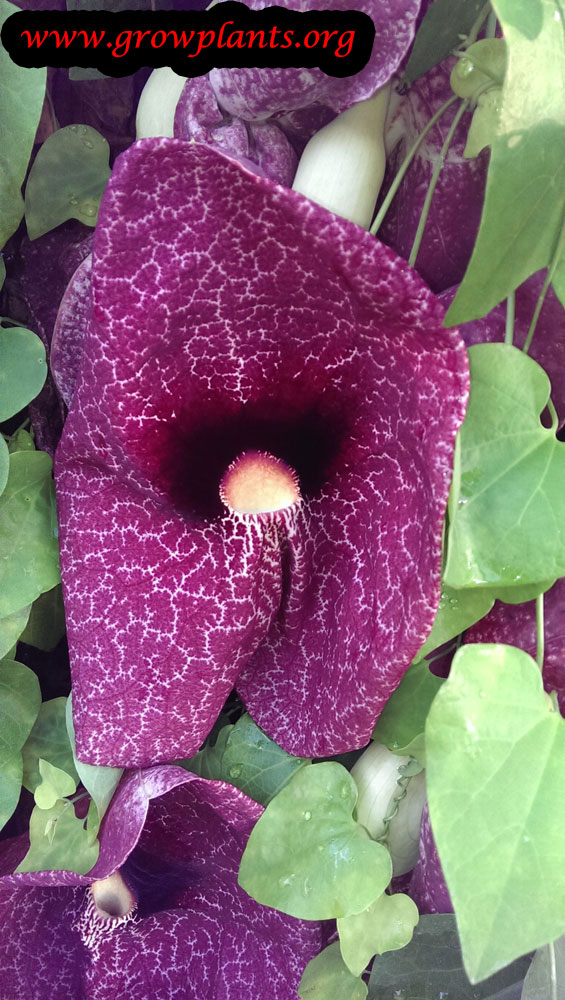
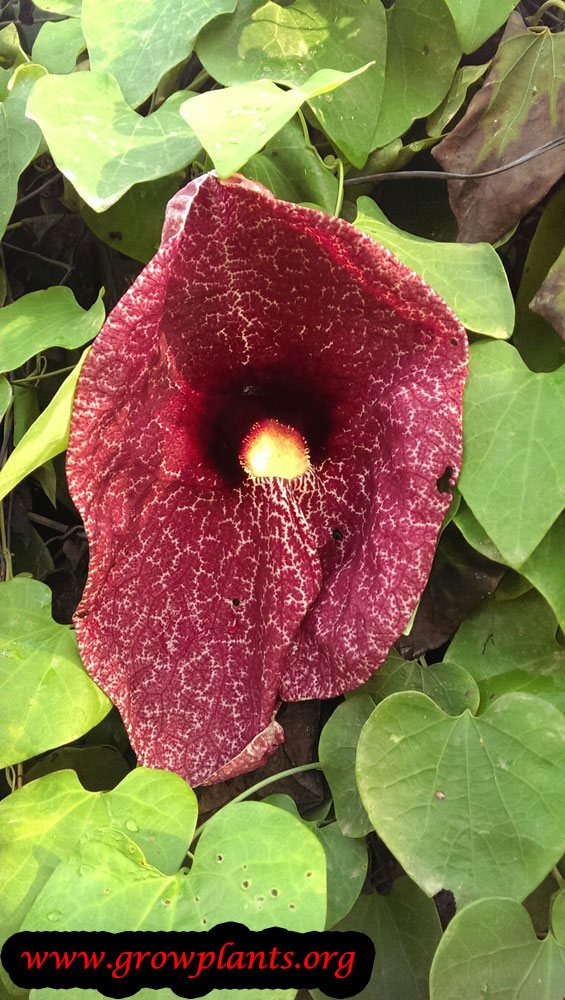
- Flower Characteristics: Curious pipe-shaped flowers – a sac-like base opening to a trumpet – patterned in purple, brown, yellow, orange, pink or red with contrasting throats; some cultivars fragrant.
Primary Uses & Landscape Value
- Functional & Ornamental Roles: Ornamental screening/cover vine for pergolas and trellises; a larval host for swallowtail (pipevine) butterflies. Can be invasive.
Care Guide: Planting, Soil & Watering
Overview: Dutchman’s pipe is a vigorous twining vine that needs a frost-free spot with a sturdy trellis, growing in full sun to part shade. It prefers fertile, moist but well-drained soil and steady, moderate moisture.
Quick Care Requirements
| Requirement | Ideal Condition |
|---|---|
| Planting Season | In spring through autumn |
| Growth Rate | Fast |
| Soil Type | Fertile, moist and well-draining |
| Water Need | Moderate; keep evenly moist |
Planting & Establishment
- Best Planting Season: Plant in spring through autumn, once all danger of frost has passed.
- How to Plant:
- Hole Preparation: Dig a hole twice as wide as the root ball beside a strong trellis or support, loosening the sides.
- Soil Amendments: Enrich the soil with compost or organic matter to fuel this fast-climbing vine and help hold moisture.
- Planting Depth: Set the top of the root ball level with the surface and keep the stem base clear.
- Growth Speed & Expectations: A fast, vigorous climber reaching 2-10 m (6-30 ft); provide sturdy support and be aware it can spread invasively.
Soil, Watering & Drainage Care
- Soil Mix & Drainage Needs: Give it fertile, moisture-retentive but well-drained soil. It can be grown in a large container with a rich, free-draining mix and a support.
- Watering Schedule & Technique:
- Young / Newly Planted: Keep the soil evenly moist while the vine establishes and starts to climb.
- Established: Water regularly so the soil does not dry out, especially in heat.
- Seasonal Adjustments: Water more in summer, reduce in cooler months, and protect from frost.
Climate, Light & Hardiness
Dutchman's pipe (Aristolochia) is a fast-growing climbing vine of warm climates, evergreen where it is frost-free and deciduous or cut back by cold at the margins of its range. It grows in full sun to half shade on a trellis and has little frost tolerance, though hardiness varies between species in this genus.
Quick Climate Specifications
| Climate Zones | Tropical, subtropical, Mediterranean and warm temperate; grown as an annual in colder regions |
| USDA Hardiness Zones | Approx. zone 10 and warmer as a perennial; grown as an annual in about zones 5–9 |
| Optimal Temp Range | Warm, roughly 18–30°C (64–86°F) |
| Cold Damage Begins | Around 5°C (41°F) |
| Approx. Survival Minimum | Near 0°C (32°F) briefly - no hard frost |
| Frost Tolerance | Very Low |
| Light Conditions | Full sun to half shade |
| Wind Tolerance | Moderate (needs sturdy support) |
Sunlight & Light Exposure
Optimal Light Setup
It flowers and climbs best in full sun to half shade; deep shade reduces flowering and thins the growth.
Shade & Heat Management
In hot climates its roots appreciate shade and mulch while the top climbs into the sun; light afternoon shade protects the large soft leaves from scorch.
Best Exposure / Orientation
Give it a warm, sheltered wall, fence or pergola to scramble over; it is a vigorous vine, not a houseplant.
Temperature Extremes & Hardiness
USDA Hardiness & Regional Limits
Reliably perennial in roughly zone 10 and warmer; grown as an annual in about zones 5–9. Hardiness varies widely across the genus - the site rating applies to the tender ornamental pipevines, while some temperate species are considerably hardier. The zone rating reflects the outdoor winter-cold limit, not a heat preference.
Cold Damage & Winter Protection
Growth stops in cool weather and chilling injury generally begins around 5°C (41°F). In marginal zones the top may be cut back by cold while a mulched, established root can resprout in spring.
Frost Sensitivity
Frost tolerance is low; the soft foliage is damaged by frost, and only established roots in mild-winter areas reliably survive.
Extreme Heat Tolerance
Heat tolerance is good - it grows fast and flowers freely through warm, humid summers.
Wind, Humidity & Microclimate
Humidity Preferences
Being a tropical vine it enjoys moderate to high humidity, which keeps the large leaves fresh.
Dry-Air Tolerance
Dry-air tolerance is only moderate; hot, dry winds can scorch and tatter the foliage.
Wind Tolerance
The long, leafy stems catch the wind, so give the vine a strong support and a position sheltered from strong gusts.
Microclimate Recommendations
A warm, sheltered spot with the roots mulched and the stems climbing into sun suits it best; in marginal zones a protected wall improves winter survival.
Growing in Pots, Balconies & Indoors
Dutchman’s pipe (Aristolochia) is a vigorous woody climber that can reach 2-10 m, so it is a container plant only while young, or where you can give it a large tub and a strong support. It is not a houseplant; grow it outdoors on a sunny to part-shaded balcony or patio with something sturdy to climb.
Quick Details
- Container Size: Large tub, 30 L or more, with a strong trellis or frame
- Indoor Suitability: Not a houseplant – too large and vigorous for indoors
- Best Spot: Full sun to part shade, outdoors, with sturdy support
- Soil & Drainage: Aerated, organic-rich mix with good drainage
- Watering in Pots: Keep evenly moist – average water; more often in a pot, which dries faster
Indoors & On the Windowsill
- Houseplant limits: The grower marks it as not an indoor plant – it is a large, fast climber that quickly outgrows any room and needs full outdoor light.
- Windowsill growing: Not suitable; there is no dwarf form that stays sill-sized.
- Safety: All parts contain aristolochic acid and are toxic if eaten – keep it away from children and pets, and wash your hands after handling.
On a Balcony or Patio
- Light, support & wind: A sunny balcony or patio is where this climber shines – give it a trellis, railing or strings to climb and shelter it from strong wind, which shreds the soft growth. Reflected heat from walls dries the pot fast, so check moisture daily in warm weather. A drip irrigation kit with a timer can take over that watering check automatically.
- Practicalities: Make sure the filled pot and its support are stable and that drainage runoff can escape freely without pooling below.
Choosing the Pot, Soil & Long-Term Care
- Pot & drainage: A large tub of 30 L or more with strong drainage holes; skip a standing water saucer so the roots never sit wet. Terracotta breathes and dries faster, while glazed or plastic holds moisture longer.
- Potting mix: Well-aerated and organic-rich – a general potting mix, or peat/coir with perlite or vermiculite.
- Feeding: Potted plants need feeding more often than those in the ground because nutrients leach out with each watering – feed lightly through the growing season.
- Repotting: Refresh the mix or pot up about every couple of years; for perennials, lightly prune the root ball and top growth at the same time.
Growing this plant in a greenhouse
A greenhouse can give dutchman's pipe frost protection and cold protection.
Greenhouse at a glance
| Greenhouse suitability | Conditional - depends on your climate |
|---|---|
| Main benefits | frost protection, cold protection |
| Season extension | earlier spring & later autumn |
| Outdoor protection advisable below | about 5°C |
| Maintain greenhouse minimum | around 5°C for active growth |
| Suitable types | unheated greenhouse, polycarbonate greenhouse, lean-to |
| Heating | Heating is optional - useful mainly for winter growing in cold areas. |
Related greenhouse guides
- Greenhouses: How to Choose the Right Greenhouse
- Best Lean-To Greenhouses
- Polycarbonate Greenhouses: What to Look for Before Buying
Fertilizing & Feeding
A moderate feeder: a balanced feeding through the warm growing season supports this vigorous vine’s leafy climb and flowering, eased back as it rests in cold weather.
Quick Fertilizing Specs
| Feeding Level | Moderate feeder |
|---|---|
| Main Nutrient Priority | Balanced complete feeding with adequate nitrogen for leafy climbing growth |
| Best Feeding Period | Spring through the warm active growing season |
| Organic Options | Compost and mulch over the root zone |
| Reduce/Stop Feeding | Ease back as growth slows in autumn and winter |
| Soil pH | Tolerates a fairly wide, near-neutral range in well-drained soil |
Feeding by Growth Stage
Establishment after planting
Settle the young vine in and get roots and shoots growing onto its support.
| Nutrient direction | A gentle balanced feeding to get roots established without forcing soft growth. |
|---|---|
| Timing | At and just after planting. |
| Frequency | A light feeding as the vine takes hold. |
| Fertilizer types | A balanced complete fertilizer, Compost worked into the planting area |
| Precautions | Go easy at first; let the root system establish before pushing top growth. |
Warm-season climbing growth
Fuel vigorous leafy growth and flowering as the vine covers its support.
| Nutrient direction | A balanced complete fertilizer with adequate nitrogen for steady leafy, climbing growth. |
|---|---|
| Timing | Through the warm active growing season. |
| Frequency | Light feeding spread through the growing season. |
| Fertilizer types | A balanced complete fertilizer, Compost or mulch as a top-dressing |
| Precautions | This is a fast, vigorous vine, so avoid overfeeding that produces rampant, hard-to-manage growth. |
Cold-season rest
Let the vine rest through cold weather, when it may drop its leaves.
| Nutrient direction | None – withhold fertilizer while the plant is not in active growth. |
|---|---|
| Timing | During autumn and winter as growth stops. |
| Frequency | No feeding at this stage; resume only when active growth returns. |
| Fertilizer types | No feeding at this stage; do not fertilize until active growth resumes. |
| Precautions | Do not fertilize now; feeding a plant that is not actively growing wastes nutrients and risks salt buildup. |
Nutrient Deficiency Signs & Corrections
Older, lower leaves fade to pale green or uniform yellow and overall growth slows.
| Possible causes | low available soil nitrogen, nitrogen lost to leaching from heavy watering or rain, thin soil low in organic matter |
|---|---|
| Appears first on | older, lower leaves |
| What to check | recent feeding history, soil organic matter, watering and drainage |
| Possible correction | Apply a nitrogen-containing complete fertilizer and build soil organic matter, then water evenly. |
Interveinal yellowing on older leaves while the veins stay green.
| Possible causes | low soil magnesium, potassium-heavy feeding competing with magnesium uptake, leaching in light, sandy soils |
|---|---|
| Appears first on | older, lower leaves |
| What to check | soil magnesium status, how potassium-heavy recent feeding has been, soil texture and leaching |
| Possible correction | Apply a labeled magnesium source such as Epsom salt or a dolomitic amendment and rebalance feeding. |
Leaf margins brown or scorch and growth stalls despite adequate watering.
| Possible causes | fertilizer salt buildup in the root zone, under-watering that concentrates salts, excessive or too-frequent feeding |
|---|---|
| Appears first on | leaf margins and tips |
| What to check | recent fertilizer amounts, watering consistency, drainage, especially in containers |
| Possible correction | Ease off feeding, water thoroughly to rinse accumulated salts, then return to lighter feeding. |
Pruning, Training & Seasonal Maintenance
Dutchman’s pipe is a vigorous, fast-growing twining vine (evergreen in frost-free climates, deciduous where grown as an annual in cooler zones) that needs regular control far more than shaping — left alone it can spread aggressively, which is flagged as a known difficulty with this plant. It tolerates significant cutting back, and the main objective of pruning is keeping the tangle of twining stems within the bounds of its support and managing its spreading tendency, not building a permanent framework. The safest and most effective time for a structural cutback is the dormant season (autumn/winter), when the vine’s growth has slowed; lighter control cuts can be made through the growing season as needed. Pruning mainly affects size, spread and how well the vine covers its trellis rather than a defined fruiting crop.
Quick Pruning & Maintenance Specs
| Pruning Tolerance | High |
| Primary Pruning Window | Autumn / winter (dormant or slowed growth) |
| Secondary Maintenance Window | Light control cuts through the growing season |
| Typical Frequency | One structural cutback per year, plus ongoing spot control |
| Main Objective | Contain spread and shape growth on its support |
| Young Plant Priority | Establish and tie in leaders onto the trellis |
| Mature Plant Priority | Control invasive spread; thin congested tangles |
| Best Tool Type | Bypass secateurs; loppers for older basal stems |
| Avoid Heavy Pruning During | The first growing season while leaders are still establishing on the support |
Pruning by Plant Age & Size
Newly Established
In the first season, prune only to remove damage; the priority is letting leaders reach and grip the support, not cutting them back.
Young / Formative
Train as a twining vine on a trellis or other support — guide and loosely tie leading stems to the structure rather than pinching for a bushy shape; this is not a plant that takes a central-leader or vase form.
Mature / Established
On an established vine, the priority becomes annual dormant-season control: cut back the previous season’s growth to keep it inside its allotted space, and thin out congested, self-tangled sections so light reaches the interior.
Seasonal Pruning Schedule
| Stage | Objective | Remove | Do Not Remove | Response / Impact |
| Dormant / Winter | Main structural control cut | Overlong stems, congested tangled growth, damaged wood | Main framework stems tied to the support | Vigorous new twining growth resumes in spring; little effect on the following bloom given flowering occurs on the new season’s growth |
| Ongoing Sanitary (growing season) | Keep the vine within bounds | Wayward twining shoots straying off the support, any self-layered rooted stems | Healthy leaders still filling the support | Redirects vigor to the trained framework and limits spread |
Structural Pruning & Training
Structural work is almost entirely about controlling a naturally rampant, self-tangling twiner: select and tie in the leaders you want to keep, remove crossing and inward-twining stems that choke the framework, and thin dense pockets so the support doesn’t become a solid mat. Renewal is simple — because the vine regrows vigorously, an overgrown section can be cut back hard in the dormant season to force fresh, more manageable growth.
Special Growth to Remove
- Self-layered stems that have rooted where they touch the ground — a key route by which this vine spreads beyond its support
- Wayward shoots twining onto nearby plants, fences or structures it isn’t meant to cover
- Spent flower stems (minor, mostly cosmetic)
Container & Small-Space Pruning
Grown in a large pot with its own small trellis, the vine is far easier to keep in bounds — confine roots to naturally check its vigor, and pinch new growing tips through the season to keep it compact rather than waiting for one big dormant-season cutback.
Tools
- Bypass secateurs — for the bulk of twining stems and dormant-season thinning cuts
- Loppers — for thicker, older basal growth at the base of a mature vine
- Soft ties or stakes — to train and secure leaders to the support as they grow
Tool Hygiene & Disease Risk
Routine — clean, sharp tools are enough. Aphids are the main recurring pest; no significant disease risk is associated with pruning cuts on this vine.
Cut Placement & Technique
Make thinning cuts back to a healthy node or junction, choosing a bud that faces the direction you want the new twining growth to travel along the support. Avoid leaving long stubs, which die back and look untidy on an otherwise clean-stemmed vine.
Heavy Pruning & Rejuvenation
Tolerated well — given its fast growth and tendency toward invasiveness, an overgrown vine can be cut back hard in the dormant season and will regrow vigorously the following season, though on a very old, thick base it is worth spreading a severe renewal over two seasons to avoid losing all cover at once.
Post-Pruning Care
After a hard cutback, retrain the strongest new leaders back onto the support promptly, since this twiner will otherwise grab the nearest available object. Keep watch for aphids on the flush of tender new growth; no extra feeding is warranted beyond normal seasonal care.
Common Pruning Mistakes
- Letting the vine go unpruned until it has smothered nearby plants or structures, given its documented invasive tendency
- Not removing self-layered rooted stems, which let the plant spread well beyond its intended support
- Providing no support or tying, so vigorous regrowth after pruning grabs onto unintended objects
When NOT to Prune
Avoid heavy structural cutting during the first growing season after planting, before leaders have properly gripped the support. In frost-free climates where the vine stays evergreen, avoid a hard cutback during its main summer growth flush if the goal is undisturbed trellis coverage that season.
Recommended Tools (by task)
| Task | Tool Category | Why |
| Routine thinning and dormant-season control cuts | bypass_secateurs | Most stems are moderate-diameter twining growth suited to a clean bypass cut |
| Removing thick, older basal stems on a mature vine | loppers | Base growth thickens with age beyond what secateurs handle cleanly |
| Training leaders onto the trellis | soft_ties_stakes | A twiner still needs initial guidance to grip a new support in the right direction |
Pruning Troubleshooting
| Problem | Possible Cause | What to Check | Corrective Action |
| Vine has smothered nearby plants or structures | Infrequent pruning on a naturally invasive twiner | Self-layered rooted stems, wayward shoots off the support | Cut back to the support’s footprint annually in the dormant season; remove rooted layers |
| Dense, tangled interior with little flowering | No thinning of congested self-twined growth | Light penetration into the support’s interior | Thin out crossing and inward-twining stems each dormant season |
| Sparse regrowth after a hard cutback | Pruned too late, cutting into a fresh spring growth flush | Timing of the cut relative to spring flush | Shift heavy cuts to late autumn/winter dormancy next time |
Propagation Guide
Dutchman’s pipe can be started from fresh seed, softwood cuttings or layering; seed suits the species while cuttings and layering keep a particular plant and build a usable vine faster. It is Moderate to propagate: fresh seed can be slow and erratic, so cuttings and layering are the dependable ways to reproduce a particular plant.
Quick Propagation Specs
| Best Propagation Method | Fresh seed or softwood/semi-ripe stem cuttings |
| Alternative Methods | Ground and air layering; division of established clumps |
| Propagation Difficulty | Moderate |
| Seed True-to-Type | Species come mostly true; any hybrid seedlings vary |
| Vegetative True-to-Type | Yes |
| Best Propagation Season | Spring to autumn (sow and take cuttings in the warm season) |
Growing from Seed
Seed Handling & Viability
Sow fresh — Aristolochia seed is short-lived and germinates far better when it has not been dried and stored for long.
Dormancy & Pre-Sowing Treatment
Germination is often slow and staggered; warmth and fresh seed help, and there is no need to invent a stronger treatment.
Germination Conditions
Use a warm, moist, well-drained mix and be patient, as emergence can be uneven.
Stem Cuttings
Cutting Type & Timing
Take softwood or semi-ripe stem cuttings during the warm season and keep them under high humidity.
Rooting Hormone
Beneficial for a more even strike.
Rooting Time
Roots generally form over several weeks in warm, humid conditions.
Air & Ground Layering
The long, flexible stems layer readily: peg a node down into soil (or air-layer a stem higher up), keep it moist, and separate the new plant once it is well rooted.
Bloom & Flower Guide
Quick Details
- Bloom Season: Spring, summer, and autumn
- Flower Appearance: Curved pipe-shaped flowers – a swollen sac at the base opening to a flared, trumpet-like mouth – in purple, brown, yellow, orange, pink, or red, often patterned, with a paler (yellow, black, or both) interior
- Edibility: Toxic – no part of this plant is edible; Aristolochia contains aristolochic acid, which is harmful to the kidneys
Detailed Blooming Overview
The blooms are the whole reason to grow Dutchman’s pipe. Each flower bends like a smoker’s pipe: a pouch at the base narrows and then opens into a trumpet mouth, marked in rich, mottled colors. Flowering runs from spring through autumn on the twining stems.
Flower Characteristics
- Pipe-shaped flowers with a sac-like base and a flared mouth.
- Colors range across purple, brown, yellow, orange, pink, and red, arranged in patterns with a contrasting throat.
Bloom Care & Thinning
- Pollination: The flowers are pollinated by small flies, which are briefly held inside the pipe by downward-pointing hairs and released once pollination is done – no bees needed.
- Handling safely: Because every part is toxic, keep cuttings and fallen flowers away from children and pets, and wash hands after pruning.
Pests, Diseases & Troubleshooting
Overview: Dutchman’s pipe is a vigorous twining vine that is fairly pest-tough but, on its soft lush foliage, attracts sap-suckers — aphids, spider mites, whitefly, scale and mealybugs — especially under cover or in dry air. As a genus, Dutchman’s pipes share this profile; species range from hardy climbers to tender tropicals, differing mainly in cold tolerance. Its most striking ‘pest’ is welcome: it is the larval food plant of pipevine / swallowtail butterflies, whose caterpillars may defoliate it but should be tolerated. Otherwise, watch for root rot in soggy soil and give it warmth, support and even moisture.
Quick Troubleshooting Overview
| Issue / Pest | Main Symptom | Primary Solution |
|---|---|---|
| Aphids | Sticky, curled new shoots, sooty mould | Water jet, beneficials, insecticidal soap |
| Spider mites | Fine speckling, webbing in dry air | Raise humidity, hose foliage, oil |
| Whitefly | White clouds when disturbed, honeydew | Yellow sticky traps, insecticidal soap |
| Scale & mealybugs | Bumps / cottony tufts, honeydew | Prune, alcohol dab, horticultural oil |
| Swallowtail caterpillars | Leaves eaten (BENEFICIAL) | Tolerate — they become butterflies |
| Root rot | Wilting, yellowing in wet soil | Free drainage, cut watering |
Common Pests & Management
- Aphids (Aphididae):
- Symptoms: Soft green or black aphids massing on tender new shoots, tendrils and flower stalks, causing curled, distorted tips, sticky honeydew and sooty mould, with ants in attendance.
- Prevention & Control: Blast colonies off with water and encourage ladybirds, lacewings and hoverflies. Pinch out badly infested tips. Insecticidal soap or neem clears heavy infestations; avoid harsh sprays, particularly if swallowtails may be breeding on the vine.
- Spider mites (Tetranychus urticae):
- Symptoms: Fine pale stippling and a dull, bronzed look to the leaves, with delicate webbing on the undersides in hot, dry air or under glass; leaves may yellow and drop.
- Prevention & Control: Raise humidity, hose and mist the foliage including undersides, and avoid dry, stagnant air. Protect predatory mites. Horticultural oil or insecticidal soap controls persistent colonies.
- Whitefly (Trialeurodes / Bemisia spp.):
- Symptoms: Clouds of tiny white insects rising from the foliage when disturbed, with honeydew, sooty mould and weakening, mainly under cover and in warm, sheltered spots.
- Prevention & Control: Hang yellow sticky traps and encourage Encarsia parasitic wasps and lacewings. Spray insecticidal soap or horticultural oil onto the leaf undersides in the evening, repeating to catch new generations.
- Scale insects (Coccidae / Diaspididae):
- Symptoms: Brown, tan or white waxy bumps along the woody stems and leaf undersides, with honeydew and sooty mould from soft scale and weakened growth under heavy infestation.
- Prevention & Control: Scrub or prune off scale, protect natural parasitoids, and apply horticultural or neem oil to smother crawlers and adults, repeating as needed.
- Mealybugs (Pseudococcidae):
- Symptoms: White cottony waxy tufts in leaf axils, on stems and at growing points, with honeydew and sooty mould; common on indoor and greenhouse vines.
- Prevention & Control: Dab colonies with alcohol on a cotton bud, rinse the plant, and treat with insecticidal soap or horticultural oil into the crevices, repeating until clear.
- Swallowtail / pipevine caterpillars (Battus / Papilio spp.):
- Symptoms: Bold caterpillars chewing the leaves, sometimes stripping foliage — but this is the vine’s ecological purpose as a butterfly host plant, and the damage is temporary.
- Prevention & Control: Tolerate them wherever possible: they metamorphose into prized swallowtail butterflies and the vigorous vine regrows. Only relocate caterpillars by hand if a young plant is at risk; never spray a vine hosting them.
Diseases & Fungal Issues
- Leaf spot (Cercospora / Phyllosticta spp.):
- Symptoms: Brown or grey spots and blotches on the leaves, sometimes with yellow halos, spreading in warm, wet, humid conditions.
- Treatment & Management: Remove spotted leaves, improve air movement around the vine, and water at the base to keep foliage dry. Copper fungicide gives preventive control where leaf spot recurs in damp weather.
- Powdery mildew (Erysiphales):
- Symptoms: A white powdery coating on leaves and shoots, worst on crowded growth in warm days with humid nights, causing yellowing and early leaf drop.
- Treatment & Management: Thin and train the vine for airflow, avoid excess nitrogen, and remove affected leaves. Sulfur, potassium bicarbonate or neem applied early keeps it in check.
- Root & crown rot (Phytophthora / Pythium / Sclerotium):
- Symptoms: Wilting and yellowing despite moist soil, with soft, dark, decayed roots or a rotted crown (southern blight can add white fungal threads and mustard-seed sclerotia at the base) in wet, poorly drained soil.
- Treatment & Management: Grow in free-draining, humus-rich soil, water when the surface dries rather than keeping it soggy, and improve drainage. Remove and destroy rotted plants and infested surface soil; no spray substitutes for good drainage.
Growing Difficulties & Abiotic Problems
- Overwatering & root rot:
- Cause & Symptoms: Constantly wet or poorly drained soil suffocates the roots, yellowing and wilting the vine and inviting Phytophthora.
- Correction Strategy: Plant in free-draining, humus-rich soil, water generously in growth but let the surface dry between times, and never leave it waterlogged.
- Cold sensitivity:
- Cause & Symptoms: Tropical species (such as the giant A. gigantea) are damaged by frost and cold, with blackened, wilted growth, while even hardier kinds resent cold, wet winters.
- Correction Strategy: Grow tender species under cover or in a warm, sheltered spot, protect from frost, and keep on the dry side in cold weather; treat as a conservatory plant in cold-winter climates.
- Poor flowering & lack of support:
- Cause & Symptoms: Too much shade gives leafy growth but few of the curious pipe flowers, and without support the vine becomes a tangled, congested mass prone to mildew.
- Correction Strategy: Site in sun to light shade, provide a sturdy trellis or frame to train the stems, and thin congested growth to improve light, air and flowering.
- Leaf yellowing from stress:
- Cause & Symptoms: Sudden shifts in watering, temperature or light, or waterlogged roots, cause general leaf yellowing and drop.
- Correction Strategy: Keep conditions steady — even moisture, stable warmth and good light — and correct any drainage problem to green the vine back up.
What Helps — Products & Tools
Rely on a water jet and insecticidal soap or neem for aphids, whitefly and mites, rubbing alcohol and horticultural oil for scale and mealybugs, and yellow sticky traps for monitoring. Use sulfur or potassium bicarbonate for powdery mildew and copper fungicide for leaf spot. Crucially, do NOT spray a vine hosting swallowtail caterpillars — tolerate them. The key cultural tools are warmth, support and free drainage.
Frequently Asked Questions
How do you grow Dutchman’s pipe vine?
Give it a frost-free spot in full sun to part shade with fertile, moist but well-drained soil and steady, moderate moisture. Plant it beside a sturdy trellis or support, digging a hole twice as wide as the root ball, since it is a vigorous, fast-growing twining climber that needs that support to get going.
What does the pipevine (Dutchman’s pipe) flower look like?
Each flower bends like a smoker’s pipe: a pouch at the base narrows and then opens into a trumpet mouth, marked in rich, mottled colors. Colors range across purple, brown, yellow, orange, pink, and red, arranged in patterns with a contrasting throat. The flowers are pollinated by small flies, which are briefly held inside the pipe by downward-pointing hairs and released once pollination is done – no bees needed.
Is Dutchman’s pipe poisonous?
Yes. Every part of the plant contains aristolochic acid, which is harmful to the kidneys and is described as nephrotoxic and carcinogenic, so no part of it is edible. All parts contain aristolochic acid and are toxic if eaten – keep it away from children and pets, and wash your hands after pruning or handling it.
Is Dutchman’s pipe invasive?
Yes, it can be invasive if left untended – left alone it can spread aggressively, which is flagged as a known difficulty with this plant. Part of the problem is self-layered stems that have rooted where they touch the ground, a key route by which this vine spreads beyond its support, so it needs regular control, mainly an annual dormant-season cutback, to keep it within bounds.