


Plant Profile & Key Characteristics
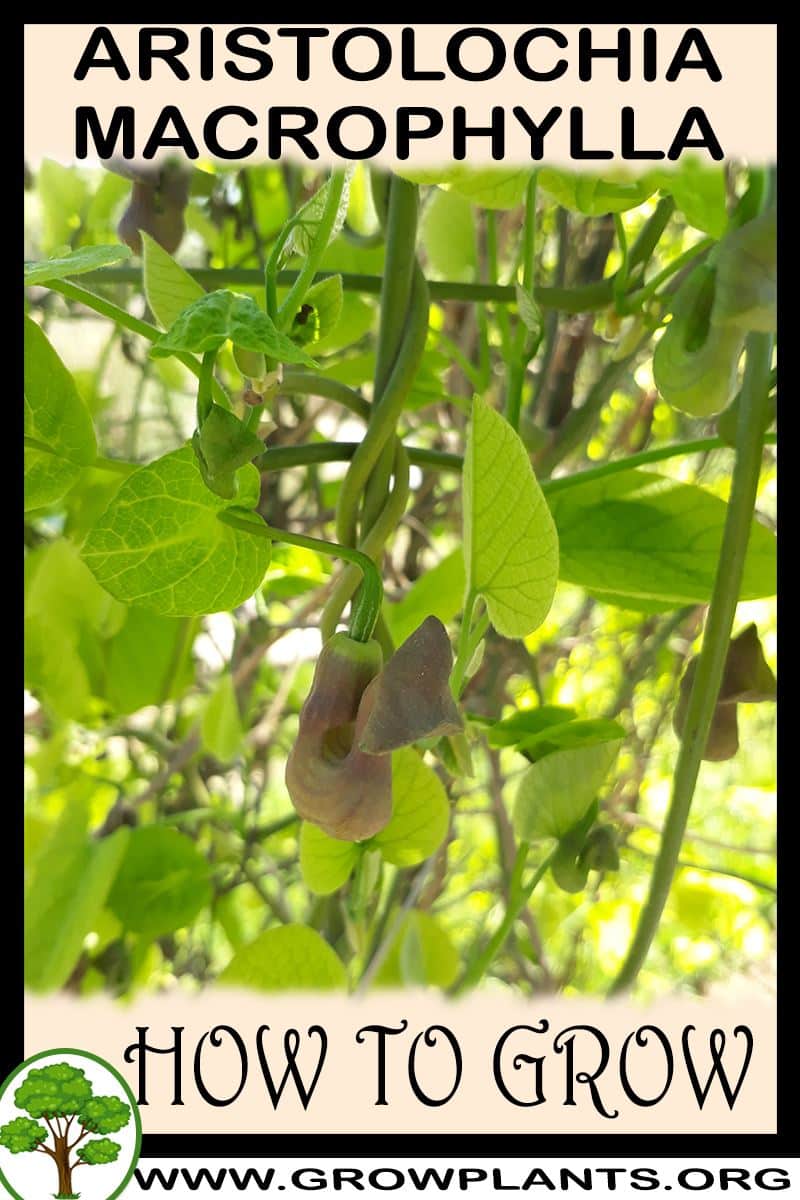
Overview: Dutchman’s pipe (Aristolochia macrophylla) is a vigorous twining woody vine reaching 2-10 m, grown for its large overlapping heart-shaped leaves and curious pipe-shaped flowers. It makes a fast dense screen but all parts are toxic.
Quick Specifications
| Specification | Attribute |
|---|---|
| Plant Type / Life Cycle | Perennial (grown as an annual in cold climates) |
| Foliage Type | Deciduous (evergreen in warm climates) |
| Mature Size | 2-10 m (6-30 ft) climbing |
| Growth Rate | Fast |
| Toxicity | Toxic – contains aristolochic acid |
| Hardiness | USDA zone 4a-8b |
Growth Form & Structure
- Height & Spread: 2-10 m (6-30 ft) as a twining vine on a trellis or support; can also be grown in a container.
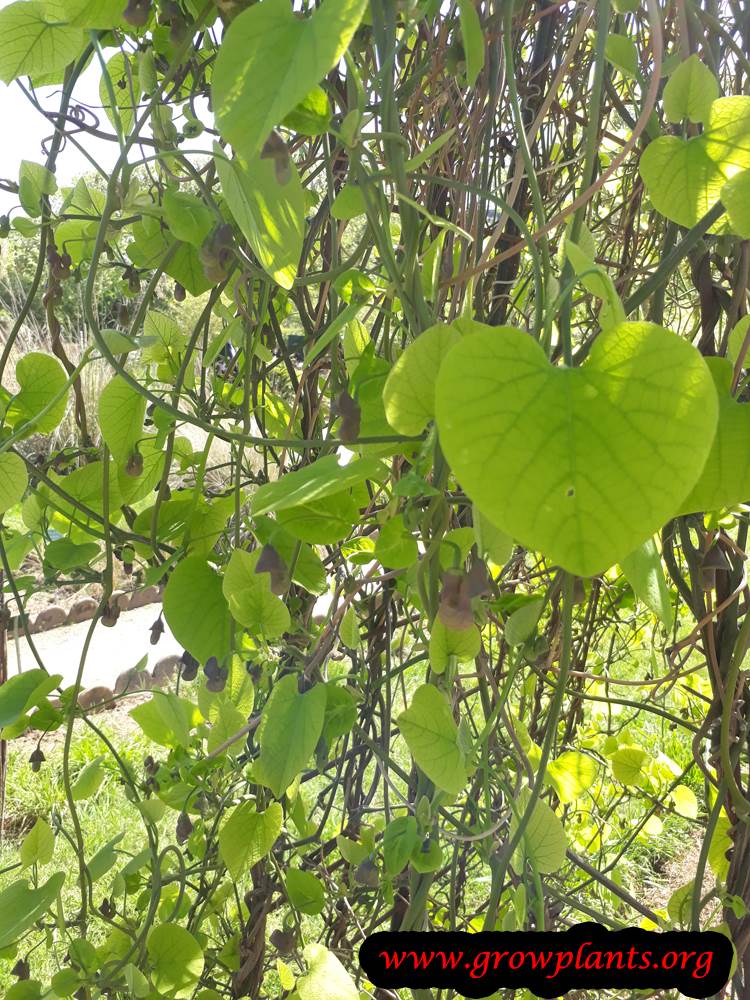
- Growth Habit & Form: Vigorous twining woody vine whose large overlapping leaves form a dense screen.
- Lifespan & Maturity: Perennial; fast to cover an arbour or trellis.
Anatomy & Physical Features
- Leaves & Foliage: Green to light green, large heart-shaped leaves.
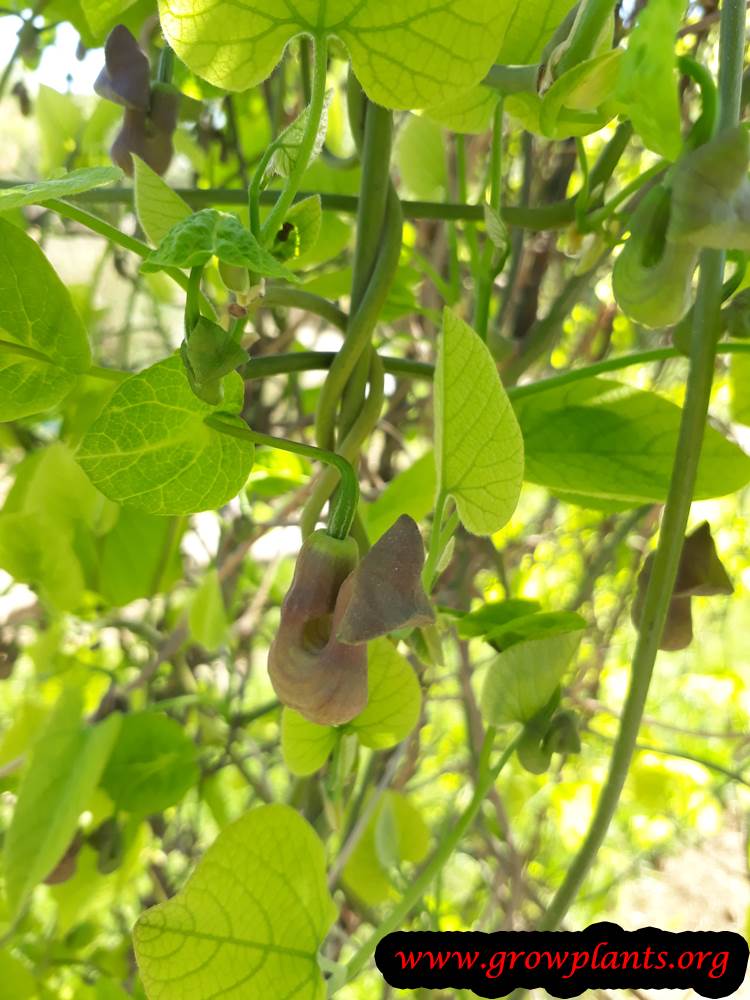
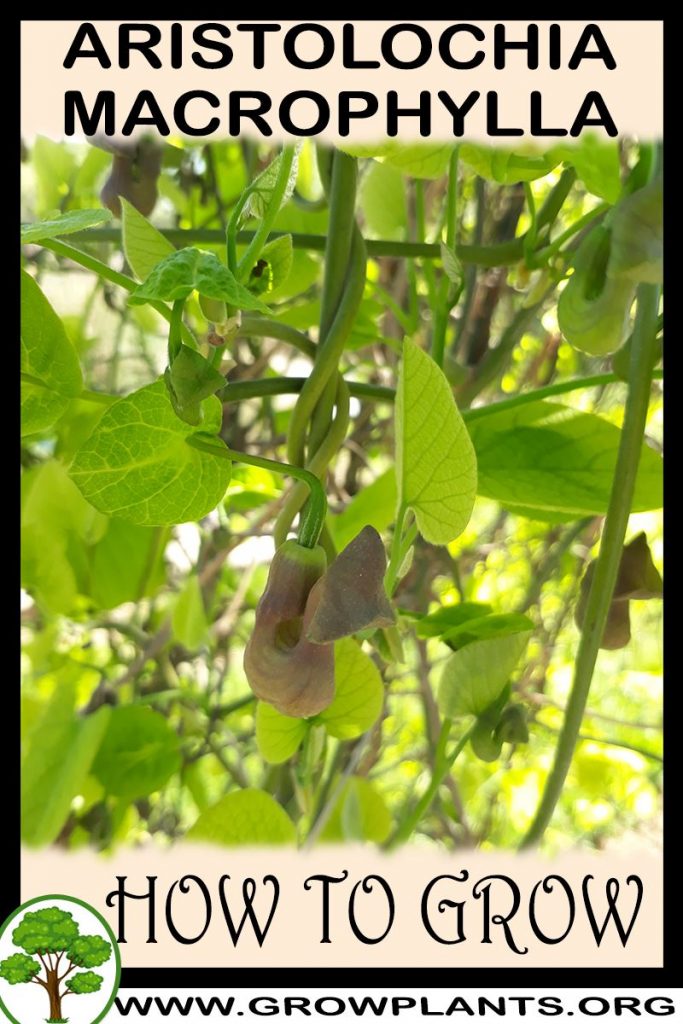
- Flower Characteristics: Brown-to-yellow pipe-shaped flowers – a pouched base flaring to a trumpet mouth.
Primary Uses & Landscape Value
- Functional & Ornamental Roles: Ornamental screening vine for arbours, pergolas and privacy; a larval host plant for swallowtail butterflies.
Care Guide: Planting, Soil & Watering
Overview: Dutchman’s pipe is a vigorous climbing vine that grows best in full sun to part shade in moist, well-drained, fertile soil with a strong trellis or support to climb. Keep it evenly moist and frost-free, and give it room, as it grows fast and can be invasive.
Quick Care Requirements
| Requirement | Ideal Condition |
|---|---|
| Planting Season | In the warm season — spring, summer or autumn, frost-free |
| Growth Rate | Fast |
| Soil Type | Fertile, moist but well-drained soil |
| Water Need | Moderate — keep evenly moist |
Planting & Establishment
- Best Planting Season: Plant in spring, summer or autumn in frost-free conditions so it establishes in the warmth.
- How to Plant:
- Hole Preparation: Dig a hole about twice the width of the root ball and set a sturdy trellis, arbour or wires at planting for the fast, heavy vine.
- Soil Amendments: Work compost or organic matter into the backfill for fertility and moisture retention.
- Planting Depth: Set the vine at its original growing depth, root collar at soil level; firm and water in.
- Growth Speed & Expectations: Fast, quickly clothing a support with large heart-shaped leaves and reaching 2–10 m; prune to control and shape.
Soil, Watering & Drainage Care
- Soil Mix & Drainage Needs: Fertile, moisture-retentive but well-drained soil suits it; keep it moist but never waterlogged.
- Watering Schedule & Technique:
- Young / Newly Planted: Water regularly to keep the soil evenly moist while it establishes.
- Established: Water regularly so the soil stays consistently moist, especially in heat.
- Seasonal Adjustments: Water more in summer; reduce in cool weather and protect from frost.
Climate, Light & Hardiness
This vigorous vine (deciduous in cold climates, semi-evergreen in mild ones) prefers full sun to half shade and thrives in humid, temperate to subtropical conditions; it is generally frost-tolerant once established, dying back to the roots in cold winters and resprouting in spring.
Quick Climate Specifications
| Climate Zones | Temperate, Subtropical, Mediterranean |
|---|---|
| Frost Tolerance | High (root-hardy; top growth is deciduous and frost-killed in cold winters) |
| Light Conditions | Full Sun to Half Shade |
Sunlight & Light Exposure
Optimal Light Setup
Grows best with several hours of full sun to half shade; in hot climates, light afternoon shade helps prevent leaf scorch.
Shade & Heat Management
Tolerates heat well when given adequate soil moisture; part shade is beneficial in the hottest summer regions.
Best Exposure / Orientation
Trellis or fence it in full sun to half shade, ideally with some shade over the root zone to keep the base cool and moist.
Temperature Extremes & Hardiness
USDA Hardiness & Regional Limits
This species is a hardy, cold-tolerant deciduous vine in temperate gardens, hardy to USDA zone 4a-8b. It dies back to the roots or older wood in cold winters and resprouts reliably from the base in spring.
Cold Damage & Winter Protection
In climates with freezing winters the vine is deciduous, losing its leaves and dying back to older wood or the root crown; a protective mulch over the root zone helps it return reliably each spring.
Frost Sensitivity
Foliage is frost-tender and drops with the first freezes; this is a normal part of winter dormancy rather than plant death.
Extreme Heat Tolerance
Tolerates warm summers well provided the roots stay cool and moist.
Wind, Humidity & Microclimate
Humidity Preferences
Prefers humid conditions typical of woodland-edge and temperate garden settings.
Rainfall & Seasonal Moisture
Prefers consistent moisture through the growing season; avoid prolonged drought at the root zone.
Microclimate Recommendations
A partly shaded, humus-rich root zone with sunnier top growth (the classic "cool feet, warm head" vine placement) suits it well.
Growing in Pots, Balconies & Indoors
Dutchman’s pipe is a vigorous woody climber, not a houseplant – but it grows well in a large container trained up a trellis on a patio or balcony where its big heart-shaped leaves make a fast summer screen.
Quick Details
- Container Size: A large, deep container – this is a strong 2-10 m (6-30 ft) vine
- Indoor Suitability: Not a houseplant; it needs full outdoor light and room to climb
- Best Spot: Full sun to half shade, against a wall or railing with a sturdy support
- Soil & Drainage: Rich, moisture-retentive but free-draining mix
- Watering in Pots: Average – keep the mix evenly moist; potted vines dry out faster than ground plants
Indoors & On the Windowsill
- Houseplant limits: Not suited to life indoors – it is a large climbing vine that wants strong light and a support to scramble over.
- Overwintering: In cold climates a potted plant can be moved to a sheltered, frost-free spot to overwinter, then brought back out in the warm season.
On a Balcony or Patio
- Light, wind & support: Give it the brightest wall you have and a solid trellis or wires; walls and paving reflect heat, so pots dry quickly – check moisture often and shelter the young growth from strong wind.
- Practicalities: A big, heavy pot of soil plus a climbing frame is weighty – set it in its final position before filling, and mind drainage runoff.
Choosing the Pot, Soil & Long-Term Care
- Pot & drainage: A large, deep pot with strong drainage holes; skip a standing-water saucer to avoid root rot. Terracotta breathes and dries faster, while glazed or plastic pots hold moisture longer.
- Potting mix: A well-aerated, organic-rich mix – peat or coir blended with perlite or vermiculite so it drains freely.
- Feeding: Potted plants need feeding more often than those in open ground, since frequent watering leaches nutrients from the mix – feed regularly through the growing season.
- Repotting: Refresh the top of the mix each year and pot up about every two years; for perennials, lightly prune the root ball and top growth when you do.
Safety: All parts of Aristolochia are toxic if eaten (aristolochic acid) – keep it away from children and pets and wash hands after pruning.
Fertilizing & Feeding
A moderate feeder while it climbs a trellis or works as a hedging vine: nitrogen-forward feeding drives the fast, leafy coverage this vine is known for, then a lighter, balanced program carries it through its pipe-shaped spring-to-summer bloom.
Quick Fertilizing Specs
| Feeding Level | Moderate feeder while filling in, lighter once established |
|---|---|
| Main Nutrient Priority | Nitrogen to build fast leaf coverage, balanced feeding through bloom |
| Best Feeding Period | Spring through the summer bloom window |
| Organic Options | Rich, humus-amended soil around the root zone, especially while young |
| Reduce/Stop Feeding | Ease off in cold-winter climates where the vine dies back to the ground for winter |
| Micronutrients | Rarely an issue in average garden soil; correct only a diagnosed deficiency |
| Soil pH | Tolerates a wide range provided the soil drains reasonably well |
Feeding by Growth Stage
Establishment after planting
Help a newly planted vine root in before it is trained onto a trellis or hedge support.
| Nutrient direction | A balanced fertilizer worked into rich soil supports steady early rooting and the first flush of heart-shaped leaves. |
|---|---|
| Timing | At planting and through the first weeks of establishment. |
| Frequency | A feeding at planting, renewed as the vine puts on its first significant growth. |
| Fertilizer types | A balanced complete fertilizer worked into the planting area, Organic matter or compost mixed into the planting hole |
| Precautions | Provide a trellis or support from the start; a young vine left without one will sprawl rather than climb. |
Vigorous climbing growth
Support the fast, dense coverage this vine produces once it is climbing or trained as a hedge.
| Nutrient direction | A nitrogen-forward fertilizer fuels the vigorous leafy growth this vine is known for. |
|---|---|
| Timing | Through the height of the growing season as the vine extends and fills its support. |
| Frequency | Regular light feedings through the peak growing period. |
| Fertilizer types | A nitrogen-forward, balanced fertilizer, Compost renewed around the root zone |
| Precautions | This vine spreads aggressively and is considered invasive in some areas; avoid pushing growth harder than the intended space with excess nitrogen, and keep it away from areas where it could escape cultivation. |
Pipe-flower bloom period
Support the distinctive pipe-shaped brown-to-yellow flowers that open from spring into summer.
| Nutrient direction | Shift toward a lighter, balanced fertilizer once coverage is established, favoring flowering over yet more leafy growth. |
|---|---|
| Timing | Through the spring-to-summer bloom window. |
| Frequency | An occasional light feeding is usually enough to sustain bloom on an established planting. |
| Fertilizer types | A balanced fertilizer used lightly, Container-grown plants may follow a container-specific feeding routine |
| Precautions | Heavy nitrogen at this stage favors foliage over flowers; ease back once the vine has filled its support. |
Cold-climate winter dormancy
Let the vine rest where winters are cold enough for it to die back to the ground and regrow as a herbaceous perennial.
| Nutrient direction | None – withhold fertilizer once the vine dies back for winter in cold climates. |
|---|---|
| Timing | From the first hard frost through winter, until new shoots emerge in spring. |
| Frequency | No feeding during this dormant period. |
| Fertilizer types | No feeding at this stage; do not fertilize until new spring growth resumes. |
| Precautions | Feeding dormant roots offers no benefit and can encourage salt buildup in the soil; wait for visible new growth before resuming. |
Nutrient Deficiency Signs & Corrections
Overall pale green to yellow foliage and noticeably slower coverage of its support.
| Possible causes | low soil nitrogen or thin, low-organic-matter soil, nitrogen leaching from heavy watering or rain, an extended period without any feeding |
|---|---|
| Appears first on | older, lower leaves |
| What to check | recent feeding history, soil organic matter, how quickly the vine is filling in compared to expectations |
| Possible correction | Apply a nitrogen-containing balanced fertilizer and refresh organic matter around the root zone. |
New leaves emerge yellow while the veins stay green.
| Possible causes | high soil pH tying up available iron, poorly drained or waterlogged soil, root stress limiting nutrient uptake |
|---|---|
| Appears first on | newest growth at the shoot tips |
| What to check | soil pH and drainage, recent watering pattern, root health |
| Possible correction | Improve drainage where possible and apply a chelated iron product per its label. |
Leaf margins scorch or brown and flowering becomes sparse despite good foliage coverage.
| Possible causes | low soil potassium, heavy nitrogen feeding without balance, drought stress limiting nutrient uptake |
|---|---|
| Appears first on | older leaf margins |
| What to check | recent fertilizer balance, watering consistency, flower production compared to foliage coverage |
| Possible correction | Switch to a balanced, potassium-inclusive fertilizer and maintain even watering. |
Pruning, Training & Seasonal Maintenance
Aristolochia macrophylla (Dutchman’s pipe) is a vigorous, fast-growing twining vine grown on a trellis or other support; it produces no freestanding structure of its own. Pruning is entirely about training it onto its support while young, then controlling its size and density once established, since it is fast-growing and documented as capable of becoming invasive. Dormant-season (autumn–winter) pruning is the safest time for the bulk of this control work.
Quick Pruning & Maintenance Specs
| Pruning Tolerance | High – vigorous twining vine that regrows readily |
| Primary Pruning Window | Autumn–Winter |
| Main Objective | Train young growth onto its support, then control size/density and spread on an established plant |
| Young Plant Priority | Tie and train leading shoots onto the trellis; select the strongest shoots as the main framework climbers |
| Mature Plant Priority | Thin congested growth; cut back stems that have outgrown the support; remove growth rooting away from the intended support |
| Best Tool Type | Bypass secateurs for most stems; loppers for thicker older growth at the base |
| Avoid Heavy Pruning During | Spring–Summer bloom, if that season’s flower display is wanted, since flowering happens on the season’s existing growth |
Pruning by Plant Age & Size
Newly Established
Minimal cutting; focus instead on tying and training young shoots onto the trellis so the vine climbs where intended rather than sprawling.
Young / Formative
Cane/shoot selection and training up the support – guide and tie the strongest leaders onto the trellis; redirect any shoots heading away from the support.
Mature / Established
Control density and reach – thin overcrowded twining stems so the support isn’t smothered, and cut back growth that has exceeded the intended coverage area.
Seasonal Pruning Schedule
| Stage | Objective | Remove | Do Not Remove | Response / Impact |
| Dormant/Winter (Autumn–Winter) | Main structural/control prune | Overgrown, congested or misdirected stems, cut back to control size on this fast, potentially invasive grower | The main framework of leaders trained onto the support | Vigorous regrowth the following season given this species’ fast growth rate; minimal cost to the coming Spring–Summer bloom |
| Ongoing Sanitary | Keep the vine healthy and on-support | Aphid-infested shoot tips, if seen; stems rooting away from the trellis | Healthy twining growth on the support | None of note |
Structural Pruning & Training
- Shoot selection: choose and tie in the strongest leaders as the main climbing framework while young
- Density control: thin congested twining stems on a mature plant so the support and nearby plantings aren’t smothered, given this species’ vigorous growth
- Spread control: cut back growth extending beyond the intended trellis/hedge area, given the species’ documented invasive tendency
Special Growth to Remove
- Stems twining away from the intended support onto nearby plants or structures
- Aphid-damaged shoot tips
Container & Small-Space Pruning
This vine can be grown in a container with its own support/trellis. In a container, prune more assertively than an in-ground planting to keep growth in scale with the pot and support, since it is otherwise a fast, vigorous climber.
Tools
- Bypass secateurs, for most of the season’s twining growth
- Loppers, for thicker older stems at the base of an established plant
- Soft ties/stakes, for training young leaders onto the trellis
Tool Hygiene & Disease Risk
Routine – clean, sharp tools are sufficient. Aphids are the pest noted for this species rather than a transmissible disease, so between-cut disinfection isn’t needed.
Cut Placement & Technique
Cut back to just above a healthy node or bud so the vine resprouts in a useful direction; when removing a stem at its base, cut cleanly rather than tearing it away from its support.
Heavy Pruning & Rejuvenation
Tolerated well given this species’ fast growth rate – an overgrown plant can be cut back hard in autumn–winter to bring it back within bounds, with vigorous regrowth expected the following season. Because it is documented as invasive, prune assertively rather than letting it spread unchecked.
Post-Pruning Care
After a significant cutback, water at this species’ normal average rate; watch regrowth for aphids, the pest noted for this species.
Common Pruning Mistakes
- Letting the vine grow unchecked given its documented invasive/aggressive tendency, rather than controlling it each dormant season
- Not training young leading shoots onto the trellis early, resulting in a tangled, self-twining mass that’s harder to manage later
When NOT to Prune
Avoid major cutbacks during Spring–Summer if that season’s flower display is wanted, since bloom occurs on the current season’s growth.
Recommended Tools (by task)
- bypass_secateurs – for cutting the season’s twining stems during control pruning
- loppers – for thicker older growth at the base of an established vine
- soft_ties_stakes – for training young leaders onto the trellis
Propagation Guide
Aristolochia macrophylla is most easily and reliably propagated from softwood or semi-hardwood stem cuttings taken in summer, or by lifting and replanting the rooted suckers it readily produces from its spreading roots – the trait behind its invasive habit. Seed-grown plants are true to the species but germinate more slowly and less predictably, so overall propagation difficulty is easy to moderate for a home gardener.
Quick Propagation Specs
| Best Propagation Method | Semi-hardwood stem cuttings, or division of rooted root suckers |
| Alternative Methods | Seed |
| Propagation Difficulty | Easy–Moderate |
| Seed True-to-Type | Yes (species, not a named cultivar) |
| Vegetative True-to-Type | Yes |
| Best Propagation Season | Late spring–summer for cuttings; dormant season (autumn–winter) or early spring for sucker division |
| Seed Germination Time | Several weeks, often uneven |
| Cutting Rooting Time | A few weeks under warm, humid conditions |
| Germination Temperature | About 18–24°C (65–75°F) |
| Seed Sowing Depth | Sow shallow, just covering the seed |
Growing from Seed
Dormancy & Pre-Sowing Treatment
Hardy vine seed of this type often germinates more evenly after a period of cold, moist stratification (several weeks refrigerated in a damp medium); treat this as optional but usually helpful rather than strictly required.
Sowing Season
Sow outdoors in autumn to get natural cold stratification, or sow in spring after artificially stratifying the seed.
Sowing Depth & Orientation
Sow shallowly, just covering the seed with soil or mix.
Germination Conditions
Keep warm (about 18–24°C / 65–75°F) and consistently moist.
Germination Time
Several weeks, and germination is often uneven.
Seedling Care
Give seedlings a support or trellis early, since this is a vigorous climbing vine, and keep them frost-free until well established.
Stem Cuttings
Cutting Type
Softwood to semi-hardwood leafy stem cuttings.
Best Timing
Late spring through summer, during active growth.
Cutting Preparation
Take 10–15cm (4–6in) cuttings with a couple of leaf nodes, remove the lower leaves, and cut just below a node.
Rooting Setup
Use a moist, free-draining rooting medium with a humid cover or enclosure to stop the large leaves from wilting before roots form.
Rooting Hormone
Optional – can improve rooting percentage and speed on semi-hardwood wood but is not essential.
Rooting Time
Typically a few weeks under warm, humid conditions.
Division, Offsets, Pups & Suckers
This vine spreads and naturalizes by root suckers, which is the source of its invasive tendency noted for this plant. Well-rooted suckers can be severed from the parent’s root system and transplanted, ideally during the dormant season (autumn–winter) or in early spring before new growth starts; keep as much fine root as possible and cut back some top growth to help the division establish. Only use suckers that have their own attached root mass – shoots without roots will not establish.
Bloom & Flower Guide
Quick Details
- Bloom Season: Spring to summer
- Flower Appearance: Curious brown-to-yellow pipe-shaped flowers — a bulging sac at the base opening into a curved trumpet, hence “Dutchman’s pipe”
- Edibility: Not edible — Aristolochia contains aristolochic acid, which is highly toxic to the kidneys; never ingest any part
Detailed Blooming Overview
Dutchman’s pipe is grown as much for its bold, heart-shaped foliage as its flowers, but the blooms themselves are fascinating: each is shaped like a curved smoking pipe, swollen into a little sac at the base. That shape is a clever trap — small flies drawn inside are briefly held while they pick up and deposit pollen, then released.
Flower Characteristics
- Pipe-shaped flowers in brown to yellow, with a sac-like base and a flared, trumpet-like mouth.
- Function as a temporary trap that uses flies to carry out pollination.
Bloom Care & Thinning
- Managing the bloom: This is a vigorous screening vine; little bloom care is needed beyond guiding and thinning the growth.
- Safety: Every part is highly toxic due to aristolochic acid — grow it as an ornamental only, and keep it away from anything that might be eaten.
Pests, Diseases & Troubleshooting
Overview: Dutchman’s pipe is a vigorous woody climber that is fairly pest-free; importantly, it is the larval host plant of the pipevine swallowtail butterfly, whose caterpillars will eat the leaves – these are a welcome sight to be encouraged, not sprayed. Its genuine problems are the usual sap-suckers on stressed plants, occasional leaf spot, and scorch or root rot from the wrong conditions. Grow it in moist, rich, well-drained soil with some shade from harsh sun.
Quick Troubleshooting Overview
| Issue / Pest | Main Symptom | Primary Solution |
|---|---|---|
| Swallowtail caterpillars | Leaves eaten by dark, red-spotted caterpillars | Leave them – this is the host plant; do NOT spray |
| Aphids | Sticky curled shoot tips with soft insects | Rinse off; insecticidal soap spot-only (protect larvae) |
| Spider mites | Fine speckling and bronzing in hot, dry air | Raise humidity; hose foliage; light oil if severe |
| Scale/whitefly | Bumps or white flies with honeydew and sooty mould | Spot-treat with oil/soap; conserve predators |
| Leaf spot | Brown spots on leaves in damp, crowded shade | Airflow; remove affected leaves |
| Leaf scorch | Bleached, browned leaves in hot afternoon sun | Provide part shade; keep soil moist and mulched |
Common Pests & Management
- Pipevine swallowtail caterpillars (Battus philenor):
- Symptoms: Groups of dark, spiny caterpillars (with rows of reddish tubercles) chew the leaves, sometimes heavily defoliating young vines – but this is the plant’s ecological purpose, as it is their obligate host.
- Prevention & Control: Do not treat these as pests: leave them to feed, as an established vine regrows readily and supports the butterflies. Plant a large, vigorous vine so it can spare the foliage, and avoid any broad-spectrum insecticide that would kill the larvae you want to keep.
- Aphids (Aphidoidea):
- Symptoms: Soft green or black aphids cluster on the tender new shoots and leaf undersides, curling growth and leaving honeydew, mainly on soft, over-fed or stressed growth.
- Prevention & Control: Rinse colonies off with water and conserve natural predators. If you must use insecticidal soap, spot-treat only the affected shoots and check first for swallowtail eggs and caterpillars, which must be protected.
- Two-spotted spider mite (Tetranychus urticae):
- Symptoms: Fine pale stippling and a dull bronze cast to the leaves in hot, dry conditions, with fine webbing in bad cases.
- Prevention & Control: Raise humidity and hose down the foliage, and conserve predatory mites; a light oil is used only as a last resort and only where no larvae are present.
- Scale insects & whitefly (Coccidae / Aleyrodidae):
- Symptoms: Brown limpet-like scales on stems and leaf undersides, or clouds of tiny white flies, both leaving honeydew and sooty mould and sapping vigour on stressed plants.
- Prevention & Control: Prune out heavily encrusted wood and spot-treat with a horticultural oil or soap, again checking for and protecting butterfly larvae; conserve the parasitic wasps that naturally control both.
Diseases & Fungal Issues
- Leaf spot (Cercospora / fungal spp.):
- Symptoms: Brown to grey spots, sometimes ringed or haloed, appear on the large leaves in damp, crowded, still conditions and can merge in bad cases.
- Treatment & Management: Improve airflow by thinning and training the vine, avoid overhead watering, and remove badly spotted leaves; the vine readily replaces foliage and fungicide is rarely needed.
- Powdery mildew (Erysiphe spp.):
- Symptoms: Occasionally a white powdery bloom appears on the leaves in crowded, humid, still conditions, causing some yellowing.
- Treatment & Management: Improve air circulation and remove affected leaves; sulphur is only occasionally warranted on this robust climber.
- Root rot (Phytophthora / Pythium):
- Symptoms: In heavy, waterlogged or overwatered soil the roots rot and the vine wilts and declines with yellowing foliage.
- Treatment & Management: Grow in rich but free-draining soil, avoid waterlogging, and improve drainage on heavy ground; remove rotted tissue and avoid deep planting.
Growing Difficulties & Abiotic Problems
- Leaf scorch:
- Cause & Symptoms: Hot afternoon sun and dry soil bleach and brown the large leaves, which prefer some shade and steady moisture.
- Correction Strategy: Site with morning sun and afternoon shade (or dappled light) in hot climates, keep the soil moist and mulched, and give wind shelter for the big leaves.
- Slow establishment:
- Cause & Symptoms: Dutchman’s pipe can be slow to get going in its first year or two before it becomes vigorous, which growers mistake for ill health.
- Correction Strategy: Be patient, keep it watered and fed in the establishment phase, and provide a sturdy support early; once established it grows strongly.
- Support needs:
- Cause & Symptoms: As a heavy woody climber it needs a strong structure; without it, growth is weak and tangled.
- Correction Strategy: Provide a robust trellis, arch or wires from the start, as the mature vine is heavy and long-lived.
What Helps – Products & Tools
On Dutchman’s pipe, restraint is the key ‘tool’: because it hosts the pipevine swallowtail, avoid broad-spectrum insecticides entirely and use only spot treatments of insecticidal soap or horticultural oil on genuine sap-sucker outbreaks, after checking for caterpillars. A copper fungicide is available for stubborn leaf spot, but airflow, part shade and even moisture prevent nearly all trouble.