Plant Profile & Key Characteristics
Also known as: Roselings, Tradescantia navicularis, Chain Plant, Phyodina navicularis
Overview: A low creeping succulent subshrub only 5-10 cm (2-4 in) tall, grown as an evergreen perennial in warm climates or as an annual/houseplant elsewhere. It is prized as an ornamental groundcover for its colourful triangular leaves.
Quick Specifications
| Specification | Attribute |
|---|---|
| Plant Type / Life Cycle | Perennial (grown as annual in cold zones) |
| Foliage Type | Evergreen |
| Mature Size | 5-10 cm (2-4 in) tall, trailing |
| Growth Rate | Fast to moderate |
| Toxicity | Sap can cause skin irritation |
| Hardiness | USDA zone 10b+ as perennial (4-10a as annual) |
Growth Form & Structure
- Height & Spread: Low 5-10 cm (2-4 in) mat that spreads to trail; equally at home in the ground, in containers or in hanging pots.
- Growth Habit & Form: Creeping succulent subshrub forming a dense groundcover of boat-shaped, stacked leaves along the stems.
- Lifespan & Maturity: Fast to establish; kept year to year in frost-free areas or overwintered indoors from cuttings.
Anatomy & Physical Features
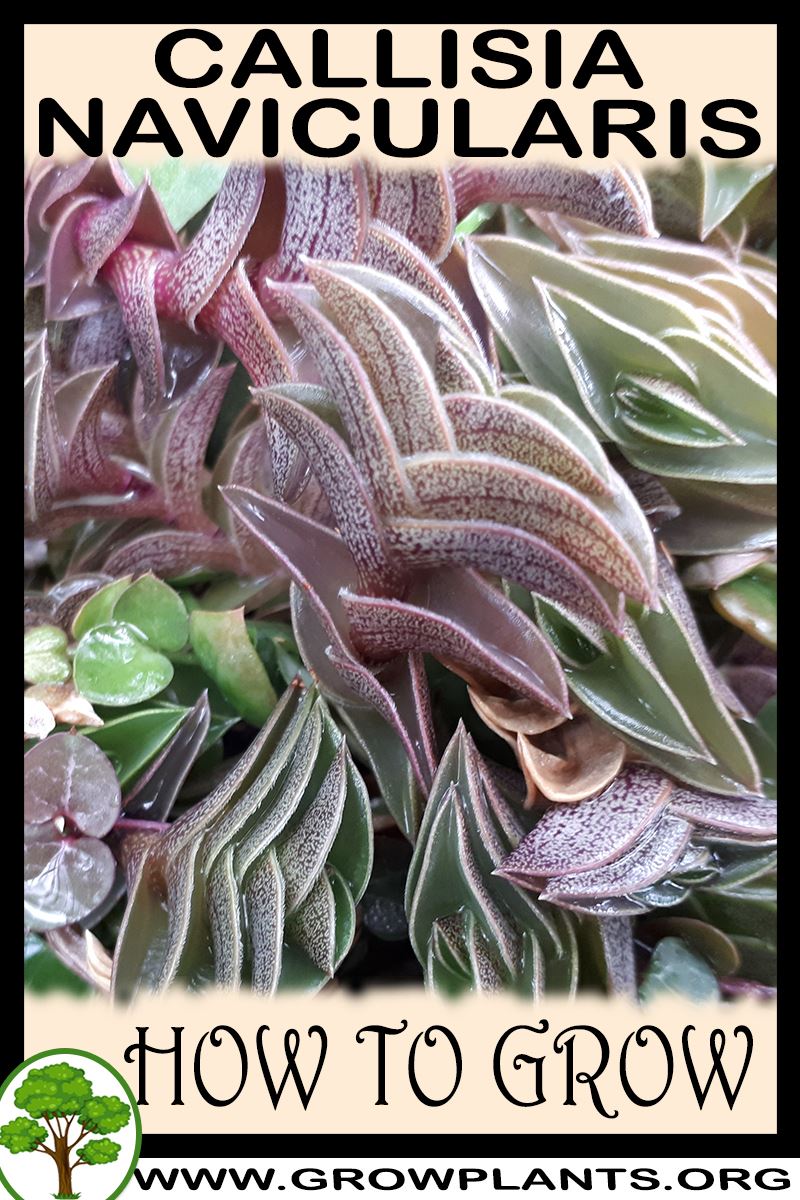
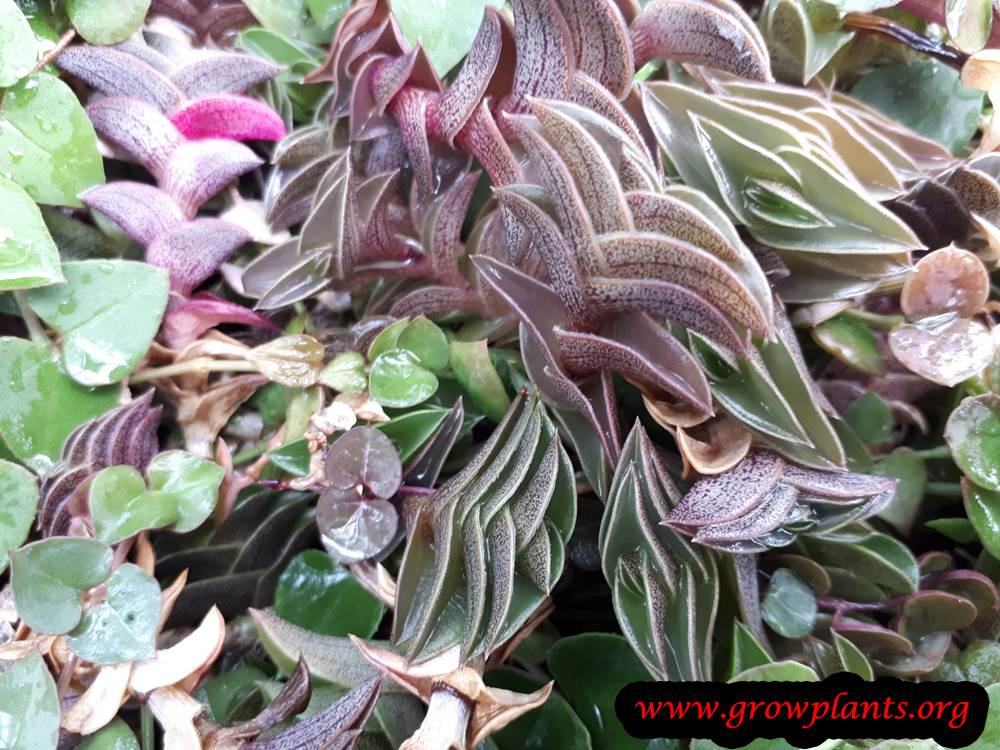
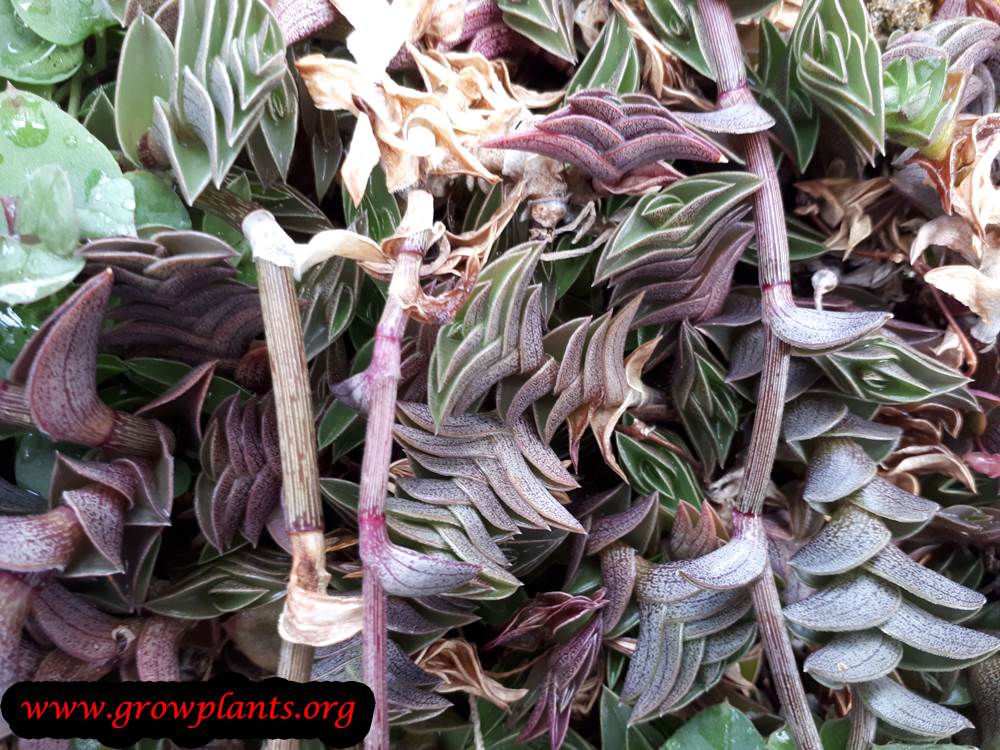
- Leaves & Foliage: Small triangular succulent leaves, green and often variegated with purple, red or pink.
- Flower Characteristics: Small purple three-petalled flowers (full detail in the Bloom section).
Primary Uses & Landscape Value
- Functional & Ornamental Roles: Ornamental groundcover, rockery and container/hanging-basket succulent; grown as a houseplant in bright light.
Care Guide: Planting, Soil & Watering
Overview: A fast-spreading, tender succulent groundcover that thrives in warmth and humidity. It wants a rich but sharply drained soil kept lightly moist, never waterlogged.
Quick Care Requirements
| Requirement | Ideal Condition |
|---|---|
| Planting Season | Spring in cooler zones; spring to autumn in zone 10b-11; year-round in zone 12+ |
| Growth Rate | Moderate to Fast |
| Soil Type | Rich, well-draining soil with organic matter |
| Water Need | Low to Moderate – let the top of the soil dry between waterings |
Planting & Establishment
- Best Planting Season: Plant in spring once frost has passed; in frost-free zones (10b-11) spring through autumn, and year-round in zone 12+.
- How to Plant:
- Hole Preparation: Dig a hole slightly wider than the root ball so the shallow roots can spread easily.
- Soil Amendments: Work in compost or organic matter, and add coarse sand or perlite to heavy soil for drainage.
- Planting Depth: Set the crown at soil level and do not bury the fleshy stems.
- Growth Speed & Expectations: Spreads quickly in warm, humid conditions to form a low 5-10 cm (2-4 in) mat.
Soil, Watering & Drainage Care
- Soil Mix & Drainage Needs: In containers use a sandy potting mix or peat with perlite; free drainage is essential to prevent rot in the succulent stems.
- Watering Schedule & Technique:
- Young / Newly Planted: Keep lightly moist while new cuttings root.
- Established: Water when the top few cm dry; the fleshy leaves store water, so err on the drier side.
- Seasonal Adjustments: Reduce watering in winter, especially indoors; give a little more in summer heat.
Climate, Light & Hardiness
Callisia navicularis is a low-growing succulent groundcover suited to warm, sunny climates across mediterranean, desert, subtropical, temperate, and tropical zones, or as a bright houseplant. It is reliably perennial to about USDA zone 10b, and further into cooler zones, down to about 4–10a, it is grown as a warm-season annual and overwintered indoors as cuttings.
Quick Climate Specifications
| Climate Zones | Mediterranean, desert, subtropical, temperate, tropic, or grown as a houseplant |
|---|---|
| USDA Hardiness Zones | Approximately 10b and warmer as a perennial; commonly grown as an annual from about zone 4 upward |
| Frost Tolerance | Very low |
| Light Conditions | Full sun to full shade with supplemental light |
Sunlight & Light Exposure
Optimal Light Setup
Grows well from full sun through half shade; in full shade indoors it needs a well-lit spot to keep its characteristic coloring.
Direct Sun Requirement
Tolerates full sun well outdoors, and strong light tends to intensify its leaf coloring.
Temperature Extremes & Hardiness
USDA Hardiness & Regional Limits
Reliable as a perennial from about USDA zone 10b upward; where winters bring freezing temperatures, roughly zone 4 through 10a, it is grown as an annual, with new cuttings taken indoors each year to carry the plant over winter.
Cold Damage & Winter Protection
Frost kills the succulent foliage and stems; in marginal zones, indoor overwintering of cuttings is the standard way to preserve the plant from year to year.
Frost Sensitivity
Highly frost-sensitive.
Extreme Heat Tolerance
Handles hot, dry summer conditions well, being a true succulent.
Growing in Pots, Balconies & Indoors
Callisia navicularis is a small, mat-forming succulent that makes an easy houseplant – the grower confirms it grows well indoors, provided it sits in bright light right next to a window. It is equally at home in a shallow pot on a balcony.
Quick Details
- Container Size: A pot at least 50% larger than the root ball (or your target size); root-prune if it outgrows it
- Indoor Suitability: A good houseplant given plenty of light – best beside a bright window
- Best Spot: Bright light; tolerates full sun to light shade
- Soil & Drainage: Sandy soil, potting mix, or peat with perlite – must drain freely
- Watering in Pots: Water sparingly; let it dry between waterings and never leave it soggy
Indoors & On the Windowsill
- A genuine houseplant: The grower grows it indoors successfully – give it the brightest window you have so the little boat-shaped leaves stay tight and colourful.
- Light matters: In a dim spot the stems stretch and lose their compact look; a sunny sill or a place right at the glass is ideal.
- Handle with care: The sap of this plant family can irritate sensitive skin and mildly upset pets if chewed – keep nibbling pets away.
On a Balcony or Patio
- Light & shelter: Happy in full sun to part shade on a balcony; in a shallow pot it dries fast, so check moisture often in warm weather.
Choosing the Pot, Soil & Long-Term Care
- Pot & drainage: Use a pot about 50% larger than the root ball with strong drainage holes; skip a standing saucer to avoid root rot.
- Potting mix: Sandy soil, standard potting mix, or peat/coir with perlite for sharp drainage.
- Feeding: A dilute balanced feed once or twice in active growth is plenty – succulents need little.
- Repotting: Every few years refresh the soil, and if the roots have filled the pot, prune the roots and leaves back before replanting.
Fertilizing & Feeding
A low-demand trailing succulent – light, infrequent feeding during active growth is enough to support its colorful rosette form, and no fertilizer is needed while growth is slow or when the plant is being kept as a fresh annual cutting.
Quick Fertilizing Specs
| Feeding Level | Light |
|---|---|
| young_feeding | Very light or none while a fresh cutting is still rooting and establishing. |
| mature_feeding | Occasional light feeding through the active warm-season growth period only. |
| Main Nutrient Priority | Balanced with restrained nitrogen so the trailing stems stay compact and colorful instead of stretching. |
| Best Feeding Period | The warm active-growth season, spring through summer. |
| Organic Options | A light top-dress of organic matter or compost for ground-planted specimens. |
| Reduce/Stop Feeding | Reduce and stop feeding as growth slows, and withhold entirely for plants held over winter indoors. |
Feeding by Growth Stage
Active Growth (Warm Season)
Support steady leaf and trailing-stem development without pushing soft, stretched growth that loses the plant’s compact, colorful rosette shape.
| Nutrient direction | Light, nitrogen-restrained feeding – a balanced or slightly low-nitrogen formula keeps foliage color and habit tight rather than leggy. |
|---|---|
| Timing | During the warm growing season while the plant is actively producing new leaves and trailing stems. |
| Frequency | Feed sparingly – this succulent rarely needs more than an occasional light feeding to stay healthy through the growing season. |
| Fertilizer types | A diluted, balanced houseplant or succulent fertilizer for container-grown plants, An occasional light top-dress of organic matter for plants grown in the ground |
| Precautions | Avoid feeding right after taking or transplanting cuttings until new roots are established, and never apply fertilizer to dry, drought-stressed soil – water first, then feed. |
Dormant or Slow Season
Let the plant rest through its slow period without pushing tender new growth during cooler or low-light conditions.
| Nutrient direction | None – withhold fertilizer while growth has visibly slowed or stopped. |
|---|---|
| Timing | Cooler months, or whenever a plant kept as an overwintered indoor cutting shows little to no new growth. |
| Frequency | No feeding at this stage – resume only once vigorous new growth clearly restarts. |
| Fertilizer types | No feeding at this stage – plain maintenance watering only, no fertilizer product needed. |
| Precautions | Do not fertilize until active growth resumes; feeding a resting plant or a freshly taken annual cutting risks salt buildup and root stress. |
Nutrient Deficiency Signs & Corrections
Leaves lose color intensity and stems stretch with unusually long gaps between leaves.
| Possible causes | Insufficient nitrogen from an overly thin or absent feeding routine, Too little light, causing the plant to reach and stretch toward a light source, A depleted or compacted potting mix limiting root uptake |
|---|---|
| Appears first on | New growth at the stem tips |
| What to check | Confirm the plant is getting bright light suited to a succulent before assuming a feeding problem, Check how long it has been since the potting mix was last refreshed |
| Possible correction | Improve light conditions first, then introduce a light, balanced feeding during the active growing season rather than a single heavy dose. |
Newer leaves turn pale yellow while the veins remain green.
| Possible causes | Iron unavailability linked to a soil pH that runs too alkaline for the plant, Waterlogged or poorly drained soil limiting healthy root function, Root stress from an old, overly tight, or compacted potting mix |
|---|---|
| Appears first on | The newest leaves near the growing tip |
| What to check | Check how quickly water drains through the pot or planting site, Check whether the potting mix has gone stale and is overdue for refreshing |
| Possible correction | Correct drainage and refresh the soil first; if pale new growth persists, a chelated iron product applied per its label can help. |
Pruning, Training & Seasonal Maintenance
Callisia navicularis is a small, mat-forming succulent groundcover with soft, non-woody trailing stems; it needs very little pruning beyond removing dead leaves and spent bloom stems, and its safest general tidy-up window is autumn/winter as growth slows. Because older stems naturally go bare at the base over time, the main “maintenance” tool is renewal by cutting and rooting fresh pieces rather than any structural cutback.
Quick Pruning & Maintenance Specs
| Pruning Tolerance | Low–Moderate |
| Primary Pruning Window | Autumn–Winter tidy-up |
| Secondary Maintenance Window | Light pinching/deadheading any time in active growth |
| Typical Frequency | Occasional as-needed trimming; periodic renewal by cuttings |
| Main Objective | Remove dead growth; refresh bare, leggy mats via propagation rather than hard pruning |
| Young Plant Priority | Pinch tips lightly to encourage a fuller mat |
| Mature Plant Priority | Remove bare/leggy stems; take cuttings to replace tired growth |
| Best Tool Type | Precision snips |
| Avoid Heavy Pruning During | Peak summer heat stress; while the sap-irritant risk makes bare-handed handling unwise in any season |
Pruning by Plant Age & Size
Newly Established
Leave newly rooted plants largely untouched beyond removing any damaged leaves; let the mat fill in before any trimming.
Young / Formative
No structural training applies to this low, trailing succulent; light pinching of stem tips encourages branching into a denser mat rather than a few long runners.
Mature / Established
As mats mature, older stems become bare at the base and less attractive; rather than a hard cutback, take fresh tip cuttings to root alongside or in place of the tired growth, then remove the old bare stems once replacements are established.
Seasonal Pruning Schedule
| Dormant/Winter | Objective: tidy and renew. Remove dead bloom stems and dead/damaged leaves (per this plant’s own care notes); a good time to also take propagation cuttings for renewal. |
| Ongoing Sanitary | Remove any rotted or damaged stem sections promptly, since succulent stems are prone to rot if they stay wet. |
Structural Pruning & Training
No true framework to train; the only structural concern is preventing the mat from thinning and going bare-based with age, which is addressed through cutting-based renewal rather than cutting the plant back hard in place.
Special Growth to Remove
- Dead or spent bloom stems
- Dead, shriveled or rotted leaves and stem sections
- Long, bare-based trailing stems on older mats — best replaced via fresh cuttings rather than simply cut back
Container & Small-Space Pruning
Very well suited to pots and hanging containers, especially near a bright window as an indoor plant; trim trailing growth to keep it in scale with the container, and refresh over-long hanging specimens periodically with new rooted cuttings rather than a hard cutback, which can leave an unattractively bare pot for a long stretch.
Tools
- Precision snips for tip pinching, deadheading and taking propagation cuttings — stems are soft and succulent, never requiring loppers or a saw
Tool Hygiene & Disease Risk
Routine: clean, sharp tools are sufficient; no significant transmissible disease risk is documented. Wear gloves when handling cut material, since the sap is documented to cause skin irritation.
Cut Placement & Technique
Pinch or snip just above a leaf node to prompt branching there; take propagation cuttings with a clean cut below a node, and let the cut end callus briefly before setting it in soil, standard practice for succulent stem cuttings.
Heavy Pruning & Rejuvenation
Does not respond as well to a hard structural cutback as it does to renewal-by-cutting; an old, leggy mat is better refreshed by rooting new tip cuttings and replacing the bare stems over time than by cutting the whole plant back hard in place.
Post-Pruning Care
Let any cut or damaged succulent tissue dry/callus before watering that area; keep new cuttings on the drier side until roots form to avoid rot.
Common Pruning Mistakes
- Cutting the whole mat back hard expecting shrub-like regrowth, instead of renewing tired stems via cuttings
- Handling cut stems bare-handed despite the documented skin-irritant sap
- Leaving rotted stem sections in a moist mat instead of removing them promptly
When NOT to Prune
Avoid heavy trimming or propagation cuts during severe heat stress; otherwise this plant tolerates light grooming through most of the growing season.
Recommended Tools (by task)
- precision_snips — pinching, deadheading and taking renewal cuttings on this soft-stemmed trailing succulent
Propagation Guide
Callisia navicularis is most easily and reliably propagated from stem cuttings, which root well in moist, peat-based soil under warm, humid conditions. Seed grown plants come largely true to the species, but strong or specific leaf coloration is better preserved through cuttings, and this is overall an Easy plant to propagate.
Quick Propagation Specs
| Best Propagation Method | Stem cuttings |
| Alternative Methods | Simple/ground layering; seed; rooting in water (site notes this can be unreliable) |
| Propagation Difficulty | Easy |
| Seed True-to-Type | Usually true-to-type for the species; specific leaf coloration is best kept via cuttings |
| Vegetative True-to-Type | Yes |
| Best Propagation Season | Spring, or indoors from late winter; also possible from autumn. In hardiness zone 10–11 spring through autumn, zone 12+ year-round; in hot-summer locations propagate in full shade |
| Seed Germination Time | 2–4 weeks |
| Cutting Rooting Time | Typically a few weeks under warm, humid conditions |
| Seed Sowing Depth | 0.5cm (0.25in) |
Growing from Seed
Seed Handling & Viability
Store seed in a dry, dark spot at room temperature until sowing.
Sowing Season
Best sown in spring, or indoors from late winter; sowing from autumn is also possible. In hardiness zone 10–11 sow spring through autumn, and in zone 12+ sowing is possible year-round; in hot-summer climates, sow in full shade.
Sowing Depth & Orientation
Sow shallow, about 0.5cm (0.25in) deep, in a sandy or well-ventilated, well-drained mix with good light.
Germination Conditions
Keep the soil moist and humid without overwatering, and do not let it dry out.
Germination Time
Around 2–4 weeks.
Seedling Care
Grow seedlings on in light with moist, well-ventilated soil; space plants roughly 20–30cm (8–12in) apart as they develop.
Stem Cuttings
Cutting Type
Stem cuttings.
Best Timing
Any time conditions are warm; when the plant is grown as an annual in colder zones, take a cutting indoors before frost to carry the plant over to the following year.
Cutting Preparation
Cut a section of stem and insert it into moist soil — peat-based soil is preferred, though other well-draining mixes also work.
Rooting Setup
Use a greenhouse or a covered plastic box to keep humidity high around the cutting. Standing the cutting in water, changing the water every few days, is possible but per site experience is less reliable than rooting it in soil.
Rooting Hormone
Not necessary — cuttings root readily without it.
Rooting Time
Typically a few weeks under warm, humid conditions.
Air & Ground Layering
Simple ground layering works well for this trailing subshrub: bend a low stem over and cover the contact section with soil, keeping it moist until roots form at the buried node, then sever the new plant from the parent.
Bloom & Flower Guide
Quick Details
- Bloom Season: Spring into summer
- Flower Appearance: Small three-petalled purple flowers in a neat triangular shape
- Edibility: Not eaten – grown for its colorful foliage
Detailed Blooming Overview
Callisia navicularis (chain plant, also listed as Tradescantia navicularis) is a low, spreading succulent grown mainly for its boat-shaped, often purple-tinted leaves. In spring and summer it adds small purple flowers. It grows outdoors in Mediterranean, desert, subtropical, temperate and tropical climates, or as a houseplant, in roughly zone 10b and warmer, and overwinters happily indoors.
Flower Characteristics
- Small three-petalled flowers in purple, echoing the triangular leaves.
- Each bloom is short-lived, but they open in succession over the season.
- Nestled among the trailing, colorful stems.
Bloom Care & Thinning
- Position: Bright light brings out both leaf color and the best flowering.
- Safety: The sap can irritate skin and is not meant for eating – a foliage plant, not a culinary one.
Pests, Diseases & Troubleshooting
Overview: Callisia are easy, fleshy-stemmed members of the spiderwort family grown as trailing houseplants or groundcovers, and they are largely trouble-free. Their main enemy is not an insect but the watering can: soft succulent stems rot quickly in cold, wet, airless compost. A handful of common sap-suckers may appear, but good light, warmth and restrained watering prevent nearly every problem.
Quick Troubleshooting Overview
| Issue / Pest | Main Symptom | Primary Solution |
|---|---|---|
| Overwatering / root rot | Mushy blackened stems, collapse | Dry out, free-draining mix, ease off water |
| Mealybugs | White cottony tufts in leaf axils | Dab with alcohol, insecticidal soap |
| Spider mites | Fine stippling, webbing in dry air | Raise humidity, rinse, soap / oil |
| Aphids | Sticky, curled young tips | Rinse off, insecticidal soap |
| Leggy pale growth | Stretched stems, faded colour | More light, pinch and trim |
| Leaf scorch | Bleached / brown patches | Shade from harsh midday sun |
Common Pests & Management
- Mealybugs (Planococcus citri, Pseudococcus species):
- Symptoms: White cottony blobs tucked into leaf axils and along stems; feeding causes yellowing, sticky honeydew and sooty mould, and colonies can hide at the root collar.
- Prevention & Control: Wipe off with a cotton bud dipped in dilute alcohol, isolate the plant and inspect neighbours. Follow up with insecticidal soap or neem, repeating weekly; a light horticultural oil smothers stubborn colonies.
- Spider mites (Tetranychus urticae):
- Symptoms: Fine pale stippling, a dull grey-bronze look and gossamer webbing on undersides in warm, dry indoor air; leaves dry and drop.
- Prevention & Control: Raise humidity, rinse the foliage regularly and keep plants off dry heat sources. Remove webbed growth and treat with insecticidal soap or horticultural oil, covering leaf undersides.
- Aphids (Aphis and Myzus species):
- Symptoms: Clusters of soft green or dark insects on tender shoot tips, causing curled, sticky new growth and sooty mould.
- Prevention & Control: Rinse colonies off under a tap, pinch out infested tips and treat any regrowth with insecticidal soap or neem in the cool of the day.
- Scale insects (Coccus, Saissetia species):
- Symptoms: Small brown or waxy limpet-like bumps along stems and leaf midribs that do not brush off; sticky honeydew and sooty mould follow.
- Prevention & Control: Scrape off light infestations by hand or with an alcohol-dipped swab, then apply horticultural oil to smother remaining scale, repeating to catch crawlers.
- Fungus gnats (Bradysia species):
- Symptoms: Small dark flies over constantly moist compost; larvae feed on fine roots and can weaken cuttings and young plants.
- Prevention & Control: Let the surface dry between waterings and top-dress with grit; use yellow sticky traps for adults and Bti or nematode drenches for larvae.
Diseases & Fungal Issues
- Stem and root rot (Pythium, Rhizoctonia, Fusarium species):
- Symptoms: Soft, blackened, collapsing stems at the base and mushy roots, almost always following cold, wet, poorly drained conditions – the commonest way these plants are lost.
- Treatment & Management: Prevention is everything: use a gritty, free-draining mix, water sparingly and keep plants warm. Cut back to firm healthy tissue and re-root clean cuttings if the crown is lost; discard soggy compost.
- Grey mould (Botrytis cinerea):
- Symptoms: Fuzzy grey mould on damaged or dying leaves and crowded, humid growth, especially in cool stagnant conditions.
- Treatment & Management: Improve airflow, remove dead and dying foliage promptly and avoid overhead watering. Space plants and reduce humidity around dense mats.
- Leaf spot (Cercospora and bacterial leaf-spot organisms):
- Symptoms: Brown or watery spots, sometimes with yellow halos, on foliage kept wet in stagnant humid air.
- Treatment & Management: Keep foliage dry, ventilate well and remove spotted leaves. It is rarely serious; sanitation usually resolves it without sprays.
Growing Difficulties & Abiotic Problems
- Overwatering and root rot:
- Cause & Symptoms: The number-one killer of Callisia: soggy compost rots the succulent stems from the base, giving yellowing, translucence and collapse even while the plant looks watered.
- Correction Strategy: Grow in free-draining pots, let the top of the mix dry before rewatering and never leave the plant standing in water. Increase warmth and light to speed drying.
- Leaf scorch and bleaching:
- Cause & Symptoms: Harsh direct midday sun bleaches and browns the leaves, fading the pink or purple tones the plant is grown for.
- Correction Strategy: Give bright but filtered light or gentle morning sun; acclimatise gradually if moving a plant outdoors, and shade from fierce afternoon sun.
- Legginess in low light:
- Cause & Symptoms: In dim conditions stems stretch, internodes lengthen and colour fades to plain green.
- Correction Strategy: Move to brighter light, pinch growing tips to encourage bushiness and trim leggy stems to propagate fresh, compact growth.
- Tip browning from dry air or salts:
- Cause & Symptoms: Crispy brown leaf tips and margins result from very dry air, under-watering or a build-up of fertiliser salts.
- Correction Strategy: Water consistently, flush the pot occasionally to leach salts, and raise humidity around indoor plants. Note the sap can irritate sensitive skin, so wash hands after handling.
What Helps – Products & Tools
These are near pest-free plants, so tools stay simple: a cotton bud with dilute alcohol for mealybugs and scale, insecticidal soap or neem/horticultural oil for aphids, mites and scale, and yellow sticky traps plus Bti for fungus gnats. The most important ‘product’ is a gritty, free-draining mix and a restrained watering routine to prevent rot.