Plant Profile & Key Characteristics
Overview: Bacopa is a fast-growing, creeping evergreen (or annual) herb reaching only 5-15 cm (2-6 in) tall but trailing widely. It is grown as an ornamental for baskets, containers and water gardens, and some species are used medicinally.
Quick Specifications
| Specification | Attribute |
|---|---|
| Plant Type / Life Cycle | Perennial (grown as an annual in cold climates) |
| Foliage Type | Evergreen |
| Mature Size | 5-15 cm (2-6 in) tall, trailing |
| Growth Rate | Fast |
| Toxicity | Non-toxic (some species used medicinally) |
| Hardiness | USDA zone 10+ as perennial; 5+ as annual |
Growth Form & Structure
- Height & Spread: 5-15 cm (2-6 in) tall, trailing well beyond the pot edge; ideal for hanging baskets, containers, ponds and some lit aquaria
- Growth Habit & Form: Low, creeping/trailing herb used as a groundcover or spiller
- Lifespan & Maturity: Fast to establish; short-lived but easily renewed from cuttings
Anatomy & Physical Features
- Leaves & Foliage: Small green leaves, heart-shaped, round, linear or ovate depending on species
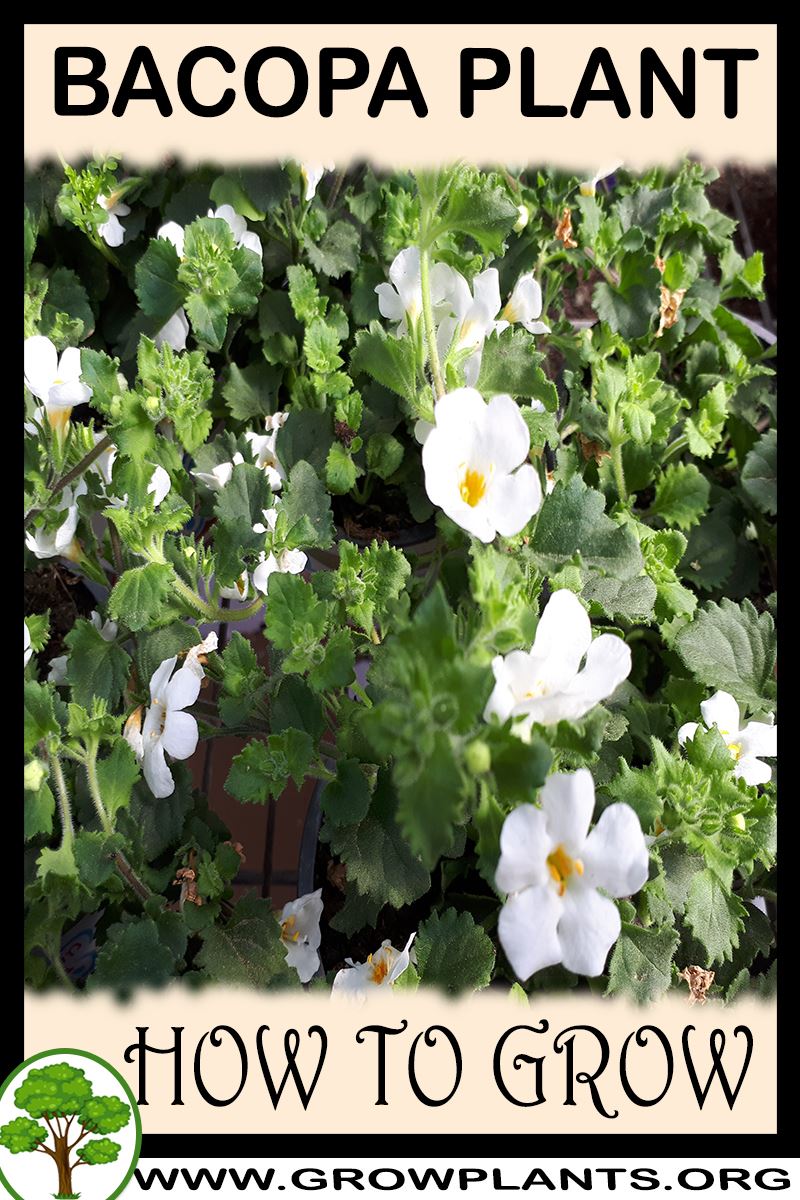
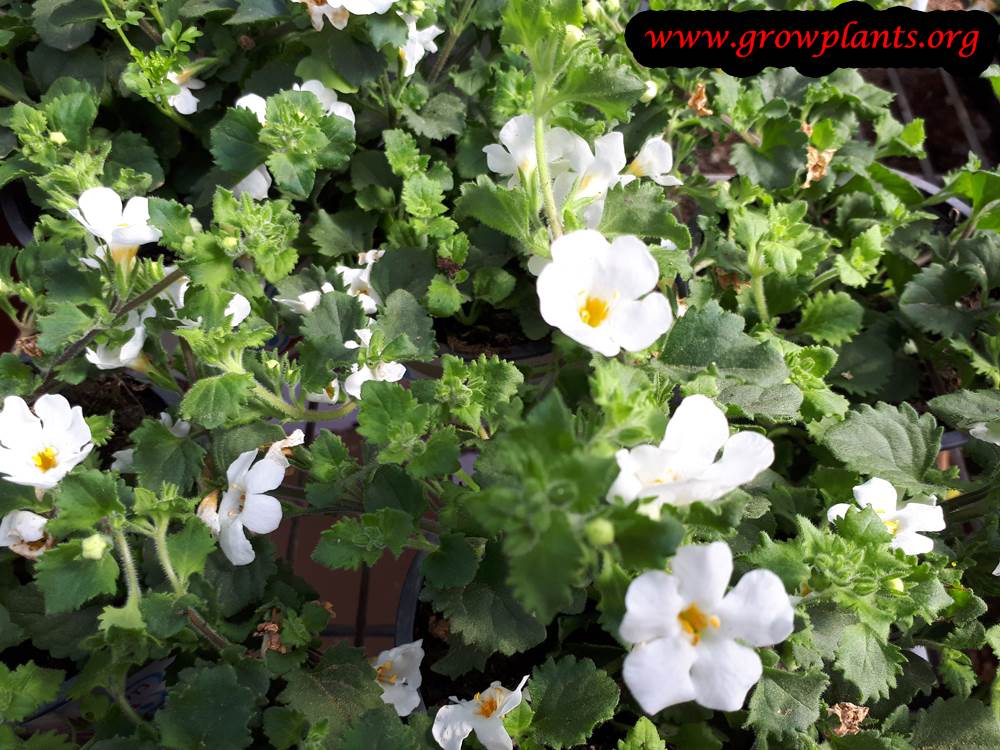
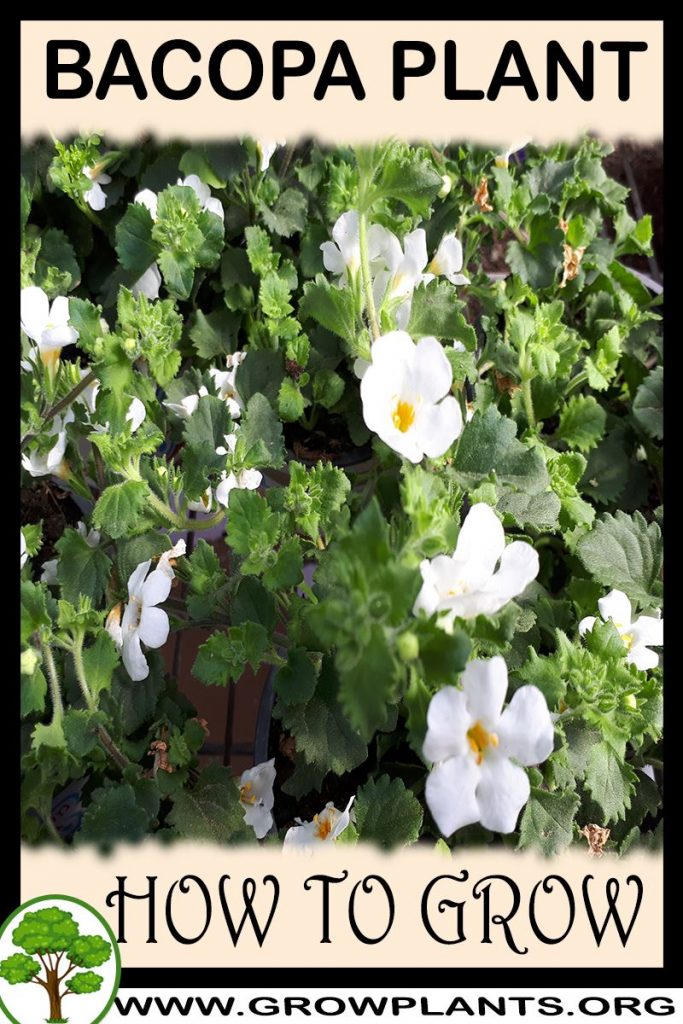
- Flower Characteristics: Small cross-shaped flowers in purple, white, blue, yellow or pink (see the Bloom guide)
Primary Uses & Landscape Value
- Edible Uses: Some species (e.g. Bacopa monnieri, brahmi) are used medicinally and as a culinary herb
- Functional & Ornamental Roles: Trailing ornamental for baskets and containers, groundcover, and aquatic/aquarium plant
Care Guide: Planting, Soil & Watering
Overview: Bacopa is a fast-growing, moisture-loving plant of aquatic and boggy habitats that grows in full sun to full shade in heavy, rich soil kept constantly wet. It thrives at the water’s edge, in shallow water or in permanently moist ground and never wants to dry out.
Quick Care Requirements
| Requirement | Ideal Condition |
|---|---|
| Planting Season | In spring where grown as an annual; spring through autumn where perennial |
| Growth Rate | Fast |
| Soil Type | Heavy, rich, moisture-retentive soil kept constantly wet; suited to aquatic and bog conditions |
| Water Need | Moderate to High – keep the soil wet at all times; tolerates standing water |
Planting & Establishment
- Best Planting Season: Plant in spring where treated as an annual, or from spring through autumn where grown as a perennial.
- How to Plant:
- Hole Preparation: Dig a hole to fit the root ball at the pond margin, in a bog bed or in a submerged container of heavy soil.
- Soil Amendments: Use a heavy, rich soil that holds water; aquatic planting baskets of loam work well for pond edges.
- Planting Depth: Set the crown at soil level; the plant tolerates being at or just below the waterline.
- Growth Speed & Expectations: Fast, forming low, spreading mats about 5–15 cm high.
Soil, Watering & Drainage Care
- Soil Mix & Drainage Needs: Unlike most plants, it wants heavy, water-retentive soil rather than sharp drainage; it can be grown in an aquarium or pond, or in containers stood in water.
- Watering Schedule & Technique:
- Young / Newly Planted: Keep the soil saturated and never let it dry out.
- Established: Maintain constantly wet soil or shallow standing water; the more consistent the moisture, the better it grows.
- Seasonal Adjustments: Keep wet through the warm growing season; in cold climates it dies back and is grown as an annual.
Climate, Light & Hardiness
Bacopa is an aquatic-to-semi-aquatic plant suited to warm, humid mediterranean, subtropical, temperate, or tropical climates, and it adapts to full sun through full shade. As a perennial it is reliably hardy to about USDA zone 10, but it is also widely grown as an annual much further into colder zones since it grows quickly from cuttings each season.
Quick Climate Specifications
| Climate Zones | Mediterranean, subtropical, temperate, or tropical; also grown as a water/aquarium plant |
|---|---|
| USDA Hardiness Zones | Approximately 10 and warmer as a perennial; commonly grown as an annual from about zone 5 upward |
| Frost Tolerance | Low |
| Light Conditions | Full sun, half shade, or full shade |
Sunlight & Light Exposure
Optimal Light Setup
Adapts to a wide light range from full sun to full shade, making it flexible for pond edges, borders, or indoor aquariums with supplemental light.
Shade & Heat Management
Tolerates shade well, and in hot climates some shade can reduce stress on the water/soil environment it grows in.
Temperature Extremes & Hardiness
USDA Hardiness & Regional Limits
Reliably perennial only in frost-free to nearly frost-free conditions (about USDA zone 10+); outside that range, freezing winters kill the top growth and the plant is treated as an annual, commonly grown as far north as roughly zone 5.
Cold Damage & Winter Protection
Foliage is damaged by frost; where grown as a perennial near its cold limit, overwintering indoors or taking cuttings before frost helps preserve the plant.
Frost Sensitivity
Frost-sensitive; cold limits it to annual culture across most of its wider growing range.
Growing in Pots, Balconies & Indoors
Bacopa is a small, fast, trailing plant the grower rates as a houseplant that also grows well in containers, with some types grown submerged in a lit aquarium. Tolerant of sun to shade, it spills prettily from an indoor pot or hanging basket as long as it never dries out.
Quick Details
- Container Size: A small pot or a hanging basket – it trails rather than climbs
- Indoor Suitability: A good indoor plant for a bright spot; keep it constantly moist
- Best Spot: Full sun to full shade; bright light gives the most flowers
- Soil & Drainage: Moisture-retentive but free-draining mix
- Watering in Pots: Average to generous – never let it dry out, or it collapses fast
Indoors & On the Windowsill
- Houseplant: A genuine small houseplant. Stand it in good light and keep the mix reliably moist; a brief dry spell can be fatal.
- Aquarium note: Some bacopas are grown submerged in a lit aquarium, so it is at home in wet conditions.
- Trailing habit: Its cascading stems suit a raised pot or basket where they can spill over the edge.
On a Balcony or Patio
- Light & water: Lovely trailing from a railing basket; in sun the small pots dry very fast, so water often – even twice a day in heat.
- Practicalities: Trim it back if it gets straggly to keep it full and flowering.
Choosing the Pot, Soil & Long-Term Care
- Pot & drainage: A basket or pot with holes and a moisture-retentive mix; because it must stay damp, a saucer or self-watering base can help here.
- Potting mix: Well-aerated and organic-rich – a peat- or coir-based mix opened up with perlite or vermiculite and enriched with compost.
- Feeding: Feed regularly for continuous flowering – potted, fast growth uses food quickly.
- Repotting: Refresh or replace it each year, as it is short-lived and easy to renew from cuttings.
Fertilizing & Feeding
A light feeder that draws much of its nutrition from a rich, heavy substrate or aquatic soil rather than frequent liquid feeding.
Quick Fertilizing Specs
| Feeding Level | Light – nutrition mostly comes from a rich substrate. |
|---|---|
| young_feeding | A light, balanced feed as new plantings root into the substrate. |
| mature_feeding | Occasional light feeding once established, since a heavy aquatic substrate supplies much of its needs. |
| Main Nutrient Priority | Balanced nutrition, with attention to the substrate rather than frequent liquid feeds. |
| Best Feeding Period | During active growth in the warm season. |
| Organic Options | Rich, heavy aquatic soil or well-rotted organic matter worked into the planting medium. |
| Soil pH | Tolerates a wide range in a heavy, moisture-retentive medium. |
| Reduce/Stop Feeding | Ease off feeding as growth slows in cooler weather or, where grown as an annual, as the plant declines. |
| Micronutrients | Rarely needed; correct only if a deficiency shows. |
Feeding by Growth Stage
Establishment in aquatic or heavy soil
Help newly planted stems root into a rich, heavy substrate.
| Nutrient direction | A light, balanced feed or an enriched aquatic substrate to support early rooting. |
|---|---|
| Timing | In the weeks after planting into a pond margin, container, or aquarium substrate. |
| Frequency | A light feeding, if any, is enough while roots establish. |
| Fertilizer types | Rich, heavy aquatic soil or planting medium, A light balanced feed worked into the substrate |
| Precautions | Avoid feeding directly into open water, which can encourage algae growth; keep nutrients in the substrate. |
Active growth
Support fast, spreading growth of stems, leaves, and flowers.
| Nutrient direction | A balanced feed delivered through the substrate supports this fast-growing plant without over-feeding the surrounding water. |
|---|---|
| Timing | Through the warm active growing season. |
| Frequency | A few light, substrate-based feedings through the growing season is usually enough. |
| Fertilizer types | Aquatic or heavy-soil root tabs worked into the substrate, A light balanced complete fertilizer for container or bedding use |
| Precautions | Keep feeding light and substrate-based; excess nutrients in open water can trigger algae blooms. |
Seasonal decline or cold-season rest
Let growth wind down where the plant is grown as an annual or goes dormant in cooler water.
| Nutrient direction | None – withhold fertilizer as the plant declines or growth stops for the season. |
|---|---|
| Timing | As cooler weather sets in, or at the natural end of the season where grown as an annual. |
| Frequency | No feeding at this stage. |
| Fertilizer types | No feeding at this stage – resume only if the plant is perennial and returns to active growth. |
| Precautions | Do not fertilize a declining or dormant planting; excess nutrients left unused can foul the water. |
Nutrient Deficiency Signs & Corrections
Pale, yellow-green older leaves and thin, weak stem growth.
| Possible causes | Low nutrients in the substrate, Substrate exhausted after prolonged growth without replenishment, Insufficient light limiting nutrient uptake |
|---|---|
| Appears first on | Older, lower leaves first. |
| What to check | Substrate age and feeding history, Light levels, Overall growth rate |
| Possible correction | Refresh or lightly feed the substrate with a balanced fertilizer during active growth. |
Yellowing between the veins of the newest leaves while veins stay green.
| Possible causes | High or alkaline water/soil pH locking up iron or manganese, Low available iron or manganese in the substrate, Poor root function from a compacted or stagnant substrate |
|---|---|
| Appears first on | Newest growth at the stem tips. |
| What to check | Water and substrate pH, Substrate condition and age, Whether roots look healthy when checked |
| Possible correction | Correct pH toward the plant’s preferred range, refresh the substrate, and if it persists apply a chelated iron or manganese product per its label. |
Algae growth in surrounding water alongside weak or stunted plant growth.
| Possible causes | Over-feeding of open water rather than the substrate, Too much light for the nutrient level present, Poor water circulation concentrating nutrients |
|---|---|
| Appears first on | Open water surfaces and slower-growing plant parts. |
| What to check | Recent feeding method and amounts, Light exposure, Water clarity and circulation |
| Possible correction | Move feeding into the substrate rather than the water column, reduce light or nutrient input, and improve circulation. |
Pruning, Training & Seasonal Maintenance
Bacopa is a low, soft-stemmed creeping herb that tolerates cutting back at almost any time; the goal is never structural framework but simply shape, density and removal of tired growth. Because it roots readily along trailing stems, light trims mainly redirect energy into fresh branching rather than affecting any woody bloom cycle.
Quick Pruning & Maintenance Specs
| Pruning Tolerance | High (soft growth, regenerates fast) |
| Primary Pruning Window | Any time growth is active |
| Secondary Maintenance Window | Light tidy after each flowering flush |
| Typical Frequency | Ongoing light pinching/trimming |
| Main Objective | Density, compactness, remove dead/leggy stems |
| Young Plant Priority | Pinch tips early to encourage branching from the base |
| Mature Plant Priority | Cut back leggy or bare trailing stems to renew fullness |
| Best Tool Type | Precision snips or fingers (pinching) |
| Avoid Heavy Pruning During | Peak summer heat stress if grown emersed/dry-sided |
Pruning by Plant Age & Size
Newly Established
Pinch growing tips once the plant has a few sets of leaves to encourage side-branching; avoid heavy cutting before roots are established.
Young / Formative
No structural training applies — this is a mat/trailing groundcover or basket plant; simply pinch regularly to build a dense mound or trailing curtain rather than a single long runner.
Mature / Established
Shear or hand-trim overgrown trailing stems back by up to half periodically to prevent bare, leggy centers and to keep flowering concentrated on fresh growth.
Seasonal Pruning Schedule
| Ongoing Sanitary | Objective: keep the mat fresh. Remove dead, blackened or rotting stems and spent flowers as seen; safe in any season since this plant is pruned all year per its own care notes. |
Structural Pruning & Training
No woody framework to train; the only structural concern is preventing bare, woody-based centers on older mats by periodically cutting the longest trailing stems back to a lower node to force new breaks.
Special Growth to Remove
- Dead or blackened (often rotted, if overwatered/waterlogged) stem sections
- Spent flower stems once bloom fades
- Excessively long, bare-based runners — cut back to encourage branching rather than letting them trail unchecked
Container & Small-Space Pruning
Very well suited to pots, hanging baskets and shallow water/aquarium culture; pinch more frequently in containers than in the ground to prevent the compact habit from turning stringy, and trim spillover growth to keep it in scale with the pot.
Tools
- Precision snips or fingertip pinching for all routine work — stems are soft, not woody, so no loppers or saws are ever needed
Tool Hygiene & Disease Risk
Routine: clean tools are sufficient; no elevated disease-transmission risk is documented for this plant.
Cut Placement & Technique
Pinch or snip just above a leaf node or pair to prompt branching at that point; when cutting back leggy stems, cut to just above a lower healthy node rather than leaving long bare stubs.
Heavy Pruning & Rejuvenation
Tolerates being cut back hard (by half or more) to rejuvenate a leggy, tired mat; fast regrowth from remaining nodes typically restores fullness within a few weeks in active growing conditions.
Post-Pruning Care
Keep soil or water evenly moist after a hard trim to support fast regrowth; no extra feeding is needed beyond the plant’s normal light routine.
Common Pruning Mistakes
- Letting mats go untrimmed until the centers are bare and woody, instead of trimming little and often
- Cutting dry soil-grown plants back hard during heat stress instead of a cooler, more active period
When NOT to Prune
Avoid a hard cutback during a severe heat or drought-stress spell in soil-grown plantings; otherwise this plant tolerates trimming in any season.
Recommended Tools (by task)
- precision_snips — the only tool this soft-stemmed trailing herb ever needs, for pinching tips and cutting back leggy stems
Propagation Guide
Bacopa roots from stem cuttings within days to a couple of weeks, making cuttings by far the fastest and easiest way to start new plants, whether rooted in water or in moist soil/aquatic substrate; seed is a slower, less commonly used alternative. Propagation is Easy.
Quick Propagation Specs
| Best Propagation Method | Stem cuttings |
| Alternative Methods | Division of rooted trailing stems; seed |
| Propagation Difficulty | Easy |
| Seed True-to-Type | Usually true-to-type (species) |
| Vegetative True-to-Type | Yes |
| Best Propagation Season | Spring–summer, or year-round indoors/in an aquarium |
| Cutting Rooting Time | Often within one to two weeks in warm, wet conditions |
Growing from Seed
Seed is possible but is slower and less predictable than cuttings, and there is little site-specific detail on sowing; cuttings remain the standard way growers start this plant.
Stem Cuttings
Cutting Type
Non-woody stem-tip cuttings, roughly 5–10cm (2–4in).
Best Timing
Spring through autumn outdoors in mild/tropical climates; any time of year indoors or in an aquarium.
Cutting Preparation
Cut just below a leaf node and remove the lowest leaves so a bare section can sit in water or be buried in substrate.
Rooting Setup
Matches this plant’s aquatic/heavy-soil preference: root cuttings directly in water, in constantly moist potting mix, or planted straight into aquarium or marginal-pond substrate.
Rooting Hormone
Unnecessary – cuttings root readily on their own.
Rooting Time
Typically roots within one to two weeks under warm, consistently wet conditions.
Runners & Stolons
Trailing stems root naturally at the nodes wherever they touch moist soil or sit in water/substrate. Rooted sections can simply be cut free from the mother plant once their own roots are established, rather than needing fresh cuttings.
Bloom & Flower Guide
Quick Details
- Bloom Season: Spring into summer
- Flower Appearance: Small five-lobed flowers in purple, white, blue, yellow or pink
- Edibility: The flowers are not eaten – grown as an ornamental (and some species as a medicinal herb)
Detailed Blooming Overview
Bacopa (waterhyssop) is a low, spreading sub-shrub of the genus Bacopa, grown as a perennial or annual and sometimes as a moisture-loving marginal plant. It flowers freely through spring and summer in Mediterranean, subtropical, temperate and tropical settings – roughly zone 10 and warmer as a perennial, or from zone 5 as an annual.
Flower Characteristics
- Small, neat flowers with a cross-like, five-lobed face.
- Colors range across purple, white, blue, yellow and pink.
- Scattered generously over trailing, small-leaved stems.
Bloom Care & Thinning
- Prolonging the display: A light trim of leggy stems keeps the plant compact and flowering.
- Position: Steady moisture and good light give the most continuous bloom.
- Pollination: Visited by bees and other small insects.
Fruit & Uses
Safety note first: Bacopa is grown mainly as a medicinal herb and as an ornamental water/bog or aquarium plant, and in a few regional cuisines its young leaves and shoot tips are eaten fresh as a bitter, pungent herb — but only plants grown specifically for food are appropriate to eat. Do not eat ornamental or aquarium-trade stock, which may be treated with chemicals not meant for consumption.
Quick Edible Specs
| Edible Parts | Young leaves and tender shoot tips |
|---|---|
| Main Use(s) | Regional culinary herb/spice, used fresh alongside savory dishes in parts of Southeast Asian cuisine; long-standing traditional medicinal-plant use (no health claims made) |
| Eaten Raw or Cooked | Traditionally eaten raw as a fresh herb, or added lightly cooked to soups |
| Preparation Required | Wash thoroughly before eating raw — it is often grown in wet soil or standing water; use only plants grown in clean, food-safe conditions |
| Harvest Season | Pick soft new growth while the plant is actively growing, mainly spring through summer |
| Storage | Best used fresh soon after picking, like other tender leaf herbs — it wilts quickly |
| Safety/Toxicity Caveat | only eat Bacopa grown intentionally as a food herb in clean conditions; never eat plants bought as ornamental groundcover or aquarium/pond stock, and confirm the species is the water hyssop type before eating, since other garden plants are also sold under the "Bacopa" name for purely ornamental use |
Leaves & Greens
The tender young leaves (green, and variably heart-, round-, linear- or ovate-shaped) and soft new shoot tips are the parts used. They are picked while still soft and pale, before stems toughen, and used fresh — either raw in small amounts alongside other food or lightly wilted into a cooked dish. Because the plant is naturally an aquatic/bog grower, only leaves from clean, food-intended water or soil should be used.
Harvesting
Take a few soft top leaves and shoots at a time during active growth (spring/summer) rather than stripping the plant, which also lets it keep producing new growth and flowering.
Preparation, Uses & Safety
Where eaten, Bacopa leaves are used fresh as a pungent herb or added to soups, similar to other bitter leafy herbs. This is a regional and marginal food use rather than a mainstream vegetable: buy or grow it specifically as a culinary herb, wash it well, and avoid any plant sold for ornamental bedding or aquarium use. Bacopa is much better known for traditional medicinal use (as “Brahmi”); no medical claims are made here beyond noting that history.
Pests, Diseases & Troubleshooting
Overview: The ornamental ‘Bacopa’ sold for baskets and containers is Sutera cordata (Chaenostoma cordatum), a trailing, small-flowered bedding plant; its main pests under warmth and humidity are aphids, whitefly, spider mites, thrips and fungus gnats, and its diseases are Botrytis, downy mildew and root rot in wet mixes. Its number-one ‘problem’, however, is abiotic: it sulks and stops flowering the moment it dries out. (True aquatic Bacopa, e.g. Bacopa monnieri, is a different, near-pest-free marginal.)
Quick Troubleshooting Overview
| Issue / Pest | Main Symptom | Primary Solution |
|---|---|---|
| Aphids | Curled sticky tips, honeydew on soft growth | Hose off, insecticidal soap, encourage predators |
| Whitefly | White flies rising from foliage, sooty mould | Yellow sticky traps, soap/neem on undersides |
| Spider mites | Fine stippling and webbing in hot dry air | Raise humidity, oil/soap |
| Stops flowering / wilts | Sudden bloom drop and wilting after drying out | Never let it dry; keep evenly moist |
| Root rot | Yellowing, collapse in soggy mix | Free-draining mix, water when top is just dry |
| Chlorosis | Pale new leaves in baskets | Iron chelate / balanced feed, check pH |
Common Pests & Management
- Aphids (Myzus persicae / Aphis spp.):
- Symptoms: Green, black or peach aphids clustered on tender shoot tips and flower buds, curling growth and coating it in sticky honeydew and sooty mould.
- Prevention & Control: Dislodge with a jet of water, pinch off infested tips, and encourage ladybirds and lacewings. Insecticidal soap or neem clears persistent colonies – wet the undersides and repeat.
- Whitefly (Trialeurodes vaporariorum):
- Symptoms: Clouds of tiny white flies rising when the plant is brushed, with honeydew and sooty mould; flat pale nymphs on the leaf undersides. Common in warm, sheltered, greenhouse conditions.
- Prevention & Control: Hang yellow sticky traps, encourage Encarsia parasitoids, and hose foliage. Apply insecticidal soap or neem to the undersides in the evening, repeating to break the life cycle.
- Spider mites (Tetranychus urticae):
- Symptoms: Fine pale stippling, a dull dry look and fine webbing at the shoot tips in hot, dry conditions – common on hanging baskets in full sun.
- Prevention & Control: Raise humidity, hose the foliage, and avoid drought stress. Treat with insecticidal soap or horticultural oil and encourage predatory mites; repeat to catch new hatchlings.
- Thrips (Frankliniella occidentalis):
- Symptoms: Silvery streaked, flecked leaves and distorted, scarred flowers with tiny black faecal specks; can transmit tospoviruses (INSV/TSWV).
- Prevention & Control: Use blue sticky traps, remove badly affected buds, and encourage predatory mites and minute pirate bugs. Spinosad or insecticidal soap controls outbreaks; rotate products.
- Fungus gnats (Bradysia spp.):
- Symptoms: Small dark flies over the mix; larvae in constantly wet compost feed on roots, weakening cuttings and young plants.
- Prevention & Control: Let the surface dry between waterings, use yellow sticky traps, and apply Bti or beneficial nematodes to the mix for the larvae.
Diseases & Fungal Issues
- Botrytis (grey mould) (Botrytis cinerea):
- Symptoms: Fuzzy grey mould on faded flowers, and soft brown rot spreading into congested, damp foliage in cool humid conditions.
- Treatment & Management: Deadhead spent flowers, remove dead leaves, and improve airflow; avoid overhead watering and overcrowding. Reduce humidity; a suitable fungicide helps only if cultural control is insufficient.
- Downy mildew (Peronospora / Plasmopara):
- Symptoms: Yellow blotching on the upper leaf with grey-purple downy growth beneath in cool, wet, humid weather; leaves yellow and drop.
- Treatment & Management: Space plants, improve airflow, water early in the day at the roots, and remove infected leaves. Copper or a labelled fungicide checks severe outbreaks.
- Root and crown rot (Pythium / Rhizoctonia):
- Symptoms: Yellowing, wilting and collapse with dark, mushy roots and stem bases in soggy, poorly drained mix.
- Treatment & Management: Use a free-draining mix, water only when the top has begun to dry, and ensure pots drain freely. Discard badly rotted plants; do not reuse contaminated mix.
Growing Difficulties & Abiotic Problems
- Stops flowering after drying out (the key complaint):
- Cause & Symptoms: Ornamental bacopa is unforgiving of drought – a single wilt-to-dryness episode makes it drop flowers and buds and sulk for weeks, refusing to rebloom.
- Correction Strategy: Keep the mix consistently, evenly moist (never bone dry, never waterlogged); in hot weather baskets may need daily watering. Trim back and feed to coax fresh flowering growth after a setback.
- Iron chlorosis:
- Cause & Symptoms: In containers, especially with hard water or high pH, new leaves pale and yellow between the veins.
- Correction Strategy: Feed regularly with a balanced fertiliser including iron, use an iron chelate if needed, and avoid very alkaline water.
- Legginess / poor branching:
- Cause & Symptoms: Trailing stems become bare and sparse without pinching, and flowering thins.
- Correction Strategy: Pinch or shear lightly to encourage branching, feed steadily, and give full sun to light shade for dense, floriferous growth.
- Heat and sun stress:
- Cause & Symptoms: In extreme heat with full sun and drying wind, foliage scorches and flowering pauses.
- Correction Strategy: Provide some afternoon relief in the hottest climates and keep moisture even; flowering resumes as conditions moderate.
What Helps – Products & Tools
Even moisture and good drainage are 90% of success. When pests appear, insecticidal soap, neem and horticultural oil cover aphids, whitefly and mites; yellow/blue sticky traps and spinosad handle whitefly and thrips; Bti or nematodes deal with fungus gnats; and a copper or labelled fungicide checks downy mildew and Botrytis. An iron-inclusive feed keeps basket plants green. Spray oils in the evening.