

Plant Profile & Key Characteristics
Overview: Anemone palmata (Mediterranean / yellow anemone) is a low deciduous perennial geophyte reaching 10-30 cm (4-12 in), sometimes grown as an annual. It is grown as an ornamental and cut flower for its yellow or white blooms.
Quick Specifications
| Specification | Attribute |
|---|---|
| Plant Type / Life Cycle | Perennial (herbaceous geophyte; sometimes grown as an annual) |
| Foliage Type | Deciduous |
| Mature Size | 10-30 cm (4-12 in) tall |
| Growth Rate | Moderate |
| Root System | Tuberous geophyte |
| Toxicity | Toxic – contains protoanemonin (buttercup family); sap can irritate skin |
| Hardiness | USDA zone 6-10 |
Growth Form & Structure
- Height & Spread: 10-30 cm (4-12 in) tall in the ground; can also be grown in planters and containers
- Growth Habit & Form: Low clump of basal leaves with single flowers on upright stems, arising from a tuber
- Lifespan & Maturity: Long-lived perennial tuber; flowers in spring to summer
Anatomy & Physical Features
- Leaves & Foliage: Green, lobed, pinnate to bi-pinnate leaves borne on stems
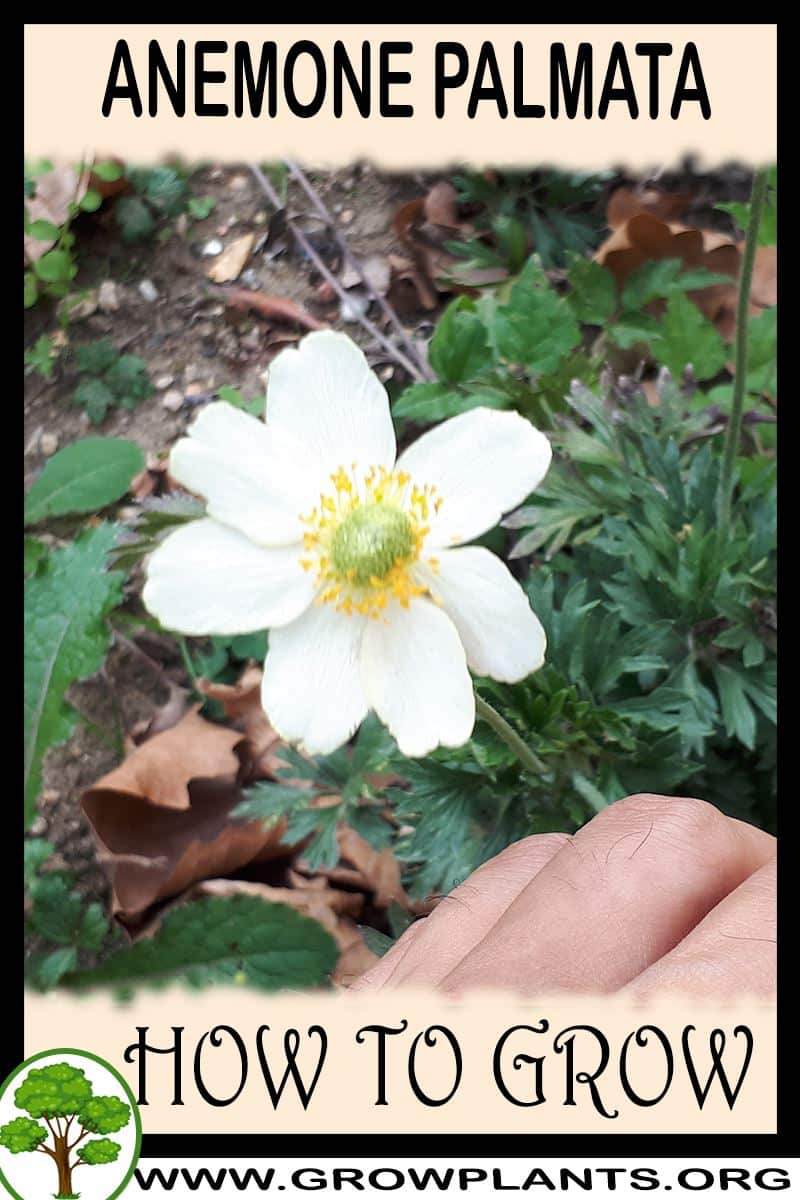
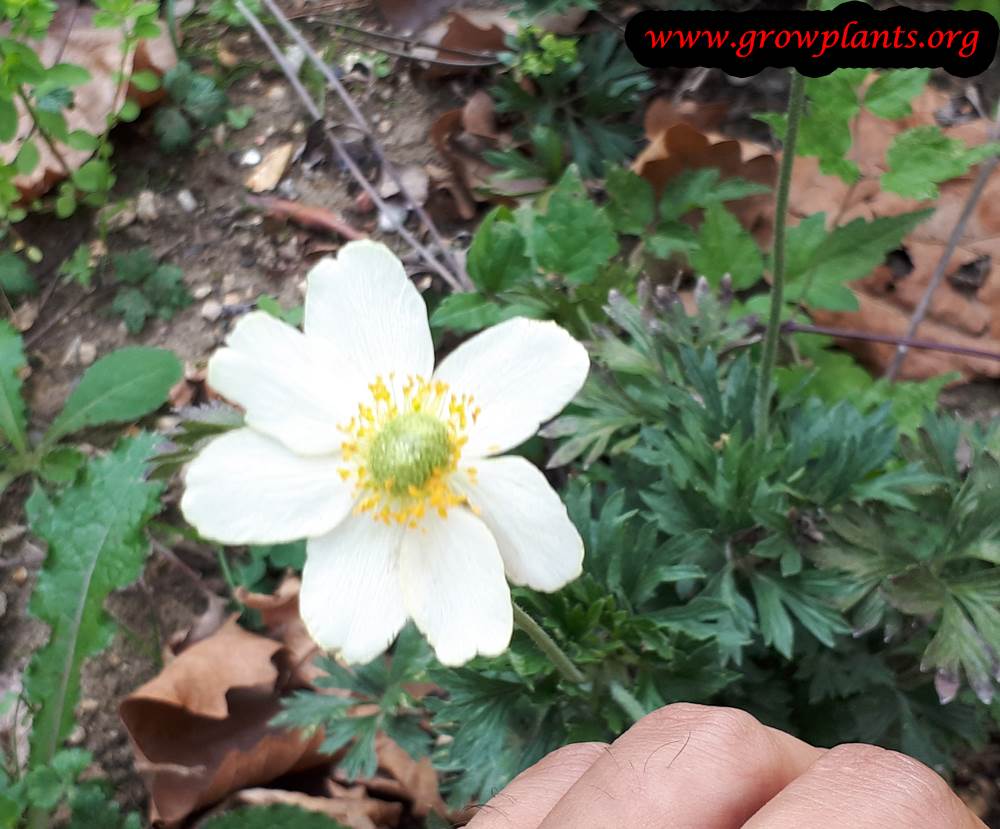
- Flower Characteristics: Yellow or white blooms with about twelve petals and a showy central boss of stamens (see the Bloom guide)
Primary Uses & Landscape Value
- Functional & Ornamental Roles: Ornamental border and rock-garden perennial and cut flower
Care Guide: Planting, Soil & Watering
Overview: Anemone palmata (Mediterranean anemone) is a clump-forming, deciduous perennial for temperate to Mediterranean gardens (hardiness zone 6-10), growing in full sun to part shade. It does best in loamy, well-draining soil that stays on the drier side in summer.
Quick Care Requirements
| Requirement | Ideal Condition |
|---|---|
| Planting Season | Spring in cold climates, autumn in milder ones |
| Growth Rate | Moderate |
| Soil Type | Loamy, well-draining soil |
| Water Need | Moderate |
Planting & Establishment
- Best Planting Season: Plant in spring in cold-winter regions, or in autumn where winters are mild.
- How to Plant:
- Hole Preparation: Dig a hole a little wider than the root ball in loosened, free-draining soil.
- Soil Amendments: Work in organic matter to build a loamy, moisture-retentive yet well-drained soil.
- Planting Depth: Set the crown at soil level so the growing point is not buried.
- Growth Speed & Expectations: A moderate grower forming a clump around 10-30 cm tall; it spreads steadily once settled.
Soil, Watering & Drainage Care
- Soil Mix & Drainage Needs: Loamy, well-draining soil suits it best, as it dislikes waterlogging, especially over winter. In containers use a free-draining potting mix.
- Watering Schedule & Technique:
- Young / Newly Planted: Keep the soil evenly moist while plants establish their roots.
- Established: Water moderately for steady, even moisture, letting the surface dry slightly between waterings.
- Seasonal Adjustments: Ease back in winter as the plant dies down, and keep summers on the drier side.
Climate, Light & Hardiness
Anemone palmata (Mediterranean anemone) is a compact, cold-hardy deciduous perennial for subtropical, temperate, and mediterranean climates, flowering in spring in full sun to half shade. It is hardy outdoors in USDA zone 6–10.
Quick Climate Specifications
| Climate Zones | Subtropical, temperate, mediterranean |
|---|---|
| USDA Hardiness Zones | 6–10 |
| Frost Tolerance | Moderate to High |
| Light Conditions | Full Sun / Half Shade |
Sunlight & Light Exposure
Optimal Light Setup
Full sun to half shade both suit this low-growing (10–30 cm) anemone.
Direct Sun Requirement
Several hours of direct sun supports good flowering.
Shade & Heat Management
Its preference for a dry summer and well-drained loamy soil means part shade can help it cope in the hotter, mediterranean part of its range.
Best Exposure / Orientation
A sunny-to-lightly-shaded rock garden or border edge suits its compact habit.
Temperature Extremes & Hardiness
USDA Hardiness & Regional Limits
Reliably hardy outdoors USDA zone 6–10; it is naturally deciduous, with foliage dying back in autumn and the plant regrowing from the roots or bulb.
Cold Damage & Winter Protection
Dead top growth is pruned away in autumn as part of its natural cycle; no special winter protection is typically needed within its hardy zone range.
Frost Sensitivity
The root/bulb system is frost-hardy within zone 6–10; soft spring growth is more vulnerable to a late hard freeze.
Extreme Heat Tolerance
Moderate – it prefers a dry summer and well-drained loamy soil with average water; it is not suited to constantly hot, wet conditions.
Wind, Humidity & Microclimate
Rainfall & Seasonal Moisture
Prefers a drier summer with well-drained loamy soil, consistent with a mediterranean-climate rainfall pattern of moist winters/springs and dry summers.
Microclimate Recommendations
A sunny-to-part-shaded, well-drained spot suits it best, particularly mimicking mediterranean-climate seasonal moisture patterns.
Growing in Pots, Balconies & Indoors
Anemone palmata is a small, sun-loving Mediterranean anemone the grower does not treat as a houseplant. It is a neat, bright plant for a sunny outdoor pot, flowering in the cooler part of the year and resting dry in the heat, so it belongs on a balcony or patio rather than indoors.
Quick Details
- Container Size: A small to medium pot; group several for a fuller show
- Indoor Suitability: Not a houseplant – a sun-loving outdoor container plant
- Best Spot: Full sun
- Soil & Drainage: Free-draining mix with plenty of holes
- Watering in Pots: Average while growing; keep drier during its summer rest
Indoors & On the Windowsill
- Houseplant limits: Not an indoor plant – it needs strong sun to grow and flower, more than a room can offer.
- Windowsill note: Only a very sunny sill would suit it, and it still prefers the open air and a proper dry rest.
On a Balcony or Patio
- Light, wind & heat: Give it the brightest, sunniest spot; walls and paving throw heat back so pots dry quickly – check moisture daily in warm spells, and stake or shelter anything tall or exposed from wind. A drip irrigation kit with a timer can take over that watering check automatically.
- Practicalities: Small pots dry fast in sun, so water while in leaf and move under cover for the dry dormant rest.
Choosing the Pot, Soil & Long-Term Care
- Pot & drainage: A free-draining pot with plenty of holes and no standing saucer.
- Potting mix: Well-aerated and organic-rich – a peat- or coir-based mix opened up with perlite or vermiculite and enriched with compost.
- Feeding: A light feed while in leaf builds the plant for next season.
- Repotting: Repot or divide when the pot fills with offsets.
Fertilizing & Feeding
A moderate feeder: balanced feeding supports this Mediterranean-climate geophyte through its cool-season growth and spring-to-summer bloom, with no feeding needed once the tuber goes dormant through the dry summer.
Quick Fertilizing Specs
| Feeding Level | Moderate feeder |
|---|---|
| Main Nutrient Priority | Balanced feeding with adequate nitrogen; extra phosphorus is not needed to drive bloom |
| Best Feeding Period | Cool-season growth through the spring-to-summer bloom period |
| Organic Options | Compost worked into loamy, well-drained soil |
| Micronutrients | Iron is usually adequate in well-drained, organic-rich soil; correct specific issues only when diagnosed |
| Soil pH | Performs best in loamy, well-drained soil; avoid highly alkaline sites, which can limit iron uptake |
| Reduce/Stop Feeding | Taper off as bloom finishes and foliage dies back ahead of the dry summer dormant rest |
Feeding by Growth Stage
Cool-season growth and emergence
Support this Mediterranean-climate geophyte’s cool-season growth as it emerges from its dormant tuber and builds foliage ahead of bloom.
| Nutrient direction | A balanced complete fertilizer to support root and leaf growth as new shoots emerge. |
|---|---|
| Timing | From emergence through the cool growing season, ahead of bloom. |
| Frequency | A light feeding as new growth emerges. |
| Fertilizer types | A balanced complete garden fertilizer, Compost worked into loamy, well-drained soil |
| Precautions | Keep soil well drained; this plant is adapted to a dry summer and resents soil that stays wet, especially once it is no longer actively growing. |
Spring-to-summer bloom
Support flower production for this ornamental cut-flower plant during its spring-to-summer bloom period.
| Nutrient direction | Continue balanced feeding with adequate nitrogen; extra phosphorus is not needed to drive flowering. |
|---|---|
| Timing | During the spring-to-summer bloom period. |
| Frequency | Light, steady feeding through bloom, tapering off as flowering finishes and foliage begins to decline. |
| Fertilizer types | A balanced complete fertilizer |
| Precautions | Ease off feeding as bloom finishes and foliage starts dying back ahead of the dry summer rest. |
Dry summer tuber dormancy
Let the tuber rest undisturbed through its natural dry-summer dormancy.
| Nutrient direction | None – withhold fertilizer while the tuber is dormant. |
|---|---|
| Timing | Summer, once foliage has died back after bloom. |
| Frequency | No feeding at this stage. |
| Fertilizer types | No feeding at this stage – allow the tuber to rest dormant through the dry summer |
| Precautions | Do not fertilize a dormant tuber; feeding now offers no benefit and risks encouraging rot in soil that should stay comparatively dry. |
Nutrient Deficiency Signs & Corrections
The tuber softens and rots, with no new growth appearing at the expected time.
| Possible causes | waterlogged or overly wet soil during the dormant period, poor drainage in heavy soil, fungal pathogens favored by damp, warm conditions |
|---|---|
| Appears first on | the tuber itself |
| What to check | soil drainage, watering during dormancy, soil texture |
| Possible correction | Improve drainage and withhold water and fertilizer during summer dormancy; discard soft, rotten tubers. |
New leaves emerge pale yellow while the veins stay green.
| Possible causes | high soil pH limiting iron availability, waterlogged soil stressing the roots during active growth, low organic matter in poor soil |
|---|---|
| Appears first on | the newest leaves |
| What to check | soil pH and drainage, recent watering, organic matter level |
| Possible correction | Improve drainage and organic matter; correct with a chelated iron product per its label if chlorosis persists. |
Fewer or smaller flowers than expected during the bloom period.
| Possible causes | excess nitrogen favoring foliage over flowers, insufficient sun for this full-sun-to-half-shade plant, a tuber weakened by wet, poorly drained conditions the prior summer |
|---|---|
| Appears first on | flower count and size across the plant |
| What to check | recent feeding balance, sun exposure, drainage history at the planting site |
| Possible correction | Rebalance feeding toward a standard balanced fertilizer, confirm adequate sun, and improve drainage for the following season. |
Pruning, Training & Seasonal Maintenance
Anemone palmata is a small Mediterranean geophyte that goes summer-dormant in its dry-summer, well-drained native conditions, so pruning is limited to clearing dead foliage rather than any shaping or structural cuts. The recorded pruning window in autumn fits this pattern well: as the dry summer ends, dead summer foliage is cleared away to make room for the autumn–winter growth flush that leads into spring bloom.
Quick Pruning & Maintenance Specs
| Pruning Tolerance | Low – seasonal cleanup only |
| Primary Pruning Window | Autumn, once foliage has died back after summer dormancy |
| Secondary Maintenance Window | None significant |
| Typical Frequency | Once a year |
| Main Objective | Remove spent, dead foliage to tidy the dormant clump |
| Young Plant Priority | None – let it establish undisturbed |
| Mature Plant Priority | Clear dead leaves in autumn; divide only if the clump becomes congested |
| Best Tool Type | Precision snips, or simply hand-clearing (soft, papery dead foliage) |
| Avoid Heavy Pruning During | Spring bloom, and while foliage is still green and photosynthesizing |
Pruning by Plant Age & Size
Newly Established
No pruning needed beyond removing any damaged leaves.
Young / Formative
None – this herbaceous geophyte has no structural training to apply.
Mature / Established
Annual removal of dead summer foliage in autumn as new growth begins; divide only if the clump has become crowded and flowering has declined.
Seasonal Pruning Schedule
Pre-Growth / Early Autumn
- Objective: clear the way for the autumn growth flush after summer dormancy
- Remove: dead, papery summer foliage
- Do not remove: any leaf tissue still green and attached, since it is still feeding the tuber
- Expected response: clean emergence of new autumn–winter foliage
- Flowering impact: none – flowers form on the following spring’s new growth regardless
Special Growth to Remove
- Dead foliage after summer dormancy sets in
- Spent flower stems after the spring bloom fades – tidy, though not essential
Container & Small-Space Pruning
If grown in a pot, the same dormancy-driven cleanup applies. Keep the dormant tuber on the dry side over summer and resume normal watering as autumn growth emerges; do not disturb or prune the roots while it is actively dormant.
Tools
- Precision snips, or hand-pulling of dead leaves – the only cutting this plant ever needs
Tool Hygiene & Disease Risk
Routine, minimal risk from cutting. The main pest pressure recorded is snails and slugs, unrelated to pruning tools.
Cut Placement & Technique
Remove dead leaves at the base, at soil level, without disturbing the shallow-planted tuber.
Heavy Pruning & Rejuvenation
Not applicable – this small geophyte has no woody growth to rejuvenate; it renews itself naturally each year from the tuber regardless of how the previous season’s dead growth is cleared.
Post-Pruning Care
Withhold heavy watering right after the autumn cleanup until new growth is visibly underway; no fertilizing is needed at this point.
Common Pruning Mistakes
- Removing foliage while it is still green and functional, cutting short the tuber’s energy storage for next year’s bloom
- Overwatering during the summer dormant period
When Not to Prune
Avoid removing any foliage while it is still green, from spring through early summer – wait until it has fully died back on its own before clearing it away.
Recommended Tools (by task)
- precision_snips – light autumn foliage cleanup only; no woody cuts are ever required for this species
Propagation Guide
Anemone palmata is a true species, not a hybrid, so seed generally comes true to type and is a practical way to raise new plants, though germination can be slow. The site notes that vegetative propagation is easy even though it isn’t strictly necessary, and dividing the small tuberous roots is in fact the quicker way to get flowering-size plants. Overall this is an Easy plant to propagate by either method.
Quick Propagation Specs
| Best Propagation Method | Division of the small tuberous roots |
| Alternative Methods | Seed |
| Propagation Difficulty | Easy |
| Seed True-to-Type | Usually true-to-type, since this is a true species |
| Vegetative True-to-Type | Yes |
| Best Propagation Season | Spring in cold climates; autumn in warmer climates, in line with the plant’s planting season |
| Seed Germination Time | Can be slow and uneven; often several weeks to a few months |
| Germination Temperature | Cool to moderate, roughly 10–18°C (50–65°F), typical for this Mediterranean-climate anemone |
| Seed Sowing Depth | Sow shallowly and just cover, since the seed is small |
Growing from Seed
Dormancy & Pre-Sowing Treatment
As with other tuberous Anemone species, seed can show some dormancy and may germinate more evenly after a period of cool, moist stratification; treat this as a helpful option rather than a strict requirement.
Sowing Season
Autumn is generally favored for sowing in mild-winter areas, matching the plant’s autumn planting preference in warmer climates; spring sowing suits colder climates.
Germination Conditions & Time
Keep the sowing medium cool and evenly moist; germination is often slow and can be spread out over a period of weeks to months.
Rhizomes, Tubers, Bulbs & Corms
Anemone palmata grows from small knobby tubers. During dormancy, established clumps can be lifted and the tubers gently separated, making sure each division has at least one growth point (eye). Replant promptly at the same shallow depth to avoid the small tubers drying out.
Bloom & Flower Guide
Quick Details
- Bloom Season: Spring into summer
- Flower Appearance: Yellow or white flowers with about twelve slender petals and a showy tuft of stamens in the center
- Edibility: Not edible – grown as an ornamental and cut flower
Detailed Blooming Overview
The Mediterranean anemone (Anemone palmata, also called yellow anemone) is a herbaceous geophyte grown from a tuber. It flowers in spring in subtropical, temperate and Mediterranean gardens, roughly zones 6-10, and can be grown as a perennial or an annual. The bright, open flowers are good for cutting.
Flower Characteristics
- Cheerful yellow or white flowers, star-like with around twelve petals.
- A prominent central boss of stamens that attracts bees.
- Held on short stems above deeply lobed foliage.
Bloom Care & Thinning
- Prolonging the display: Remove faded flowers to keep the plant looking fresh.
- After bloom: Allow the foliage to die back naturally so the tuber can recharge for next season.
- Pollination: Visited by bees and other insects for pollen.
- Safety: The sap is irritant; the flowers are ornamental only and should not be eaten.
Pests, Diseases & Troubleshooting
Overview: Anemone palmata is a tuberous windflower grown from corms/tubers. Anemones are relatively resilient but are grazed hard by slugs and snails and attacked by aphids, caterpillars/cutworms, flea beetles and both leaf and root nematodes; their main diseases are powdery and downy mildew, anemone smut, rust and leaf spot, with viruses in older stock. Culturally, its tubers rot readily if planted in wet, cold soil, so drainage and sanitation lead the management.
Quick Troubleshooting Overview
| Issue / Pest | Main Symptom | Primary Solution |
|---|---|---|
| Slugs & snails | Grazed, holed leaves and flowers; slime | Hand-pick at night, iron-phosphate bait, barriers |
| Aphids | Curled, sticky shoot tips; virus spread | Water-blast, beneficials, insecticidal soap |
| Caterpillars / cutworms | Chewed leaves; seedlings cut at base | Hand-pick, collars, Bt |
| Leaf & root nematodes | Vein-bounded leaf blotches; stunting | Remove leaves, clean stock, dry foliage |
| Powdery / downy mildew | White coating / grey-purple undersides | Airflow, base watering, sulphur/copper |
| Anemone smut & rust | Black blistered leaves; rust pustules | Remove infected leaves, resistant stock |
Common Pests & Management
- Slugs & snails (Deroceras / Helix spp.):
- Symptoms: Ragged holes and grazed, tattered leaves, buds and flowers with silvery slime trails; most damaging to soft new spring growth and low-growing tuberous types (matching the source note).
- Prevention & Control: Hand-pick after dark, clear damp hiding places, water in the morning, and use iron-phosphate bait with copper or grit barriers around clumps.
- Aphids (Myzus / Aphis spp.):
- Symptoms: Green or black soft insects clustering on shoot tips, buds and flower stalks, causing curling, honeydew and sooty mould; they also transmit viruses.
- Prevention & Control: Blast off with water, conserve ladybirds, lacewings and parasitic wasps, control ants, and use insecticidal soap or neem for heavy colonies.
- Caterpillars & cutworms (Noctuidae / Agrotis spp.):
- Symptoms: Chewed, holed leaves and flowers with dark frass; cutworms sever young plants at the soil line overnight.
- Prevention & Control: Hand-pick, use cardboard collars for cutworms, encourage birds and predatory wasps, and apply Bacillus thuringiensis (Bt) to young larvae.
- Flea beetles (Phyllotreta spp.):
- Symptoms: Tiny jumping beetles pit young leaves with small round ‘shot-holes’, mainly on tender new growth.
- Prevention & Control: Protect emerging plants with row cover, keep beds weed-free, and use kaolin clay or spot treatment if damage is heavy.
- Leaf & stem nematode (Aphelenchoides spp.):
- Symptoms: Angular brown-to-black blotches sharply bounded by the leaf veins, spreading upward in wet conditions; leaves shrivel and die.
- Prevention & Control: Remove and destroy affected leaves, avoid wetting foliage, space for quick drying, use clean stock, and discard badly infested plants.
- Cutworm / root-feeding grubs (Agrotis / Otiorhynchus spp.):
- Symptoms: Roots and tubers grazed by soil-dwelling grubs and vine-weevil larvae, causing wilting and collapse of otherwise healthy plants.
- Prevention & Control: Check soil and rootballs, water in beneficial nematodes against weevil grubs, and cultivate to expose grubs to predators.
Diseases & Fungal Issues
- Powdery mildew (Erysiphe / Podosphaera spp.):
- Symptoms: White powdery patches on leaves and stems in warm days with cool nights and crowded plantings, causing yellowing and distortion.
- Treatment & Management: Improve spacing and airflow, avoid drought stress and excess nitrogen, remove affected leaves, and treat with sulphur, potassium bicarbonate or horticultural oil.
- Downy mildew (Peronospora spp.):
- Symptoms: Pale, yellow or angular blotches on the upper leaf with grey-purple mould beneath in cool, wet, humid weather.
- Treatment & Management: Space and ventilate plants, water at the base in the morning, remove infected leaves, and use a copper fungicide under heavy pressure.
- Anemone smut (Urocystis anemones):
- Symptoms: Small blister-like swellings that burst to release masses of black powdery spores on leaves and stems, distorting growth. It systemically infects some anemones, deforming leaves and flower stems.
- Treatment & Management: Remove and destroy infected plants and leaves, avoid replanting anemones in the same infected soil, and use clean stock.
- Rust (Tranzschelia / Puccinia spp.):
- Symptoms: Yellow spots above and orange-to-brown powdery pustules beneath the leaves; anemone is an alternate host for some stone-fruit rusts.
- Treatment & Management: Remove infected leaves, improve airflow, avoid overhead watering, keep susceptible anemones away from plum/prunus, and use a fungicide if severe.
- Leaf spot & Botrytis (Colletotrichum / Botrytis cinerea):
- Symptoms: Brown leaf spots, and grey mould on flowers and buds in damp, cool, still air, especially on tuberous types.
- Treatment & Management: Improve airflow, remove spent flowers and infected leaves, keep foliage dry, and use a fungicide only if pressure is high.
- Viruses (Cucumber mosaic / tomato spotted wilt & others):
- Symptoms: Mottling, ring spots, distortion and ‘colour break’, spread by aphids and thrips and not curable.
- Treatment & Management: Buy clean stock, control aphids and thrips, disinfect tools, and rogue out infected plants.
Growing Difficulties & Abiotic Problems
- Tuber rot from wet, cold soil:
- Cause & Symptoms: Tubers planted in cold, waterlogged ground rot before or soon after sprouting.
- Correction Strategy: Plant into warm, free-draining soil, avoid waterlogging, and start difficult sites by pre-sprouting corms in trays before planting out.
- Poor / erratic emergence:
- Cause & Symptoms: Dry, hard-stored corms or unsuitable planting depth give patchy, weak emergence.
- Correction Strategy: Soak corms briefly before planting, plant at the right shallow depth, and keep soil evenly moist during establishment.
- Frost damage to flowers:
- Cause & Symptoms: Early flowers and buds are nipped by late frosts.
- Correction Strategy: Provide a sheltered spot and light cover during frost, and mulch tubers in cold areas.
- Chlorosis / poor drainage:
- Cause & Symptoms: Yellowing and weak growth in heavy, wet or alkaline soil.
- Correction Strategy: Improve drainage and organic matter, and correct extreme pH; feed lightly for steady growth.
What Helps – Products & Tools
Cultural control leads: sharp drainage, airflow, sanitation and morning watering prevent most trouble. Keep iron-phosphate slug bait and copper/grit barriers for molluscs; insecticidal soap or neem for aphids; Bacillus thuringiensis (Bt) for caterpillars; beneficial nematodes for weevil grubs; and, for disease, sulphur or potassium bicarbonate for powdery mildew and a copper fungicide for downy mildew and rust. Spray oils in the evening to protect pollinators and follow the label.