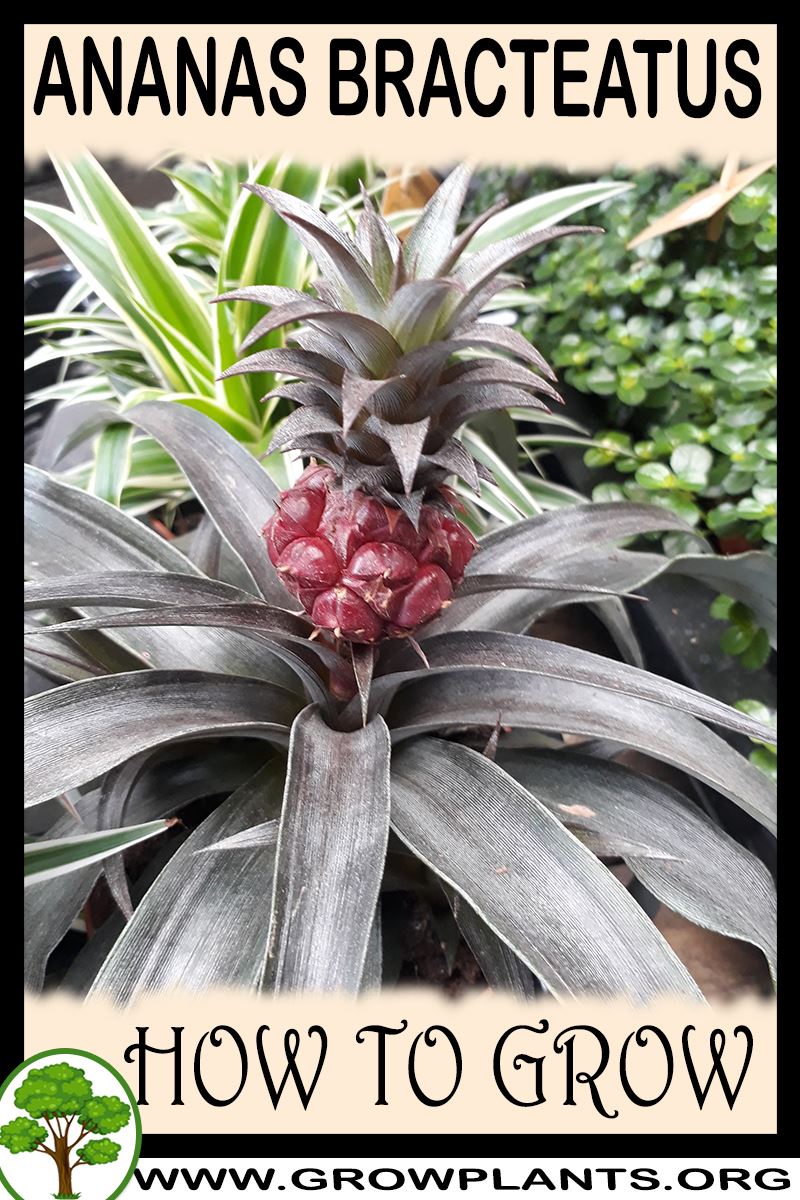
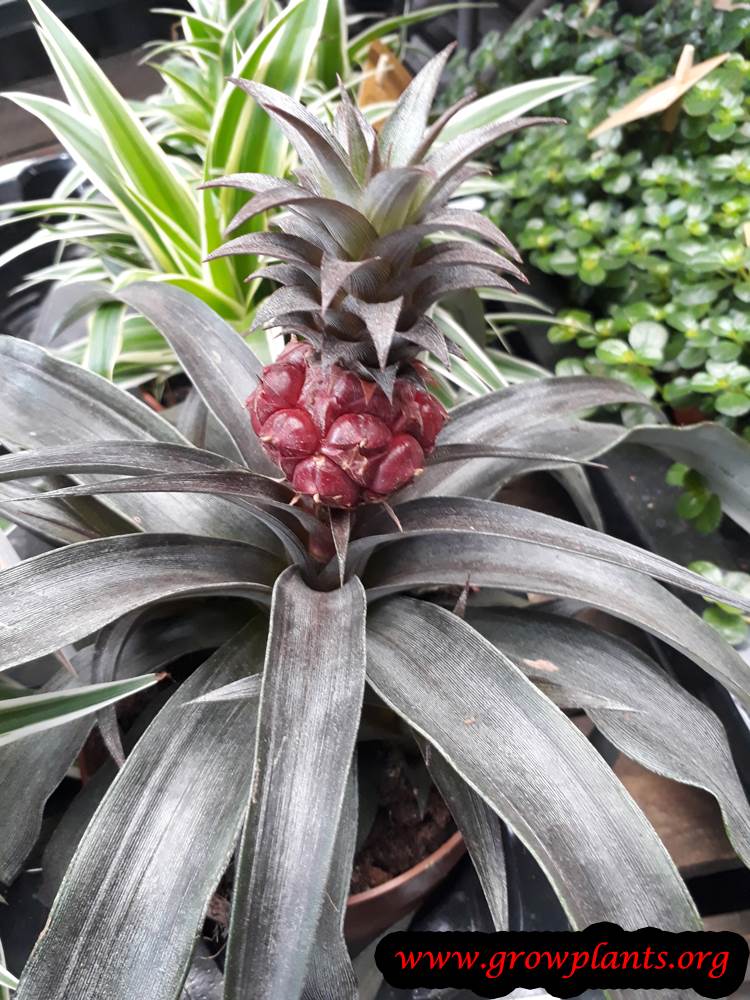
Plant Profile & Key Characteristics
Overview: Ananas bracteatus (red pineapple) is an evergreen perennial bromeliad reaching 0.5-1 m (20-40 in). It is grown mainly as an ornamental for its colourful fruit and foliage, with edible fruit as a bonus.
Quick Specifications
| Specification | Attribute |
|---|---|
| Plant Type / Life Cycle | Perennial (evergreen bromeliad) |
| Foliage Type | Evergreen |
| Mature Size | 0.5-1 m (20-40 in) tall |
| Growth Rate | Slow |
| Root System | Shallow, fibrous |
| Toxicity | Ripe fruit edible; non-toxic |
| Hardiness | USDA zone 10b+ |
Growth Form & Structure
- Height & Spread: 0.5-1 m (20-40 in) tall in the ground; grows well in containers and as a houseplant, though fruiting needs light
- Growth Habit & Form: A rosette of stiff, strap-like leaves with the fruit borne on a central stalk
- Lifespan & Maturity: Each rosette generally lives to fruit once (taking 1-2 years), then is replaced by offsets (pups)
Anatomy & Physical Features
- Leaves & Foliage: Flat, narrow, concave leaves, spiny-edged in some cultivars, forming a rosette
- Flower Characteristics: Small red or purple flowers massed in a crown atop the stalk (see the Bloom guide)
- Fruit Profile: A compound fruit, yellow to green, red or brown outside with white to yellow flesh (see the Fruit guide)
Primary Uses & Landscape Value
- Edible Uses: Fruit eaten fresh, juiced, cooked, or used in ice-cream and cakes
- Functional & Ornamental Roles: Ornamental red pineapple for containers and as a houseplant, with edible fruit
Care Guide: Planting, Soil & Watering
Overview: Ananas bracteatus (red pineapple) is a tropical bromeliad grown in full sun in warm, frost-free climates (hardiness zone 10b+) or as a houseplant. Like other pineapples it wants moist yet well-draining, organic-rich soil and steady warmth, and needs winter protection where it is cool.
Quick Care Requirements
| Requirement | Ideal Condition |
|---|---|
| Planting Season | Year-round in warm climates; spring to summer where cooler |
| Growth Rate | Slow |
| Soil Type | Moist, well-draining soil rich in organic matter |
| Soil pH | Slightly acidic |
| Water Need | Moderate to High, but never waterlogged |
Planting & Establishment
- Best Planting Season: Plant year-round in warm regions, or in spring to summer where the climate is cooler; provide winter protection outside the tropics.
- How to Plant:
- Hole Preparation: Plant into loosened, free-draining soil, or start from a rooted crown or pup.
- Soil Amendments: Enrich with organic matter while keeping the soil open and well-drained.
- Planting Depth: Set the plant shallowly with the base of the leaf rosette at soil level; do not bury the central crown, which rots if kept wet.
- Growth Speed & Expectations: A slow grower reaching around 0.5-1 m that takes 1-2 years to fruit and needs good light to do so.
Soil, Watering & Drainage Care
- Soil Mix & Drainage Needs: Give it moist but sharply-draining, organic-rich soil; in containers use a well-draining potting or peat mix with good drainage holes.
- Watering Schedule & Technique:
- Young / Newly Planted: Keep the soil moist while the crown or pup roots and establishes.
- Established: Water moderately to generously so the soil stays moist and drains freely; indoors it needs less, as the soil dries slowly.
- Seasonal Adjustments: Water more in warm, active growth and ease back in cool weather; shield it from cold and avoid waterlogging.
Climate, Light & Hardiness
Ananas bracteatus (red pineapple) is a true tropical, also grown in Mediterranean and subtropical climates or as a houseplant, hardy outdoors only from USDA zone 10b upward. It needs full sun in the tropics but appreciates half to full (bright, indirect-light) shade outside the tropics, and can survive at the margins of its range with winter help, though it rarely fruits there.
Quick Climate Specifications
| Climate Zones | Tropical, Mediterranean, Subtropical |
|---|---|
| USDA Hardiness Zones | 10b and warmer |
| Frost Tolerance | None |
| Light Conditions | Full Sun (tropics); Half Shade to Full (bright) Shade outside the tropics |
Sunlight & Light Exposure
Optimal Light Setup
In true tropical climates, full sun suits it best. Outside the tropics, half shade to full shade with plenty of indirect light is preferred, and in warm but dry climates the plant needs some sun protection unless humidity/moisture is also high.
Temperature Extremes & Hardiness
USDA Hardiness & Regional Limits
Reliably hardy only in USDA zone 10b and warmer. It can sometimes be grown just outside this range with extra winter protection, but fruiting becomes rare and growth is slow-going near the cold edge of its tolerance.
Frost Sensitivity
No frost tolerance; freezing temperatures are likely fatal.
Extreme Heat Tolerance
Handles heat well in humid tropical conditions; in hot but dry (low-moisture) climates it needs some shade or sun protection to avoid stress.
Growing in Pots, Balconies & Indoors
Ornamental pineapple (Ananas bracteatus) is a 0.5-1 m (20-40 in) bromeliad that the grower lists as a houseplant and container plant – as the grower notes, it needs bright light to bear its colourful little fruit. It makes a striking, easy-care indoor rosette.
Quick Details
- Container Size: A 10-20 L (3-5 gal) pot
- Indoor Suitability: A good houseplant; give it the brightest light for it to colour up and fruit
- Best Spot: Full sun; outside the tropics, bright indirect light or half shade indoors
- Soil & Drainage: Open, free-draining mix rich in organic matter
- Watering in Pots: Average to generous in growth; keep a little water in the central rosette and let the mix drain freely
Indoors & On the Windowsill
- As a houseplant: The grower lists it as suitable indoors. Give it the brightest spot you can – it needs strong light to develop fruit – and water into the central ‘cup’.
- Windowsill: A sunny sill is ideal; the leaves colour best in strong light.
- Spines: The leaf edges are spiny – site it away from busy walkways and small children.
On a Balcony or Patio
- Light & wind: Give it the sunniest spot; walls, railings and paving throw back heat so pots dry quickly – check moisture often and shelter or stake it on an exposed, windy balcony.
- Practicalities: Account for the weight of a full pot and make sure drainage water can run away freely without staining the balcony.
Choosing the Pot, Soil & Long-Term Care
- Pot & drainage: Use a pot with strong drainage holes and skip a standing-water saucer to avoid root rot; terracotta breathes and dries faster, while glazed or plastic holds moisture longer.
- Potting mix: Well-aerated and organic-rich – a quality potting mix, or peat/coir with perlite or vermiculite.
- Feeding: Potted plants use up their soil faster as nutrients leach out with each watering – feed lightly through the growing season.
- After fruiting: The main rosette dies slowly after fruiting but makes offsets (‘pups’) – pot these on to keep it going.
Fertilizing & Feeding
A light feeder – this slow-growing bromeliad does well on modest feeding, whether grown in the ground or in a container
Quick Fertilizing Specs
| Feeding Level | light |
|---|---|
| Main Nutrient Priority | Nitrogen while the leaf rosette builds, then a shift toward balanced feeding with potassium as flowering and fruiting begin |
| Best Feeding Period | Warm months during active growth, tapering during cooler or slower periods |
| Soil pH | Prefers a well-drained, aerated growing medium |
| Micronutrients | Iron and manganese support healthy leaf color, especially in container culture |
| Reduce/Stop Feeding | Ease off feeding during cooler weather or whenever growth slows |
| Organic Options | Compost or well-rotted organic matter worked into the growing medium |
Feeding by Growth Stage
Establishment After Planting
Support root establishment while a newly planted crown or offset settles in
| Nutrient direction | Balanced feeding to support root establishment while the new plant settles in |
|---|---|
| Timing | After planting, through the first period of active root growth |
| Frequency | Light, infrequent feedings while the plant is establishing |
| Fertilizer types | A balanced, complete fertilizer for bromeliads or container fruiting plants, Compost or well-rotted organic matter worked into the growing medium |
| Routine trace nutrients | iron, manganese |
| Precautions | Keep feeding light immediately after planting; a freshly rooted crown or offset is sensitive to fertilizer salts |
Rosette Leaf Growth
Build a strong rosette of leaves ahead of flowering
| Nutrient direction | A nitrogen-forward feeding to build a strong rosette of leaves ahead of flowering |
|---|---|
| Timing | During the main leaf growth period before the flower spike forms |
| Frequency | Regular light feedings through active leaf growth |
| Fertilizer types | A nitrogen-forward complete fertilizer suited to bromeliads, Diluted feeding applied to the growing medium rather than the leaf cup |
| Routine trace nutrients | iron, manganese |
| Precautions | Avoid concentrated fertilizer pooling in the central leaf cup; feed the roots or growing medium instead |
Flowering and Fruit Development
Support flowering and fruit development on the crown
| Nutrient direction | Shift to a balanced fertilizer with adequate potassium to support flowering and fruit development |
|---|---|
| Timing | From emergence of the flower structure through fruit development |
| Frequency | Light, consistent feeding through flowering and fruit development |
| Fertilizer types | A balanced, complete fertilizer with adequate potassium for fruiting bromeliads |
| Routine trace nutrients | iron |
| Precautions | Favor lighter, well-diluted feeding – this plant remains a naturally modest feeder even while fruiting |
Nutrient Deficiency Signs & Corrections
Pale, yellowish leaves and slowed rosette growth
| Possible causes | Insufficient nitrogen availability, Poor drainage or compaction limiting root uptake, Cool temperatures slowing nutrient uptake |
|---|---|
| Appears first on | Older, outer leaves first |
| What to check | Overall growth rate and leaf color, Drainage and aeration of the growing medium, Recent temperature drops or cold stress |
| Possible correction | Apply a nitrogen-forward complete fertilizer or side-dress with compost |
Interveinal yellowing on new central leaves while the veins stay green
| Possible causes | High growing-medium pH limiting iron availability, Waterlogged or poorly aerated medium restricting root function, Root stress or disturbance reducing nutrient uptake |
|---|---|
| Appears first on | Newest central leaves |
| What to check | pH of the growing medium, Drainage and aeration around the roots, Recent root disturbance or overwatering |
| Possible correction | Correct the growing medium pH toward slightly acidic where practical and apply a chelated iron product according to its label |
Marginal browning or scorch on older outer leaf tips and weak fruit development
| Possible causes | Low potassium availability in the growing medium, Drought or underwatering stress, Leached, sandy, or fast-draining medium low in retained nutrients |
|---|---|
| Appears first on | Older, outer leaves first |
| What to check | Watering consistency, Growing medium texture and leaching potential, Whether scorch is confined to leaf margins |
| Possible correction | Apply a balanced fertilizer with adequate potassium and maintain consistent watering |
Pruning, Training & Seasonal Maintenance
Ananas bracteatus (red pineapple) grows as a single spine-edged rosette, and each individual rosette flowers and fruits only once; afterward, new growth continues through basal offsets (pups) and the fruit’s own crown rather than from renewed growth on the original rosette. There is no woody framework or repeat-flowering structure to train, so pruning is limited to removing dead or damaged leaves and, after fruiting, deciding which pups to keep for the next generation of plants. Some cultivars carry spined leaf margins, so handle cut material with care.
Quick Pruning & Maintenance Specs
| Pruning Tolerance | Low – only dead material is removed; the plant is never shaped |
| Primary Pruning Window | Ongoing, as individual leaves die (tolerated all season) |
| Main Objective | Remove dead leaves; after fruiting, manage which offsets/crown carry the plant forward |
| Young Plant Priority | Leave leaves intact so the rosette can build up to flowering size |
| Mature Plant Priority | After the rosette fruits, choose which pups to keep, and use the crown for propagation |
| Best Tool Type | Precision snips or bypass secateurs for dead leaves; gloves for spined cultivars |
| Avoid Heavy Pruning During | Never cut into the central growing point – it is the plant’s single source of new growth and, once fruited, of the harvest itself |
Pruning by Plant Age & Size
Newly Established
Minimal – remove only clearly dead or damaged outer leaves; don’t disturb the developing rosette.
Young / Formative
No structural training applies to a single-crown rosette; simply let it bulk up toward flowering size.
Mature / Established (post-fruiting)
Manage offsets: this species propagates by basal shoots (pups) or a crown cut, so after harvest decide which pup(s) to grow on as the replacement plant, and remove extras if a single, tidier clump is wanted. The spent flowering/fruiting rosette itself will not flower again.
Seasonal Pruning Schedule
| Stage | Objective | Remove | Do Not Remove | Response / Impact |
| Ongoing, year-round | Keep the rosette tidy | Fully dead or browned leaves, cut near the base | Any green leaf tissue, or the growing point | No regrowth response needed – new leaves come only from the plant’s own center, not from pruning |
Special Growth to Remove
- Fully dead or browned leaves, cut near the base
- The spent fruiting rosette center once harvest is complete, since that rosette will not fruit again
- Basal shoots (pups): keep one or more as the succession plant(s); remove extras if a single clean plant is wanted, using the same division technique used for propagation
Container & Small-Space Pruning
This species can be grown as a houseplant, though it needs good light to fruit indoors. In a pot, limit the number of pups kept – thin more aggressively than an in-ground planting – so the container isn’t overcrowded, and expect the plant’s naturally slow growth to keep it in scale with its pot.
Tools
- Precision snips or bypass secateurs, for dead-leaf removal
- A clean, sharp knife, for the crown cut or basal-shoot division used in propagation
- Gloves, given the spined leaf margins on some cultivars
Tool Hygiene & Disease Risk
Routine for leaf removal; use a little more care with a clean, sharp blade when taking a crown cut or dividing a basal shoot, since that creates an open wound on propagation material. No major transmissible disease is noted for this species – snails are the pest flagged, both on the plant and the fruit.
Cut Placement & Technique
Cut dead leaves near their base without nicking the living rosette center. For a crown cut, cut close to the fruit flesh as described in the species’ propagation guidance; for a basal shoot (pup), separate it with its own root tissue where possible.
Heavy Pruning & Rejuvenation
Not applicable – this is a single-growing-point rosette with no canopy to cut back hard, and removing the growing point would end that rosette’s life. Renewal comes only from pups or a crown cut, never from pruning the parent plant harder.
Post-Pruning Care
No special aftercare after removing dead leaves. After taking pups or a crown cut for propagation, keep the new division’s medium evenly moist while roots establish (a crown cutting roots in a couple of weeks in water, per grower guidance) and protect it from full baking sun outside humid tropical conditions until it’s established.
Common Pruning Mistakes
- Cutting into the central growing point while trimming dead leaves
- Expecting the spent rosette to reflower after fruiting, instead of relying on a pup or crown for the next plant
- Removing all pups at once and losing the succession plant
When NOT to Prune
- Never cut the rosette’s central growing point
- Avoid dividing or removing pups before they have enough size or roots of their own to survive independently
Recommended Tools (by task)
- precision_snips – for trimming individual dead or damaged leaf tips
- bypass_secateurs – for cutting off a fully dead leaf at its base
- grafting_knife – a clean, sharp knife for the crown cut used in propagation, made close to the fruit flesh as recommended for this species
Pruning Troubleshooting
| Problem | Possible Cause | What to Check | Corrective Action |
| No new plant after fruiting | All basal shoots (pups) or the crown were removed or damaged instead of one being kept and grown on | Base of the plant for surviving pups; whether a crown cutting was started | Keep at least one healthy pup, or root a crown cutting, to replace the spent rosette |
| Rosette center rotting after leaf trimming | Cuts made too close to the growing point, or a dirty tool introduced rot into moist tissue | Base of the youngest leaves for soft, discolored tissue | Leave a clean margin of living tissue when trimming leaves; use a clean, sharp blade |
Propagation Guide
Red pineapple is propagated vegetatively, either from the leafy crown of the fruit or from basal shoots (pups) that form at the base of the plant, since the site notes vegetative reproduction is necessary for this plant. This is an Easy, reliable method for a home grower, with basal shoots being the fastest route since they already carry their own roots.
Quick Propagation Specs
| Best Propagation Method | Basal shoots (pups) |
| Alternative Methods | Crown cutting |
| Propagation Difficulty | Easy |
| Vegetative True-to-Type | Yes |
| Best Propagation Season | Spring / Summer |
| Cutting Rooting Time | Basal shoots: already rooted at separation; Crown cut: roots typically form within about 2–7 weeks |
Division, Offsets, Pups & Suckers
Basal Shoots (Pups)
Basal shoots that develop at the base of the plant already come away with roots attached, so once separated they can be given the same treatment as a fully grown plant – plant directly into the growing medium. Best taken in spring or summer.
Crown Cutting
Cut the leafy crown from the top of the fruit, taking about 1cm of the fruit’s flesh along with it. Place the cut head in water, changing the water every 2 days at first; once the leftover fruit residue has cleared away, the water can be changed just once or twice a week. Roots typically develop within a few weeks, around 2–7 weeks, after which the rooted crown can be potted into soil. Best done in spring or summer.
Bloom & Flower Guide
Quick Details
- Bloom Season: Spring and summer
- Flower Appearance: Many small red or purple flowers packed into a crown at the top of the stalk, ahead of the ornamental fruit
- Edibility: Grown mainly as an ornamental; the individual flowers are not eaten
Detailed Blooming Overview
Ananas bracteatus, the red pineapple, produces a dense head of small red-to-purple flowers on a stout stalk before the colourful fruit forms. Like the edible pineapple, the many flowers fuse together as they develop into the single composite fruit that crowns the plant.
Flower Characteristics
- Numerous small flowers in red or purple, clustered into a crown-like head.
- Borne on a stout central stalk above the spiny-edged rosette.
Bloom Care & Thinning
- Pollination: The flowers can be worked by hummingbirds – but if you want a seedless ornamental fruit it is better that they are not pollinated.
- Managing the bloom: No thinning needed; simply let the flower head develop into the decorative fruit.
Fruit & Uses
Ananas bracteatus is grown mainly as an ornamental bromeliad for its colorful bracts and foliage; its pineapple-like fruit is genuinely edible but is smaller, more fibrous and noticeably more tart than a supermarket pineapple (Ananas comosus), so it is best treated as a minor bonus rather than a dessert-quality fruit. When used, it is eaten fresh or cooked/juiced after peeling.
Quick Edible Specs
| Edible Parts | Fruit (compound/multiple fruit) |
| Main Use(s) | Secondary culinary use (fresh eating, juice, cooking) – the plant is grown primarily as an ornamental |
| Eaten Raw or Cooked | Raw or cooked |
| Preparation Required | Peel tough rind; remove fibrous core |
| Harvest Season | Summer / Autumn |
| Storage | Can be picked slightly under-ripe and left to finish ripening indoors |
| Safety/Toxicity Caveat | Under-ripe fruit is markedly tart/fibrous and, as with other bromeliads, can irritate the mouth – wait for full color change before eating |
Fruit
The fruit is a compound structure made of many small fruitlets fused together, similar in form to a culinary pineapple. The outer skin can be yellow, green, red or brown; the flesh inside is white or yellow. Compared with Ananas comosus, this fruit is generally smaller, firmer and more fibrous, with a sharper, more acidic flavor, which is part of why the plant is grown chiefly for its ornamental bracts and foliage rather than as a food crop. Ripening fruit benefits from netting to protect it from birds and snails.
Harvesting
Fruit is harvested in summer or autumn once fully colored. It can also be picked a little early and allowed to finish ripening off the plant. Each rosette generally fruits once before the plant is propagated onward from offsets or the cut crown.
Preparation, Uses & Safety
Where used, the tough rind is peeled away and the fibrous core removed before the fruit is eaten fresh, juiced, or cooked into desserts – broadly the same uses as culinary pineapple, though expect a firmer, tarter result. Because this is a far less common food fruit than commercial pineapple, treat any specific recipe use as illustrative rather than a guarantee of good eating quality, and always let the fruit fully ripen before tasting to avoid the mouth irritation associated with under-ripe bromeliad fruit.
Pests, Diseases & Troubleshooting
Overview: Ananas bracteatus is an ornamental bromeliad grown for its colourful fruit and foliage. Its signature problem is the pineapple mealybug, which not only sucks sap but transmits mealybug wilt; ants that farm the mealybugs, scale, thrips, mites and nematodes complete the pest picture, while heart rot and root rot (Phytophthora) are the key diseases in wet soil. Management hinges on controlling mealybugs and ants, clean planting material and sharp drainage.
Quick Troubleshooting Overview
| Issue / Pest | Main Symptom | Primary Solution |
|---|---|---|
| Pineapple mealybug | White tufts in leaf axils; wilt/reddening | Control ants, clean slips, horticultural oil |
| Ants | Trails farming mealybugs and scale | Bait/barrier ants to break the partnership |
| Scale | Grey/brown crusts on leaves and fruit | Encourage predators, horticultural oil |
| Thrips & mites | Silvery flecking; stippling on leaves | Predators, insecticidal soap/oil |
| Heart / root rot | Base rot, leaves pull out easily | Clean material, sharp drainage, avoid wet crown |
| Nematodes | Stunting, poor roots, wilting in heat | Clean planting stock, healthy soil, rotation |
Common Pests & Management
- Pineapple mealybug (Dysmicoccus brevipes):
- Symptoms: Pinkish, white-waxed mealybugs clustered in leaf axils, on roots and at the fruit base, sucking sap and – crucially – transmitting mealybug wilt, which reddens, curls and collapses the leaves; the single most important pineapple pest.
- Prevention & Control: Start with clean, mealybug-free slips and suckers, control the ants that spread and protect them (the key step), encourage ladybirds and mealybug destroyer (Cryptolaemus), and treat with horticultural oil or insecticidal soap into the axils.
- Ants (various (e.g. Pheidole, Solenopsis)):
- Symptoms: Ant trails running up the plant, farming and moving mealybugs and scale for their honeydew and shielding them from predators – the engine behind mealybug wilt spread.
- Prevention & Control: Break the partnership by baiting and barriering ants, keep the base clear, and use sticky barriers on ornamental container plants; controlling ants is often more effective than spraying the mealybugs directly.
- Scale insects (Diaspis bromeliae):
- Symptoms: Grey to brown crusty scales encrusting leaves and fruit, sucking sap and downgrading fruit quality.
- Prevention & Control: Encourage parasitic wasps and ladybirds, wipe or scrub off light infestations, and smother with horticultural oil.
- Thrips (Thrips / Frankliniella spp.):
- Symptoms: Silvery flecking and scarring on leaves and fruit from tiny slender insects; some thrips also spread disease.
- Prevention & Control: Encourage predatory mites and minute pirate bugs, hose foliage, and use insecticidal soap or spinosad in the evening if severe.
- Mites (Steneotarsonemus ananas / Tetranychus spp.):
- Symptoms: Pineapple fruit/tarsonemid mites cause corky russeting at leaf bases and on fruit, while spider mites stipple and bronze leaves in hot, dry conditions.
- Prevention & Control: Keep plants unstressed and humid, encourage predatory mites, and apply horticultural oil or insecticidal soap for heavy infestations.
- Nematodes (Meloidogyne / Rotylenchulus spp.):
- Symptoms: Root-knot and reniform nematodes stunt roots, causing poor vigour, heat-of-day wilting and reduced fruiting.
- Prevention & Control: Plant clean stock in fresh or solarised soil, build up organic matter and beneficial microbes, and rotate – chemical control is limited and best avoided in gardens.
Diseases & Fungal Issues
- Mealybug wilt of pineapple (associated virus + Dysmicoccus mealybugs):
- Symptoms: Progressive reddening, curling, tip die-back and wilting of leaves and root collapse, linked to mealybug feeding and an associated virus – the classic ‘wilt’ of pineapple.
- Treatment & Management: Control mealybugs and ants rigorously, start from clean planting material, and remove badly affected plants; there is no cure once virus-associated wilt is established.
- Heart rot & root rot (Phytophthora nicotianae / P. cinnamomi):
- Symptoms: Soft rot at the heart (central leaves pull out easily and smell foul) and rotting roots in wet, poorly drained soil; plants yellow and collapse.
- Treatment & Management: Plant in free-draining soil or raised beds, avoid waterlogging and water sitting in the crown, use clean material, and remove and destroy rotted plants; a labelled phosphonate/copper treatment can help in outbreaks.
- Fruitlet core rot / black rot (Fusarium / Thielaviopsis (Chalara) paradoxa):
- Symptoms: Internal browning of fruitlets, or soft, watery black rot of fruit entering through wounds after harvest.
- Treatment & Management: Handle fruit gently to avoid wounds, keep the field clean, cure and store fruit cool and dry, and remove infected fruit.
- Bacterial heart rot (Erwinia (Dickeya) chrysanthemi):
- Symptoms: Water-soaked, foul-smelling collapse of the central leaves in hot, wet, humid conditions.
- Treatment & Management: Improve drainage and airflow, avoid injury and overhead water in the crown, and remove affected plants.
Growing Difficulties & Abiotic Problems
- Sunburn / sunscald on fruit:
- Cause & Symptoms: Exposed fruit scald in intense sun, especially if the plant lodges, giving pale, collapsed patches that invite rot.
- Correction Strategy: Shade exposed fruit (traditionally with foliage or covers), keep plants upright and vigorous, and avoid sudden exposure.
- Crown / heart rot from water in the cup:
- Cause & Symptoms: Water and debris sitting in the central cup during cool, wet weather rots the growing point.
- Correction Strategy: Avoid overhead watering into the crown in cool spells, provide airflow, and plant so water drains freely.
- Chlorosis / nutrient deficiency:
- Cause & Symptoms: Iron, zinc or nitrogen deficiencies (often on alkaline or waterlogged soil) yellow the leaves and slow growth.
- Correction Strategy: Correct drainage and pH, feed with a suitable balanced fertiliser, and use foliar iron/zinc where deficiency shows.
- Bird & snail damage:
- Cause & Symptoms: Birds peck ripening fruit and snails graze foliage and fruit (matching the source note).
- Correction Strategy: Net or bag ripening fruit, hand-pick snails and use iron-phosphate bait, and harvest promptly.
What Helps – Products & Tools
The priorities are clean planting material, ant control and drainage. Useful products are ant baits and sticky barriers to cut off mealybugs and scale; horticultural oil and insecticidal soap for mealybugs, scale, thrips and mites; iron-phosphate bait for snails and netting for birds; and, for disease, a phosphonate or copper treatment for Phytophthora heart/root rot in outbreaks. Spray oils in the evening to protect pollinators and follow all labels and harvest intervals.