Plant Profile & Key Characteristics
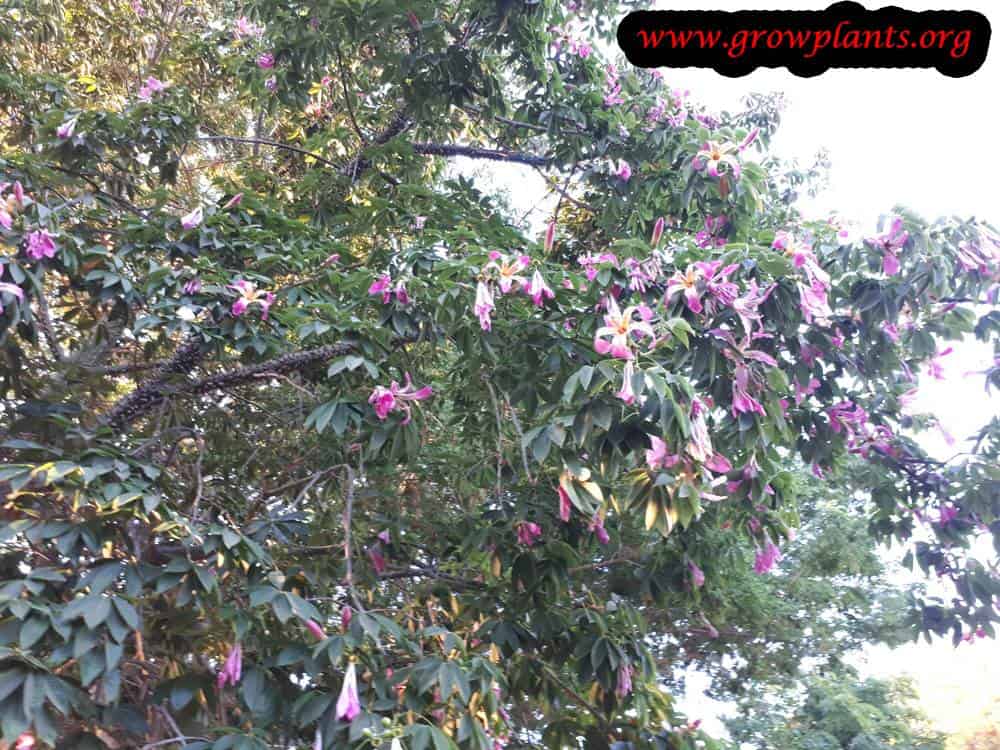
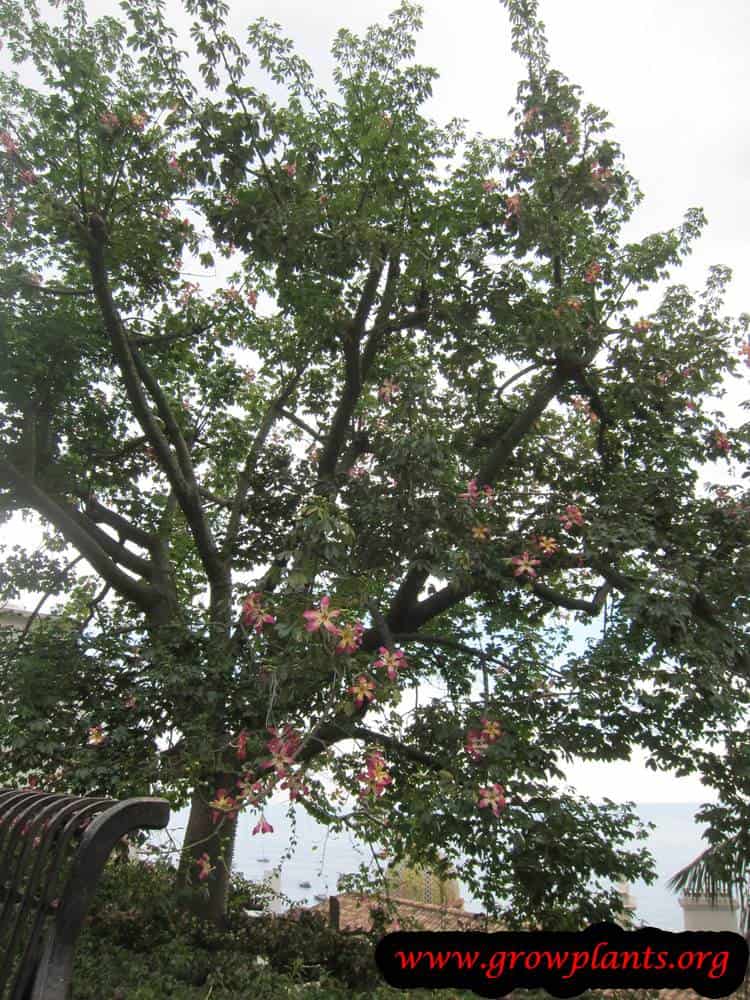
Overview: Ceiba speciosa (floss silk tree) is a deciduous ornamental tree of 7-15 m (23-49 ft) with a distinctive swollen, bottle-shaped, often thorny trunk. This perennial is grown for its palmate foliage and large showy flowers, attracts pollinators, and is also trained as a bonsai.
Quick Specifications
| Specification | Attribute |
|---|---|
| Plant Type / Life Cycle | Perennial tree |
| Foliage Type | Deciduous |
| Mature Size | 7-15 m tall (23-49 ft) |
| Growth Rate | Moderate |
| Hardiness | USDA zones 10+ |
Growth Form & Structure
- Height & Spread: 7-15 m (23-49 ft) as a spreading landscape tree. Not suited to permanent container culture except when trained as bonsai.
- Growth Habit & Form: Deciduous tree with a broad canopy and a characteristic bottle-shaped trunk.
- Lifespan & Maturity: Long-lived, moderate-growing perennial tree.
Anatomy & Physical Features
- Trunk & Bark: Brown, often thorny trunk that is typically swollen into a bottle shape.
- Leaves & Foliage: Green palmate leaves of elliptic leaflets joined at the base, resembling a hand with about seven fingers; deciduous.
- Flower Characteristics: Pink flowers with a yellow centre and five petals, borne from winter through summer.
- Fruit Profile: Green capsule ripening brown, splitting to release seeds embedded in a mass of white cotton-like floss.
Primary Uses & Landscape Value
- Functional & Ornamental Roles: Ornamental flowering and specimen tree that attracts pollinators; the seed floss is used as a kapok-type stuffing fibre, and the tree is popular for bonsai.
Care Guide: Planting, Soil & Watering
Overview: Floss silk tree (Ceiba speciosa) is a moderate-growing deciduous tree for frost-free subtropical and tropical climates (hardiness zone 10+), needing full sun to part shade. Its swollen, water-storing trunk means it wants a well-drained soil and only low to moderate watering.
Quick Care Requirements
| Requirement | Ideal Condition |
|---|---|
| Planting Season | In the warm season once frost has passed |
| Growth Rate | Moderate |
| Soil Type | Well-drained soil |
| Water Need | Low to moderate – let the soil dry between waterings |
Planting & Establishment
- Best Planting Season: Plant in the warm season after all frost risk has passed.
- How to Plant:
- Hole Preparation: Dig a hole about twice the width of the root ball and no deeper than it.
- Soil Amendments: Add grit or coarse organic matter to sharpen drainage on heavy soils.
- Planting Depth: Set the root collar at soil level; avoid burying the trunk, and mind the thorns when handling.
- Growth Speed & Expectations: A moderate grower reaching 7-15 m (21-45 ft), developing its characteristic bottle-shaped trunk.
Soil, Watering & Drainage Care
- Soil Mix & Drainage Needs: Free-draining soil is essential – the water-storing trunk makes it prone to rot in soggy ground.
- Watering Schedule & Technique:
- Young / Newly Planted: Water moderately to establish, keeping the soil lightly moist but not wet.
- Established: Water sparingly once established, letting the soil dry well between waterings; it is drought-tolerant.
- Seasonal Adjustments: A little more in summer heat; keep drier while dormant and leafless in the cool season.
Climate, Light & Hardiness
This floss silk tree grows in subtropical, tropical, and Mediterranean climates, hardy outdoors from about zone 10 upward. It grows in full sun to half shade and needs frost–free conditions, making it slightly more cold–sensitive than the related Ceiba chodatii.
Quick Climate Specifications
| Climate Zones | Subtropics, tropics, Mediterranean |
|---|---|
| USDA Hardiness Zones | 10+ |
| Frost Tolerance | Very Low |
| Light Conditions | Full Sun to Half Shade |
Sunlight & Light Exposure
Grows well in full sun to half shade; full sun supports the fullest flowering on this deciduous, thorny–trunked tree.
Temperature Extremes & Hardiness
USDA Hardiness & Regional Limits
Hardy outdoors from about zone 10 upward; it is a warm–climate tree not suited to regions with freezing winters.
Cold Damage & Winter Protection
The site specifies frost–free conditions are needed; unlike some related species, this one has little buffer against even brief freezing temperatures.
Frost Sensitivity
Not frost tolerant; freezing temperatures are likely to cause serious damage.
Wind, Humidity & Microclimate
As a deciduous tree from subtropical and dry tropical regions, it generally tolerates seasonal dry spells well once established.
Growing in Pots, Balconies & Indoors
Silk floss tree (Ceiba speciosa) is a large, fast tree with a green, spiny, bottle-shaped trunk – the grower marks it as neither a houseplant nor a container plant. It needs the open ground; the notes below cover why and what a young potted plant needs short-term.
Quick Details
- Container Size: Not recommended long-term; only a young plant in a large pot
- Indoor Suitability: Not a houseplant – a large tree unsuited to indoor light
- Best Spot: Full sun to part shade
- Soil & Drainage: Very free-draining mix
- Watering in Pots: Low to moderate; drought-tolerant once established
Indoors & On the Windowsill
- Not a houseplant: Marked No – it becomes a large tree (7-15 m), far too big for indoors.
- Windowsill: Not viable given its size.
On a Balcony or Patio
- Container caveat: The grower marks container growing No – a young plant can be held briefly in a large, free-draining pot before it must be planted out.
- Light & heat: Full sun and warmth; let the mix dry between waterings.
- Safety: The trunk is armed with stout spines – keep it away from paths and children and handle with gloves.
Choosing the Pot, Soil & Long-Term Care
- Pot & drainage: A large, well-drained pot only for a young plant with strong drainage holes; skip a standing-water saucer to avoid root rot. Terracotta breathes and dries fast, while glazed or plastic holds moisture longer.
- Potting mix: A well-aerated, organic-rich mix – peat or coir blended with perlite or vermiculite for free drainage.
- Feeding: Potted plants run their soil down fast as nutrients leach out, so feed more often than plants in open ground during active growth.
Fertilizing & Feeding
Ceiba speciosa is a frost-sensitive, bottle-trunked flowering tree that stores water in its trunk; it generally rewards light, well-timed feeding over heavy routine inputs.
Quick Fertilizing Specs
| Feeding Level | Moderate while establishing, light once mature. |
|---|---|
| young_feeding | Newly planted trees benefit from light, balanced feeding through the growing season to build a strong root system. |
| mature_feeding | Mature, established trees are fairly self-sufficient and typically need only occasional, light feeding. |
| Main Nutrient Priority | Balanced overall nutrition rather than any single nutrient. |
| Best Feeding Period | Once new leaves flush out and through the main growing season. |
| Organic Options | Compost worked into the planting area is generally enough for most sites. |
| Soil pH | Tolerant of a range of well-drained soils; drainage matters more than a specific pH. |
| Reduce/Stop Feeding | Taper off as the tree heads into its leaf-off, resting period. |
| Micronutrients | A complete tree fertilizer supplying iron and manganese is generally sufficient. |
Feeding by Growth Stage
Active Growth After Leaf-Out
Support canopy rebuilding and stem growth once new leaves emerge for the season.
| Nutrient direction | A balanced feeding supports steady leaf and branch development without pushing excessively soft growth on a species that stores water and reserves in its trunk. |
|---|---|
| Timing | Once new leaves flush out and through the frost-free growing season. |
| Frequency | Light, infrequent feeding during active growth is usually sufficient; this species does not need heavy or frequent inputs to thrive. |
| Fertilizer types | A balanced, general-purpose tree fertilizer applied sparingly around the root zone, or a slow-release granular product. |
| Routine trace nutrients | iron, manganese |
| Precautions | Keep feeding light – pushing soft growth can leave the tree more vulnerable to cold snaps and works against its natural resilience. |
Bloom Period
Maintain adequate overall nutrition through the striking pink-flowered bloom window.
| Nutrient direction | Continue balanced nutrition; flower production is driven by overall plant health and season, not by a phosphorus boost. |
|---|---|
| Timing | Through the bloom window, which can extend from winter into the following growing season. |
| Frequency | Minimal feeding is usually needed during bloom itself if the tree was already fed during active growth. |
| Fertilizer types | The same balanced, general-purpose formulation as the growth stage, applied lightly if at all. |
| Precautions | Avoid high-phosphorus ‘bloom booster’ products; they are rarely needed and most soils already supply enough phosphorus for good flowering. |
Deciduous Leaf-Off Rest
Allow the tree to rest fully during its natural leaf-off period.
| Nutrient direction | None – withhold fertilizer while the tree carries no leaves and is not actively growing. |
|---|---|
| Timing | During the deciduous leaf-off period. |
| Frequency | No feeding at this stage. |
| Fertilizer types | No feeding at this stage; resume only after new leaves emerge. |
| Precautions | Do not fertilize a leafless, resting tree – unused nutrients can encourage poorly timed new shoots that are vulnerable to cold. |
Nutrient Deficiency Signs & Corrections
Interveinal yellowing on newly emerged leaves while veins stay green.
| Possible causes | Iron deficiency, often induced by high or calcareous soil pH, Waterlogged roots limiting iron uptake, Root stress from recent transplant or soil disturbance, Naturally alkaline or heavy soil |
|---|---|
| Appears first on | Newest leaves as the canopy flushes out. |
| What to check | Soil pH and drainage around the root zone, Recent transplanting, grading, or root disturbance, Irrigation frequency relative to how fast the site drains |
| Possible correction | Improve drainage first; if pH-related, correct soil pH gradually and consider a chelated iron product applied per its label. |
Pale, undersized new leaves and slow canopy rebuild after leaf-out.
| Possible causes | Nitrogen deficiency in lean or sandy soil, Root competition from nearby turf or weeds, Extended dry spells limiting nutrient uptake, Compacted soil restricting root growth |
|---|---|
| Appears first on | New leaves across the whole canopy. |
| What to check | Overall leaf size and color compared to prior seasons, Soil texture and any recent drought stress, Competing vegetation near the root zone |
| Possible correction | A modest, balanced feeding as new growth begins is usually enough; also address drought stress or root competition if present. |
Marginal browning or scorch on older leaves.
| Possible causes | Potassium deficiency, Drought or salt stress, Leaching of nutrients from fast-draining, sandy soil, Root restriction in a confined or paved planting site |
|---|---|
| Appears first on | Leaf margins of older leaves. |
| What to check | Consistency of irrigation, especially during dry spells, Soil texture and drainage rate, Any nearby source of salt exposure |
| Possible correction | Keep watering consistent during establishment and use a balanced fertilizer with adequate potassium; avoid salty irrigation sources where possible. |
Pruning, Training & Seasonal Maintenance
Ceiba speciosa tolerates only light, purposeful pruning: it is grown chiefly for its showy pink-and-yellow flower display and its distinctive thorny bottle trunk, and the trunk itself heals cuts slowly and can rot if wounded carelessly. Summer, while the tree is in full leaf and active growth, is the safest and most effective pruning period, since wounds compartmentalize fastest then; cutting into the trunk or major limbs while the tree is leafless should be avoided. Because flowering happens on wood the tree produces on its own schedule, pruning affects the tree’s silhouette and size far more than it affects bloom itself, but any hard cutback close to the flowering period will visibly reduce that season’s display.
Quick Pruning & Maintenance Specs
| Pruning Tolerance | Low–Moderate (shapes well when young; go cautiously on the mature trunk) |
| Primary Pruning Window | Summer, during active leaf growth |
| Secondary Maintenance Window | Light deadwood/thorn-hazard removal as needed |
| Typical Frequency | Annual formative check while young; infrequent thereafter |
| Main Objective | Trunk/canopy silhouette, size control, and protecting the flower display |
| Young Plant Priority | Establish a single leader; protect the developing trunk taper |
| Mature Plant Priority | Remove only dead, crossing or hazardous growth; avoid trunk wounding |
| Best Tool Type | Loppers and pruning saw, used cautiously; thorn-resistant gloves essential |
| Avoid Heavy Pruning During | The leafless/dormant season and shortly before the bloom period |
Pruning by Plant Age & Size
Newly Established
Limit cuts to damaged growth only, letting the young tree build its characteristic trunk taper undisturbed.
Young / Formative
Train a single central leader for standard tree form; where grown as bonsai, rely on wiring, pinching of new shoots and root pruning at repotting rather than large structural cuts.
Mature / Established
Restrict work to dead, diseased, crossing or hazardous thorny growth; avoid cutting into the trunk, and avoid removing large limbs shortly before the bloom season.
Structural Pruning & Training
- Maintain one dominant leader; remove competing co-dominant stems early to prevent weak, included-bark unions later.
- Remove crossing or rubbing branches; keep overall thinning minimal, since heavy interior thinning offers little benefit on this species and adds unnecessary wounds.
- Not typically grafted, so there are no rootstock suckers; unwanted basal shoots are best removed young while soft.
Special Growth to Remove
- Dead or storm-damaged wood.
- Low thorny branches near paths or seating, removed while still small.
- Basal shoots not being kept as a replacement leader.
Tools
- Bypass secateurs for young/formative cuts and bonsai work.
- Loppers for young-tree branch removal.
- Pruning saw only for necessary larger cuts on established trees, kept to a minimum.
- Heavy-duty, thorn-resistant gloves for all work near the spiny trunk and branches.
Tool Hygiene & Disease Risk
Increased risk: the water-storing trunk is a rot entry point once wounded. Use clean, sharp tools, keep trunk cuts to a genuine minimum, and disinfect blades between cuts when working on or near any dieback, soft wood or discoloration.
Cut Placement & Technique
- Cut outside the branch collar; never cut flush into the trunk.
- Favor thinning cuts over heading cuts to avoid dense regrowth close to the trunk.
- Make single, clean cuts rather than ragged ones, which are slower to seal on this species.
Heavy Pruning & Rejuvenation
Heavy or rejuvenation pruning is not well tolerated – the bottle trunk responds poorly to hard cutback and large wounds heal slowly. Keep intervention to necessary corrective and safety cuts rather than attempting a drastic reshape of a mature tree.
Post-Pruning Care
- Avoid overwatering around the trunk base after cutting, to limit rot risk while the wound seals.
- Skip extra fertilizing purely to force regrowth after a cut.
- Check cut sites over the following season for soft, discolored or oozing wood, a sign the wound has not sealed cleanly.
Common Pruning Mistakes
- Cutting into the trunk, which this species tolerates poorly.
- Pruning heavily right before the bloom period and losing that season’s flower display.
- Working without heavy gloves near the thorny trunk and branches.
When NOT to Prune
- Avoid pruning during the leafless/dormant period.
- Avoid heavy cuts shortly before flowering if the bloom display matters that season.
- Avoid trunk cuts during prolonged wet weather, which raises rot risk in a fresh wound.
Recommended Tools (by task)
- bypass_secateurs – young formative cuts and bonsai pinching.
- loppers – young-tree branch removal.
- pruning_saw – occasional necessary larger cuts on established trees, used sparingly.
Propagation Guide
Ceiba speciosa is grown from seed, the method the site lists for this tree, and grafting or vegetative propagation is not necessary for typical garden or specimen trees; bonsai growers, however, sometimes start this species from thick stem or trunk cuttings to speed up the swollen bottle-shaped trunk it is prized for. Propagation is easy from seed and moderate to specialist from trunk cuttings.
Quick Propagation Specs
| Best Propagation Method | Seed |
| Alternative Methods | Thick stem/trunk cuttings (mainly for bonsai) |
| Propagation Difficulty | Easy (seed); Moderate to Specialist (bonsai cuttings) |
| Seed True-to-Type | Usually true-to-type for the species |
| Best Propagation Season | Winter, spring, summer |
Growing from Seed
Sowing Season
Winter, spring or summer, matching the plant’s planting season.
Germination Conditions
Warm, well-drained conditions typical of this subtropical to tropical tree; keep the mix moist but not soggy.
Seedling Care
Handle young plants carefully once thorns develop on the trunk; grow on in full sun to half shade before transplanting.
Stem Cuttings
Cutting Type
Thick, semi-hardwood to hardwood trunk or branch sections, used by some bonsai growers for faster trunk formation; not one of the site’s own listed methods, and more specialist than growing from seed.
Best Timing
Warm growing season (spring to summer), avoiding cold or dormant periods.
Cutting Preparation
Take a substantial section of mature wood, working carefully around any thorns, and let the cut surface callus briefly before planting.
Rooting Setup
Very well-drained, gritty mix; keep on the drier side to reduce rot risk in the fleshy trunk tissue.
Rooting Hormone
Optional; not required for rooting to succeed.
Rooting Time
Root and callus formation is comparatively slow and can take an extended period.
Bloom & Flower Guide
Quick Details
- Bloom Season: Through the warm months – winter, spring and summer in frost-free subtropical and tropical climates
- Time to First Bloom: A tree that flowers once well established; young specimens may take several years to reach blooming size
- Flower Appearance: Large, five-petalled flowers in pink with a cream-yellow centre
- Edibility: Ornamental – grown for its showy blooms and bottle-shaped trunk, not eaten
Detailed Blooming Overview
The silk floss tree is prized for its bold flowers: large, five-petalled and pink with a paler yellow throat, carried in flushes through the warm season. As a deciduous tree it often flowers as the canopy thins, so the blooms show off against the striking, bottle-shaped trunk, and their nectar keeps pollinators busy.
Flower Characteristics
- Five broad pink petals with a cream-yellow inner zone.
- Large and showy, borne on a stout, sometimes thorny deciduous tree.
- Nectar-rich and attractive to bees and other pollinators.
Bloom Care & Thinning
- Position: Full sun and free-draining soil give the strongest flowering.
- Frost: The tree and its flowers are frost-tender – it needs a warm, frost-free spot to bloom well.
- Managing the bloom: No thinning is needed – this is an ornamental tree, so simply enjoy the show.
Pests, Diseases & Troubleshooting
The silk floss tree (Ceiba speciosa) is a large, fast-growing tropical tree that is generally robust and remarkably pest-free once established; its realistic problems are ordinary sap-suckers (scale, mealybugs, aphids), seed-feeding bugs, and root rot in poorly drained or overwatered soil. Management is mostly about siting, drainage and protecting young trees from cold and overwatering rather than routine spraying. Its green, spiny water-storing trunk is prone to rot if the soil stays wet.
Quick Troubleshooting Overview
| Issue / Pest | Main Symptom | Primary Solution |
|---|---|---|
| Scale insects | Waxy/crusty bumps on twigs and leaves, honeydew, sooty mould | Horticultural oil; prune out; conserve predators |
| Mealybugs | White cottony masses in leaf axils and on roots | Alcohol swab, horticultural oil, check roots |
| Aphids | Curled shoot tips, sticky honeydew, sooty mould | Water jet; insecticidal soap; encourage predators |
| Cotton stainer bugs | Feeding on developing seeds/floss; staining | Sanitation of fallen pods; tolerate; monitor |
| Root & collar rot | Wilting, dieback, decline on wet/poorly drained soil | Improve drainage; avoid overwatering; remove rot |
| Cold/frost damage | Blackened soft growth, dieback on young trees | Protect young trees; site frost-free |
Common Pests & Management
- Scale insects (Coccidae / Diaspididae):
- Symptoms: Waxy, crusty or shell-like bumps clustered on twigs, branches and leaf undersides suck sap; soft scales exude honeydew that blackens foliage with sooty mould, and heavy infestations weaken young growth.
- Prevention & Control: Prune out heavily encrusted twigs; smother with horticultural oil timed to the crawler stage, repeating as needed; conserve ladybirds and parasitic wasps by avoiding broad-spectrum insecticides; control ants that protect scale.
- Mealybugs (Pseudococcus / Planococcus spp.):
- Symptoms: White cottony insects in leaf axils, shoot tips and on the roots of container-grown trees, sucking sap, stunting growth and leaving honeydew and sooty mould.
- Prevention & Control: Dab clusters with an alcohol swab; rinse and spray with horticultural oil or insecticidal soap, repeating; check the root ball of potted trees for root mealybug and treat or repot; isolate new plants.
- Aphids (Aphis spp.):
- Symptoms: Colonies of soft aphids on tender new shoots suck sap, curling young leaves and coating growth with honeydew and sooty mould; mainly a problem on flushing young trees.
- Prevention & Control: Encourage ladybirds, lacewings and hoverflies; dislodge colonies with a water jet; treat persistent numbers with insecticidal soap or horticultural oil in the evening; control ants.
- Cotton stainer bugs (Dysdercus spp.):
- Symptoms: Red-and-black bugs feed on developing seeds and the fibrous floss inside pods, staining and damaging the fibre and seeds; mainly relevant where pods and floss matter.
- Prevention & Control: Clear fallen pods and seeds that sustain them; tolerate on ornamentals where floss is not harvested; hand-pick or spot-treat aggregations; remove nearby weedy Malvaceae hosts.
- Spider mites (Tetranychus spp.):
- Symptoms: Fine stippling and bronzing of leaves with faint webbing in hot, dry, dusty conditions, especially on young or container trees.
- Prevention & Control: Hose foliage to knock back mites and dust; keep trees watered in drought; horticultural oil or insecticidal soap on reachable foliage; conserve predatory mites.
Diseases & Fungal Issues
- Root and collar rot (Phytophthora / Fusarium spp.):
- Symptoms: On heavy, wet or overwatered soils the roots and root collar rot, the crown thins and yellows and branches die back; young and container trees are most vulnerable and can be killed.
- Treatment & Management: Prevent with free-draining soil and careful watering-never waterlog; plant on a raised site in wet ground; avoid piling mulch against the trunk; remove severely affected trees; keep trees vigorous.
- Anthracnose / leaf spot (Colletotrichum spp.):
- Symptoms: Brown to black spots and blotches on leaves in warm, wet conditions, sometimes with early leaf drop; largely cosmetic on established trees.
- Treatment & Management: Improve airflow; avoid overhead wetting; rake and destroy fallen infected leaves; copper fungicide only for repeated severe infection on young trees.
- Sooty mould:
- Symptoms: A superficial black film on leaves and twigs wherever sap-suckers leave honeydew; it blocks light rather than infecting tissue.
- Treatment & Management: Control the underlying scale, mealybugs or aphids and the mould stops forming; wash off deposits with mild soapy water on reachable foliage.
Growing Difficulties & Abiotic Problems
- Overwatering and poor drainage:
- Cause & Symptoms: These trees resent constantly wet feet; soggy soil suffocates roots, invites rot and causes wilting, yellowing and dieback, particularly in pots and young plantings.
- Correction Strategy: Grow in free-draining soil or a gritty mix; water deeply then allow drying; ensure pots drain freely; ease off water in cool seasons.
- Cold and frost sensitivity:
- Cause & Symptoms: As tropical trees they are damaged by cold; frost blackens soft growth and can kill young trees, though established trunks are hardier.
- Correction Strategy: Site in the warmest, most sheltered spot; protect young trees through cold snaps; grow under cover in marginal climates; prune cold-damaged wood once growth resumes.
- Nutrient chlorosis and establishment stress:
- Cause & Symptoms: Poor, compacted or alkaline soil causes pale, yellowing leaves and slow establishment; the swollen water-storing trunk can also crack if growth is erratic.
- Correction Strategy: Feed with a balanced fertiliser in the growing season and correct iron chlorosis with chelated iron; plant into well-prepared, free-draining soil and water consistently while establishing.
What Helps — Products & Tools
Care is mainly cultural: free-draining soil, sensible watering, sanitation of fallen pods and protection of young trees from cold. Horticultural oil and insecticidal soap (plus alcohol swabs) cover scale, mealybugs, aphids and mites; copper fungicide addresses persistent leaf spot; chelated iron corrects chlorosis. Drainage is the main defence against root rot.